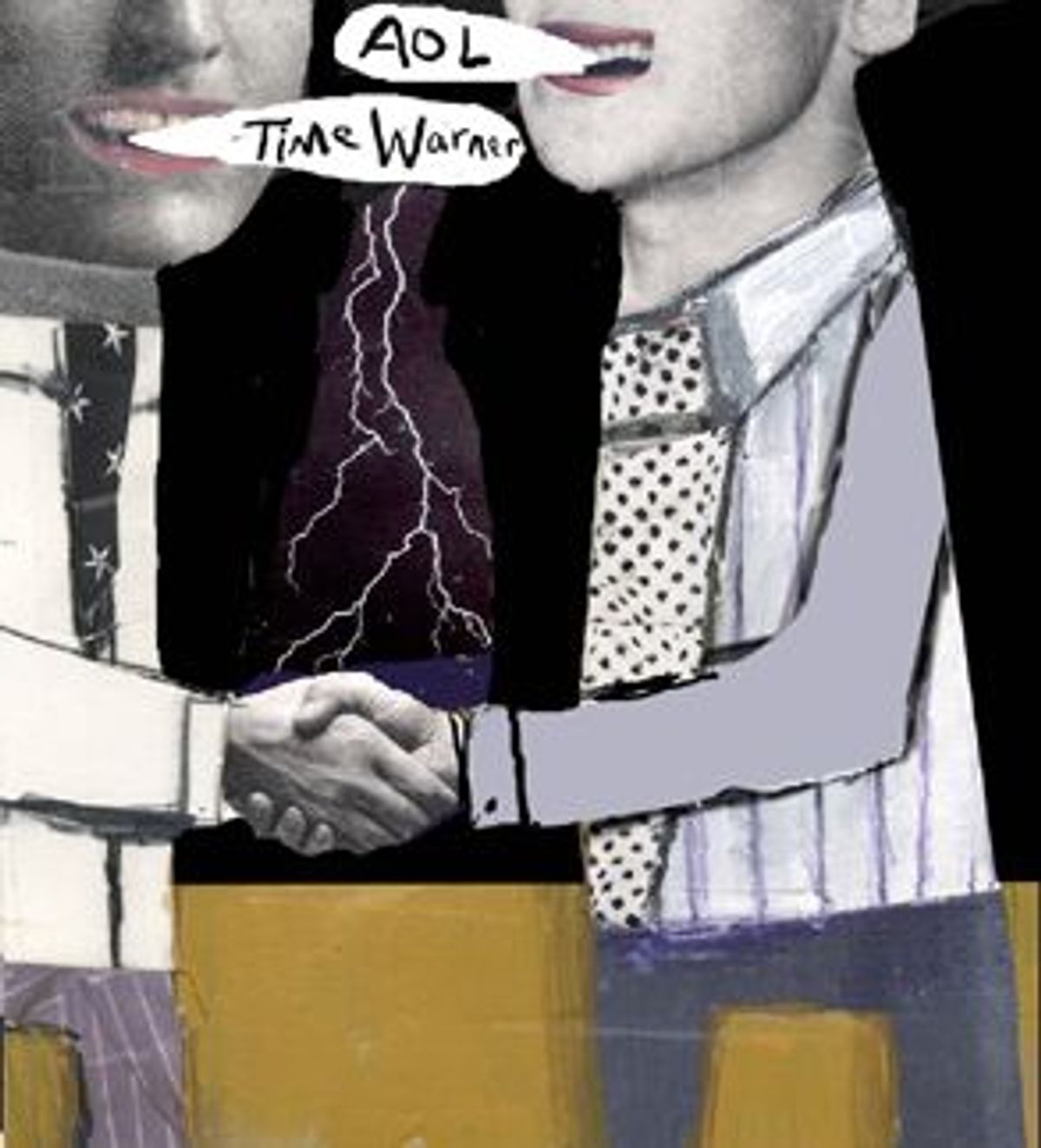
As the merger of America Online and Time Warner lumbers toward its sweaty conclusion, odd pockets of resistance -- all joined by a singular desire to derail this megamarriage before it starts -- are cropping up in unlikely places.
Among the strange bedfellows: Internet service providers and Web sites that fear a lockout from an AOL Time Warner network, the authors of much of the content of the Time Inc. magazine division, skeptical congressmen from both political parties and a consortium of consumer advocacy groups encouraged by Disney.
Though this motley insurgency stands a snowball's chance in hell of actually derailing the merger -- the government has until the end of the year to approve it -- the assorted partisans (most of whom are fighting in the name of public interest and consumer protection) could wind up altering the nature of the agreement, quite likely for the better.
Open Sesame
The biggest gun in the arsenal aimed at AOL Time Warner is a 158-page "Petition to Deny" presented to the Federal Communications Commission and the Federal Trade Commission by a consortium of consumer interest groups. The irate consumer organizations include the Consumers Union, the Consumer Federation of America, the Media Access Project and the Center for Media Education.
The consumer interest groups' argument against AOL Time Warner should be familiar to anyone who has paid even partial attention to the antitrust debates surrounding media mergers: It concerns the question of open access.
Simply stated, open access is the right of other ISPs to use the broadband networks that AOL Time Warner (and AT&T) will be tempted to hog by nature of their vast cable holdings.
"At the end of the day, these guys are going to control everything," says Jeffrey Chester of the CME. "That's why open access is important. If you're going to live in a world dominated by a few media companies, you have to have an architecture that permits a greater diversity of voices."
Even AOL used to think open access was important. Before the deal with Time Warner, Steve Case and company campaigned tirelessly for open access. Afraid that AT&T (which controls the Excite@Home network) and Time Warner (with its Roadrunner service) had sewed up the future using fiber-optic cable, AOL wanted Uncle Sam to guarantee that its own service would be delivered on that fast rail. It spent tens of millions of dollars funding OpenNET, an independent group that advocates open access via government regulation.
Then Case decided to buy Time Warner. And in a conversion that rivals Constantine's move to Christianity, the whole open-access problem was no longer quite so nettlesome.
Enter the consumer advocacy groups and their petition to deny. The Consumers Union -- publisher of Consumer Reports -- and the other petitioners are just the sort of gnats would-be monopolists loathe. If the government won't deny the merger, says the petition, it must at least require AOL Time Warner to guarantee open access to all.
But AOL and Time Warner are not guaranteeing anything. In a "Memorandum of Understanding" the two companies presented to the FCC and Congress in February, lip service was paid to their shared "commitments" to open access -- but no promises were made. And there was certainly no call for government regulation. The free market would sort it out.
Members of the congressional committee were less than impressed.
"Given that this document lacks both enforceability and specificity," chairman Sen. Orrin Hatch, R-Utah, chided the newly engaged moguls, "this committee remains to be convinced of its value beyond the boardroom and public relations office of AOL Time Warner."
And that was before the ABC blackout.
Of all the insurgents sniping at the merger, none stands out more clearly than Disney. "Normally the public interest groups are alone on these very critical issues about media ownership and diversity," allows the CME's Chester. "In the past couple of years what you've seen is a sort of silent agreement on the part of the big media companies: You don't spoil my monopoly, I won't spoil yours."
Disney has been assembling a media monopoly of its own, culminating in its merger with Capital Cities/ABC in 1995. Lost in much of the coverage of the ABC blackout was Disney's role in the debacle. Disney had been demanding that Time Warner take an unprecedented number of cable networks as part of its overall carriage deal. Thanks to the negative fallout from Time Warner's blackout, it got exactly what it wanted: a seven-year, $2 billion deal for a lot of programming of no proven value.
"Disney has not somehow been transformed to sweet guys with halos," says the Media Access Project's Andrew Schwartzman. "If you want to view this as Disney vs. Time Warner and a battle of two corporate cultures you can, but you're missing the point. This is really the cable monopoly vs. other content providers. Disney was willing to go much more public than a lot of people who are grousing privately."
A good deal of that public grousing came from Disney's top lobbyist, Preston Padden, a loquacious and well-heeled figure on the media legislation scene. Before the company reached its carriage agreement with Time Warner, Padden was traveling across the country, visiting local cable franchisers and providers and preaching against the merger.
"Disney made us aware of the issues out there and the authority we have to approve or disapprove the transfer," says Mary Morales, executive director of the Public Cable Television Authority. Representing a band of small cable providers in Southern California, the PCTA is one of many cable authorities that will get to vote on the transfer of Time Warner cable to AOL. The group had until June 11 to cast its lot, though it asked for a 30-day extension. AOL and Time Warner should be concerned.
Disney "encouraged us to scrutinize the transfer," says Morales, whose group is responsible to 80,000 subscribers. "They made themselves available to answer any of our questions."
Though Disney reached a carriage agreement with Time Warner, an agreement that made it seem as if the two titans had kissed and made up, anyone who thinks Disney will back off of its resistance to the AOL merger can't tell the forest (access to broadband) for the trees (Disney's immediate retransmission consent rights). Last week, Disney helped organize a powwow among the consumer advocate groups in Washington; in May it filed critical "Reply Comments" to the merger proposal with the FCC. (Padden pointedly declined to comment on his lobbying efforts or the merger's prospects.)
"Allowing any entity to have this level of control over this country's broadband future raises issues of profound public interest concerns," Disney declared in its reply.
And you thought it didn't care.
Insurgents wear many hats. Disney is hardly the only company concerned about the downside of a merger between AOL and Time Warner. Here are a few more potential enemies of the state:
And then there's the European Union Commission, which announced Tuesday that it has delayed a decision to begin a full-scale probe of the merger until June 19.
Calling Judge Jackson
Meanwhile, back in the States, interested parties are wondering if the FTC might be less inclined to go easy on the merger in the wake of the Department of Justice's successful suit against Microsoft. The DOJ and the FTC have joint authority under the Sherman Antitrust Act over mergers (the DOJ got AT&T-Media One; the FTC, TBS-Time Warner) and, according to the Media Access Project's Schwartzman, "the FTC and the Justice Department also have this rivalry. Each one wants to show that they can be tougher than the other. The fact that the Microsoft case has gone forward gives [FTC chairman Robert] Pitofsky some incentive to show that his is bigger than [Microsoft prosecutor] Joel Klein's. Or gives him more political cover to do what he wants to do."
Pitofsky, a former Georgetown University law professor with an interest in the interaction between the First Amendment and antitrust laws, is, by all accounts, of an open mind. "He thinks this proceeding is an extremely important one, that this would be a new kind of business company," says Schwartzman, "and not necessarily a bad one. But there are aspects of it that are problematic; this thing will get an unusually thorough scan from the FTC." (Neither the FTC nor the FCC can comment on matters under review.)
Get me a rewrite
A smaller voice in the midst of all this cacophony comes from the people who actually create a lot of the content in question: lowly scribes. The National Writers Union is filing an objection to the merger, claiming that Time Warner discriminates against freelancers with its "all-rights contracts." These contracts, which compel writers and illustrators to sign away rights to their work "in perpetuity," have become the norm in media companies. Jay Tasini, NWU president, contends that the effect of all-rights contracts will be more insidious as writers' work is spread out across more platforms.
"This merger, in our view, gives Time Warner the right to concentrate copyright in their hands," he says. "That will affect the diversity of content in the marketplace, and could even ultimately affect consumer prices: If Time Warner owns all copyright, they can set prices as they see fit."
AOL did not return repeated requests for comment on the petition to deny or on any of the other threats to its merger. Why should it: Case and Time Warner chief Gerry Levin have spun the whole union as a win-win situation for all, with Levin proclaiming that the new company will "improve the lives of consumers worldwide."
AOL and Time Warner shareholders will have a chance to appreciate his Utopian vision on June 23 as they meet in Vienna, Va., and New York, respectively, to vote on the merger. Barring wild cards like Ted Turner (who was rumored to be unhappy with his place in the new corporate firmament), the proposal seems destined to pass.
Then there is the small matter of AT&T's involvement in the deal. In approving the telecommunications company's purchase of cable giant Media One, the FCC insisted that AT&T sell off some of its cable holdings -- the most likely being its share in Time Warner Entertainment. Old rivalries such as that between AT&T and AOL could hamper the future dealings of the two conglomerates, though greed is likely to prevail. In a complicated hostage swap, AT&T could sell its cable properties back to Time Warner with the understanding that it could provide local phone service on Time Warner's cable and AOL would be available on AT&T's broadband network.
Is everybody happy?
An enthusiastic report from Merrill Lynch on the prospects of AOL Time Warner says the merged companies will become "the operating system for everyday life." As broadband -- with its promises of even more instant communication, interactive TV and shop-before-you-think e-commerce -- becomes more of a reality for many American homes, AOL Time Warner stands to be the central nervous system for many wired families.
Which is precisely why the merger bears such scrutiny now. The press has been largely silent on the subject since it was accepted, with great fanfare, in January. And television news isn't about to do anything too critical as networks scurry for deals that will put them within the walled garden of AOL Time Warner.
And which is all the more reason that questions such as open access need to be addressed now. You may not hear about them on that fat pipe that's going to bring you your evening paper and favorite game show at the same time. (Hell, it will even walk your dog.)
"It's much harder to stop something after it starts," says the Media Access Project's Schwartzman, "to go in and try and break it up. You get everybody yelling about government intrusion."
Tell that to Bill Gates.
(Additional reporting by Diane Seo)
Reports of my death: Last week Salon laid off some of its staff, myself included. Since then I have agreed to continue to write this column on a freelance basis, thereby avoiding any further interruption in service. Thank you for your continued interest and support.
Shares