
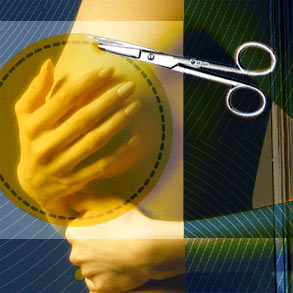

Rarely in human history has a single lump of flesh so completely saturated our cultural landscape. From Cleopatra’s ill-fated bosom to Pamela Anderson Lee’s supersize specimens, nothing says woman more than a good set of knockers.
Even in our “enlightened” 21st century, when most gender markers have gone the way of the corset and the chastity belt, breasts are still viewed as the telltale sign of femaleness. How else to decipher the woman beneath trousers and a buzz cut? Breasts. Breasts. Breasts. They are everywhere and everything. Men are captivated by them. Drag queens covet them. And women, well, we just have to deal with them. And deal with them we do, sometimes by any means necessary.
“I’ll just wait until I have kids,” says Debbie Winn, 25. “Then, chop chop.”
While the thought of a breast-free life may be inconceivable for most women in their 20s, it is virtually the only choice for Winn. Her genetic Rubik’s cube reveals cancer on all its mixed-up sides: Winn’s mother died of cancerous brain tumors that had metastasized to her lungs, breasts and other vacant body parts. Winn’s grandmother died of breast cancer and two aunts were diagnosed with the same scourge.
Winn would rather have both her breasts removed than fall prey to her genetic kismet. As far as she sees it, a prophylactic mastectomy is a way, the only way, to beat the odds that are so startlingly “racked” against her.
A 1999 study from the Mayo Clinic — the only comprehensive study on prophylactic mastectomy to date — followed 639 women who had this procedure done between 1960 and 1993. According to original projections, 37 of the moderate-risk women would develop breast cancer and 10.4 would die from the disease. But at the close of the study, only four women had actually developed breast cancer and none of them had died. There were similar findings in the high-risk group: Three women had developed breast cancer, as compared with 39 percent of the control group. Overall, the study revealed a dramatic 90 percent reduction in risk. Such statistics represent a choice between life and breasts, and Winn, quite emphatically, has chosen life.
“For me, I just think how could I not,” says Winn. “It’s the responsible thing to do. I haven’t had any genetic testing, but I know I’m at high risk,” she says. “As far as I’m concerned, apart from nursing, I’m not very attached to my breasts. They sit here and they look cute in tops, but they’re not functional. If I had to cut off a body part, they are the most useless ones.”
If this seems like an overly pragmatic attitude toward this historically “essential” part of the female anatomy, Winn contends that she defines her sexuality in myriad ways, not just through her cup size. Given a choice between life and breasts, she says, there is no choice.
Winn is not alone. According to a Dutch study published last week in the Lancet, of 198 women who tested positive for a genetic predisposition to breast cancer, 51 percent opted to have both breasts removed as a means of prevention. But these findings — and Winn’s decision — have unsettled those doctors who are striving to treat patients already suffering from breast cancer with less extreme measures.
“There is an irony here,” says breast cancer guru Susan Love, author of “Dr. Susan Love’s Breast Book” and other women’s health books. “The treatment for breast cancer is lumpectomy. The only time we do mastectomy is if the lump is so big we can’t get it out otherwise. We preserve the breast if it will work as well for treatment.”
Love cites what has become the common trend in breast cancer oncology: less invasive, more focused treatments for existing cancer and preserving the breast at — almost — any cost.
Yet women keep deciding to have their breasts removed before any signs of cancer have appeared, even in the face of other preventive treatments such as cancer drugs Tamoxifen and Raloxifene, which have recently been proved to significantly reduce the risk of developing breast cancer.
“I think it’s a drastic thing to cut off a body part in order to prevent a disease,” says Love. “There are very few organs one would do that to. It shows that you don’t understand a disease.”
But as a registered nurse, Winn is all too familiar with the insidious ways of diseases like cancer. She has also witnessed the devastating treatments and imperfect science of medicine.
Winn’s mother, also a nurse practitioner, suffered from severe headaches for years. Though she practically “lived” in the hospital, never once did the resident physicians do a CT scan or an MRI on her head. By the time her headaches became unbearable, it was too late. She had five huge inoperable brain tumors and died six weeks later.
“Because of prophylactic mastectomy, breast cancer is one of the few things that you have a bit of power and control over,” Winn says. “The others just kind of creep up on you. Aside from taking good care of yourself, there’s not much more that you can do.”
Even skeptics of prophylactic mastectomy like Love won’t discount the power of fear. “I think there are some women who are just so anxious that they can’t tolerate it,” Love says. “It’s more of a psychological thing.”
And the mind can certainly play funny tricks on people.
“I was driving myself crazy,” recalls Judy Hime-Everschor, 42. “I would keep checking, but there was no way to tell.”
For years, Hime-Everschor suffered from severe fibrocystic change in her breasts. The cysts were so plentiful and were reproducing so rapidly that her bust size increased from a B to a double D over a seven-year period, and she was constantly in excruciating pain. Still, her doctors refused to biopsy her breasts.
“They assumed every new lump was a symptom of fibrocystic change, not a tumor,” says Hime-Everschor. “I asked how they knew, and my doctor just looked at me and said, ‘There’s no answer to that.'”
But Hime-Everschor needed an answer. She had watched her mother survive one bout of breast cancer, only to die of second bout 18 years later.
“Basically, she was a woman that the doctors were following closely and she still got breast cancer,” says Hime-Everschor. “Follow closely doesn’t mean prevent. It means they didn’t catch it in time.”
But prevention — not closely supervised disease — is what many women want. They don’t want the psychological burden of having to wait a year between mammograms. They don’t want to think of the rest of their lives in terms of percentages. And they certainly don’t want to worry that each time they have a scare, they might not be crying wolf.
“My doctor told me that 60 percent of women find their own breast lump,” says Hime-Everschor. “I touched my breast and found 500. Preventive mastectomy removed the thing that could kill me.”
According to the American Cancer Society, however, Hime-Everschor may be oversimplifying things.
“There is no way to know how this surgery would affect a particular woman,” explains the ACS in its terse online information about preventive mastectomy. “Some women with BRCA [gene] mutations will develop a very aggressive breast cancer early in life, and a prophylactic mastectomy might add many years to their life expectancy. Some women with BRCA mutations never develop breast cancer, and these women would not benefit from the surgery.
“It is important to realize that while this operation removes nearly all of the breast tissue, a small amount remains. So, while, this operation reduces the risk of breast cancer, it does not guarantee that a cancer will not develop in the small amount of breast tissue remaining after surgery.”
This is a very cautious stance for one of the leading cancer organizations in the United States, especially in light of the numbers. About 50 to 60 percent of women with one of the two inherited breast cancer genes — BRCA1 or BRCA2 — will develop cancer by age 70. A 90 percent reduction in risk (as found in the Mayo Clinic study) could lower a woman’s chance of developing breast cancer from the high double digits to the low single digits. For some women, this huge decrease is reason enough to have a prophylactic mastectomy.
At the age of 51, Sharon Weiss discovered that she carried one of two breast cancer genes. At this point, all things considered — age, lifestyle, family history, genes — her risk jumped from a 50 percent to an 84 percent chance of developing breast cancer during her lifetime. The odds, and years, were inextricably stacked against her. At 51 she had already surpassed her mother, who died at 45, and her grandmother, who died at 47, from breast cancer.
“I had lived as long as I had without breast cancer,” says Weiss, who asked that her name be changed. “I had been told that with each generation it occurs earlier. I was already 51; I didn’t think I would have gotten that far if I had the mutation.”
But her 51 years were not scot-free. Weiss had plenty of breast cancer scares. The first occurred two weeks before she gave birth to her son; the second, third and fourth scares happened not too long after, and she eventually started seeing a surgeon every six months, just in case. When her risk jumped a whopping 34 percent, Weiss couldn’t tolerate the exhausting trauma and decided to take action. With the help of a physician friend and her supportive family, Weiss decided to have both of her breasts and her ovaries removed. She has not regretted it since.
“I have so many things I want to do,” says Weiss. “I don’t have to be as concerned anymore for myself.”
What was a relatively straightforward — though not easy — decision for Weiss and Hime-Everschor can be much harder for women who see their breasts as an integral part of their being, one that’s not so easily given up.
“I was overdeveloped at a young age,” says Ellyn Shein, 55. “The kids used to tease me, to call me Boobsie and Waterwings. I would wear big sweaters and cover things up — it has been part of my person since 13.”
Shein has a family history of cancer that reads like those of the other women. Her father had breast cancer, her grandmother had ovarian cancer and her grandfather had colon cancer. Several years ago, Shein underwent a lumpectomy to remove a Stage 1 tumor from her breast, followed by short bouts of chemotherapy and radiation. To top it all off, in November Shein discovered that she carried the genetic mutation for breast cancer.
“My doctor told me that I’ve been living with this risk my whole life,” she says. “The only thing now is that I know about it.”
Shein’s right: Nothing has changed except that she now knows just how high her risk is. And, as Love points out, the risk that physicians talk about is not a risk of dying of cancer, it is the risk of developing cancer. But as a breast cancer survivor, Shein feels as if she is now faced with a choice: to have a prophylactic mastectomy or not to have one — that is the question.
“It’s not life threatening like a tumor,” she says. “But I know I have decisions to make. I’m presented with a whole other set of rules. Will it save my life? It probably would. But I’m having trouble.”
She has already decided to opt for a prophylactic oophorectomy (the surgical removal of one or both ovaries), and she has created several scenarios in her mind: If she finds another breast tumor, she will absolutely, no questions asked, have both her breasts removed. But if not, she doesn’t know what she’ll do.
In the meantime, Shein is vigilant about checking for breast cancer. She jokes about her twice-yearly appointments with the radiologist, oncologist and gynecologist: “Everybody wants to cop a feel.”
Shein also wants to find other women to talk to about their experiences with prophylactic mastectomies or a psychologist who specializes in genetic counseling. She hopes this will help her make the decision that she can’t make by herself.
And who knows, by the time she makes up her mind, science may have caught up to her.
“In a way, prophylactic mastectomy is the old answer,” Love explains. “Because we haven’t quite gotten to a new answer, it is still an option. My bet would be that in five years, it won’t even be something we consider. We’ll have other things that people will consider as good, or better.”
