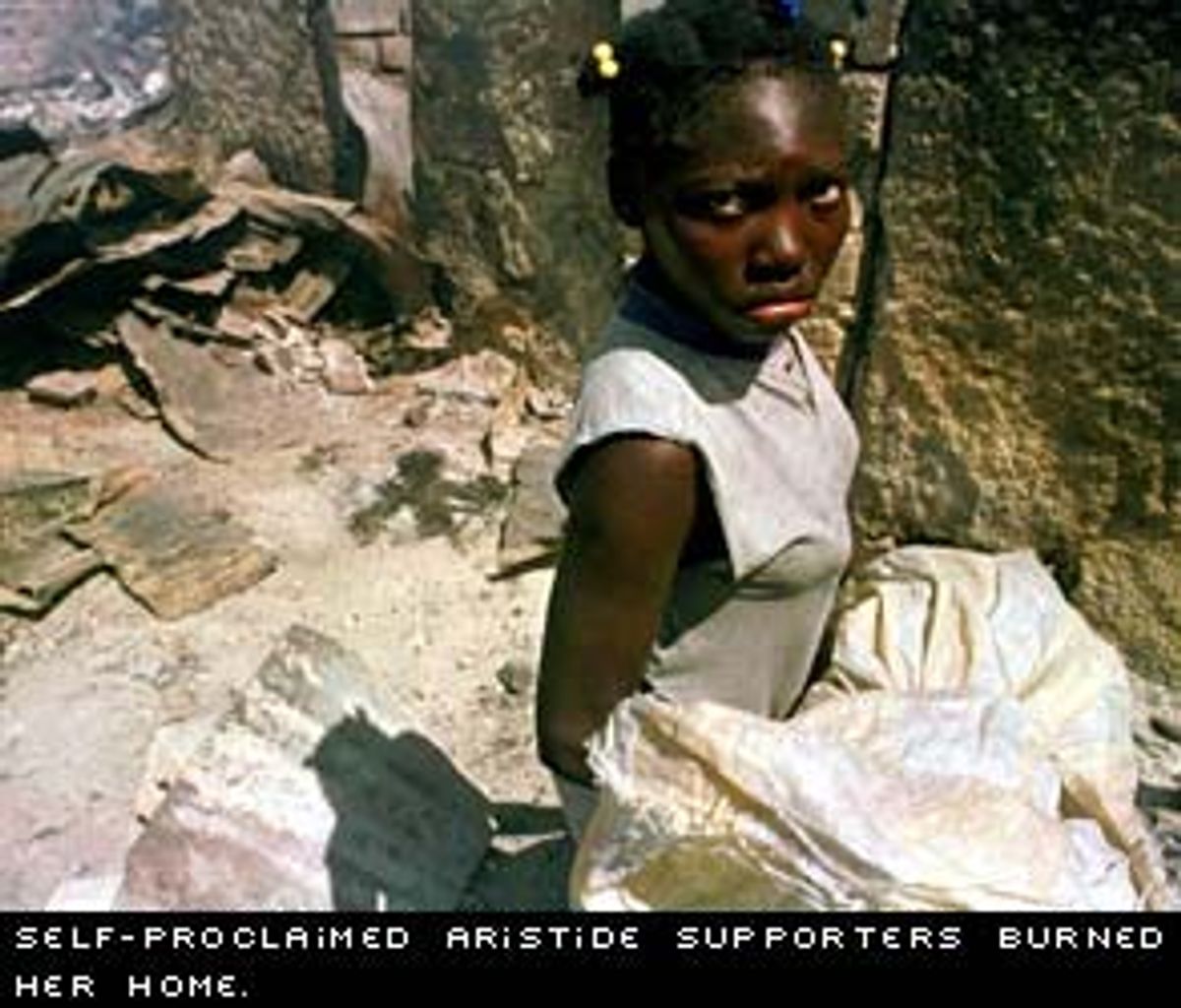
Haiti, a country I love and where I lived for months in 1997, seems once again to be drifting, inexorably, toward its own terrible, particular marriage of anarchy and dictatorship. In the run-up to the parliamentary elections that were held May 21 (where former president Jean Bertrand-Aristide’s Fanmi Lavalas party won 16 of 19 Senate seats outright), the country witnessed a spate of political violence on a level not seen since the dark days of Raul Cedras’ military junta of the early 1990s.
In the space of six months, Jean Dominique, the country’s most respected journalist, was gunned down outside his radio station, an opposition campaign director was macheted to death inside his home and the campaign offices of opposition party Espace de Concertation were burned to the ground by a mob chanting pro-Lavalas slogans and calling for the death of Espace’s leader, former mayor of Port-au-Prince Evans Paul. Recently, the president of Haiti’s electoral council fled to the United States, fearing for his life after he refused to sign off on the election results.
Members of various opposition groups were jailed in advance of last week’s announcement of the electoral results. The Lavalas government has given explanations for these “detainments” ranging from the accusation that those arrested were accumulating firearms in preparation for a strike against the government, to saying that the detained were being threatened and that they were taken into protective custody for their own good as a “preventative measure.” Meanwhile, the disputed count has Lavalas taking 16 of the 17 available Senate seats and likely to control both houses of Parliament.
While a second round of voting has been indefinitely postponed, the elections so far have been marred by allegations of fraud. The opposition has declared the results invalid, vowing to sit out the runoff elections. People murmur that the Organization of American States (OAS) electoral monitors are trying to shove a sham election down the country’s throat just so all the international types can go home feeling that their money was well spent on “democratic” development programs, since some form of democracy was restored in 1994. Although the OAS recently released a statement calling the methodology of the vote tally “incorrect,” there are many who think that it is too little, too late.
This situation is all the more troubling because Fanmi Lavalas (“lavalas” means “the flood” in Creole) is a political party whose dominant figure, Jean Bertrand-Aristide, has been the country’s most outspoken, fearless champion of democratic rights. He fought for those rights during days when championing such a cause meant death.
Aristide is the preeminent political figure in the country. It was Aristide who spoke out against the Tonton Macoutes and human rights abuses of Frangois and Jean-Claude Duvalier’s regimes. Aristide, who continued the democratic struggle under the military regimes of Henri Namphy and Prosper Avril, men who found it politically expedient to massacre voters in 1987 on Ruelle Vaillant at Port-au-Prince, and then again in 1988 at the Cathedral St. Jean-Bosco while Aristide, then a practicing Catholic priest, was celebrating Mass.
It was Aristide and Lavalas, also, who were chased out of the country by a military coup in 1991 (after Aristide had become Haiti’s first democratically elected president) and then returned to power by the U.S. Marines in 1994. Barred from serving consecutive terms as president, Aristide reluctantly handed over power to his protigi, Rene Preval, and is said to be waiting until he can again run for (and almost certainly win) the presidency of Haiti in 2001.
Haitians, meanwhile, are left wondering whether they will have a heroic, visionary Nelson Mandela or an authoritarian, scapegoating Robert Mugabe (two other third-world leaders who came to power on a tide of popular movements) on their hands come that time.
Sadly, as I found out, the hard facts of Haiti don’t make it easy to stay a hero for long.
“These are difficult times in Haiti,” said Mirlande Manigat, an unsuccessful candidate for the Senate. Manigat is a member of the Assembly of Progressive National Democrats (RDNP), and a constitutional law professor at the University of Quisqueya in the capital. “The many political parties in Haiti reflect the polarization of Haitian society, and one party wins over 90 percent of the vote? Impossible.”
A pleasant, highly educated woman, Manigat is the wife of onetime Haitian president Leslie Manigat. Her husband (whom Haitians had never really warmed to and whose election many regarded as fraudulent itself) was booted out of the post in 1988 in the chaos of post-Duvalier Haiti by Gen. Henri Namphy, a vicious dictator now alleged to be slowly and quietly drinking himself to death in exile in the Dominican Republic.
“My political party doesn’t believe in violence or dictatorial force, so we now have no recourse … We are heading for a gloomy time in Haiti.” She looked down at her desk, and then wistfully out the window of her university office. “I didn’t expect this for my country, now.”
The climate of violence affects everyone here. A shellshocked Reuters correspondent, just arrived from the States, appeared at the house I was staying at in Port-au-Prince to inform us that his car had been detained as a group of young men ran past, smashing bottles and carrying tires under their arms. Word on the street had it that they were angry because Lavalas still hadn’t paid them for their “work” during the elections. Zenglendos (armed thugs) stuck a gun in my friend’s sister’s face as she sat stuck in traffic on a downtown street. Finding notebooks that indicated she was a student, they threw them back at her through the car window as they drove away on their motorcycles.
As a friend of mine, a wealthy progressive mulatto, said, “The security situation here is not good.” The fact that the streets of a city of 2 million people are empty at 8 p.m. is testimony enough to that.
I got a taste of how unstable that situation was firsthand when a group of friends and I ventured out one night to a hotel in the affluent suburb of Petionville. We went to see a concert by Sweet Micky, the legendary “president” of compas, Haiti’s singularly slinky and sensual popular music. Micky is an unrepentant supporter of the 1991 coup against Aristide, and is as famous for his scabrous double-entendres as for his anti-Lavalas politics. His sweaty, exhilarating shows are known to attract a raucous crowd of ex-secret police, soldiers and gang members.
Sure enough, once we arrived among the massive, dressed-to-kill crowd, the audience scattered over the demurely arranged deck chairs and around a pair of illuminated pools — not once but three times — as groups of men drew their guns on one another, spitting invective and threatening violence. After one particularly nasty stampede, where I badly twisted my ankle knocking over a table to get away from any potentially flying bullets, a teenage Haitian boy got up with his girlfriend from their own pile of scattered chairs, looked at me and said simply, “Blan,” the Creole world for foreigner. He was doubled over with laughter.
But in the face of such terror, kindness persists. A musician insisted that I partake of his young daughter’s first Communion cake. An evangelist minister drove me the whole, hot, long, dusty way from Aristide’s foundation at Tabarre to drop me off in downtown Port-au-Prince and then refused to take any payment for his services. A Haitian English teacher in a frayed suit who had lived near my own home in Brooklyn for 14 years began a conversation with me, unsolicited, just to hear what New York was like these days. As we walked down the street, he asked me with a sad shake of his head to tell people “what they [Lavalas] did to these elections.”
Cleansing rain showers began in a flash on an afternoon of brilliant sunshine, the city never darkening a bit. These people’s kindnesses and the stunning beauty of this place are what make the story of what is happening in Haiti something you must know.
“I came down here in 1985 to research voodoo rhythms,” says Richard Morse, a surpassingly tall New York transplant, as he takes a drag off an early morning cigarette. We’re in the lobby of the hotel he runs, a space where his group, Ram, also plays regular weekly gigs. The hotel itself is one of the outstanding examples of gingerbread architecture in Port-au-Prince.
“I took over the hotel in 1987, formed a band in 1990 and stopped counting governments in 1996.” He remembers a time in the early 1990s when coups and counter-coups gave the country three governments in 12 hours. Morse, a Haitian-American educated at Princeton, is not hopeful about the current state of affairs in his adopted country. He says the lines between the old military regimes and Lavalas are getting fuzzier.
“They’re trying to set up a system where there’s no opposition, and they’re willing to try any methods necessary to attain that,” he says. He disagrees with the Organization of American States’ qualified approval of the election results. “The OAS is saying, ‘There were some discrepancies, but everything’s OK.’ Well everything’s not OK. They’re killing people. They’re killing people and people are going into hiding.”
Lavalas essentially terrorized the opposition into hiding until two weeks before the elections, Morse believes. Then, with a statement from Aristide calling for peaceful elections, the violence miraculously ceased and the opposition was told to field their candidates in what was to be a competitive election.
Morse thinks that the OAS is trying to pretend an election is valid despite obvious fraud and unfair voting practices, as they are currently accused of doing in Peru. Critics say the OAS is lowering the bar for what is acceptable in democratic elections under the philosophy that some movement forward (i.e., the holding of elections at all) is better than no movement forward.
Reiterating Manigat’s sentiment, Morse stated flatly: “The precedent has been set that if you want to be involved in politics in this country, you’ve got to get your guns together … Nothing’s changed, the teams have changed but not the modus operandi.”
Before we switched to music and New York, he punctuated our political conversation simply. “You can get killed here for saying the shit I just said.”
- – - – - – - – - – - -
Yvon Neptune and I sat around a table inside the house where he keeps his offices in downtown Port-au-Prince. An intense man with his beard and hair going gray around the edges, Neptune is the spokesman for Fanmi Lavalas who recently defeated Manigat to become a senator in the Haitian parliament.
The room was cool and quiet, away from the noise of the street. Cabinets were arranged around the room, lined with books in several languages. A bird chattered away from somewhere in the garden out back.
“The Haitian people are pleased” with the results of the election, he said. “The majority of the voters are pleased, because the elections have been an opportunity for them to state their position on the situation in Haiti.”
Over the course of an hour, Neptune spoke of the policy of agrarian reform begun under President Aristide and continued under Preval, and also about encouraging the private sector, local and foreign, to invest in Haiti. He alluded to the pending approval of agreements with the IMF and World Bank by the new parliament, and of the necessity of modernizing the administrative infrastructure of Haiti.
Asked about Lavalas’ commitment to democracy, and about the violence preceding the election, Neptune commented that “we continually stated our position on violence in Haiti: denouncing the violence, condemning the violence. We encourage everybody, everybody,” he continued, “not to let themselves be intimidated and to come out and vote. And that’s exactly what they did.”
When questioned about the attacks on the opposition headquarters, specifically the arson of Espace de Concertation’s offices, Neptune shifted blame back to that party’s leaders, and their supporters, whom he characterized as party “cronies.”
“It is difficult to accept the value of the opposition, the weight of that opposition, because it is practically nonexistent except for a few politicians who would use the airwaves to make accusations,” he said. “They often commit violent act [sic] or delegate people to commit violent acts and they go as far as posturing as Fanmi Lavalas partisans. It is very easy for them to do that.”
The fire, he implied, was probably set by Espace themselves. “That particular organization failed to pay the rent on that building for almost five years.”
Again and again, talking to people of various backgrounds and political stripes, I heard of how Aristide’s party has been acting recently in ways that are reminiscent of dictator Frangois “Papa Doc” Duvalier. It’s hard for many Haitans to forget that Papa Doc came to power on a wave of noirisme, resentment of the elite light-skinned minority. And recently Lavalas members on state-run TV labeled mulattos of any ideological orientation as the “racist bourgeoisie” for the crime of criticizing Fanmi Lavalas (and by extension Aristide).
Dany Toussaint, a close confidant of Aristide and a newly elected senator, dismissively referred to several prominent mulattos including journalist Jean Dominique as “ti wouj” (the little red ones). Dominique had been an advisor to both Aristide and Preval. But he was murdered shortly after Toussaint’s comment. That fact, and Dominique’s intimations about Toussaint’s alleged involvement in drug trafficking, shifted suspicion for the journalist’s killing onto Lavalas.
And yet.
One goes downtown in Port-au-Prince to the slums of Bel Air, near the Palais Nacional, the crowded, congested streets of Avenue Jean-Jacques Dessalines, or the dusty, chaotic suburb of Delmas (favored base for the zenglendos) where, as one friend told me, “everyone gets robbed.” You go to these neighborhoods and you are struck by the absolute belief that exists there that “Titid” (as Aristide is affectionately known) is the only man capable of solving Haiti’s multitude of problems, the only man who has ever stood up for the poor, the only one who ever gave a damn.
The desperate, begging street boys on the Champs Mars dress in rags and sleep on the ground. I talked to young men who have moved from the countryside to the Cite Soleil and La Saline slums who have never found a job and probably never will. Old women sell fritays and fried bananas under the withering noonday sun. “N’ap toujou renme w Titid” (We will always love you Aristide) is scrawled on crumbling walls.
Some words come to mind that Aristide spoke, just days before the coup of 1991 forced him out of office and Cedras and company began an orgy of bloodletting unrivaled even in Papa Doc’s time. Aristide, his back to the wall, had been informed of rumors that a plot was about to topple him and perhaps kill him, and that lists of his supporters who were also to be killed were being drawn up. This was the famous “Pere Lebraun” speech, which many in the media never tire of referring to as the moment when Aristide began calling for the “necklacing” of the opposition:
Again, under the flag of pride, under this flag of dignity, under this flag of solidarity, hand in hand, one encouraging the other, [...] each one will pick up the message of respect that I share with you, this message of justice that I share with you, so that the word ceases to be the word and becomes action. [...] it’s you who will find what you deserve, according to what the Mother Law of the country declares.
One alone, we are weak,
Together we are strong. Together, together.
Together we are the flood (crowd: Frenzy!)
Do you feel proud? (crowd: Yeah!)
So true, that there is power in numbers. Whether or not Jean-Bertrand Aristide and Fanmi Lavalas are committed to using their popularity — and, more important, Aristide’s sacred relationship with many in the country — to push forward a program of real democratic change remains to be seen, but the signs are not encouraging.
If they fail, or succumb to the temptations for a naked power grab that have too long plagued Haiti’s rulers, their betrayal of the Haitian people will be doubly bitter, coming as it does on the backs of all who followed Aristide’s clarion call for democracy to their graves: the voters at Ruelle Vaillant, the martyrs of St. Jean Bosco and the thousands who died under the junta of 1991-94.
As always in Haiti, only time (and not words) will bear out their true intentions. But they’re walking on a razor’s edge.
“With a strong government and parliament, and a strong political program,” Neptune said to me toward the end of our interview, “we’ll spend less time bickering over power, so the majority who represent the people will have enough time to concentrate on their jobs. I think that’s what needs to happen. And it is about to happen.”
The black T-shirt — so tight, so come-hither. And oh, those safari button-downs — joke-worthy on Eddie Bauer mannequins, but on news correspondents, so … enticing.
America missed these sartorial seductions, pined for their sweet suggestive nothings. And now, finally, a nation of television addicts can thank its disaster pornographers for bringing back the lurid garments — and the lustful voyeurism they evoke.
Yes, thousands of miles from the San Fernando Valley’s seedy studios, the adult entertainment business is alive and panting in Haiti. This year’s luminaries aren’t the industry’s typical muscle-bound mustaches of machismo — they are NBC’s Brian Williams pillow-talking to the camera in his Indiana Jones garb, CNN’s Sanjay Gupta playing doctor and, of course, CNN’s Anderson Cooper in that two-sizes-too-small T-shirt “rarely missing an opportunity to showcase his buff physique,” as The New York Times gushed. They are all the disaster porn stars in the media with visions of Peabodys and Pulitzers dancing in their heads.
And we the ogling people drink it in.
Like any X-rated content, this smut is all flesh and no substantive plot. The lens flits between body parts and journalists pulling perverse Cronkite-in-Vietnam impressions (at one point, CNN showed Cooper and his T-shirt saving a child). But there is little discussion of how western Hispaniola was a man-made disaster before an earthquake made it a natural one.
Though neighboring the planet’s wealthiest nation, Haiti has long been one of the world’s poorest places. It sports 80 percent unemployment and a GDP smaller than the annual executive bonus fund at a single Wall Street bank. The destitution is tragic — and a reflection, in part, of colonial domination.
For much of the last two centuries, Western powers used embargo threats to force the country’s population of erstwhile slaves to reimburse their former European masters for lost “property.” As Harvard’s Henry Louis Gates recounts, America aided these efforts from the beginning because President Thomas Jefferson feared a successful black republic would “inspire slave insurrections throughout the American South.”
Crushed by this oppression, Haiti was then assaulted in the 1990s by American “free” trade policies that destroyed its agriculture economy and tried to turn the country into the world’s sweatshop. In recent years, as the menace of Western-backed coups lurked, Haiti has at times been compelled to pay more interest on its debt than it received in foreign aid.
This is the real story of Haiti that the black T-shirts and safari button-downs (and, alas, their viewers) have never cared about. They’ve only noticed the country when a cataclysm provided more telegenic images than the daily death and despair of the island’s pre-earthquake squalor.
Even now, as the casualty count rises, disaster pornographers barely mention the macabre history. They know that doing so would break unspoken rules against holding up a foreign policy mirror to America and against riling the politicians and business interests that contributed to Haiti’s demise.
Rather than reporting on what made Haiti so poor and therefore its infrastructure so susceptible to collapse, we get clips of Haitians momentarily cheering “USA!” as food packages trickle into their devastated capital. Rather than inquiries about how poverty made Haiti so ill-prepared for rescue operations, the disaster pornographers instead obediently follow George W. Bush, who self-servingly says, “You’ve got to deal with the desperation and there ought to be no politicization of that.”
“Politicization” — so that’s the safe-for-TV euphemism they’re using these days, huh? Evidently, it must be avoided — evidently, nothing kills an audience’s heaving passion faster than “politics” or (God forbid) contextualized news.
Anything like that — anything beyond the exploitation of raw disaster porn — well, it might ruin the money shot.
Continue Reading
Close
Hispaniola, 1999.
“Sorry, no, it’s too dangerous,” says the driver.
“Um. OK.” To the best of my knowledge and experience, Port-au-Prince is the only place in the world where a cabby will refuse a $20 bill to take a pilot into town for a quick tour. Where else, I don’t know. Maybe Monrovia or Freetown during the wars there?
I’m in Haiti for 90 minutes, on a two-stop turn out of Miami. I was awake before dawn to the roar of the air-conditioning unit when the phone rang, the scheduler rattling off the report time for an afternoon trip to Port-au-Prince and Santo Domingo — a three-leg out-and-back.
This means a grand tour of sorts of Hispaniola, the island shared in an east-west split between Haiti and the Dominican Republic, whose capitals we’ll be stopping in. The border between these nations is one of the few international demarcations clearly visible from 30,000 feet — the latter’s green tropical carpet abutting a Haitian deathscape of denuded hillsides the color of sawdust. You could argue that Hispaniola is perhaps the least glamorous landfall in the Caribbean. But you can’t beat the weather and the on-board pineapple tray.
With nothing else to do I wander the Port-au-Prince apron. Behind our dormant freighter a row of scarred, treeless hills bakes in the noon heat, raped for charcoal by millions of hungry Haitians. In front of the terminal, men ride past on donkeys and women balance baskets atop their heads. Somebody has started a cooking fire on the sidewalk. Haiti is the poorest country in the entire Western Hemisphere, and the squalor along the airport perimeter is at least as distressing as anything I’ve seen in Africa.
And, how to say this, it smells. If you’ve ever been to the tropics, maybe you’ll understand: It’s not a bad or foul smell, necessarily, and this isn’t to be taken as some Ugly American pejorative of things foreign or other-skinned. But it’s pungent. For those who live with changing seasons, it’s like the smell of a neighbor’s fireplace or wood stove on the first cold night of the year. Except it has no season; it’s simply always there, ceaseless and permeating like the heat of the Sahara or the numbness of a glacier. It’s the odor of rain forests burned, of foliage, charcoal and garbage incinerated — these destructive, ubiquitous pastimes of the Third World — and it hits you the second you step from an airplane in almost every latitudinally challenged republic on earth.
I notice a pallet of large white drums being unloaded from our airplane. Something doesn’t look right — crew member intuition — and, concerned that we’d accidentally transported some hazardous material, I ask a loader if he knows what the barrels contain. A forklift carries them to a corner of a ramshackle warehouse, and the driver pries off one of the heavy plastic lids.
What’s revealed is a tangled white mass of what appears to be string cheese floating in dirty water. A vague, quiveringly rotten smell rises from the liquid. The driver sticks in his hand and gives the ugly congealment a churn. “For sausage,” he answers. What we’re looking at, it turns out, is a barrel full of intestines — casings to be stuffed with meat at some horrible Haitian factory. Why the casings need to be imported while the meat itself is apparently on hand, I can’t say, but somebody found it necessary to pay the shipping costs and customs duties to fly 400 gallons of intestines from Miami to Port-au-Prince.
Thirty-three minutes away is Santo Domingo, the filth-and-stucco capital of the Dominican Republic — or the D.R., as savvy travelers and baseball announcers love to call it. The neighborhoods around the airport are some of the poorest on the island, and we’re two days on the heels of a terrible storm. Most of the roofs are missing, and as our jet drops its tires and aims for the runway at Las Américas International, we look straight into the islanders’ concrete-block lives, their belongings violently mingled: plastic bags, rain-soaked clothes, corrugated tin. And in all directions are the triangular, tornado-shaped plumes of garbage fires.
What it lacks in glamour, maybe, Santo Domingo makes up for in history. This is the oldest capital in the New World. With some time to kill, I hire a taxi, this time with no resistance. I’m going to see Christopher Columbus, who died in Spain but whose remains, depending which historian you believe, are interred beneath the cathedral here.
To me there’s something about that name, Santo Domingo, that evokes images of 15th-century explorers, their gray-sailed ships anchored offshore. To others, maybe, it’s thoughts of the slave trade, of indigenous islanders keeling over from those special European gifts of smallpox and typhus. Or boats taking cannonballs through their hulls, bars of gold falling to the ocean floor.
As with every big capital down here, the whiteness of the skyline is striking. White paint is splashed over everything: hotels, apartment blocks, schools. From the highway it looms ahead, clusters of white buildings set against brilliant blue beachfront; against emerald hillsides; against the mushrooming, oil-black storm clouds. And as the taxi brings me closer, I taste and feel that tropical force of humanity and heat — a grimy ooze through every white crack.
Later, in darkness, we’re loading up for the leg home, as it were, to Miami. They’ve unloaded our pallets of automobile parts and tractor tires — tools that will help turn the landscape of this small country into parking lots and strip malls like the rest of the world — and soon we’ll be gone.
I’m in a foul mood, and our captain is a retired Air Force pilot who’s boring us to tears with embellished stories: adventures of earthquakes in Pakistan, crash landings in the Kenyan countryside. He’s old and his face is wrinkled and it makes me miserable to hear him, because who cares, really, about his stories, now that he’s just some old retired serviceman with three ex-wives who’s lost all his hair? And I feel myself, like a disease, turning into the next version of this guy.
I’m tired and I need a shower. I’ve got grease on my shirt. From the metal railing I see the moon. It’s an odd, eerily dangling crescent surrounded by an inky redness, like the moon of the Turkish flag. There’s something wild and strange about it.
- – - – - – - – - – - -
Reports by news outlets have stated that emergency efforts in Haiti have been hampered because the Port-au-Prince airport’s radar was knocked out. Can planes take off or land with no air traffic control radar?
First of all, so that everyone understands, “radar” is a somewhat generic term that can mean different things, the same basic technology used for different purposes. We have cockpit radar, for instance, which is used by crews to detect storms and precipitation. But in this context we’re talking about air traffic control (ATC) radar, which allows controllers to monitor the position, speed and altitude of flights, sequencing them appropriately. There are radar facilities for the higher, en route sectors of airspace, as well as local, or “terminal,” facilities that manage traffic coming and going from particular airports.
But while it might sound primitive, all around the world you will find airports, as well as large swaths of en route airspace, lacking radar coverage. Over the oceans, for example, and in much of Africa. Or at Port-au-Prince. It had no radar even before the earthquake.
Lack of radar means that flights are sequenced “manually” through the use of position reports. Planes on oceanic crossings are spaced by time and altitude along paths or longitude and latitude, sending periodic position reports to distant ATC facilities. In and around airports themselves, controllers handling arrivals and departures will often ask crews for updates on their exact bearing and distance to a particular radio beacon or point-in-space fix, as well as their altitudes, and space them accordingly. Holding patterns are sometimes assigned when multiple flights are inbound, and instructions to turn, climb or descend will sometimes be referenced to fixes, distances or radials. A takeoff clearance might include the following:
“Air Haiti 209, cleared for takeoff. Maintain runway heading until passing 3,000 feet, then turn right on course. Maintain 5,000 feet until passing the 340 radial from the PAP VOR.” Occasionally with climbs or descents there’s a time restriction: “Cleared to climb from level one-three zero to level two-four zero by time one-six four-five. Report reaching. Time now one-six three-five.” In other words, “You’ve got 10 minutes to climb from 13,000 feet to 24,000 feet, and let us know as soon as you get there.”
It sounds old-fashioned — and it is — but it works pretty well, albeit at a much slower pace than at radar-equipped airports. Luckily, if not necessarily, traffic tends to be light at most non-radar airports.
The congestion problem at Port-au-Prince isn’t about radar being “knocked out” (it wasn’t there in the first place), but rather the sudden influx of humanitarian flights into airspace — and tarmac space — that is normally uncrowded. Up to 200 aircraft a day have been arriving at Toussaint Louverture International, with some stacked in holding patterns for 90 minutes or more. At one point all inbound flights from the U.S. were “ground stopped” due to saturation on and around the airport.
In addition, the Port-au-Prince control tower was badly damaged, requiring U.S. military personnel to set up a temporary facility. The media was conflating the terms “control tower” and “radar.” Although tower controllers will use radar, if available, they are not the same things. The loss of the tower, from which aircraft are cleared to taxi, take off and land, was a much more critical issue than a lack of radar it never had.
Speaking of the media, I also heard a CNN reporter describe the Port-au-Prince airport rather emphatically as “tiny.” Not sure what that was about. While it might lack the room for dozens of military transport jets, it’s pretty spacious by Caribbean standards. It has a 10,000-foot runway and a wide rectangular apron.
There is no such thing as “Air Haiti,” by the way. Years ago a small company with that name existed, but today Haiti is one of relatively few countries around the world lacking a national airline. Two others in the region that jump to mind are Guyana and Belize.
As far as earthquakes go, I keep getting asked what might happen if a runway starts shaking just as a jet is taking off or landing. I really don’t know. It depends, I guess, on the severity of the shaking and the speed of the plane. I don’t know what a magnitude 7 temblor feels like, but suffice it to say things would get bumpy. Probably not bumpy enough, however, to damage anything, as aircraft are designed to withstand some pretty severe jolts. As we know, it’s not the shaking of the ground that kills and injures people, but rather buildings falling on top of them. Overall, a plane is probably a pretty safe place to be — much safer than a building.
A runway coming apart is another story. Striking a fissure at high speed would be dangerous — albeit statistically unlikely. I am not aware of anything like that ever happening, although the 1974 disaster film “Earthquake” features a scene where a 707 touches down just as a major temblor hits Los Angeles. The runway fractures and the crew executes a go-around just in the nick of time.
The last scheduled passenger flight to leave Port-au-Prince after the quake was an American Airlines flight to Miami. Presumably the crew ensured that runway conditions were safe. This would have been done by taxiing along the surface, and/or by sending a vehicle out to assess things.
- – - – - – - – - – - -
Do you have questions for Salon’s aviation expert? Contact Patrick Smith through his Web site and look for answers in a future column.
Continue Reading
Close
Soon after almost every disaster the crimes begin: ruthless, selfish, indifferent to human suffering, and generating far more suffering. The perpetrators go unpunished and live to commit further crimes against humanity. They care less for human life than for property. They act without regard for consequences.
I’m talking, of course, about those members of the mass media whose misrepresentation of what goes on in disaster often abets and justifies a second wave of disaster. I’m talking about the treatment of sufferers as criminals, both on the ground and in the news, and the endorsement of a shift of resources from rescue to property patrol. They still have blood on their hands from Hurricane Katrina, and they are staining themselves anew in Haiti.
Within days of the Haitian earthquake, for example, the Los Angeles Times ran a series of photographs with captions that kept deploying the word “looting.” One was of a man lying face down on the ground with this caption: “A Haitian police officer ties up a suspected looter who was carrying a bag of evaporated milk.” The man’s sweaty face looks up at the camera, beseeching, anguished.
Another photo was labeled: “Looting continued in Haiti on the third day after the earthquake, although there were more police in downtown Port-au-Prince.” It showed a somber crowd wandering amid shattered piles of concrete in a landscape where, visibly, there could be little worth taking anyway.
A third image was captioned: “A looter makes off with rolls of fabric from an earthquake-wrecked store.” Yet another: “The body of a police officer lies in a Port-au-Prince street. He was accidentally shot by fellow police who mistook him for a looter.”
People were then still trapped alive in the rubble. A translator for Australian TV dug out a toddler who’d survived 68 hours without food or water, orphaned but claimed by an uncle who had lost his pregnant wife. Others were hideously wounded and awaiting medical attention that wasn’t arriving. Hundreds of thousands, maybe millions, needed, and still need, water, food, shelter, and first aid. The media in disaster bifurcates. Some step out of their usual “objective” roles to respond with kindness and practical aid. Others bring out the arsenal of clichés and pernicious myths and begin to assault the survivors all over again.
The “looter” in the first photo might well have been taking that milk to starving children and babies, but for the news media that wasn’t the most urgent problem. The “looter” stooped under the weight of two big bolts of fabric might well have been bringing it to now homeless people trying to shelter from a fierce tropical sun under improvised tents.
The pictures do convey desperation, but they don’t convey crime. Except perhaps for that shooting of a fellow police officer — his colleagues were so focused on property that they were reckless when it came to human life, and a man died for no good reason in a landscape already saturated with death.
In recent days, there have been scattered accounts of confrontations involving weapons, and these may be a different matter. But the man with the powdered milk? Is he really a criminal? There may be more to know, but with what I’ve seen I’m not convinced.
What Would You Do?
Imagine, reader, that your city is shattered by a disaster. Your home no longer exists, and you spent what cash was in your pockets days ago. Your credit cards are meaningless because there is no longer any power to run credit-card charges. Actually, there are no longer any storekeepers, any banks, any commerce, or much of anything to buy. The economy has ceased to exist.
By day three, you’re pretty hungry and the water you grabbed on your way out of your house is gone. The thirst is far worse than the hunger. You can go for many days without food, but not water. And in the improvised encampment you settle in, there is an old man near you who seems on the edge of death. He no longer responds when you try to reassure him that this ordeal will surely end. Toddlers are now crying constantly, and their mothers infinitely stressed and distressed.
So you go out to see if any relief organization has finally arrived to distribute anything, only to realize that there are a million others like you stranded with nothing, and there isn’t likely to be anywhere near enough aid any time soon. The guy with the corner store has already given away all his goods to the neighbors. That supply’s long gone by now. No wonder, when you see the chain pharmacy with the shattered windows or the supermarket, you don’t think twice before grabbing a box of PowerBars and a few gallons of water that might keep you alive and help you save a few lives as well.
The old man might not die, the babies might stop their squalling, and the mothers might lose that look on their faces. Other people are calmly wandering in and helping themselves, too. Maybe they’re people like you, and that gallon of milk the fellow near you has taken is going to spoil soon anyway. You haven’t shoplifted since you were 14, and you have plenty of money to your name. But it doesn’t mean anything now.
If you grab that stuff are you a criminal? Should you end up lying in the dirt on your stomach with a cop tying your hands behind your back? Should you end up labeled a looter in the international media? Should you be shot down in the street, since the overreaction in disaster, almost any disaster, often includes the imposition of the death penalty without benefit of trial for suspected minor property crimes?
Or are you a rescuer? Is the survival of disaster victims more important than the preservation of everyday property relations? Is that chain pharmacy more vulnerable, more a victim, more in need of help from the National Guard than you are, or those crying kids, or the thousands still trapped in buildings and soon to die?
It’s pretty obvious what my answers to these questions are, but it isn’t obvious to the mass media. And in disaster after disaster, at least since the San Francisco earthquake of 1906, those in power, those with guns and the force of law behind them, are too often more concerned for property than human life. In an emergency, people can, and do, die from those priorities. Or they get gunned down for minor thefts or imagined thefts. The media not only endorses such outcomes, but regularly, repeatedly, helps prepare the way for, and then eggs on, such a reaction.
If Words Could Kill
We need to banish the word “looting” from the English language. It incites madness and obscures realities.
“Loot,” the noun and the verb, is a word of Hindi origin meaning the spoils of war or other goods seized roughly. As historian Peter Linebaugh points out “At one time loot was the soldier’s pay.” It entered the English language as a good deal of loot from India entered the English economy, both in soldiers’ pockets and as imperial seizures.
After years of interviewing survivors of disasters and reading firsthand accounts and sociological studies from such disasters as the London Blitz and the Mexico City earthquake of 1985, I don’t believe in looting. Two things go on in disasters. The great majority of what happens you could call emergency requisitioning. Someone who could be you, someone in the kind of desperate circumstances I outlined above, takes necessary supplies to sustain human life in the absence of any alternative. Not only would I not call that looting, I wouldn’t even call that theft.
Necessity is a defense for breaking the law in the United States and other countries, though it’s usually applied more to, say, confiscating the car keys of a drunk driver than feeding hungry children. Taking things you don’t need is theft under any circumstances. It is, says the disaster sociologist Enrico Quarantelli, who has been studying the subject for more than half a century, vanishingly rare in most disasters.
Personal gain is the last thing most people are thinking about in the aftermath of a disaster. In that phase, the survivors are almost invariably more altruistic and less attached to their own property, less concerned with the long-term questions of acquisition, status, wealth, and security, than just about anyone not in such situations imagines possible. (The best accounts from Haiti of how people with next to nothing have patiently tried to share the little they have and support those in even worse shape than them only emphasize this disaster reality.) Crime often drops in the wake of a disaster.
The media are another matter. They tend to arrive obsessed with property (and the headlines that assaults on property can make). Media outlets often call everything looting and thereby incite hostility toward the sufferers as well as a hysterical overreaction on the part of the armed authorities. Or sometimes the journalists on the ground do a good job and the editors back in their safe offices cook up the crazy photo captions and the wrongheaded interpretations and emphases.
They also deploy the word “panic” wrongly. Panic among ordinary people in crisis is profoundly uncommon. The media will call a crowd of people running from certain death a panicking mob, even though running is the only sensible thing to do. In Haiti, they continue to report that food is being withheld from distribution for fear of “stampedes.” Do they think Haitians are cattle?
The belief that people in disaster (particularly poor and nonwhite people) are cattle or animals or just crazy and untrustworthy regularly justifies spending far too much energy and far too many resources on control — the American military calls it “security” — rather than relief. A British-accented voice-over on CNN calls people sprinting to where supplies are being dumped from a helicopter a “stampede” and adds that this delivery “risks sparking chaos.” The chaos already exists, and you can’t blame it on these people desperate for food and water. Or you can, and in doing so help convince your audience that they’re unworthy and untrustworthy.
Back to looting: of course you can consider Haiti’s dire poverty and failed institutions a long-term disaster that changes the rules of the game. There might be people who are not only interested in taking the things they need to survive in the next few days, but things they’ve never been entitled to own or things they may need next month. Technically that’s theft, but I’m not particularly surprised or distressed by it; the distressing thing is that even before the terrible quake they led lives of deprivation and desperation.
In ordinary times, minor theft is often considered a misdemeanor. No one is harmed. Unchecked, minor thefts could perhaps lead to an environment in which there were more thefts and so forth, and a good argument can be made that, in such a case, the tide needs to be stemmed. But it’s not particularly significant in a landscape of terrible suffering and mass death.
A number of radio hosts and other media personnel are still upset that people apparently took TVs after Hurricane Katrina hit New Orleans in August 2005. Since I started thinking about, and talking to people about, disaster aftermaths I’ve heard a lot about those damned TVs. Now, which matters more to you, televisions or human life? People were dying on rooftops and in overheated attics and freeway overpasses, they were stranded in all kinds of hideous circumstances on the Gulf Coast in 2005 when the mainstream media began to obsess about looting, and the mayor of New Orleans and the governor of Louisiana made the decision to focus on protecting property, not human life.
A gang of white men on the other side of the river from New Orleans got so worked up about property crimes that they decided to take the law into their own hands and began shooting. They seem to have considered all black men criminals and thieves and shot a number of them. Some apparently died; there were bodies bloating in the September sun far from the region of the floods; one good man trying to evacuate the ruined city barely survived; and the media looked away. It took me months of nagging to even get the story covered. This vigilante gang claimed to be protecting property, though its members never demonstrated that their property was threatened. They boasted of killing black men. And they shared values with the mainstream media and the Louisiana powers that be.
Somehow, when the Bush administration subcontracted emergency services — like providing evacuation buses in Hurricane Katrina — to cronies who profited even while providing incompetent, overpriced and much delayed service at the moment of greatest urgency, we didn’t label that looting.
Or when a lot of wealthy Wall Street brokers decide to tinker with a basic human need like housing … Well, you catch my drift.
Woody Guthrie once sang that “some will rob you with a six-gun, and some with a fountain pen.” The guys with the six guns (or machetes or sharpened sticks) make for better photographs, and the guys with the fountain pens not only don’t end up in jail, they end up in McMansions with four-car garages and, sometimes, in elected — or appointed — office.
Learning to See in Crises
Last Christmas a priest, Father Tim Jones of York, started a ruckus in Britain when he said in a sermon that shoplifting by the desperate from chain stores might be acceptable behavior. Naturally, there was an uproar. Jones told the Associated Press: “The point I’m making is that when we shut down every socially acceptable avenue for people in need, then the only avenue left is the socially unacceptable one.”
The response focused almost entirely on why shoplifting is wrong, but the claim was also repeatedly made that it doesn’t help. In fact, food helps the hungry, a fact so bald it’s bizarre to even have to state it. The means by which it arrives is a separate matter. The focus remained on shoplifting, rather than on why there might be people so desperate in England’s green and pleasant land that shoplifting might be their only option, and whether unnecessary human suffering is itself a crime of sorts.
Right now, the point is that people in Haiti need food, and for all the publicity, the international delivery system has, so far, been a visible dud. Under such circumstances, breaking into a U.N. food warehouse — food assumedly meant for the poor of Haiti in a catastrophic moment — might not be “violence,” or “looting,” or “law-breaking.” It might be logic. It might be the most effective way of meeting a desperate need.
Why were so many people in Haiti hungry before the earthquake? Why do we have a planet that produces enough food for all and a distribution system that ensures more than a billion of us don’t have a decent share of that bounty? Those are not questions whose answers should be long delayed.
Even more urgently, we need compassion for the sufferers in Haiti and media that tell the truth about them. I’d like to propose alternative captions for those Los Angeles Times photographs as models for all future disasters:
Let’s start with the picture of the policeman hog-tying the figure whose face is so anguished: “Ignoring thousands still trapped in rubble, a policeman accosts a sufferer who took evaporated milk. No adequate food distribution exists for Haiti’s starving millions.”
And the guy with the bolt of fabric? “As with every disaster, ordinary people show extraordinary powers of improvisation, and fabrics such as these are being used to make sun shelters around Haiti.”
For the murdered policeman: “Institutional overzealousness about protecting property leads to a gratuitous murder, as often happens in crises. Meanwhile countless people remain trapped beneath crushed buildings.”
And the crowd in the rubble labeled looters? How about: “Resourceful survivors salvage the means of sustaining life from the ruins of their world.”
That one might not be totally accurate, but it’s likely to be more accurate than the existing label. And what is absolutely accurate, in Haiti right now, and on Earth always, is that human life matters more than property, that the survivors of a catastrophe deserve our compassion and our understanding of their plight, and that we live and die by words and ideas, and it matters desperately that we get them right.
At the dawn of the millennium, three catastrophes were forecast for the United States: terrorists in New York, a hurricane in New Orleans, and an earthquake in San Francisco. Rebecca Solnit lives in San Francisco with her earthquake kit and is about to make her seventh trip to New Orleans since Katrina. Her latest book, “A Paradise Built in Hell,” is a testament to human bravery and innovation during disasters.
Continue Reading
Close