Let them eat Big Macs
Will the unappetizing plans of McDonald's, the WTO and the European Union spoil classic French cuisine? Not if a 50-year-old dairy farmer from Roquefort can help it.
By David Downie
The year is 1960. The place: a posh restaurant just waddling distance from the colonnaded Assemblie Nationale on the Left Bank. Over classic poulet en demi-deuil — chicken in “half-mourning” shrouded with garlic, black truffles and an artery-plugging butter-and-cognac sauce — plump Gaullist parliamentarians discuss the Algerian War.
But something’s wrong. The statesmen — there isn’t a woman to be seen — shake their jowls and summon le chef.
“The truffles are sublime, monsieur,” snorts a senior senator. “Regrettably your poulet tastes of fish.”
“Fish?” gasps the chef, doffing his toque.
“How can we bring Giniral De Gaulle to dine here tomorrow?”
The chef crumbles into a velvet-upholstered armchair. “It’s true, messieurs, I can no longer find chicken that tastes of chicken. The caged poulets eat fishmeal with hormones and taste of the sea. I may have to fall on my sword before the Giniral like Vatel!”
The senators drop their cigars; Algeria fades from their minds. Frangois Vatel, chef to Prince Condi of Chantilly, chose suicide rather than serve Louis XIV substandard fare. “This is a national emergency,” cries one parliamentarian, “a red emergency!”
Several months later “Poulet Label Rouge” — the “Red Label” — is created to certify top-flight French chicken. No fishmeal or hormones, no cages, nothing but the old-fashioned best. And soon — when the grain-fed free-range roasters have grown to edible age — the senators, le chef, le Giniral himself (not to mention a grateful French nation), are smiling once again.
The preceding, of course, is fiction, though a similar scenario probably occurred circa 1960. Fiction or not, the Label Rouge system celebrates its 40th anniversary this year, a testament to France’s continuing commitment to agricultural excellence. The Label Rouge system is also a reminder, however, that the complicated battle against lousy food — what the French call “la malbouffe” — continues.
Bad food in France has been front-page news for the past year. Dioxin-tainted chicken, salmonella, listeria and illegal hormones, not to mention genetically modified organisms (GMOs), have all made for daily reading. There is even a movie out, “La Vache et le President,” about a farm boy, mad cows and the French president.
How could this have happened in the land of King Henri IV (“a chicken in every pot”) or the magistrate-gastronome Brillat-Savarin (“Tell me what you eat and I’ll tell you who you are”), namesake of the country’s richest, 75-percent-fat cheese? A country that overthrew the Ancien Rigime for lack of bread (“Let them eat cake”), then named a steak after Napoleon’s plenipotentiary minister (Chateaubriand), and, 100 years later, invented the Michelin red guides with their multimillionaire starred chefs? France, a lay republic where food — the last cultural ID card of vanished duchies and kingdoms — is sacred? Where “crise de foi” (crisis of faith) and “crise de foie” (liver crisis) are homonyms?
According to some French food experts, including feisty members of the Fidiration Paysanne (an association of small-scale “peasant” farmers) who challenged the WTO in Seattle and attacked a McDonald’s in Millau, the trouble really began in the late 1940s. This was when “industrial” or “American-style” farming first took root. With modern agro-business came chemical pesticides and fertilizers, boundless fields sans hedgerows, battery breeding and long-distance transport of products and live animals.
In truth, France’s alimentary troubles began with the abandonment of countryside and village — classic French food is essentially rural (except urbane haute cuisine) — during the industrial revolution. As many as 120,000 provincials per year poured into Paris in the late 1800s, turning the capital into a culinary crucible while bleeding the countryside; the slaughter of World War I simply sped up the process. French agricultural workers once numbered in the tens of millions. By 1960 there were 5 million; by 1980 only 1.8 million. Two years ago, in 1998, the latest year for which statistics are available, a mere 910,000 were left.
This tiny group now produces a fifth of the European Union’s agricultural products, making France the world’s second biggest food exporter (after America). Food products remain the country’s largest single industrial sector, worth 816 billion francs (about $116 billion) in 1999. Over 67 million tourists a year visit France (25 million go to Paris alone), many of them still expecting to taste the most refined cuisine in the universe. And taste they will — foie gras, escargot, conserves, wine and hundreds of tangy cheeses made from the raw milk so dreaded by the FDA.
Visitors may also have to swallow “la malbouffe.”
For French cuisine, the late 20th century has been a roller coaster — the perceived lows sometimes coinciding (in critical American eyes) with trade wars, economic cycles and unfavorable dollar-to-franc exchange rates. It’s safe to say that French cooking bottomed out in the late 1960s or early 1970s, before the Label Rouge and other high-quality niche initiatives finally bore fruit.
Witness the cookbooks of the period. My modest collection includes a 1969 paperback titled “Cuisine pour toute l’annie” by Monique Maine. Her introduction includes the following ominous observation: “There has been enormous progress in the food industry, packaged foods are now all of excellent quality, but, above all, frozen food has entered our lives.” In other words, no more seasonal local specialties, just pop down to the “hyper-market” and stock up on canned or freeze-dried goodies.
As French hypermarkets began to spring up, so died village mom-and-pop shops. This accelerated demographic flight, or what the French dubbed “the desertification” of the countryside. The catchphrase “la malbouffe” was coined in the 1970s by prescient French nutritionist Jokl de Rosnay.
Contrast these facts with the words of English food writer Elizabeth David. In her 1960 “French Provincial Cooking” — still considered one of the great French cookbooks — she is strangely, perhaps willfully, out of touch. “Changes brought about by modern methods of transport and food preservation have not destroyed [the] traditions of French provincial cookery,” she writes.
Destroyed? Perhaps not. Changed, yes indeed.
Seventeen years later, in her preface to the 1977 edition, David concedes, “Over the years, a certain amount of what I wrote about the provinces of France has inevitably passed into history. Nobody would pretend that the deep freeze isn’t everywhere, or that restaurants don’t sometimes serve disgraceful prefabricated sauces and inadmissible travesties of famous dishes … my inclination now is to try harder than ever for quality.”
In her 1983 preface to the same cookbook, David recalls that by 1960, when the work was first published, the so-called cuisine classique — elaborately rich flour-based sauces with overcooked vegetables — had been outmoded since at least 1939. David looked with a mixture of alarm and wry amusement upon nouvelle cuisine. Was French food as a whole condemned to ridicule, she wondered, because of nouvelle cuisine’s “airy little nothings accompanied by their trois sauces served in dolls’ house swimming pools round one side of the plate”? No, decided David, “it is not so much the cooking that is wrong, except in the most blatantly arrogant establishments, as a certain coldness and ungenerosity of spirit.” By the early 1980s, the excesses of nouvelle cuisine were already clichis.
Just about anywhere in France today you find — often at the same time — the haute cuisine of the Michelin-starred chefs; the “classic” cuisine bourgeoise of the gastronomically attentive middle classes; remnants of cuisine rigionale scattered around the provinces; improvised eclectic (a Franco-ethnic mix of store-bought, semi-worked and precooked ingredients); and something like “cuisine nostalgique-ritro” — what grandma might have cooked (but never did), served primarily in the faux bistros of big French cities.
Add in the countless ethnic cuisines in France (some of the best Moroccan, Vietnamese and Thai food found anywhere), and fast food outlets (over 2,500 of them, including about 800 McDonald’s) and you get the picture: It’s like looking down into a churning food processor.
Meanwhile, Label Rouge now boasts 27,110 members raising or growing 429 types of high-quality produce (from chickens to snails, shallots to beef), and you can get certified organic or GMO-free foods in every supermarket in the land. Open markets thrive in big cities where nary a street is without its butcher, baker and chocolate maker (not to mention greengrocer, deli, wine merchant and so forth). A recent Louis Harris poll shows that 99 percent of the French describe taste (“le go{t”) as a “strong cultural value,” and 79 percent consider it the primary determinant in making their food purchases.
All this sounds like great news — a happy culinary cycle of novelty, reaction and revival, with a welcome opening to the outside world.
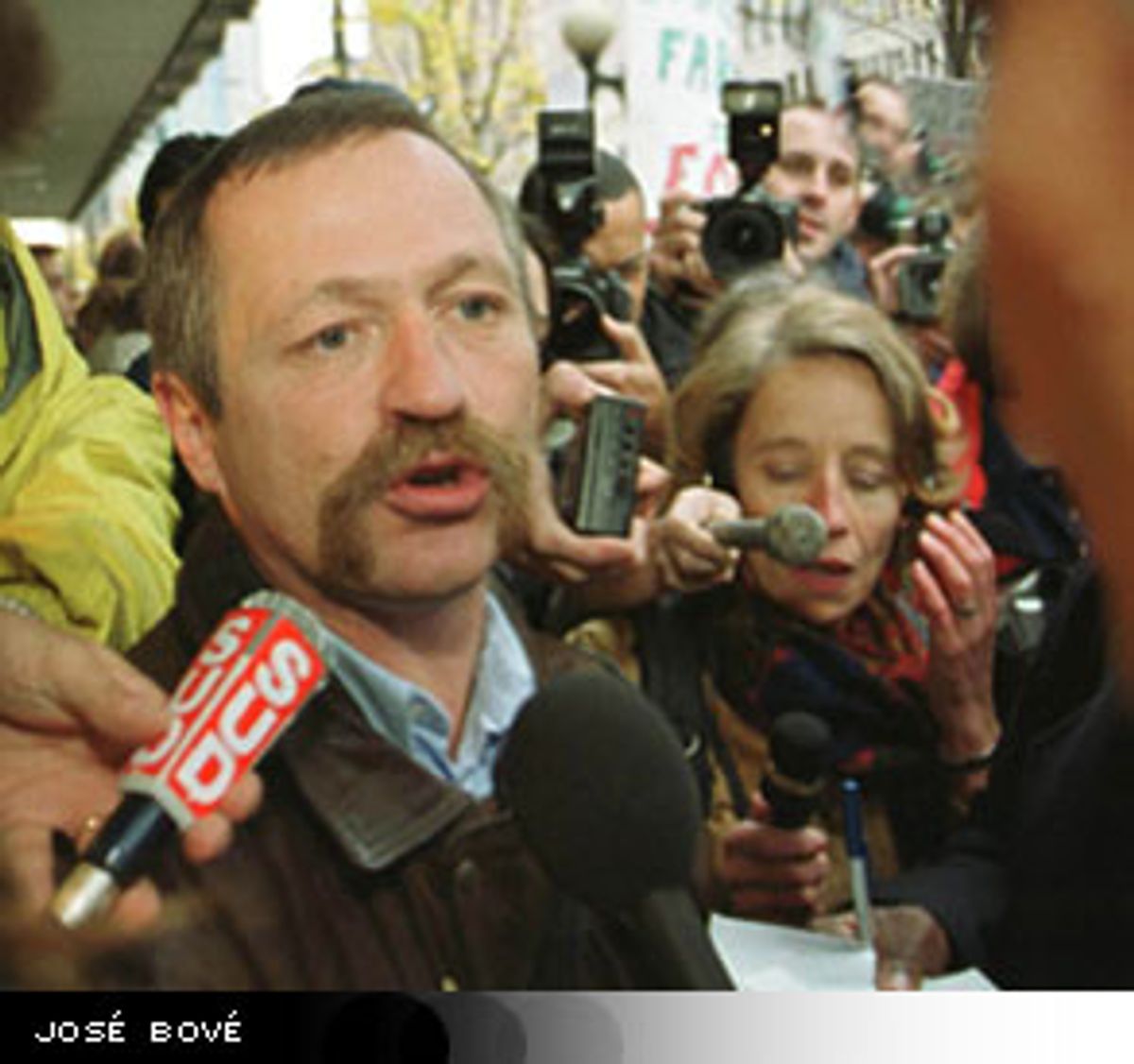
Not according to Josi Bovi.
Bovi, the militant co-founder of the Fidiration Paysanne and co-author of the current bestseller “Le Monde n’est pas une Marchandise” (“The World Isn’t for Sale”), insists that this cycle has been broken.
Bovi believes the future of French food — and, by extension, of French society — is in mortal danger from wholly new factors. Among them are the European Union’s peasant-crushing Common Agricultural Policy (CAP), the United Nations’ sinister Codex Alimentarius international food treaty, unfettered global trade, environment-unfriendly agro-business practices, hormones, mad cows and GMOs. Another insidious threat allegedly comes from big-money fast-food chains, specifically McDonald’s, which the French call “MacDo.”
“If we don’t act now it’s finished, it’s over,” the gravel-voiced Bovi told me recently, tracing a doomsday picture with his ever-present pipe.
Bovi’s critics call his rhetoric scaremongering. But if everything’s hunky-dory in French fields, kitchens and dining rooms, then why is this 50-year-old dairy farmer from Roquefort a national hero?
Bovi’s book has been on the bestseller list for months. Wherever he goes, TV, radio and newspapers follow. French people of all ages cajole him to autograph their T-shirts, their pants, their books: whatever’s handy when he appears.
Bovi and his fellow Fidiration Paysanne activists have not merely touched a chord in food-worshipping France. They’re playing a cacophonous symphony with choral complement. Furious farmers, rabid ranchers, disgruntled politicians from across the spectrum and, most of all, millions of wary shoppers have lined up behind him, making him a Gallic David against the global Goliath.
Bovi’s deification began last August in Millau, a bucolic dairy village outside Roquefort, when the stocky curd-wrangler with a horseshoe moustache led a wildly enthusiastic group of 300 local farmers, environmental militants and Fidiration Paysanne activists in the “destruction,” according to prosecutors, of an unfinished McDonald’s franchise as police watched.
Though several arrests were made at the time of the attack, a manhunt by French secret servicemen followed a few days later. Bovi, along with a handful of fellow Fidiration Paysanne militants, were tossed in jail for about three weeks.
Thus began what Bovi now sees as “$30 million’s worth of free publicity” for the Fidiration Paysanne’s peasant revolt against “la malbouffe” and its perpetrators.
On Friday and Saturday, an estimated 40,000 supporters showed up for Bovi and his codefendants’ hearing in Millau on charges of “ransacking” the McDonald’s. But Bovi’s anti-”MacDo” crusade began in spring 1999, when the United States, faced with refusals by France to import American beef (as a result of feared growth hormone residues), applied punitive duties on dozens of French products.
One of the hardest hit was Roquefort cheese. Roquefort makers sell 440 tons of their pocked blue curd to America every year at a wholesale value of 30 million francs ($4.3 million). Needless to say, local milk suppliers like Bovi weren’t happy. As if to add insult to injury, a new McDonald’s franchise — nearly 800 Golden Arches already grace some 420 French towns — was under construction in nearby Millau, Roquefort’s backyard.
The punitive tariff on so symbolic a food was viewed by Bovi as pure provocation. Roquefort isn’t just any fromage. In 76 B.C. the ancient Roman chronicler Pliny the Elder traveled to Gaul, reporting back about the peculiar mold-flecked cheese. Enlightenment philosopher Denis Diderot called Roquefort “the king of French cheeses.” In 1925 Roquefort became the first French product to receive the coveted AOC (Appellation d’Origine Controllie), devised to thwart counterfeiters.
“It was truly stupid for the American administration to take Roquefort cheese hostage in the hormone-beef trade war,” Bovi tells me in Paris, puffing away. “They represent two utterly irreconcilable types of farming. Doubling the import duties on a high-quality AOC to force us to buy hormone-beef? It’s folly.”
Despite the confrontational tone, Bovi and his Fidiration Paysanne’s gastro-crusaders did not target McDonald’s simply because it’s American. Nor is Bovi your average French dairyman. He spent part of his childhood in California with his scientist parents. (They were doing agricultural research at the University of California at Berkeley.) He speaks fluent English and scoffs at attempts to discredit him by labeling him anti-American or cravenly nationalistic.
“When I was in America last year I talked to farmers and consumers and our message got through,” he says. “Texan cattle ranchers, non-GMO soy growers, Alaskan salmon fishermen — they’ve taken inspiration from European movements. I think there’s an awakening of consciousness in America, too; things are beginning to move.”
Bovi and his federation targeted McDonald’s, he says, because the chain serves what he calls “food from nowhere” — what he and many other Frenchmen perceive as corporate, culture-less and rootless food. Menu items such as hamburgers or chicken nuggets, notes Bovi, are “recomposed” from myriad sources; they’re standardized, bland, sterilized. This, to his mind, is the antithesis of traditional French food and all that goes with it — the art of growing, eating and cooking with a reverence for the soil and the seasons.
“In France the link to your roots is very much through food and cooking traditions,” explains Bovi, whose ranchland near Roquefort is encircled by 800-year-old stone walls. “In America there’s no sense of an ancient civilization with a rural identity, etched over time into the landscape.”
The notion that food is both sacred and site-specific is the root of the emotionally charged French concept of “terroir.” First applied to describe the association of grape variety and soil in winemaking, it has come to evoke the wholesome, earthy qualities of regional foods and cooking.
The more France goes global, the more fast foods and hyper-markets there are, the more tenaciously the French adhere to concepts such as “terroir,” talismans against an uncertain future.
And for good reason. France’s gastronomic future looks increasingly overweight. Researchers such as Dr. Philippe Froguel of France’s prestigious CNRS and Institut Pasteur in Lille, believe that Europeans will reach American obesity levels in the next 20 years.
“Half of Americans are overweight,” Froguel told me. “A quarter are obese. Right now 30 percent of Europeans are overweight. However, European children are getting fatter all the time. Child obesity has doubled in France in the past five years, and obesity among young French adults has shot up 45 percent.” Froguel, also a diabetes expert, adds that “atypical diabetes” (i.e. juvenile diabetes) — an affliction associated in part with a genetic predisposition and in part with unhealthy eating habits — was unknown in France until 1999.
Why is this happening? According to Froguel, the French appear to believe they are increasingly under the sway of “MacDomination” and “Cocacolonization.” The power of terroir would seem to be weakening.
“Just because we’ve got these great French chefs it doesn’t mean the mass of French restaurants is good,” says a pragmatic Bovi. “Responsibility for McDonald’s popularity falls on French restaurants and bistros that are frozen in time, like in a [Robert] Doisneau photograph [from the 1950s] … Institutional restaurants are disgusting, school restaurants are revolting. In them we have tasteless, insipid, homogenous food, so kids prefer to eat at MacDo instead of the school cafeteria.”
McDonald’s France counters by claiming that its food is wholesome, its beef French (and hence hormone-free). Where the Fidiration Paysanne sees economic and cultural domination, McDonald’s sees sponsorship: It builds RonaldLand playgrounds for kiddies, donates money to charity and offers seminars to teach French parents how to behave — according to McDonald’s — like parents. It has annual sales of over $1.5 billion and its restaurants employ about 30,000 locals and “help animate” downtown areas that would otherwise be deserted (presumably because, as in America, suburban hypermarkets and malls have killed off traditional shopping areas in many French towns and cities).
All of which makes France’s enduring Label Rouge glamorous and more important than ever. Now a $1 billion business, its labels distinguish the exceptional quality characteristics of everything from fruit to fish. As a consequence a Label Rouge chicken could cost 50 percent more than a non-label competitor. Slow-growing, slow-fattening species are favored. Farmyard guinea fowl from the Landes, for example, take 94 days to grow to slaughterhouse age, compared to the usual 45. Poultry must be slaughtered locally (within two hours or 60 miles of the farm). Herbivores are fed only top-quality grain; animals must be either “raised in the open air” or “totally free-range.” A Label Rouge “farmyard porker raised in the open air,” for instance, is better off than your average Parisian: It gets a minimum 50 square meters (about 530 square feet) to trot in — the size of an average one-bedroom apartment.
“It is not an elitist social class thing,” Dominique Chaillouet, a Label Rouge spokesman, told me, “but rather a question of festive food. Even the poor buy Label Rouge for special occasions; it’s a question of frequency.”
The “Agriculture Biologique” or “AB” label, on the other hand, is an 8,100-member government-certified labeling scheme (recognized by the EU) that imposes strict regulations on about 3,000 organic products, concerning itself only with the healthfulness of its foods — no chemical pesticides, fertilizers, dyes or food coloring or flavoring; only organic feeds and fodder; free-range conditions; limited use of antibiotics (no more than twice a year); respect for natural cycles; encouragement of biodiversity.
Bigger by far are France’s prestigious AOC government-certified products, a 100 billion franc ($14.5 billion) market with 133,000 members. Many consumers mistakenly think AOCs apply only to wines. In fact there are dozens of other AOC food products, each with a specific charter to protect it. They include Vallie des Baux de Provence and Nyons olives and oil; Chasselas de Moissac grapes; Ile de Ri potatoes; Coco de Paimpol beans; green lentils from Puy; Grenoble walnuts; Vosges fir-tree honey; Bresse chicken and turkey; Camargue bulls; Haute Provence essential lavender oil; hay from Crau — and, of course, Roquefort cheese. (Bovi is the president of the Roquefort AOC.)
But the palette of “labelized” French products is wider still. It also includes IGPs (Indication Giographique Protigie), which specifies the qualities or characteristics of a specific region or regional farming tradition. Then there are the AOPs — appellation d’origine protigii, which means the product comes from a particular region that is protected for a variety of cultural and environmental reasons. Just to confuse things further, some Label Rouge products can also bear IGP, AOP or AB labels and vice versa. Add in supermarket “labeled” brands (“Agriculture Raisonnie — reasonable farming; “Agriculture Durable”), plus dozens of other products made to resemble authentic government-sanctioned quality labels, and consumers wind up in a daze.
There is one new label that has grabbed everyone’s attention of late: “GMO-free.” In part because of the Fidiration Paysanne’s ongoing campaign against GMOs — militant actions have included ransacking grain silos and destroying crops — but also because of agitation from Greens across the continent, GMOs are a nonstarter in Europe. Most supermarket chains won’t stock them and “GMO-free” has become a favorite marketing gimmick. According to GMOs’ supporters, science has been swept away by fear and emotion.
The glut of labels is symptomatic of French consumers’ desire to be able to trace a product back to its origin. Once upon a time, before the advent of the hyper- or supermarket, you knew your butcher and greengrocer got their goods from their cousins, the local pig farmer, snail and frog breeder or oyster cultivator. Until there is a mass exodus from cities back to the countryside, and a return of small specialty stores to deserted French towns and villages, labels and product traceability will remain important means of informing and protecting consumers.
“This is a historic moment in civilization in terms of its relationship with agriculture and food,” Bovi told me, citing the EU agriculture commission’s stated goal of eliminating millions of supposedly “inefficient” small-scale European farms.
Historic, indeed.
Last weekend at Millau at least 40,000 pro-peasant, anti-globalization militants and sympathizers provided a large-scale indication that the EU will continue to face considerable challenges in carrying out any policies judged unfriendly to small farming. Bovi’s trial also provided a convenient opportunity for a miniature rerun of the anti-WTO demonstrations of last year in America. Millau, sited in the Tarn River region, was dubbed “Seattle on the Tarn.”
Like the earlier “action” against McDonald’s, this one was nonviolent. The charge against Bovi was redefined from “ransacking” to “dismantling” on the basis of photographic evidence and eyewitness testimony that indicated little damage had been done. Another charge, that Bovi allegedly threatened to bomb the McDonald’s, was dropped. Bovi risked up to five years in jail and a 500,000-franc ($72,566) fine. But the magistrate hearing the case recommended a symbolic 10-month sentence with nine months suspended. Since Bovi already spent almost one month in jail in 1999 following his arrest, he probably will not be incarcerated again. The final sentence is due to be pronounced Sept. 13. Bovi, undaunted, says he will appeal whether or not he goes back to jail, and is already calling for yet another mega-assembly of anti-globalization campaigners for the sentencing.
Meanwhile, the feisty dairy farmer continues to crisscross France, signing books and speaking to packed houses. He is less concerned about his destiny than that of his cause. “The real challenge is to face down the prospect of industrial agriculture’s triumph, with a little niche market for tourists, so your American readers can still find a good Bordeaux, or a great cheese made by somebody somewhere,” he told me in Paris, provocative as always. “But that will be a minimal niche market, for folklore, for tourism. Right now we still have a heritage that we can save in France, but we’ve got to radically change agricultural policy.”
Others are more optimistic, pointing to the groundswell of support for the Confederation Paysanne and France’s all-out fight within the European Union to preserve “traditional French chocolate” made with only sugar and pure cocoa butter. France was also a key player last year in the EU’s victorious battle with the WTO over raw-milk cheeses. (Had a U.S.-sponsored initiative won, the French would have been forced to stop making brie, camembert, reblochon and many other raw-milk cheeses with centuries-old pedigrees, and even nascent artisan U.S. cheese makers could have been affected.)
Says Frangois Dufour, co-founder of the Fidiration Paysanne, “I think we’re stemming the tide, we’re reversing things. It’s not just the peasants, it’s local people in various parts of France who’re aware of the problems and willing to stand up and fight.”
Battles over growth hormones, raw milk, GMOs, vegetable fats in chocolate and countless other food-related issues are bound to continue. The feistiness of French farmers and consumers — the country’s national symbol is a cocky rooster after all — is the best guarantee that French food and cooking will continue to be excellent in decades to come. In the meantime, I’m heading to my favorite local bistro for a bang-up 1950s-style meal Robert Doisneau would’ve loved.
School for scandal
A Parisian course teaches the fine art of seduction to lame wannabe Lotharios.
By David DownieTopics: Love and Sex, Sex
A miniature black sheepdog darts through Paris’ fashionable Bois de Boulogne among other coiffed pooches. The man at the end of the retractable leash approaches a Catherine Deneuve look-alike attached to a poodle.
“Madame Fifi?” he splutters, taking cues from another woman nearby. “Perhaps you could help me and my dog adapt to Paris life — we’ve just moved here.”
Cut to a crowded Paris cafe. Another guy, a schlump in his mid-30s, has been eyeing the woman at the next table but hasn’t dared talk to her. On cue from a half-hidden figure seated behind, the man stutters, “Pardonez-moi, I know this sounds strange, but there’s something really interesting on the back page of your newspaper and …”
At an upscale boutique on the Rue Saint Honori, a 40-ish character dressed like Marcello Mastroianni steps in bearing a single perfect white rose. “Your eyes are so beautiful I wanted to thank you,” he sings, handing her his card. “Next time I’m in Paris, can I take you to lunch?”
What do these corny pickup scenes have in common? Vironique Jullien, founder of Paris’ first and only School of Seduction. She and her crack team of Italian and Latin American “seduction coaches” lead luckless French lovers into the field for just such hands-on sessions. Dogs in parks, newspapers in cafes and roses in boutiques are three of the hokey tricks Jullien uses to nudge tongue-tied Parisian Romeos to besiege the femme fatale of their dreams.
“It’s not a technique,” says Emmanuele, a 25-year-old white-collar worker and enthusiastic graduate of Jullien’s school. “You learn to develop your innate ability to seduce people, and Vironique helps you to bring that out — she had me join a theater company to learn to act, and now I’m engaged.”
Judging by her success, Jullien must be more than a mere monger of egregious platitudes and soft-porn hokey-dokey. Her school opened in 1995 and the concept has attracted American backers. A knockoff Vironique Jullien Seduction School may be coming soon to a town near you, probably in Silicon Valley. Negotiations are also underway in Singapore. And the press has been falling all over her: CBS, NBC and the Discovery Channel have shown up in the past month for interviews, not to mention the main French and Italian newspapers. Why?
Simple: No one can believe Parisian men need to be taught how to seduce women. What has become of the Jean-Paul Belmondos, the Jean Gabins, the Alain Delons of this sex-steeped country, where every ad campaign seems to feature burgeoning crotches and topless sex bombs?
“Frenchmen aren’t seducers the way they were up to the mid-1980s,” Jullien tells me in rapid-fire French, flailing her arms for emphasis. “The relationship between men and women began to go downhill starting then. The reason is 50 years of feminist revolution — at a certain point it had to backfire. We’ve become victims of the war we’ve waged.”
Tall, muscular and in her 40s, Jullien is an ex-Club Med staff member, a former sales team manager and business consultant, matchmaking agency director and dancer/cabaret artiste. She has an imposing presence, a permanently bronzed alpha-female look, with large mobile features, big brown eyes, vast quantities of hair, lavish gestures and cannon-shot exclamations. Her body language and speech are pushy-randy, verging at times on raunchy.
In my 15 years in Paris I have encountered French women like her, though none wearing, as she is, a loose white shift paired with red basketball shoes. Her mane is crowned by a pair of sunglasses, despite the fact that we’re inside an office building. Most of the Parisian alpha females I know sport Chanel suits and flirt outrageously with executives who come to cut a deal with them, perhaps before leaping into the sack.
High-strung and meteoric, Jullien moves in her small Opira-neighborhood office like a Puerto Rican dancer in “West Side Story.” (It’s one of her favorite musicals, she tells me.) She plucks the sunglasses off her Medusa curls, twirls them, drops them on her cluttered desk by her shrilling cellular phone, replaces them, scratches at her stress-martyred hands.
“Seventy percent of my clients are men,” she reports. “30 percent women.” Almost all the women, it turns out, come on the pretext of wanting to master communications skills. But in a country with a 33 percent divorce rate, where adultery is the national pastime, most of them really want to learn how to keep the men they have.
“Between you and me,” she says, “we French women are spoiled. We’ve got full rights, we can have an abortion, we can take the pill, we can cheat on our husband — no one busts your ass anymore if you commit adultery, and it sure wasn’t like that once upon a time. We work, we’re independent. I just don’t understand why we complain.”
The main problem with Frenchmen, it seems, and therefore the raison d’jtre of Jullien’s school, is the very power French women now wield, women who have no time for families, love or courtship.
Jullien’s men — mostly 30-to-50-year-old engineers, computer programmers, business executives or other professionals — can’t handle these superwomen, don’t know how to communicate with them and have come to fear them. Jullien’s school is the Last Chance Saloon for those who’ve already been to shrinks, singles clubs and matchmakers. (There are 1,500 matrimonial agencies in France today.) These men spend $1,000 to $2,200 for two to nine months of learning from Jullien how to overcome their fears — of rejection, ridicule, psychic castration.
“For a while there, I wasn’t exactly cuddly with men myself,” she says, fixing me with a serrated gaze. “I was one of those castratrices. Yes, we are ball cutters, but Frenchmen have become pretty wimpy, too, pretty weak. It’s like, ‘We were victims, now the men are victims, everyone gets his turn.’ But that’s not going to fix anyone’s problems.”
- – - – - – - – - – - -
I cross and recross my thighs uncomfortably and can’t help thinking of Italy. A similar set of problems — increasing social mobility, waning family values, the greater independence of women — arose at about the same time in the heartland of the Latin lover. Ten years ago I reported on Italy’s first seduction school, run by Giuseppe Cirillo, aka the Prince of Seduction, a Neapolitan lawyer turned psychologist-sexologist.
Starting in the late 1980s Italian males were suddenly faced with liberated females chanting the slogan “Bread but also roses,” a baffling refrain that helped spawn countless then-unheard-of lonely hearts clubs, as well as Cirillo’s seduction school. The colorful Cirillo method, as I experienced it, involved individual and group activities ranging from the banal — matching facial expressions with Cirillo’s “75 primary emotions,” gauging “gait and body language,” using “voice modulation, eye and hand techniques” — to the outlandish.
Not only did I engage in thigh-to-thigh role-playing (in one session I had to explain my way out of being caught sleeping with my girlfriend’s best friend), I was also introduced to Cirillo’s secret weapon, the “tavola delle esclusioni,” a painted wood silhouette of a woman with strategically placed slots at head, shoulder and waist level. Out went the lights; in came a female presence. After sliding the silhouette’s panels back and forth, allowing us to see the mystery woman’s eyes, lips or waistline, Cirillo ordered us to step up one at a time and knead and stroke her. This was an extravagantly embarrassing episode, though my fellow students, some of whom hadn’t been inside a flesh-and-blood woman in years, went pink with pleasure.
Being both French (i.e., tending to constipation) and a woman, Jullien has nothing remotely like Cirillo’s ingenious contraption, and when I tell her about it she goes ballistic. “He must have a bunch of basket cases as clients, guys in death throes, morbidly shy guys,” she machine-guns. “I have normal guys.”
As proof she shows me a few photographs and explains her methodology. The first thing she does when she meets you is conduct a frank interview. Then she gives you a questionnaire and sends it to a clinical psychologist.
After you’ve been profiled, Jullien, working with the shrink, devises a personal course of instruction. It might include everything from role-playing to field trips (pickup practice in clubs, cafes, parks) to lambada dance classes to appointments with a sexologist. “Some of my clients are virgins,” she admits. “Others say they don’t know how to put on a condom.”
Typically, the beginning of a course is a sartorial and hygienic remake. She shows me before-and-after photos of a client transformed from a hopeless guy — mismatched tie and shirt, baggy outdoorsy pants, unkempt hair — to a snazzy hunk. The remade dude is wearing a gray suit and dark turtleneck. His hair is raked back. She calls the makeover a “re-lookage,” a wonderful bit of Franglais. “I often use Alain Delon as an example of how to dress,” she explains, telling me she believes that clothes make the man. “He’s a successful role model. You might or might not like him, but he’s not your run-of-the-mill actor, and he did it himself, so it means you can transform a man. When you work at it, when you have the will to change yourself, you can.”
Cirillo may have his silhouette, but Jullien has two secret weapons of her own. Unwittingly, I’ve been smelling one all along and now realize the feral odor and snorting sounds I’ve been hearing emanate from a miniature black Belgian sheepdog. Parisians are dog-obsessed. Jullien lends her pet to clients so they can pick up dog-owning ladies.
The second weapon comes in the form of field trips to one of Cirillo’s stomping grounds: Rome. Jullien met her husband there, she tells me, an Italian who picked her up in a cafe. This explains why she is convinced that Cirillo’s clients are total basket cases. Just as I can’t believe Parisians need her, she can’t believe Romans need Cirillo.
“I take a bunch of Parisian men, we fly to Rome, we go to the center of town, and I and my women helpers are the bait,” she says. “We sit at a cafe and demonstrate how Roman men pick us up. We get all dolled up, we sit down, with our clients nearby, and then we wait. And I assure you we don’t wait long. Go sit at a Paris cafe — and unless you’re wearing a miniskirt pulled up to your panties, you can wait two hours before a guy will even talk to you.”
So, leaving aside Cirillo’s basket cases, the secret of being a great lover is to be Italian? I can just imagine the Bill Gates look-alikes at Jullien’s future Silicon Valley campus exchanging their pen protectors for La “Dolce Vita” suits, worn boldly to help cyber Don Giovannis shark in on single gals slurping smoothies at the local strip mall.
“I’m not going to teach American men to pick women up like Roman men,” she protests. “The essential thing is to be likable in the first seconds when approaching someone.” Besides, she adds, seduction techniques are universal — the winning smile, the bouquet of flowers, the self-confident yet sensitive charm. “Any man who knows how to pick up women, wherever he goes — to a museum, an antique shop, a boutique, in the street, in a park — will succeed anywhere in the world with any kind of woman, a German, a Dane, whatever … Forget the intellectual psychology stuff — a woman is a woman. She’s got tits, an ass; we’ve all got ‘em. A woman needs to be made to dream, to use her imagination.”
It’s obvious why Jullien’s savvy imagination has been captured by California, a mother lode of dot-com nerds, luckless Bobos and geeks surrounded by post-feminist castratrices with pruning sheers, fat wallets and dating contracts. (“You shall not touch me until I specifically request you to do so …”) But is she qualified? She has traveled to, though she has never lived in, California. She speaks fluently flawed English with Parisian panache and demonstrates an original understanding of American culture.
“My impression,” she confides, “is Americans don’t know how to flirt. There isn’t a single American who knows how to flirt, and I mean the mating dance, the seduction dance — they don’t know how to do it. They don’t have good table manners, either. I’m not saying all Americans are like that — some aren’t of course — but the guys in Silicon Valley, in front of their computers all day, they barely know how to hold a fork. American guys can be jokesters, bons vivants, and suddenly they reach out and grab your ass and say, ‘I want to fuck you’ or whatever. They’re capable of behaving like real hicks. Whereas the bourgeois American guy is calmer, more puritanical.”
Tits, asses and the urge to screw may be universal but, wisely, Jullien plans to surround herself with Americans conversant with the country’s hick-puritanical heritage.
As I left her office and met one of her cringing clients, I came up with a quick crib of the Jullien method, in three easy steps: 1) If you’re a man, have Roman-gene-implant therapy, memorize the script of “La Dolce Vita” and get a Mastroianni “re-lookage.” 2) If you’re a woman, fly to Rome and nurse your latte there. 3) If the first two don’t work, buy a dog.
And don’t bother coming to Paris. No matter what Jullien does, the women are viragoes, the men wimps.
A tale of two cities
Two exhibitions, one in London, the other in Paris, offer clashing views of "Paris 1900" -- and 2000.
By David DownieTopics: British Election, England, France
To the contemporary imagination, riotous Belle Epoque music halls, sinuous art nouveau styles and debauched fin-de-sihcle fantasies seem as natural to Paris in 1900 as they were alien to Victorian London or turn-of-the-century New York. Yet all three cities are holding exhibitions this millennial year on 1900 themes — art and architecture, sexuality, decadence, nostalgia and optimism on the brink of modern times.
Paris’ show, at the 100-year-old Grand Palais, itself the centerpiece of the 1900 Exposition Universelle, is titled “1900.” Its curators clearly state that “this is neither an evocation of the splendor and misery of the Belle Epoque nor a commemoration of the exposition of a century ago with which Paris wished to astound the world, nor an homage to Art Nouveau and its master practitioners.”
By contrast, London’s offering, “1900: Art at the Crossroads” (co-produced by the Royal Academy and New York’s Guggenheim Museum) seeks to assess “fin-de-sihcle artistic crosscurrents” by evoking Paris’ 1900 Exposition Universelle through artworks shown at the fair or excluded from it.
Why these museums didn’t team up to produce a bigger and better traveling show is an enigma wrapped in fin-de-sihcle tendrils. This is more than a tale of feisty Frogs versus Rosbifs and Yanks, however, and begs several questions. For instance, why have Paris, London and New York decided to feature 1900 instead of focusing on Y2K? And what do the “splendor and misery” and the “artistic crosscurrents” of a century ago tell us about our world today?
These and other queries jostled me as I rode the high-speed Eurostar train from Paris’ 19th century glass-and-iron Gare du Nord to the ultramodern Waterloo International. You barely have time to read Le Monde and The Guardian before Paris’ sprawl of 11 million gives way to the even more sprawling 14 million of London. It’s indicative of these cities’ perennial rivalry, though, that the British named their Eurostar station for the battle marking Napoleon’s defeat and the end of France’s European Empire.
From Waterloo to the Royal Academy it’s a pleasant half-hour walk through a resurgent cityscape. The postwar jumble of concrete south of the Thames reminds you that London was half-destroyed by Nazi rocket-bombs, then hastily rebuilt. There’s none of Paris’ symmetrical, tree-lined beauty here. Emerging from Waterloo you cross the Thames in view of the Houses of Parliament, Big Ben and the Millennium Wheel — the world’s tallest Ferris wheel. As chaotic and polluted as the streets knotted on either side of it, the wide tidal river is alive with tugboats, barges and tour boats.
Depending on your route, you either pass Downing Street and the Horse Guards in their silly helmets, or St. James’ Park and The Mall. Nearer the Royal Academy you’re likely to encounter several unmistakably English sights — the Royal Automobile Club, Christies, Fortnum & Mason — in the hodgepodge of sublime and ridiculous urbanism that characterizes the city as a whole.
Half the culture-seekers lining to get into “1900: Art at the Crossroads” were French fresh off the Eurostar — apparently they’d taken the tube from Waterloo to Piccadilly and beat me. Greeting us as we swept up the stone staircase loomed a series of giant photographic blow-ups from the 1900 Exposition Universelle.
Here was the Eiffel Tower hedged by countless gimcrack domes, pagodas, globes, colonnades and minarets, with two phallic brick chimneys belching out black smoke. Through the pall a Ferris wheel turned and lights winked. The atmosphere crackled with electricity — literally.
As the exhibition and catalog make clear, electricity was still a novelty in 1900, an authentic technological wonder and metaphor for modernity’s positive elements. It became the theme of the exposition, which drew 50.8 million visitors to Paris in a mere six months. The fair’s lighting and machinery were powered entirely by dynamos housed in the gaudy Palais de l’Electriciti — the origin of most of the black smoke in the photos. This hulking colonnaded Wurlitzer glowed with 5,000 multicolored “Fairy Lights.” Its crown, the Fie de l’Electriciti (the Spirit of Electricty), rode in a chariot showering colored sparks and flames.
Black-and-white photos of the day don’t do the fie justice. But Italian painter Giacomo Balla, who attended the fair (his work wasn’t shown in it), captured the scene in his magical “The World’s Fair at Night,” on display here. Balla’s dark human silhouettes and spinning carousels foreshadow his later work as founding member and leader of the Futurist Movement.
It’s said the expression “Ville Lumihre” — City of Light — was coined at the Paris fair in the shadow of the Palais de l’Electriciti. Ville Lumihre became both the city’s nickname and a self-congratulatory catch phrase still used today by Parisians to mean we are the spiritual and material beacon to the world.
In two oils by Camille Pissarro (“Boulevard Montmartre: Foggy Morning”) and the now-forgotten Maximilien Luce (“The Sainte Chapelle”), you gaze upon a strangely familiar Parisian cityscape; familiar in its layout of cannon-shot, sycamore-lined boulevards with Haussmann-style apartment buildings, yet wonderfully, disconcertingly different, and not only because it wasn’t choked with cars. In these and other paintings you sense the wild, outlandish energy of what was the world’s first cosmopolis.
That energy brought mixed blessings, as hinted at by Pierre Bonnard’s “Nude with Black Stockings,” Edgar Degas’ “Spanish Dance” and Pablo Picasso’s “Moulin de la Galette” and “The Absinthe Drinker.” Among these works’ subtexts was prostitution: Servants, dancers, models and seamstresses routinely rounded out their meager wages by selling themselves to the paunchy men in tuxedos Degas loved to draw.
In 1900 relations between men and women stood at a critical juncture, as the first assault on patriarchal society was mounted. A favorite theme of male artists of the time was Salomi — the devilish temptress — and there are half a dozen renditions of her here, dancing or lustily clutching John the Baptist’s severed head.
It was during the Belle Epoque in Paris — a period stretching from the end of the Second Empire in 1871 to the beginning of World War I in 1913 — that the upper classes in particular, frustrated by stifling customs, began experimenting with their sexuality. Orgies, Sapphism, pederasty and cross-dressing became fashionable not only with the so-called hors natures but also among straight women and men.
Absinthe, ether and alcohol — as captured by Toulouse-Lautrec, Picasso and others — were the drugs of choice in private and at the city’s boisterous cafes, bars and music halls. Meanwhile other tuxedoed gentlemen fought duels in the Bois de Boulogne, and an average 100,000 starving peasants flooded into town each year to work in factories or in what we’d now call service sector jobs.
This explosive mixture infused the art of 1900 and somehow transformed Paris into a cosmopolitan crucible of creativity, a magnet for the world’s greatest talents.
So, was 1900 a “crossroads,” as the show’s curators suggest? Well, perhaps more like a spider’s web tossed over a thousand traffic turnarounds, with Ferris wheels and hot-air balloons galore.
By including hundreds of sculptures and paintings from the 1900 Paris fair, plus work by artists who were left out of it — Henri Matisse, Paul Cizanne, Henri Toulouse-Lautrec, Maurice de Vlaminck and other greats — the exhibition convincingly proves that the turn of the last century indeed embraced everything and its opposite.
“It’s as if,” said a Londoner friend I met at a pub after the show, “you had David Hockney’s L.A. swimming pools next to Damien Hirst’s split cows under formaldehyde. It makes perfect sense.”
That pub — a trendy place called All Bar One near the refurbished Covent Garden, now a shopping mall — offered pseudo-French salads, faux Italian panini, cold German beer on tap and Chilean chardonnay. It was tasty enough and perfectly fin-de-sihcle 2000.
Later, as I perched at the faux-French brasserie atop Oxo Tower overlooking the Thames, I stared out at the crazy megalopolis and couldn’t help thinking there might be parallels to draw. Could London in 2000, bombed and rebuilt, freewheeling in spirit, have anything in common with Paris in 1900? The city is indeed celebrating Y2K, but not with a world’s fair. It has, however, spent a billion dollars on the Millennium Dome, put up the giant Millennium Wheel and has almost finished the spectacular Millennium Bridge, complete with Fie de l’Electriciti-style lighting. Along the river’s south bank runs the new Thames Path, a hiking trail looping clear across town. The Tate Gallery has split, moving its 1900-onward art collections to the reconverted Southbank powerhouse. Somerset House and its magnificent art galleries, also on the Thames, will be reborn later this year.
There’s certainly a buzz in the air, and it’s not just the sound of a million dirty diesels.
Back in the Ville Lumihre after a lightning Eurostar ride I hopped on the metro — built, incidentally, for the 1900 Exposition Universelle — and at Champs Elysies-Clemenceau strolled through the turn-of-the-century gardens there, looking with new eyes upon the Petit Palais-Grand Palais-Pont Alexandre III complex.
A time tunnel? You bet. As centerpieces, these two palace-museums and the heavily gilded bridge beyond them were the only 1900 Exposition Universelle buildings intended to be permanent. And permanent they are, like that other symbol of Paris, the Eiffel Tower, a “temporary” display for the 1889 Exposition never torn down. All three appear almost exactly as they did in those 1900 photographs on display in London, testimonials both to cutting-edge technology and academic 19th century taste.
The Grand Palais’ kitsch neo-classical exterior, for instance, hides a stunning main hall with swooshing iron staircases, flying iron arches and curved glass. Unfortunately it has been closed for several years while engineers try to keep it from subsiding into the Seine. So exhibitions are now held in smaller side galleries that have been so utterly modernized you’d never guess they were part of a 1900 Expo building.
Awaiting visitors at the entrance to “1900″ is a 6-foot panel carrying the curators’ triple-negative welcome: This is neither an evocation of the Belle Epoque’s splendor and misery, nor a commemoration of the Exposition Universelle, nor an homage to Art Nouveau. The words keep you guessing as to what the show is really about, other than not being like its rival in London and New York. But it’s a gorgeous conundrum all the same, stuffed with paintings, drawings, renderings, photographs, sculptures and — unlike the London-New York show — a wealth of furniture, objects and jewelry. Despite the curators’ desires to avoid an homage to art nouveau, the most numerous and compelling pieces here (including the renowned butterfly woman by Lalique adorning the exhibition catalog’s cover) are art nouveau.
There are art nouveau architectural drawings by Hector Guimard, from private villas and the Paris metro. A boomerang art nouveau writing desk with mushroom lamps by Henry van de Velde. Inlaid Art Nouveau wooden stands by Louis Majorelle, et al. And encrusted art nouveau glass by Emile Galli.
It’s apparent that Galli and his followers sometimes stepped through the looking glass into Wonderland while trying to infuse the decorative arts with new vigor. Twisted tables sprout from the floor. Wings envelop seductive women. Tendrils and algae ensnare limbs. Among the weirdest pieces displayed are a series of 1899-1905 photographs by German artist Karl Blossfeldt. They show tortuous wrought-iron “flowers” — insect-like impatiens glandulifera, spiky dipsacus laciniatus, curlicue curcurbita, delirious delphinium and cobra-headed fiddle tops seemingly fed on absinthe and decomposition.
Decadence, anguish and nostalgia — for paradise lost, or a mythical pre-industrial world — are intertwined with a thrusting urge toward the new, the unknown.
Nowhere are there evocations of Paris, however, of daily life in 1900, of the intellectual ferment in salons and cafes, of the world’s fair, of the Palais de l’Electriciti or the artists’ colonies of Montmartre and Montparnasse. More surprisingly, there is no mention of the countless fin-de-sihcle structures in the City of Light today, a city at least superficially preserved in 1900 aspic. Such trifles would perhaps have been too obvious for the show’s curators.
Feeling perplexed, I resolved to revisit a handful of my favorite 1900 Paris locales the next day. Near a cafe appropriately called Le Paris-Londres, on the Place de la Madeleine, I took the spiraling staircase down to the subterranean art nouveau toilettes publiques, a cavern of carved wood, brass and mirrors, with floral frescoes and stained-glass windows in each cabinet. I awoke the sleeping Madame Pipi (as bathroom attendants are still called) and once I’d tidied up as a fin-de-sihcle gentleman would have, set off for one of my regular Paris haunts, the Gustave Moreau Museum.
This house-atelier of the mad symbolist painter (much admired by everyone from Gustav Klimt to Picasso) has remained unaltered since Gustave Moreau’s death in 1898. Prominently displayed was the jewel-like, gold-embossed rendition of the temptress Salomi facing the hovering head of John the Baptist — Moreau’s most famous painting. The place oozes fin-de-sihcle unease, and it’s thronged.
A half-mile away in the Rue du Faubourg Montmartre I peeked into Chartier, among Paris’ authentic fin-de-sihcle restaurants. Beneath an immense skylight hang brass chandeliers with white glass globes. There are brass coat racks and carved panels, bentwood chairs, vast mirrors and kitsch paintings. A century after it opened, the same kind of work-a-day food — celery-root salad with mayo, roast chicken, steak and fries — still graces the handwritten menu.
Another quarter mile east I stuck my head into Julien, built for the 1889 Exposition Universelle. With its lapis lazuli peacock panels, stained-glass skylights and rampant floral-theme plasterwork, it’s a prototypical Belle Epoque interior. Here, too, the specialitis de la maison haven’t varied much for a hundred years and neither have the bustling, smoky atmosphere or the waiters in aspic.
It was too early for dinner, but an espresso at Angelina, on the Rue de Rivoli, seemed like a good idea. Unaltered since 1903 (except for a few art deco lamps from the 1930s), this temple dedicated to straight-laced chocoholics used to be Coco Chanel’s and Marcel Proust’s hangout. The tall, plaster-encrusted mirrors now reflect distinctly New World clients lapping at the famed chocolat chaud and nibbling finger-cakes worth their weight in platinum cards.
While sipping my coffee, I thought about all the other places in Paris I could visit on a 1900 whirlwind tour. There was La Pagode, the cinema made from a Japanese pagoda, unveiled in 1896. There was the Grivin museum and its theater. If you skipped the waxwork displays and concentrated on the so-called “Palais des Mirages” — a hall of mirrors hung with sculpted elephant heads and snakes, with Fie de l’Electriciti lighting — you’d actually be experiencing something salvaged from the 1900 Exposition Universelle.
What else? Another dozen restaurants, certainly … The daunting list seemed to stretch forever, from the Samaritaine and BHV department stores to the parterres of the Bois de Vincennes and Bois de Boulogne, via the tombs of Phre-Lachaise or Montparnasse cemeteries, to half the buildings lining the streets of Paris. The list was as long, in fact, as the city’s seemingly endless turn-of-the-century boulevards. Baron Haussmann’s creative destruction — 25,000 old buildings flattened — may have begun under Napoleon III in the Second Empire (1850-1870), but it was still under way in 1900.
Hungry by now, I decided to ride the metro to Le Train Bleue at the Gare de Lyon. Both the station and its luxurious upstairs restaurant were built, like the subway, for the 1900 Exposition Universelle. Unlike the subway and station, however, Le Train Blueu, a landmark, hasn’t changed an iota. A dizzy pantheon of plaster putty, overflowing amphorae and fruit and floral garlands cling to the heavily gilded neo-Rococo ceiling. The place gleams with brass, cut-crystal and carved, wood-frame, painted panels depicting destinations served by the trains hooting below. The dining room is about 100-yards long. I felt like a pearl on the comfy upholstered banquette, in what must be one of the city’s only non-smoking sections with a view. After ordering a Belle Epoque duck breast and a bottle of inky Saint-Joseph, I studied the catalog of the Paris exhibition. I soon found a clue to explain at least in part what “1900″ was about.
The curators — most of them from the Musie d’Orsay, itself housed in a 1900 former train station also built for the world’s fair — seemed to see in the art of 1900 the opposite of what London’s and New York’s curators had seen. To the Paris contingent, what stood out was the “profound and original unity” and “common aspirations” of Europeans at the time. The curators, it seems, heard echoes in various nationalist artworks of a “profound need for identity, at times an authentically threatened one,” like that of Finland, subjugated in 1899 by a repressive Russian czar. Parallels?
I finished my duck thinking of French TV and film quotas, of the language police, of the many laudable and lamentable efforts being made in Y2K Paris to preserve French culture from the onslaught of the free-market, Anglo-Saxon, English-speaking world. I thought of Jean-Paul Sartre’s description of the emblematic 19th century poet Charles Baudelaire, a man who “chose to advance backwards with his face turned toward the past.” I thought of the ancient Roman god Janus, protector of thresholds both spatial and temporal, who teaches us that to look forward we must look back. And the “1900″ exhibition became clearer: Some of us are still living in 1900.
But only some of us. I walked home across the Place de la Bastille, past yet another Guimard Metro station, an Indiana Tex-Mex, a Juventus pizzeria, a McDonald’s and several theaters showing primarily American movies. I dodged an international gang of in-line skaters under giant posters screaming “Internet et la nouvelle economie.” And I realized that, as in 1900, everything and its opposite — nostalgia and a lusting for the future, the retrograde and the avant-garde, wealth and misery, high art and kitsch, open-mindedness and paranoia — are alive and kicking in Paris 2000.
“1900: Art at the Crossroads” is at the Royal Academy in London until April 2, and at New York’s Guggenheim Museum from May 18 to Sept. 13. “1900″ runs at the Grand Palais in Paris until June 26.
Going Dutch
Can America learn from the Netherlands' drug policy of tolerance and ambiguity?
By David DownieTopics: Drugs
The pungent perfume of grass wafts down the Amsterdam street where you walk, under shade trees on a curving canal fronted by landmark brick buildings. You look up, nostrils flaring. Neon lights wink from the facades of cafes with names like the Grasshopper, Dutch Flowers or the Bulldog.
Better known as “smoking coffee shops,” these Dutch dope dens dispense soft drugs, marijuana and hashish, to a mixed bag of customers. Tourists and locals saunter in then stagger out in a cloud of smoke. Inside the air is blue. People puff and joke, some of them laughing crazily, others digging into snacks while lounging in armchairs. Seventies rock alternates with cool jazz and house music. Soft-drug menus are passed from behind the bar, where an “ethical dealer” has just delivered half a kilo of “skunk nederwiet” — the Netherlands’ prized, domestically grown high-THC power weed.
A couple of bucks buys you a joint of it. Even if you don’t light up your head begins to spin from a contact high. You glance around nervously, expecting the cops to show up. But they don’t. And they won’t. As long as the coffee shop plays by the rules.
That’s where the confusion comes in. Popular misconceptions about the Dutch approach to consuming and regulating
drugs have remained firmly rooted across Europe and America since the Dutch began liberalizing drug-use policies in 1975.
It’s true that you can still smoke grass or even shoot up without fear of punishment in Holland. But drugs, even marijuana and hash, have never been legal, are not legal now and are unlikely ever to be legalized in the Netherlands. Like Americans, most Dutch want drugs to remain illegal; unlike Americans, the Dutch are realistic about who should go to jail.
The Dutch are progressively tightening the screws: The number of
drug-related arrests in Holland — many involving the booming synthetic drugs trade — has more than doubled since 1995. Lately the Dutch Ministry of Justice has even begun using the outdated and inaccurate American nomenclature “war on drugs” in reference to their efforts to fight international drug trafficking. That’s in part because the Netherlands has become not only Europe’s cannabis and cannabis-seed capital, but also a
major production, warehousing and shipping center for ecstasy (and related synthetic drugs), as well as a transit country for heroin and cocaine.
The popular misconception about the Netherlands’ drug policy — that anything goes — stems from two quintessentially Dutch attitudes that have underpinned Dutch society for the last 400 years: tolerance and ambiguity. Tolerance, which the Dutch call “gedogen,” has been a way of life since the Catholic-Protestant religious strife of the 16th and 17th centuries.
Drugs — alcohol, tobacco and opiates — have been tolerated at least that long. Scholars now point out that the merrymakers in the fanciful Golden Age paintings of Jan Steen (1626-1679) and Adriaen Brouwer (active 1620s-30s) appear to be more than merely drunk as they stagger, swoon and grope through atmospheric inns and taverns.
They may well be tripping, too. Indeed, historians wonder whether the Golden Age Dutch mixed narcotics with their tobacco. The institution of the Brown Cafe — so called because the walls of such places haven’t been scrubbed since the Golden Age — is still going strong, booze and cigarettes being the demons of choice.
And demons they are: In its November 1999 report, “Drug Policy in the Netherlands,” the Dutch Ministry of Health, Welfare and Sport (MHWS) clearly states that “the social and health damage that results from alcohol abuse and alcoholism [in the Netherlands] is many times greater than the damage resulting from drug use.”
As it relates to narcotics today, the Dutch sense of tolerance means that use of small quantities (5 grams or less) of “soft drugs” — marijuana and hashish — is not a criminal offence. Use of even smaller quantities (0.5 grams) of “hard drugs” — cocaine, heroin, ecstasy — is also tolerated, though users will be referred to rehabilitation centers, and repeat offenders can be forced to choose between long-term detoxification or prison.
Here’s where the ambiguity comes in: Use is not a crime but possession of any drugs, hard or soft, is. More ambiguity: Possession of small quantities for personal use (5 grams and 0.5 grams, as per above) is generally tolerated, unless the user is a repeat offender or a troublemaker (i.e., causes a public nuisance). In any event, all illicit drugs, no matter how small the quantity, found during police searches of persons or places are systematically confiscated. The number of searches and seizures continues to rise dramatically. Importing, exporting, selling, trafficking, manufacturing or growing any illicit drugs is also a crime subject to fines (5,000 to 1 million Dfl, or $2,500 to $500,000) and/or imprisonment (four to 16 years).
Related to this is another series of ambiguous facts to put in your pipe and smoke. The country’s 861 “smoking coffee shops” (290 in Amsterdam alone) are allowed to sell adult clients (18 and over) small amounts (5 grams per person per transaction) of soft drugs. But in theory they can’t advertise the drugs, can’t sell alcohol on the same premises, can’t allow clients to cause a public nuisance, can’t sell drugs for take-out use or have more soft drugs on hand than the coffee shop conceivably needs to supply clients’ daily demands (500 grams, just over a pound).
But if importing or growing dope is illegal, you might ask, how do these legitimate establishments get their supplies? The question makes Dutch government officials queasy. “This is the inherent paradox of the Dutch drug policy,” says Frank Kuitenbrouwer, a legal commentator and member of the editorial board of the NRC Handelsblad, a leading centrist Dutch newspaper. “It’s known as the front-door/back-door problem: if the Dutch government tolerates people going in the front door of the coffee shop, what about the back door, the supply?”
Unofficially, police authorities allow “ethical dealers” — individual small-scale suppliers untainted by international trafficking rings — to handle transactions. But an Amsterdam city official, speaking on condition of anonymity, told me he believes that 90 percent of smoking coffee shops in the city are controlled by organized crime.
This is where tolerance and ambiguity become dangerous. “The front-door/back-door policy has created an enormous amount of organized crime in Holland,” confirms reporter Kurt van Es, a drug specialist at Amsterdam’s top daily Het Parool, and pro-legalization author of a book on smoking coffee shops and soft drugs. “The Dutch have become the Colombians of marijuana and hash trafficking in Europe.”
The Netherlands is a major marijuana growing country (of plants and, especially, seeds for export). Estimates are that if they were allowed to, Dutch growers could supply about 75 percent of domestic demand, thereby undercutting organized crime. But Dutch anti-drug squads systematically root out hemp plantations, and growing will probably remain illegal due partly to pressure from the E.U. and America. “This is a very bizarre situation,” adds van Es, “but somehow we don’t dare take the further step of legalizing the trade of soft drugs at coffee shops or other points of sale — bars or pharmacies.”
- – - – - – - – - – - – - – - – - – - – -
Curiously, at the perfumed floating Flower Market in central Amsterdam you can tiptoe through tulips and buy blooms in any season — and marijuana starter kits. They sell for about 15 Dfl, around $7.50. Follow instructions and you get smokeable, albeit weedy, plants in about 10 days. You see pot plants on cozy barges along picturesque canals, and on the window sills of old brick houses. Illegal? Yes, but tolerated. The Dutch officially call their confusing brand of ambiguity regarding drugs “The Expediency Principle.” That means officers and officials can decide case-by-case whether it’s in the public interest to arrest or detain drug users, growers and suppliers.
In recent years another recreational substance has sprung up in the forest of Dutch ambiguity: magic mushrooms. The Dutch call them “paddos” or “smart drugs.” They are sold dried, powdered or as spore starter kits at dozens of New Agey stores (they’re most popular in Amsterdam). Many smart drug boutiques also sell mescaline, and boast pause-for-thought names like “Conscious Dreams.” Attempts to regulate them are under study (they may soon become illegal, but tolerated). The Dutch MWHS concedes that “no reliable data is available on the scale of [their] use.”
The ultimate stated goal of the Dutch government’s drug policies is to “protect the health of individual users, the people around them and society as a whole,” according to the Ministry of Justice. In concrete terms that translates into decriminalizing — while actively discouraging — personal drug use; separating the markets and use-patterns of “soft” and “hard” drugs; keeping all drug users out of jail; rehabilitating and reintegrating addicts rather than repressing and punishing them; controlling the trafficking, import, export, manufacturing and growing of illicit drugs.
This approach is markedly different from America’s $18 billion a year war on drugs, better known to many in Holland as “the John Wayne” approach. Of the 2 million U.S. prison population, 500,000 are non-violent drug offenders (though the classification is itself ambiguous). The prevailing view in the U.S. appears to be that there should be no distinction between soft and hard drugs, that “use is abuse” and that tolerance leads to increased use of drugs of all kinds.
The Dutch have been applying their imperfect methods — like other countries they seem unable to control organized crime or ecstasy/amphetamine production and use — to fighting narcotics for about 25 years. By a variety of measures (notably habitual use and addiction rates) they appear to be working. For example, it’s estimated Dutch authorities reach 75-80 percent of heroin users. After rising sharply from 10,000 in 1979 their number has hovered between 25,000-28,000 for years and is falling as addicts’ average age (currently 36) increases. Dutch rehab efforts are applauded by European, and even American, drug-control agencies.
The Dutch argue that there is no statistical evidence to suggest tolerance has spawned a “drug culture,” or that soft drugs dispensed by smoking coffee shops are a “gateway” leading to hard drugs. But U.S. officials disagree. “I don’t think the argument is premised on, is marijuana a gateway drug?” says Rob Housman, assistant director of strategic planning at the Office of National Drug Control Policy (ONDCP) in Washington.
“I’m insisting that marijuana on its own is not benign. That marijuana has dramatic, terrible consequences for large numbers of the youths that use it and independent of any other impact on any other drug, those are risks that are unacceptable for America’s kids. Separate from that, does societal acceptance of drugs, hard or soft, create an attitude that in turn leads to other drug use?”
The answer, according to the ONDCP, is yes. However, according to the November Dutch MHWS report, the percentage of Dutch adults (age 12 and over) that have used cocaine is 2.1 percent in the Netherlands, compared to 10.5 percent in the U.S. — five times as high. Cannabis has been used by 15.6 percent of Dutch (age 12 and over) while the U.S. figure is 32.9 percent for the same age group.
The U.S. contests the validity of these data, citing incomparable survey methods. “I don’t think we ought to worry about whether there is a bigger Dutch problem or a bigger U.S. drug problem,” notes Housman of the ONDCP. “The problem is we all have a problem. We have different approaches. What is acceptable, what is workable within one society, may not be the right solution for another society.”
Data from the E.U.’s nonpartisan European Monitoring Center for Drugs and Drug Addiction (EMCDDA) show that in many other European countries (which do not have Dutch smoking coffee shops) consistently higher rates of drug use prevail (especially in Spain, the U.K. and Denmark), compared to the Netherlands.
Rates of problem drug use (defined by the EMCDDA as “intravenous or long duration/regular use of opiates, cocaine and/or amphetamines”) are lower in the Netherlands than in Belgium, Denmark, France, Ireland, Italy, Luxembourg, the U.K. and Norway, and almost on a par with those reported in
Germany, Austria, Finland and Sweden.
“I wouldn’t say drugs are banal,” notes Frank Kuitenbrouwer of the NRC Handelsblad. “They’re normal, we talk about them with our kids. The idea is not to criminalize or demonize drugs. Everyone agrees that tolerance has worked, but coffee shops are a nuisance and there has been a backlash.”
In fact hundreds of operating licenses have been pulled from smoking coffee shops in the last five years because of complaints about public nuisance. Drug tourism in Dutch border cities routinely “disgusts” and “revolts” locals. “Amsterdam is not only the marijuana and marijuana seed capital of Europe,” says Kuitenbrouwer, “it’s also the ecstasy capital of Europe and
that’s something that really worries the Dutch and gives rise to public revulsion.”
Is the sleaze — the noise, the smell and the cat-and-mouse presence of organized crime — engendered by smoking coffee shops worth it? Ultimately most Dutch seem to feel it is, though they are troubled by it and are the first to see its flaws. Kurt van Es of Het Parool cautions, however, that “The most disturbing thing for neighbors living around coffee shops is young people gathering outside, parking their cars or leaving the engine running to dash in and buy their stuff then go away again. But if you live
near normal bars and pubs you have similar problems and I don’t know whether you can say this is specific to coffee shops.”
One key argument against the Dutch has long been that their policies are too culture-specific to be exported. However, after decades of resistance, the rest of the E.U. is now reluctantly adopting some elements of the Netherlands’ drug policies, though each country’s approach differs widely.
The EMCDDA remarks that Denmark does not prosecute for possession or supply of small quantities of cannabis, and gives users “warning” for “drugs other than cannabis.” Imprisonment is reserved for offenses “involving supply for commercial reasons or organized trafficking.”
Frank Kuitenbrower suggests that decades ago the Danes actually applied a similar “separation of hard and soft, but they didn’t preach about it, whereas we Dutch had to make noise and use ‘the lifted finger’ to tell everyone that what we were doing was right. That’s why we were reviled by the French and Germans in particular. Yet the Germans have now largely adopted the Dutch policy in big cities.”
EMCDDA data confirm that Germany no longer prosecutes for use, import, export or possession of “insignificant quantities” of drugs; ditto Austria and Luxembourg. Ireland now levies fines for cannabis use. Sweden fines or requests users to seek counseling. In the United Kingdom, proceedings are often dropped for “possession of small quantities, occasional or personal use.”
Spain and Italy apply “administrative sanctions” (fines, suspension of driver’s license, etc.) for personal use — de facto decriminalization. “There are laws under consideration to totally decriminalize drugs,” says Dr. Silvia Zanone, an Italian drug policy consultant at the Social Affairs Ministry’s Prevention and Rehabilitation Activities Coordination Unit in Rome.
Zanone, acknowledging Dutch influences on Italy, adds “there have been calls for the creation of something like the coffee shops. If drug use is completely decriminalized then logically there must be a legal way for people to get them other than the illegal trade in drugs. But all of these proposals have been held up for years in parliament.”
In France “occasional users of illicit drugs” are now warned or referred to health or social care services. Michel Bouchet, head of the French Interior Ministry’s Anti-Drug Commission, confirms that “the use of all drugs is illegal in France but that does not mean you’ll waste away in prison if you take them.”
He adds, however, that France rejects the notion of toleration or separating drugs into hard/soft, and is in opposition to most Dutch policies. “I do not think there are ‘soft’ or ‘hard’ drugs. It’s difficult for there to be ‘soft use’ of hard drugs, and it’s certain there is hard use of soft drugs.” As the French government pushes citizens to stop
smoking cigarettes and reduce drinking, fears of Dutch-style liberalization are compounded by perceived risks of increased domestic multiple-drug abuse (tobacco and alcohol plus narcotics), as well as higher synthetic-drug consumption.
It’s tempting to wonder whether features of Dutch drug policy –
decriminalization of use combined with rehabilitation — could work in America. Detractors point out that America’s Puritan heritage makes it unlikely, an argument that, if it ever made sense, becomes steadily less compelling as the U.S. goes global, multiethnic and multicultural.
Consider the Dutch: like Americans, they’re always ready to “raise the finger” and preach; their roots are in Calvinism, a Puritanical form of Protestantism. Ask the Dutch what country theirs most resembles and the overwhelming response is America. Holland, like America, is a dynamic, high-tech driven multiethnic hodgepodge of some 145 nationalities (nearly half Amsterdam’s population is of non-Dutch origin). Certainly, the Netherlands resembles America more than it does Italy or Spain (Catholic cultures with millennial traditions) yet even these hidebound societies have moved toward liberalization.
“We need to provide alternatives to incarceration for first-time
non-violent drug offenders, and others who are non-violent offenders a second time, who don’t sell to kids and who aren’t using weapons,” admits Housman of the ONDCP, citing the Clinton administration’s multibillion-dollar anti-drug education and rehabilitation campaigns. “We absolutely agree that we need to refocus the efforts of the criminal justice system with respect to drugs.”
But while Congress and American law enforcement agencies contemplate whether to pursue the war on drugs or to emphasize decriminalization and rehabilitation, the Netherlands’ smoking coffee shops will continue to fill with curious Americans. As a proud proprietor once told me, “Americans are some of our best customers.”
Michelin shakes the stars
The just-released edition of the legendary Red Guide destroys a cherished culinary myth.
By David Downie
Thousands of French gourmet conspiracy theorists were shocked on Monday when the 2000 edition of the Michelin Red Guide to restaurants and hotels in France appeared.
Michelin’s Red Guide celebrates its 100th birthday this year, and perhaps more than ever it can make or break restaurants; millions of dollars ride on the star system.
So why the shock? The big news is that chef Guy Martin at Paris’ historic Grand Vifour has earned a third Michelin star — with no losses among 1999′s 21-strong three-star lineup. Conspiracy theorists have long believed that for a chef to get a third Michelin star — the guide’s highest rating — someone at the top has to die or be demoted, so that the total will stay at 21.
Now that the total of three-star properties in France stands at 22, everyone is talking about how this notion has just been “un grand nonsense” all along.
The 43-year-old Martin started his climb in 1983 at the Chateau d’Esclimont, taking over as chef des cuisines and directeur of Grand Vifour in 1991. His promotion comes as no surprise. “It’s a consecration,” Alain Sarraute, star-watcher at Le Figaro, told me. “We were expecting it last year.”
What earned Martin his third star? Specialties like ravioles de foie gras ` l’emulsion de crhme truffie (ravioli with foie gras and creamy truffle sauce), omble chevalier du Lac Leman (firm-fleshed char from Lake Geneva) and tourte aux artichokes et ligumes confits (savory pie of artichokes and vegetables slow-cooked to their delectable essence, then mingled in a pie crust). Martin’s desserts — especially his unusual vegetable-based confections — have won him praise even from carnivorous chocoholics.
The restaurant’s pedigree and striking beauty may also have had something to do with the award: Michelin isn’t known for throwing three stars at homey joints serving great grub. Born in 1784 as the Cafi de Chartres, the Grand Vifour miraculously survived the Rivolution and 200-odd years of depredations with landmark decor intact. Painted glass panels show scantily robed muses holding aloft baskets of fruit. Above them nymphs and putti romp among garlands. Beyond the restaurant’s windows open the elegant arcades and symmetrical gardens of the Palais Royal. In other words, even if the food were indifferent, the Grand Vifour would be a feast for the eyes.
Three other Y2K Michelin-star events (or nonevents) also have Michelin star-trekkies talking.
Taillevent, sometimes described as France’s best restaurant, and certainly its most traditional, kept its three stars despite a change of chefs last year. (Philippe Ligendre moved to Le Cinq at the rebuilt Hotel Georges Cinq and was replaced by Michel del Burgo, formerly of the Bristol Hotel.)
The irrepressible Alain Ducasse, the most-starred chef of the land (three stars in Paris, three in Monaco), got another star for his newest hostelry, Bar et Boeuf.
Disappointment greeted three-star guru Marc Veyrat, of Lake Annecy near Switzerland. Hoping to do a Ducasse, Veyrat last year opened a “winter restaurant” called La Ferme de Mon Phre, in nearby Mighve, but got no stars at all.
The biggest thud to be heard was from the falling star of l’Espadon at the Ritz in Paris, now down from two to a single sparkler. The ritzy Plaza Athenie’s restaurant, Regence, moved up from one to two, placing it among the capital’s top-rated hotel eateries.
As expected, after moving north to the City of Luxe last year, the so-called Queen of Southwest Cooking, Hilhne Darroze, got a single star for her trendy restaurant of the same name in the Latin Quarter.
Many Michelin-watchers were predicting fireworks this year and they got them in a muted form: For the first time the guide actually describes the hotels and restaurants it lists. So in addition to the usual cryptic symbols and pictograms — stars, spoons-and-forks, rocking chairs and so on — you now get a blue diamond followed by what Michelin calls “clean, objective information,” i.e., a one- or two-line thumbnail sketch.
Nostalgia lovers will be tickled pink to know that with the Y2K edition you get a free reprint of the original 1900 guide (conceived by the Michelin tire company for intrepid motorists). A “100″ symbol marks establishments that have been around from the beginning of Michelin Time.
Longtime Red Guides director Bernard Naegellen summed up the 2000 edition’s spirit using the pithy phrase “tradition with audacity.” Audacity? Traditionalists need not be alarmed. Next year Michelin will no doubt go boldly forward sprinkling stars on more Grand Vifour-style, foie gras and truffles places.
Repast recaptured
Feasting in a temple of traditional gastronomy in rural France.
By David Downie“It’s incredible: The menu is the same!” exclaimed my wife. “It’s exactly the same as it was the first time we were here, the second time, the third time …”
She was right: The renowned chef’s specialties hadn’t changed an iota in the 12 years since we had first eaten at this, our cult retro restaurant. My mouth watered at the thought of chicken liver terrine with foie gras, pike dumplings, pan-fried frog’s legs, veal sweetbreads in a creamy sauce Grand-Mhre Ducloux …
“Only one thing has changed,” I remarked, taking a sharp breath. “The prices.”
Each delicacy now required the sacrifice of many hundreds of French francs. I estimated the upcoming damage to be on the order of $200. The classic, the unchanging, the steadfastly rich dishes at this archetype of French country establishments, a veritable temple of gastronomy, had substantially outstripped inflation.
Some critics might even claim that the prices were inflated to start with, way back in 1947.
The same chef-owner, Jean Ducloux, has been cooking the same food here since then. Actually, most of Ducloux’s dishes are much older than that — from the 19th century or maybe even the Roman Empire.
Ducloux’s place is called Greuze, in reference to the French genre and portrait painter Jean-Baptiste Greuze (1725-1805). It is located in Tournus (pronounced “tour-new”), where Greuze was born.
Tournus is a time tunnel of a town on the banks of the Satne River in southern Burgundy. The nearest big city is Lyon, about an hour south. Paris is a million miles to the north, in another universe altogether.
Tournus and Greuze go hand in glove. Everything about them is slow, generous and wonderfully old-fashioned.
On our latest visit we arrived early for lunch and killed time by strolling around this small but ancient town, founded, apparently, by Celtic tribesmen several millennia before the Romans showed up.
Pot-bellied boule players tossed their balls under the shade trees lining the Satne, a torpid river that slogs its way south through Burgundy vineyards and Charolais cattle pastures to Lyon, where it joins the fast-flowing Rhtne.
When they weren’t nodding off along the embankments, Tournus’ intrepid fishermen were wetting lines and leisurely pulling big, bottom-feeding fish out of the river.
Closer to the restaurant, trucks lumbered around the edge of town on the Route Nationale highway. All the trucks seemed to be hauling cases of wine to Paris and Lyon, or loads of milk-white Charolais beef cattle to market. The big, slow, docile beasts stared at us and mooed.
Tournus is mostly medieval. One of its churches — squat Saint Valerian — was built between 1008 and 1028. It was de-consecrated some time ago and has been transformed into a fancy antique shop we dared not enter for fear of incurring instant bankruptcy.
Not far from Saint Valerian, a bulging Renaissance building with mullioned windows bore a faded, 19th century advertising slogan that read: “It’s the root, and not merely the branches of the sickness, that Soeur Borel tea attacks.”
The Greuze Museum, dedicated to the faltering memory of this great native son, has been closed for about 15 years, we learned. In all our many visits to this town we have never been able to see it, though this time when we inquired we were assured that it was scheduled to reopen soon, in a new location. Soon …
“Some things take a long time to get done in Tournus,” admitted the friendly woman at the local tourism office. In her voice I could detect the Satne River lazing by.
There wasn’t a great deal to see by way of monuments in town — other than the 1,000-year-old fortress abbey of Saint Philibert, which makes Saint Valerian seem positively postmodern and would in itself be worthy of a detour to Tournus. This magnificent Romanesque pile, one of the great abbey churches in France, is built of herringbone brick and banded stone, its narthex held aloft by massive brick columns. Its towers are visible from miles around.
We took a turn through Saint Philibert and confirmed our recollections: It’s the kind of sanctuary likely to withstand the next Deluge or two. And we were happy not to have the one-franc coin required to switch on the lights in the crypt — alone, we drank in the moody half-light.
The back wall of Greuze, the restaurant, abuts Tournus’ ancient Gallo-Roman citadel, which rings Saint Philibert’s abbey. The restaurant’s main dining room is actually built against the old city walls, and there’s a smaller dining room inside one of the 1,700-year-old towers.
The setting struck me as important, because it reinforced the timeless quality of the Greuze experience. And that’s what we had come back for. We wanted the total time-tunnel effect.
We weren’t disappointed. Chef Ducloux cultivates antediluvianism: He is probably the most archly traditional cook in the country, a sworn enemy of nouvelle cuisine, culinary fashions and itinerant superstars who spend more time on airplanes than in their kitchens.
He also seems unconcerned about the vegetarian craze sweeping the Western world, so much so that a veggie-loving friend to whom we recommended the restaurant was bitterly disappointed.
Ducloux is almost 80 and we had expected him to be somewhat diminished since our last visit. But as we trooped in we saw that he looked exactly the same as he always had, with shockingly black hair ` la Ronald Reagan. He was even dressed in the same outfit we had always seen him wear: black clogs, dark pants and a white apron and toque. He was sporting his giant, Elton John-lookalike glasses, with thick black rims and tinted lenses. This time, though, he had a hearing aid behind one ear, the only sign of his 79 years.
Ducloux gave us the same slow yet breathless greeting we’d received each time we came. He pretended to remember us. How could he possibly recognize diners like us, I wondered, people who come only once in a long while? Thousands have patronized his restaurant over the last 52 years, from local wine makers to movie stars and politicos.
No matter. He pretended to know who we were, shook our hands and inquired after our health and that of our children (we have none). He seemed authentically delighted to hand us over to the maitre d’ and the brigade of longtime, white-suited waiters that milled around. They outnumbered the guests: It was a rainy day, midweek, and we were early.
We’d reserved not in our own names but merely as “the hikers.” That was because we were in the area to indulge our favorite sport: country walks. Mostly we’d wanted to excuse ourselves in advance for showing up at a luxurious, two-star restaurant wearing muddy clothes and hiking boots.
“Don’t worry” the man with the Spanish accent who answered the phone had said. “Mud doesn’t matter.”
He turned out to be the same friendly Spanish waiter in starched whites who had served us over the years. He sat us at the same table we’d had at least twice, near the giant fireplace. Written across the chimney piece was the legend “Vinum bonum laetificat cor hominum.” Even with high-school Latin I had figured that one out: “Good wine fills man’s heart with joy.”
I could see that it also filled woman’s heart with joy. My wife and I sipped glasses of dry white Beaujolais — nothing nouveau or pink about it — and crunched on the delicious goujon cheese puffs set out to keep us occupied while we studied the menu. It was a menu we knew well.
Several tables filled up with French provincials, the men in natty suits or blue blazers, the women wearing tailleurs. A young couple hid behind a giant bouquet of flowers; by their antics we guessed they were on their honeymoon. We hid our hiking boots under the long white tablecloth and looked back on the mock-1700s dining room — rough plaster walls, faux roof beams, flagstone floors — built against the authentically ancient ramparts. There was the telltale bulge of the defensive tower and a hole where a cannon once sat.
Hanging on the walls were dark oil paintings, presumably in the style of Jean-Baptiste Greuze or at least intended to evoke him. The heavy, upholstered chairs had a mock-medieval look, as did the faux stained-glass windows.
Everything was the same as it had always been, an antique fantasyland. And I found that wonderfully comforting.
In a fit of nostalgia my wife ordered the quenelle de brochet pike dumplings, on which Jean-Baptiste Greuze was probably weaned, if not Louis XV or earlier kings. I went for the chicken liver terrine with foie gras ` l’ancienne — possibly a favorite of Saint Philibert himself, if not Augustus Cesar, who stopped by Tournus in 52 B.C. on the way to the battle of Alisia, where he defeated the Gauls.
As second courses, my wife ordered jugged hare, a medieval treat, and I opted for Charolais beef in pinot noir wine sauce. The beef was practically a modern dish; it couldn’t have been around for more than a thousand years, I estimated, unless Saint Philibert’s monks had also been cattle ranchers.
We spent the next two hours or so savoring the luscious, pre-modern richness of these dishes, watching the waiters perform their theatrical tricks, catching snatches of conversation from other tables about wine, cattle and real estate. Southern Burgundy is what people call la France Profonde — deep, rural France. The region itself exists in a time warp and Greuze is the tunnel in its center.
Our Spanish waiter followed his boss’s example and also pretended to remember us. He probably does that with everyone, we figured, but he pulled it off so skillfully that we were flattered. It was like visiting a card reader. He remembered that we came through the area regularly (we’d mentioned that on the telephone), that we loved wine (he could see that from the way we were swilling it) and that we liked to hike (our boots told all).
“Didn’t Madame order this the last time you came?” he guessed as he wheeled a silver cart over and flourished a silver platter and serving tool. “Or was it the time before that?” Indeed, it was the last time: Statistical chance had won out again.
He sliced two slabs of the chicken liver pbti I’d ordered and lifted them from a huge white serving dish. It was enough for three, but was all for me.
The pike dumplings, napped with a lobster sauce, were orange-hued grenades bursting with the flavor of fish, shellfish and cayenne pepper. One would’ve been enough but my wife got, and devoured, several.
Midway through our meal Ducloux had already worked the rest of the dining room and decided to join us at our table. He waved his hands like a true thespian and told us his life story (again).
He was born in Tournus in 1920, he said; his father died young, he started working when only a boy and he trained with the big names of the 1930s, who taught him the 19th century classics.
“I worked in Alexandre Dumaine’s kitchen,” he sang. “I worked with Fernand Point,” he added, referring to two of the most celebrated French chefs of the first half of the century.
The tale continued. After setting up in Tournus in 1947, he said, he got his first Michelin star in ’49 and his second in ’78.
Perhaps, I reflected, it was precisely because he revered the past — not the present and certainly not the future — that the third star never came along? Or maybe it was because the jocular Ducloux had always been outspoken and provocative, jousting with French foodies and bucking trends?
I asked him about the big chefs, the big restaurants, the French gastronomic culture of opulence and excess that had developed over the decades.
“C’est du cinima,” he snorted, sweeping his arms around. “It’s all a show,” is what he meant. He should know, I thought.
Ducloux pointed upstairs and sighed. He told us that he still lives directly above the restaurant, and never travels anywhere. His wife occupies one side of the building and he claims the other half. “I travel the world by talking to people like you,” he added, waving his arms and pushing his thick glasses to the bridge of his nose. “Where are you from? Amsterdam? London?”
My wife shook her head and asked if he’d ever been to California. “Never been on an airplane and never will,” he said. He told us how he’d once loved sea travel, and that he’d worked in Africa before the war. “The Second World War,” he specified. All of a sudden he seemed tired of talking about himself. “Now let’s travel to California,” he quipped.
Once he’d found out as much from us as he could, he asked if we were opera singers from San Francisco and seemed disappointed to learn that we weren’t. He piped a few bars from some operatic aria neither of us recognized, shook our hands and left us to enjoy our jugged hare and Charolais beef.
The hare was redolent of spices and wine; the steak was redolent of wine and spices. The first had pepper. The second had pepper, plus bone marrow and sea salt.
In French, “saucier” (sauce-maker) and “sorcier” (sorcerer) are very close word-concepts. Both of Ducloux’s sauces were almost black in hue and tasted of chocolate, cinnamon and pinot noir.
Since we’d already finished our glasses of white and bottle of red, the thoughtful waiter offered us an extra ration of pinot noir, gratis, to accompany the cheese and the desserts that followed.
In between, as we came up for air, we learned about the price of local beef on the hoof (about $1 a pound); the origin of the crayfish (from Louisiana) that had taken over local waterways and the restaurant’s source of rabbit (Poland, for some mysterious reason).
As we waddled out like force-fed geese, Ducloux was there, waiting for us. I asked if we could have a menu as a souvenir. It seemed like he was expecting that: He reached down, slid open a drawer and pulled one out.
While he wrote us a dedication and struggled with our names, I unfolded another menu I’d brought along with me, dated Jan. 25, 1989. They were identical.
“Clever you,” he said. “Only the prices have changed.”
Ducloux shook our hands and herded us to the door. “See you in another 10 years,” he said. “I’ll be around.”
We certainly hoped so. The show must go on.
Restaurant Greuze, 1 rue Thibaudet, Tournus; tel: 03-85-51-13-52; fax: 03-85-51-75-42. A la carte prices range from about 800-1,200 FF ($1 = about 6 FF) for two, without wine. Fixed-price menus available at 275 FF and 540 FF per person.
Page 1 of 4 in David Downie