Dennis Hopper

Hell’s author

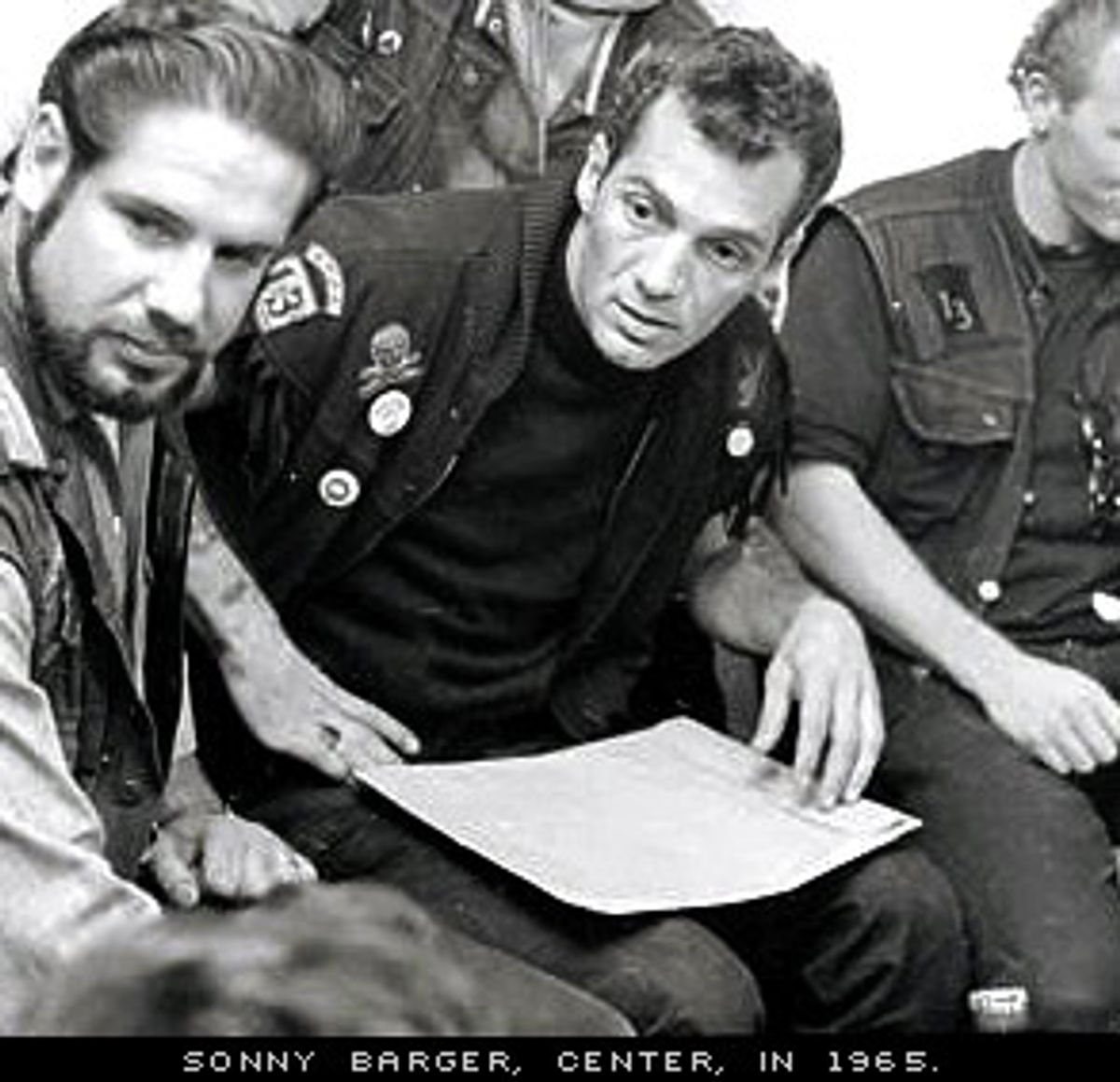
Legendary badass biker Sonny Barger and his roaring Harley are burnin' up the highways on a ... uh ... book tour?

  • more
    • All Share Services

Hell's author

In 1982, after smoking three packs of Camels a day for 30 years, Sonny Barger, the founder of the Oakland Hells Angels motorcycle club, was diagnosed with cancer of the larynx and his vocal cords were removed. On the way to the operating room, he smoked one last cigarette. “They cut a hole in the front of my neck,” he writes in his new autobiography, “Hell’s Angel: The Life and Times of Sonny Barger and the Hell’s Angels Motorcycle Club.” When he recovered, he had to learn how to talk again. “I put a finger over the hole,” he continues, “and vibrate a muscle in my throat.”

As I talk with Barger at a movie producer’s office in West Hollywood, two bodyguards — Pete from the Dago chapter (San Diego) and Bobby from Cave Creek (Arizona, where Barger now lives) — sit on a couch across from us and look on from behind their shades. Also present is Fritz Clapp, Barger’s lawyer and associate, a non-Angel out of prep school and Dartmouth, by way of the Marines. After a while, when it is evidently clear that I am not an actor in some greater play involving Barger’s very life, they leave.

At 61, Barger, still stocky and buffed, moves with the quick edge of a street-fighter. I ask him how he heads into the wind with a hole in his throat and pipes that don’t work the old-fashioned way. He explains that since his operation, he has worn a full-face helmet (though he is still not in favor of helmet laws). His bike has a windshield. There is an “obvious economy of speech,” a phrase from his book, yet one senses that back in the day, before the cancer, his rap was quite engaging.

Barger is a perpetual and metaphorical fugitive, ever on the road, except for when he’s been in jail, time which amounts to a total of 13 years. “They can’t scare you once they put you in jail,” he says. His rap sheet has become a calling card, and he includes it at the end of his book, as others might list sports stats. The arrests — 21 of them — began in the ’50s for drunken driving and continued through the next 30 years, with Barger charged with, among other things, attempted murder (charge dismissed), kidnapping (time served), drug possession (disposition unknown) and racketeering (59 months).

The mythology around him has swirled accordingly. He’s either a bad guy as in really cool, or a bad guy as in he really is not a nice person, depending on one’s value system. Either view has attracted women and journalists. All previous accounts of him are inaccurate, Barger says, referring to Hunter Thompson’s “Hell’s Angels: A Strange and Terrible Saga” (which he agrees is well-written) and Yves Lavigne’s atrociously written informant-based reports called “Hell’s Angels” and “Hell’s Angels: Into the Abyss.”

Now, with the publication of “Hell’s Angel,” Barger is telling his own story. To promote his book, he has embarked on what might be called a road jaunt, though he now sleeps in hotels and friends’ homes instead of stopping wherever he chooses and taking a pill to knock himself out as he used to. But there’s still an element of bad in the book tour.

The tour began in Chicago on Michigan Avenue at a Barnes & Noble, and it was not lost on some observers that it had kicked off in the heart of Angels’ enemy territory, the Midwest and particularly Illinois — the home turf of the Outlaws, a rival club. Was this a ballsy strike on Barger’s part, or did the publisher start the tour here to take advantage of a package deal on a room at the Hilton? Who knows. If the Outlaws ever have a book signing in Oakland, I guess we’ll learn the answer.

Yet turf matters not to the devoted; often, wherever Barger has gone, from bookstores to Harley dealers, he’s encountered a writer’s wet dream: selling 500 to 700 copies at a pop, as legions of his fans wait in long lines for a papal visit and blessing. The book’s first printing of 45,000 copies has sold out and there have been several additional print runs. It’s hovering at No. 15 on the New York Times bestseller list, and is under option to producer Ben Myron with Tony Scott set to direct and Barger and Clapp to produce.

“Maybe it’ll be good,” Barger says. “I like what Tony has to say about riding. He used to ride, you know. In England. But I have no idea who should play me. The only actor I like these days is Jim Carrey.”

In his book, Barger takes on his enemies, informers, cops, the RICO act and, to this gal’s delight, the Rolling Stones. He blames the Stones for the famous incident at Altamont in which a fan pulled a gun and was killed by an Angel. I’ve always hated the Stones; I know a good garage band when I see one and the Stones ain’t it. Barger likes to tell this story about Altamont: “The crowd was waiting all day to see the Stones,” he recalls, “and they were sitting in their trailers acting like prima donnas … They got the crowd worked up and they used us to keep the whole thing going. All that shit about Altamont being the end of an era was a bunch of intellectual crap. It was the end of nothing.”

It’s true that eras do not begin and end with music festivals, yet Barger’s disclaimer may have come too late; as it has been decreed in the press, Altamont may forever remain the epitaph for the ’60s.

Barger is no stranger to the fable factory. All his life, as he tells it, he has been misunderstood by the culture that both builds and feeds off his myth. Pegged as a bad boy, he does not shy away from the characterization. He readily talks about his run-ins with cops, Angels who have been killed in fights or bike accidents, years of drug abuse, the toll that it took on the people around him, particularly his second wife who after years of doing speed with him finally left, but not before passing him off to the woman to whom he is now married. He laughs about how the cops are still, and probably forever, on his tail.

At a book signing in Albuquerque, N.M., someone was arrested for carrying a firearm. “There are undercover cops at all my signings,” he says. “The store in Albuquerque had two parts — one was a bookstore, the other was a restaurant which sold wine. You’re not supposed to bring a firearm into a place that sells liquor so that’s what they used to arrest the guy, even though the place was also a bookstore.” At the signing in Glendale, Calif., evidently a high-ranking member of the police department had parked his car outside the Harley dealer to keep an eye on things, but sent an emissary in to buy an autographed copy of Barger’s book. “Cops are like children,” he says.

One could say that Barger was first busted as a baby. When he was born, his father, Ralph Hubert Barger Sr., worked in California’s Central Valley, laying down pavement for Highway 99, drinking and sleeping in motor courts in the accompanying little towns. Sonny’s mother, Kathryn Carmella Barger, would take Sonny and his older sister, Shirley Marie, to visit Ralph, shuttling “like gypsies” between Oakland and Modesto, Calif., on a Trailways bus. When Sonny was 4 months old, his mother ran off with the bus driver, landing in Twentynine Palms, Calif. (once-and-future way station for the country’s wanderers), leaving her son with a babysitter in Modesto who alerted the cops. Came the call from the police department: “Mr. Barger, we’ve got your son down here.”

When old enough, Barger began to escape. His first runs were to San Francisco — on his 26-inch Schwinn one-speed with coaster brakes. Later, after a stint in the U.S. Army and a series of dead-end jobs (including a shift on a potato chip assembly line), he hooked up with other war vets who had seen the world and weren’t happy with the one they found back at home. They set up shop in Oakland, and enacted a set of rules that comprised a fun house mirror image of military structure: on California runs, weapons will be shot only between 0600 and 1600 hours; Club will furnish patch which remains club property; there is a five-dollar fine for fighting among club members (“Hardly a deterrent,” Barger says); no spiking the club’s booze with dope; no messing with another member’s old lady. (“Big-time rule,” says Barger; “There are 50 million women in the world, which leaves only a few thousand Hells Angels old ladies you can’t fuck with.”)

But in talking to Barger, there is the sense that he would like to make yet another escape — from the myth around him, the one that he’s out on the road, selling. He prefers Japanese bikes to American, says they’re better, but continues to “buy American.” He talks about encroachments on freedom. “They’re taking away our guns,” he says. He lives in Arizona because it has fewer laws than other states. “I love the desert,” he says. “It’s like California used to be.”

Barger continues to name other signs of what he sees as impending fascism. “Did you know that the Army’s helmets look exactly like Nazi helmets in World War II? They’ll never tell you that but take a look. They’re getting us ready,” he says. Ready for what? “Well, this is how it starts. Little things.” I ask when the Army adopted the helmets. “Ten years ago,” he says, and then trails off as the answer itself seems to indicate that the helmet style, like Altamont, has not heralded the beginning or end of anything, except as Barger then points out, “They’re Kevlar; maybe bullets bounce off them better.”

The following evening Barger appears at a book signing at Beyond Baroque, an ever-hip literary establishment in Venice, Calif. About 100 have come for the meet-greet-and-buy (far fewer than the throng that had shown up earlier at the Glendale Harley dealership). Dennis Hopper introduces Barger, calling him his hero. The connection isn’t clear: Hopper’s street creds appear to come simply from his appearance in “Easy Rider,” which Barger writes is a movie about drug dealers who happen to ride motorcycles. But no matter, flanked by the bodyguards from Dago and Cave Creek, Barger tells a quick anecdote about an old friend and a Chevy El Camino and then signs books for his fans: members of the Vietnam Vets MC, the Chosen Few and other Angels who have made the pilgrimage.

“This is the first time I’ve bought a book,” one says. Barger poses for pictures and listens intently as people recall meeting him at this or that rally — Sturgis ’85 or the river, last year. Later, outside, in the dark, he flirts with a few girls, then jumps on his bike, heading for Modesto to count more coup in the form of books, going from zero to really fast on the sidewalk and then into the streets, gunning those Harley pipes, and that sweet badass sound — siren echo of his own gone voice — lingers in the night like a strange American lullaby as he escapes again into the mists.

Deanne Stillman's writing is widely published, anthologized and produced. Next year, William Morrow will publish her nonfiction book, "The Murders at Twentynine Palms."

Cannes: Gus Van Sant’s emo remake of “Love Story”

Mia Wasikowska and Dennis Hopper's son star in "Restless," a relentlessly eccentric tale of young love cut short

  • more
    • All Share Services

Cannes: Gus Van Sant's emo remake of Mia Wasikowska and Henry Hopper in "Restless"

CANNES, France — Gus Van Sant certainly seems like the logical choice to make a love story about two death-haunted young outsiders. Maybe too logical, because the emo-flavored “Restless,” which opened the Certain Regard section of the Cannes Film Festival on Thursday, is so washed-out and wispy it seemed to dissipate promptly in the Mediterranean breeze. There are plenty of reasons to like this movie, from the casual, desaturated photography of Harris Savides — as usual, Van Sant employs the watery light of Portland, Ore., his hometown — to the effortless performance of rising star Mia Wasikowska as Annabel, a teenage girl dying of brain cancer. (I suppose that’s an Edgar Allan Poe reference, of sorts.) But “Restless” just mopes along in its bittersweet, Goth-meets-Zen mode, emulating the drifty, affectless lives of its characters way too closely. For a movie about a brief, doomed love affair its emotional payoff is almost imperceptible.

Van Sant has long pursued a dual career as a Hollywood filmmaker (from “Good Will Hunting” to “Milk”) and also as a director of youth-culture indies, beginning with seminal late-’80s/early-’90s films like “Drugstore Cowboy” and “My Own Private Idaho.” He no longer has much of an American audience in the latter category; roughly since “Gerry” and “Elephant” (which won the Palme d’Or here in 2003) he’s belonged to the Woody Allen-Jim Jarmusch club, as an auteur celebrated in Europe but ignored at home. “Restless” feels like an attempt to split the difference between the mass-market success of “Milk” and the near-total invisibility of, say, “Paranoid Park,” Van Sant’s moody 2007 exploration of Portland skater culture. That’s not a terrible idea, and remaking “Love Story” for the “Twilight” generation probably isn’t a bad idea either, but you never quite feel that this mild, eccentric sub-”Harold and Maude” vision of death engages Van Sant’s full attention.

Looking strikingly like her namesake Mia Farrow, with close-cropped hair and a boyish wardrobe, Wasikowska finds a specific energy in Jason Lew’s rather bland screenplay, making it clear that Annabel’s relentlessly sunny demeanor is driven by a steely ferocity. She’s going to die and she knows it, but she won’t give in to the rhetoric of death, and insists on viewing it from a detached perspective. She’s fascinated by Darwin and memorizes details about seabirds and insects, as if trying to put the impending end of her short life into a greater evolutionary perspective. As she tells her protective older sister Lizzie (Schuyler Fisk), viewed in geological terms dying in three months is no different from dying in three days or 30 years. When she spots Enoch (Henry Hopper) at a friend’s funeral, she ID’s him immediately as a chronic funeral-crasher — he’s dressed too formally, and his manner is too downcast. “No one wears black at these things anymore,” she says. “It’s a bummer.”

Hopper looks at first glance — and second, and third — startlingly like a boyish, blond version of his late father, Dennis Hopper, and it’s hard to say whether that helps or hurts the film. The younger Hopper doesn’t have his dad’s natural ferocity as an actor, but neither does anybody else. He isn’t terrible by any means, but this is his first adult movie role (he’s 20) and Enoch is a maddening character who reveals almost nothing about himself but is expected to carry much of the film’s emotional weight at critical moments. At first he wants nothing to do with Annabel; it’s almost like she’s decided she wants a boyfriend for her last weeks of life, and even this deranged loser will do. His parents are dead; he goes to funerals but not to school; his best (and only) friend is the ghost of a World War II kamikaze pilot (Ryo Kase). When he’s not at funerals, he sits in his room playing Battleship with his spectral Japanese pal, and losing.

There’s no denying that these two look great together — Hopper certainly has the bored, androgynous beauty Van Sant has always admired in his leading men — and I’d say that the director and his stars come close to rescuing “Restless” from the pileup of whimsical details and the relentless jangling of the indie-pop soundtrack, which ruins almost every intimate moment. There’s a misty, lovely Halloween interlude (the second such scene I’ve seen in two days — has every director been studying the Blu-ray of “Meet Me in St. Louis”?) that finally brings this chaste duo together as lovers and reminds us that they’re not much more than damaged children, trying to face a tragic twist of fate on their own terms. You can’t come away totally hating “Restless,” especially since Annabel and Enoch may well be right that life and death and love are transitory phenomena, not to be taken too seriously. But in that case movies don’t matter either, and the chronically diffident Gus Van Sant is not the guy to argue otherwise.

Continue Reading Close

Behind the “celebrity deaths come in threes” curse

After Gary Coleman and Dennis Hopper pass, why are we all asking, Who's next?

  • more
    • All Share Services

Behind the

When the news broke on Saturday that Dennis Hopper had died, one day after the untimely passing of Gary Coleman, pop culture obsessives around the world had just one question: Who completes the trinity? Did Art Linkletter’s death on Wednesday mark the beginning of the celebrity death trifecta? Did sculptor Louise Bourgeois’ demise on Monday make it the hat trick? Or should Bret Michaels be sleeping with one eye open?

Humans are pattern-seeking creatures. We’re the species that can find Jesus’ face in a frying pan and cite the cover of “Abbey Road” as proof that Paul is dead. But when you really want to prove the uncoincidental nature of the universe, three is the magic number. Three has a certain music to it. It works, rhythmically. Its origins are shrouded in the mists of time — the idea that deaths come in threes predates celebrity — but high-profile deaths certainly gave the theory a boost.

In truth, the only authenticated incident of celebrity death occurring in triplicate was Feb. 3, 1959, when Buddy Holly, Ritchie Valens and the Big Bopper went down together in an Iowa plane crash. But we’ve been looking for approximations ever since, with occasionally persuasive results.

Isn’t it weird that Johnny Cash, Warren Zevon and John Ritter all died in the same September week in 2003? Or that Suzanne Pleshette, Brad Renfro and Heath Ledger all shuffled off the mortal coil within a seven-day period in January of 2008? And when Michael Jackson and Farrah Fawcett died last June 25, just two days after Ed McMahon finally joined Carson on the other side, that couldn’t have just been random, could it?

Note the elegant symmetry there. For the rules of celebrity death clusters to work, the stars should be of similar magnitude, and the deaths should come within a close time span. Hence, OxiClean pitchman Billy Mays’ death last June 28 doesn’t make for a rare quartet because he wasn’t famous enough, and David Carradine’s passing on June 3 is disqualified because it was too early in the month. And while trend spotters may wonder how Jimi Hendrix and Janis Joplin managed to die in the same month in 1970, or Princess Diana and Mother Teresa expired in the same week in 1997, two of anything is still officially just a coincidence.

The axiom isn’t just handy for celebrities either. “Death comes in threes” is a persistent superstition even in families and communities where nobody’s ever been the subject of an E! True Hollywood Story. And the notion that catastrophes and fads arrive in waves of three is the basis for 50 percent of all the stories in the New York Times’ Style section.

Which brings us to Hopper and Coleman, the countless celebrity lives that no doubt remain in jeopardy, and the online speculation that will continue until the next famous person leaves behind this vale of tears. Though the two men’s statures were far from equal, their quirkiness, their willingness to appear in some real schlock, and most of all, the proximity of their deaths unites them forever, begging for a third to complete the circle. You’d have thought the gods already proved their point when Lynn Redgrave, Ernie Harwell and Lena Horne died within days of each other earlier in month, but obviously no.

One could note that there are a lot of people in the world who’ve attained some degree of notoriety in their lives, many of whom are old, sick, fly in airplanes, have a more than recreational relationship with the pharmaceutical industry, or are otherwise subject to the laws of mortality. One could further say that Alexander McQueen, J.D. Salinger and Corey Haim made it to Boot Hill this year without setting off any copycat epidemics. But where’s the fun in that?

Death, that great, random and cruel mystery, will have dominion over all of us yet. All we can do in the meantime is pretend to understand it — with steadfast magical thinking, lighthearted wagering, or a little bit of both. Not because we’re primitive or callous. But because sometimes when we lose people, especially people who made movies we love or TV shows that remind us of childhood or music we rocked out to our in our bedrooms, the need to believe in something is compelling and comforting. It imposes sense upon the senseless. So if it helps, I say that metal god Ronnie James Dio, who died the week prior to Coleman and Hopper, is a completely valid candidate for the trio. Consider fate appeased. And Larry King safe.

Continue Reading Close
Mary Elizabeth Williams

Mary Elizabeth Williams is a staff writer for Salon and the author of "Gimme Shelter: My Three Years Searching for the American Dream." Follow her on Twitter: @embeedub.

American rebel: Dennis Hopper’s iconic roles

Slide show: From his "Rebel Without a Cause" debut to "Easy Rider" and "Hoosiers," he was nothing but an original

  • more
    • All Share Services

American rebel: Dennis Hopper's iconic rolesAs Babalugats in "Cool Hand Luke," 1967

View the slide show

Dennis Hopper (1936-2010) appeared in more than 100 movies, and he couldn’t have chosen a more auspicious debut: 1955′s “Rebel Without a Cause.” Over the next half-century, Hopper made his name as one of the most eccentric, and dogged, figures in Hollywood, with a career as a filmmaker (whose “Easy Rider” became a generational rallying cry), writer, artist and political provocateur. But it’s acting for which he will be best remembered, from the singularly deranged Frank Booth of “Blue Velvet” to his inspirational, Oscar-nominated turn as Shooter in “Hoosiers.”

Take a look at Hopper’s most memorable roles.


View the slide show

Dennis Hopper’s strange, brilliant career

The late actor dared to play dangerous, damaged men, while off-screen he remained a fascinating Hollywood outsider

  • more
    • All Share Services

Dennis Hopper's strange, brilliant careerActor Dennis Hopper attends a panel for the Starz drama series "Crash" at the Television Critics Association 2008 summer press tour in Beverly Hills, California July 11, 2008. The series premieres in October. REUTERS/Mario Anzuoni (UNITED STATES)(Credit: © Mario Anzuoni / Reuters)

Before Dennis Hopper, who died Saturday of prostate cancer, became a rebel filmmaker or a generational symbol or a legendary debauchee or a Hollywood aesthete and Renaissance man (or a George W. Bush Republican and then an Obama voter), he was an actor. I’m inclined to believe that all the roles Hopper played across 74 years of life and more than 50 years of moviemaking were aspects of his acting career, of his passionate interest in the mysterious fusion of being, imagining and pretending that allows you to be yourself and someone else at the same time.

Hopper appeared in a handful of memorable films — “Apocalypse Now,” “The American Friend” and “Blue Velvet,” along with his own “Easy Rider” — and a seemingly infinite litany of forgettable ones. Even when he performed in children’s TV or straight-to-video Eurothrillers or the 1993 film version of “Super Mario Bros.,” you always had the feeling that Hopper was performing a kind of existential high-wire act, perhaps more for himself than the audience: How much of his own soulful madness would he let out? How much of the inanity and mediocrity around him would he absorb?

On the one occasion when I met Hopper, at a film-festival party in San Francisco about 15 years ago, he gave a vintage performance, drinking wine and laughing it up with a group of people he barely knew (or, in my case, didn’t know at all). He wore a white linen suit and a trim goatee, regaled us with yarns from his heyday as a “total madman” in the 1960s, and looked terrific against what I remember as a crisp, sunny day. At some point his female companion — I’m not going to try to figure out who that was, and it doesn’t matter — stalked off after some heated private conversation, but he didn’t seem concerned.

When I asked Hopper what he remembered most about James Dean, with whom he appeared in “Rebel Without a Cause” and “Giant,” his demeanor changed. He became intensely earnest, explaining that Dean had changed his approach to acting and to life. Hopper had begun acting in television at a time when it was all about clarity and economy, he explained: You hit your mark, you said your lines clearly, you made your exit. Then he got on the set of “Rebel Without a Cause” (his film debut) and met Dean, who had been studying under Lee Strasberg at the Actors’ Studio in New York.

“Here was this kid, Jimmy — I mean, he was older than me, but he was still a kid,” Hopper said, “and the stuff he was doing was amazing, it just blew me away.” (I won’t pretend these are verbatim quotes; this is the conversation as I recall it.) He remembered Dean rolling around on the carpet of the set that was supposed to be the Stark family’s Los Angeles home. “I asked him what the hell he was doing. I mean, you just didn’t do that. It was completely from another planet.” Dean explained that Jim Stark, his alienated teenage character, had spent a lot of time on that carpet and was intimately familiar with it. He needed to know what it felt like.

Along with Marlon Brando, Dean was one of the principal vectors for the transmission of Strasberg’s “Method acting” approach into the Hollywood mainstream, and Hopper became an eager disciple. (Publicity photographs from “Rebel Without a Cause” show Hopper reading Stanislavski’s “An Actor Prepares” on the set, which can only have been Dean’s idea.) After Dean’s death, Hopper abandoned Hollywood for Manhattan and spent five years studying under Strasberg. In later years, as the Method came to dominate American film acting, several of its practitioners became much bigger stars than Hopper: Robert De Niro, Al Pacino and Sean Penn, along with Hopper’s close friend Jack Nicholson. But I’m not sure any of those men internalized the Method, or pursued its philosophical and psychological dimensions to their logical extremes, the way Hopper did.

Viewed narrowly, the Stanislavski-Strasberg Method is a means to an end: An actor employs his own emotions, memories and sensations in order to portray a character in more lifelike and convincing fashion. Hopper seemed to develop his own expanded, synthetic interpretation, probably shaped by his appetite for consciousness-altering substances, avant-garde art and thorny philosophy. Every Hopper performance was just a facet of his lifelong, overarching performance as Dennis Hopper, and the professional separation most actors maintain between themselves and their characters evaporated entirely. Apocryphal or not, the story of Hopper’s phone call to David Lynch after he had read the script for “Blue Velvet” is on point: “You have to let me play Frank Booth. Because I am Frank Booth!”

Of course Hopper wasn’t really an amyl-nitrite-huffing, psychopathic rapist any more than he was a disgraced Indiana basketball coach (as in “Hoosiers”) or a disgruntled bomb-squad officer (as in “Speed”). But he pursued roles as dangerous and damaged characters, at least in the second half of his career, with a fervor that suggests he found them personally therapeutic as well as financially rewarding. Frank Booth was a revelation because he was horrifyingly, recognizably real, in a way movie villains hardly ever are. Even with his exaggerated vices and mannerisms, his foulness was rooted in genuine pain. (And Frank’s profane preference for Pabst Blue Ribbon over Heineken launched a trend among young consumers that endures two decades later; the brewery should have paid Hopper and Lynch a lifetime commission.)

Right after his breakthrough 1986 performance in “Blue Velvet,” Hopper starred in the hoops drama “Hoosiers,” a commercial success which garnered him, amazingly enough, the only Oscar nomination of his entire acting career. (He had been nominated for best original screenplay for “Easy Rider,” along with co-writers Peter Fonda and Terry Southern.) After that, he returned to the director’s chair for the first time in 17 years, making the solid L.A. gangland drama “Colors,” a midsize hit. A late-career renaissance as a star character actor and indie auteur beckoned, but Hopper, in entirely typical fashion, just didn’t seem to care about that, or even to think about himself in conventional, careerist terms.

He spent the last 20-plus years, in fact, doing about the same stuff he did for the 20-plus years before that: Acting feverishly, in whatever context presented itself. You’ve seen or heard Hopper in big, noisy movies (“Speed,” “Boiling Point”), smaller, quieter ones (“Red Rock West,” “Jesus’ Son”), TV series (“24,” “E-Ring,” “Crash”) and a baffling array of video games, documentaries, animated specials and indistinguishable direct-to-video crime films. (Have you seen “Lured Innocence”? “Bad City Blues”? “The Spreading Ground”? If so, I salute your devotion. Now, please get professional help.)

From a normative, celebrity-centric point of view, Hopper’s career has been a series of failures. He failed to cash in on his early acclaim as Dean’s co-star with major movie roles, failed to turn his anarchic, lightning-in-a-bottle success with “Easy Rider” into a directing career, and failed to turn his post-”Apocalypse Now” comeback into anything approaching the brandy-snifter, lion-in-winter act we expect from aging actors. But each of those failures stemmed from the one before it, and Hopper used each one to create the Zen bon-vivant persona that was fed by all those deranged guys he played on screen but was bigger and more satisfying than any of them.

At some point in the late ’50s or early ’60s, Hopper must have realized that a guy with an aquiline face, ferocious eyes and the body language of a rabid terrier wasn’t going to become a movie star. So he made a living on TV and became an important portrait photographer, as well as an autodidact art collector who helped introduce modernist and postmodern art to Los Angeles. He used his Hollywood outsider status as creative fuel in making “Easy Rider” with Fonda, Southern and Nicholson. In all its post-adolescent male angst and self-centered artistic ambition — director Henry Jaglom was called in to edit Hopper’s 220-minute version into something releasable — is an awkward mishmash of a movie, but an enormous cultural milestone.

In an era when virtually every Hollywood actor and director ingested all sorts of elaborate chemicals, Hopper became the media’s whipping boy for drug abuse. After the critical and commercial debacle of “The Last Movie,” his semi-experimental follow-up to “Easy Rider,” his directing career lay in ruins and he evidently decided to live the part fully. But the idea that Hopper’s ensuing European exile was nothing but lost years of cocaine and crap movies is at least partly undermined by the evidence, most notably his terrifying turn as Patricia Highsmith antihero Tom Ripley in Wim Wenders’ brilliant “American Friend” (for my money, the second-best Hopper performance of all, after “Blue Velvet”).

Hopper clambered back into the American limelight with “Apocalypse Now” and got partly and conditionally sober in the early ’80s and moved on to play Frank Booth and Frank Sinatra (in an Australian film I’ve never seen) and supervillain Victor Drazen in “24″ and whoever he played in an animated special called “Santabear’s High Flying Adventure.” He eventually got old and sick and now he is dead, leaving behind one of the strangest peaks-and-valleys legacies in showbiz history. I think the whole time he was rolling around on the carpet. In order to be Dennis Hopper from one moment to the next, he needed to know what it felt like.


Continue Reading Close

Dennis Hopper dies at 74

The "Easy Rider" star passes away in his California residence, finally losing a long battle with prostate cancer

  • more
    • All Share Services

Dennis Hopper, the high-flying Hollywood actor-director whose memorable career included the 1969 smash “Easy Rider,” has died. He was 74.

Family friend Alex Hitz says Hopper died Saturday at his Venice home, surrounded by family and friends. The actor had been battling prostate cancer.

Hopper’s roller coaster career also included “Rebel Without a Cause,” “Blue Velvet,” “Apocalypse Now” and “Hoosiers” as well as flops such as “The Last Movie.”

But the improbable success of the 1969 hippie-biker epic “Easy Rider” remained his biggest triumph. He not only co-starred but directed and co-wrote the film, which also starred Peter Fonda and Jack Nicholson.

Hopper, Fonda and Terry Southern were nominated for Oscars for best screenplay.

Page 1 of 3 in Dennis Hopper