Caroline Knapp

Crashing and burning

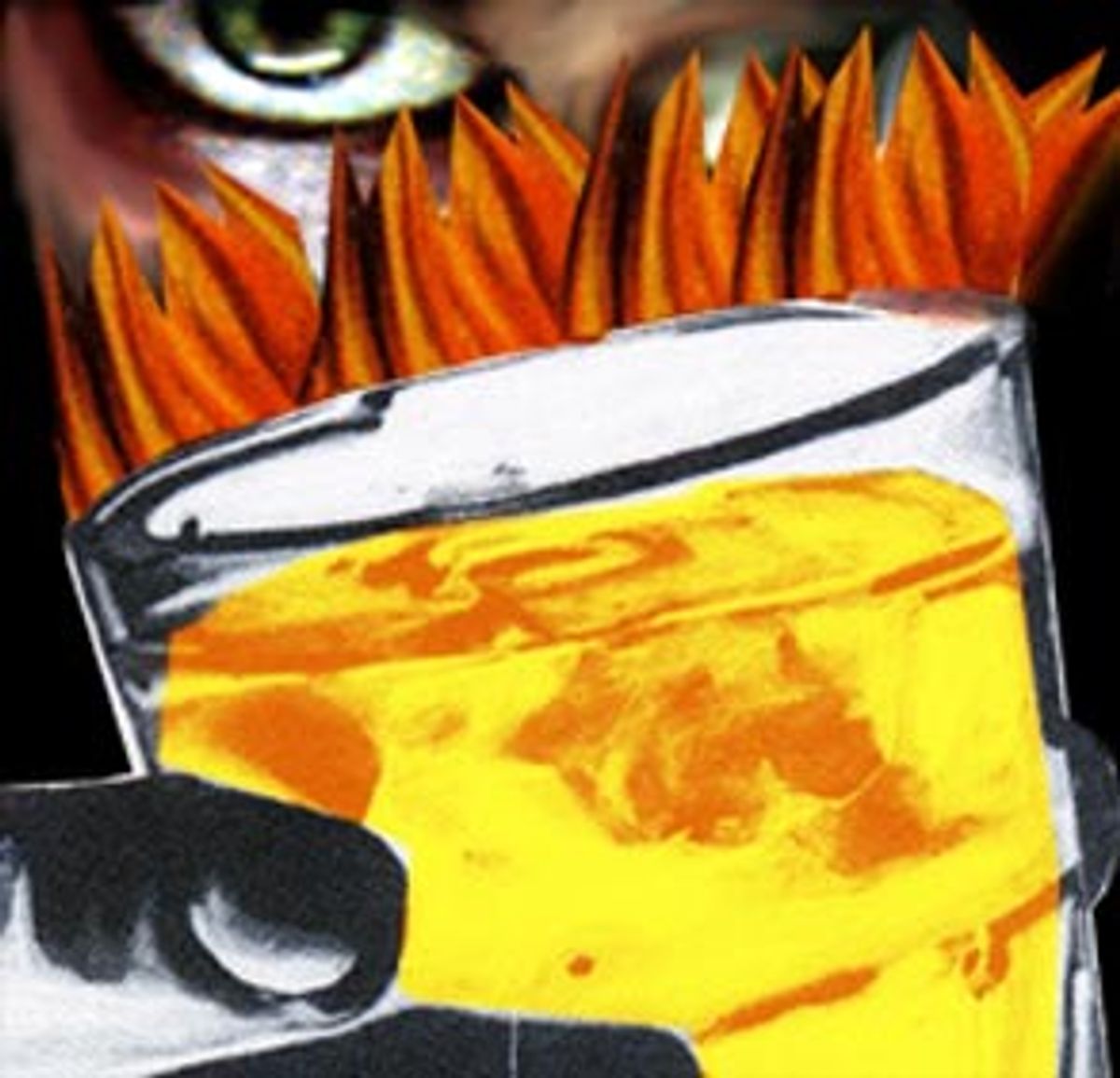
When the founder of the "alcohol in moderation" movement pleaded guilty to vehicular homicide last week, it was a sobering reminder that there's no alternative to quitting cold turkey.

  • more
    • All Share Services

Crashing and burning

Every evening, in thousands of church basements in hundreds of cities, clusters of us sit in rows of metal folding chairs and listen to a fellow alcoholic tell his or her story. The details always vary: Some of us are rich, some poor; some were at the peak of our careers when we first came to Alcoholics Anonymous, some homeless and unemployable; some of us looked shiny and bright on the outside, some were in tatters.

But for all the external differences, the central narrative in these stories is the same, identical threads of desperation and grace woven through each. Perhaps you woke up in a hospital, unable to remember the final moments before your car careened off the road. Perhaps you lost your job, or your spouse, or your kids. Perhaps (and this is just as common) nothing at all earth-shattering occurred — there was no tangible turning point, no financial ruin, no injury or loss of life — but you woke up one morning and could no longer bear your own life, the corroded sense of self and dignity and hope that had come to define it.

In the common parlance, these moments are known as “hitting bottom,” and they are exquisitely agonizing affairs, portraits in anguish: The jig is up, all systems failed, it’s over. You peer into the future and realize that your relationship with alcohol — which feels like your lifeblood, as vital as air, your primary drive and need and love — has got to end.

With rare exceptions, these are also intensely private affairs, personal reckonings that take place in the darkest corners of the heart and soul. AA members may understand them intimately — we know how scary it is to lose control over drinking and how unfathomable the prospect of living without it can be — but even we tend to see only the tail end of the process: the drinker who’s just surrendered, who’s shown up at a meeting for the first time, who’s trembling through the first week or day or hour of abstinence. The moments prior to that, the days or weeks or years that lead to the end, are generally solitary and dark and internal, a private hell that’s largely invisible to the wider world.

Last week, when Audrey Kishline pled guilty to two counts of vehicular homicide, she gave that brand of hell a public face; an alcoholic’s hidden agony was rendered extraordinarily and grotesquely visible. I first heard word about Kishline, who has made a career out of teaching drinkers to curb their consumption, an hour or so after coming home from an AA meeting. I froze in my kitchen: The news had such an eerie and familiar ring, such an “it could have been me” feel, and it made me cringe. This is a classic alcoholic crash landing, the kind of story that makes you realize how lethal alcoholism is and how precarious sobriety can be.

The irony here, of course, is 150-proof. Kishline, now 43, is the very outspoken founder of Moderation Management, a self-help treatment program that purports to help “problem drinkers” drink responsibly. Challenging most of the central tenets of alcohol treatment in the U.S., her view offered a tantalizing set of possibilities: Alcohol abusers, she suggested, could be taught to cut down on their drinking without resorting to total abstinence. Recovering alcoholics might be able to return to drinking at moderate (and therefore safe) levels, and budding alcoholics might be able to control their consumption before it got out of hand. Kishline, who clearly knew her own way around a liquor store, founded her program in 1993 and published a book — “Moderate Drinking: The New Option for Problem Drinkers” — a year later. An advertisement for the book said: “Based on her own unsatisfactory experience with total abstinence-based programs, Kishline offers inspiration and a step-by-step program to help individuals avoid the kind of drinking that detrimentally affects their lives.”

As she has made painfully clear, moderation did not serve Kishline so well. Last March, at the tail end of a binge-drinking episode, Kishline, who is a housewife and mother, got into her pickup truck, headed the wrong way down an interstate freeway in central Washington and smashed head-on into a car, killing a 38-year-old electrician named Danny Davis and his daughter, LaSchell, who had just celebrated her 12th birthday. According to prosecutors, her blood-alcohol level was three times the legal limit. When she woke up in a hospital trauma unit, Kishline said, she could barely remember getting into the truck.

The moral here is fairly clear: Moderation for alcoholics is a very dicey idea, and Kishline will no doubt go down in history as the best evidence against her own theory, the woman who single-handedly, spectacularly, caused it to crash and burn. The line between problem drinking and full-fledged alcoholism may be blurry and difficult to discern — certainly it’s difficult for the drinker to accept — but once you’ve passed a certain point in your abuse, moderation simply ceases to be an option, a fact Kishline’s critics have long understood. The very concept of moderation is oxymoronic in the world of alcoholism, and in abstinence-based circles like AA, her approach seemed not only deluded but dangerous, a form of codified denial that offered little more than false hope.

The hope, of course, is powerful: Most of us — alcoholic and non-alcoholic — want moderation to work. We want there to be an alternative to complete abstinence, which sounds like such a desert of self-abegnation and deprivation. This prospect — no drinking, no alcohol-laced relief, never again — ultimately turns out to be the great benefit of recovery, the gateway to the rediscovered self, but it’s terrifying when you’re still clinging to booze, and it’s what keeps so many of us grasping for other options, desperate to believe that “normal” drinking is a possibility.

I don’t know one recovering alcoholic who didn’t struggle to control his or her drinking, who didn’t make rules and then break them, who didn’t set limits and make promises and deploy strategies to cut back, anything to avoid doing what the true alcoholic is so thoroughly loath to do: learn to live without alcohol. In the years before I quit, I tried drinking only after 8 p.m., I tried limiting myself to two glasses a night (which invariably turned into two glasses the size of buckets), I tried swearing off hard liquor and sticking to wine. The trials rarely lasted for more than a few days and they never worked; the nagging doubt — “I cannot do this, I have a real problem” — festered and grew. This is what makes Kishline’s story so classic: Alcoholics are by definition failures of moderation, walking case studies in its impossibility.

Five years ago, Kishline’s movement began to gain a certain amount of cachet, with full-spread coverage in Self magazine, Newsweek and the New York Times. (Self headlined it a “radical new approach” to alcohol treatment.) I was just about a year sober at the time, and still stunned by the vastness of what it meant to live without liquor, and I wrote a not-very-eloquent column about the movement, calling it, among other things, “moronic” and “bullshit.” Today, far from feeling smug or vindicated by Kishline’s very public fall, I feel humbled, and sobered, very much the way I feel when someone stumbles into an AA meeting after a relapse. This is a hideous story, one whose horror will only be compounded if we fail to learn from it.

And it has plenty to teach. There are obvious lessons about the dangers of moderation as an approach — and they’re important, timely ones, particularly in the age of medical cost containment, when insurers and healthcare providers are desperate to find quick and measurable fixes for complex and elusive problems. (In a bizarre twist of timing, just days after Kishline’s guilty plea, a feud erupted at New York’s prestigious Smithers Addiction Treatment and Research Center, when the director decided to steer the clinic toward a moderation-based approach.)

But there are also lessons in Kishline’s story about the profound complexity of alcoholism, and the insidiousness of its grip, and the enormous challenges of treatment. Few of us can know what Kishline’s past few years have been like, although we can certainly speculate about the horrors. Apparently, she’d given up the moderate approach prior to her drinking spree, and had tried unsuccessfully to stay sober through AA. Following her guilty plea, she went public about that, reversing her stance on the movement she helped found and stating through her lawyer that Moderation Management involves a lot of “alcoholics covering up their problem.” She also talked, again through her lawyer, about the shame and humiliation of relapse, and about her profound remorse at causing the deaths of two innocent people.

You don’t have to read too carefully between the lines to see how deeply and tragically alcoholic this narrative is. It’s all there: the desperate struggle to find a way to hold onto alcohol, the failure first of moderation and then of denial, the horror — and horrific consequences — of relapse. Kishline will be sentenced on Aug. 11. Prosecutors are seeking a four-and-a-half-year term, although the maximum penalty is life. Judging her, of course, is the easy part. Learning from her is far harder, but the instruction is vital.

Wasting disease

I ate nothing but cottage cheese and rice cakes. I was a set of bones hunkered over a tiny saucer. What was I feeling? What was I trying, so desperately, not to feel?

  • more
    • All Share Services

Wasting disease

What is this drive to be thinner, prettier, better dressed, other? Who exactly is this other and what does she look like beyond the jacket she’s wearing or the food she’s not eating? What might we be doing, thinking, feeling about if we didn’t think about body image, ever? These are the questions that pain me when I think of myself at twenty-one and twenty-two and twenty-three, a set of bones hunkered over a tiny saucer, nibbling at those miniature squares of apple and cheese. What was I feeling? What was I trying, so desperately, not to feel?

- – - – - – - – - – - -

I have probably grappled with the matter of appetite my whole life — a lot of women do; we’re taught to do battle with our own desires from a tender age, and reinforcements are called in over time on virtually every front — but if I had to pinpoint a defining moment in my own history, I’d go back twenty-three years, to an otherwise unmemorable November evening when I made an otherwise unmemorable purchase: a container of cottage cheese.

Innocuous as it sounds, this would actually turn out to be a life-altering event, but the kind that’s so seemingly ordinary you can’t consider it as such for many years. Certainly, I didn’t see anything remarkable happening at the time. I was nineteen years old, a junior at Brown University, in Providence, Rhode Island, vaguely anxious, vaguely depressed. I was also, less vaguely, hungry. This was 1979, Thanksgiving weekend. I’d gone home to see my family, then returned to campus the next day to write a paper. My roommates and most of my friends were still away, I didn’t especially feel like slogging over to the campus cafeteria to eat by myself, and so I put on my coat and walked up the block to a corner grocery store, and that’s what I bought: a small plastic tub of Hood’s cottage cheese and a solitary package of rice cakes.

Cottage cheese, of course, is the food God developed specifically to torture women, to make them keen with yearning. Picture it on a plate, lumpy and bland atop a limp lettuce leaf and half a canned peach. Consider the taste and feel of it: wet, bitter little curds. Now compare it to the real thing: a thick, oozing slab of brie, or a dense and silky smear of cream cheese. Cottage cheese is one of our culture’s most visible symbols of self-denial; marketed honestly, it would appear in dairy cases with warning labels: this substance is self-punitive; ingest with caution.

I didn’t know this back then, which is important to note. Naturally thin, I’d never given my weight much thought before, and although I knew plenty of women who obsessed about their thighs and fretted over calories, I’d always regarded them as a rather alien species, their battles against fat usually unnecessary and invariably tedious, barely a blip on my own radar. I, in turn, had very little personal experience with cottage cheese. I’d never bought cottage cheese before, I’m not sure I’d even eaten cottage cheese before, but on some semiconscious level, I knew the essential truth about cottage cheese — it was a diet food — and on some even less conscious level, I was drawn to it, compelled to buy it and to put it in the mini-refrigerator in my dorm room and then to eat it and nothing else — just cottage cheese and rice cakes — for three consecutive days.

And a seed, long present perhaps but dormant until then, began to blossom. A path was laid, one that ultimately had less to do with food than it did with emotion, less to do with hunger than it did with the mindset required to satisfy hunger: the sense of entitlement and agency and initiative that leads one to say, first, I want, and then, more critically, I deserve. So as inconsequential as that purchase may have seemed, it in fact represented a turning point, the passage of a woman at a crossroads, one road marked Empty, the other Full. Not believing at the core that fullness — satiety, gratification, pleasure — was within my grasp, I chose the other road.

- – - – - – - – - – - -

One of the lingering cultural myths about gender is that women are bad at math — they lack the confidence for it, they have poor visual-spatial skills, they simply don’t excel at numbers the way boys do. This theory has been widely challenged over the years, and there’s scant evidence to suggest that girls are in any way neurologically ill-equipped to deal with algebra or calculus. But I’d challenge the myth on different grounds: Women are actually superb at math; they just happen to engage in their own variety of it, an intricate personal math in which desires are split off from one another, weighed, balance, traded, assessed. These are the mathematics of desire, a system of self-limitation and monitoring based on the fundamental premise that appetites are at best risky, at worst impermissible, that indulgence must be bought and paid for. Hence the rules and caveats: Before you open the lunch menu or order that cheeseburger or consider eating the cake with the frosting intact, haul out the psychic calculator and start tinkering with the budget.

Why shouldn’t you? I asked a woman that question not long ago while she was demurring about whether to order dessert at a restaurant.

Immediate answer: “Because I’ll feel gross.”

Why gross?

“Because I’ll feel fat.”

And what would happen if you felt fat?

“I hate myself when I feel fat. I feel ugly and out of control. I feel really un-sexy. I feel unlovable.”

And if you deny yourself the dessert?

“I may feel a little deprived, but I’ll also feel pious,” she said.

So it’s worth the cost?

“Yes.”

These are big trade-offs for a simple piece of cake — add five hundred calories, subtract well-being, allure, and self-esteem — and the feelings behind them are anything but vain or shallow. Hidden within that thirty-second exchange is an entire set of mathematical principles, equations that can dictate a woman’s most fundamental approach to hunger. Mastery over the body — its impulses, its needs, its size — is paramount; to lose control is to risk beauty, and to risk beauty is to risk desirability, and to risk desirability is to risk entitlement to sexuality and love and self-esteem. Desires collide, the wish to eat bumping up against the wish to be thin, the desire to indulge conflicting with the injunction to restrain. Small wonder food makes a woman nervous. The experience of appetite in this equation is an experience of anxiety, a burden and a risk; yielding to hunger may be permissible under certain conditions, but mostly it’s something to be Earned or Monitored and Controlled. e = mc2.

During the acute phases of my starving years, I took a perverse kind of pleasure in these exhibitions of personal calculus, the anxious little jigs that women would do around food. Every day at lunchtime, I’d stand in line at a cafe in downtown Providence clutching my 200-calorie yogurt, and while I waited, I’d watch the other women deliberate. I’d see a woman mince edgily around the glass case that held muffins and cookies, and I’d recognize the look in her eye, the longing for something sweet or gooey, the sudden flicker of No. I’d overhear fragments of conversation: debates between women (I can’t eat that, I’ll feel huge), and cajolings (Oh, c’mon, have the fries), and collaborations in surrender (I will if you will). I listened for these, I paid attention, and I always felt a little stab of superiority when someone yielded (Okay, fuck it, fries, onion rings, PIE). I would not yield — to do so, I understood, would imply lack of restraint, an unseemly, indulgent female greed — and in my stern resistance I got to feel coolly superior while they felt, or so it seemed to me, anxious.

But I knew that anxiety. I know it still, and I know how stubbornly pressing it can feel, the niggling worry about food and calories and size and heft cutting to the quick somehow, as though to fully surrender to hunger might lead to mayhem, the appetite proven unstoppable. If you plotted my food intake on a graph from that initial cottage cheese purchase onward, you wouldn’t see anything very dramatic at first: a slight decline in consumption over my junior and senior years, and an increasing though not yet excessive pattern of rigidity, that edgy whir about food and weight at only the edges of consciousness at first. I lived off campus my senior year with a boyfriend, studied enormously hard, ate normal dinners at home with him, but permitted myself only a single plain donut in the morning, coffee all day, not a calorie more. The concept of “permission” was new to me — it heralded the introduction of rules and by-laws, a nascent internal tyrant issuing commands — but I didn’t question it. I just ate the donut, drank the coffee, obeyed the rules, aware on some level that the rigidity and restraint served a purpose, reinforced those first heady feelings of will and determination, a proud sensation that I was somehow beyond ordinary need. I wrote a prize-winning honors thesis on two hundred calories a day. The following year, my first out of college, the line on the graph would begin to waver, slowly at first, then peaking and dipping more erratically: five pounds up, five pounds down, six hundred calories here, six thousand there, the dieting female’s private NASDAQ, a personal index of self-torture.

- – - – - – - – - – - -

Who has the best features? This was a little game, conducted several times and always with the same results, in seventh grade, the time when so many of life’s little horrors begin. A very pretty and popular girl named Jill, a leader of the in-crowd, organized the event during recess, gathering seven or eight of us around her on the steps by the school’s entrance and beginning the scrutiny. My friend Jen always got best skin, rosy and smooth. My friend Nina got best hair, thick and blond. Jill gave herself best eyes, I think, but I may just be guessing (she did have beautiful eyes, large and dark and framed with the most naturally thick lashes). Me, I got prettiest hands, which felt bitterly disappointing at the time. Hands? Hands didn’t matter. Who cared about hands?

If you could change any one thing about your looks, what would it be? We played this, too, frequently: Oh, I’d have Jen’s skin, we’d say. I’d have Nina’s hair, I’d get rid of these freckles. Once, I mentioned something about wanting curly hair instead of straight hair, and a girl looked at me and said, “If I were you, I’d get rid of those little nostril veins.” I didn’t even know I had little nostril veins, but as soon as I got home from school that day, I looked in the mirror and sure enough, there they were: several tiny distinct red squiggles, horrifyingly visible, creeping down the skin from inside my nose to the base of each nostril.

These were early exercises in gaze-training, a way of coaxing the eye outward instead of inward, of learning to experience the body as a thing outside the self, something a woman has rather than something she is. From seventh grade on, we would hone this skill, breaking the body down into increasingly scrutinized parts, learning to see legs and arms, belly and breasts, hips and hair as separate entities, most of which generated some degree of distress, all of which were cast in hierarchical and comparative terms, viewed in relation to others: my hair versus Nina’s hair, my eyes versus Jill’s eyes; this needs fixing, that needs hiding. Pore by pore, we learned to take ourselves apart.

There’s no question that this way of thinking is reinforced in the world beyond seventh-grade school yards, that the art of self-dissection receives constant visual support, that it’s part of consumer culture’s lifeblood. Thick auburn tresses cascade across a magazine page, shiny and rich with Pantene shampoo. An enormous Maybellined eye stares out from a TV screen, each lash glossy and distinct. A calf stretches across a billboard, lean and taut in an $800 Jimmy Choo pump. American companies spend more than $200 billion each year hacking women’s bodies into bits and pieces, urging comparisons between self and other, linking value to air-brushed ideals, and as the girls in my seventh-grade class graduated to high school and beyond, the imagery around us would only grow more specific, more pummeling, more insidious. Models would become more thoroughly eroticized, presented in more states of obvious arousal, with more full-out nudity and more undertones of violence; the ideals they presented would become more specific and out of reach, with more and more body parts exposed and subject to critique (butt, arms, hips, and abs as well as the traditional breasts and legs) and ever more Byzantine configurations of beauty presented (bodies with no fat but huge breasts; delicate bodies with muscular limbs; fifty-year-old bodies that still look twenty-five).

Even more dramatic would be a shift in the pitch of imagery, the level and nature of the bombardment. Around the time I began starving, in the early eighties, the visual image had begun to supplant text as culture’s primary mode of communication, a radical change because images work so differently than words: They’re immediate, they hit you at levels way beneath intellect, they come fast and furious. When televisions first appeared in the 1950s, the image on the screen used to change every twelve to fifteen seconds. By the eighties, the speed of change had increased to about seven seconds. Today, the image on the average TV commercial can change as quickly as once every 1.5 seconds, an assaulting speed, one that’s impossible to thoroughly process or integrate. When images strike you at that rate, there’s no time to register the split-second reactions they generate, no time to analyze them or put them in their proper place; they get wedged inside, insidious little kernels that come to feel like truth.

Continue Reading Close

Consciousness on overload

A memoirist seeks to untangle the mass of contradictory emotions following the tragedy that changed our lives forever.

  • more
    • All Share Services

Consciousness on overload

The sense of purposeless exhaustion set in around Day 4, Friday night, a fatigue that seemed both bone-deep and unjustified. Like me, most everyone I saw and spoke to that day was safe, insulated from the disaster, mere spectators: We hadn’t lost loved ones, we’d only seen the devastation on TV and in pictures, we weren’t involved in rescue efforts and so our weariness felt out of proportion and strange. I walked my dog that afternoon; the people I ran into looked uniformly shell-shocked and felt uniformly guilty about it, as though we hadn’t quite earned our despair. Fear and horror — the dominant sensations earlier in the week — had given way to a vague heavy-hearted despondency by then. The stories of individual tragedy were beginning, cruelly, to blur. Even language had failed us, leaving most people I know with a single empty fallback word: “stunned.” I’m stunned. I don’t know what to do with myself, I’m just stunned. I went home that night, watched TV in a teeth-clenched, blank-faced way, and then fell into the darkest sleep.

I am not used to harboring such a wide variety of conflicting emotions at one time. Usually, it’s one feeling at a time, maybe two. Anxiety here, contentment there. A dash of melancholy on a bad day; a flash of joy on a good one. By Friday, and persisting well into this week, that simple synaptic system was all out of whack, consciousness on overload. This may be normal, but it’s also deeply disorienting. The magnitude of the physical devastation; the fear about what it may unleash; the sense of sudden vulnerability; the reach of the grief, each life lost touching an incalculable number of other lives: This is more than an ordinary brain can process, and so the mind is left to flit from one sensation to another. It cannot land on just one, it cannot absorb them all.

Which is why the neurons seem to be firing from all directions. I feel enveloped in safety, insulated within my own little house and also deeply jittery. A plane flies overhead and I freeze: What is it? Who’s on it? Is it about to crash? I feel compelled to watch footage of the towers collapsing over and over and over and then compelled to look away, not sure what’s voyeurism and what’s an attempt to grasp the ungraspable. One emotion surges only to be supplanted by its opposite.

A blind man tells a CNN reporter how his guide dog, a yellow Labrador retriever with the most noble gaze, led him to safety down 87 flights of stairs, and the heart melts at the miracle, man and his brave attendant. Moments later, an executive breaks down in sobs on camera, 700 of his employees unaccounted for, among them his own brother, and the heart tightens and sinks, a stab of pure sorrow. The most heartening pride at human kindness mixes with despair at human hatred, often in the same instant. A woman I run into tells me she started to weep without warning on a subway train in downtown Boston and that a total stranger, a man sitting beside her, took her hand and held it, simply and firmly, for the duration of the ride. She felt so touched by this display of compassion she cried even harder, but then, when she left the subway station, she saw fresh graffiti on a wall: NUKE ISLAM.

How to reconcile all of this? I, a woman who’s never responded to an American flag with anything more stirring than benign indifference, feel deeply, surprisingly, wholly patriotic and also, perhaps less surprisingly, deeply skeptical, mistrustful that our political and military response will be anything but rash, expensive and short-sighted. I feel protective and defensive about the depth of hatred toward America, a mama bear guarding her cub, and I feel humbled, aware that we’ve played no small part in earning and fomenting that animosity. And I also feel ashamed, embarrassed by the self-constructed cocoon of ignorance and complacency I’ve been living in: Until last week, I could not have spelled the name Osama bin Laden, let alone told you what degree of threat his organization represented.

Our culture thrives on black-and-white narratives, clearly defined emotions, easy endings, and so this thrust into complexity exhausts. Too many feelings competing for head space, no happy ending in sight, no tacit belief that our minuscule attention spans will protect us this time, and little solace from our ordinary opiates — movies and sports and computer solitaire. The people I talk to feel an odd, almost adolescent yearning for leadership, craving and mistrusting it in the same breath.

Some of us feel compelled to reach out — give blood, light candles, sign petitions, anything! — and simultaneously compelled to retreat, edges of paranoia leaking in, talk of terrorists in the backyard. I feel catapulted from one extreme to another: protected one minute and vulnerable the next, heartsick and then detached, connected and then estranged, so full of goodwill one moment I’d like to hug the guy at Starbucks who pours me my coffee, so irritable the next I’d like to slap the man who cuts in front of me while I’m trying to pour milk. Mostly I feel unmoored, some rock of permanence and safety having given way to shifting sands, the familiar now eerily unfamiliar. Sirens sound different, scary and consoling at the same time. Work feels irrelevant. Normalcy as yet undefined.

I suppose this is what people mean when they talk about being stunned — this gamut of feeling, which overwhelms the psychic system, leaves you feeling exhausted and powerless and unable to tease out one emotion from the next — and I think the response is both human and frightening. Surely, it’s one of terrorism’s intended effects, to literally stun our morale, to blow up strength and will along with buildings, and the reaction is hard to counter.

On Saturday, still feeling blank and enervated, I spent part of the afternoon at a gathering of people who met to talk about caring for a mutual friend, a man who’s dying of cancer at the age of 49. The lens shifted suddenly, the unfathomably wide panorama of disaster yielding to a much more personal and individual close-up of tragedy, and it suggested something to me about the numbing effect of emotional overload, which can so easily mutate into a kind of hopeless despair. I did not particularly want to go to this meeting; I drove there feeling fragile and depressed, but I showed up anyway, and sat in a room with 20 other people, and faced a loss in a communal and reflective way. We talked about how we felt about watching our friend die, what we were scared of. We talked about practical things we could do: cooking meals, doing laundry, spending time with him.

Unlike the thousands of lives so hideously obliterated without warning, this man and the people who love him have an opportunity to approach death consciously and with foresight, to say things that need saying, to help one another without the mobilizing impetus of disaster. This, too, is exhausting work, but it’s important work, its value immediate and tangible, and it reminded me that the line between feeling stunned and being passive can be very thin. I can give blood. I can send money to relief organizations, I can write letters and sign petitions. I can also be present and active in my own small world, which is a gift that cries out for recognition, even from this stunning roar of mixed emotion.

Continue Reading Close

Reporting Live

Caroline Knapp reviews 'Reporting Live' by Leslie Stahl.

  • more
    • All Share Services

Early in her memoir, “Reporting Live,” CBS journalist Lesley Stahl notes that there are two kinds of reporters: those like the late Charles Kuralt, whose talents lie in lyrical writing and powerful storytelling, and those like Stahl herself, who rely instead on hard facts. True to form, Stahl has written a very straightforward, fact-laden account of her career as a journalist, starting the story in 1972, when she first landed a job at CBS News in Washington, and ending in 1991, when, after long stints as chief White House correspondent and host of “Face the Nation,” she joined “60 Minutes.” Stahl’s career during those years was impressive and rich, and her narrative, organized chronologically, is driven by the events she covered. The hard facts take us from Watergate to the Gulf War; they give us close-up looks at Presidents Nixon, Carter, Reagan and Bush; and they provide an insider’s look at the daily strains of Beltway journalism and at the forces that have shaped broadcast news over the last two decades.

This is fertile territory. There are juicy details about news personalities (Dan Schorr as a back-stabbing sexist) and amusing asides about the special challenges faced by feminine reporters (chasing down stories, literally, in high heels). There are also heftier observations about the interplay between journalism, politics, economics and culture, which Stahl is singularly well-equipped to address. She has witnessed firsthand the various ways in which presidential administrations and the press use, benefit from and antagonize each other; she has seen news organizations radically reshaped by new technologies, financial pressures and sources of competition; as both a working mother and a woman in a once male-dominated field, she has watched, and been a part of, seismic cultural shifts involving women.

Stahl comes across in her work as highly ambitious and rather frantic, the kind of person who thrives on pressure and rarely stops long enough to invite insight. “Just when you have time to contemplate how you feel,” she writes, in what may be one of the most inadvertently self-revealing lines of the book, “wham! — a story breaks that blots out every second of your life.” If her book has a central flaw, it’s that her narrative often has the same frenzied, underprocessed quality, feeling more at times like a chronicle of change than a considered analysis of it. She tends to fire off descriptions of news stories, one after the other, pausing briefly to raise larger, more essential questions (What does it mean that Sam Donaldson is considered assertive while she’s considered bitchy? How should journalists handle the blurring line between news and entertainment?), then dashing off to the next press conference, the next “Face the Nation” interview, the next contract negotiation. The overall effect can be choppy and overwhelming: You wish she’d take a vacation, sit back and reflect rather than report.

Stahl’s more personal descriptions have a similarly underdeveloped feel. She characterizes the bulk of her 40s, for example, as “a decade of rage,” a time dominated by personal fury and bouts of laryngitis, but she never explores the real sources of her anger; nor does she comment on the apparent connection — familiar to many women — between rage and voicelessness. Her domestic life gets the same choppy, fits-and-starts treatment as her professional descriptions: nods here to family trips; nods there to interactions with her daughter; brief accounts of major life events (a husband afflicted with clinical depression, a brother with malignant tumors on his vocal chords) that often have the hurried feel of asides.

By definition, memoir demands a certain degree of introspection and self-disclosure: In order to fully engage a reader, the narrator has to make herself known, has to allow her own self-awareness to inform the events she describes. As the title of her book suggests, Stahl is more intent on describing her career than her inner life, but without some sense of who she really is, without some understanding of how the external dramas have shaped the internal, you’re left a bit disoriented and a bit hungry, wanting to know less about Stahl the journalist and more about Stahl the person.

Continue Reading Close

The Merry Recluse

A single woman chooses a life of solitude in the Land of We.

  • more
    • All Share Services

Nine forty-five p.m. I am standing in my kitchen preparing my very favorite
meal, a zesty blend of wheat flakes, Muslix and raisins that comforts me
deeply. It is a Thursday, which means that “ER” is on in 15 minutes, and it
is mid-May — sweeps month — which means that I am filled with
anticipation: yes, a new episode. I feel serene. I am wearing torn
leggings, a T-shirt, a bathrobe. The dog is in the living room, curled
contentedly (and wordlessly) on the sofa; the phone machine is blinking
with several messages, which I’ve dutifully screened and have no intention
of answering until tomorrow. And a thought comes to me, a simple statement
of fact that arrives in a fully formed sentence. I hear the words: I am
the Merry Recluse.

This, I must say, is a magical, transformative moment; it represents a
kaleidoscopic shift of sorts, the kind of sudden internal restructuring
that occurs when an established set of facts about the self seems to spontaneously
shift, presenting itself in a new order, a surprising new
light. An old thought becomes a new thought; a prior definition takes on a
twist, a new edge, a new meaning.

Listen to it again: I am the Merry Recluse. Doesn’t that sound
chipper and grand? Had you asked me to sum up my sense of place in the
world a day before — an hour before, 10 minutes before — I would have
offered something very different: I am a single woman, I might have
said. Age 38, a bit of a loner. My voice might have had an
apologetic edge, as though I were acknowledging the sad and spinsterish
associations behind such words, and I might have shrugged a bit sheepishly,
as if to say: Ooops, sorry, this is all an accident; I was supposed to
be married by now. But in that instant, poised above my bowl of
Wheaties, the psychic kaleidoscope turned a notch, the apology blurred,
something new shifted into view, something that looked very much (dare I
even say it?) like happiness.

Happy and alone, you say? Reclusive and merry? How oxymoronic!
Pas possible! Alas, the concept is lost on so many. A friend,
recently divorced but involved with someone new, asked me a question over
dinner not long ago: “So,” she said, her expression concerned, “how does it
feel not to be in a relationship?” I tried to ignore her tone, which was
vaguely pitying, and pretended to be kidding when I answered by pointing at
the dog: “But I am in a relationship,” I said. “I have her.” She
laughed, a rather halfhearted and dismissive laugh, then resumed the line
of questioning: Wasn’t I lonely? she wanted to know. Didn’t I find it hard
to be responsible for all the household details — the cooking, the
shopping, the errands and bills? Didn’t I worry about the future, about
growing old alone, about whether or not I’ll find someone?

I sat there and mused for a moment. The questions are difficult to respond
to, not because the answers are complex (which they are) but because we
live in a culture that puts such a high premium on romantic intimacy, that
uses partnership as a measure of mental health and social normalcy. Answer
affirmatively (yes, I get lonely; yes, solitude can be very stressful and
worrisome), and you sound sorrowful, the slightly pathetic outsider; answer
negatively (nope, I’m quite content, thank you very much) and you sound
hermetic, incapable of following the accepted path to human happiness,
pathologically disengaged somehow. In fact, 25 percent of the adult
population lives alone today — that’s almost double the number that lived
alone 35 years ago — and although plenty of us may end up on our own for
unhappy reasons (divorce, fear, geography, any number of quirks of fate and
timing and circumstance), it seems both simplistic and erroneous to assume
that solitude is an inherently sorry state, something you wouldn’t
choose if you had a better option.

I said as much to my friend. “Sure there are downsides,” I said, “but I
really like being alone.” I ticked off a little list: the freedom to
set my own hours, make my own rules, indulge my own tastes; the relief at
not having to interact or negotiate or compromise with another human unless
I choose to; the little burst of accomplishment I periodically feel at
being the architect of my own space, physical and psychic. “It’s a choice,”
I said, “a style I’m comfortable with.”

She listened, nodded soberly; I could tell she didn’t believe a word.

Exchanges like this wouldn’t bug me if they weren’t so common. I often walk
my dog in the morning with a friend named Wendy who’s been in a
relationship for the last 19 years and whose social calendar is packed so
tight it makes me dizzy: a constant stream of parties and potluck suppers,
movie and theater outings, vacations and visitors from out of town. Every
Friday she asks me what I’m doing over the weekend and every Friday I
demur: “Oh, not much,” or, “The usual: just hanging.” The truth is, I
rarely make weekend plans, at least not social ones. My recipe for bliss on
a Friday night consists of a New York Times crossword puzzle and a new
episode of “Homicide”; Saturdays and Sundays are oriented around walks in
the woods with the dog, human companion in tow some of the time but not
always. This doesn’t mean I’m a misanthrope: I have a small,
carefully cultivated social life — a handful of treasured friends; a
beloved sister; people whose presence and support mean the world to me –
but Wendy can’t quite make the distinction between a quiet life and an
empty one, and she finds my style unsettling. A look of veiled discomfort
comes over her face when I hem and haw about the weekend, as though she
envisions 48 hours of disconnection and sadness, so sometimes I make stuff
up to placate her: I tell her there are dinner plans, movies scheduled, a
shopping trip with a girlfriend, and she always responds with a little
heave of maternal relief, which I find mildly patronizing. “Oh, how
nice for you!”

Me, I walk along and feel quietly defensive, a recluse in the Land of We.

That’s quite the loaded word, “we.”

- – - – - – - – - -

Not long ago, in the locker room of my gym, I eavesdropped as a woman held
forth about her upcoming wedding. We’re thinking about a honeymoon in
Hawaii, she said. We’re registering at Bloomingdale’s. We’re buying a new
car. We’re doing A, B and C. We, we, we. I stood there, and I
thought about how infrequently I use plural pronouns to describe the events
of my life, and I felt a familiar stab of inadequacy, questions about
priorities and social worth scratching at the subconscious. On the broad
spectrum of solitude, I lean toward the extreme end: I work alone, as well
as live alone, so I can pass an entire day without uttering so much as a
hello to another human being. Sometimes a day’s conversation consists of
only five words, uttered at the local Starbucks: “Large coffee with milk,
please.” I also work out alone, and I grocery shop alone and I cook and eat
and watch TV alone, and if you don’t count the dog (I do; many don’t), I
sleep alone at night and wake up alone every morning. Much of the time I
don’t question this state of affairs — it just is — but I listened
to this woman in the gym, and I spun out a vivid fantasy about her life
(the best friend at the next StairMaster, the colleagues at the office, the
fiancé at home, the 200 friends and family members at the wedding
reception, the children two or three years hence), and I felt like an
alien, a member of some mutant species getting dressed in the locker room
before crawling back to her dark, solitary cave.

Why don’t I want that? That’s what comes up. Why do I find the fantasy –
husband, family, kids — exhausting instead of alluring? Is there
something wrong with me? Do I have a life?

In fact, that woman at the gym, poised as she is at the matrimonial brink,
is not necessarily headed for a more “normal” life than the one I lead. For
the first time, there are as many single-person households in the United States as
there are married couples with children — 25 percent of the population in
each camp — but moments like that I understand that cultural standards and
expectations haven’t quite caught up with the numbers. Census figures be
damned: If you choose to be alone, you’re destined to spend a certain amount
of time wondering why.

I suppose the why, at least for me, is internal, temperamental, as deeply
personal as sexuality. Like most women, I grew up expecting to marry someday, expecting to have a family, expecting to want babies. And like some
women (and men), I’ve found that the years have passed and passed and
passed and those things simply haven’t happened, as though some deeper
yearning simply failed to kick in. Lots of life decisions are made that
way: Choices are revealed by default, answers arrived at far more passively
than we might expect. I look up today and realize, with some surprise, that
I’ve spent the bulk of my adult life alone — 15 of the last 18 years. For
much of that time — indeed, until my merry little epiphany in the kitchen
– I’ve tended to see my solitary status as a transient state, a product of
circumstance instead of a matter of style. In fact, I suspect I’ve lived
this way for a reason, that the degree of solitude I’ve chosen feeds me in
some way, that the fit — me with me — is right.

Considered in that light, the “why” — why spend so much time alone? –
becomes a more interesting question: why not? I’ve always been drawn
to solitude, felt a kind of luxurious relief in its self-generated pace and
rhythms. I eat breakfast pretty much ’round the clock — muffins in the
morning, scones for lunch, cereal at night — which may be odd but is also
oddly satisfying, if only because the choice is my own. I am master of my
own clutter, king of the television remote, author of every detail, large
and quirky: The passenger seat of my car, uninhabited by humans most of the
time, will always be a disaster area, a repository of cassette tapes and
empty coffee cups and errant dog toys; my alarm clock will always blast
National Public Radio at precisely 6:02; my ashtrays (smoking permitted
here constantly) will always be blessedly full and stinky. Solitude is a
breeding ground for idiosyncrasy, and I relish that about it, the way it
liberates whim.

Of course, living alone can make you psycho, too. I often feel deranged in
the supermarket, hunting down grazable foodstuffs that don’t come in
family-size packages, wishing I could buy grapes in bags of 10 so that the
other 80 don’t rot in the refrigerator, wondering if the check-out clerk
has noticed my apparent obsession with wheat flakes. The lack of backup can
overwhelm the solitary dweller, especially when you’re confronted with
life’s more fearsome tasks (decoding assembly instructions, killing
spiders); the lack of distraction, which alters your core relationship to
physical space, can make you think you’re nuts. The other night, I caught
myself talking to a spoon, which had twice fallen off the counter and
clattered onto the tile. “Hey!” I said. “Stop doing that!” And then I stood
there and shook my head, aware of that tiny persistent question, the
low-level mosquito whine inside: Is this normal? Is it?

For me, the most pressing challenge involves negotiating the line between
solitude and isolation, which can be very thin indeed. Social skills are
like muscles, subject to atrophy, and I find I have to be as careful about
maintaining human contact as I am about maintaining physical health: Drop
below a certain level of contact with other humans, and the simplest social
activities — meeting someone for coffee, going out to dinner — begin to
seem monumental and scary and exhausting, the interpersonal equivalent of
trying to swim to France. Solitude is often most comforting, most
sustaining, when it’s enjoyed in relation to other humans; fail to strike
the right balance and life gets a little surreal: You start dreaming about
TV characters as though they were real people; houseflies start to feel
companionable; minor occasions that others find perfectly ordinary (the
arrival of a house guest, an event requiring anything dressier than
sweat pants) start to feel bizarre and unfathomable.

And yet I’d be hard pressed to leave this little world, singular and self-constructed as it is. I have lived in the Land of We; at times, I have
pounded on the door for admission, frantic with worry and need. When the
friend at dinner asked me how it felt not to be in a relationship, I
remembered all too clearly what it was like to feel despair at the state,
to regard my own company as scary and inferior. When I see that look of
discomfort come over my friend Wendy as I talk about my unplanned weekends,
I remember how horrifying I once found the concept of unstructured time,
how much difficulty I’ve had simply sitting still, giving my own emotions
room to surface. And when I hear people pepper their speech with the word
“we,” like that woman in the gym, I remember a lot of painful years spent
struggling to define myself in relation to other people, as though my own
existence didn’t count unless it was attached to someone else’s.

That night in my kitchen, fixing my Kellogg’s feast, reveling in the order
and quiet of my own home, felt like a gift, a victory of sorts, an
awareness that some of those struggles have receded further into the past.
I am shy by nature, a person who’s always found something burdensome about
human interaction and who probably always will, at least to some degree.
Accordingly, I have always felt a deep relief in solitude, but I’ve not
always been able to bask in it, to sit alone in a room without
getting edgy, to feel that comfort and solace and validation are available
outside the paradigm of a romance, to believe that my own resources — my
own company, my own choices — can power me through the dark corridors of
solitude and into the brightness.

I took my cereal bowl into the living room, settled down in front of the
TV and thought, so merrily: I’m home.

Continue Reading Close