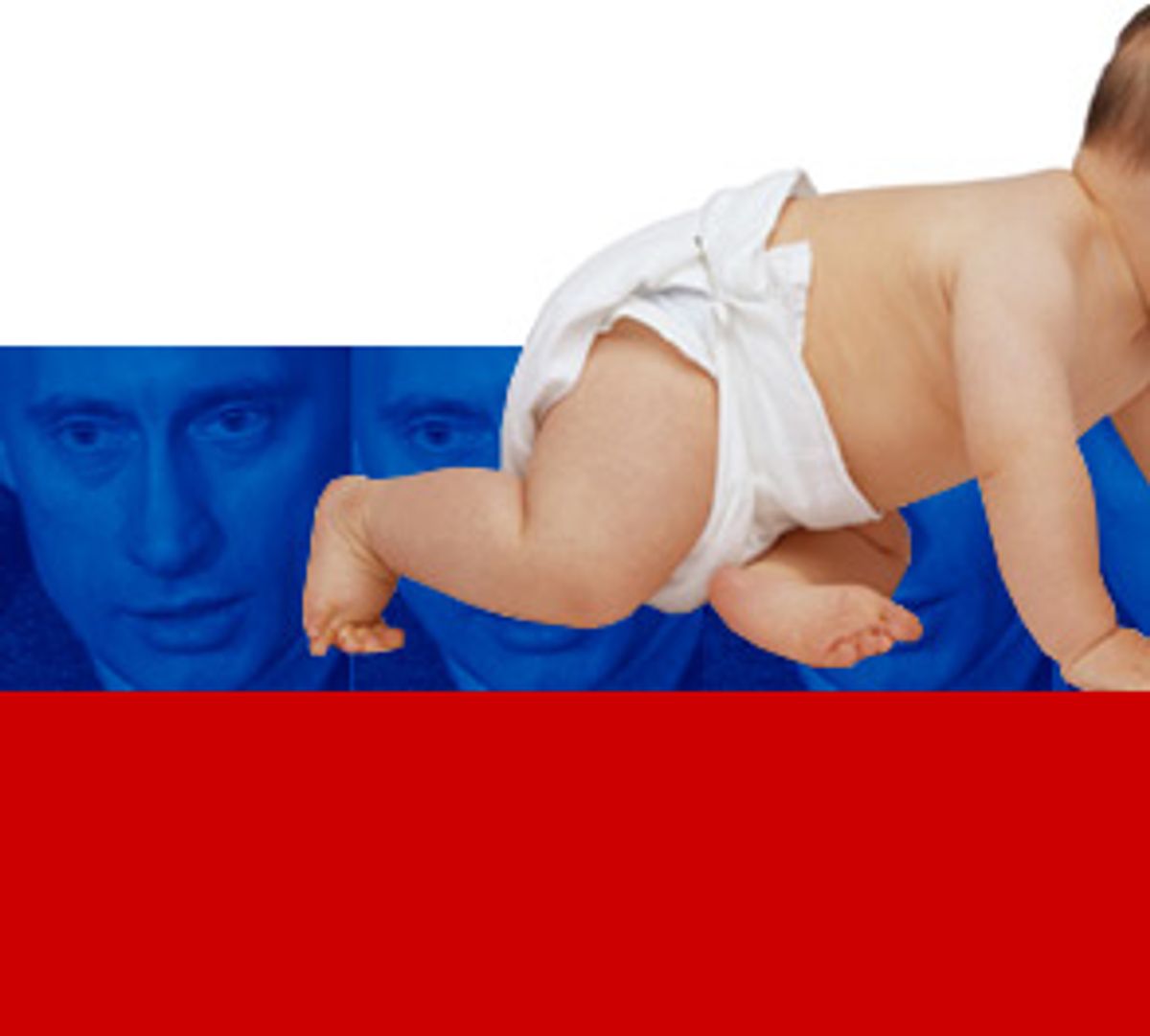
Adoption

The cry that came in from the cold

Will a new measure adopted by the Putin administration change who profits from Russia's lucrative baby-selling business?

  • more
    • All Share Services

Topics: ,

The cry that came in from the cold

Vodka, caviar, nuclear warheads, pasty men in big furry hats. Make a list of Russian exports and you’re likely to come up with the preceding list. All that would be missing is babies. Since the collapse of the Soviet Union, adoption — especially in the case of children destined for homes in the United States — is rapidly climbing up the roster.

Adoption has become a cottage industry in Russia; a back-of-the-envelope estimate suggested the country last year generated in the ballpark of $70 million in cash receipts — equivalent to nearly 4 percent of the amount generated by Russia’s growing tourism industry, according to Goskomstat, the Russian statistics agency.

This is hardly a humanitarian victory. To take a Russian child to America via adoption is to enter a world littered with Soviet-style bureaucrats in shiny green suits, many of whom make Donald Trump seem like Mother Teresa. It’s a path cluttered with dank offices in labyrinthine buildings and Orwellian interlopers who prey on naive foreigners for whom “da” and “nyet” represent advanced Russian. Many adoption agencies are little more than fronts for shady child selling; conniving translators specialize in hoodwinking adoptive parents into believing that they’re doing a good thing. Meanwhile, legitimate agencies devoted to child welfare suffer.

Ironically, Russia is likely to lose its position as America’s most popular foreign source for adopted children this year (4,348 Russian kids joined families in the U.S. in 1999, up from just 324 in 1992, according to the U.S. State Department). A decline is likely in 2000, however, as the result of a measure implemented in April by then President-elect Vladimir Putin that seeks to draw a distinction between baby selling and legitimate adoption. Putin has decided to put on hold all foreign adoptions by requiring foreign agencies to be accredited — via a process developed by a bureaucracy that has yet to be created. “One of the first measures the Putin administration put into force regarding adoption is also restricting Russian kids from having a better life,” says an industry observer, “at least for the time being.” One suspects that Putin’s interest in regulating foreign adoptions means he wants a bigger piece of this big business.

Sadly, Putin’s new rules — which are in part the product of a twisted sense of xenophobic national pride about “Russia’s future” (even as this part of Russia’s future rots in the country’s horrific orphanages) — are likely to result in even greater headaches and expenditures for prospective adoptive parents. Worst of all, it could mean fewer Russian kids will get the chance for a better life abroad.

Indeed, getting children out of Russian orphanages and into Western homes — no matter how dirty the process has become — is one small step toward making the world a better place. In a 1998 report, Human Rights Watch described the “shocking levels of cruelty and neglect” Russian orphans are subjected to. Boris Altshuler, who heads a children’s rights program at the International Helsinki Federation for Human Rights, recently estimated that of the 15,000 or so kids who leave the orphanage system upon reaching adulthood, 30 to 50 percent are homeless and/or criminals within a year, while an additional 10 percent commit suicide.

Stroll through a few of Moscow’s train stations, dodging the legions of glue-sniffing kids begging for bread, and you get a sense of what befalls the children who escape Russian orphanages. But Russia has a lot more people interested in making a buck than in making the world a better place, and the process of adopting a child from Russia — even under the old system — had more in common with Kafka than with the Red Cross.

Most U.S. adoption agencies employed so-called consultants in Russia, freelancers who had good connections with court officials, judges and orphanages in particular regions or cities in Russia. Even the most well-meaning adoption agencies in the West, such as those affiliated with religious institutions or that have a clear social agenda (such as promoting the family structure, viewing foreign adoption as only a last-ditch measure to save a child), had little option but turning a blind eye to the modus operandi of their local hires.

Excess and abuse on the Russian adoption front were the predictable result, as adoption consultants became adept at prying cash out of the planeloads of wealthy (a relative term in a country where the official monthly wage is less than $74 a month) Americans pining for Russian orphans. Many would-be parents had to fork over to their consultant $15,000 or more in cash upon arriving in Moscow, at which point the clock began to tick.

Prospective adoptive parents arriving in Russia were force-fed a small infantry of housekeepers, drivers, translators, lawyers and other miscellaneous service providers, most of whom were in cahoots with the consultant (if not the immediate family of the consultant) to maximize their short-term earnings. The local judge in the area where the institutionalized child lived was called upon to pronounce how long he would need to consider the adoption paperwork — a decision usually influenced by the size of the cut he received from the adoption consultant; the longer the delay, the more the future parents would have to pay. Prospective parents were often prompted to offer a “donation” to the local orphanage (no receipt requested or required) — to be used to buy food for the children, of course.

One family’s breakdown of expenses for adopting a Russian child provides a fairly typical example of how the economics of foreign adoption work here. Nearly half the family’s total cost of $28,419 went to the Russian adoption fee, which covered the consultant’s expenses and fees — before an additional $8,000 for transportation and exorbitantly expensive miscellany. Included among the expenses is $100 per night for a home stay in the small city where the orphanage was located — probably 10 times any kind of reasonable rate. The family’s costs also included $275 for cab rides in Moscow — this in a city where the ravages of devaluation mean that you can get anywhere in town for a $3 taxi ride (or a 14-cent subway fare) and where many university-educated professionals earn less than $300 a month.

But the distinction between legitimate adoption and baby selling, which is arguably at the core of what the Russian government is trying to address with the new certification process, doesn’t lie so much in how badly foreign adoptive parents get shafted. In fact, adoptive parents will likely have to pay even more for Russian children under the new regime, since the Kremlin and the new bureaucracy will want a sizable cut as well. The key difference between adoption and baby selling is whether the child’s welfare is the driver of the whole process or selling an available child to the first comer is the focus of the transaction.

Child vendors who have given the adoption industry in Russia a bad name focus on making money, despite their claims of nonprofit status, at the expense of the needs of both parents and children. Some agencies publish photos of children available for adoption, with Reader’s Digest summaries of their characters. (“Victor is very polite and very caring toward other children,” reads one.) The local consultant may have made a quiet deal with an orphanage and local judge to free up a particular kid, and it is the agency’s role to move the merchandise. If corners are cut along the way — and needs of both the prospective parents and the child are misdiagnosed, or not diagnosed at all — too bad. “Baby farms do no diagnostics, make no attempt to find a good match; they’re just selling bodies,” comments one insider affiliated with a legitimate adoption agency. Some parents have adopted children with serious emotional difficulties that they were not told of beforehand, setting up all parties for failure.

The more legitimate adoption agencies (some of which have left the market altogether rather than compete with the child hawkers) often aren’t even focused on adoption per se, but rather on building social structures in Russia to keep families together in the first place. Foreign adoption is often one of the last options considered to save a child, since in-country adoption, for example, is far less traumatic for the child than is an international adoption. The adoption agency — often affiliated with a religious institution — takes the time and effort to understand what prospective parents are looking for in a child, in terms of gender, age and temperament. It matches the needs of the parent and the needs of the child, and the agency’s local consultant then searches for a child who fits the bill. A match creates a family rather than a jagged jigsaw of prospective parents and frightened child from different sides of the globe.

Portions of the scenery will change, however, thanks to the new measure requiring all foreign adoption agencies operating in Russia to be certified. In 1998, the Russian press made a stink over a few isolated but widely publicized incidences of abuse by American parents of their adopted Russian children, along with rumors that foreigners were paying Russian women to have babies and then selling the babies outright. Many elements of the Russian media — as a brief scan of the giant headlines and photos of blood and gore at the newsstand suggests — aren’t always preoccupied with the truth. Also, anyone with a few extra rubles and an ax to grind can buy an article or pay for his own to be published — not as an advertorial but as real copy. So it doesn’t take much for someone with an agenda to get his point across.

The Duma (Russia’s lower house of Parliament), never a body to ignore a potentially rabble-rousing issue, started comparing international adoptions to cultural genocide. It didn’t take long for Putin — sensitive to the suggestion that Russia is a third-world hellhole that sells its own kids, particularly when its population is falling precipitously — to in effect suspend all foreign adoptions while the certification process is established. The only problem is, the proposed certifying body doesn’t even exist, and it will take at least half a year before the rusty gears of post-Soviet Russian bureaucracy create it. Many legitimate adoption agencies are optimistic about the new accreditation system, saying it is likely to flush out some of the worst offenders in the industry. Baby vendors either will be refused accreditation or will simply pick up and move elsewhere. Agencies with a mission beyond trading babies will be more inclined to see the process through, and will benefit from a more transparent, fair and reasonable process.

Chances are, though, that adoption won’t get any cheaper or easier, and that the process will basically remain the same. The Putin administration may well just be trying to centralize the cash flows from the industry, and any order imposed will be a beneficial side effect rather than an aim. Even a small percentage of the massive sums of money involved in the child trade could build a lot of Putin cronies some great villas on the French Riviera, with money to spare for some Land Rovers with black tinted windows to cruise the streets of Moscow. In the meantime, Russia’s orphans suffer, with every unadopted child — no matter how heinous the adoption system — left to rot.

Continue Reading Close

Steve Kimian is a freelance journalist living in Moscow.

Stop diagnosing my son

When we adopted Jake at 7, we waited years before letting a psychologist label him. Others haven't been so kind

  • more
    • All Share Services

Topics: , , , ,

Stop diagnosing my son (Credit: Shutterstock)

“Sounds like your son has Asperger’s syndrome,” she said. “Have you ever thought of that?”

I looked back at my son, hanging upside down on the monkey bars. “Sounds like you have Asshole syndrome,” I said. “Have you ever thought of that?”

In my head, I said that. What I said out loud was something like, “We think he’s just Jake, and that’s good enough for us.”

“Well, he might have Asperger’s,” she pursued. “And you should have him tested.”

“Well, you might be a bitch,” I said, in my head. “Is there a test for that?”

My actual words were, “We’re not interested in labeling him at this point.”

I was standing under a tree with a woman from our home-school play group when this dreaded “developmental milestones conversation” occurred. Her son had all his multiplication facts memorized; mine still hadn’t memorized addition facts. Her son was complimented for being polite; mine often ignored other children’s personal space. Her son was reading three grade levels ahead; mine was reading three below.

Well-meaning folks, I discovered, were happy to share their unsolicited pop psychology diagnosis of my son, certain I’d be grateful for the 15 seconds of thought they put into it. In modern American culture, we are quick to participate in the labeling melee. Someone’s “ADD is kicking in,” and another is “so OCD,” and their boss is “obviously bipolar.” It’s common lingo. So why not label a kid who seems a bit different?

But it was this labeling issue that smacked me in the face when I became a parent.

In 2002, my husband, John, and I traveled to Ukraine to adopt our son. Jake was 7 ½, weighing 35 pounds and speaking rapid Russian, he raced into our lives like a little tornado. The adoption process prepared us for disabilities. We were told Jake had “psycho-motor delay,” a common catch-all meaning “he might be slightly behind.” He couldn’t read or write, not even his own name.

The typical route for most parents adopting older children from a foreign country is to have their kids evaluated as soon as they return to the States. We hesitated. “Of course he’s going to have delays,” John said. “He’s lived in an orphanage his whole life and he’s the size of a 4-year-old.” Before a professional informed us what was wrong with Jake, we wanted to let Jake show us who he was on his own.

The first weeks at home were thrilling and exhausting. Jake explored everything. He played with our two German shepherds, he flipped light switches off and on and off and on. He opened the front door and ran into the street with the dogs. He touched everything and sniffed everything else. He hugged anyone who showed him kindness, including the baggers at the grocery store.

He was curious, joyful and supremely energetic. He pounded trees with sticks, broke branches off the bushes to use as play swords, did flips off his bed, tried to do pull-ups off the bathroom towel bar. He enchanted and amazed us.

But he was also fidgety. As I began working with him on numbers or letters in brief sessions, our son demonstrated the attention span of a flea.

“He might have ADHD,” I told John. “He just can’t focus on anything — unless it’s something he really wants to do, like build with Legos.”

John could relate. As an adult he self-diagnosed his ADHD and understood what it was to grow up unfocused. With Jake’s 12-word English vocabulary and overabundance of energy, we decided to home-school him, at least until he caught up.

That first year was glorious. We went to the zoo every two weeks as part of animal study. We caught bugs in the backyard and took nature hikes. We cooked. We sang. We danced. We worked on letters, numbers and sounds. Jake thrived, and we kept going.

But after two and a half years, we hit a plateau. Jake was stuck. And I couldn’t figure out how to unstick him. John and I began to believe a diagnosis might help now, if only because it would help us figure out how to help him.

His assessment was no surprise. It included ADHD, dyslexia, dyscalculia and auditory processing disorder. Overwhelmed but determined, I hoarded books from the library, talked to specialists and surfed the Web for techniques and curricula that would match his multiple diagnoses — and the boy I knew.

And a new question arose: What do we tell Jake?

I’ve talked to many parents, of both adopted and biological children, who’ve struggled with the same dilemma. Our kids usually know they’re different, but they often don’t understand it.

Some parents bust out the clinical terms and explain each: ADD, OCD, SID, ADHD, Asperger’s, autism. The alphabet soup of the multi-diagnosis becomes part of the family’s regular dialogue. Others take a less scientific approach, focusing on their child’s gifts and differences rather than deficits. We wanted to celebrate those differences, but also understand and work around his deficits, making certain he sees there’s a place for him in the world. Where was that line between cold analysis and sugarcoated truth?

John and I tried to find a middle road that explained his diagnoses but focused on his uniqueness. So ADHD became: “You have a turbo-charged jet engine that likes to move fast.” Dyslexia was: “Your eyes sometimes flip words around like a carnival ride, which makes it hard for you to see what’s actually on the page.” And auditory processing disorder was: “Sometimes things float in the shallow end of your mind for a while before they go in deep so your brain can make sense of them.”

I think these gave Jake a sense of peace. But that didn’t mean we didn’t have problems. A few months later, mid-morning of an early fall day, the kitchen table was stacked with school books and laptops, mugs of hot tea, and plates scattered with pumpkin muffin crumbs— and Jake was in the throes of a full-scale math meltdown.

“There’s something missing in my brain,” Jake wailed. “I’m missing a wire somewhere that ruins my thinking. I think God made a mistake on my brain.”

“Jake,” I said his name clearly and firmly, and as lovingly as possible, “there is nothing wrong with you, and God does not make mistakes.”

We pushed math aside for the day and took the dogs for a walk. Outside, I told Jake a piece of his story, our story. A story he’d heard before.

“On the day we met you,” I said, “your dad and I were amazed by your joyfulness. Here you were, abused and practically starving, yet you decided you would find joy in life. Now your dad and I are here to help you remember the Jakeness deep inside you — and to help you work on everything else. You don’t have to survive on your own anymore. You have a mom and dad — and five dogs who love you. And you know how much those dogs love you!”

The smile returned to Jake’s face, and we talked about happier things. In the weeks following, I consulted with experts, researched new curriculum, and tried to focus on what was right about Jake rather than what was wrong about Jake.

Friends helped in ways they couldn’t possibly understand. Every few weeks, someone shared a story about Jake’s happy spirit — how he’d walked all the way across the room to say hello to them or told another kid not to make fun of someone, and I stored these nuggets as precious jewels, never knowing when we’d need affirmation that other people saw the specialness in our son, too.

About a year later I turned a corner in our home-school co-op just in time to see Jake scamper down the hallway, peek into a classroom, pound on the door and run away. “Jake!” I whisper-shouted.

“Oh, that’s your son,” a voice said from behind me.

One of the co-op board members gazed at me down the hallway. “Yes,” I said, “that’s Jake.”

“He’s completely out of control,” she declared.

My skin prickled. “He has boundary issues,” I said, “but he’s not completely out of control.”

“No, he’s completely out of control,” she said. “I know exactly what he needs.”

“I bet I can tell you exactly what you need,” I declared, in my head. Instead, she rattled on while I entertained thoughts of stuffing her into a supply closet.

Aloud, I mumbled, “Thanks so much.”

I retracted my claws and headed toward the multi-purpose room to reprimand my son. I found him helping a harried mom of seven with her unruly toddler. There would be ample time to scold, but just at that moment, it was time to appreciate what my son was doing right.

Continue Reading Close

Debra Hanlon is a former high school English teacher and community college composition and literature instructor, now a home-school mom. She lives in northern Illinois with her husband, her son and their five German shepherds. Her occasional blog is LifeItIs.org—Insights and Incidents.

How do I tell my daughter she’s adopted?

Can't we just forget about that little detail of her parentage?

  • more
    • All Share Services

Topics: , ,

How do I tell my daughter she's adopted? (Credit: Zach Trenholm/Salon)

Dear Cary,

I am perhaps the happiest person who has ever written to you. My life is full and I am at peace and I have finally reached a balance that eluded me all my life. How did this happen? Well, at the age of 38 I adopted a baby. She was a day old when I held her and she came home with me when she was 3 days old. The paperwork took months but that’s not important.  I have worked very hard all my life, forever chasing goals, climbing the corporate ladder, traveling and working internationally. But I was literally sick of it. Neither the money nor the travel meant much. I hated the constant politicking and the random viciousness of work life. I saw no escape. I couldn’t imagine dropping out and then I went through a severe illness that left me unable to bear a child. I had a nervous breakdown. I am lucky enough to have a supportive husband, who while not acknowledging the possibility of a breakdown, did everything physically possible to make me better. I stopped working. I was completely washed out, I would be suicidal if that did not require an effort and the ability to feel. And then like a miracle I got my baby. I remember being quite ambivalent when I went to meet her. Yet, something clicked when I held her. I felt a sense of fierce belonging I have never felt before and I know my baby knew me too. She was and is amazing. She never cried as an infant. Except for food. She is very loving, brave, curious, smart, speaks two languages at 2 and a half. OK I am blabbing. I mean, now she is a handful. She is not perfect. She runs around in an airplane, gets hyper in malls, and goes crazy if she hears the sound of a packet of crisps, but I see an awesome person in the making. A kiss can still make my day. And we do believe in manners and discipline and naughty corners, so she is not spoiled or anything.  The past two and a half years have been blissful. My husband is a great daddy and I suspect my daughter’s heart belongs to him, but that’s cool. I am just incredibly lucky. My friends who knew me as the hard-driving MBA are amazed that I am happy as a stay-at-home mom, a choice my younger self would have derided. Actually my daughter goes to daycare twice a week and she would be happy there, so I can easily go back to work, this is no spiel for motherhood.

My circumstances were unique and who knows if I would have been this happy if I were a teenage mum with no support.

The only problem, Cary, is that despite being educated and well informed, I can not imagine telling my daughter that she is adopted. I thought adoption is so cool, I would be transparent.. Many times people talk of adoption as some altruistic act, but my lil monstah has given me more than what I could ever give her. It would be selfish to even want to be the center of her life, but she truly is the love of our lives. Seriously every parenthood cliche has come true for us.

I felt such a  possessive primal emotion from the first, which really surprised me. I don’t think you can be a mum with all the sleepless nights and life changes, without this bonding; she is mine and I am hers. From the start I started getting irrationally offended when friends referred to it. I cut off someone because she said “oh, she has really taken to you.” Like, why should she not, she is my daughter. I regret that this was shared with the whole family and I had a bit of a showdown where I made it clear that this is not something we discuss or even refer to whenever we meet or ever. Everything I read tells me that this information should be shared early. However, I also read that adopted children grapple with the issue, agonize over it. I mean, why should my lovely daughter have to deal with something her peers do not? Also, her birth mother cannot be traced. The information will really not help her get her genetic or medical information. If after a childhood of happy memories she does come to know, would it really shock her so much? Surely she would be strong enough to deal with it then. I had a tough childhood and teenage years. I was never close to my parents. Now I acknowledge that this could partly be my fault. All kids go through a rough teenage when they hate their moms, don’t they? What if knowledge of adoption compounds this angst? Leads to greater estrangement? I am going crazy, Cary, I can’t think straight. Isn’t love enough? Have you seen how the press always refers to the Cruise kids or the Jolie-Pitt kids as “adopted kids”? It makes me so angry.   I just want to be her mother, not her adoptive mother. And I want to give her a perfect childhood, though I realize it’s not wholly up to me. Already she has her own life and friends and soon she will go to school and my daughter can’t help but be independent. I am happy except when this issue comes up. What’s wrong with me? Am I turning into the crazy mom?

Can’t We Just Forget About It?

Dear Can’t We Just Forget About It,

What would you learn if you learned you were adopted?

You would learn that what you thought was true wasn’t true. It would be more a kind of unlearning than learning. It would be an acquisition of not-knowledge.

Maybe it would be like learning that most of the universe is dark matter and dark energy. You would have to start over. That might not be a bad thing. You might  acquire a new, more flexible notion of selfhood.

For one thing, you would have to conclude that you are not your genetic origin, right? Ideally, you would learn that you are a unique being, much loved, who came to be in a particular family here through unique circumstances.

But it isn’t as simple as that. We envision the unbroken line of success leading back to some early forms of human being and then back beyond them to advanced apes and less advanced apes and back and back and back to archaebacteria, the very earliest life forms. We see ourselves in a continuum, and we find comfort in imagining ourselves before we were born, and the lives of those who gave birth to us. We love deeply these images of those we take to be our parents. So it is a big disruption to what we thought was true, to what we thought we could depend on.

And it’s not a simple thing, for we are not simple creatures and we are not computers; we do not just know things and move on. We are haunted.

Old lovers haunt us. Things that might have been haunt us. It’s the season of haunting and we are haunted by ghosts.

It’s how we handle the ghosts that counts. There are always going to be ghosts in our lives. You may be adopted or not; you don’t really know where you come from. No one does. Your daughter, once she realizes she did not come out of your womb, might take some wise comfort in realizing that those who feel they know exactly who they are don’t really know, either. It’s much more complicated. Maybe this will be a gift to her; it will stretch her mind, her self-concept.

My best friend in junior high found out he was adopted and it bothered him. I don’t think it was the fact that he was adopted. I think it was the way his parents handled it. The being-adopted part of it just stood in for a much larger grievance.

You are a good parent. You love this child and as far as you are concerned she’s your daughter and that’s that. That’s pretty powerful. She belongs to you. She’s yours.

If someone along the way should whisper to her this secret, and if she should become confused and ask you, then you can tell her that she’s your daughter and you’re her mom and you love her. There’s no question of who’s her mom. Who else would be her mom but you? You don’t need to deny the truth but you can direct her to what is important and away from what is not important. You love her and she’s your daughter. That is what’s important.

And if at a certain more advanced point in her evolution you must discuss the biological details of whose womb she came out of, well, discuss. What’s wrong with that? It would be disrespectful to lie to her, wouldn’t it? Then you may get into the difficulties of the hard fact that her birth mother cannot be traced. Well, there is another mystery that if handled well could be a kind of enlightenment: For who among us can say with any certainty that our origin is not in some way a mystery to us?

Let’s put it this way: What does it matter whose car we came in? We’re at the party now.

We step out and there are glittering lights and a carpet and we walk up the steps to be greeted by old friends and new. Whose car did you come to the party in? What does that matter? We’re here. Let’s find the coat check.

Tricky moments will come to pass in time, or not. What else can you do but handle them with love?

Right now, you are happy, and she is loved, and you are loved in turn, and these other things, let them be. Let them be for now. Let time and circumstance decide. The basic truths are enough for now. You love her. She loves you. You’re happy. She’s your daughter. You’re her mom.

Continue Reading Close
Cary Tennis

Cary Tennis writes Salon's advice column, leads writing workshops and creative getaways, publishes books, writes an occasional newsletter and tweets as @carytennis.

Join Cary's Online Writing Workshops

What my mom told me before she died

She always refused to talk about my birth mother. Was she finally ready to open up?

  • more
    • All Share Services

Topics: , ,

What my mom told me before she died

Having been adopted in New Jersey, I was never able to obtain my original birth certificate. Growing up, I would beg my adoptive mother for any tidbit of information about my birth mother until one day, shooting her foot through the kitchen wall, she screamed, “Don’t ever ask me that again.” For years I went on believing I was the product of rape or incest, or that my birth mother just wanted to get rid of me. I never fantasized about being the daughter of famous celebrities unable to raise me for fear that an illegitimate birth might ruin their careers. I reconciled myself to not knowing the truth, and I thought that was the end of the story until my mother lay on her deathbed.

When it became clear that her two-year battle with cancer was drawing to a close, my mom put a lot of effort into apologizing to me. As I sat by her beside, trying to comfort her now that we knew she was near death, she told me, “I know I was a bitch to you.” The confession came as a surprise, but I smiled, figuring it was the morphine talking. Maybe the drug gave her the freedom to let go of her pride. “You were a lovable bitch,” I responded, with a wink and a smile. But inside, my heart was breaking. Why couldn’t she have apologized years ago? We could have had so much time to rebuild our relationship.

We both laughed. For the first time in years, maybe ever, we opened up to each other. In this dreary hospital room, with its green walls and its threadbare divider curtains, with its IV drip and heartbeat monitor, my mom, for the first time in memory, wasn’t judgmental. When she told me she was proud of me, I had to wonder: Why did she wait until now? I felt so much pain growing up, but I couldn’t tell her how she had hurt me. Not now. Not when she was dying.

A week before she passed away, she told me about a lockbox hidden in her bedroom closet. “There are important papers in there,” she said. Then she gave me the secret code: “Your daddy’s birthday.”

For the first time in my life, I felt nervous being alone in my childhood home. As I prepared myself to open “the secret hidden box,” I felt my heart pounding in my throat.

Balancing on a chair in front of the closet, I reached past the stacks of hat boxes, the silk scarves, the leather gloves; my hand touched metal. I pulled out the box, placed it on my mother’s quilted bedspread and stared at it.

I took a deep breath and rotated the first cylinder to “6.” The second was already in the correct position. After easing the third cylinder into place, I felt the lid release and slowly open. It was filled with papers. Insurance documents. Itemized lists appraising the trinkets my parents collected: jewelry, furs, monogrammed silverware, the china my father shipped over from Hungary during the war. “My inheritance.”

 As I worked my way through the documents, my heart stopped: “Adoption Papers.” The piece of paper listed my birth name. I could hardly read through the hot tears that filled my eyes. After removing my fogged-over contact lenses, I was able to examine the hand-typed court documents drafted so many years ago. While I studied the pages, one memory came to mind.

“Don’t ever ask me that again,” she’d yelled, so many years ago. Had she told me where this box was so I’d find the papers and open up a dialogue? Did she want me to ask her about this now? She had apologized for all of her cruelties. She realized she had been unfair. But was she ready to talk? Was that the reason she told me about the box?

I returned to the hospital the next morning expecting her to ask me about it. Did you find the box, do you have any questions? I’m ready now to answer anything. But she never mentioned the lockbox and I didn’t have the heart, or guts, to bring it up there, on her deathbed. I wasn’t going to do or say anything to upset her. She had to be the one to broach the subject. I waited.

In the end, no matter how many disappointments my mother had in her life, she couldn’t bring herself to talk to me about her greatest disappointment of all: that she could not give birth. She said nothing and I said nothing.

She died the following week. We never discussed her secret.

Continue Reading Close

The daughter we both wanted to keep

After years of trying to conceive, I was thrilled to adopt a girl. I never dreamed her mom would ask for her back

  • more
    • All Share Services

Topics: , , ,

The daughter we both wanted to keep

After every appointment at the fertility clinic, I would have a nightmare. It didn’t matter if the appointment had gone well (New medicine to try! Your ovaries are huge!) or if the appointment had been torturous (Internal ultrasound! Ooops! The doctor was just called out to deliver a baby. You’ll have to come back). The dreams that followed that night were never good.

I would toss and turn, trying all my tricks to get to sleep. I laid my hands flat, open, underneath my pillow. I smoothed my hair behind my ears, I bent my legs slightly, and I swept my foot back and forth, caressing the sheet. I stilled my breathing, then matched it to the motion of my foot. I willed myself to breathe deeper, to let go …

- – - – - – - -

I wasn’t surprised, but clearly everyone else was. I looked again at the bundle in my arms. I felt joyful and tender as I rearranged the tiny blanket around her. I cooed to her, my little sweetheart. She didn’t stir, still exhausted from the delivery.

I said quietly to the room, “You could be happy for me.”

The nurse said, “It’s a kitten. You delivered a kitten.”

“She’s beautiful,” I said. Then more firmly, “We’re going to be fine.”

I heard clucking tongues, spilling pity. Two nurses stood by me, trying to take her from me. I petted her cheek, turning over names in my mind. Could I call her the same name I had chosen for a human baby — Emily? Maybe just Emmy. I whispered it, and she sighed softly. “Then Emmy it is,” I said. I looked up, ready to confront them,”I want you to treat her like any other baby on this unit, or you will hear from my lawyer. She’s my baby, and I love her.”

“But she’s not a real baby,” the charge nurse said.

“This isn’t right, honey,” said the plump nurse. “Let us take her, and you can try again.”

“I have been trying for seven years!” I screamed. “This is my baby. She’s beautiful, and she’s mine, and I will not give her back. “

When I woke up, I had a sore throat.

- – - – - – - -

When we first met Daria, the birth mother, at Big Boy’s, I thought she looked like Mariah Carey. She had blond, streaked hair, big, aqua-colored eyes (they had to be contact-enhanced), and high cheekbones. She smiled at us as though she knew us. Well, of course she did. We had sent her our adoption portfolio, full of pictures and personal history. She knew the colleges we attended, the size of our home, our family history, our medical history, even our dog’s name, for Christ’s sake. We knew only her first name, a few vital statistics, and that she was pregnant.

“There she is,” I whispered, and we both rose to greet her. I noted the slight drag of her right foot, but I tried not to look at it. I remembered that on her medical sheet, she said she had had a slight stroke after her last pregnancy.

I smiled at her and extended my hand. “I’m Lydia,” I said, and then shoved Sean forward, eager for him to take the lead for me. He shook her hand and looked at me. He never had accepted responsibility easily. What was I thinking?

I grabbed the flowers we had bought on the way up, trying to cover my embarrassment for him. “These are for you.”

Daria looked surprised.

“You said your favorite color was purple,” I said, pointing to the delphinium and iris.

“And you remembered that?” Daria asked, referring to our previous phone conversations, where we had asked everything from, “What’s your favorite color?” to “Do you have any communicable diseases?” I had remembered every answer; obviously, she had not even remembered the phone call.

“Thank you. They’re pretty,” she said. I had been hoping for more.

She was pretty too. Sean pulled out a chair for her, and Daria sat down, oblivious to my stares. She was wearing a tan sundress that ballooned away from her. She wore heavy ’80s makeup, foundation that had been carefully tinted, blue eyeliner that matched her stunning eyes, blush striped to her hairline, and lipstick with a glossy finish. It wasn’t garish, but it was practiced and perfect. She wore little jewelry, except for a blue topaz ring that was boldly expensive. I hoped the father of the baby had given it to her. I wanted the baby to have been conceived in love.

- – - – - – - -

On the day that we were to give Emma back, James and I went down to the lake. It was about 85 degrees, and the sun was just starting to warm up. I took care to shield Emma from the sun, making a tent of sorts with her blankets. James was playing in the sand, “Making tracks” he called it, cutting tributaries down to the water. He asked me to play with him, but I said no rather sharply, and he got the message.

I looked down at Emma and at the lake. Both were still. I knew I should pray. I knew I should cry. I knew I should clasp her to me and rock and cherish her and memorize her every bone. I couldn’t do any of it.

I felt movement before I heard it, and turned to the swamp to my left. Seven blue heron rose from the reeds, perfectly spaced. They called and crackled; I know of no other word for it, maybe it was their wings beating or maybe it was the wind vibrating, but as they rose, the weather, the wind, the cloud, the bird, and my hope gathered as one, and flew.

James was already staring, and I lifted Emma’s blankets, and this I swear: She opened her eyes and saw her first miracle. It was the first of many in her young life. Fortunately, I was there to see them all. For I was, eventually, legally named her mother, although it took an 18-month court case and all our life savings to be so. But that is a nightmare that deserves its own story.

Continue Reading Close

Was Obama nearly put up for adoption?

U.S. Immigration files reveal Obama's father expressed plans to give up the president as a baby

  • more
    • All Share Services

Topics: , ,

Was Obama nearly put up for adoption?President Barack Obama speaks as he hosts military fathers and their children for a screening of Disney/Pixar movie 'Cars 2' in the South Court Auditorium of the Eisenhower Executive Office Building on the White House complex, Wednesday, June 15, 2011. (AP Photo/Pablo Martinez Monsivais)(Credit: AP)

President Barack Obama’s parents may have planned to put their son — the now president — up for adoption. The Boston Globe’s Sally Jacobs, whose book on the life of Obama’s father will be released next week, wrote in the Globe Thursday about U.S. immigration files which indicate the elder Obama planned to give up his child.

“Subject got his USC wife ‘Hapai’ [Hawaiian for pregnant] and although they were married they do not live together and Miss Dunham is making arrangements with the Salvation Army to give the baby away,” read a memo written by an administrator at the Honolulu office of the U.S. Immigration and Naturalization Service.

The memo, which dates from April 1961, was released by the Homeland Security Department in response to a Freedom of Information Act request made by the author.

Jacobs notes that it is possible that the elder Obama made up adoption plans simply to appease immigration officials, who were allegedly concerned about the Kenyan student’s “playboy” lifestyle. Sources close to Obama’s mother, Ann Dunham — including her uncle — told Jacobs that Dunham had always been committed to bringing up her son and had never mentioned adoption.

Similarly, former White House press secretary, Robert Gibbs, told Jacobs that the president had never before heard of his parents’ adoption considerations and did not believe that his mother actually ever contacted the Salvation Army.

Continue Reading Close

Natasha Lennard covers the Occupy movement for Salon. A British-born, Brooklyn-based journalist, she has been covering Occupy Wall Street since before the first sleeping bag was unrolled in Zuccotti Park. One of the first journalists arrested at an Occupy action, she has managed to enrage Andrew Breitbart, Rush Limbaugh and Glenn Beck. You can follow her on Twitter (@natashalennard), and email her any Occupy updates/videos/ideas to natasha.lennard@gmail.com

Page 1 of 14 in Adoption