Amy Reiter

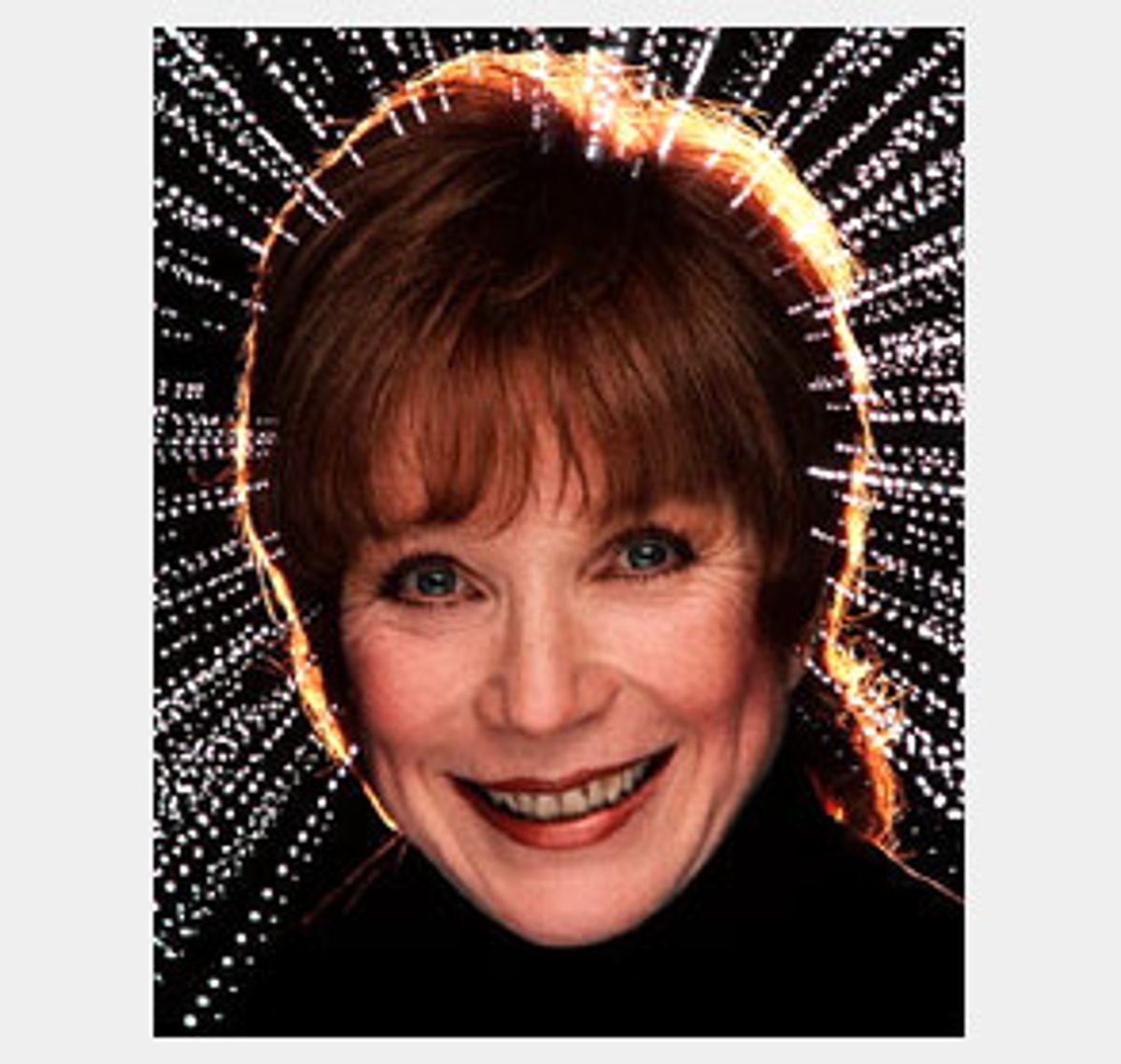
A Shirley MacLaine way of knowledge

In a far-ranging conversation, the indefatigable actress and author says she wants to "spiritualize the Web."

  • more
    • All Share Services

A Shirley MacLaine way of knowledge

The blisters Shirley MacLaine acquired during her 500-mile, 30-day trek along the Camino de Santiago de Compostela, an ancient pilgrims’ walk in Northern Spain, have long since healed. The book in which she chronicled her journey, “The Camino: A Journey of the Spirit,” has flirted with bestseller status. And the widespread tittering over her claim to an affair with Charlemagne (to whom she says she bore three children during a past life as a Moorish girl) has faded to the occasional whisper.

But MacLaine caught something during her monthlong solitary journey that hasn’t gone away — dot-com fever. “Things occur to you when you’re walking alone for a month,” she says. “I want to spiritualize the Web and the whole interchange between learning and technology.” That’s where ShirleyMacLaine.com comes in.

Recently launched, it’s her very own spiritual Web portal, which she says answers the public’s raging “hunger for spiritual subjects” — and features everything from “the best footage of UFOs” to a chat board about “pet spirituality.”

But that’s only one item on the actress’s list of things to do before she moves on to her next life. MacLaine’s also directing her first feature film and taking her spiritual act on the road. A few days ago she paused in the middle of juggling projects to talk with Salon.

One of the first things you did when you got back from your trek was direct your first film, “Bruno,” with Gary Sinise and Kathy Bates …

Yeah. It’s the story of a little boy who’s growing up in a Catholic environment and who has contact with angels. He has a father cop, played by Gary, and a mother who weighs 500 pounds and is a dressmaker. Because the mother is a dressmaker and he talks to angels, the little boy wears dresses to his spelling bee contests and it gets everyone upset. He wins the National Catholic Spelling Bee Contest, because he’s a little intellectual, and the reward is he goes to Rome to meet the pope — who is also wearing a dress. So it’s kind of up my alley — with a lot of these spiritual things and funny, too.

You also spoke with angels during your journey. Was it the spiritual aspect that attracted you to the project in the first place?

That and the identity of a little kid and how he’s trying to find himself. He believes in these angels at the same time that he’s having such problems on Earth. It’s a darling story, and a very good little movie, I think.

Is directing something you always wanted to do?

Not really. I just wanted to have the experience of fulfilling my own vision.

What about the Web site, how did you get started on that?

Well, you know, when you walk over 10 hours a day for 30 days, you begin to realize some spiritual aspects inside you that you didn’t know were there. I got in touch with a lot of past-life experiences.

And when I got back, I realized that I should be sharing some of this so I wrote the book. Then after the book was released, I saw that the hunger for spiritual subjects and how to go within oneself and how to meditate and how to align yourself with your own power was very strong.

So I put up this Web site that has information on everything from astrology to prophesy to numerology to dream interpretation to chi energy to ESP, reincarnation, UFOs and crop circles. And I’ve gotten, I don’t know, over 5 million hits, because people are extremely interested in these subjects.

I understand you’re now planning to take your spirituality on the road and give seminars around the country?

Yes. I did them in the ’80s, and now I’ve decided to start them up again so I can share with people all the things that I’ve learned relating to how to get in touch with the higher self, how to align the chakras. I’ll teach them what chakras are, because they’re basically energy centers, which are the organs of the soul.

And when you align yourself with your mind, body and spirit, the power becomes so incredibly productive that you know what your destiny is.

How do you mean?

Oh lord, people cry and sob and forgive their worst enemy and understand why their mother is treating them like this and why did this husband do that to them and the children. And they begin to get in touch with whatever it was in the past that created this drama in the present.

And you know, I had people at the seminars I did in the ’80s who were literally paralytic when they came and, at the end of the weekend, walked out.

No!

Yeah!

Come on.

They did. Several of them did, but this one got up and testified to the whole thing about how she had learned to heal herself within.

Come on!

Why are you finding it so hard to believe?

How could they just be magically healed?

[As if speaking to a very slow child] Because there was blocked energy. It comes down to the power within to unblock the things that are restricting your vehicular power. And she did it.

Things like that happened over and over.

So why did you stop doing the seminars?

You know, I would have a thousand people in the room and the power involved in having a thousand people getting the energy from each other was so extraordinary. But many of them gave their power away to me, they didn’t take it for themselves.

They gave you their power?

They thought I did it for them. But now with this new millennium shift, they’re ready to take it for themselves and I can feel that, so I’m going to escalate what I did in the ’80s and make them even more profound. I just feel the urgency to go back and do ‘em.

What do you mean “with the millennium shift”? You feel there’s been some drastic change from within?

Oh, yeah. I think that after Jan. 1, 2000, we had an extraordinary shift. You know, when Y2K did not really happen, I think we felt this kind of positivity that happened over New Year’s Eve and has been continuing.

Now, people feel the positivity but they don’t know what to do with it, because we don’t learn how to do these things like meditate and align ourselves within, we have such busy hectic lives — addicted to technology. And people are searching on the Web, for example, for relationships and intimacy, but the intimacy is really necessary within yourself. If you use that new positive energy to align yourself within, man, you could do anything you want to do in your life, and it makes intimacy with other people in your life so much deeper.

When you go into a meditation and connect with your higher self, your higher self guides you along the timeline to where you can understand some of your past life experiences and how they impact on your life today; it’s quite extraordinary.

When was the first time you felt that?

Well, I’ve been doing this for the last 30 years, and when I went through my divorce, it was extremely painful. But when I got in touch with what that person meant to me over time, down through different incarnations, I didn’t feel any bitterness or any sense of loss. We had served each other and it was time to be over. And because of that understanding of the past lives I had with this person — and many of them, by the way — I was able to adjust more and be balanced and peaceful with the divorce. That’s when it really happened to me.

Ever since you started talking about your past lives, you’ve really taken a beating in the press. Do you ever feel like maybe it’s just not worth talking about it?

Oh, no. I don’t think they’ve beaten me up. I think they make jokes.

The ridicule doesn’t bother you?

Not at all. I’m amused by people who think I’m a nutcase. I even help them write the jokes! I just insist that they’re funny. If they’re not funny, I think that’s a humiliation.

And even the people who are really threatened by this are kind of reluctant to be really, really hard on me because, you know, what if it’s true? [Laughs.]

Who knows?

What if karma really works! [Laughs some more.]

Speaking of karma, you were recently the butt of a lot of jokes for saying you’d had an affair with Charlemagne in a past life and had discovered he bore a striking resemblance to Olof Palme, the Swedish prime minister with whom you had an affair in this life. Do you know when something you say is going to get you poked at in the gossip columns?

Oh, sure. I’ve been in this business long enough and worked for 50 years with the press, I know what they’re gonna do. And some of it’s been funny, but you know, there were many less jokes this time, with this last book, than there were before. Because more people are into understanding that they have lived before. Three-quarters of the Earth’s people believe in reincarnation. The whole East! It’s Christianity that’s not very sure. And I’m not convinced that that wasn’t what some of the great teachers — including Jesus — were saying.

I mean, there are many things still left in the Bible, and as you know the Bible’s been rewritten several times. I’m not positive that Jesus was not talking about this. At one point he asked his disciples, “And who do you think I was?” And they say, “Elias, Elijah” — they give certain names to what they thought Jesus had been before — and he didn’t refute it.

And there are several little things like that that are still left in sections of the New Testament. In the laws of karma, which is really “Do unto others as you would have them do unto you,” it comes back. So this is the cosmic justice.

Listen, this whole country, which I find very fascinating, was based on the founding fathers’ beliefs in transcendentalism, they were all transcendentalists. They were all Masons. Some of them 33-degree Masons. They were convinced of the tenets of reincarnation, except for Jefferson. And Jefferson speculated on it quite seriously and quite profoundly, but he wrote his own bible. I have a copy of the Jeffersonian bible, I don’t know if you’ve read that. But this whole country was based on these metaphysical precepts. That’s why we have “In God we trust” and the pyramid with the third eye over it on the dollar bill.

And they learned it, of course, from the Iroquois Nation and a lot of our Constitution is based on the amalgamation of nature, the rebirth and the self-governing principles of nature. And if you are a metaphysician, which most of these founding fathers stated themselves to be, you understand that self-governing is what democracy is really about. So we’ve in many ways lost what our heritage intended for us to be.

So it’s not something to really ridicule at all. It was why our founding fathers revolted against the repression of the church in Europe.

In terms of reincarnation, do you have a sense of who you’d like to come back as, if you could pick?

No, I don’t get into that. I don’t know about once I leave. I haven’t really completed what I came here to do yet. I think I will do it with this Web site. I want to build a huge Web site that makes all the subjects that I’ve mentioned accessible. So they don’t have to search around the Web and look.

You know, we already know that the most popular sites on the Web — after pornography, of course — are about astrology, UFOs and reincarnation.

Do you think that, like pornography, those are things people are embarrassed to talk about?

I think they find privacy in the Web, and they don’t know where else to go to discuss it. And you know, on my site I have this reincarnation chat board, which is really busy all the time. People talking about who they think they were or why did they love this person at first sight or why did they dislike this person the moment they got in contact with the energy of that person — all these esoteric things that are not so provable by science but are definitely feelings that are very strong.

What sort of feedback have you had about the Web site?

Oh my lord, I’ve had over 5 million hits.

Do you get a lot of e-mail too?

Oh yeah. I get like 500,000 e-mails a week.

Do you read them?

Oh sure. And answer them. I’ve got people — a big organization — working for me. That’s one of the reasons I want to go out and do these seminars around the country. That’s how I’m going to finance the Web site, because it takes a lot of money to do this. And I want to put up some salable things to help them, like aromatherapy and the right kind of vitamins to take.

So there’ll be an e-commerce aspect?

Well, mostly it’ll be a portal where you can log on to learn about these subjects. I have a whole page on pet spirituality — you know, how you feel about your pet, it’s just an amazing intimate relationship of love. So what is all that about? Where did you know the pet before?

I want people to share with each other their own letters on how they found love with the pet. [Laughs]

Does the site change to reflect visitors’ interests?

Absolutely. Every week I’m adding something new to it. I’ve got the best UFO footage in the world. And I have a lot of people contacting me about their experiences with UFOs, a lot of whom have been reluctant to talk about their contacts.

So this is what I’m going to do now. I will still act and all that, I’m doing a picture in September, but this is my life now. I really enjoy this. I think it’s my destiny. So they’ll make more jokes. So what? [Laughs]

Why even keep doing the acting, if this is what really jazzes you?

Well, I might not. Because this is what I really enjoy now. It’s true.

But, when I do the movie, for example, I’m gonna put a Shirleycam on the set and feed it to my site so people can see how a movie’s being made, because making a movie, quite frankly, is really a metaphysical experience, too.

What movie will they see being made?

It’s called “These Old Broads.” It’s a comedy written by Carrie Fisher, and starring me, Joan Collins, Debbie Reynolds and Elizabeth Taylor.

That’s quite a lineup.

Yeah. And it’s a story of four actresses who worked together a long time ago, and they’ve come together to do another project but they can’t stand each other and it’s hysterical because it’s a bunch of divas together and how they interrelate. It’s very fun.

How did the other actresses feel about having a camera on the set?

Everyone was fine with it. No objections. Well, not yet.

Finding joy in Down syndrome

The author of "Bloom" talks about accepting her daughter's condition and rethinking her idea of the "perfect child"

  • more
    • All Share Services

Finding joy in Down syndrome
This article appears courtesy of The Barnes & Noble Review.

Kelle Hampton, the author of the eye-opening new memoir “Bloom: Finding Beauty in the Unexpected,” left for the hospital to give birth to her second child with “everything just — perfect,” packing not only the birth music, the blankets she’d made herself, the baby’s coming-home outfit, a special nightgown and a crown for the baby’s big sister, but also hand-designed, beribboned favors to pass out to visitors. Yet the moment her newborn daughter, Nella, was placed in her arms, Hampton’s concept of perfection altered in an instant: Though ultrasounds had signaled nothing unusual, Nella was born with Down syndrome.

Barnes & Noble ReviewHampton writes with bracing, brave honesty about her initial response to Nella’s condition — “I think I cried for seven hours straight. It was gut-wrenching pain” — and her struggle to find hope, joy and an expanse of possibilities in what first seemed to bring only sadness. As on her blog, Enjoying the Small Things, the journey Hampton records in “Bloom” becomes a call — and not only to parents — to rethink our concepts of perfection, discover our capacities for resilience, appreciate the family and friends on whom we depend and, yes, find beauty where we may not have noticed it.

We asked Hampton, via email, about “Bloom” and the experiences and impulses that inspired it. It may be typical of the author that she immediately turned the task of tackling our questions into an event worthy of celebration, writing, “I’ll put some good music on tonight, light a candle, grab a beer, and completely enjoy the process.”

The Barnes & Noble Review: One remarkable aspect of your writing is your knack for tapping into emotions, both your own and your readers’. Has motherhood — and particularly Nella’s birth — made you more connected to your emotions?

Kelle Hampton: I feel emotions very intensely. Expressing them is another story. I think we’re all conditioned to mask certain emotions because we think they won’t be accepted or they’re “too much.” Motherhood definitely compelled me to express emotions more freely. The depth of love, the fear of losing, the need to protect, the unearthly joy — it was too much for me to contain. That’s why I started writing more. And writing something I was thinking seemed more acceptable than saying it out loud. Then with Nella’s birth, there were these contrasting emotions that were so difficult to deal with — grief, fear, sadness, shame. But once I expressed them through writing and realized other women related to them, it gave me the freedom to express myself in a way I had never done before.

BNR: ”Bloom,” like your blog, uses photos and text to tell your story. Why did you choose to combine both elements?

KH: The book is a testament to my journey that first year, and writing and photography played equal parts in my healing and perspective shift. Because the book deals with Down syndrome, a condition that has many negative stereotypes, the photos are a powerful way to showcase the beauty of these children and the beauty Nella brought to our family.

BNR: Early in “Bloom” you mention a book you read shortly before Nella’s birth, Donald Miller’s “A Million Miles in a Thousand Years,” which spoke to you of “the power of challenges — how living a life of comfort does nothing to make us grow, and how hard times shape us.” But you also say you couldn’t fully grasp Miller’s message until you went through your own challenges. Can we learn life lessons from books or only from our own experiences?

KH: I’ve thought about this question a lot, especially from a parent’s perspective, because we make efforts to keep our children from pain and to give them happiness. No one wishes heartache for their child, and yet I know a lot of my happiness and contentment today comes from challenging experiences and sadness in my past. I think we can learn a lot from others’ experiences, and books give us an opportunity to do that. But life without any pain is unrealistic, and the great thing about reading books and learning from others is that when we do go through hard things, we’re more equipped to handle them and don’t feel quite so alone.

BNR: I initially assumed that, before Nella’s birth, you’d led a life without much difficulty. But then you discussed challenges you faced during childhood, in particular the breakup of your parents’ marriage when your father, a preacher, came out as gay. Did those childhood challenges help prepare you for those you’ve faced as a mother?

KH: My siblings and I talk about this a lot — the fact that we are so grateful for our past, even though it has a lot of pain, because it made us tough and definitely more compassionate. Once I started writing those chapters from my past, it really hit me how much those painful memories created a foundation for later challenges in my life. Does that mean someone who had a dreamy, heartache-free childhood is at a disadvantage for handling hard times as an adult? Not necessarily.

It’s important to me, as a mother, not to shield my children from life’s more disheartening realities but to bring awareness to them in a way that gives my children both a sense of gratitude for what they have and the motivation to bring positive change to their world. I want my girls to know that life isn’t going to be without pain, but I also want to equip them with love and confidence and a perspective that allows them to face these challenges when they come.

BNR: You learned fairly early in life to embrace difference. But still you struggled at first to embrace the ways Nella was different from the daughter you had envisioned. How has your sense of “perfection” changed since you had Nella?

KH: I’ve definitely shifted my views of perfection away from image and more to inner happiness, and that shift has taken away so much pressure and allowed me the freedom to really be myself. That, in itself, is happiness.

BNR: After Nella’s birth, your close circle of girlfriends — your “Net,” as you call them — stayed with you, giving you incredible support. What do you think is the secret to having such close female friends?

KH: I think women’s friendships get a bad rap in the media. They’re portrayed as catty, jealous and unsupportive. That saddens me because I know how amazing it is to be part of a group of women where you find love and support. I think women have high expectations for each other, and sometimes we are inclined to run or drop a friendship at the first sign of drama. I embrace my friendships with the understanding that because we are all women with fiery personalities, big dreams, and a hell of a lot of passion, some drama is inevitable.

You have to approach it with compassion and forgive mistakes, because we all make them. Of course, yes, you also need to make choices to surround yourself with people who bring out the best in you, who challenge you, who bring good energy. Those who don’t aren’t worth exhausting efforts.

Secondly, if you want close relationships with friends, you have to be vulnerable. I know how much it means to me when a friend admires me enough to call, crying, asking for help or trusting me with an intimate conversation. Likewise, I want to do the same and reach out to my friends, revealing my own vulnerabilities. My friends are great for shopping, laughing, or going out for drinks, but the best, most beautiful moments I’ve experienced with them are far more serious. And when you experience heartache with a friend at your side, it is bonding in a way that can’t be forgotten.

BNR: Do you think women can support each other in ways that men (even husbands) cannot in tough times, and particularly those involving parenting?

KH: As much I support equal rights for men and women, there are certain gifts women possess that men don’t naturally have and vice versa. Even though Nella is [Hampton's husband] Brett’s child and he, of course, was the only one who could sympathize with that personal parental loss of receiving her diagnosis, there was something so comforting that came from my friends — women who understood, in a way Brett couldn’t, the emotional aspect of the end of a pregnancy, a mother’s expectations, the ideal birth experience.

BNR: You write that you knew immediately, before anyone told you, that Nella had Down syndrome and worry that you didn’t show her enough love at that moment. We all sometimes feel a disconnect between the mother we want to be and the mother we fear we are in a particular moment. Should we even have a concept of what makes the “perfect” mother? Does that give us something to strive for, or give us only impossible standards we’ll never measure up to?

KH: I think we all have this imaginary version of the perfect mother we want to be. There is a quote I love about the fact that there is no way to be a perfect mother, but there are a million ways to be a good one. I try to focus on that, to know that when I try my best, acknowledge mistakes, follow my instincts, and remind myself of what’s most important, that is perfect parenting.

BNR: I wonder, too, about the dangers of our expectations for our kids. If we have a preconceived notion of who they should be, we may fail to appreciate them as they are. That’s a lesson you say you’ve learned. Is it something you feel is important for all mothers to learn?

KH: Yes! I’m learning it with Lainey [Hampton's elder daughter] just as much as with Nella. I’ve been challenging myself not to push Lainey to be a leader all the time. I have a preconceived notion that kids need to be leaders, not followers, and my husband recently reminded me that we do not need to tell our children to be leaders; we need to tell them to be themselves. It makes us all happier — to sit back, to lead by example, to accept what we are given, and to love our children no matter what path they choose to take in life.

BNR: Motherhood can be a touchy topic. Some of the emotions and responses you talk about in the book are bound to incite strong responses — mostly positive, but perhaps also negative. Were you afraid, writing about such personal topics, that you might be misunderstood and attacked?

KH: When I first published Nella’s birth story [on her blog], I discovered right away that being honest about touchy things is not always well received. It was good for me to read responses, even those “Oh my God, what kind of mother would say they want to run away!?” remarks. It initiated a personal process for me of challenging myself to write what’s true — in a respectful way, of course — and not to change my writing to cater to other people.

BNR: Did you ever find yourself pulling back? Or did you just write through those concerns?

KH: There were parts that I went to write and stopped to ponder the effects first. And, most always, I proceeded, hoping that people will understand this is my journey. Memoirs are personal, and not everyone is going to shake their head “yes” to every line, and that’s OK. The other side is that it has been incredibly fulfilling to read e-mails from women who have said, “Thank you for saying that. I felt it too, but didn’t want to say it, and you make me feel normal for admitting it.”

BNR: Do you worry about how your kids will respond to what you write when they’re old enough to read and understand it?

KH: What I wouldn’t do to have my own mother’s thoughts and photos and words and things that inspired her preserved from when we were little. I hope my children, through reading everything I’ve written — the good, the bad, the beautiful — will always read between the lines and be inspired by the constant truth of “Wow, she loved us. She celebrated life.”

BNR: One of the things you consider is how much you let your sense of how society perceives you shape how you feel about yourself. Was writing this book a way of shaping your own identity — and taking charge of your own narrative?

KH: I can’t begin to explain what writing this book has personally done for me. I owned every word I wrote, and as I typed it, I believed it even more. Empowerment — that’s what it is. I realize how much stronger I am, how much more effective I am in living purposefully, when I take control of how I feel about myself, my family and raising my kids, write it down, and put it out there for the world to see.

BNR: It sounds like writing is deeply therapeutic for you.

KH: There’s something mysterious and enlightening about the space I give myself when I write. It’s when I take all those loose philosophical/emotional thoughts I’ve had throughout the week and weave them together. I learn a lot about myself. I face my pain and struggles head-on, and I overcome them through the process of expressing myself. And, for me, when I write I’m going to do something? It’s even more powerful than saying it. When I write, “I’m going to rock this out,” it’s almost as if I hear the band in the background with each letter I type. I feel motivated, eager, excited. I’m inspired in a way I can’t explain. Writing is powerful — and it doesn’t cost near as much as therapy does.

BNR: Is it the same with photography?

KH: After taking pictures for a while, you begin to look at life a little differently, continually scanning landscapes, people, situations for that “framable” shot. In those first days, taking photos of Nella brought light to her beauty and made me recognize how perfect she was — the new, wrinkled skin on her fingers, those sparse rows of tiny eyelashes, her soft cowlick of silky hair. And it went beyond Nella as well. When I thought my world was this depressing reality, I’d pick up my camera and see the opposite — oh look, a sunset. Vivid blue skies. My child holding an ice cream cone with rainbow sprinkles. A dimpled smile. My husband rocking his new girl to sleep. I never stopped taking pictures of these things, and it sinks in after a while: Look for the good, and you will find it.

BNR: What are you most hoping readers will take away from “Bloom”?

KH: Life is full of challenges. But life is also as beautiful as you create it to be.

Continue Reading Close

“Busy Monsters”: A wacky debut novel

The wacky, wonderful "Busy Monsters" follows a writer through a series of hilarious encounters

  • more
    • All Share Services

If Charles Homar, the narrator and antihero of William Giraldi’s debut novel, “Busy Monsters,” somehow showed up on your doorstep — on his way, perhaps, to murder a romantic rival, to capture the mythical beast Bigfoot, or to reclaim the giant squid-obsessed object of his affection, Gillian — you might want to shut the door politely yet firmly. Not only is Charlie seriously solipsistic, thoroughly trouble prone, given to talking as if he’s devoured a thesaurus, and occasionally weapon toting; you’d also assuredly find your foibles and failings flamboyantly recounted for the 600,000 readers of New Nation Weekly, where Homar’s memoirs regularly appear.

Barnes & Noble ReviewBut as unpalatable as the fictional Homar would be as a real live person, he’s an absolutely delicious character, making a series of hilariously nearsighted (and outright bad) decisions to propel himself through this far-fetched (and downright funny) narrative.

Each wacky, action-packed chapter of “Busy Monsters” is an installment in the serialized memoirs Charles publishes in his weekly magazine column; he periodically pauses in the midst of his adventures to hammer out another segment on deadline “for my slave-driving editor.” Amusingly, the people Charles meets in each chapter have all read his preceding serialized installments — and have opinions on Charles’ story and style that may echo the reader’s own thoughts and responses. “I have a nagging suspicion that only about forty percent of what you write is true,” one character tells Charles upon meeting him. “I also think your people all speak alike.”

It’s a clever device, and less gimmicky than you might think, in part because Giraldi, who teaches writing at Boston University and is a fiction editor at the literary magazine AGNI, seems completely in control. The voice he has given Charles is singular and arresting; it’s flowery but a bit thorny, too — occasionally overwhelming like a heavy perfume — and filled with quirky turns of phrase, unexpected literary and cultural allusions, self-aware asides, and highfalutin word choices that would make Roget swell with pride.

The plot, too, is an exciting yet masterfully managed hodgepodge. “Stunned by love and some would say stupid from too much sex, I decided I had to drive down South to kill a man,” the book begins. A different author might try to stretch the suspense stirred by that opening setup into an entire novel; Giraldi settles that plot point in the first chapter and then takes us all sorts of other surprising places.

One moment Charlie is drunk with love and breaking into a Virginia state trooper’s home with blood on his mind and “a killer’s knife tucked into my boot,” the next he’s mad with heartbreak, firing a borrowed rifle at the hull of a squid hunter’s ship. The latter escapade lands him in a pleasant Maine jail, where he enjoys gourmet prison food and shares a cell with a computer geek interested in the Loch Ness monster. And then he’s off to Washington state on a misguided mission to impress his far-flung former fiancée by bagging Bigfoot, accompanying a man whose business card reads “ROMP: I BRING IT BACK DEAD.”

Let us pause here for a description of Romp, courtesy of Charles’ friend Groot: “Hunter. Scholar. Priest. Negro. Prophet. Man of jazz and all items sacrosanct. Shaves with obsidian. Has razzle and the necessary dazzle to mix it with. Also copulated with Florence Ballard [of the singing group the Supremes] in 1974.”

Giraldi’s characters are all similarly kooky and compelling. We meet people like Sandy McDougal, Charles’s wall-eyed ex-girlfriend, who has traded academia for alien abduction and taken up with a pint-size Filipino flim-flam man; Morris Hammerstein, an enlightened Jewish astronomer and family man who ends up boxing an angry lesbian (stereotypes are self-consciously abundant in Charles’ narratives) in his backyard; and Richie Lombardo, a famous body builder with a couple of Ivy League-educated Asian call girls named Mimi from Madam Chung’s House of Superior Entertainment going at it near the basement barbells in his luxe New Jersey manse.

After all his randy and reckless romps hither and thither, by the time Charles finally, in the story’s finale, makes a decent decision — “People? This is how I develop here, people: by taking charge of this situation in a sensible fashion, by choosing order over chaos, by pushing instead of being pulled. I am asserting my will,” he tells a passel of characters urging a more dramatic and dangerous choice — readers may be ready to see him go. The same cannot be said of this entertaining debut’s author. Having invited him in, we’ll want to see Giraldi stick around awhile.

Continue Reading Close

“Does the Noise in My Head Bother You?”: A rock star revealed

The Aerosmith frontman has done many drugs and slept with lots of women -- and he'd like to tell you about it

  • more
    • All Share Services

During a recent episode of “American Idol,” the popular TV talent show in which the famously foul-mouthed and flamboyant Aerosmith frontman Steven Tyler has reinvented himself as a family-friendly judge, host Ryan Seacrest good-naturedly stopped by the judging table to rib Tyler about his new book, “Does the Noise in My Head Bother You?”

Barnes & Noble Review“This book is not for the faint of heart,” Seacrest noted, adding, “You’ve really exposed yourself here. Is there any area you haven’t touched?”

Tyler dodged the question, but the answer may well be “no.” In his wildly galloping memoir (not to be confused with Aerosmith’s 2003 exercise in group autobiography, “Walk This Way”), the man who has long fired up the blue-jean-wearing masses with songs including “Dream On,” “Sweet Emotion,” “Walk This Way” and “Dude (Looks Like a Lady),” singing and strutting his way into rock ‘n’ roll history, seems to have left no story untold, no score unsettled, no secret unrevealed.

He rips into venal ex-managers and jealous ex-wives. (No fan of lawyers or monogamy he.) He goes into detail about the drugs he’s done (he seems to have done them all, fondly describing where and how he did them and with whom and how they affected him) and the women he’s done (ditto). He describes long-standing grievances with fellow band members (he and guitarist Joe Perry weren’t called the “Toxic Twins” for nothing: “JOE’S A CREEP — I’M AN ASSHOLE,” he writes emphatically) and even goes so far as to reveal their relative endowments.

While the book is unapologetically profane, inarguably self-serving and at times ragingly uncontrolled (like a memoir amped up on speed), it’s also bracingly honest, frequently funny (as “Idol” watchers and Aerosmith fans know, Tyler has a way with a clever turn of phrase) and admirably human. Tyler’s now 63 and a grandpa. He’s gotten clean (several times), had children by three different women (two of whom he’d married), broken up and gotten back together with his band (who knows how many times?), and has finally made peace with many of his demons: the drug addictions, the romantic betrayals, the parenting failures, the ego-driven battles with band mates.

“I may be a monster,” he writes, in apparent hope that the reader might see “the more spiritual side of me” beneath the bad boy stereotype, “but I’m a sensitive monster.”

Ultimately, Tyler seems torn between the urge to preserve his carefully cultivated rock star pose and the desire to drop the mask. “It’s hard to tell who I am by the trail left by my musical career,” he writes. “I am the Demon of Screamin’, the dude that looks like a lady, the rag doll that married Lucy in the Sky. But I’m also something more than the rock ‘n’ roll junky whore who got his foot inside the door.”

Beneath Tyler’s sex-and-drugs-and-rock-’n'-roll tough talk and raging narcissism — Tyler calls it LSD: Lead Singer Disorder — there’s a surprising self-awareness, a capacity for empathy, an ability to connect. That’s a big part of what has attracted all those fans and all those women — and now, one imagines, all those readers.

Continue Reading Close

Your sons’ summer vacation reading list

From amphibian tales to sinister sci-fi, your guide to keeping your boys reading throughout the holiday months

  • more
    • All Share Services

Your sons' summer vacation reading list

Last week, we hoped to spark conversation — and further suggestions — with a list of five amazing books to hand daughters this summer. We’re not leaving the boys behind. Here is our list of five great books for boys of all ages (books that will also, of course, appeal to girls, too). If your (or your kid’s) favorite book has been left off this list — John D. Fitzgerald’s “The Great Brain”? Norton Juster’s “The Phantom Tollbooth”? The Lemony Snicket books? Or, for the sports-minded child, Dan Gutman’s Baseball Card Adventure Series, or Kadir Nelson’s remarkable “We Are the Ship”? — blog about it on Open Salon: Just make sure to tag your post “Building a bookworm,” and we’ll cross-post the best ones onto Salon itself.

And now for our list:

“Frog and Toad Are Friends” by Arnold Lobel (Ages 4-8)

The thing about Lobel’s Frog and Toad — see also the equally wonderful “Days With Frog and Toad,” “Frog and Toad All Year” and “Frog and Toad Together” — is that, despite the whole amphibian thing, they’re so damn human. Toad is crabby, self-doubting and, let’s face it, somewhat prone to depression. Frog has a sunny, can-do disposition. And they may be an odd couple, of the Oscar and Felix variety, but they are also kind, supportive, considerate, loving friends. And though these stories are, of course, beloved by children of both sexes, the way these two very different fellows take care of each other — and delight in each other’s company — seems like a particularly valuable example for young boys.

“Diary of a Wimpy Kid” by Jeff Kinney (Ages 9-12)

Kinney’s “Wimpy Kid” series may not be writing at its finest, but it has struck a major chord with boys, capturing the attention of even the most reluctant readers. Described as “a novel in cartoons” — with lots of drawn illustrations, a lined-paper format and a font that looks like handwriting — it has an undeniable charm, evoking the misery that is middle school in spare, deft strokes. Its beleaguered narrator, Greg Heffley, isn’t the most sympathetic character, selling out his best friend Rowley when the occasion suits him, but he has a keen eye for demoralizing details. Like the cheese that lies rotting and repulsive on his school blacktop, spawning the terrors of “Cheese Touch.” “It’s basically like the Cooties,” Greg explains. “If you get the Cheese Touch, you’re stuck with it until you pass it on to someone else. The only way to protect yourself from the Cheese Touch is to cross your fingers.” If that doesn’t take you right back to middle school, well, you’re luckier than some of us.

“Danny the Champion of the World” by Roald Dahl (Ages 9-12)

If there is a more moving depiction of the relationship between a son and his father in all of literature than the one in this rollicking adventure tale, we’d sure like to know about it. “It is impossible to tell you how much I loved my father,” Dahl’s narrator, Danny, tells us. “When he was sitting close to me on my bunk I would reach out and slide my hand into his, and then he would fold his long fingers around my fist, holding it tight.” But Danny’s love for his dad — a filling station owner and widower who is raising his only child in a gypsy caravan — is apparent in every line, every moment of this story. Danny’s dad, he tells us, is an “eye-smiler,” whose eyes flash and twinkle when he is amused, but who never much moves his mouth. “I was glad my father was an eye-smiler,” Danny writes, “because it is impossible to make your eyes twinkle if you aren’t feeling twinkly yourself.” This gentle, funny, genuinely wonderful book will leave boys (and their parents) eye-smiling and deliciously amused.

“The Lightning Thief” by Rick Riordan (Ages 9-12)

Start your son on this first book in Riordan’s Percy Jackson and the Olympians series and watch him read away his summer. When we first meet Percy, he just seems like a troubled kid on the verge of getting kicked out of yet another school. In fact, he’s gone through six schools in six years: Bad things just seem to keep happening to him. It isn’t long before Percy (short for Perseus), and we, learn that those strange things he thinks he’s been hallucinating are actually real. Mythological monsters and gods — satyrs, minotaurs, centaurs — really are populating his life and he himself is a half-blood: His father, whom he never knew and had been told had been “lost at sea,” is, in fact, Poseidon. This popular series is a great read for any myth-minded kid who cut his teeth on “D’Aulaires’ Book of Greek Myths.” Come to think of it, it’s a great read for any kid. Come to think of it again, it’s just a great read.

“The Giver” by Lois Lowry (Young Adult)

This book about a futuristic world that initially seems utopian (no crime, no poverty, no illness, abundantly good manners), but, as it turns out, is less than ideal (no color, no music, no sunshine), is creepy yet altogether compelling. As it begins, 11-year-old Jonas is apprehensively anticipating his Ceremony of Twelve, when he will receive his adult Assignment from the Committee of Elders. Will he be a Nurturer or a judge, like the parents who are raising him? Will be a Caretaker of the Old, like his friend Fiona? But Jonas does not receive a conventional assignment: He is selected to become the community’s next Receiver of Memory, tasked absorbing the collective recollection of pain and pleasure, which the community has long since eschewed in pursuit of comfort, stability and Sameness. Jonas meets daily with the previous Receiver, now the Giver, and learns to appreciate a world with choice and compassion — and love.

Continue Reading Close

Your daughters’ summer vacation reading list

Looking for smart books to entertain your girls when they're home from school? Here's your guide

  • more
    • All Share Services

Your daughters' summer vacation reading list

Memorial Day is just around the corner, and school is nearly out. Even if you’ve planned a full summer of activities for your kids — camps, trips, days at the beach — there may come a moment when they look at you, bored and beseeching, wondering how to fill those long, hot days. What then?

Hand them a book. A really good book. To help you out, we’ve put together two lists of great books for kids, one tailored especially for girls, one curated with boys in mind, though of course all the books on these lists may be enjoyed by kids of either gender. This week we’ll start off with especially engaging reads for girls of all ages (the boys list will appear next Thursday):

“Lilly’s Purple Plastic Purse” by Kevin Henkes (Ages 4-8)

Plenty of people have other favorites by Henkes — “Chrysanthemum,” “Owen,” “Sheila Rae, the Brave,” “Chester’s Way.” But “Lilly’s Purple Plastic Purse” stands out for its emotional nuance. Lilly, a young mouse who wears fabulous red cowboy boots, adores her teacher, Mr. Slinger. One day, Lilly brings her new purse to school, and is seriously excited to show it to the class. Asked to wait, she can’t quite manage to restrain herself, repeatedly interrupting the class to show off her new treasure. When Mr. Slinger takes the purse away until the end of the school day, Lilly, infuriated, gets revenge by drawing a mean picture of him and slipping it into his bag. Then, on the way home, she finds that Mr. Slinger has written her a sweet note, “Today was a difficult day. Tomorrow will be better.” Lilly is filled with sickening regret. But she apologizes and is forgiven and, best of all, manages to forgive herself. Mr. Slinger’s words, and Lilly’s acceptance of herself — on good days and bad — are lessons that any fabulous little girl (or grown woman) who occasionally struggles to control her impulses can take to heart.

“Eloise” by Kay Thompson, Drawings by Hilary Knight (Ages 7 and up)

There’s a reason this book about a 6-year-old girl making all manner of mischief in New York’s Plaza Hotel, originally published in 1955, is beloved by girls and women everywhere. Actually, there are myriad reasons, Knight’s breathtakingly elegant, deliciously expressive illustrations significantly among them. But mostly, it’s Eloise herself — that never-bored, perpetually inventive little girl, who orders everything from room service with a definitive “and charge it please, Thank you very much,” torments her tutor, adores her nanny, misses her absent mom (though she’d never say so), braids her pet turtle Skipperdee’s ears first thing each morning (“Otherwise he gets cross and develops a rash”), and generally spends her days, well, pretty much as she pleases. She’s a far cry from the overscheduled, helicopter-parented children of today.

“Ramona the Pest” by Beverly Cleary (Ages 7-12)

There are those who would make a strong case that Barbara Park’s more recent Junie B. Jones series is the better girl-starring series for this age group. Then there are those who remember devouring Cleary’s books by the pile when they themselves were around 7. Those people will point to the books’ enduring popularity, and the fact that the adventures (er … misadventures) of the irrepressible Romana can still deeply absorb girls — and yes, boys, too — just transitioning to chapter books, and make them laugh and laugh. If Ramona is a pest, she’s a pest many children can truly relate to.

“Little Women,” by Louisa May Alcott (Ages 9-12)

Ah, the March sisters — coltish tomboy Jo; frail, sweet Beth; beautiful, practical Meg; pampered, artistic Amy — living in genteel poverty with their mother, Marmee, in their New England home and struggling to make the best of things while their father is away, fighting in the Civil War. As wonderfully warm and endearingly romantic as you may remember them to be, the stories that make up the novel are surprisingly insightful, fresh and modern. It’s a book worth returning to, if you haven’t picked it up since childhood, and a lovely book for girls in the midst of their own.

“Are You There God? It’s Me, Margaret” by Judy Blume (Ages 9-12)

For many girls and young women, this book pretty much wraps up their preteen years: the angst over their changing bodies (or bodies that aren’t changing fast enough), the confusion over fitting in socially and staking a claim to their own beliefs, the deep desire to know right now what life will bring them at its own pace. Blume’s protagonist, 11-year-old Margaret, whose family moves to the New Jersey suburbs from New York City when she’s on the brink of sixth grade — that universally difficult year — contends with all of this, chatting with God in her bed at night though she has been raised in a non-religious home. Grown-ups who read this book years or even decades ago (it was initially released in 1970) can probably conjure images of first bras and first periods. And while they may recall how personal and real the book felt, they may have forgotten how funny it is, too.

——————

Is your favorite book sorely lacking from this list? Let’s face it, any list of five great books for girls is, by definition, woefully inadequate. Where, you might ask, looking over this handful of literary selections, is Frances Hodgson Burnett’s “The Secret Garden”? Or Roald Dahl’s “Matilda”? Or L.M. Mongtomery’s “Anne of Green Gables”? Or Astrid Lindren’s “Pippi Longstocking”? Or Madeline L’Engle’s “A Wrinkle in Time”? Or Alice, or Madeline, or Coraline? Or, frankly, a host of other long-loved favorites?

If your most treasured read hasn’t been included here, don’t shake your fist in the air and curse the gods at the injustice of it all: Blog about your own summer reading suggestions for kids on Open Salon (make sure to explain what makes them so great). Don’t forget to tag your post “Building a bookworm.” We’ll be cross-posting your submissions on Salon in the coming weeks.

Continue Reading Close

Page 1 of 133 in Amy Reiter