
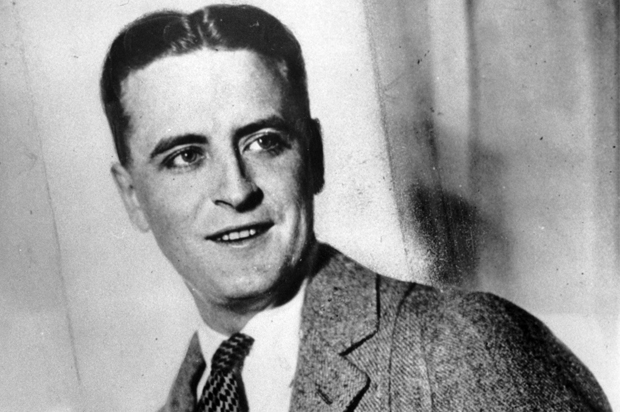

Questions about Jay Gatsby used to be so simple. Was he a bootlegger? Did he kill a man? Was he in on the fix of the 1919 World Series?
But now, 75 years after the publication of F. Scott Fitzgerald’s “The Great Gatsby,” a literature professor has a new question: Was Gatsby black? And he has arrived at an answer: Yes. “Fitzgerald characterizes Jay Gatsby as a pale black individual passing as white,” says Carlyle V. Thompson, an assistant professor in the department of literature, languages and philosophy at Medgar Evers College in Brooklyn, N.Y. And the reason he does so? “It is the manifestation of Fitzgerald’s deep-seated apprehensions concerning miscegenation between blacks and whites.”
Thompson has found ample textual evidence for this throughout the book. Among the primary bits: Gatsby wears his hair trimmed short, or “close-cropped,” as Thompson puts it. He owns 40 acres and a mansion, instead of 40 acres and a mule. He changes his name from Gatz to Gatsby, much the way black individuals looking to pass change their names to begin a new future. And he tells Nick Carraway that his family is dead. “The word ‘dead’ is significant in that those light-skinned black individuals who pass for white become symbolically dead to their families,” Thompson wrote in a paper presented at a spring meeting of the College English Association in Charleston, S.C.
The general theme of the conference was “Back to the Future: Diversity for the New Millennium,” and Thompson participated as part of a panel on “Passing and Colorism in American Fiction.” His paper is titled “The Tragic Black ‘Buck’: Jay Gatsby’s passing in F. Scott Fitzgerald’s ‘The Great Gatsby.'” He hopes to publish it in a scholarly journal.
In the meantime, he says he has not run the idea by any Fitzgerald scholars. “I haven’t had the time.” Then he says, “I didn’t want to spook them. In some ways, they might be offended by it. No black scholars have looked at this book in any serious way. You need a black individual grounded in African-American history and folklore, and familiar with the signs of racial passing. Scholars are heavily invested in Gatsby’s being other than black. You’ve got Robert Redford in the movie.”
Thompson adds, “When I ask people what basis there is for Gatsby being white, I get silence. I have asked students, colleagues. They don’t know. They cannot give me any evidence to back up the speculation. And why haven’t people made this argument so far?”
Fitzgerald scholar Matthew J. Bruccoli has one answer. “Because it’s mishigas! If Fitzgerald wanted to write about blacks, it wouldn’t have taken 75 years to figure it out. If that’s what Fitzgerald wanted, he would have made it perfectly clear in April 1925. Great works of literature are not fodder for guessing games. This kind of thing is bad for literature, bad for Fitzgerald, bad for ‘The Great Gatsby’ and bad for students who get exposed to this kind of guessing game.”
But Thompson sees racial anxiety as the central narrative tension of the book, from the moment Tom Buchanan warns his friends that the white race has to “watch out or these other races will have control of things.” When Fitzgerald describes Gatsby as pale, such as in the scene when he meets Daisy for the first time in five years and is “pale as death,” Thompson sees evidence of an “ambiguous racial identity.”
More than that, “Every time we see black individuals — such as ‘the three modish negroes, two bucks and a girl’ in the limousine, or the ‘pale well-dressed negro’ who describes the yellow car that hit Myrtle Wilson — we see Gatsby or Gatsby has just left,” Thompson says. “And yellow always suggests high yellow, which is a signifier for people who pass.”
When he first presented the idea to his students, they were skeptical, he says. Then they began to come around, or at least some of them did. “I told them, ‘You’re not here to agree with me, I’m just giving you another way to look at this text.’ They get it because when you begin to add up all these connotative and denotative things, he’s doing something very specific. He’s setting up an analogy for Gatsby and blackness which we need to pay attention to. I think he is very caught up in the hysteria of the period around race.”
In academia, reading a text in a new way is generally known as “problematizing” a text.
“It’s the literary equivalent of the Rorschach blots. People just want to read into classics something original and new and totally divorced from the authors’ intentions,” says Charles Scribner III of Thompson’s idea. His family’s firm, Charles Scribner’s Sons, was Fitzgerald’s publisher. “I mean, it’s ridiculous. There’s nothing in Fitzgerald’s documentation, in the drafts, in his letters back and forth to the editor, Max Perkins, that would give any credence to such an interpretation of ‘The Great Gatsby.'”
Scribner, an editor at the Scribner imprint of Simon & Schuster, nevertheless sees an upside to the notion. “I suppose if it entices people to read this classic, it’s all for the best. Look, this is bad history but it’s not bad pedagogy. He can use the analogy to approach some of the themes of ‘Gatsby’ — of the outsider trying to be an insider, of the self-invented man. But please don’t claim that Fitzgerald intended this as the factual basis of his book.”
Thompson remains unfazed by such criticism. “Bruccoli’s career is invested in Gatsby being white. And a publisher is not a literary scholar,” he says. “Toni Morrison laid the groundwork for this in ‘Playing in the Dark: Whiteness and the Literary Imagination.’ She looks at Hemingway and Cather but not at Fitzgerald. People bring in new ideas. That is the way the world works.”
Thompson situates the book within a racially charged historical context. He notes that “Gatsby” was published six years after the “bloody Red Hot Summer of 1919, when membership in the Ku Klux Klan — a nativist group — was at its peak … In 1924, the Johnson-Reed Act excluded immigrants of African descent from entry to the United States.” He also identifies the correct title of the book that the character Tom Buchanan refers to as “‘The Rise of the Colored Empires’ by this man Goddard”; the actual text is “The Rising Tide of Color: Against White World-Supremacy,” by eugenicist Lothrop Stoddard, published in 1920.
But he doesn’t cite the publisher. Which happens to be Fitzgerald’s own Charles Scribner’s Sons. When a reporter raises the point, Thompson says, “It’s an interesting coincidence. Maybe it was a book they sent him.”
But Fitzgerald knew he was a rebel author being published by a then-conservative house. It was something he got off on. And so the mention of the book, according to Bruccoli, “was an inside joke. He’s teasing the people at Scribner. Here’s Fitzgerald using their book to characterize his character as a fool, a dope, a man of limited intelligence. It was a way of Fitzgerald pulling the leg of his friends at 597 Fifth Ave.”
Werner Sollors, a professor of Afro-American studies at Harvard University and author of “Neither Black Nor White Both: Thematic Explorations of Interracial Literature,” reads Tom Buchanan’s reasoning another way. “He sees himself ‘standing alone on the last barrier of civilization’ and philosophizes: ‘Nowadays people begin by sneering at family life and family institutions, and next they’ll throw everything overboard and have intermarriage between black and white,'” Sollors says. “In the context of the way in which Tom Buchanan’s own adherence to marital fidelity is portrayed, it would be difficult to view this as an authorial position on Fitzgerald’s part. Buchanan’s invoking of Lothrop Stoddard — Walter Benn Michaels made the connection very emphatically in ‘Our America: Nativism, Modernism, and Pluralism’ — similarly casts a certain light on Tom himself.”
Bruccoli has not read Thompson’s paper, but asked whether the book could be considered a “passing narrative,” which would place it alongside such works as “The House Behind the Cedars” by Charles Waddell Chesnutt and “The Autobiography of an Ex-Coloured Man” by James Weldon Johnson, his answer is simple: “God no.”
It was in 1997 that Thompson began his textual analysis of the book in earnest by turning to a concordance. There he discovered that the word “yellow” appears 22 times. He might have also noticed tallies of other colors — gold (10), pink (6), green (17).
“It may get the chap tenure, and it may get him a promotion,” says Bruccoli, who is Jefferies professor of English at the University of South Carolina. “Anybody in academia trying to get ahead deserves sympathy. It’s a mug’s game, an occupation in which the odds are against the people engaged in it. His idea is absurd, but I don’t want to take the bread out of someone’s mouth.”
