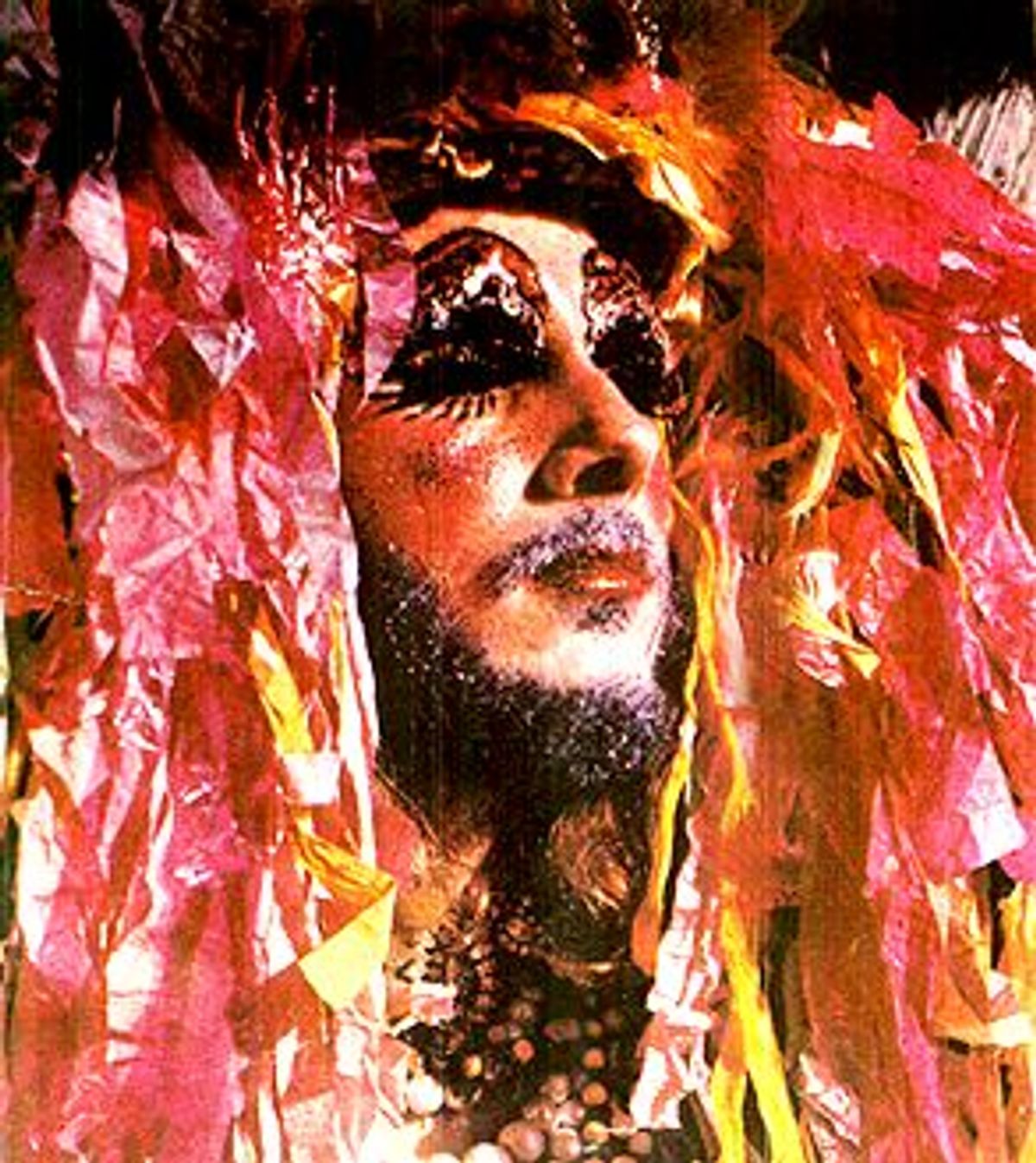
It began almost by accident, as a lark dreamed up by a man named Hibiscus. From 1969 to 1972, the Cockettes — an outrageous theatrical troupe comprising gay men, women and babies — used their LSD-infused exuberance, imaginations and a gift for dressing to the nines in thrift-store drag and glitter to illuminate a series of funny, flamboyant and utterly unprecedented midnight musicals performed at a run-down San Francisco movie theater.
The live shows, with names like “Tinsel Tarts in a Hot Coma,” “Pearls over Shanghai” and “Journey to the Center of Uranus,” were chaotic and witty costume extravaganzas featuring singing, dancing and in-your-face sexuality. As the Cockettes’ legend grew, they attracted fans such as Truman Capote (“The Cockettes are where it’s at!”) and Rex Reed who, in his nationally syndicated column, called the performances “a landmark in the history of new, liberated theater.”
Inevitably, the Cockettes became media favorites, showing up everywhere from Rolling Stone to Paris Match. They made a film, “Tricia’s Wedding,” a transvestite send-up of then-President Nixon’s daughter’s nuptials, and appeared in other films –”Elevator Girls in Bondage” and “Luminous Procuress.” When they were invited to bring their stage shows to New York, the cream of the city’s art and culture scene — Oscar de la Renta, Diana Vreeland, Robert Rauschenberg, John Lennon, Gore Vidal and Anthony Perkins — partied with them and showed up in force for the opening night performance. And that was when the party ended.
San Francisco filmmaker David Weissman and his partner, editor Bill Weber, are now in the final stages of completing “The Cockettes,” a feature-length documentary on the theatrical troupe that Weissman credits with, among other things, inspiring “the glitter rock era of David Bowie, Elton John, the New York Dolls, and the campy extravaganzas of Bette Midler and ‘The Rocky Horror Picture Show.’”
“Their influence was enormous,” Weissman remarked during the following conversation about the ebullient acid queens of his documentary. “Their whole presence was completely new and garnered a lot of attention. Drag had not received anywhere near that degree of visibility, particularly in a cultural context, outside of the gay community, prior to the Cockettes.” And during their star-crossed New York debut, columnist Lillian Roxon, commenting on the troupe’s impact on pop culture, wrote, “Every time you see too much glitter or a rhinestone out of place, you [will] know it’s because of the Cockettes.”
David, can you describe the San Francisco scene that gave birth to the Cockettes?
It was almost perfect — the Cockettes’ first show was New Year’s Eve 1969-70. So, symbolically, they defined the cusp — from the 1960s to the ’70s, from the Haight-Ashbury psychedelic, hippie era into the beginnings of the sexual revolution and gay liberation.
How were things changing then in the San Francisco counterculture?
The Haight-Ashbury scene was going through a decline that had started about 1968, which was due to the influx of millions of people from all over the world and enormous media attention, along with an increase in crime and the use of bad drugs — speed, cocaine, heroin. All those elements combined to degenerate the spirit of what the Haight had been before. But there were still a lot of interesting, creative people living in the Haight, and it remained a counterculture epicenter for the world. Of course, there had long been a gay scene in San Francisco.
Yes, since the 1930s or ’40s, perhaps earlier.
Absolutely. But the Cockettes didn’t really come out of the traditional gay scene. They emerged largely from the hippie, counterculture world of the Haight-Ashbury. But there was a pretty broad range of gay life here then. Remember, it was before Stonewall, although San Francisco had had its own gay activism — as early as the mid-1960s there was a lot of activity here. So, in a way the community was already much more receptive and more progressive in relationship to gay issues than most anywhere else in the world, or at least anywhere in the United States. Yet, it was before the official beginning of the gay liberation movement, which theoretically started with New York’s Stonewall riots in 1969.
How did the Cockettes begin? Who was the main creative force behind the group?
There was a magic moment when a lot of things came together. It all coalesced at the Pagoda Palace Theater on Washington Square in North Beach, which at the time was running a series of midnight movies every weekend called the Nocturnal Dream Shows. This was started by a filmmaker named Steven Arnold and a guy named Sebastian. They would show very eclectic screenings ranging from Betty Boop cartoons and Busby Berkeley movies to you name it. The audiences were these crazed hippies on acid who dressed up in costumes to attend.
What took place at the Pagoda Palace before midnight?
It was a Chinese movie theater showing Chinese-language films. The Chinese audience would file out at midnight into this massive crowd of crazed, decked-out hippies waiting to come into the Nocturnal Dream Shows. Now, the Dream Shows started as just a movie series, then the Cockettes, whose live performances became part of the after-midnight entertainment at the Pagoda Palace, emerged from the imagination of a man named Hibiscus, who died in 1982.
What was his background?
Hibiscus was from a New York theater family. He came to San Francisco in 1967. He was a very flamboyant character, very theatrical and charismatic. Over a period of time he got connected with people who shared an interest in a flamboyant street presence — in dressing up, wild costumes and street theater. And on that particular New Year’s Eve, a whole group of them got together and — there are a lot of different stories as to how it actually happened — apparently Hibiscus had asked Steven Arnold and Sebastian if he could bring a bunch of friends, men in dresses and beards and also women, and do an intermission act at the New Year’s show. It wasn’t on the program or anything. The Cockettes came up on stage and they did a can-can dance to the Stones’ “Honky Tonk Woman.” Everybody wound up with half of their clothes off — it was this wild bacchanal. Nobody had ever seen anything like it. There had never been bearded hippie drag queens before.
In traditional drag performances a man would impersonate a woman, but this was something different.
Right — this was not about female impersonation. This was what came to be known as gender-fuck, but it had not been done before. And everybody was stoned out of their brains and they had a ball. That’s how it happened. That first night was just a one-time idea to do a can-can during intermission.
Then they actually started writing scripts?
No, that took a while. For the early shows, Hibiscus, who was sort of the leader of the group in the sense that he was the charismatic one, would draw people together and come up with themes, but the themes were very loose for the few months the shows were just casual reviews. It was anarchic — everybody making up their own parts. It was very much about costume, dress-up and a theatrical attitude. Then, over time, the Cockettes started to become a big draw for the Palace and the show started getting a little more structured and developing in ways that had not been anticipated at the beginning. This was great, but it also started to cause problems.
What do you mean?
Hibiscus always had this idea of doing a free theater company. And while he loved the Cockettes, the fact was that they were doing this as part of a commercial endeavor. That was problematic because he believed that if you’re going to perform it should only be for free. Hibiscus had a more anarchic vision of what the Cockettes should be.
Did they get salaries?
They got a little money. Everybody has different memories of how much money they got, but it was not much. Sebastian became their manager and the whole issue of money started to stir things up. But the show started getting bigger and better — more structured, scripted — and they became quite popular.
What gave you the idea to do the documentary?
It’s funny, I never really thought about making documentaries before, but this movie is something that I was born to make. I’ve always had an interest in the world of drag as subversive, political humor. And for a long time I was interested in trying to do a book about the Angels of Light, the group that Hibiscus started after the Cockettes, but that never worked out. One day, I happened to be sitting at a cafe talking to a friend about the Cockettes and I said, “You know, somebody really needs to make a film about them, because they define such an incredible, historical moment.” That’s where I started. Then I asked Bill Weber, who is an extraordinary editor, if he might be interested in participating as my partner.
How did you go about raising the money?
Raising money is an ongoing process. First we had to determine whether or not the surviving Cockettes were willing to participate. And from the beginning we got a great reaction from them. They understood that we were serious and that we were going to approach this with integrity, respect and the appropriate amount of irreverence. Secondly, we needed to get a sense of whether or not there was enough material out there to allow a movie to be made. And we very quickly determined that there was — a lot of material: news articles, photographs, film, audio interviews, etc.
How close is the film to completion?
We’ve done about 90 percent of our shooting. And we’ve interviewed a number of Cockettes and other people, like John Waters. A lot of Cockettes have died. Starting in the early ’70s there were many deaths from drug overdoses. And then, beginning in the early ’80s and going all the way through to the present, there have been a lot of deaths from HIV, AIDS. But, amazingly, there’s still a solid core group of key Cockettes who have been interviewed for the film.
Were the Cockettes simply a long-running, theatrically tinged party or were they serious artists — or a little of both?
A little of both — or rather, a lot of both.
Their New York debut was something of a disaster, wasn’t it?
Yes, that was quite a fiasco. It all got started because there was a performance here in San Francisco that was attended by Rex Reed and Truman Capote. Reed wrote a wildly raving article about the Cockettes being the greatest thing that was happening in the world culturally. That started a big stir in New York and the Cockettes got very excited about going to New York and performing. What wound up happening was an incredible culture clash that was a disaster for the group. You see, the Cockettes really existed in the reality of the Palace Theater and that reality encompassed the audience and San Francisco.
The expectations of the San Francisco audience were completely different from those of New York audiences. The New Yorkers expected a high degree of professionalism and sophistication. The Cockettes just weren’t thinking in those terms, so you had a clash of East Coast and West Coast cultures. To some extent it brought out all the contradictions of what the Cockettes were. They were basically a ragtag group of hippies acting out their imaginations on stage.
They’d taken street theater indoors, but in New York they were seen as just amateurs?
Yes. The New York disaster was primarily opening night, which, of course, is the worst night to have a disaster in the theater. But there were a lot of reasons why opening night went wrong that probably could have been avoided. They took two different shows to New York and opening night they did the much weaker, less interesting, less original of the two — “Tinsel Tarts in a Hot Coma.” And they also didn’t have time to rehearse, really.
And expectations were very high.
The Cockettes were wined and dined and partied all over town by people like Robert Rauschenberg, Diana Vreeland and the Warhol folks. They were treated like royalty at the same time that they were being put up in this roach-infested hotel and not being paid anything really. So they were running around getting free food at parties, along with lots and lots of drugs. Consequently, when it came time to perform, they were a mess. They were tired from partying too much. The sound was bad in the New York theater, and their sets for the Palace Theater, which they brought with them, were just cardboard. The stage in the New York theater was more than twice as big as the Palace’s, so their sets looked like little rinky-dink things. There was just not a lot of advance thought put into bringing the show from San Francisco to New York.
The Cockettes apparently felt, “Well, we’ve done these shows 50 times. We know the material; we’re not big on rehearsing anyway, because our whole thing is about spontaneity, freshness and whatever happens, happens.” I think it says a lot about the Cockettes story: People had very grand delusions that often produced good results, but New York wound up being a big disaster.
They came back to San Francisco and continued for some time, but the luster was gone. In New York they hit both the top and the bottom.
Yes.
You see their impact on pop culture as being quite broad. How were the Cockettes influential?
It’s hard to differentiate the Zeitgeist from specific performers. Clearly, a lot of the glitter-rock stuff came very shortly after the Cockettes. Also there were Bette Midler’s big extravaganzas — she was performing at the Continental Baths in New York at the time the Cockettes performed in the city, and I know she went to see them. And Elton John’s glitter phase came very shortly after the Cockettes. Did the Cockettes make glitter rock happen? It’s hard to say. But they unquestionably created quite a stir in terms of their gender-bending, their campy, glittery presentation and just in terms of the drag. Drag had not received anywhere near that degree of visibility, particularly in a cultural context, outside of the gay community prior to the Cockettes.
I think it is impossible to deny that their influence was enormous. They were featured in Paris Match. They were in Rolling Stone all the time. Their whole presence was completely new and garnered a lot of attention. People loved photographing them. And when Diana Vreeland met them in New York, she was completely wowed by their costumes which were 50-cent thrift-store clothes. I think that their influence was significant in that they created a whole new genre of performance and visual presentation.
When will the film premiere?
I hope to have it done by the beginning of 2001.
You’ll be able to do that?
I think we will. It depends on fundraising — always a slow process. Documentaries raise their money through contributions from foundations, government and individuals. Because of the subject matter, we’re not going to get any NEA money for “The Cockettes.” We have received a number of foundation grants and we’re working to get individual donors. But this is an unusual project. It’s not a sober, social-issue documentary about the Holocaust, poverty in Latin America, abortion or something of that nature. The people who donate to documentaries based on specific social issues are not likely to fund a film about the Cockettes. On the other hand, this is going to be an extremely fun movie and I believe that it has an important, historical and social story to tell, but in a very entertaining context. I think that will work in our favor over the long run. It will give the movie more visibility than most documentaries get because it’s a very wild story.
This is the final part in a series of excerpts from “Season of the Witch,” Salon founder David Talbot’s new book about the wild and bloody birth of San Francisco values. Read
Part 1 and
Part 2.
By early 1977, it seemed that Jim Jones had conquered San Francisco. He had Mayor George Moscone in his pocket and commanded the fawning loyalty of power brokers such as Willie Brown and rising stars like Harvey Milk. Using San Francisco as its power base, the Peoples Temple was ready to expand its operations in Los Angeles, Seattle, and other cities where it had already sunk roots.
But in July — on the eve of a Peoples Temple expose in New West, a California magazine owned by Rupert Murdoch – a spooked Jones suddenly uprooted his flock and fled to the jungles of Guyana, far from the reach of curious reporters and government investigators.
Dave Reuben and his team in the district attorney’s office were stunned by Jones’s sudden flight. They thought the timing of his escape was suspicious, prompted not just by the imminent publication of the New West expose but also by their own investigation. Somebody in the Hall of Justice had clearly tipped off the temple. “We were ready for grand jury indictments; we were this close,” said Reuben. “And [DA] Freitas would’ve had to go along with it, because he had no other choice. The next thing I know, I get a phone call in the middle of the night. ‘Guess what, he’s gone.’ Jones is gone, and the temple is packing up and getting ready to join him. I remember, we had a meeting in the office, and we said, ‘Somebody snitched us off.’”
In the fall of 1977, as Jim Jones hunkered down in Guyana’s steaming tropical wilderness with his flock of more than 1,000 souls, disturbing reports about the “utopian” community began filtering back to the Bay Area. But political supporters like Harvey Milk, newly elected to the board of supervisors, stuck by the increasingly fanatical leader, out of fear, expedience, or stubborn loyalty. In December 1977 Milk wrote to Joseph Califano, President Carter’s secretary of health, education, and welfare, protesting HEW’s decision to stop forwarding Social Security checks to elderly temple members in Guyana — a key financial pipeline for Jones. “Peoples Temple,” Milk informed Califano, “[has] established a beautiful retirement community in Guyana, the type of which people of means would pay thousands of dollars to patronize.”
Other icons of the Bay Area left, including Angela Davis and Huey Newton, also continued to rally around Jones. Longtime Black Panthers attorney Charles Garry agreed to represent the preacher in his legal battles. Garry became an aggressive mouthpiece for the temple back in the United States, telling the press, “There is a conspiracy by government agencies to destroy the Peoples Temple.” Privately, Garry began to question Jones’s mental stability, but he kept his doubts to himself. After visiting Jonestown in October 1977, the radical lawyer announced, “I have seen paradise.”
In reality, the Jonestown “paradise” was a nightmarish Third World police state. Everyone but the youngest and oldest were forced to work like mules from dawn to dusk in the sweltering fields, scratching out a living from the wild jungle terrain. Chronically short of food, residents struggled to keep their weight up with starchy meals like cassava bread drenched in brown syrup and rice soaked with gravy. Families and lovers were forced to live apart, relatives were pitted against one another, neighbors were ordered to inform on each other.
After dinner, the exhausted community was forced to assemble for interminable “emergency meetings” and listen to Jones’s increasingly mad ravings late into the night. Punishment was swift for those who nodded off. One evening a 60-old father of five named Charlie, worn out from fieldwork, slumped to the ground. An incensed Jones commanded Charlie’s son to wrap a boa constrictor around his father’s neck, releasing him only after the poor man’s face was turning red and he had humiliated himself by pissing his pants.
Jones and his heavily armed security team kept the community in a state of terrorized obedience. Minor infractions could send malefactors of all ages, even children, to the dreaded Box, a stuffy underground cubicle where they could be held for days. Those who dared to dissent were dispatched to the medical unit, where they were forcibly drugged and kept in a zombified state indefinitely.
While his followers lived hungry, Spartan lives, Emperor Jones resided in relative splendor in a cottage well stocked with electric appliances, delicacies like hard-boiled eggs, snacks, and soft drinks, and a cache of medications that he had expropriated from his aging and feeble residents. His drug supplies were endless.
The temple leader had been dependent on amphetamines, sedatives, and other drugs for years. Jim Jones Jr. remembered that as far back as the family’s days in Redwood Valley, his father kept a tray of white liquid in the refrigerator and would fix syringes with the fluid and inject himself. One time he overdosed, flailing around on the floor, and the worried kids were told that their father had suffered a heart attack. But years later, after working in a hospital, the younger Jones came to realize his father had displayed the symptoms of a speed addict.
In the glorious isolation of Jonestown, under his tropical canopy, Jones surrendered fully to his drug-fueled manias. He created an Orwellian dystopia and forced his captive followers to live in it. The nights were the worst, as the jungle’s dark silence was broken by a ghastly soundtrack of howler monkeys’ screechings and Jones’s sudden eruptions over the loudspeakers. Father’s voice was everywhere: in the huts, outhouses, fields. There was no getting away from his sleepless rants.
“White Night!” Father would yell in the deepest black of night, jolting his followers from their exhausted slumber. “White Night!” Residents were rushed toward the glaring lights of the pavilion, the elderly shuffling along in a daze, the children crying. When they were all gathered there, Jones — spazzy and hot-wired on speed — told them that the US government was about to pounce. They had to act quickly.
“Hear that sound?” Father told them. “The mercenaries are coming. The end has come. Time is up. Children . . . line up into two queues, one on either side of me.”
The guards stood solemn vigil over a large vat next to Jones.
“It tastes like fruit juice, children. It will not be hard to swallow.”
The White Night drill. It was terrifying but not real. Until the day it was.
Excerpted from “Season of the Witch” by David Talbot. Copyright 2012 by David Talbot. Excerpted by permission of Free Press, a division of Simon & Schuster. All rights reserved. No part of this excerpt may be reproduced or reprinted without permission in writing from the publisher.
Continue Reading
Close
This is Part 2 in a three-part series of excerpts from “Season of the Witch,” Salon founder David Talbot’s new book about the wild and bloody birth of San Francisco values. Read Part 1
here.
David Reuben — a short, scrappy investigator with the kind of commanding beak that looked like he enjoyed sticking it in people’s business — leaned back in his chair in San Francisco’s Hall of Justice building, nursing a cup of jailhouse java. Reuben listened with growing intensity as a middle-aged couple named Al and Jeannie Mills unraveled a jaw-dropping story about their lives in Jim Jones’s peculiar church. The Millses were the kind of homespun, American Gothic–looking people you wouldn’t glance at twice on the streets. But if 10 percent of what they were saying was true, Reuben figured, this case was going to rock the city — and the tremors would radiate far and wide.
Reuben had been recruited by San Francisco District Attorney Joe Freitas after the DA was swept into office with progressive mayor George Moscone in 1975. Like Moscone, Freitas was a Kennedyesque Catholic politician with wavy-haired, Mediterranean good looks. Raised in a Portuguese family in the Central Valley, Freitas had served in all the stations of the liberal cross, including the National Urban League and Common Cause, before running for San Francisco DA at the age of 36. Brimming with youthful self-confidence and political ambition, the new district attorney created a special prosecutions unit, filling it with young “red hots”—as Reuben described himself and his gung-ho colleagues. Freitas promised his mod squad a free hand in going after city corruption. “He told us there were no holds barred: dirty cops, dirty politicians, payoffs,” recalled Reuben. “Joe said, ‘I don’t care who it is, you go after them.’”
Freitas recruited crusading lawyers and investigators from all over the country for his new unit. Reuben and his crew came in with guns blazing, targeting the deep corruption in the San Francisco police force, including payoffs to cops by the skin trade moguls in North Beach. But Reuben soon found that the San Francisco justice establishment was more impregnable than he had imagined.
Coming from Chicago, where he had broken in as an investigator for the state attorney’s office, pursuing corruption in Mayor Richard Daley’s permanent regime, Reuben thought he had seen it all. But the San Francisco cop culture proved an even tougher nut to crack. “I thought that coming from Chicago, I knew old-boy’s networks,” he said, “but this was really something out here. It’s a true old-boy’s network. All the cops and prosecutors know each other, they’re all friends and family, they all went to the same parochial schools. And here we all come into the DA’s office: we were all in our twenties, and we’re all ballbusters. I mean, I took on the Daley machine. We didn’t care, we were going to investigate everybody. Well, it turns out that you don’t do that in San Francisco — not unless you have the inside support. And I’m Jewish, from Chicago. So I was more outside than you can ever imagine.”
By the time that Al and Jeannie Mills walked into his small office at the Hall of Justice in early 1977, Reuben and his team were beginning to feel demoralized. They had won some minor victories in their campaign against police corruption, but they were feeling increasingly isolated—not just within the Hall of Justice, where police inspectors feared and hated them, but within the DA’s office itself, which was bitterly divided over Freitas’s progressive reign. But the Peoples Temple investigation could make up for all the frustrations, Reuben realized. It was the kind of case that could make an investigator’s career.
The Millses, who defected from the Peoples Temple in 1976, told Reuben and his team that Jim Jones was a violent, drug-crazed despot. They accused him of ordering the murders of disaffected members and subjecting others to savage beatings, including their 16-year-old daughter, who was whipped so severely, according to Al, “her butt looked like hamburger.” The couple — who had changed their names from Elmer and Deanna Mertle to evade temple enforcers — told the investigators that Jones forced members to turn over their property and possessions to the church and confiscated their welfare and Social Security checks. They said Jones had also built his organization into a potent political machine, manipulating elections and politicians and working his way into the inner circles of power in San Francisco.
Reuben and his colleagues immediately recognized how explosive the Millses’ charges were. “At the time, Jim Jones was an acknowledged civic leader,” recalled Reuben. “I mean, he was the Second Coming in this city, bringing together black and white, rich and poor. He had presidents and governors and congressmen kissing his ring. And Joe Freitas was one of those people.”
Reuben and the chief of the special prosecutions unit, a former US prosecutor named Bob Graham, girded their loins and walked into their boss’s office to present the accusations against the Peoples Temple. As Reuben and Graham itemized the charges to Freitas and his number two man, Danny Weinstein, the room grew tense. “We lay it all out, and you could’ve heard a pin drop,” Reuben said. “And then Joe looks at us and says, ‘What, are you guys nuts?’”
Freitas heatedly pointed out to his special prosecutions team that people walked into the DA’s office all the time with wild charges and personal grudges. “You guys can’t just buy this stuff,” Freitas admonished them.
Reuben and Graham were incensed. The hard-charging, windmill-tilting DA who had hired them — and told them they had carte blanche — was now suggesting that they back off what could be the hottest case they’d ever worked. They immediately knew what was going down. They’d read the newspapers and knew all about the furious allegations swirling around the city: that Jim Jones and his zombie flock had stolen the election for Mayor Moscone, and had worked hard for Freitas too.
“We were pissed,” Reuben recalled later. “It was too dynamic for us not to dig into. All the names mentioned — Willie Brown, Dianne Feinstein, George Moscone — the whole gang was in there, I’m sure. And, of course, it was obvious to us — we’re not idiots — Joe was in the middle of the thing. He knew that if we started doing this thing, his career might be affected.”
Freitas was too politically savvy to simply shut down the Peoples Temple investigation. He knew that his angry investigators’ suspicions could wind up in the press. So he gave his special team just enough leash to quietly look into the Millses’ accusations. And to make sure that Reuben and Graham did not dig too deeply, Freitas appointed a young deputy named Tim Stoen as his liaison on the case.
Reuben did not know much about Stoen. The deputy DA, who wore horn-rimmed glasses and three-piece suits, was a straitlaced loner. “He was a nerdy kind of guy,” Reuben recalled. “Very bright, well spoken. We thought he was one of us, a reformer. But we joked about it, because he seemed too idealistic. He really wasn’t friendly with anybody, just did his own thing.”
As Reuben and his team dug deeper into the Millses’ hair-raising stories about the Peoples Temple, the allegations were checking out. Interviewing other defectors and anxious relatives of temple members, the investigators soon learned how fearful these people were of reprisals from Jones’s security guards — all of whom, Reuben discovered, had long rap sheets. Reuben promised his witnesses that he would protect their anonymity. But when he and his colleagues casually referred to their partner on the case, Deputy District Attorney Tim Stoen, the witnesses looked stunned. “Tim Stoen?” said one defector to Reuben, with panic in his eyes. “He’s Jim Jones’s top legal advisor.”
A chill ran up Reuben’s spine when he heard this. Afterwards he and Bob Graham stumbled in a daze over to a cop bar across the street from the Hall of Justice, to compare notes. What the hell was going on? The question hung over them like a noose as they hunched over their drinks. “So now we’re figuring, Is Stoen a plant? Does Freitas know who he is, or did this guy just weasel his way in? Does this all go back to Jones? Even before this, we didn’t know who to trust in the office. But now we’re really paranoid, because we don’t know who’s calling the shots.”
The two investigators marched into Freitas’s office to confront their boss. “We blew up,” recalled Reuben. “We said, ‘What’s going on here? Are we being made patsies in this whole thing?’”
Freitas acted surprised. “He said, ‘Are you guys sure?’ And this and that, like he didn’t know anything about Stoen.” But the investigators realized that Stoen was far too cozy with their boss for him not to have known.
Joe Freitas would later tell the press he had no idea that Tim Stoen was Jones’s right-hand man when he hired him; that he had simply plucked his resume out of the slush pile. But in truth, the Peoples Temple, which had contributed money and campaigned for Freitas, engineered Stoen’s insertion into the DA’s office as a political reward for its efforts. And in a brazen move to cover up the voter fraud committed by the temple during the 1975 election, Freitas put the temple’s lawyer in charge of the investigation. In doing so, he ensured that San Francisco would never find out who’d really won the mayoral election. Stoen brought in Peoples Temple clerical volunteers to help with his politically sensitive probe. The foxes had free run of the henhouse, and they left only feathers.
Three years later, after the name Jim Jones had gone down in infamy, state and federal investigators finally began looking into the shady election. When they asked for all the rosters showing who voted, the city’s deputy registrar of voters went searching for the records in three locked vaults where they were kept. All the records were missing.
After they found out about Stoen, Reuben and Graham began taking their files home at night, no longer sure that they could protect the confidentiality of their Peoples Temple witnesses, some of whom feared for their lives. The investigators’ suspicions were well founded. Stoen, it turned out, was literally a sleeper in the DA’s office. He often spent the night there, though he had a residence on Page Street, giving him free access to the office’s most sensitive documents for almost a year. Stoen and his wife, Grace, whom he had brought into the temple, enjoyed “a free romp through the place after hours,” one source reported. Freitas later shrugged off his deputy’s after-hours routine. “He was a hard worker,” the DA explained, and after toiling late into the night he often needed to avail himself of his office couch.
Excerpted from “Season of the Witch” by David Talbot. Copyright 2012 by David Talbot. Excerpted by permission of Free Press, a division of Simon & Schuster. All rights reserved. No part of this excerpt may be reproduced or reprinted without permission in writing from the publisher.
Continue Reading
Close
“Season of the Witch,” the new book by Salon founder David Talbot, tells the story of the wild and bloody birth of “San Francisco values.” The following excerpt – Part 1 in a three-part series -- recounts one of the darker dramas before the ultimate triumph of those values.
Jim Jones, the strange and charismatic leader of Peoples Temple, proved a master at politically wiring San Francisco in the mid-1970s. The driven preacher had begun his climb up the political pyramid by planting roots in the Fillmore district, the city’s devastated black neighborhood. Jones moved into the Fillmore at its most vulnerable moment. Urban renewal czar Justin Herman – the Robert Moses of San Francisco — had “literally destroyed the neighborhood,” observed community activist Hannibal Williams, “[and] people were desperate for solutions, something to follow. Jim Jones was another solution. He had a charismatic personality that won the hearts and souls of people. And people followed him to hell. That’s where Jim Jones went. That’s where he took the people who followed him.”
Jones’s flock, ignored and scorned by society, was electrified by the preacher’s vision of a new Eden. Everybody was exalted in his services, even the lowliest recovering drunks and addicts. “He made us feel special, like something bigger than ourselves,” said one temple member. “Total equality, no rich or poor, no races,” said another. “We were alive in those services,” testified one more. “They had life, soul power.”
Jones — an oddball and renegade his entire life, someone who never felt at home in his own skin — had found his identity by taking on a black persona. He saw himself following in the footsteps of Malcolm and Martin, leading “his” people out of bondage and into the promised land.
In reality, Jones maintained a racial hierarchy within the organization. While church membership was primarily black, the 37-member planning commission, as Jones called his leadership council, was dominated by white women — at least six of whom were his sexual conquests and firmly under his sway. “When people talk about my father manipulating black people, that’s true,” said Jim Jones Jr., the preacher’s black adopted son. “It was politically advantageous for him to give me his name.”
There was something exhibitionistic about the way that Jones and his wife treated their black son. “I was the chosen one,” he said. “I was more loved in my family than the other kids, even their biological son, Stephan. I remember Mom wiping charcoal off a dirty pot one day and rubbing it all over her face — to show that we were all black.”
Jones soon learned that his control over a well-organized, mixed-race army of some 8,000 dedicated followers gave him major stature with San Francisco’s liberal elite. Redevelopment had bulldozed the Fillmore’s political power into the ground. But now this strange white man with the hipster shades, Indian-black hair, and cadences of a black Bible-thumper seemed to be erecting a new political power line into the rubble-strewn, crime-ridden no-man’s-land. Jones could be counted on to deliver busloads of obedient, well-dressed disciples to demonstrations, campaign rallies, and political precincts. The city’s liberal Burton machine — run by congressional powerhouse Phil Burton — quickly identified the Peoples Temple juggernaut as a potentially game-changing ally in its long battle to take over city hall.
It was Burton ally Willie Brown – a rising force in California’s state capital — who first recognized that Jones’s organization could play a pivotal role in his friend George Moscone’s run for mayor. Moscone, a charming and handsome state legislator, had electrified San Francisco progressives with his campaign for city hall. A champion of gays, women, minorities, tenants and organized labor, Moscone was locked in a tight race with a pack of opponents led by conservative realtor John Barbagelata, whose campaign evoked a nostalgia for an older San Francisco, when it was ruled by traditional Catholic values. A meeting was set up between Jones and Moscone in the office of Don Bradley, the candidate’s veteran campaign manager. Bradley was initially cautious. “I was a little leery we were getting into something like the Moonies,” he later recalled. But after he looked into the temple’s campaign history and saw how effective it was in delivering victories, Bradley enthusiastically embraced Jones’s volunteer army. Nearly 200 temple members showed up at Moscone headquarters, fanning out to campaign in some of the city’s toughest neighborhoods, and helping the candidate finish first in the November 1975 election.
In the December runoff between Moscone and Barbagelata, Peoples Temple went even further to secure victory for its candidate. On the eve of the election, Jones filled buses with temple members in Redwood Valley and Los Angeles and shuttled them to San Francisco. Security at polling places was lax on Election Day, and many nonresidents were able to cast their ballots for Moscone, some more than once. “You could have run around to 1200 precincts and voted 1200 times,” said a bitter Barbagelata later, after losing by a whisper of a margin. But he was not the only one who claimed that the Peoples Temple stole the election for George Moscone. Temple leaders also claimed credit.
“We loaded up all 13 of our buses with maybe 70 people on each bus, and we had those buses rolling nonstop up and down the coast into San Francisco the day before the election,” recalled Jim Jones Jr. “We had people going from precinct to precinct to vote. So could we have been the force that tipped the election to Moscone? Absolutely! Slam dunk. He only won by 4,000 votes. I’m sorry, but I’ve got to give my father credit for that. I think he did the right thing. George Moscone was a good person; he wanted what was best for San Francisco.”
Jim Jones made sure that George Moscone never forgot his political debt to Peoples Temple. The man who began his term in city hall with a ringing promise to make San Francisco a beacon of enlightenment would start off his administration with a wretched burden on his back. The mayor could never rid himself of the stench of contagion that Jones brought with him, and as time went by, the power-hungry preacher only sunk his fangs in deeper. The pastor was a wickedly smart reader of a politician’s character, and he knew that the way to enchant Moscone was with young women, not money. When it came to bribing politicians, the temple leader had ample supplies of both. Jones bragged of supplying Moscone with black female members of his congregation. Jim Jones Jr. remembered the mayor as “a party guy. He’d always be there at temple parties with a cocktail in his hand and doing some ass grabbing.”
Temple insiders talked about how Mayor Moscone was one of the politicians under the control of “Father.” They gossiped about the night that the mayor had fallen into Jones’s hands. “Moscone was known to be a boozer; he liked to drink at parties,” recalled temple member Hue Fortson, now a pastor in Southern California. “One night there was some sort of temple event that the mayor attended. The next morning I heard that Jones phoned Moscone and told him it was a pleasure to see him the night before and to see him having such a good time. ‘But I want to let you know that the young lady you went off with is underage,’ Jones told him. ‘Now don’t worry, Mayor, we’ll take care of you — because we know that you’ll take care of us.’”
Jones might have made up the stories of sexual blackmail. He was known to concoct outlandish tales. “Jim was always bragging that he had sexually compromising information about politicians,” remembered Terri Buford, an on-again, off-again mistress of Jones who belonged to the temple’s inner circle. “But you never knew if what he said was true. He once told me that Willie Brown was sexually attracted to him. He just made stuff up.”
Whether or not Moscone was sexually compromised by Jones, he was certainly politically ensnared. The mayor initially resisted the temple’s efforts to insert its members throughout city government. And when Jones himself pushed for a high-level appointment, Moscone at first tried to appease him with a harmless post on the human rights commission. But the temple leader insisted on a position that had more clout, and the mayor decided he was in no position to alienate Jones. In October 1976 Moscone announced that he was naming Jones to the San Francisco Housing Authority, which oversees the operation of the city’s public housing. The agency, the largest landlord in the city, was a notorious maze of corruption, and it provided Jones’s organization with ample opportunity for shady self-dealing. A few months later, Moscone pulled strings to promote Jones, making him chairman.
Jones swept into the normally tedious meetings of the housing commission like a banana republic despot, surrounded by an entourage of aides and grim-faced security guards. Looking stern and inscrutable behind his aviator sunglasses, Jones ran the meetings with scripted precision while sipping a frothy white drink brought to him by a hovering retainer. The audience, packed with elderly black temple worshippers, erupted into wild cheers at his most routine pronouncements. Temple enforcers roamed through the meetings, keeping a watchful vigil, and even blocking people from entering the bathroom while Jones was inside.
Jones used his position to take possession of public housing units and install temple members in them, and he put other followers on the housing authority payroll. The preacher was building his own power base within city government. “He was using his power to recruit members and to put the hammer on people,” said David Reuben, an investigator for San Francisco District Attorney Joseph Freitas, another politician under Jones’s sway. “He had a lot of authority.”
“Jim Jones helped George Moscone run this city,” said Jim Jones Jr., a chillingly matter-of-fact assessment of the temple leader’s creeping encroachment in San Francisco.
Political leaders, aware of Jones’s ability to deliver — or manufacture — votes, lined up to pay tribute to the preacher. He worked his way into the good graces of officials high and low — most of them Democrats, since that was the party in power in California and San Francisco in the mid-1970s. But Jones was also happy to exchange mutually complimentary correspondence with the offices of Ronald Reagan and statesman Henry Kissinger.
During the 1976 presidential campaign, Jones wangled a private meeting with Jimmy Carter’s wife, Rosalynn, at the elegant Stanford Court Hotel on Nob Hill, arriving with a security contingent that was larger than her Secret Service squad. Later Jones accompanied Moscone and a group of Democratic dignitaries who climbed aboard vice presidential candidate Walter Mondale’s private jet when it touched down at San Francisco International Airport.
Governor Jerry Brown sang the preacher’s praises. Congressman John Burton, Phil’s brother, lobbied the governor to appoint Jones to the high-profile board of regents, which oversaw California’s sprawling public university system. San Francisco Supervisor – now U.S. Senator — Dianne Feinstein accepted an invitation to lunch with Jones and to tour Peoples Temple.
But no political figures were more gushing in their praise of Jones than Willie Brown and Harvey Milk, San Francisco’s rising tribune of gay freedom. Milk, a perennial candidate for office until he finally won a supervisor’s seat in 1977, aggressively sought Jones’s political blessing. “Our paths have crossed,” Milk wrote Jones during an earlier campaign for supervisor, in a letter filled with the kind of awed reverence that the cult leader demanded from his followers. “They will stay crossed. It is a fight that I will walk with you into . . . The first time I heard you, you made a statement: ‘Take one of us, and you must take all of us.’ Please add my name.”
Not content to hear dignitaries whisper flatteries into his ear, Jones staged a testimonial banquet in his own honor and demanded that politicians in his debt offer him public tribute. On the evening of September 25, 1976, the Peoples Temple headquarters on Geary Boulevard was converted into a formal dining hall with linen tablecloths and floral arrangements. At the head table sat Mayor Moscone, District Attorney Freitas, and Assemblyman Willie Brown, who acted as the evening’s exuberant master of ceremonies. As he introduced the man of the hour to the overflow audience, Brown reached new heights of shameless, ass-kissing puffery. “Let me present to you,” Brown roared, “a combination of Martin King, Angela Davis, Albert Einstein . . . Chairman Mao.” By the time Jones rose to tumultuous applause, he seemed likely to walk on water.
Privately, San Francisco political leaders expressed doubts about Jones and his strange church. One day a friend of Milk’s named Tory Hartmann dropped off some boxes of campaign brochures at Peoples Temple, so that Jones’s army could distribute them. Hartmann was immediately unnerved by the uptight, high-security atmosphere inside the temple, where sentries stood at attention outside each room, like the palace guards in the Wicked Witch’s castle. “This is a church?” Hartmann said to herself. Later, after she sped back to the Castro and told Milk about her bizarre experience, the naturally cheery politician turned deadly serious. “Make sure you’re always nice to the Peoples Temple,” he told her. “They’re weird and they’re dangerous, and you never want to be on their bad side.”
Cleve Jones, a young Milk aide, accompanied him to Peoples Temple for a couple of Sunday services. “Harvey told me, ‘Be careful, they tape everything.’ Everyone knew Jim Jones was creepy, everyone knew he was a megalomaniac. But everybody also saw this church full of black and white people — black people from the Fillmore who had been subjected to apartheid-like policies and seemed to finally be getting some respect.”
Members of Moscone’s staff were also beginning to hear troubling reports about Peoples Temple. One day mayoral aide Dick Sklar suggested to his family maid — an African-American woman who had followed the Sklars to San Francisco from Ohio — that she attend a Sunday service at Peoples Temple. “I didn’t know anything about it,” Sklar said, “but she was a churchgoing woman, and I thought she might like it. Afterward she came back and said it was the scariest place she’d ever been. They searched her, asked her questions. I had no idea.”
Moscone himself could not ignore how peculiar his political ally was. “I was at every meeting that Jim Jones ever attended with the mayor,” said Moscone press secretary Corey Busch. “I can tell you that after every one of those meetings, the reaction was, ‘This is one weird bird.’ He always wore the dark glasses. You couldn’t predict Jonestown, but he was definitely weird. In retrospect, maybe we should have seen that, but we didn’t.”
Excerpted from “Season of the Witch” by David Talbot. Copyright 2012 by David Talbot. Excerpted by permission of Free Press, a division of Simon & Schuster. All rights reserved. No part of this excerpt may be reproduced or reprinted without permission in writing from the publisher.
Continue Reading
Close
This essay is the first in a new series on Salon about bisexual experiences.
I proposed to my last girlfriend in Lesvos, Greece, at sunset, overlooking the craggy shores of Skala Eresou. I carried the ring 8,000 miles. I wasn’t eloquent, but she cried and I cried and as we walked back to our rented house, we played a game where we guessed the number of stray cats we’d see along the way. We said the loser had to kiss the winner a million times.
Shortly after that, we moved to San Francisco. Shortly after that, I was on a different shore and she was on a boat drifting farther away from me each day. Shortly after that, we stopped having sex. Words were somewhere in the absence growing between us but I couldn’t find them. My only weapon was repetition. I made us dinner. We watched “Glee.” We went to yoga. Shortly after that, she told me she wanted to date men, that our relationship was over.
My ex-girlfriend now has a boyfriend and lives in Minnesota. My yoga teacher, who announced to her mom at age 8 that she was a lesbian, now exclusively dates men, and has been in a committed relationship with a man for more than a year. My straightest guy friends have all at least made out with other men, while others are now dabbling in full-on dude sex. Whatever norm you came in with, San Francisco eventually takes it and turns it right on its (uncircumcised, pierced) head. It shouldn’t have surprised me that the City wanted to have its way with me too. Still, I was the last person who thought I’d be a lesbian who spent the next year and a half of her life sleeping with men.
San Francisco is no stranger to the provocative, I know. Nary a rally or Sunday stroll exists without the backdrop of a few naked men in cock rings and pink faux-hawks. Here the rainbow flag is larger than the American one, parents push strollers around the Folsom Street Fair, and spectators can always drop in to the monthly porn wrestling matches at the Armory if dinner and a movie is too passé.
Sometimes I think S.F. is one of those Emerald City-type places where, free of many of the cultural or religious constraints that plague other cities, you can be the truest version of yourself, or at least have a really good time exploring untrue versions of yourself along the way. It’s a city that embraces the idea of potential, not limitations. I realize, of course, that sexuality can’t really be articulated or altered by a ZIP code, but all this flip-flopping seemed pervasive to me, and I figured the City itself, its brazenness, its tendency toward experimentation and spectacle, had to at least play a role in this shifting sexual mind-set.
I didn’t realize I liked girls until I was 20, so I was never a gold-star lesbian (someone who never slept with boys), but I am pretty stereotypically gay. I was a high school gym teacher. I drive a pickup truck. I minored in women’s studies. I know the difference between tempeh and seitan. It’s all womyn and grrls up in this hizzy, in other words. Yet I found myself a few months after my breakup mired in men, and behaving a lot straighter than I had at any other time in my life, which includes the brief affair I tried to have with eyelash crimpers in high school.
The first guy in S.F. I slept with was a friend I’d known for years. He offered to be my wingman at a tranny dance party during Pride weekend, but at the end of the night, we were the lone “straight” couple making out on the dance floor. It was somewhat embarrassing, actually. I felt like I was betraying myself, and “my people,” which was silly because no one knew who I was or cared about whom I made out with. As if the hot boi in the bow tie and suspenders would suddenly leap up and pronounce me a fraud between Le Tigre mashups. I went home with my friend and we had sex for hours. We didn’t discuss anything or stop to wonder if this was a good idea. We just kept moving to the rhythm of each other’s particular hungers. Afterward I felt so relieved. The months of frustration and rejection that led to my breakup were all released during this one marathon night of hetero sex. “I’m OK,” I thought. “I’m going to be OK.” While waiting for the bus outside his house, I burst into tears.
Then there was another friend, a new one. We went to a bar and he told me to tell him my life story, starting from birth. It took 12 hours, and he didn’t once let me ask him any questions in return. We held hands on the way back to his apartment and I remember thinking, “This is so wrong. Our hands don’t fit together. Our hands are just grasping at anything.”
San Francisco’s not an easy city to live in. Everyone is struggling a little, to pay the exorbitant rents, to stand out in a lasting way, to grow up as slowly as possible. I was unemployed the first five months I lived here, then took an internship that paid $6.25 an hour. Without the relationship luxury of shared expenses, I was barely surviving. But I was writing and I was having sex, which somehow made my financial and emotional woes more bearable. After a while, being straight felt more subversive to me than being queer, even more so when I was having queer sex with straight men. I would strap on a dildo and screw men face down on the mattress. I would grip their hips in my hands and feel alive, powerful. “I am moving on,” I thought. “I am free and empowered. This city won’t break me.”
I had a moment of panic shortly after that, where I blamed all of this on my ex-girlfriend. If she can be straight, then so can I, I told myself, as if that would prove anything. As if it would take away the anguish and loneliness of a life that would never again be ours.
Since many of us in San Francisco are struggling, it makes our connections to other people all the more urgent. We may be dropping a grand each month to live in a closet, but at least we have friends, lovers and many of those murky, in-between relationships that resist definition and ease.
I had quite a few of these relationships. There was the writer, the filmmaker, the lawyer. None of them had names really. They were known to me by their professions, or in some cases, their kinks. It was freeing, in a way. In S.F., I wasn’t defined or confined by my identity as a lesbian. Nor did I have to make excuses as to why I didn’t want to be in a relationship with any of these men. It felt radical, for a time. I would tell them I liked girls, always expecting it to be a deterrent, slightly disappointed that it never was. Or maybe they just didn’t believe me. To these new people, my track record as a queer lady existed only in words, in stories that seemed to take place in some bygone era, when in fact it had less than a year.
In my darker moments, I saw my newfound straightness for what it was: a crutch to avoid the pain of being hurt again. If I in no way imitated that girl who got her heart broken, then I was safe. And since I wasn’t getting any attention from queer women anyway, did it even matter?
The longer I went without emotionally or physically connecting with women, the more confused I became. It was like I was watching a foreign film of my life without subtitles.
Being with men started becoming my norm. And it freaked me out. Because even though it wasn’t familiar, it was easy. There’s very little guesswork involved with picking up men. There was no need to scrutinize fingernail length or namedrop “The L Word” in order to determine if someone was amenable to sleeping with me. In fact, it was pretty much assumed that 15 minutes of uninterrupted talk with a dude meant the possibility of sex was on the table.
We like to name things because it gives us a sense of order and comfort. So we can feel connected to one another. If I say I’m a daughter we all know what that means. Or a liberal, or a feminist, or a molecular biologist. But sexuality often doesn’t work that way. If you don’t look the part of a queer, then you don’t exist. I encountered this problem in other areas of my life as well. I’m half Native American, but you’d never know it unless I was standing next to my raven-haired mother. In this way, my queerness didn’t make sense unless it was in relation to who I was fucking at the time, which further alienated me from my former sexual identity. When all you have is your word, you’re always dependent on other people’s beliefs.
On the rare occasion that a woman did express interest in me, she was usually straight, another byproduct of San Francisco’s peculiar lure. Everyone was getting their rocks off, but no one was happy. This became even more evident when my dude sex started to sour. One guy I met online thought he could make me orgasm by simply commanding me to do so. Another guy reached over and took a hit from a pipe while inside me. Then two of my sex partners started having sex with each other and stopped having sex with me. It was all such a big, sticky mess that I am still trying to untangle.
S.F. author Stephen Elliott wrote recently that “San Francisco is this great drug and you sit on top of Bernal Heights and watch boats named ‘Opportunity’ and ‘Raw Ambition’ and ‘Your Worst Self’ sail by so far off you can’t read the red paint on their hulls, and throw your head back and open your mouth in the shape of a cloud.”
San Francisco taught me that a lot of things in my life had to end before I could begin again. It also taught me that there are no right or wrong ways to conduct your life, only honest ones.
Continue Reading
Close
From New York to Nashville, from Miami to Seattle, tens of thousands of people have taken to the streets to protest America’s shocking income inequality and a broken political-financial system that is designed to ensure that the rich get richer and the rest of us get nothing. It’s the most significant progressive protest movement in years. And yet in America’s most left-wing city, pundits for the San Francisco Chronicle, the city’s daily newspaper, are coming across like the smarmy voice of the Chamber of Commerce. They’re so obsessed with the Occupy San Francisco movement’s illegal encampment, its effects on local businesses and the unruliness of some of its members that they have failed to grasp its historic significance.
You’d expect this from a paper in Salt Lake City. But San Francisco? The place famous for nurturing the Beats and the hippies, the women’s and gay rights movements? The free-spirited city-state that has always laughed at American Babbitry and fought for social justice? We deserve better than this.
On Thursday, Oct. 27, the Chronicle ran an editorial titled, “Occupy Oakland exits the high ground.” While acknowledging that “[t]he sweeps were rough and far from perfect,” it defended Oakland’s decision to remove the tent city, saying it had become a “health hazard and a public nuisance.” “Health inspectors are equally concerned about San Francisco’s campground at the foot of Market Street.” The editorial warned that public support for the movement would likely wane if it didn’t comport itself in a more respectable way. “It’s doubtful the country wants permanent tent villages on its public doorstep,” the editorial concluded. “It’s more than just manners and hygiene that are discrediting this movement. The protesters’ messages, mixed and muddled from the start, are getting eclipsed by the unruliness that is afflicting people and businesses on Main Street.”
Chronicle columnist C.W. Nevius has been striking a similar note. To be fair, Nevius has not been strictly opposed to the Occupy San Francisco movement: He has sympathetically interviewed protesters and defended their First Amendment rights. But like the author(s) of the Chronicle’s Op-Ed, he has seen the movement through a prism of seemliness. On Tuesday, Oct. 25, Nevius wrote a column titled “Time for police to move in on Occupy SF protesters.” Nevius argued that the San Francisco police should never have allowed any tents to go up in the first place, but that it was now necessary to remove them. “Many of the city’s homeless residents have gravitated there, the sanitation is a nightmare, there are rats, and car batteries are neither a safe nor ecological energy source,” he wrote. He urged Mayor Ed Lee to prove his leadership qualities and remove the camp. “There is no other choice. As Occupy SF gets bigger and louder, the potential for trouble only increases. Lee is getting persistent questions about why there are tents all over the Embarcadero, and with the election looming, you can bet he’d like to show he can handle this.”
As the last sentence shows, Nevius’ column was written in an oddly ambiguous manner. On the one hand, he was clearly advocating that the camp be removed. On the other, he was simply acting as if were a neutral channel, a kind of Greek chorus for nameless power-broker types who were raising “persistent questions” about the unsightly tent village. The contradictions in this split perspective came into full view just three days after his column.
The very night Nevius’ column appeared, the debacle in Oakland took place, when decorated Iraq war veteran Scott Olsen had his skull fractured by a projectile fired by the police as they cleared the Occupy Oakland camp. The international press, not to mention mom-and-apple pie papers like USA Today, were all over the Olsen story.
In his Friday column, Nevius abruptly changed his position. Apparently, the “sanitation nightmare” and increasing “potential for trouble” that had existed three days earlier were no longer such pressing concerns. “There is no rush,” Nevius wrote. “[San Francisco Police Chief Greg] Suhr and [Mayor] Lee are still talking vaguely about clearing the area, perhaps by force. I’d say cool your jets and wait and see what happens. The great truth of law enforcement is that there is always time to overreact.” To his credit – although it also revealed the incoherence of his position — Nevius gave space to sources who completely contradicted the points he had made three days earlier. Apparently summarizing the position of political consultant Chris Lehane – although the context also left open the possibility that he was speaking for himself — Nevius wrote, “The city’s claim that the Occupy SF camp was rife with urine, vomit and feces was exaggerated. It looked like a way to justify a raid.”
Memo to Greek-chorus-channeling, “neutral reporter” Nevius: tell that to your alter ego, the guy who insists that the city has to tear down those unsightly tents now.
The bottom line is that the prissy preachiness of the Chronicle’s punditry, in the guise of “civic concern,” has led them to end up taking the Chamber of Commerce’s side on a crucial issue that goes to the heart of San Francisco’s identity. This is a far cry from the open-minded tradition of former Chronicle executive editor Scott Newhall, who ran the paper in its ‘60s glory days and made sure it welcomed the unsightly and unruly hippies, and the legendary columnist Herb Caen, who despite hobnobbing with the rich and powerful always sided with the little guy, with the bohemians and oddballs his beloved town was famous for.
Yes, the Occupy San Francisco tent village is illegal. Yes, it is unruly. Yes, there are homeless people there. The movement is filled with oddballs and dropouts and nuts, and based on my own visits there, they outnumber the “respectable” types, the unemployed workers and students and housewives. And if real problems arise, violence or vandalism or disease, the city has the right and obligation to take steps to remedy them. But since no such problems have arisen, it’s impossible to escape the conclusion that the hand-wringing about the tents is all about image. The Occupy San Francisco movement is flawed and unsightly, like panhandlers and street people. The tourist-friendly solution: clean it up.
But the crazies and dropouts and street people who are part of the movement deserve to be there, deserve to be seen. For they bear inarticulate witness to the inequities the movement is protesting. Of course, they didn’t all end up there because of society’s sins; bad choices and personal responsibility also played a role. They’re not the best spokesmen for the movement. But they, too, are part of the America that the movement is trying to make better. They, too, are our brothers.
That isn’t liberal swill. It comes from a book called the Bible.
There is an inevitable tension in this nascent movement between the homeless and the middle-class, between the hardcore types who welcome confrontation and the moderate types who don’t. But the tents at the foot of Market Street are literally big enough for all of them. And San Francisco, of all cities, should welcome those tents. They may be ugly, but there is something beautiful about them. Saint Francis, for whom this city is named and who began his saintly career when he gave his clothes to a poor man, would have understood that.
Continue Reading
Close