Daniel Kraus

Roo the day

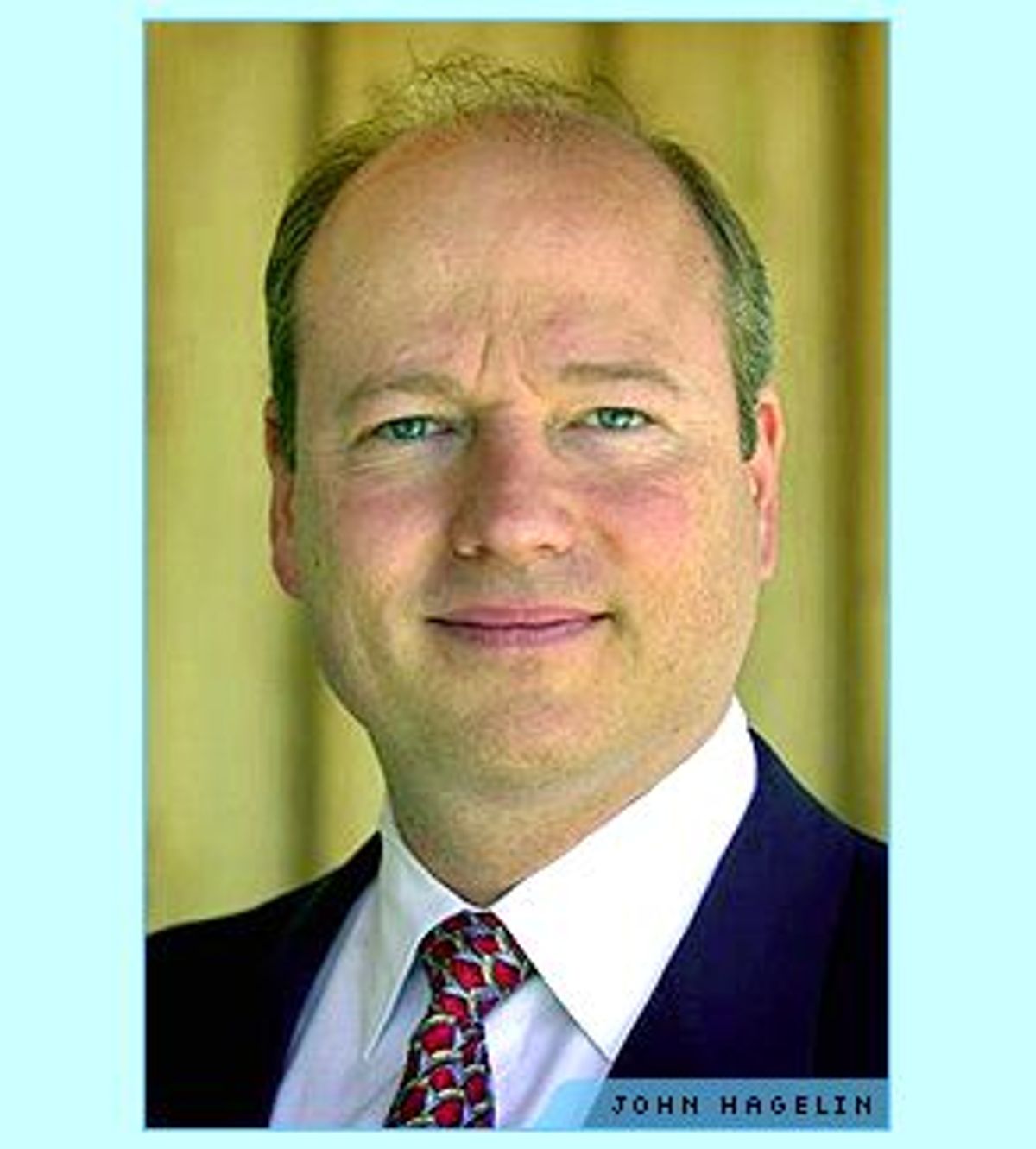
Presidential candidate John Hagelin and I come from different sides of the tracks in Fairfield, Iowa. And finally, I'm OK with that.

  • more
    • All Share Services

Roo the day

Today there is yet another outsider in our midst. In case you’re not familiar with Reform Party (and Natural Law Party) presidential candidate John Hagelin — and judging by a July 17 Reuters poll in which he got exactly zero percent of the vote, you’re not — let me tell you: He’s a “roo.” Lately Hagelin has tried to distance himself from his roo roots — strategically understandable, but ultimately unfortunate. Because the roos, as politically maladroit as they may be, are good folk.

I grew up in Fairfield, Iowa, population 9,768. At 35 mph, it takes five minutes to pass through. It is the home of the Fairfield Trojanettes (state basketball champs, ’83), a historic town square with a great Christmas-light display, a brand-new Burger King, an original John D. Rockefeller library building and a tiny little movie theater called the Co-Ed, where I worked as a teen.

Fairfield’s also the home of the Maharishi University of Management and the Maharishi School of the Age of Enlightenment (preschool through 12th), an educational system based on, among other things, a system of deep rest and stress release called transcendental meditation. MUM, where Hagelin is a physics professor, was founded in 1979 by the Maharishi Mahesh Yogi — who is best known as the guy who taught TM to the Beatles. The centerpiece of MUM is two enormous domes used for mass meditation, which can result, supposedly, in yogic flying — a period of heightened awareness that manifests itself in high hopping or levitation. (Masters of this technique sometimes engage in “flying” contests that involve racing, high jumps and hurdles.)

In Fairfield, you are either a “townie” or a “roo,” which is short for “guru” — Fairfield slang for meditator. I was a townie and, like all townies, thought the roos were completely out of their minds.

The roo adults, being in touch with their mind-body connection and whatnot, were prime targets for townie ridicule. The women wore flowing hemp skirts, the men had long hair. They appreciated art (the freaks!) and they hung out in the lobby of the Co-Ed as I tried to close down, discussing the performances and cinematography. On occasion, I’d get really oddball requests — one roo patron insisted that I plug in a digital clock somewhere in the theater, as it would help the film’s “transmission.” I never did figure that one out.

The roo kids were just as easy to spot. Many, being vegetarians, were skinny and pale. Some were foreign. Roo kids wore white MUM uniforms, had punk-rock hair, rode skateboards and listened to music we didn’t like (or wouldn’t discover until college). In a city of reasonable size, roos wouldn’t have been given a second look, but in Fairfield, they were sideshow curiosities: raving street lunatics dining on spinach pie and room-temperature water and talking about building an ideal society.

Besides, we townies — cruising around “the loop” in our Guess overalls, hair-sprayed bangs and rattail mullets, listening to the progressive sounds of Alabama and Whitesnake while chewing plugs of Skoal — were, quite obviously, already the picture of Utopian civilization.

Townies drank beer to spice up what was essentially a monotonic existence. The roo kids did drugs, we speculated, to find respite from the cultlike atmosphere at MUM. Ignorant of our basic sameness, S.E. Hinton-style rumbles would result. If you were an oddsmaker, you’d favor the townies (hey, we were bigger), but, as any townie would concede, you could never count out the roos — those crazy sumbitches were liable to go postal on your white butt.

In 1992, I attended one of the first Natural Law Party rallies in Fairfield, but only because the girl I was dating babysat for the family whose estate it was held on. The lawn was segmented into quadrants filled with representatives of each of the 50 states. There was a large stage with Hagelin’s picture and the Natural Law Party logo, consisting of a rainbow and puffy blue clouds. Roos were everywhere — more than I had ever dreamed existed. People were playing acoustic guitars. Couples in their 40s were kissing, for Pete’s sake. I was 16 years old and had never seen anything like it.

Soon after, I started gritting my teeth when I heard the word “roo” at the kitchen table. (A couple of years later, in what should have been a foreseeable linguistic development, the roos reclaimed the word, and today call themselves “roos” with good-humored impunity. In fact, the roos have a history of subverting townie spite — in the early ’80s, roo-mocking “Fly Iowa” hats were a big hit with the roos, to the chagrin of the creators.)

This May, Fairfield townies were in an uproar when MUM tore down Parson’s Hall. Not only was the building a remnant of the historic, townie-loved Parson’s College (on whose grounds MUM now stands), but it was being torn down because its doors did not have an eastern orientation, which could have, as MUM executive vice president Craig Pearson said, “negative and damaging effects” on those working inside it.

This is part of “vastu,” the art of building design that fosters health, happiness and prosperity. Vastu has inspired homeowners and shopkeepers all over Fairfield to board up their southern entrances and, in some cases, knock down entire walls. Some townies argued that Vedic architecture is derived from the Hindu religion and, therefore, destroying a federally funded campus building like Parson’s Hall violated the separation of church and state. (A roo friend of mine commented, “People take the Maharishi too literally. Next he’ll tell you to board up your north entrance, then your east and west. Only then will people realize that the only way out is up.”)

Taking lifestyle cues from a peaceful, bearded spiritual leader who lives in a compound far away does have obvious religious overtones. MUM has always sort of floated around, so to speak, in that taboo territory between science and religion, although TM practitioners insist that TM is not a religion and only enhances any beliefs you already practice. “The Transcendental Meditation technique is automatic,” says the MUM Web site. “It does not require any belief. It works for everyone.” The fee to learn this all-inclusive technique: $1,000.

But meditators claim that they’ve scientifically proved their “crime vaccine” — essentially, a gathering of meditators whose accumulated good energy lowers the crime rate of a given locale, like Washington, D.C. (July 1993), or Kosovo (August 1999). As a press release on the Web site states, “When the group reached about 350 Yogic Flyers, the [Kosovo] destruction ended.”

On the other hand, in Fairfield — where 20 percent of the population meditates on a daily basis — “criminal arrests on drug charges, weapons charges and for drunken driving increased dramatically in 1999,” according to the Fairfield Ledger. The town’s overcrowded jail was forced to send prisoners to five other Iowa jails in late 1999.

Considering that the Reform Party has become a group of political X-Men — fringe candidates whose mutant powers are not yet accepted by the human race — a levitating nuclear physicist like Hagelin seems a perfect leader. Unfortunately, he may merely be in the right place at the right time: Some Republicans are backing Hagelin simply to prevent Pat Buchanan from getting the disputed Reform Party nomination (and the $12.6 million in federal funds that the Federal Election Commission is deciding which of the two candidates is entitled to). Of course, if Hagelin does get the nomination, there’s no way he’ll receive the 5 percent of the vote that would entitle the Reform Party to any future federal funds — which could, in effect, bring an end to the party. Even in Jefferson County, where Fairfield is the only major township, Hagelin received only 23 percent of the presidential vote in 1992 and 21 percent in 1996.

Ominous Maharishi proclamations like “Democracy must be replaced by a system of administration that will create an integrated unified nation” and perplexing platform statements like “Natural law is the orderly principles — the laws of nature — that govern the functioning of nature everywhere, from atoms to ecosystems to galaxies” only succeed in frightening people. Instead of trying to push concepts such as the “crime vaccine” and “divine rule” (which, by most folks’ common logic, leads to “divine rulers”) on an unsuspecting America, perhaps the TM movement should spend more time disseminating the practical and personal uses of TM through more traditional outlets — radio, magazines and the talk show circuit.

Me, I love the roos. After I graduated from high school and moved away from Fairfield, I began to appreciate them more than ever. Their worst offense was that, on occasion, they seemed agreeably naive. But on the whole they were kind, courteous, artistic — and ultimately very conscious — people. They cared about what was happening in their community. They cared about what was happening in the world. They cared about what was happening to one another. And a byproduct of their presence was the most wonderfully multicultural small town in the Midwest.

It saddens me to hear that MUM is now looking into breaking off into its own city (tentatively called “Golden”). Separating from Fairfield would not be a good sign — if the roos can’t reach a community understanding within Fairfield, Iowa, they can hardly expect to succeed politically on a national level.

“Blood, guts, death, mayhem and nudity”

Eli Roth on the atrocious state of horror movies, actresses who won't get naked, his pal David Lynch, and the flesh-eating inspiration of his new film, "Cabin Fever."

  • more
    • All Share Services

Say what you will, horror fans take care of their own.

In 1981, Stephen King saw a gruesome little movie called “The Evil Dead” and liked it so much he gave the filmmakers a quote to put on their artwork: “The most ferociously original horror film of the year.” Thousands of underage VHS junkies — myself included — rented “The Evil Dead” on the basis on this endorsement and were treated to 85 of the most stomach-churning minutes in motion picture history.

“The Evil Dead,” directed by Sam Raimi (who went on to make “A Simple Plan” and “Spider-Man”), inspired hundreds of budding filmmakers, including a New Zealander named Peter Jackson. The future “Lord of the Rings” director promptly went out and shot “Dead Alive,” the only film to date able to approximate Raimi’s wildly inventive use of gore as comedy.

Today, the cycle continues. The one sheets and TV spots for Eli Roth’s “Evil Dead” homage “Cabin Fever” are dominated by a quote from Jackson: “Brilliant! Horror fans have been waiting years for a movie like ‘Cabin Fever.’” The nod is merely the latest in more than a year’s worth of hype, beginning with Lion’s Gate dishing out a record “high seven figures” for the film at the 2002 Toronto Film Festival and ending on every horror-film message board on the Internet. Not since “The Blair Witch Project” has a horror flick been so frightfully overexposed.

The bad news is that “Cabin Fever” is not the Second Coming — in fact, the film is somewhat redundant if you’re at all up on your horror history. But stranded as we are in a sea of irrelevant rubbish like “They,” “FearDotCom” and “Darkness Falls,” “Cabin Fever” is a bona fide adrenaline shot, a vivid reminder of the potent potential of horror.

The setup is simple but brutal. Five college friends rent an isolated cabin in the woods and discover a bloody, pus-covered drifter who communicates to one of them a deadly flesh-eating virus. Nobody wants to be next. Boyfriends turn on girlfriends. Best pals turn on best pals. Some barricade themselves in. Others try to flee. But can you ever really outrun a virus?

Roth spoke to me by telephone from his parents’ home in Boston.

It’s obvious right from the start of “Cabin Fever” that you genuinely love horror films.

Yeah, I love them and the genre’s been so fucking ghettoized in the last 20 years. It’s in shambles right now. We’re really in trouble.

We are. Have you seen “Valentine,” for example?

Things are fucked. It’s so bad. I wrote the story for “Cabin Fever” 10 years ago and finished the script eight years ago — that’s how long it took us to get this film made.

Why, of all things, a flesh-eating disease?

I’ve had a bunch of really horrible rare illnesses. When I was 12 I got this weird virus in my hip that paralyzed me. It’s called toxic synovitis and it strikes one in a million kids — and I was the one. Then, when I was 17, I went to Russia and I got this parasite called giardia and on top of it I had mono, so I spent about five months in bed drinking this poison that made my stomach feel like it was on fire, but if I didn’t drink it these things would be eating me. Then, when I was 19, I was in Iceland and I was working on this farm and got this weird infection in my face. I woke up one night and was scratching my face in my sleep and looked and there were chunks of blood and skin in my hand. The next morning I went to shave and literally began shaving off chunks of my face. It peeled like a banana.

Yuck.

Then, when I was 22, I was lying in bed and it felt like there was glass cutting my legs. I peeled back the sheet and my legs looked like Karen’s legs in “Cabin Fever” — just rotted, black, bleeding. And I hadn’t even had sex; I was like, “What the fuck is this?” And I went to the dermatologist and he said, “This is psoriasis.” But I’d just picture this army of things multiplying inside me and eating me from the inside.

Now that you mention STDs, “Cabin Fever” could be viewed as an AIDS parable.

Elvis Mitchell in the New York Times felt the same thing. My feeling was that I wanted to make a movie where if people wanted to see blood, guts, death, mayhem and tits they’d go and have a great time. But if they wanted to go again, they could think of the nature of the way people treat each other when they have a disease and that gray area where compassion turns into self-preservation. I wrote this story in 1993 and, yeah, AIDS was a big concern. We grew up watching these ’80s movies where everybody’s having sex with everybody and nobody’s discussing condoms. Then suddenly we were in college and everyone’s like, “If you have sex with the wrong person you’re going to die.” I mean, in a best-case scenario, bacteria and viruses get all of us.

It’s rare these days to see a horror film without an identifiable villain.

We got a lot of stupid comments from people saying, “Where’s the killer? There’s no killer!” When a [potential investor] would come up with a suggestion like, “We gotta have the disease start from aliens” — which was an actual suggestion — we’d say, “You’re fucking ridiculous.” When we were shooting two years ago, people kept saying, “Aw, God, the girl gets sick and they lock her in the shed? That’s so horrible.” But look what happened with SARS. When people don’t understand something, they isolate it. It’s something very dark in human nature that’s been going on for hundreds of years, from leper colonies to smallpox isolation and now SARS.

I was surprised that your film contains nudity. Not only is that rare these days, but it’s particularly effective when you see these nubile young bodies start to decompose.

That’s the idea. But it was a nightmare to find a girl who could act who was beautiful and would take her clothes off. Peter Jackson told me, “I can’t believe you had nudity in a horror film!”

Really? It was difficult? Once upon a time, nudity was mandatory in horror films.

Oh my God, no girls would do it. When people see nudity in a horror film script, they think it’s going to haunt them for the rest of their lives. If you do nudity in an artsy movie like “Monster’s Ball” then you’re rewarded for it, but if you do it in the wrong movie, it ruins you. I’d come in and meet with these actresses and they’d be stunning and gorgeous and they could act and were perfect for the part and they’d say, “But I won’t do the nudity. It’s exploitation.” They’ve just heard this term from their managers and don’t understand it.

I’d say, well, what about the seven-page spread you did in Maxim magazine, topless, covering your nipples, with your legs spread in a G-string? What’s that?” And they’re like, “That’s publicity. That’s different.” It’s like saying, “Yeah, I’ll be a secretary but I won’t answer the phone.” Acting is a job and there’s certain things that are required of this particular job, and one of those things is being naked in a sex scene.

Your film is filled with explicit references to other films. “The Evil Dead”…

“The Texas Chain Saw Massacre”…

“Deliverance”…

“Dawn of the Dead”…

“Last House on the Left”…

“Night of the Living Dead,” “After Hours”…

OK, so you’re into all these great “feel bad” movies of the ’70s, films that pressed buttons and pushed boundaries. Why don’t horror films do that anymore?

What happened was, in the ’70s making a horror film was taken seriously as an art form. You had every major director in the world, from Spielberg, Kubrick, Philip Kaufman, Richard Donner with “The Omen,” Ridley Scott, William Friedkin, all making horror films, going, “I’m going to make the scariest movie I can. I’m going to get the best actors, the best screenwriter, the best D.P., the best composer, and make it a world-class production that could win Oscars.” At the same time, you had a whole wave of young filmmakers making films about subjects that really terrified them. Tobe Hooper felt that you could be living right next to the Manson family, and so he made “The Texas Chain Saw Massacre.” George Romero felt like America was cannibalizing itself and we were becoming zombie slaves to consumerism, and so he made “Dawn of the Dead.”

Kind of like how you came up with “Cabin Fever” based on what scared you.

Exactly. Here’s what killed horror: In the ’80s the studio heads realized that even their shitty horror movies were making money. Movies like “Prom Night,” which were fun, but they weren’t “The Shining,” they weren’t “The Texas Chain Saw Massacre.” The slasher films killed horror. And then in 1985 Schwarzenegger took over and every time he killed someone, like in “Commando,” he made a pun and people ate that shit up. So now you have the Freddy Krueger sequels and every time he kills someone he makes a joke. By the end of the ’80s, horror films were a joke — filmmakers weren’t taking them seriously, fans weren’t taking them seriously, and at the same time there was a big backlash against the “Rambo” violence of the mid-’80s, so the MPAA starts cutting back on the gore and by 1990 you get the “Night of the Living Dead” remake and it’s bloodless — a bloodless movie! Then “The Silence of the Lambs” came out, right?

Right.

Fucking terrifying movie. But they go, “No, we’re not a horror film” because they don’t want to be associated with those shitty slasher movies, all those Freddy and Jason sequels. So they call it a “thriller” and it wins every Oscar. So then “Misery” comes out and they make a big stink saying they’re a thriller. And they win Oscars.

So now I’m trying to make my film, and people are like “horror is dead” and I’m like, “What about ‘The Sixth Sense’?” and they’re like, “That’s not a horror film — that’s a supernatural thriller.” Bullshit — that’s a fucking horror film! The term “supernatural thriller” did not exist before “The Sixth Sense”! Even movies like “28 Days Later,” you will not find a single interview where [director Danny Boyle] calls it a horror film — they call it a “viral thriller”! Despite the fact that the last third of the movie is completely stolen from “Day of the Dead”!

But I understand why. It makes sense, because when I told people I was making a horror film, it was like I was making a porn film. People said, “Oh, that’s great, I love B-movies.” And I said, “I love B-movies too, but I’m not making one.” So now you get these awful, awful movies like “I Know What You Did Last Summer” and “Valentine” and a bigger problem happens: Now you have TV stars like Neve Campbell and Jennifer Love Hewitt say, “I wanna go be in a horror movie” and you get stuff like “Halloween H2O.” All of a sudden, TV stars are looking at horror films as their vehicle to get famous. Only there’s one problem: They have a young fan base and, because they’re already stars, they don’t want to do what’s required of them in the role, i.e., nudity and effects scenes.

Which results in all these horror films being rated PG-13, right?

You get these fucking bullshit pussy-ass fucking suck-ass neutered-down castrated horror films where nobody is thinking, “How is this idea scary? How can we be pushing the envelope?” But if horror movies have shitty dialogue and a script like “Freddy vs. Jason” and they’re still successful, there’s no incentive to make them better.

Then why aren’t the eminent directors going back to make these kick-ass $500,000 horror films — guys like Tobe Hooper, John Carpenter, Wes Craven — filmmakers who clearly aren’t doing their best work anymore?

Tobe Hooper just did. He just shot “The Toolbox Murders” in 18 days. But it’s tough for some of these guys. I think a lot of these guys — I’m not saying anyone in particular — got lazy. There’s no incentive, they’ve lost their drive, they’ve done it, they’ve proven themselves. And they’ve just gotten beat down by the system — every time they make a movie it’s just years and years and years of all the good stuff being taken out and being told, “You can’t do this, you can’t do that.” It takes a lot out of you, and if you’re like 50 or 60 it’s not easy to do that. That’s why I’m setting up this company Raw Nerve, so that there will be a fund for them, for guys like Tobe Hooper.

I thought your company was called Dragonfly.

Dragonfly is my main company, but Raw Nerve’s goal is to make low-budget no-bullshit fucking scary fucked-up horror movies. It’s tough right now. You get a lot of scripts and they suck, so we’re just waiting and finding the right people — young filmmakers who want to do something really sick and older filmmakers that have been fucked with and have had their movies compromised. We want to be a safe haven for those people.

Would it be too grandiose to say Raw Nerve intends to reinvent the horror genre?

No. But it’s up to people like me and up to the fans to support them. Because I can sit here and squawk all I want, but ultimately my movie’s got to kill at the box office on opening weekend. You gotta realize the way Hollywood views “Cabin Fever”: R-rated, low-budget, no stars. Can it compete with “Matchstick Men” and “Once Upon a Time in Mexico”? Can you have a movie that’s just scary and disgusting and sick and people will still support it? If the answer is yes, it’ll open the floodgates for filmmakers to get their movies made.

You’ve been called a protégé of David Lynch…

I wouldn’t use that word. It’s not like I went to the David Lynch Academy.

But you’ve done research for him and did a lot of original work on his Web site.

On Thanksgiving 1999 Lynch called me and said, “We’re going on the Net, DavidLynch.com,” and he invited me over to talk and start throwing out ideas. And I started helping him coordinate these ideas and produce these shoots and it was a blast. He’d been so frustrated with “Mulholland Drive” — which had shut down at the time — that he just wanted to grab a camera and shoot with no boundaries. And that’s what we did.

Did he give you any advice before shooting “Cabin Fever”?

I said, “What’s the one piece of advice you could give me?” and he said, “Keep your eye on the doughnut, not the hole.” And he’s like, “What I mean by that is your movie — all the information that’s recorded on those 24 frames — that’s the doughnut. Everything else, all the distractions, all the egos, all the temper tantrums, all the bitching and the whining, everything — that’s the hole. But the only thing the audience members are ever going to see is what’s in front of the camera.” Keep your eye on the doughnut, not the hole.

That’s good advice.

Yeah. You know, if nothing else, people are finally remembering that horror films make the greatest date movies. If you wanna get laid, take your girl to “Cabin Fever.” You take her to a so-called date movie like “How to Lose a Guy in 10 Days” and the whole time you’ll be wondering when to make your big move. I personally guarantee that every two minutes in “Cabin Fever” there will be a chance she’ll grab you or stick her head in your chest. Your date should be in your lap in no less than 20 minutes. If you can’t score after seeing “Cabin Fever,” you’re hopeless.

Continue Reading Close

A Greek tragedy starring the Osbournes

Director Andrew Jarecki talks about his explosive documentary "Capturing the Friedmans," in which a family's home videos follow its own destruction in a bizarre child-abuse case.

  • more
    • All Share Services

A Greek tragedy starring the Osbournes

In 2002, filmmaker (and Moviefone founder) Andrew Jarecki began to shoot a documentary about New York birthday clowns. While working with one of the city’s most popular bozos, David Friedman, Jarecki noticed several offhand comments Friedman made about his family — something about his father, something about an injustice. When Jarecki inquired further, Friedman merely said there were some things he would rather not get into.

So, like any budding Errol Morris, Jarecki got into it. Research revealed that David’s Long Island family had been destroyed in 1987 when his father, Arnold, and younger brother Jesse were accused of hundreds of appalling crimes. The charges included possession of child pornography and the sodomizing of dozens of young boys enrolled in Arnold’s home-school computer class.

Jarecki switched the focus of his film to the Friedman case, whereupon David presented him with 25 hours of home videotapes shot contemporaneously by family members during the crisis — discomfiting, surreal footage of vicious arguments, shifting loyalties and grossly inappropriate mugging. This first-person depiction of the family’s implosion is as close to “snuff” as you will ever want to see, and is the most chilling use of amateur video since “The Blair Witch Project.”

By combining these home movies with the Friedman’s old 8mm reels and personal video diaries — plus an overwhelming collection of TV news footage and courtroom video archives — Jarecki makes an unsettling bio-technological discovery: A camera is a camera; the human brain is also a camera. Both run on electrical impulses. And both are infinitely fallible when employed to recover “the truth.”

Both Arnold and Jesse Friedman pleaded guilty to numerous heinous charges of abuse. Arnold died in prison in 1995 and Jesse served 13 years in prison before his release in 2001. But the question of whether they were really guilty of these dreadful and dramatic crimes is, to put it mildly, called into question by Jarecki’s exploration of the case.

The result of Jarecki’s efforts is the startling film “Capturing the Friedmans,” which won the Grand Jury Prize at the 2003 Sundance Film Festival. It opened last weekend at the Angelika Film Center in New York, where it broke the house box-office record for a documentary (set a year earlier by Michael Moore’s “Bowling for Columbine”). Openings in many more cities will follow. I spoke with Jarecki in Chicago.

America in 1987, when the Friedman case broke, was really at the dawn of home video culture. Our obsession with recording every “significant moment” of our lives is still growing. Why is that?

A big theme in the movie is the transient nature of memory; the ephemeral nature and dynamic nature. People talk about a “memory bank” like it’s a place where your memories sit static, but the reality is that as soon as you have an experience and it goes into your memory, it becomes just another electrochemical impulse, and it sits there bubbling like any other chemical reaction. Your memories evolve over time. I think recording is our effort to prevent that in some way. Certainly this [happens] in the film, when David says, “Maybe I shot the videotape so I wouldn’t have to remember it myself.”

Do you think the Friedman family was conscious that the camera lens was shielding them from the terror and confusion they should be feeling?

Well, David would tell you that they were just recording themselves because their father was going to jail and they wanted to record his last moments with his family, and you can understand that. At the same time, there’s also that feeling that so much was going on in their lives at that moment — it was so confusing, every day there was a new accusation or a new newspaper article — that you can also imagine they wanted to codify the past, they wanted to have a record they could go back to. They saw members of the family going away and knew [the family] was about to be destroyed. So I think they were clinging to those moments and saying, “Well, let’s capture them, and maybe later we can understand them better.”

OK, but now that they have seen the footage again, 16 years later, do they realize their home video recording habits were unusually intrusive and intimate?

They would say that the family was very theatrical to begin with. In the opening of the movie, you see these credits that they made in their own home movies, in happier times. They’d put up a big poster board in the street and they would write “Presented by the Friedman Family,” and then somebody off-camera would throw a basketball and knock it over. They were creative. They had a lot of good ideas. And they liked seeing themselves on film.

So they were well trained — it was like being trained for battle or something. Suddenly this thing that was all about the comedy of being able to record home movies comes in handy and is like really, really important. There is a feeling, I think, that 10 years from now all documentaries will have this first-person camera component. But at the time the Friedmans were doing it, they were the vanguard, they were really on the cutting edge of self-documentation. They were ahead of the curve, although it’s kind of tragic.

One of the most troubling things about the Friedmans’ home videos is that they often appear to be making light of their horrific situation. The most glaring example of this is when Jesse is awaiting sentencing, and he’s performing a Monty Python skit for his brothers on the courthouse steps.

That’s certainly a moment that is play-acted intentionally, because they’ve been waiting for three hours to get in the courthouse and they’re pretty freaked out and nervous. I understood that perfectly. The people who were watching them from the courthouse said, “Well, those kids are completely out of touch with reality.” And once you believe someone is crazy, you can believe that they’re capable of anything — and that was what happened in the investigation.

For example, you see this moment where David puts a pair of underwear on his head and walks around the front yard yelling at the TV cameras [when his father, Arnold, is first arrested]. If you believe the detective, David was reverting to an infantile state. That indicates that, well, he and his family members are not only crazy but crazy in such a way that underwear is implemented — “Aha!” But a second later in the film, David says, “There were 25 TV cameras. I reached into my bag and the first thing I came out with that I could put over my head was underwear.”

It’s hard not to compare your film with reality television. It’s like what might happen if the Osbourne family were suddenly charged with gruesome sex crimes.

That’s a fair characterization, but I also think the film is kind of epic and biblical and tragic; I really think it’s a Greek tragedy meets “The Osbournes.” There certainly is that voyeuristic quality. But I think here the stakes are so much higher — there were consequences, a family was destroyed, countless other families left the process believing that incredibly horrible things happened to their children, people ended up in jail, people ended up dead! You watch reality TV and the highest stakes are, “Is the girl going to get the bachelor?” Then they’re off to Cancun where you’re not going to see them again, and you’re going to turn on the next show.

With my film you don’t walk away thinking, “Well, I don’t know what happened, but who cares? Let those people rot in jail, let those other people feel like they were molested.” You feel you have to have an opinion. I think that’s what they’re searching for, frankly, in reality TV: Making people care about the characters and not just making it some momentary spectacle like “Jackass.”

I suppose the difference is clearest right at the beginning of the film, when David, in his video diary, says to the camera, “This is private. If you’re not me, turn it off.”

Yeah. Even in today’s world of reality TV, it’s OK to see somebody buried in a shallow grave with maggots all over them because that’s their biggest fear. But when somebody says, “I don’t want to be seen right now,” it still grabs us a little bit.

Continue Reading Close

“The Phantom Edit”

How one "Star Wars" fan nearly fixed the "Episode 1" disaster, and why George Lucas is indirectly stoking another kind of digital revolution.

  • more
    • All Share Services

Earlier this year, rumors of a new, supposedly better version of “Star Wars: Episode 1 — The Phantom Menace” began surfacing on the Internet. The rumor-mongers were not talking about the video version, which had already been released. Nor were they chattering about the then-unreleased DVD — just out, with extended scenes and George Lucas commentary — but actually a shorter version that was traversing the bootleg circuit. This version had been reedited by a fan who disliked the film, but who saw a lot of promise in the footage. The revision was titled “Episode 1.1 — The Phantom Edit,” and was, allegedly, much better than Lucas’ original.

For a while it was treated as but a wishful myth. But through the infamous underground network of “Star Wars” fanatics, copies of the new version began popping up all over the place. Fans would watch it in a friend’s living room or at a party, dub off a copy for themselves, download it onto their Web site and send it to other rabid fans.

No one knew who the “Phantom Editor” (as he identified himself at the start of the movie along with the e-mail address thephantomedit@hotmail.com) was or where the tape had its origins. But this added to the mystique and appeal, for materialized from out of nowhere was a good film that had been hidden inside the disappointing original one — perhaps the film that every adult “Star Wars” fan had been hoping “Episode 1″ would be.

Lucas supposedly was interested in seeing the reedit. And then it was rumored that the project was the work of filmmaker Kevin Smith (“Clerks,” “Chasing Amy,” “Dogma”), until a statement on Smith’s Web site denied it, adding that he “has seen a copy and can confirm that it does exist.” As further confirmation, a fan site popped up as a home base for discussion and analysis of the film (more than 105,961 hits thus far). Sample discussion subjects included “E-mail me if you want a copy,” “need a copy of the re-edit.please!!!!” as well as the more jargon-y “unpacked .rar file is a 700MB DivX encoded video.”

In early June, the alleged Phantom Editor himself, using the alias “Emily,” posted a fabricated Chicago Tribune article on the fan site, falsely reporting that several Aurora, Ill.-area Blockbusters were renting the revised film. The article was soon pulled, but not until after it had been quoted as fact in several publications, including the New York Post and Inside.com.

Things continued to escalate. Bootleg tapes were being sold on the street and at comic book conventions. A group calling itself “The Phantom Edit Fan Network” began organizing mass distribution of the tapes, handing them out in front of theaters and sending them to people in as many different states and countries as they could. Other edited versions, known as “Episode 1.2″, “1.14″ and “The Phantom Re-Edit NY” began to surface, each with its own take on how to make the movie better. Reputable news sources like the Chicago Tribune began running reviews of these revisions. “There has never, so far as I know, been a movie-critic’s cut,” wrote Village Voice critic J. Hoberman in the New York Times Magazine.

Meanwhile, the responses from Lucasfilm spokespeople began turning from amiable to intimidating. Back in mid-June, Lucas spokeswoman Jeanne Cole told Zap2it.com, “When we first heard about the [reedits], we realized that these were fans having some fun with ‘Star Wars,’ which we’ve never had a problem with. But over the last 10 days, this thing has grown and taken on a life of its own — as things sometimes do when associated with ‘Star Wars.’

“And, when we started hearing about massive duplication and distribution, we realized then that we had to be very clear that duplication and distribution of our materials is an infringement. And so we just kind of want to put everybody on notice that that is indeed the case.”

Furthermore, said Cole, Lucas no longer had any intention of watching any of the reedits.

On June 28 — two weeks after the veiled threat from Lucasfilm — the alleged Phantom Editor (who had previously admitted he was an industry outsider living in Los Angeles) e-mailed an apology to Zap2it.com, which it published in its entirety. It read in part:

“This project began as a personal endeavor when I watched ‘The Phantom Menace’ as an audience, analyzed it with the care and attention of a Lucas team member, and carefully re-edited it, concentrating on creating the storytelling style that Lucas originally made famous. … Although I definitely appreciate all the unexpected attention and support, I also respect and understand the discontentment of Lucasfilm Ltd.

“For the record, I am not now nor have I ever sold copies of ‘The Phantom Edit,’ and I DO NOT support this. I do not want my name associated with these kinds of activities. … I sincerely apologize to George Lucas, Lucasfilm Ltd. and the loyal ‘Star Wars’ fans around the world for my well-intentioned editing demonstration that escalated out of my control.” It’s true that the distribution channels for Phantom Edits have become a convoluted underground of hidden identities and carefully chosen words. No one wants to get in trouble with the Lucasfilm behemoth. At the same time, none of the editors seem to want credit for their work, either. These faceless “fan-toms” simply want to get their beloved Phantom Edits seen. For years, Lucas has been touting the approach of a new age of filmmaking, a revolution of sorts brought on by advancements in digital technology. He backed up his boasts with several key maneuvers. In 1997, he rereleased his original “Star Wars” trilogy as Special Editions. Each film was digitally remastered for optimal sound and picture quality and also included new scenes, shots and creatures of entirely digital origin.

“Episode 1 — The Phantom Menace” relied even more on digital imaging: Entire cities, action sequences, even major characters (including the much-maligned Jar-Jar Binks) existed principally inside a computer. Audaciously, Lucas decided to shoot next year’s “Episode 2″ on a 24-frame digital video camera rather than the standard 35mm film. The entire movie industry is well aware that a success could change the face of Hollywood forever.

However, it seems that the very technology that Lucas embraces has turned against him. Whereas digital technology equals “boundless imagination” for Lucas, it equals “cheap accessibility” for everyone else. These days, for a couple thousand dollars, you can own your own digital video camera and editing system, from which you can burn your movie directly to a DVD or download it onto your personal Web site. High-quality moviemaking no longer takes a crew of hundreds. It takes one person. And this is how “The Phantom Edit” was most likely created.

If you want to judge “The Phantom Edit” for yourself, it’s not too hard to nab a copy — just log onto the fan site, and read the discussion board, where you’ll find plenty of people willing to send or download you a copy. But far-reaching ramifications aside, “The Phantom Edit” itself is no classic, although it is indeed a better film than the 1.0 version.

The edit begins with the famous yellow scroll across the starry sky, only this time the scroll reads, in part:

“… Being someone of the ‘George Lucas Generation’ I have re-edited a standard VHS version of “The Phantom Menace,” into what I believe is a much stronger film by relieving the viewer of as much story redundancy, Anakin action and dialog, and Jar Jar Binks as possible.”

(Lucas’ perplexing opening paragraph about “trade relations” and the “Imperial Senate” is gone. And we don’t miss it because it wasn’t necessary. Already, “The Phantom Edit” is making improvements.)

Twenty minutes have been cut from the original 133, and as a result the film is tighter and faster. Jar-Jar, who has been demoted to an almost silent supporting role, is actually enjoyable. (A different “Phantom Edit” has dubbed over Jar-Jar with an alien voice, giving him subtitled dialogue that turns the gibbering idiot into a wise sage, spouting pearls like “Children and fools ask more questions” and “Pride can blind you from the truth.”) Likewise, young Anakin — whose shouts of “Yahoo!” and “Whoopee!” made many “Star Wars” fans grimace — is a thoughtful, much quieter protagonist.

Although entire extraneous sequences are missing (the journey to and from Jar-Jar’s underwater home have been sliced), most of the changes are simply felt rather than individually noticed, as is the case with any good edit. The Phantom Editor has smartly taken advantage of Lucas’ trademark “wipes” (a scene transition that scoots a new scene in from one edge of the screen to the other) to duck out of scenes early.

Although the film is improved in pace and structure, the result is a movie that occasionally moves too fast. We are left with a film made up of really short scenes — almost sound bytes — that start to feel choppy and rushed. While it advances the story faster, the film obviously cares for its characters even less than before.

More than anything, “The Phantom Edit” magnifies problems that can’t be fixed with clever editing: too many bland, uninvolving characters (the stoic Jedis, the stoic Princess Amidala, way too many digital characters), too few scenes with Darth Maul, no renegade comic relief à la Han Solo, and a typically confusing final battle that takes place in about 13 different locations at once.

Until the “Phantom Edit” controversy, the role of the editor has rarely been appreciated by the public. And in a way, “The Phantom Edit” illustrates that editors are not automatons serving a dictatorial director, but artists in their own right, contributing as much to a finished film as a writer or cinematographer.

But it is not easy to classify the Phantom Editor as simply an editor, for he is also a revisionist filmmaker, a film critic and — perhaps most of all — a restoration artist. The Phantom Editor has gone back to a completed artwork and tried to bring out what he saw as the “real” film, buried within Lucas’ edit. Aside from the fact that he’s subtracting footage rather than adding, the only difference between “The Phantom Edit” and what Lucas did with his rereleased “Special Editions” is permission.

If the still-growing deluge of “Phantom Menace” interpretations are any indication, this is only the beginning. We might see ambitious amateur editors take on overlong projects like “The Green Mile” or “Meet Joe Black,” or perhaps attempt to edit a TV series like “Twin Peaks” into a coherent feature-length film. It almost goes without saying that if 2002′s “Episode 2″ fails to live up to expectations, we will see “Episode 2.1″ through “2.9″ by year’s end.

With its obvious parallels to the Napster debate, the shifting of power from the filmmakers to the fans is both disturbing and exciting. It is disturbing because there will no longer be any sort of quality control, aside from the natural assumption that the best “fan edits” will be the ones that get passed around the most. We may have 100 different versions of the next “Star Wars,” and 95 of them will be sub-par.

What’s exciting is that one or two of these versions will not only be reedits but reimaginings, radically changing the narrative through unexpected audio and visual juxtapositions. The possibilities are endless — indeed, “Battlefield Earth” may be a much better picture when reedited into a 15-minute experimental short film. In the upcoming years we will be privileged to witness, essentially, critics making movies, which we haven’t seen in abundance since French New Wavers like Godard and Truffaut decided that the best response to a film was making another film.

If nothing else, the arrival of the fan edit takes its place alongside the recent slew of good movies made on consumer video cameras (such as “The Celebration,” “Dancer in the Dark,” “Chuck & Buck,” “The Blair Witch Project” and the just-released “Lisa Picard Is Famous”), as yet another way in which the proliferation of digital technology could change the movie industry for the better. Because if the filmmakers themselves can’t cut it, the fans will.

Continue Reading Close

Have a very Wookie Christmas

The dark, ugly secret of "Star Wars" is a "Holiday Special" banned from TV forever.

  • more
    • All Share Services

Aw, what’s wrong? Holidays giving you a case of the “Wookie-ookies”?

Take heart, friend. It could be worse. A lot worse. A hell of a lot worse.

A long time ago, in a galaxy far, far away (Nov. 17, 1978), CBS broadcast a two-hour holiday event called “The Star Wars Holiday Special.”

Never heard of it? That’s because after its ill-fated premiere, “Star Wars” creator George Lucas banished it forever from the realm of human existence. But something of this much weight has a way of reaching the masses.

“Special” is certainly one word for that show. Other words one might choose to apply include “distressing,” “appalling” and “bad.”

Yes, it was that unprecedented. Yes, it was that bad.

Among the “Star Wars” faithful, it’s taken for granted that their aloof Marin County Buddha wants every last trace of it expunged from the earth. Nearly every actor involved — essentially the entire cast of the first film — would probably rather forget his or her participation, especially Carrie Fisher. If you’re unlucky enough to come across a 10th-generation dub of this underwhelming indignity, you’ll find her performing a musical number.

A musical number with Wookies.

“The Star Wars Holiday Special” is like a massive train wreck — you see it coming, it makes a whole lotta noise and it’s really, really long.

There’s no plot per se, but the show drifts along something like this: It’s Life Day on the Wookie planet of Kashyyyk. (Life Day is sort of like Thanksgiving and Chanukah put together, except it’s much, much more boring.) Chewbacca’s return from his galactic adventures is eagerly awaited by his family — wife Malla, father Itchy and son Lumpy.

Once again, that’s “Itchy” and “Lumpy.”

Anyhow, Malla (who I think is supposed to be pretty, but looks a little like Leatherface from “The Texas Chain Saw Massacre”), Itchy and Lil’ Lumpy have several in-depth conversations regarding different Wookie-related matters. Of course, since they’re speaking Wookie-ese, we can’t understand a word.

This nonsensical squawking and squealing goes on for 20 minutes. Thankfully, Art Carney finally shows up and bestows upon the family a “mind evaporator.”

Which, come to think of it, actually explains most of the program so far.

Apparently unimpressed with the low caliber of the show’s guest-star cameo, Itchy settles down to indulge in a little Wookie porn via a sort of proto-cybersex virtual reality machine. Diahann Carroll appears in his porn finder, purring, “I am your fantasy. I am your pleasure. So enjoy me.” Which Itchy — licking his rubbery lips and shuddering orgasmically — proceeds (at length) to do.

Occasionally, the producers cut to space battle footage cribbed from “Star Wars” and check in on Chewbacca and Han Solo, who are in the Millennium Falcon, struggling to get Chewy back in time for Life Day. No, Harrison Ford didn’t weasel his way out of this TV bad boy, either. Nor did Mark Hamill, C-3PO or R2D2. (This is what is known as a “contractual obligation.”)

Luke Skywalker surfaces briefly, slathered in girlish makeup, and blathers incoherently for a while. Then there’s a few more dance sequences, a cartoon that introduces Boba Fett, no fewer than four different high-larious characters played by Harvey Korman, a Tatooine Cantina ballad sung by Bea Arthur (“You’re such a dear friend/You know I’m here, friend/Is that a tear, friend?”) and a startlingly bad performance by Jefferson Starship.

No, seriously.

Chewy eventually shows up back at home. Han greets the family: “Malla. Lumpy. Itchy.” Han scruffs the little one’s head, saying, “Look at Lumpy, he’s all grown up. I think his voice is changing.” Then Han hugs all four fur balls and pauses meaningfully at the door: “All of you are an important part of my life.”

Finally, we witness the moving Life Day ceremony. And at the end, when all the Wookies line up in their red robes and walk through the stars and into the moon …

Well, it’s, uh, really, um, baffling. I mean touching.

Was Lucas high when he authorized this? Although technically only 120 minutes long, the “Holiday Special” has the futuristic ability to slow time, and one emerges from its vortex some six days later bearded, weeping, defeated and sporting a limp. It’s the kind of experience that makes you want to go lie down in the road.

Yet, much as with “Schindler’s List,” perhaps everyone should be forced to watch it once, just so that nothing this abominable ever happens again. In their haste to capitalize on the entirely unexpected extraordinary success of “Star Wars” only months earlier, 20th Century Fox and CBS rushed to cater to the lowest common denominator. Quite obviously, they shot way, way, way too low.

Thankfully, lessons can be learned from this mistake. The progam’s jabbering nonsense and preschool sensibilities forewarned us of “Episode One’s” inexcusable Jar Jar Binks. Also, by showing us the absolute low point of the “Star Wars” universe, the special pointedly illustrates the harmful legacy of Lucas’ original masterpiece — namely, the priority put on cool lasers and nifty explosions as well as the leniency now granted galaxywide to expository “if only there was a way to get Chewy home for the holidays and still find time to shoot the ‘Star Wars’ franchise in the foot”-style dialogue.

And to ambitious movie producers, “The Star Wars Holiday Special” gives a stark warning as well: Do not, under any circumstances, make one that sucks.

But for now, Lucas can count his blessings. You will not be seeing “The Star Wars Holiday Special” — not this year, not any year. And if you’re lucky and pray really, really hard, maybe your grandkids will never have to see it either. Maybe there can be peace on Earth; maybe there can be goodwill toward men.

So have a merry Christmas. And may the Force most certainly not be with you.

Continue Reading Close

It's good to be the queen

For the belles of North Carolina's Azalea Festival, there's nothing like learning to graciously accept appreciative gawking.

  • more
    • All Share Services

It's good to be the queen

They begin appearing at 7:30 in the morning, clutching Egg McMuffins and steaming Hardee’s mugs. Wearing windbreakers and scarves, and mostly bald or white-haired, they sit down on the cement steps facing the empty riverside stage. They’re usually up at this hour anyway.

They have come to witness the Azalea Festival, which, fueled by a budget of $900,000 and more than 1,000 volunteers, is the biggest annual event in Wilmington, N.C. (population 60,000). More specifically, they have come to see the arrival and crowning of the 53rd Azalea Queen.

For 48 years, a woman known only as Funny Face has jockeyed for the best spot on the Cape Fear riverside, one that will give her ample room to blow a kiss to the Azalea Queen as she promenades toward the coronation stage. Funny Face has been here since dawn, her breakfast in a plastic bag and her folding chair bungee-corded to her back.

Ben and Mary Glisson are also here. They attended the first Azalea Festival back in 1948, when Hollywood starlet Jacqueline White was crowned the first queen and TV’s “Queen for a Day” offered a trip to the Azalea Festival as a grand prize, and they have attended all 52 since.

“We used to get up even earlier than this and go down to the circus to watch the elephants pull up the tents. But the [elephants] don’t do it no more.” Ben Glisson smiles and squints his wrinkled eyes. “They got too old.”

With the raspy swish of taffeta on pavement, the Azalea belles begin arriving — 96 local high school girls strapped and tucked into girdles, petticoats, sun hats and hoop dresses. They wear fingerless lace gloves and hold frilly silk parasols. Their hair — curled, woven and cunningly barretted — is so labored and extravagant you feel shamed by its lustrous proximity.

“What an experience for these young ladies,” raves one onlooker. The highly coveted opportunity to be a belle is largely one of learning how to gracefully accept appreciative gawking. Like their floral namesake, the Azalea belles are strategically planted around town to add an elegant, silent backdrop to every festival event.

Today, a local television crew asks one of them what’s happening, exactly. She responds, “We’re just sitting around, smiling.”

In 1998, during the crowning of Queen Alla Korot (from ABC’s “All My Children”), the unspoken strangeness of the Azalea belles became suddenly — and painfully — clear. The day was hot and the stone-still, cardiovascularly constricted Azalea belles began turning green and staggering like drunken sailors.

“Then they just started droppin’ one at a time, droppin’ like flies, boom, boom, boom, boom, boom, boom, boom,” recalls queen coordinator Sam Garner. “I remember seeing three or four go down.” They hit the cobblestone in a swirl of garters, bloomers and pretty pink flowers; it was like a scene from a David Lynch film, minus the dancing dwarf.

- – - – - – - – - – - – - – - – -

“I’ve lived in Wilmington since I was a little girl,” says 16-year-old belle Emily Sloan. “And every year I would come down to the festival and I’d see the belles, and it was like my dream to be one. They were so pretty and they looked like princesses — and every little girl wants to be a little princess.”

Fellow belle Candice Paige, 16, goes one better: “I’d love to be queen,” she says. So would dozens of other girls, for as many reasons:

“They give away $32 million of scholarship money every year, and I’m very grateful for the help with tuition.” — Miss North Carolina, Kelly Trogdon, 24.

“Because Miss East Coast represents the CUE Foundation, which works with missing children, and I’m a big fan of kids.” — Miss East Coast, Cheree Justus, 20.

“So I can represent my county and show girls that they’re beautiful inside and out.” — Teen Miss Brunswick County, Amanda Dew, who will achieve this goal by clog dancing to a “Grease” remix.

Teen Miss Valentine Sweetheart 2000-2001, Tiffany Danielle Smith, 16, was late for her performance and now slumps on the lawn in a pretty pink dress, dejected.

“Ever since I was a little kid, I always saw girls walking around with crowns on, and I always wanted a crown,” she says. “But now that I got the crown, I like the title, because it seems to make me feel like I’m somebody, and that I’m here and nobody can mistake me for anybody else.”

At the street fair, dozens and dozens of crown-topped young women crowd the Cape Fear Stage, a small, tarp-covered proscenium featuring performances by the likes of Little Miss Yam Festival, Teen Miss Tobacco Festival and Wee Miss Dublin Peanut Festival. Everywhere you look are sparkled tutus, spangled leotards, lips, hair, teeth and crowns. The hardest thing about the pageant is telling the princesses apart from one another.

“There’s a lot of crowns,” admits 16-year-old Melanie Brooks, who is the 2000 Azalea Princess (sort of an Azalea Queen Jr.). “But you can tell who the big crowns are. The Azalea Queen has a crown that requires no bobby pins whatsoever; it just slips on, very convenient. She’s a very important person — all the queen’s court, their crowns are bigger, pointier. My crown is more of a princess/girl crown, not as pointy, more rounded on the edges.” Brooks laughs. “It’s all very significant and meaningful.”

The show, like most pageants, is bittersweet. You can’t help reflecting on the absurd amount of preparation involved in winning a prize that unfortunately doesn’t exist in the real world: “Best Overall Girl.”

Chaplets firmly stapled to their skulls, the girls perform tap routines to Cher’s “Believe” and interpretive sassy-jazz ballets to “Phantom of the Opera” medleys while throwing worried glances through clenched grins at the flimsy stage structure that is ever threatening to crumple beneath the gusting winds. They play to an appreciative audience of other pageant winners and their mothers and exit the stage to canned applause.

While most Azalea Queens are soap opera starlets flown in from New York or Hollywood, Queen No. 53, Nina Repeta, is a hometown girl — and a costar on the locally shot teen drama “Dawson’s Creek.” Repeta has an affable tomboy charm, and she seems enjoyably out of place here, both flattered and amused by her sudden regal omnipotence.

Personable or not, getting an interview with Repeta during the festival is really, really difficult. Repeta and her court are shuttled between the circus, concerts, sporting events and parades, where they share the spotlight with the Hellmann’s mayonnaise jar, dung-scooping knaves from Medieval Times restaurant and exactly 1,752 local high school marching bands.

Repeta and her court take in a show at the local senior center. The Golden Pom-pom Cheerleading Team rushes the stage to belt out their names and ages: “Irma! 72! I-R-M-A!” “Martina! 67! M-A-R-T-I-N-A!” They proceed to execute Azalea Festival cheers, along with somersaults, splits and an actual pyramid. Strangely, the threat of cracked skulls and snapping limbs actually increases the audience’s enjoyment.

Although the seniors’ program is a sly parody of representations of beauty, it is also humorous and affectionate. Afterward, the nubile, young princesses willingly disperse into the sea of blue hair, gnarled fingers and wheelchairs, while the seniors squeeze arms and hug shoulders, as if contact with newer flesh might make them young again. The queens, sensing this almost carnal need, give generously.

Finally, I am inked in for an interview with Queen Nina between 8:15 and 8:30 in the morning, directly after she appears on a local morning television show. When I show up, I am told I have two minutes. Repeta is led over to me. The following is a partial transcript of that encounter:

I’ve got something like 75 seconds …

OK, go for it, go for it.

How early did you have to get up today?

Today I had to get up at a quarter to six, and it was very painful, but I made it.

Man: [butting in] We just really want a picture; could you be in it, too?

[Generously] You can go ahead and take pictures, we’re just …

[Very generously] Oh, yes, yes!

[Pretty much to myself at this point] I’m just gonna keep talkin’.

[Posing for the photo, smiling] You just keep talkin’.

Forty-five seconds later, she is whisked away, and I am left with post-royalty depression. Repeta has worked hard to get where she is and has, in my estimation, earned a celebration. And there’s nothing wrong with beauty being a part of that celebration — beauty is why people get up at 6 a.m. to see the Azalea Queen’s coronation, and beauty is why 6-year-old girls put on purple and gold lami and dance to Britney Spears songs.

But what happens when you’re forced to choose among beauties? What happens when you have to pick one beauty over another?

Sometimes there’s so much beauty in the world, you can hardly stand it.

Continue Reading Close

Page 1 of 3 in Daniel Kraus