Espionage

As the case crumbles

A judge orders scientist Wen Ho Lee free on bail as the prosecution's case appears to fall apart.

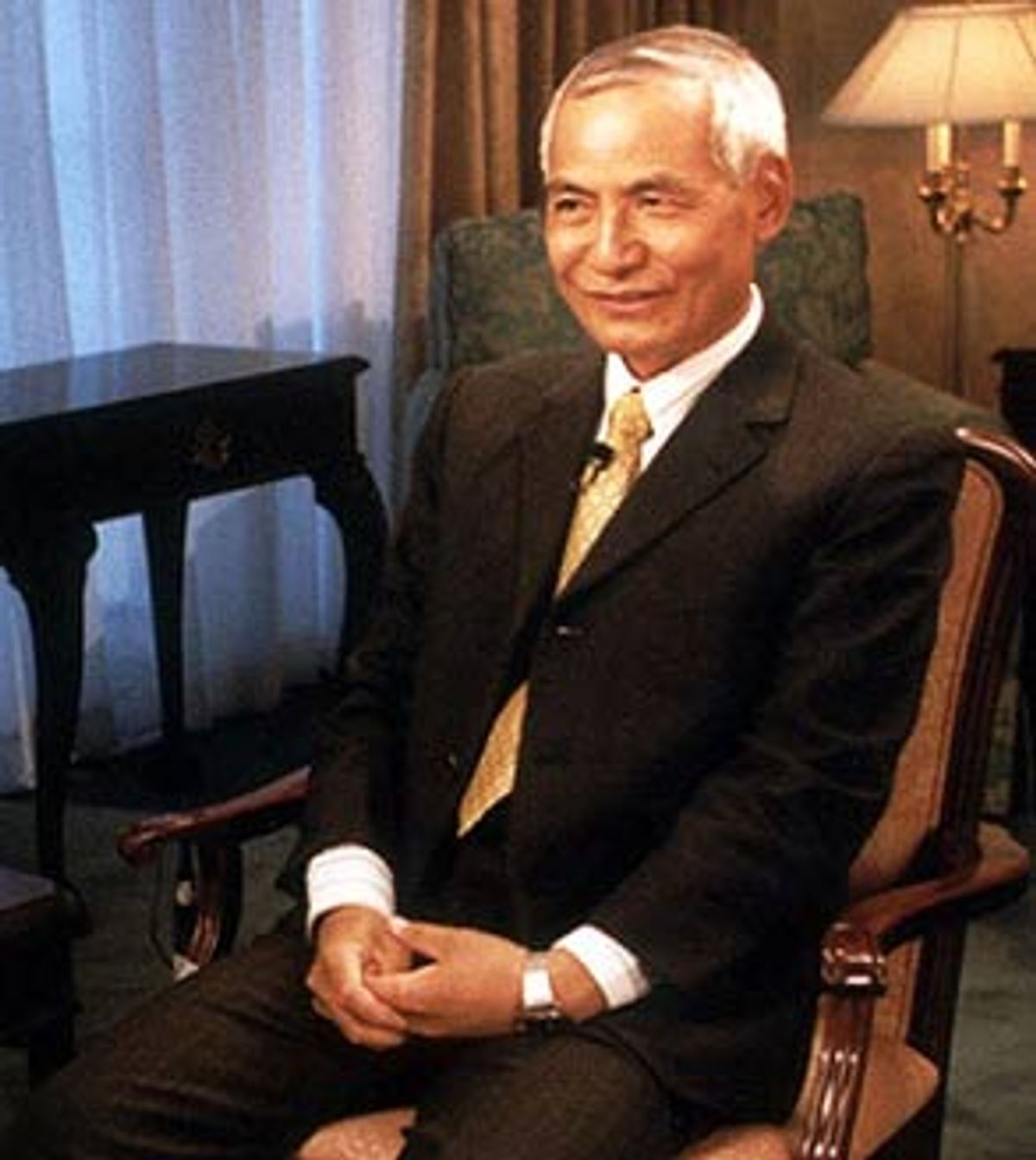
After eight months in jail, nuclear scientist Wen Ho Lee will be released as early as next week on $1 million bail, and allowed to return to his home. After months of hysteria over Chinese nuclear espionage, the man at the center of one of the biggest spy scandals since the Rosenberg case in the 1950s won’t even be charged with spying.

Federal District Court Judge James A. Parker ruled Thursday in Albuquerque that the case against Lee “no longer has the requisite clarity and persuasive character” necessary to justify keeping Lee behind bars until his trial starts in November. Lee has been held in solitary confinement since he was indicted on 59 counts of mishandling nuclear secrets. Parker’s decision represents a major blow to government prosecutors, who had convinced the judge in December that Lee posed enough of a danger to national security that he should be kept behind bars.

Lee’s supporters lauded Parker’s decision.

“As supporters and friends of Wen Ho Lee, we delight in the fact that very soon he’s going to be going home and not have to deal with this humiliating treatment of shackles and chains,” said Cecilia Chang, spokesperson for the Wen Ho Lee defense fund. “Obviously it’s not over yet. But to all of his supporters this is a relief because we do believe that the justice system should give him due process.”

Scholars and scientists who have been following the Lee case also welcomed Parker’s reversal.

“The way I see it, the prosecution overreached and will suffer for it,” said Stephen Aftergood of the Federation of American Scientists.

“Lee’s alleged downloading of weapons-related information is extremely alarming and the government’s concern was entirely legitimate,” said Jessica Stern, a senior fellow at Harvard’s Belfer Center for Science and International Affairs. “But some officials appear to have panicked in response to the news. Their overreaction and mishandling of the case will ultimately damage national security.”

During a three-day bail hearing this week, it was revealed that government prosecutors had misled the court. Weapons experts testified that the information Lee is said to have downloaded was of little value to foreign powers, and that the data wasn’t so sensitive or secret as to be “of a caliber where hundreds of millions of people could be killed” if leaked, as lead prosecutor George Stamboulidis had warned earlier in the week.

Lead FBI investigator Robert Messemer also admitted to Judge Parker that previous statements he had made in court about alleged deceptions by Lee were incorrect. (Messemer had previously testified that Lee had lied to a coworker by asking for password access in order to download a risumi. But the coworker told the FBI Lee had simply asked to download data files.) Nor have prosecutors presented any evidence that Lee handed over any information to any foreign powers.

But Lee isn’t out of the woods yet. When his case goes to trial in November, the scientist will face strong evidence that he violated important security procedures, flagrantly and repeatedly, by downloading classified information about nuclear weapons from secure government networks onto his home computers. Seven computer tapes allegedly containing information the scientist downloaded are still missing; Lee claims he destroyed them.

So far, the prosecution has failed to gather enough evidence to show that Lee committed these indiscretions with the intent of sharing nuclear secrets with the Chinese government. The difficulty of proving such charges was illustrated at a hearing in early July, when prosecutors admitted his security infractions were partly a matter of his hunt for a new job.

Evidence presented by the prosecution suggests that Lee had been seeking government positions in Australia and Switzerland — a job search that wouldn’t be highly unusual given the international demand for nuclear scientists.

Lee now sits in a maximum security prison in New Mexico, cut off from contact with anyone but his lawyers and family. During the one hour each week he is allowed to visit his family (through glass, with government agents sitting in the room), he is bound in shackles at the wrists and ankles.

When he returns to his New Mexico ranch-style home, Lee will be closely monitored. He will have access to one telephone line, wiretapped by the government, and will not be permitted to use any electronic devices, including computers. Only his wife, Sylvia, will be permitted to stay with him. Other family members may visit during the daytime, but only after arranging visits with government officials.

The way the government and the media have handled the prosecution of Lee has also taken on a serious racial dimension. Supporters say Lee, born in Taiwan and naturalized as a U.S. citizen, was singled out because of his ethnicity, and ensuing protests over “racial profiling” by the federal government have led to a brain drain of talented nuclear scientists of Asian ethnicity from national laboratories. Lee’s daughter, Alberta, has spearheaded protests against what she sees as racist scapegoating of her father because he is an Asian-American.

On Wednesday, a New York Times editorial called for Lee to be released on bail because the “integrity” of the prosecution’s case had been weakened by the latest disclosures. The Times was one of several papers across the country, including the Los Angeles Times and the Chicago Tribune, to call for Lee’s release. But the editorial didn’t mention the Times’ own role in the Lee saga — a special report on Chinese espionage in March 1999 that all but indicted Lee.

Although his name was never mentioned, the story continually characterized him as a “computer scientist who is Chinese-American,” as a “suspect … who ‘stuck out like a sore thumb’” — because his wife had presented a speech to a Chinese conference on computers, and because he had taken a work-related trip to Hong Kong — and as having failed a lie-detector test administered by the FBI. (Later that year, it was revealed that Lee had in fact passed the polygraph, and that the FBI had told Lee he had failed, possibly in order to intimidate him into revealing more information about his conduct.)

The hook for the story was the fact that China had somehow gotten hold of the plans for the compact W-88 warhead. In a special report by James Risen and Jeff Gerth, the Times documented a series of security leaks, and criticized the late detection of those leaks and the allegedly slow response by Energy Secretary Bill Richardson and others in the Clinton administration.

The major source for this story was former Energy Department counterintelligence operative Notra Trulock, a Republican who testified in Congress about the alleged nuclear theft, and later fueled the conspiracy rhetoric by comparing the alleged breach on national television to “the Rosenbergs-Fuchs compromise of the Manhattan Project information.”

Within days of its first investigative story, the Times revealed that the scientist was Lee. But it soon became clear that no evidence existed to support allegations that Lee had supplied the Chinese government with classified information about the W-88. Further investigation revealed that the plans in question weren’t even housed at Los Alamos, and that Lee couldn’t have been the culprit.

Not surprisingly, the New York Times is now coming in for criticism, as well as the FBI. Los Angeles Times columnist Robert Scheer chided the paper for relying on the government’s “lurid reports” in its initial story on Lee, and printing that Lee had failed the polygraph test which he’d passed. Scheer also blasted the government’s handling of the case, saying it raised “the specter of a government out to crucify an innocent individual in order to placate congressional and media critics.”

A hearing laying out the specific conditions of Lee’s bail begins Tuesday.

Fiona Morgan is an associate editor for Salon News.

Did the CIA spy on Iraq war critic Juan Cole?

Former agency officer claims the Bush White House asked for personal information on antiwar blogger

The New York Times is reporting a former CIA officer’s claim that the Bush White House and the CIA asked operatives to spy on university professor, blogger (and frequent Salon contributor) Juan Cole in 2005 and 2006.

From James Risen’s Thursday morning Times piece:

Glenn L. Carle, a former Central Intelligence Agency officer who was a top counterterrorism official during the administration of President George W. Bush, said the White House at least twice asked intelligence officials to gather sensitive information on [Professor Cole]. …

In an interview, Mr. Carle said his supervisor at the National Intelligence Council told him in 2005 that White House officials wanted “to get” Professor Cole, and made clear that he wanted Mr. Carle to collect information about him, an effort Mr. Carle rebuffed. Months later, Mr. Carle said, he confronted a C.I.A. official after learning of another attempt to collect information about Professor Cole. Mr. Carle said he contended at the time that such actions would have been unlawful.

If Carle’s claims are true, it would likely mean the CIA acted illegally; as former Agency lawyer Jeffrey H. Smith tells Risen: “The statute makes it very clear: you can’t spy on Americans.”

Cole has already responded to the news on his blog, calling for a full congressional investigation of Carle’s claims, which he says he believes are true:

It seems to me clear that the Bush White House was upset by my blogging of the Iraq War, in which I was using Arabic and other primary sources, and which contradicted the propaganda efforts of the administration attempting to make the enterprise look like a wild shining success.

Carle’s revelations come as a visceral shock. You had thought that with all the shennanigans of the CIA against anti-Vietnam war protesters and then Nixon’s use of the agency against critics like Daniel Ellsberg, that the Company and successive White Houses would have learned that the agency had no business spying on American citizens. …

I hope that the Senate and House Intelligence Committees will immediately launch an investigation of this clear violation of the law by the Bush White House and by the CIA officials concerned.

He concludes by telling readers “what alarms [him] most”: “I know I am a relatively small fish and it seems to me rather likely that I was not the only target of the baleful team at the White House.”

Continue Reading Close

Emma Mustich is a Salon contributor. Follow her on Twitter: @emustich.

“A Covert Affair”: Julia Child, spy girl

A new book tells the cloak-and-dagger story of the famous chef's early years in espionage

Shrewd marketing and its online equivalent, SEO (search engine optimization), dictate that Julia Child’s name gets top billing in both the title of Jennet Conant’s new nonfiction spy saga and in the headline for my review of the same. Yes, the famous French chef of cookbook and public television fame did work for the OSS (Office of Strategic Services), a U.S. intelligence agency, during World War II, as did Paul Child, the man she would eventually marry. However, Julia Child’s war was not so exciting as Jane Foster’s, and if Conant’s “A Covert Affair: Julia Child and Paul Child in the OSS” is somewhat of a bait-and-switch, providing more of Foster’s story than Child fans will expect, it’s hard to complain: Foster is such a remarkable, engaging, ambiguous character.

Foster and Julia McWilliams (Child’s maiden name) were part of a cohort of women (invariably referred to as “girls” by their colleagues) who signed up to work for William “Wild Bill” Donovan’s OSS during the war. They wanted to serve their country, but most of them — Julia especially — were looking for adventure, too. Foster’s ability to speak Malayan (the legacy of a brief marriage to a Dutch diplomat in her early 20s) and Julia’s superior administrative skills made them desirable recruits. So did their backgrounds.

Both women were from wealthy, prominent, conservative California families and had gone to tony women’s colleges, as did Betty MacDonald, one of Conant’s primary sources. The word around the OSS offices was that Donovan’s idea of the ideal female hire was “a cross between a Smith graduate, a Powers model and a Katie Gibbs secretary.” He liked to recruit rich Ivy Leaguers of both genders, reasoning that they were more resistant to bribes. Julia — tall, a bit gawky and unworldly — was intent on livening up her own personality after a youth spent in the narrow-minded upper echelons of Pasadena society. Foster, on the other hand, devoted herself to livening up everyone else’s.

Foster seems to have adopted the “madcap heiress” of 1930s Hollywood comedies as a role model. In her first posting, Ceylon, Foster adopted a baby chipmunk, which she raised, named Christopher and took to carrying around in her pocket. The animal’s many escapes and Foster’s subsequent pursuits led to absurd scandals, such as the time Foster crawled under a table to look for the rodent and ran her hand up a general’s pant leg. Charged with Morale Operations (propaganda), Foster devised a notorious operation in which hundreds of condoms were stuffed with anti-Japanese tracts and malaria medication then released by passing submarines off the coasts of Malaysia and Indonesia. She ran local agents and helped devise bogus news reports that mimicked Japanese broadcasts but were subtly tweaked to offend the native population of enemy-occupied territory.

Foster’s duties resembled those of a CIA case officer, although the CIA did not yet exist; Julia, on the other hand, ran the OSS camp’s “nerve center,” compiling the research that came in from the field and dispatching it to Washington and the field operations that needed it. Arguably, Julia’s was the more important job (she had a higher security clearance), but Foster’s was the more thrilling. And while the levelheaded, famously discreet Julia spent her time in the CBI (China-Burma-India) theater pining over Paul Child, who would not realize how perfectly suited they were to each other until after the war, Foster had tragic affairs, got into countless comical scrapes and saw much more of the conflict firsthand.

Things began to go wrong for Foster after the war, when she was sent to Indonesia and Vietnam to help supervise the liberation of POWs and otherwise keep an eye on things. The U.S. was so focused on rebuilding Europe that it was willing to sacrifice many Asian allies who had expected to be granted independence as a reward for helping to defeat the Japanese. Instead, the old, hated, European colonial powers began to reestablish their hold, unimpeded by the Americans. This outraged Foster, who witnessed atrocities and other injustices committed by Dutch and French troops against Indonesian and Vietnamese civilians and believed the U.S was seriously undermining its own interests. She wrote a blistering white paper condemning American policy in Indonesia (it was ignored) and quit her government job to head back to the States.

Meanwhile, after weathering a rough-and-ready posting in Chungking (“It’s dirty beyond belief, utterly inconvenient, full of disease, misery, corruption and mystery,” Paul Child wrote to his twin brother, “but I love it.”), the Childs finally concluded their long courtship. He went to work for the United States Information Service in Paris and she decided to learn to cook. They would not reconnect with Foster until 1952, when they discovered that she, too, was living in Paris, working as a painter under the name Madame Zlatovski. (She had married — or rather, remarried, since it turned out she’d been secretly married to a Russian immigrant throughout the war.) They found her, in Paul’s words, “just as lazy, hazy, impractical and loveable as she was seven years ago.”

The happiness of that reunion was short-lived. Foster and her husband were soon embroiled in the Red Scare, and Paul Child himself was briefly and scarily caught up in the slipstream of her troubles. “A Covert Affair” is a skillfully told tale of espionage, combining just enough background information with the right amount of boisterous anecdote to make the reader feel simultaneously amused and informed. For the early parts of the book, Conant leans heavily on Foster’s own memoirs, as well as Paul Child’s marvelous letters home. But when she gets to Foster’s indictment by a federal grand jury on charges of espionage for the Soviet Union, she has to pick her way across far more uncertain ground. She does so with aplomb.

Was Foster a Soviet spy or a victim of overzealous anti-Communist crusaders who were far too willing to believe the testimony of a showboating informer who also happened to be a proven plagiarist and con man? Without relinquishing her fundamental sympathy with Foster, Conant faults her subject for “her denial and her self-delusion” as well as her refusal “to confront the truth about herself at the most fundamental level.”

The larkish first half of “A Covert Affair” gives way to a much darker but more intriguing consideration of how personality becomes destiny; the very qualities that make Foster so much fun to read about also led to her downfall. The Childs are relegated to the sidelines in this final act, but it hardly matters; by that point, Foster is the one you really care about. Her considerable talents went to waste after the war, mostly because she insisted on saying things about Southeast Asia that the officials back home just didn’t want to hear. No surprise, they all turned out to be true.

Continue Reading Close
Laura Miller

Laura Miller is a senior writer for Salon. She is the author of "The Magician's Book: A Skeptic's Adventures in Narnia" and has a Web site, magiciansbook.com.

Tiny spy planes mimic birds and insects

Researchers are working on nature-inspired drones to help rescue people during disasters and, yes, also to spy

You’ll never look at hummingbirds the same again.

The Pentagon has poured millions of dollars into the development of tiny drones inspired by biology, each equipped with video and audio equipment that can record sights and sounds.

They could be used to spy, but also to locate people inside earthquake-crumpled buildings and detect hazardous chemical leaks.

The smaller, the better.

Besides the hummingbird, engineers in the growing unmanned aircraft industry are working on drones that look like insects and the helicopter-like maple leaf seed.

Researchers are even exploring ways to implant surveillance and other equipment into an insect as it is undergoing metamorphosis. They want to be able to control the creature.

The devices could end up being used by police officers and firefighters.

Their potential use outside of battle zones, however, is raising questions about privacy and the dangers of the winged creatures buzzing around in the same skies as aircraft.

For now, most of these devices are just inspiring awe.

With a 6.5-inch wing span, the remote-controlled bird weighs less than a AA battery and can fly at speeds of up to 11 mph, propelled only by the flapping of its two wings. A tiny video camera sits in its belly.

The bird can climb and descend vertically, fly sideways, forward and backward. It can rotate clockwise and counterclockwise.

Most of all it can hover and perch on a window ledge while it gathers intelligence, unbeknownst to the enemy.

“We were almost laughing out of being scared because we had signed up to do this,” said Matt Keennon, senior project engineer of California’s AeroVironment, which built the hummingbird.

The Pentagon asked them to develop a pocket-sized aircraft for surveillance and reconnaissance that mimicked biology. It could be anything, they said, from a dragonfly to a hummingbird.

Five years and $4 million later, the company has developed what it calls the world’s first hummingbird spy plane.

“It was very daunting up front and remained that way for quite some time into the project,” he said, after the drone blew by his head and landed on his hand during a media demonstration.

The toughest challenges were building a tiny vehicle that can fly for a prolonged period and be controlled or control itself.

AeroVironment has a history of developing such aircraft.

Over the decades, the Monrovia, Calif.-based company has developed everything from a flying mechanical reptile to a hydrogen-powered plane capable of flying in the stratosphere and surveying an area larger than Afghanistan at one glance.

It has become a leader in the hand-launched drone industry.

Troops fling a four-pound plane, called the Raven, into the air. They have come to rely on the real-time video it sends back, using it to locate roadside bombs or get a glimpse of what is happening over the next hill or around a corner.

The success of the hummingbird drone, however, “paves the way for a new generation of aircraft with the agility and appearance of small birds,” said Todd Hylton of the Pentagon’s research arm, Defense Advanced Research Projects Agency.

These drones are not just birds.

Lockheed Martin has developed a fake maple leaf seed, or so-called whirly bird, loaded with navigation equipment and imaging sensors. The spy plane weighs .07 ounces.

On the far end of the research spectrum, DARPA is also exploring the possibility of implanting live insects during metamorphosis with video cameras or sensors and controlling them by applying electrical stimulation to their wings.

The idea is for the military to be able to send in a swarm of bugs loaded with spy gear.

The military is also eyeing other uses.

The drones could be sent in to search buildings in urban combat zones. Police are interested in using them, among other things, to detect a hazardous chemical leak. Firefighters could fling them out over a disaster to get better data, quickly.

It is hard to tell what, if anything, will make it out of the lab, but their emergence presents challenges and not just with physics.

What are the legal implications, especially with interest among police in using tiny drones for surveillance, and their potential to invade people’s privacy, asks Peter W. Singer, author of the book, “Wired for War” about robotic warfare.

Singer said these questions will be increasingly discussed as robotics become a greater part of everyday life.

“It’s the equivalent to the advent of the printing press, the computer, gun powder,” he said. “It’s that scale of change.”


Continue Reading Close

White House denies WikiLeaks’ spying charges

Assertions that Secretary Clinton ordered her diplomats to engage in espionage is "ridiculous," says Robert Gibbs

President Barack Obama’s spokesman is labeling as “ridiculous” an assertion by the founder of WikiLeaks that Secretary of State Hillary Rodham Clinton should resign if she was involved in asking U.S. diplomats to gather intelligence at the United Nations.

In an online interview with Time magazine from an undisclosed location, founder Julian Assange on Tuesday called on Clinton to resign “if it can be shown that she was responsible for ordering U.S. diplomatic figures to engage in espionage in the United Nations” in violation of international agreements.

White House press secretary Robert Gibbs said Wednesday that Assange’s statements “are both ridiculous and absurd.” Clinton, he said, has done nothing wrong, and U.S. diplomats do not engage in spying. He spoke in an interview on NBC’s “Today” show.

State Department officials said Tuesday that secret instructions to American diplomats to gather sensitive personal information about foreign leaders originated from the U.S. intelligence community but did not require diplomats to spy. Requests for DNA and biometric data on foreign officials were contained in leaked classified cables published by WikiLeaks.

“Secretary Clinton is doing a great job,” Gibbs said. “The president has great confidence in and admires the work that Secretary Clinton has done.”

Continue Reading Close

How to catch a Taliban impostor

If Afghan officials don't want to be fooled by another huckster, they should take a close look at these movies

Hamid Karzai (left) and the ladies of "Sex and the City 2"

Today the New York Times reports that a still-unidentified Afghan man was posing as a Taliban leader in secret peace talks with Afghanistan officials. It’s unclear whether this individual was a con man out to line his pockets, a Taliban agent out to sabotage the talks, or a plant from Pakistani intelligence. The writers, Dexter Filkins and Carlotta Gall, note that the incident “could have been lifted from a spy novel.” Regrettably, they may be right. The days when writers of espionage fiction conceived of impostor spies who called themselves Julian or Raoul seem to have passed in favor of writers who are less interested in the glamour of international intrigue than in impostors who don’t drink and call themselves Mullah Akhtar Muhammad Mansour.

Further reports on the story are sure to observe that the entire episode might have been plucked from the movies. This is incorrect. Plucked from films, yes. The story is half-ready for the art house. Strip the tale of glamour, remove any potential for excitement and you’ve not only got a greenlight, but guaranteed analysis in Cineaste, and a panel accompanying the New York opening consisting of Naomi Klein, a New York University expert on the Middle East, and any film critic dextrous enough to use “hegemony” in a sentence.

But the movies? Forget it. Hollywood is too besotted with sequels, reboots, animation to stick a toe into the real world. And the supposed change from this routine that the holiday season offers consists usually of adaptations of the kind of novels (usually Booker winners) that are purchased instead of read, or a Nancy Myers comedy in which a 50-ish divorcee (Meryl/Goldie/Diane) who has founded her own successful wrapping-paper company has to decide if her heart lies with her younger lesbian business partner (Debra Messing) or with a rakish older European diplomat (Bernard-Henri Levy).

Opportunities for film viewing in Kabul are understandably sparse. Salon’s sources in the city report that there are only two screens in operation at the city’s sixplex and they are currently offering “Speed Racer” and “Lambada: The Forbidden Dance.” Clearly, it’s time for America to intervene. Despite our massive expenditures in the country, our officials can surely afford a selection of DVDs designed to train Afghan officials on not falling for an impostor.

We suggest:

“Guess Who’s Coming to Dinner?” (1967) — We direct Afghan leaders to the suspicion shown by Spencer Tracy and Katharine Hepburn in the early part of the film toward the doctor their daughter brings home as her fiancé. The audience may consider their fears unreasonable because the doctor is, after all, Sidney Poitier and the young woman could as easily have brought home Eldridge Cleaver or Sonny Liston. But had the Afghans treated the impostor’s moderate proposals with even a smidge of the skepticism Spence and Kate show toward even such a paragon as Poitier, surely this embarrassing situation might have been avoided.

“Brokeback Mountain” (2005) — Was this individual really in close contact with the Taliban? If he had, he surely would have shown some inclination to the rugged, and all too often lonely, life that solitary figures like insurgents or closeted gay cowboys lead. Simply the mention of certain items — Ralph Lauren flannel shirts; beef jerky; a pet mule named Faiza — would have elicited a certain gleam in the eye of the real McCoy.

“Footloose” (1984) — Certainly only as dedicated a zealot as an actual Taliban leader could resist the combined lure of Kevin Bacon’s dancing and Kenny Loggins’ music. Slip the movie on during a break in negotations. Does this alleged mullah tap his feet, or nod his head sternly during John Lithgow’s fire-and-brimstone sermons? For the sake of the money you’ve just shelled out, pray it’s the latter.

“The Passion of the Christ” (2004) Four words: It’s the Jews’ fault. Sure to warm the heart of any true jihadist.

“Sex and the City 2″ (2010): Watch your man as he watches Carrie and the girls live it up in Abu Dhabi. Does he chuckle at their antics or make proclamations about profanations of the infidel harlots? (Note: The film can also be useful for other methods of recognition. See: “Brokeback Mountain.”)

Charles Taylor is a writer in New York.

Continue Reading Close

Charles Taylor is a columnist for the Newark Star-Ledger.

Page 1 of 32 in Espionage