Books
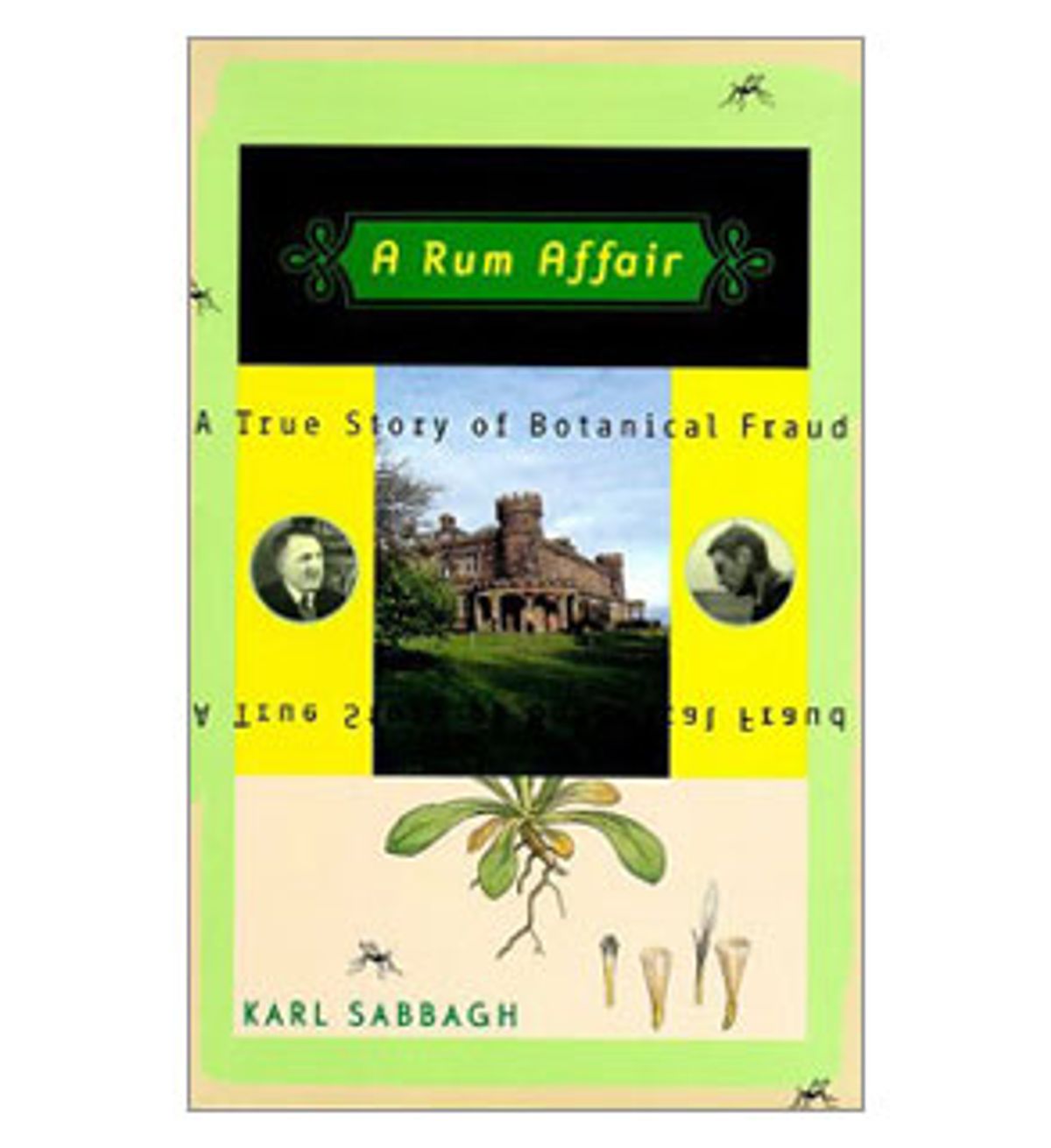
“A Rum Affair” by Karl Sabbagh
Floraphiles get nasty in a true story of the near-perfect botanical crime.
Ernest Rutherford once sneered that botany was more like stamp collecting than real science. The celebrated early 20th century physicist was referring to the field’s lack of mathematical rigor, its frequent unsuitability for experimental research, its openness to amateur enthusiasts.
Before the discovery of DNA, which converted all of biology into the hot zone of science, botanists could indeed seem like nerdy kin to stamp collectors, birdwatchers and hoarders of 300 varieties of salt and pepper shakers. Their passion was not for growing plants, but for finding, identifying and categorizing them. They went out into the field and got excited, for god’s sake, about grasses and sedges and such.
In this seemingly unpromising terrain, Karl Sabbagh, an English author and producer of science programs for BBC Television, has unearthed an intriguing story about the politics of science. It’s a saga with dueling protagonists, outraged charges and countercharges, motivations shrouded in mystery. Yet it’s a saga without a proper conclusion, ebbing away in very low-key, very British understatement. “A Rum Affair,” for sure, as the Brits like to say about odd or strange events.
The time is 1948. In one corner is John Heslop Harrison, an ironworker’s son risen to a professorship in botany at Newcastle University and membership in the Royal Society, Britain’s equivalent of our National Academy of Sciences. His young accuser, John Raven, is a well-connected scion of Cambridge. He is the son of a don in theology and a graduate and tutor in classics himself. Yet he is also an accomplished amateur botanical scholar.
Heslop Harrison has gained prominence as an authority on the flora of the Hebrides, the islands off the northwest coast of Scotland. A man of immense learning and field experience, he is also a brusque personality, dogmatic in his views and hostile to anyone who dares question him. Which is precisely what Raven does. Willing to stand up for his beliefs, no matter how unpopular — he was a conscientious objector during World War II — Raven has come to believe that Heslop Harrison is a liar. For Harrison claims to have discovered on the Isle of Rhum (later called Rum) rare plants, including some of those grasses and sedges previously thought not to be indigenous to the Hebrides. Not a big deal, one might think, except that the claim is a key link in a more far-reaching hypothesis that the islands, unlike the rest of Scotland, somehow escaped the last Ice Age 10,000 years ago.
Sabbagh’s method is to follow his young hero as he stalks esoteric plants and the villainous Harrison. Roadblocks are everywhere. Rhum is isolated and owned by one Lady Bullough, though it’s guarded by Heslop Harrison as though it were his private domain. Raven manipulates his way onto the island, cannot find any sign of the plants, retreats to Cambridge, writes a scathing report for university authorities charging that the great scholar has imported and planted the specimens himself. Simply put, Heslop Harrison’s breakthrough discoveries are fake.
But, alas, Raven’s revelations go nowhere. Harrison suffers no public exposure, no loss of job. Despite never again trusting the man’s work, no one in the British botanical establishment wants to make any waves. And besides, the evidence of fraud isn’t foolproof. Raven’s impossible task has been to prove a negative: that on Rhum’s 40 square miles the specimens do not exist.
Thus “A Rum Affair” becomes a scientific detective tale. Like Susan Orlean’s “The Orchid Thief,” it chronicles skullduggery among floraphiles, though without that New Yorker writer’s smoothly witty delivery. Like Simon Winchester’s “The Professor and the Madman,” it portrays an intellectual odd couple in a British setting, though without that book’s boffo drama of murder and madness.
Though we keep expecting Sabbagh to surprise us by uncovering evidence that Heslop Harrison was innocent after all — in dramatic terms, he’s too much the stock villain, a despot as department head at Newcastle and a nasty, officious opponent for Raven — the author remains convinced of his wrongdoing. In British field guides today, he notes, Heslop Harrison’s “finds” are subtly dismissed.
Sabbagh tries to put his malefactor in context by examining scientific fraud elsewhere, but, oddly enough, never mentions the case that rocked the American molecular biology establishment in the ’90s. What’s most startling is the contrast. A public accusation by a young post-doc that her boss at MIT had faked data, the involvement of Nobel Prize winner David Baltimore, congressional hearings and the accused’s eventual exoneration — all of this would have been anathema among Britain’s tweedy gentlemen of the ’40s.
In the Heslop Harrison case, the most puzzling aspect is the apparent lack of motive. Already at the summit of his profession, he risked his good name for a few more morsels of fame. In the end, Sabbagh’s research indicates that the man was probably a congenital liar. Even in his ventures into entomology, he couldn’t control his penchant for extravagant claims. His alleged sightings on Rhum of the Large Blue butterfly and several species of water beetles have never been duplicated.
Then there’s the matter of Heslop Harrison’s address. Throughout most of his career, he listed his as “Gavarnie, The Avenue, Birtley.” He bestowed a pretentious name, Gavarnie, on his home. So far, so good. It’s the English way. Yet he didn’t in fact live on The Avenue, the most imposing street in his Scottish village, but on an adjoining, less impressive road. You could chalk this aberration up to class resentment against people who began life with more advantages. Or you could simply call it pathology.
Dan Cryer is a book critic for Newsday. More Dan Cryer.
“People Who Eat Darkness”: The disappearing blonde
A true crime story set in Tokyo illuminates the complicated truths behind media cliches
Joji Obara and Lucie Blackman (Credit: Estate of Lucie Jane Blackman) Lucie Blackman, 21, went out for the afternoon in 2000, phoning her roommate and best friend Louise to arrange a meeting later that night. Lucie never showed up, and within a few days she’d become one of those vanished blondes whose fates fuel headlines and hours of speculative media coverage. She was British, a former flight attendant, and she and Louise were living in Tokyo. They were also bar hostesses, a profession with a very specific meaning in Japan, difficult to explain to foreigners and not entirely clear to the Japanese themselves. Lucie both did and didn’t match the classic Missing Blonde profile, and for a while the mystery of what happened to her threatened to lapse into permanent obscurity.
Continue Reading Close
Laura Miller is a senior writer for Salon. She is the author of "The Magician's Book: A Skeptic's Adventures in Narnia" and has a Web site, magiciansbook.com. More Laura Miller.
Corporate criminals gone wild
The maker of the documentary film "Inside Job" has a new book excoriating Wall Street -- and President Obama
A detail from the cover of "Predator Nation" “Inside Job,” Charles Ferguson’s Oscar-winning documentary film on how government, Wall Street and academia colluded to deliver us the worst financial crisis since the Great Depression, made a powerful case that something was very very rotten at the heart of the American political/economic nexus. His follow-up book, “Predator Nation: Corporate Criminals, Political Corruption, and the Hijacking of America,” can be considered the legal brief that dots every “i” and crosses every “t” in his argument. A tightly argued, profusely footnoted and deeply enraged castigation of everyone involved, “Predator Nation” isn’t just a factually unchallengeable account of how Wall Street blew up the global economy. It’s a denunciation, a call for justice and a warning: After getting away with the crime of the century, Wall Street still isn’t satisfied.
Continue Reading Close
Andrew Leonard is a staff writer at Salon. On Twitter, @koxinga21. More Andrew Leonard.
Can you identify?
Science shows that the only way around some readers' prejudices is to trick them
(Credit: Shutterstock/Salon) The news of recent research documenting how readers identify with the main characters in stories has mostly been taken as confirmation of the value of literary role models. Lisa Libby, an assistant professor at Ohio State University and co-author of a study published in the Journal of Personality and Social Psychology, explained that subjects who read a short story in which the protagonist overcomes obstacles in order to vote were more likely to vote themselves several days later.
The suggestibility of readers isn’t news. Johann Wolfgang von Goethe’s novel of a sensitive young man destroyed by unrequited love, “The Sorrows of Young Werther,” inspired a rash of suicides by would-be Werthers in the late 1700s. Jack Kerouac has launched a thousand road trips. Still, this is part of science’s job: Running empirical tests on common knowledge — if for no other reason than because common knowledge (and common sense) is often wrong.
Continue Reading Close
Laura Miller is a senior writer for Salon. She is the author of "The Magician's Book: A Skeptic's Adventures in Narnia" and has a Web site, magiciansbook.com. More Laura Miller.
“The Aleppo Codex”: The bizarre history of a precious book
A reporter traces the shadowy fate of the definitive version of the Hebrew Bible
Matti Friedman An ancient and priceless book, a murky history of evasions and coverups, an underground of sinister and possibly violent dealers, a former spy who drops tantalizing hints and a wily 84-year-old millionaire who says stuff like, “The problem with this story is that it could damage your health”: Are these the ingredients for a cheesy, improbable historical thriller? Yet “The Aleppo Codex,” Matti Friedman’s account of his attempts to learn the history of one of the world’s most precious books, sports all of these assets, and it’s nonfiction. If reporting this story damaged Friedman’s health, it probably happened when he realized what he’d stumbled into and his reporter’s heart started beating in doubletime.
Continue Reading Close
Laura Miller is a senior writer for Salon. She is the author of "The Magician's Book: A Skeptic's Adventures in Narnia" and has a Web site, magiciansbook.com. More Laura Miller.
Augusten Burroughs: Conquer trauma by letting it go
Salon exclusive: The best-selling memoirist says past horrors haunt us because we think about them too much. Stop
Augusten Burroughs Many people continue to feel influenced and even controlled by the things that happened to them a long time ago. Sometimes, people harbor dark, traumatic memories from childhood. Or fragments of memories — incomplete scenes, uncomfortable feelings, perhaps even a sense of certainty that something specific and terrible happened to them, but little more than this.
Others experienced something traumatic in adulthood that continues to affect them day to day many years later. Maybe an assault has left a person afraid to leave their home or enter a particular neighborhood.
Continue Reading CloseAugusten Burroughs' many books include "Runnning With Scissors," "Dry," "Sellevision," "Magical Thinking" and "Possible Side Effects." His latest book is "This Is How." More Augusten Burroughs.
Page 1 of 984 in Books