Author Interviews

Citizen of the world

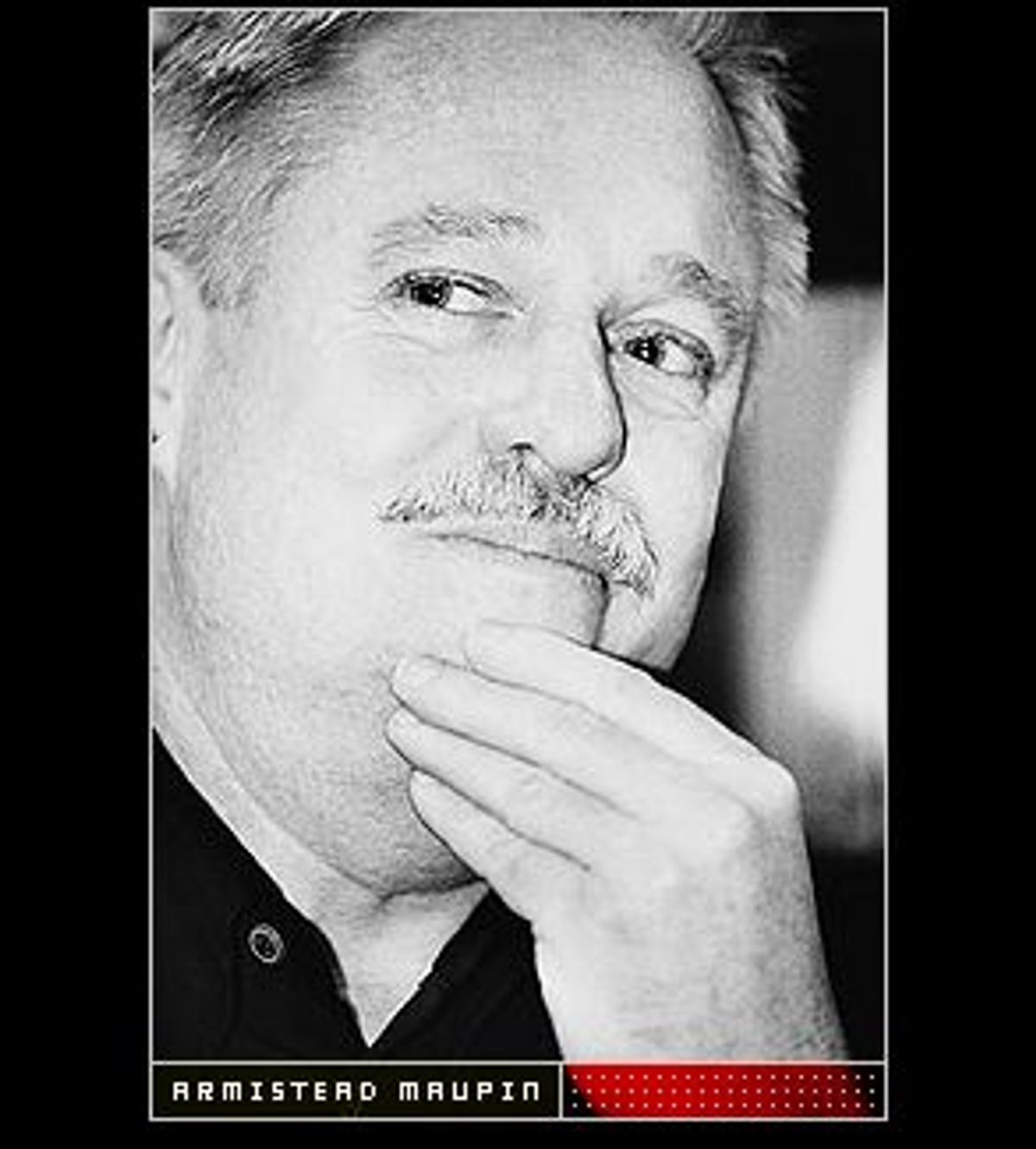
Armistead Maupin talks about getting divorced, the self-ghettoization of gay lit and the strange, true story behind his new novel of suspense.

For a writer whose first book is so well-loved that people actually ask to be buried with it, follow-up can be tough. Armistead Maupin’s “Tales of the City” series (which originally began as a newspaper serial) has preoccupied most of the author’s professional life — he’s worked on two miniseries based on the books — for the past decade or so. There was 1992′s “Maybe the Moon,” a Hollywood novel narrated by a dwarf actress, but it’s only now that Maupin has returned to mining his own life for fiction.

With “The Night Listener,” Maupin presents readers with Gabriel Noone, a successful, middle-aged, gay writer famous for his radio serial about the adventures of an outlandishly diverse passel of San Franciscans. Gabriel confronts two challenges in the course of the novel: getting over the breakup of a long relationship — a “marriage” in all but the legal sense of the word — and making sense of his new friendship with a 13-year-old boy, an AIDS patient and a survivor of horrific abuse who has written a moving memoir. Although Gabriel feels tremendously close to Pete and even goes so far as to refer to him as his “son,” the two have never met; their relationship builds entirely over the phone. When Gabriel begins to wonder whether he knows the real truth about Pete, a remarkable mystery (the more so for being based in reality) unfolds. Salon telephoned Maupin at his home in San Francisco to learn more about his life and fiction after the “Tales.”

This is your first novel in how long?

Eight years.

What took so long?

I’ve been working on three miniseries in the interim both as a producer and a writer, as well as adapting my last novel into a screenplay, which has yet to be produced. And there was a divorce in there somewhere, which ended up being partially recorded in “The Night Listener.”

I’m also not one of those driven writers who has to produce every day or I’ll fall apart. I look at my life as feeding my work, and sometimes I have to let things happen to me before I’m ready to write again.

With this book, you do almost everything but stamp “Warning: Contents May Contain Autobiography” on the cover. Most fiction writers go out of their way to stress that while there’s always some autobiographical material to their work, this is fiction.

Well, we do want to have it both ways. I wanted to do that with this novel, too, because I play fast and loose with the facts, or at least with the order of things. I invented conversations that never occurred. I tried to be as emotionally true as I possibly could be, to tap my own insecurities and pain to make something that felt real to the readers. That’s the single axiom I’m faithful to: Try to remain as honest and candid as possible. And don’t hide behind a 32-inch dwarf actress, which is what I did in my last book.

There are two stories running through “The Night Listener,” one of which is the breakup that you mentioned — which really is a divorce because your life was so intertwined with your partner’s. You began writing about that relationship in the “Tales,” and part of what you wanted to do there was demonstrate an exemplary gay relationship. Did you worry about the “gay P.R.” aspect of writing about your breakup in “The Night Listener,” in other words, about undoing the social point you tried to make in the “Tales”?

No. I really didn’t. If anything, it was my sincere belief that to chronicle the breakup of a gay relationship would record its depth and reality far more effectively than something that was all sweetness and light. I play with the idea in the novel. Gabriel dotes on this perfect gay relationship and both partners relished displaying their love to the world. Most openly gay people in the public eye have that experience. It must have been extremely exhilarating for Ellen and Anne to be lovey-dovey in public because it was both a political act and a sign of their personal happiness. And I identified with them all the more when they split because of that. But my responsibility first and foremost is to record my life and the conclusions I draw from it as honestly as possible. That process had always served me very well in the past and I knew I had to do it one more time.

One thing people love about “Tales of the City” is the community of people it depicts, people who are mixed in terms of their sexual orientations and outlooks on life. But Gabriel seems strikingly alone in this novel, which makes him all the more open to this odd phone relationship after Jess leaves him. It’s not as though he, like Mary Ann from “Tales of the City,” can just go downstairs in the house on Barbary and find someone to talk to.

I deliberately made Gabriel somewhat more isolated a person than I am, but I must admit that celebrity has narrowed my frame of reference to a certain degree. I tend to be more cautious about hooking up with strangers. And as I get older I find myself content in my small circle of friends. But I do have a very tight circle of friends who do cover just about every racial and sexual stripe, and I treasure them.

Certainly, though, Gabriel’s agony and pain during the initial separation from Jess is drawn directly from my own experience. It was how I pulled myself through that time, by writing that first chapter, which existed for a long time before the rest of the book. I didn’t have the stamina to imagine a second chapter. Gabriel at some point says, “How can I go on with this story when I don’t know what the end is?” and that’s how everybody feels when the rug gets pulled out from under you in such a dramatic way. All of your placid assumptions are challenged. But if you’re asking me about the state of my happiness now, it’s better than it’s been in a long, long time!

Actually, I was wondering whether you think that San Francisco has changed in that way as well, or whether it’s mostly your own circumstances that have changed.

It’s a different moment for me. I’m 56 years old. I’m a writer who’s had some success in the world. I live an odd, rarefied life. I’ve built a family out of my ex-lover and my closest friends. That’s what I can write about now. I’m not 25 years old and looking for an apartment on Russian Hill, and I can’t even comment about people who are. I’m often asked what the state of gay life is today, and I can’t answer that. There was a point in my life where I might have been described as a gay Everyman, but I don’t think I fall into that category anymore. Maybe nobody does.

It’s a hard one to call. I can’t disentangle my own aging process from the way the city itself has changed. I’m making every effort, though, not to piss and moan about a Golden Age that has passed because it makes me sound too much like my parents. The people I have valued the most over the years have been the people who have found something to love about the present moment. Christopher Isherwood was my mentor, and he remained charming and delightful company well into his 80s because he lived in the moment and celebrated the moment with whoever he met.

As a San Franciscan traveling in England, I was struck by how many people knew the “Tales” and kept asking me if it was really like that in the city. And I’m not even the author of the book …

The answer is that it is like that. I was accused of being a fantasist, a Pollyanna, when I first started writing “Tales of the City.” Most gay people in other parts of the country couldn’t imagine that gay and straight people could sit down together, cast aside their differences and be human beings with one another. That was true for me 20 years ago and it’s still true for me. That’s one of the reasons I’ve resisted the whole ghettoizing of gay lit. I’ve always felt myself to be writing about all of humanity, and that my redemption would come by regarding myself as a citizen of the world. It wasn’t my intention with “Tales of the City” to invent a subculture we could all safely hide in.

It’s always hard to talk about this because there’s this assumption that I’m running away from my homosexuality. I was open about my homosexuality before most of the writers currently working.

How could anyone possible think you were running away from your homosexuality?

Because an industry has evolved around gay writing, and many of the people in that industry are interested in keeping it apart from the rest of literature. I’m not. “Tales of the City” began as a thoroughly mainstream property. It began in a daily newspaper, and what was radical about it was that I placed gay subject matter in the context of the world at large. In the marketing of “The Night Listener,” I’ve spent a great deal of time trying to persuade the powers that be that this is not a “gay novel,” but a novel that could interest anyone. At the same time I’ve tried to be as flagrantly queer as I can possibly be. It delights me to think that some grandmother who’s reading this gripping little mystery story is going to find herself in the back of a truck with a hunky trucker before the novel is over.

Those readers are often more open to that than they’re given credit for.

I think the American public is far more sophisticated about gay subject matter than it’s given credit for.

The other thread in the novel is this strikingly odd, mysterious relationship with the boy, Pete. And yet this is also based in reality.

I’ll go so far as to say that some of that storyline is drawn from personal experience, but to assume that it’s the whole truth would be a grave mistake.

It’s interesting that in the same way that some of the events in “Tales of the City” just seem too preposterous to believe, so does the idea of developing such a close relationship with someone you’ve never met, someone you know solely over the telephone and whose identity you might come to doubt. It seems like some cooked-up premise for a thriller!

It does, doesn’t it? [Laughs] You can say I cackled demonically. However, I really feel a responsibility to not confuse the public or people I know with my fictional storytelling. All I can really say with any degree of conscience is that some of it is based in reality and it was a reality that was so strange that I felt as if I were living in a novel myself. It was really the oddest thing that ever happened to me. I’ve never felt more compelled to write something. And because that story remains a mystery to me to this day, it would be irresponsible to speculate publicly.

OK. Gabriel gets into this phone relationship when he’s very vulnerable because of the breakup, but there’s another aspect to his vulnerability, which is an unsatisfied fatherly impulse. Is that an important yearning for you?

It’s not for me. Gabriel says that he didn’t have any latent father instincts and I mean that to be true. It was really this particular person and the way in which they had something to provide for each other. For years, the inability to experience parenthood was offered as the big drawback to homosexuality. There are too many gay people these days who have broken that rule completely, either by choosing to have children or adopting. Those options are open to everyone. I’ve never really yearned for a child, I can honestly say that. Which is not to say that I don’t enjoy the company of children and see them as other human beings who might enlighten me and make my life more interesting.

But choosing to have a child is not the same thing as having fathering impulses.

You’re right, it’s not. Part of maturity is the need to pass on what you know to younger people. I’ve found myself doing that a lot in recent years. I have friends who are 22 or 23 towards whom I feel extremely fatherly, and it’s lovely because they’re also gay, or some of them are, and I’m able to be a gay father in some sense. I’m able to pass on my life experience to a younger person and let them bounce their heartaches and dreams off of me. It makes me feel that much more useful because I didn’t have anyone to do that for me when I was a young man, and I wished that I had it.

I’ve been involved with a group called LYRIC that provides support for gay teens. A lot of gay people have been leery about that for fear of looking like pederasts, but to think that way is to rob gay kids of the chance to experience a mentor relationship.

Gabriel does bump up against that anxiety in other people. However, Pete is straight, and one of the great points in “The Night Listener” is when Gabriel sends Pete a Playboy.

That’s more like being an uncle or grandparent. They get to commit that kind of sacrilege and thereby become closer to the children.

Nevertheless, a lot of straight people who are comfortable with gays in most other ways are still not quite comfortable with this. It must be very painful for gay people of either gender, who want to have that elder relationship with a young person, that it has to be so fraught.

For many people it’s fraught with those fears, but it’s just another aspect of homophobia that gay people must cast off. Most children today, most teenagers today, are perfectly comfortable with the concept of homosexuality. At least, they know what it is and they’re often more blunt about the subject matter than a middle-aged gay man in San Francisco might be. I have some very civilized friends here who chose to make me and my lover Terry the godparents of their two boys, one of whom is 18 now and the other of whom is 6. The 18-year-old has known since he was about 5. He won the Ernest Hemingway award, which is a high school journalism competition, for writing about his relationship with me and Terry. He’s the coolest dude on the planet, and he’s as straight as they come. His parents never communicated any uncomfortable feelings about me and Terry, and so consequently, he never had them. It was a wonderful, rich opening-up for me because I was able to let go of that feeling that I better be careful or it’ll look like I’m proselytizing, whatever that means.

As if you could!

Yes, as if you could.

One of the things that Gabriel is still trying to come to terms with, even in his 50s, is his relationship with his own father. I wonder if you think that it’s taken him so long because he’s gay or if, conversely, the process is happening at all because Gabriel’s gay. Does the fact that they have this big issue to deal with force them to really talk to each other in ways they wouldn’t have otherwise?

Well, I can say that, on a personal level, my homosexuality helped differentiate me dramatically from my father, so that we could finally arrive at a loving friendship between two different people, not just Armistead Maupin and Armistead Maupin Jr. As far as confrontation goes, I don’t know how being gay figures into it, because both my brother and my sister are — in their 50s — finally reaching a sort of ditente with my father, and they’re both rampantly straight.

Something really lovely arose as a result of this novel, which is a far closer relationship with my father. He called me up to tell how much he liked the novel, how proud he was of me, how he thought it was my best work yet, and how he was sure it would be a bestseller. I was stunned! I had imagined every possible response — from him never speaking to me again to him being heartbroken — except for the one he came up with, which was to behave in a completely generous and loving manner. It was pretty damn amazing.

Perhaps one thing he liked, which is something dads often seem to like, is that you’ve crafted a plot that’s a bit like that of a thriller, though I wouldn’t exactly use that term for “The Night Listener.”

I always flinch a little when I pick up the TV guide and see “Vertigo” described as a thriller, because that was the single work of art that most influenced me in my writing.

Really? The sensibility seems so different from yours.

If you look at the bone structure of “The Night Listener,” you’ll see that, like “Vertigo,” there’s a major turnaround in the middle of it. It involves obsession and longing and switched identities and a middle-aged man on a quest. It’s very interesting for me to watch “Vertigo” today and see so much in Jimmy Stewart’s performance that reveals so much to me about the state of being single in your middle years. It’s a very complicated and interesting performance. Most of my friends look at the relationship between him and Barbara Bel Geddes and say “That’s just like a gay man and his best friend.” It was very radical at the time to show two grown-ups of the opposite sex who were actually friends who did things together, who went to the movies together.

Though their relationship is hardly that simple.

Yes, that’s true. It’s very complex. The movie deals with every possible human longing and the nature of loneliness, and also with that experience of arriving at the place where you began. “Tales of the City” was a sort of train that I got on and its form dictated what I had to do. There were moments when you could glimpse my fascination with mystery stories and those darker themes, but for the most part it was a sunnier, more optimistic climate. I love mystery novels and movies that test you mentally, that are about human themes and that don’t resort to violence and mayhem as part of the excitement.

Yet most of those books and movies aren’t autobiographical. We don’t think of them as being true to life. It must have been strange to take the elements of your life and put them into the kind of plot that’s usually thought of as being escapist because it’s contrived and not at all like real life.

No one marries memoir to mystery! I think you can do both. I tried to arrive at some kind of heart truth in the course of telling a gripping suspense story. I used the autobiographical stuff to serve the story and not the other way around. I’ve always wanted to keep people interested more than anything else.

Laura Miller

Laura Miller is a senior writer for Salon. She is the author of "The Magician's Book: A Skeptic's Adventures in Narnia" and has a Web site, magiciansbook.com.

A cartoonist gets personal

Alison Bechdel talks about the fraught mother-daughter relationship that shaped her latest work

This article appears courtesy of The Barnes & Noble Review.

Over three decades, Alison Bechdel’s comics have grown increasingly intimate. Her alt-weekly strip, “Dykes to Watch Out For,” was as emotionally true as it was funny and shrewd, but as with other great political cartoons of the era, like “Bloom County” and “Doonesbury,” the travails of its cast — a gay-community ensemble whose lives Bechdel chronicled from the Reagan era through the first anxious decade of a new century — only hinted at the life of the artist herself.

Barnes & Noble ReviewHer own personality burst out more explicitly in 2006 with the appearance of “Fun Home,” a masterful graphic memoir about her relationship with her clever, exacting and very closeted father, who taught school and ran a funeral home simultaneously, and whose death under mysterious circumstances raised the possibility of suicide. Critics justly heaped acclaim on “Fun Home,” praising its intricate narrative architecture and honest, despairing voice. In reconstructing her path from girlhood to womanhood, from nervous young diarist to nervous young artist, Bechdel overturned many of her family’s myths, and a host of broader cultural ones.

Her new book, “Are You My Mother?,” is even more personal, restless and reflective, a wry, self-interrogating look at her relationship with her mother, and the ways that relationship has fed — and obstructed — Bechdel’s own work. Like Roland Barthes’ “Mourning Diary,” it’s a gorgeous meditation on the lack of a mother’s love, one that keeps shuddering over a catastrophe that has already occurred; but whereas Barthes’ notes came into being in the months following his mother’s funeral, Bechdel wrote and is publishing her book while her mother is still alive. “The secret subversive goal of my work,” she has said, “is to show that women, not just lesbians, are regular human beings.” I spoke with the author by phone earlier this month about that project, and about her book and the fraught relationship it documents. The following is an edited transcript of our conversation.

The Barnes & Noble Review: You wrote ”Fun Home” looking back on your relationship with your dad, but you were constantly talking to your mom while you wrote this book. And she was a somewhat grudging subject. Was this one harder?

Alison Bechdel: Yes, as I learned during the research for ”Are You My Mother?,” and also instinctively from my experience being a human, mothers are just more difficult than fathers. It’s a much more fraught and complex relationship for everyone whether you’re male or female because this is someone who you’re physically a part of. And so it became very confounding for me, trying to sort that out. The psychoanalyst who I write a lot about in the book, Winnicott, wrote that the mother must be dismantled whereas the father can be murdered. And I feel like somehow I murdered my dad, and that was really a walk in the park. That was so much easier than dismantling my mother.

BNR: You were talking to her all the time, transcribing your conversations with her, and you had all these letters and diaries, and really precise memories, and then all of your reading, of Winnicott and Virginia Woolf and ”The Drama of the Gifted Child.” It must have been a lot to wrangle.

AB: It was, especially the Winnicott stuff. I kind of had to give myself a tutorial on psychoanalysis, which really took me a couple of years — you know, learning that language and getting a handle on it, just a slim grasp of the body of Winnicott’s ideas. That was a big project, but a kind of enjoyable procrastination too, because I couldn’t quite face what I was going to have to do.

BNR: But Winnicott ends up being, in a way, a character in the book.

AB: That was a real breakthrough for me, the moment that happened. When I began, I guess I realized it could be possible to introduce Winnicott as a character but I felt very firmly that I wasn’t going to do that, that somehow it was not in the scope of what I was doing. But then he somehow sort of insisted. That was soon after I ruled out the first name of the book and started over. Virginia Woolf and Donald Winnicott appeared in my mind crossing paths one day in London and that started me out in a new direction.

BNR: I love the way their experiences live alongside and reflect yours — your relationship with your mom, your romantic relationships, your psychoanalysis.

AB: I don’t know how this book is going to go over. I don’t know how many people are interested in psychoanalysis. I feel like most people are impatient with it.

BNR: Did you happen to see Maria Bustillos’ piece for “The Awl” about going to David Foster Wallace’s archives at the Ransom Center and looking through his self-help books?

AB: Oh God, no. I’m looking it up now. The first page I Googled has an image of ”The Drama of the Gifted Child” on it.

BNR: He wrote notes in it about his relationship with his mom, and that piece cycled around and around the Internet. ”The Drama of the Gifted Child” has a huge readership among people who are interested in literature and ideas.

AB: The interesting thing about that book is, it’s really intended for other analysts. It’s not meant for a lay audience, really. I mean it wasn’t directed toward that audience, though that’s the audience it found. But I just want to say, I’m relieved I didn’t see that. I feel like it would’ve distracted me from what I was doing.

BNR: One thing you highlight beautifully in ”Are You My Mother?” is that writers have the same problem analysts do: They compulsively analyze people. Would you say that your mom shares that tendency?

AB: Yeah, I would say she has a really keen kind of psychological insight into other people and their motivations.

BNR: Is it hard to talk about this, knowing that she might read the interviews?

AB: You know, I can’t even think about that. Whenever I do interviews I just have to assume that she’s not going to see them. She really is not interested to that extent, and I’m pretty sure she doesn’t seek stuff out online. So I think I’m just going to tell myself that she’s not going to see this interview.

BNR: OK, then, gloves off! One thing that makes her such a fascinating character is that you can’t tell — I can’t tell — whether she’s being intentionally undermining or just applying the same critical lens to your work that she uses to judge the rest of the world.

AB: I think it’s the latter, but I always have to deal with the former. You know, when she makes these comments about other writers or other cartoonists and seems to be comparing me to them, my first feeling is always that I’m coming up short and she’s criticizing me, trying to humiliate me. But I don’t think she’s really trying to do that.

BNR: That tension absolutely comes across. You transmit it so well, I found myself squirming. But I came to like her more and more as the book went along. Especially when you ask her to tell you the first thing she can think of that she learned from her mother, and she says she learned that boys are more important than girls.

AB: That was a really pivotal moment. My first therapist told me to do that, thinking it would yield some useful information, and it did. That was like the key to my childhood. I also want to say, I genuinely like my mother in a way that I don’t think a lot of my friends do. They love their mothers, they’re close to their mothers, but I don’t know if they genuinely enjoy their mothers’ company in the way that I do. Sometimes she drives me crazy, but she can also seem completely delightful. I can have serious conversations about writing with my mother, which I think is kind of amazing. I’m also still scared of her, so that was the biggest thing I had to grapple with in the book and don’t know if I succeeded. I don’t know if I really took her on in a way that if I were completely honest I would have. Because I’m still afraid of her.

BNR: She is formidable. But then at times she would play with you and make stories with you.

AB: One of my earliest, most powerful memories of my mother is playing this game where I would be a crippled child like the kids I would see at the orthopedic wing of the hospital when I would go to get my fallen arches checked up on. I was just fascinated with these children, with their external signs of disability, their crutches and braces and big shoes. There was something about that that I needed to reenact, and my mother entered into that imaginary space so willingly with me and in such an encouraging way. Even though I knew there was something weird about having this fantasy about disabled children, she didn’t censor it. She encouraged me to go with it, and I feel like she probably did that with me in lots of imaginary games as a kid but for some reason this is the one that I remember the most vividly. And I speculate in the book that it’s because it was a fantasy that she shared to a certain extent as well.

BNR: And when your OCD was making it really difficult to keep the diary, your mom would write down your entries. I remember that from ”Fun Home,” too, and both times it gave me chills. The devotion implicit in it.

AB: Oh my God, that was another pivotal moment. She would sit there and write down everything I said. It was amazing. It also becomes weirdly this template for my relationship later with therapists, other women who would sit there and take down notes on what I was saying.

BNR: Yes! What’s it like to go back and look at those journals now? Those diaries where she wrote the entries for you?

AB: It’s really powerful. I’m at the University of Chicago right now, teaching a class. I moved out here for a couple months, and part of what I’m doing is putting up an exhibit of my work in a space on campus. One of the things that I wanted to show was the way I used all these different archival references in my work.

And so I took a section from ”Fun Home,” a section where my mother starts writing in my diary near the end of Chapter 5. There’s this accident and these people are killed, one of them’s a young boy, and they’re all at our family funeral home, all the bodies. On the wall, along with the printed pages from the book, I show the topographical map of my hometown, the big coloring book page from the ”Wind in the Willows” coloring book when I was a kid. And also I scanned my childhood diary, first the spread of the week before this terrible accident when my OCD was reaching a crescendo and there’s just this childish handwriting with these big squiggles and blocks all over it, and the following week — the next thread — is my mother’s tidy handwriting. It’s still my language but her writing. I think it’s such a visual and striking image of this moment of transmission or connection with her. It’s still, you know, really arm’s length. It’s this intellectual exercise. That’s as much as I got, and that’s what I will take.

BNR: She was giving the gift she knew how to give you. It’s a striking counterpoint to her early days as a mother when she’s trying to breastfeed you and can’t, and the doctor tells her she’s not a good cow, which is (laughing) just awful.

AB (laughing): I know, he really said that.

BNR: But then the journals, the storytelling, was just something she could so naturally share with you.

AB: But what she did is a double-edged sword. Yes, she was teaching me to write, but this cathexis, for lack of a better word, around the diary entries, I feel like that’s what made me want to write memoir. That’s what makes nonfiction so vital for me. That she taught me to write about my particular life, but she doesn’t like that I do that. She really wishes that I were a fiction writer.

BNR: Right, which is…

AB: Like you.

BNR: Well, I’ve written plenty of nonfiction stuff about my mother. A lot of it seems, now that I’m older, not very generous. I was filled with rage toward her when I was younger, and now I feel much more love and empathy. Your work is vastly more mature and more nuanced.

AB: I wonder how much the empathy you’re feeling now is a result of the fact that you wrote about her, you know? Would you be able to feel that if you hadn’t done that writing?

BNR: That’s a good question. Do you think writing ”Fun Home ”and ”Are You My Mother? ”helped you move beyond and change some of your own feelings?

AB: I totally do. That’s why I do it, and it feels so fraught to talk about this because writing is not supposed to be therapeutic. A sort of analogy has occurred to me. People ask me, was writing “Fun Home” therapeutic? And I feel like, yes it was, but that’s kind of like asking somebody if swimming the English Channel was a good workout for them. That’s not why they did it — “of course “it was a good workout. Both of these books have entailed transformative processes. You can’t engineer or will yourself to undergo a transformation, but that’s what both of these books have involved. I kind of set out on a journey, and I know that that’s what I have to do, and it’s sort of a high-wire act in that respect. Especially with this book about my mother, when I had a book deal for it, I couldn’t really promise that I was going to figure this out in three years or whatever my initial contract was for. And in fact I didn’t; it took me a lot longer.

BNR: How long did it take?

AB: Six years, almost as long as ”Fun Home.” “Fun Home” was a seven-year project, but I was also writing my comic strip for that time, and with ”Are You My Mother?,” for two years of that I was writing the comic strip, and then for the next four years all I was doing was writing this book. It’s kind of crazy.

BNR: But the work shows. And your process is so painstaking. You’ll take photographs of yourself in various positions and then translate them into drawings.

AB: Yeah. That’s really crazy, I do that for every figure in the book.

BNR: One of your therapists advanced this theory, and it dovetails with some of Winnicott’s ideas and ”The Drama of the Gifted Child,” that in encouraging your diary to the extent she did, your mother was teaching you to be the repository of all of the emotions that your family couldn’t process. And so in addition to predisposing you to the memoir form by helping you write your diary, your mom was also — if that’s true — making it fraught for you.

AB: Yes. Very much. Interestingly, my father too, I feel, was complicit in the diary thing, because he’s the one who physically started me off writing in a diary. My very first entry, he wrote the first sentence or began the first sentence, “Dad is reading ‘The Trumpet of the Swan.’” Both of my parents sort of ceremonially made me the, I don’t know, repository for all of this emotional anguish.

BNR: They really liked the idea of their daughter taking on that role. I guess it’s typical to give a girl a diary — to hope that she’ll write secrets in it and use the little key that comes with it.

AB: You know, that’s so interesting. I didn’t address at all the archetypically feminine role that the diaries have, but that’s so much a part of the story too. Why is that? We don’t give boys diaries.

BNR: I laughed out loud when your mom says, after reading an early draft of the book, “You must have a pretty good memory.”

AB: Yeah, I don’t quite know how to take that.

BNR: But then she also seems pleased. She says that it coheres and there are clear themes, and it’s a meta book, which goes back to what you were saying about being able to talk with your mother about stories and about literature at a really high level.

AB: I feel like she’s at a higher level than I am. She thought of it as a meta book; I hadn’t even been thinking of it in that way. So you know, she’s actually much more well-read than I am, much more up on what’s happening in literature at this moment.

BNR: Well, as someone who spends a lot of time reading opinions about books online, I’m not really sure for a writer that that’s a good thing.

AB: In my mother’s case I wonder too if she’s so — she’s following the state of criticism so closely that she can’t write because she feels so scrutinized.

BNR: To have the level of critical acumen that she has and to have the very precise ideas that she seems to have about what stories should be and the best way to tell them — for many people, that’s death to more creative kinds of writing.

AB: As I worked on this project about her, my image of who she could have been or what she could have been kept morphing. At first I thought, oh, my mother was a frustrated poet. Then I saw more of her frustrated actress part, and in the end I feel like it’s really her frustrated critic part that is maybe the most… maybe that’s who she really would have been. Like when she says she wishes she could’ve been Helen Vendler.

BNR: And how your dad had her read books for him and help him write his papers.

AB: She should’ve been an academic, I think. She did teach high school English, but I think she could’ve gotten a PhD and been a really kick-ass poetry professor.

BNR: You write early in ”Are You My Mother?”: ”My foremost difficulty is the extent to which I have internalized my mother’s critical faculties.” Apart from all your second-guessing of your writing itself, I’ve noticed that you’re really hard on yourself for using a font based on your handwriting to letter your frames.

AB: I do feel guilty about it, like it’s somehow cheating to use a digital font, and to not actually hand-letter my work. But at the same time, I have these lengthy passages of quotations from Winnicott or from Virginia Woolf that I have obsessively hand-lettered.

BNR: So interesting: the parts that aren’t your language.

AB: Yeah. In fact those things are treated as drawings in the book, even though they’re text. I frame them as a drawing and often overlay them with my digital narration. It’s almost like I’m giving those words more attention than my own words, but not really.

BNR: I’m so interested in — and ignorant of — the mechanics of putting together graphic novels. Were all of the quotes from other writers treated as drawings, or the longer ones?

AB: Pretty much all of them. I mean, there are very short things that are just half a sentence that I might have quoted in my own narration, but most of them are actually copied from the original text where I read them. Part of it was trying to replicate my own experience as a reader. Well, not replicate but transmit. To get people to read kind of through my eyes. In my early drafts the quotations went on a lot longer. My editor really pushed me to cut them down.

BNR: How was that, working with an editor and showing her the book in stages?

AB: I had an amazing connection with my editor about this book. She’s the same editor I had for ”Fun Home,” which seems like a great gift in this era, to have that kind of continuity with a publisher. Let’s go back to the question of how I actually do the book. I do write first, but my writing is very drawing-based. I actually write in a drawing application, in Adobe Illustrator. So I’m not just writing in a word processing program, I’m creating these panels on the page and I create little text boxes for the narration or dialogue and I’m able to move that stuff all around. I’m thinking about the page as a two-dimensional field as I write, which feels to me like a kind of drawing even though I’m not drawing with a pencil or not drawing much. I will do occasional sketches. So that takes a really, really long time and that’s how I get the whole story mapped out. If you saw the pages at that point, it would be just blank boxes with the text and the dialogue, with the narration and the dialogue and maybe a few images dragged in here and there.

BNR: Is that what your mom had seen when she said that she couldn’t imagine how you were going to draw it all?

AB: Yeah. It was hard for her to read that, and it’s hard for anyone to. It doesn’t make sense unless you’re really comics literate, and my editor is somehow able to see how that stuff is working without the pictures, and then proceed to edit me the way she would edit any book. I’ve never really talked with other cartoonists about how they work with their editors. It’s hard for me to imagine Chris Ware or Joe Sacco being edited at all. I feel like drawing is more primary in their work somehow. Maybe not. I don’t know if they work with editors, but I just somehow imagine that they don’t, but who knows.

BNR: Your work feels more literary to me than a lot of graphic novelists’.

AB: Well, you know… I’m sorry to use this word in this way, but I think I probably do privilege the writing more than the drawing. I mean the drawing I do work very hard at, but it’s a little more in service of the writing than vice versa, and I think that mix varies a lot for different cartoonists.

BNR: Your visuals are wonderful, but I always feel very connected to the internality of your characters.

AB: You know what, Maud? I feel like cartooning for me has been like a way to be a crypto-writer. I couldn’t ever say I wanted to be a writer because my mother was a writer, and even now I’ve had to find this alternative way of expressing myself as a writer. I don’t want to diminish the drawing. I think it’s integral to what I do. But I’m kind of a secret writer.

BNR: Not so secret really, I hate to tell you. I was reading another interview in which you said that each of your parents had carved out and claimed huge portions of the artistic sphere. Your dad was so visual arts driven, and your mom was a writer and an actor, so you felt like cartooning was this little sliver of creative self-expression that neither of them had claimed.

AB: Yeah.

BNR: When I read about your font, I had the image of you sitting there trying to decide which –

AB: Actually, I basically did that. This guy had me write five or six versions of each letter, and then he kind of averaged them out.

BNR: Does it help with the niggly copyediting problems — “its/it’s” and whatnot — that pedants like me notice in a lot of graphic novels?

AB: Yeah, it enables me to make corrections of typos or to make last-minute editing changes in a way that would be just way too onerous to do by hand. You’d have to go in and manually erase and re-draw the “it’s” and take the apostrophe out and move the space. It would take you forever; it’s insane. So I feel like I’m able to write more carefully because I’m using a digital font. A lot of cartoonists, their stuff is filled with typos. It’s part of the charm, but I feel like my kind of writing I can’t do that. I can’t live with that.

BNR: Your work is so precise and well-considered that I would imagine you’re constantly revising. Do you ever find yourself having to choose a word that will fit in the spot?

AB: Oh yeah, very much. I’m very wordy for a cartoonist. I’m always struggling against that, because the more space your words take up the less room you have for pictures. So it’s always this precarious balancing act. I will often use a word that’s shorter than the word I really want just so I can fit it into three lines instead of going to four. I can’t give you an example right now, but I do that constantly. Editing decisions based on that really minute kind of space.

BNR: So as you’re creating the panels, as you’re drawing, do you ever find yourself shortening things so that you’ll have more room to include some other object in the panel?

AB: Well, just as a general principle, I try to keep the words at an absolute minimum. What’s interesting, as I continue with the drawing process, is that I often find spots where the words become kind of vestigial because I’m conveying something in the picture that makes them redundant. I can delete the words and get these powerful moments in the story that way. There was that one section, when I’m talking about my parents and their courtship and how my mother would like go to my father’s grad school classes with him occasionally. I had a line there saying explicitly “I think my mother should have gone to grad school” or something like that. And it became very clear as I was illustrating this that that my opinion was much more powerful as an implied thing, and so I took that line out and then it came to life. Sometimes the words overdetermine it and kill the energy of the writing. I guess that’s true of any type of writing, you hope to get to the phase when you can just delete stuff and get rid of all that baggage. But in my case, a lot of the time, it’s things I’ve already done in the drawing that enable me to get rid of words.

BNR: Your mom wished you’d written ”Fun Home” as fiction, but in the end she capitulated. She read the draft and said some perceptive things about it –

AB: I feel like she hasn’t really capitulated. She has this really amazingly schizoid response to what I’m doing. On the one hand, she’s very excited about the book actually coming out. She’s sort of anxious that it do well as a book, but just like with ”Fun Home” she doesn’t want to talk about the content of the book. And she’s really — beyond those few things that you just said, like that she observed that it coheres and it’s a meta book, she really hasn’t said much to me about the substance of the book. Has said nothing to me.

BNR: Were you conscious when writing of trying to communicate something to her about your relationship, or did you try to put her reaction out of your mind?

AB: I feel like this book is at its core just a simple and quite pathetic effort to get my mother to hear me tell her that I love her. I could not possibly do that in person, I mean I’ve tried that. I’ve done that. It goes OK, but it’s never what I want. And even having done this, I don’t… you know, I’m still waiting for some kind of response from her that I’m sure I will never get. She really feels like the book is — she sees the hostility; she doesn’t see the love. And that is distressing to me.

BNR: It’s so clearly drenched in love and in longing for that kind of response from her. But part of the tragedy of the book is that she doesn’t feel like — well, like the kind of character who’s going to be able to give that sort of response.

AB: Something that really captures her sort of split response to the book is that I got a pre-pub review that talked about my “substantive yet essentially distant” relationship with my mother, and I showed her that review and she was really psyched about it. She thought it was good. It was a starred review, and she was happy about that. She did not seem the least bit fazed to hear our relationship described as “substantive yet essentially distant.” I think she would agree that’s accurate.

BNR: Have you ever heard your mother describe your relationship?

AB: No. No, I haven’t. I have no idea what she would say. I know that she talks about me to other people, like in this kind of bragging way. I know that she’s proud of me and takes some vicarious pleasure in my successes, but she doesn’t say that to me. I only gather that she says that to other people.

BNR: So other people will tell you, “Your mom is so proud of you. She told me that your new book got a starred review in Kirkus?

AB: No, actually, I feel like I overhear her at her house. If I’m visiting, I can hear her saying to her best friend on the phone or to someone else on the phone. That’s how I know she does that. It’s like she doesn’t care if I’m overhearing her or not, I’m not really part of the – she’s not factoring me in, I don’t think.

Continue Reading Close

Jonathan Lethem’s “perfect” album

The "Motherless Brooklyn" and "Fortress of Solitude" author's new book explains his fixation with the Talking Heads

Jonathan Lethem

In essay collections like “The Disappointment Artist” and last year’s acclaimed “The Ecstasy of Influence,” best-selling novelist Jonathan Lethem brought his sharp critical lens and personal passion to bear on Marvel Comics, Roberto Bolaño, Bob Dylan and the John Carpenter movie “They Live.” Add to that diverse list of cultural artifacts the Talking Heads album “Fear of Music,” the subject of Lethem’s latest book, and published as part of Continuum’s 33 1/3 series of music writing.

The collision of Lethem and Talking Heads makes perfect sense. Both can’t escape being identified with New York – or, in Lethem’s case, Brooklyn – and despite working in disparate modes, each brings the formalism and precision of the high arts to popular forms. Lethem fans already know of his love of the band – composed of David Byrne (vocals and guitar), Tina Weymouth (bass), Chris Frantz (drums) and Jerry Harrison (keyboards, guitar) –  from his essay “The Beards.” There, he connected his love of  “Fear of Music” to the aftermath of his mother’s death from a brain tumor. “I have an obvious predisposition to handling the material of 1978 and ’79 with an exaggerated, personal intensity,” he told me. We spoke via Skype, Lethem from his office at Pomona College where he is the Roy E. Disney Professor in Creative Writing.

What drew you to Talking Heads’ music as a youth?

In 1978 I launched myself out of a very difficult Brooklyn public school and got into the High School of Music and Art, in Manhattan. It was like crossing the threshold. Suddenly I was hanging out in Harlem, trying to figure out who the cool kids were and how I could become one of them, or whether I somehow already qualified. Everyone had their band; it was pretty much like a menu: You could be into the Ramones or Cheap Trick or the Dictators. U.K. punk was this attractive signal coming in, but we had a special affinity for the New York bands. I had a friend that semester who was into Television — he was a little hipper than I was.

I was just at the right conjugation of nerdy, alienated and hyper-alert that I identified instantly with Talking Heads. They sang songs about books! I got it immediately.

In the book you call “Fear of Music” a paranoid album, and other works of art you’ve written about – some Stanley Kubrick films, and Philip K. Dick’s novels, for instance – have this bent as well. Are you a paranoid person?

Paranoia is closely related to a subject that’s right at the heart of the album: fear. Paranoia is an intellectual shading on a somatic experience, a physical reality that is fear. I experienced a lot of fear — not only my mother’s death, but I lived through a rather desperate chapter of New York’s urban history  —and it shaped me. Paranoia is a kind of utilization of fear, like “Let’s pick this fear up and shine it around like a flashlight and see what I can see with it.” As it invests itself in certain kinds of artworks, like in Philip K. Dick’s novels, paranoia tends to be a mode of inquiry and exploration — a philosophical mode, really. In that sense, it was attractive to me, because it was a lot less passive than just lying there and trembling.

But I try to disentwine my inclination for conspiracy and paranoia in artwork from its general lack of not only usefulness but interest in everyday life, where it’s actually a way of shutting possibilities down.

Do you have a favorite song on “Fear of Music”? From your description of “Heaven” – “If heaven’s impossible to know, ‘Heaven’s’ hard to recollect” – that seems to be your least favorite.

I received, in a very specific way, skepticism about “Heaven.” I have a friend, John Hilgart, who was a sounding board while I worked on this book. Hilgart said, quite passingly, “I always felt on Side 2, after ‘Air,’ there’s a three-song lull. I like ‘Heaven’ in principle, but to listen to it is kind of boring.” And then he felt, and I think this would be a much more common remark, that “Animals” and “Electric Guitar” are buried on Side 2 because they’re less inspired melodically or fully realized, and bear less relistening.

I had always held the whole album on this pedestal, where, in a way, it was all exactly as good as itself. I saw it as fractal, “This album is perfect, therefore everything on it is perfect.” Besides, I had always taken “Heaven” as a sacred object — everyone knows this is one of the masterpiece songs. But when Hilgart said that it was like – click! – “Heaven” is one of those things that I listen to and tell myself I’m loving it, but it’s actually boring. I started focusing on the idea of tedium, because the song’s self-referential; it wants to be boring.

In fact, I like “Heaven” a lot. The only song I’m uncomfortable with is “Electric Guitar.” The song is crippled by its disorganized quality, and it doesn’t seem as pure conceptually, because how do you put an electric guitar up there with air, heaven, animals, mind? It doesn’t belong on that stage. Also, it’s been played live barely ever. It’s a sitting duck if you need there to be a worst song on the album, though, really, I don’t know if “Fear of Music” needs to have one.

I do know that my favorites are the two side closers. I wouldn’t want to have to choose between “Drugs” and “Memories Can’t Wait.” Those became the most rewarding songs to write about; they just got richer and richer for me. I actually made myself like them even more, which I didn’t think was possible. Of course, “Life During Wartime”  is pretty good too. [laughs]

Did you find yourself liking the album more in general as a result of writing about it?

It was like having any subject before you when you’re writing a book — your own characters, your childhood, some stupid idea you made up about Tourette’s syndrome, whatever it might be that you’ve committed years of your life to — you love it and hate it a lot along the way. There were days when I felt utterly under its hobnailed boot, and there were days when I did not want to listen to “Fear of Music” again. I wrote through those feelings, of course, as you do with your contempt for all the different assignments life has given you, and I was enraptured by the end.

What’s weird is that I put it on for pleasure now. Your iTunes counts listenings, and my entire top 25 most-listened-to tracks on iTunes is all “Fear of Music” and different live versions of the songs. It was ceaseless, to the point where my wife would force me to switch to the headphones.

How did you start?

I rarely delay — and certainly proportionate to how many pages the piece was, I don’t think I’ve ever delayed starting a project as long. There are novels that I had in mind for three or four years, or even more than that before I began writing them, but those were very long novels. I took three years circling around this.

I kick-started myself in a really specific way. I accepted an invitation to the Experience Music Project Conference to be on a panel about urbanism. I said I would talk about Talking Heads’ relationship to urbanism and the evolution of their vanity as urban dwellers, starting with the “More Songs About Buildings and Food” song “Big Country,” which goes “I wouldn’t live there if you paid me,” to “Fear of Music’s” “Cities,” “I’m finding a city I’m going to check out,” and ending with “True Stories’” “People Like Us,” where they’re pretending to be hicks from Texas. I saw this as a topic I could make an interesting presentation on, but of course I was thinking, I’ll start writing about “Cities” and then I’ll have myself on the page about “Fear of Music.”

There are small traces of that presentation in the chapter on “Cities” in the book. A lot of it had to get thrown out, but at least it got me thinking about how to make something actually occur. I knew that I would write about each song directly and that I wanted to intersperse those chapters with provocative side questions about the album as a whole — I had that structure sitting there. I wrote about the commercial, the radio spot advertising “Fear of Music,” and then I wrote about the album jacket, and then I started writing about “I Zimbra.” Except that I had this weird chunk of thinking about “Cities,” which I incorporated, I wrote the book straight through as it reads.

Were there critical works or other texts that influenced your approach?

I was very conscious of the 33 1/3 books. I’ve been an eager customer, so I was thinking of some of the ones I loved best, like Franklin Bruno’s “Armed Forces,” Douglas Wolk’s James Brown book, “Live at the Apollo,” and Carl Wilson’s book on Celine Dion, “Let’s Talk About Love.” Not that I was going to ape their approaches, which are quite divergent anyway, but I write to enter into a conversation that books on shelves are having. I wanted to be a really exciting member of the 33 1/3 team, I wanted to come in with something that only I could do, but that also was recognizably a contribution to this recent but very interesting tradition.

In terms of critical writing, I followed less a specific example and more the general idea of close reading. I had written a book on the John Carpenter movie “They Live,” where I had just stared at the movie and free-associated. I wanted to do that but more so. “They Live” had a relatively high number of outside comparative texts brought in — other films, artworks and some theoretical things. With “Fear of Music” I thought, let me bring in fewer, and let me sometimes bring in none at all, let me just be with the sound of the songs and say what I’m hearing.

You write that it’s never unimportant asking what was going on in the artist’s life at the moment of creation. Let me turn that on you. Why write this book now?

How can I reconstruct or account for such a sprawling intention? I began fantasizing that I might do a 33 1/3 book before I had even agreed to do one, and “Fear of Music” was always the record that I knew I would write about. Then three years elapsed between agreeing to do it and actually starting.

I have been amazed to find myself doing so much critical and cultural writing, a lot of it being a weird mix of criticism and memoir, or covert memoir pieces pretending to be critical pieces. There’s a long evolution for me, thinking I would write fiction that was all going to be invented, and that I like to read criticism but I would never want to write it, then having it invest in the fiction itself. “Fortress of Solitude” is where that really starts, but “Chronic City” extends it. I incorporated a lot of critical impulses, cultural commentary — even things like liner notes crept into the voice of the book.

Having come into this hyper-developed critical voice without ever meaning to, I wanted to both do it service and quarantine it by writing this book. Like, you go over here and write a whole book about “Fear of Music,” then shut up. This and the “They Live” book would be both a summit and a farewell, which has to do with an intention for what I want to have happen in my fiction next, which is that I want to stop incorporating the critical voice into it in the same way.

Simultaneously, I think I’m also done with the tokens of my 14- or 15-year-old self. I can’t really imagine anything after this climax of “Fear of Music.” It’s like I finally came out of hiding, like once you show yourself you can slam the door, because the internal paparazzi are satisfied, they got their shot.

In the liner notes of “Sand in the Vaseline,” Jerry Harrison said, “There is a shared sensibility [with Talking Heads fans] that would make friendships immediate.” What’s that sensibility?

They’re pretty bookish. One of the things I thought interesting was how underwritten the songs are. They’re not wordy, really, but the sensibility is so fundamentally literary. Usually people think about Leonard Cohen or Bob Dylan or somebody recent like Craig Finn, who have these cascades of descriptions and evocations. Byrne never did that and it doesn’t seem like there was ever a phase in his songwriting career where he was even thinking to do it. But in another way I think Talking Heads are a very literary band in their fundamental stance, their ambivalence and sense of inquiry. I think even when he’s switched to nonsense lyrics there’s a spirit of inquiry that pervades all of Byrne’s best work, and “Fear of Music” is dominated by it.

Continue Reading Close

Brian Gresko has contributed to The Huffington Post, The Atlantic, The Daily Beast, The Paris Review Daily and The Millions. He lives in Brooklyn.

Sanjay Gupta: Doctors learn when they admit mistakes

Sanjay Gupta tells Salon why his new novel is set in once-secret "morbidity and mortality" meetings

Sanjay Gupta (Credit: AP/Mark Lennihan)

While some people think doctors see themselves as gods, oblivious to their mistakes, the behind-the-scenes reality tends to be quite different. In regular meetings called “morbidity and mortality” (or M&M, for short), doctors close the doors and candidly discuss their mistakes and try to learn from them. The meetings can be full of ruthless — and helpful — self-flagellation.

Most people don’t know they even take place. Now, “Monday Mornings,” a novel by Sanjay Gupta — CNN’s chief medical correspondent and a practicing neurosurgeon at Atlanta’s Emory University — lifts the veil on these gatherings.

While driving one of his three daughters to school last week, Gupta, 42, talked to Salon about his bestselling first novel, how doctors can do better, and the controversial ethics of being both journalist and physician.

What made you decide to leap into fiction?

It was an evolution. Originally, I wanted to write a nonfiction book about my specific experiences as a resident. I always took very diligent notes, and when I pulled them out, it really reminded me about that time. Then I learned that the whole idea that a meeting like M&M even exists was surprising to a lot of people. I had assumed that most people knew that doctors and surgeons got together regularly to discuss their mistakes. It turns out that most people didn’t know that, even ones who work in health care. This was interesting in and of itself. So I wanted to show people that this existed and that it can be one of the most indelible experiences that somebody can ever have. But to do that, it would need to be fiction, so it could be more unrestricted and have some creative power.

What’s the message of the book for doctors and their patients?

I think the biggest point was to expose people to M&M. When a mistake happens, or an unexpected outcome, oftentimes the immediate thought is “That’s a bad doctor.” They may even think “That’s a bad human being.” Most of the time that’s not true, and often doctors beat themselves up, to the point where I’ve seen some of them disengage. They no longer feel they’re up to it. They couldn’t stand the fact that someone got hurt because of something they did. So I wanted to tell a story about how people react to a mistake in medicine, and then to show the accountability that doctors hold for each other is sometimes far worse than any other punitive system. It doesn’t take the place of malpractice or administrative sanctions. This is doctors on doctors — and sometimes that has a much greater impact. It’s a pretty unique thing — the idea that you close the doors and be candid. It’s worth asking whether there’s a role for that kind of meeting in other places in our society as well.

Are we in medicine good at learning from our mistakes?

In 1999, because of the Institute of Medicine Report, people started paying more attention to medical errors. It’s not a great study, and even the way they define mistakes is different [from how others in the field] define mistakes. Still, there’s a problem, and over the past decade or so we have focused on this, and some of the things people have done have been effective at trying to curb mistakes. Yet if you look at the number, there’s hardly any evidence that mistakes have gone down.

So learning from our mistakes requires a more immediate sharing of the lessons.  There’s also the cultural change for any new thing that needs to be done. These things need to come from within the medical community as opposed to being mandated. How do you get a significant cultural change and get everyone to buy into it? One place I saw cultural change happen lightning-fast was through the M&M meetings. It was so indelible and vivid, it just became the way we did things.

During the book’s first M&M meeting, the chairman of your fictional team of surgeons, Dr. Harding Hooten, makes a statement about missing the basics in medicine. Do you think doctors in this country, because of the cushion of medical technology, have lost sight of getting the fundamental medical history and giving a complete physical?

No question. We overtreat. The irony is that we do this in part to prevent errors — and as a result we probably make more errors. As I was writing the book, I read Abraham Verghese’s essay in the New York Times. I attempted to incorporate some of that into Hooten’s dialogue.

Can we go back? Is it too late to regain that appreciation and rely on a conversation with and an exam from your physician?

It’s difficult to go back. I think we can mitigate some of the increase in the use of technology. Some of that was part of the discussions around health care reform. I also think that our tolerance for risk in medicine is different from anything else we do. I hate to be trite, but if a plane crashing every day would equal the same number of people who die each year from medical errors — we haven’t done a good job of explaining risks and benefits very well. Even informed consent is almost like a hat tip; people do it because they have to, not because they really sit down and really have a conversation about the risks.

What about the patient’s side of the equation? When you see the story of the face transplant or the former vice president getting a heart transplant, you’re left with the view that in American medicine, all things are possible. Is there a way we can communicate better what it is what we can and cannot do? 

Yes. It’s hard because people want those stories. It’s a tough balance, and we have to be very careful in our reporting to present the risks of things. I think people tend to focus on costs, but they don’t talk as much about risk.

When you were in Haiti in 2010 covering the earthquake, some people criticized you for becoming part of the story when, with cameras rolling, you began caring for patients at an abandoned medical camp. What’s your view of balancing journalistic objectivity with your commitment as a physician?

It’s a little bit artificial to say journalistic objectivity and helping people when you can are somehow at odds with one another. I’m not in way trying to demean journalistic objectivity. But whether or not you’re a physician, if you can help someone as opposed to just sitting there, I think most people from a human standpoint will do that. Anderson [Cooper] for example, was in a situation once where a boy was getting pummeled with rocks. He was right there and grabbed the kid and pulled him out. You would do it. Anybody would do it.

It’s worth pointing out that so much of the time I was in Haiti, for example, I was going to general hospitals and doing things. It wasn’t stuff for the cameras. There was just a tremendous need, as journalists get into these situations so quickly. Many times we are the first ones there before anybody else. In Haiti we were there within 12 hours of the earthquake because we have such an infrastructure built into the work that we do. In Iraq, I was embedded with Navy doctors; I was reporting on them and what was happening. And then I was asked to operate because there were no neurosurgeons there.  I took some criticism for that, and that was early on in my career, and I was a bit befuddled by it. Having trained as a doctor, why would anybody think that I wouldn’t do it? But when I came back and had lots of conversations with lots of other people in the journalism community, they raised the question of whether I can be objective. I think it was a worthy discussion to have, but as a general rule, I don’t think putting on a press badge means parting with your humanity. I’m pretty comfortable that as a journalist-physician, I am a physician first.

How do you keep a balance between your duties as a doctor and your duties as a journalist?

It’s pretty busy. I like to make rounds early, around 5 to 5:30 a.m., so I can come back and take the girls to school. I find that the car rides are the only times where you get one-on-one time and get to talk. When you have three kids, the house is active.  The medical stuff, the work, has a pretty defined schedule. Every Monday and every other Friday I operate. In total, it’s about 2.5 days a week of work. Straddling two fields, I have a view of both. I know medicine’s changed a lot. But when I wake up in the morning, when I’m in the operating room, there’s such a clear sense of purpose. It’s very hard to replicate that in anything else I do or anywhere else in society. I love that part of my life.

Continue Reading Close

Rahul K. Parikh is a physician and writer in the San Francisco Bay Area. He wrote the Vital Signs column on Salon in 2008-2009. His pop culture-medical column, PopRx, runs on alternate Mondays.

Finding joy in Down syndrome

The author of "Bloom" talks about accepting her daughter's condition and rethinking her idea of the "perfect child"

This article appears courtesy of The Barnes & Noble Review.

Kelle Hampton, the author of the eye-opening new memoir “Bloom: Finding Beauty in the Unexpected,” left for the hospital to give birth to her second child with “everything just — perfect,” packing not only the birth music, the blankets she’d made herself, the baby’s coming-home outfit, a special nightgown and a crown for the baby’s big sister, but also hand-designed, beribboned favors to pass out to visitors. Yet the moment her newborn daughter, Nella, was placed in her arms, Hampton’s concept of perfection altered in an instant: Though ultrasounds had signaled nothing unusual, Nella was born with Down syndrome.

Barnes & Noble ReviewHampton writes with bracing, brave honesty about her initial response to Nella’s condition — “I think I cried for seven hours straight. It was gut-wrenching pain” — and her struggle to find hope, joy and an expanse of possibilities in what first seemed to bring only sadness. As on her blog, Enjoying the Small Things, the journey Hampton records in “Bloom” becomes a call — and not only to parents — to rethink our concepts of perfection, discover our capacities for resilience, appreciate the family and friends on whom we depend and, yes, find beauty where we may not have noticed it.

We asked Hampton, via email, about “Bloom” and the experiences and impulses that inspired it. It may be typical of the author that she immediately turned the task of tackling our questions into an event worthy of celebration, writing, “I’ll put some good music on tonight, light a candle, grab a beer, and completely enjoy the process.”

The Barnes & Noble Review: One remarkable aspect of your writing is your knack for tapping into emotions, both your own and your readers’. Has motherhood — and particularly Nella’s birth — made you more connected to your emotions?

Kelle Hampton: I feel emotions very intensely. Expressing them is another story. I think we’re all conditioned to mask certain emotions because we think they won’t be accepted or they’re “too much.” Motherhood definitely compelled me to express emotions more freely. The depth of love, the fear of losing, the need to protect, the unearthly joy — it was too much for me to contain. That’s why I started writing more. And writing something I was thinking seemed more acceptable than saying it out loud. Then with Nella’s birth, there were these contrasting emotions that were so difficult to deal with — grief, fear, sadness, shame. But once I expressed them through writing and realized other women related to them, it gave me the freedom to express myself in a way I had never done before.

BNR: ”Bloom,” like your blog, uses photos and text to tell your story. Why did you choose to combine both elements?

KH: The book is a testament to my journey that first year, and writing and photography played equal parts in my healing and perspective shift. Because the book deals with Down syndrome, a condition that has many negative stereotypes, the photos are a powerful way to showcase the beauty of these children and the beauty Nella brought to our family.

BNR: Early in “Bloom” you mention a book you read shortly before Nella’s birth, Donald Miller’s “A Million Miles in a Thousand Years,” which spoke to you of “the power of challenges — how living a life of comfort does nothing to make us grow, and how hard times shape us.” But you also say you couldn’t fully grasp Miller’s message until you went through your own challenges. Can we learn life lessons from books or only from our own experiences?

KH: I’ve thought about this question a lot, especially from a parent’s perspective, because we make efforts to keep our children from pain and to give them happiness. No one wishes heartache for their child, and yet I know a lot of my happiness and contentment today comes from challenging experiences and sadness in my past. I think we can learn a lot from others’ experiences, and books give us an opportunity to do that. But life without any pain is unrealistic, and the great thing about reading books and learning from others is that when we do go through hard things, we’re more equipped to handle them and don’t feel quite so alone.

BNR: I initially assumed that, before Nella’s birth, you’d led a life without much difficulty. But then you discussed challenges you faced during childhood, in particular the breakup of your parents’ marriage when your father, a preacher, came out as gay. Did those childhood challenges help prepare you for those you’ve faced as a mother?

KH: My siblings and I talk about this a lot — the fact that we are so grateful for our past, even though it has a lot of pain, because it made us tough and definitely more compassionate. Once I started writing those chapters from my past, it really hit me how much those painful memories created a foundation for later challenges in my life. Does that mean someone who had a dreamy, heartache-free childhood is at a disadvantage for handling hard times as an adult? Not necessarily.

It’s important to me, as a mother, not to shield my children from life’s more disheartening realities but to bring awareness to them in a way that gives my children both a sense of gratitude for what they have and the motivation to bring positive change to their world. I want my girls to know that life isn’t going to be without pain, but I also want to equip them with love and confidence and a perspective that allows them to face these challenges when they come.

BNR: You learned fairly early in life to embrace difference. But still you struggled at first to embrace the ways Nella was different from the daughter you had envisioned. How has your sense of “perfection” changed since you had Nella?

KH: I’ve definitely shifted my views of perfection away from image and more to inner happiness, and that shift has taken away so much pressure and allowed me the freedom to really be myself. That, in itself, is happiness.

BNR: After Nella’s birth, your close circle of girlfriends — your “Net,” as you call them — stayed with you, giving you incredible support. What do you think is the secret to having such close female friends?

KH: I think women’s friendships get a bad rap in the media. They’re portrayed as catty, jealous and unsupportive. That saddens me because I know how amazing it is to be part of a group of women where you find love and support. I think women have high expectations for each other, and sometimes we are inclined to run or drop a friendship at the first sign of drama. I embrace my friendships with the understanding that because we are all women with fiery personalities, big dreams, and a hell of a lot of passion, some drama is inevitable.

You have to approach it with compassion and forgive mistakes, because we all make them. Of course, yes, you also need to make choices to surround yourself with people who bring out the best in you, who challenge you, who bring good energy. Those who don’t aren’t worth exhausting efforts.

Secondly, if you want close relationships with friends, you have to be vulnerable. I know how much it means to me when a friend admires me enough to call, crying, asking for help or trusting me with an intimate conversation. Likewise, I want to do the same and reach out to my friends, revealing my own vulnerabilities. My friends are great for shopping, laughing, or going out for drinks, but the best, most beautiful moments I’ve experienced with them are far more serious. And when you experience heartache with a friend at your side, it is bonding in a way that can’t be forgotten.

BNR: Do you think women can support each other in ways that men (even husbands) cannot in tough times, and particularly those involving parenting?

KH: As much I support equal rights for men and women, there are certain gifts women possess that men don’t naturally have and vice versa. Even though Nella is [Hampton's husband] Brett’s child and he, of course, was the only one who could sympathize with that personal parental loss of receiving her diagnosis, there was something so comforting that came from my friends — women who understood, in a way Brett couldn’t, the emotional aspect of the end of a pregnancy, a mother’s expectations, the ideal birth experience.

BNR: You write that you knew immediately, before anyone told you, that Nella had Down syndrome and worry that you didn’t show her enough love at that moment. We all sometimes feel a disconnect between the mother we want to be and the mother we fear we are in a particular moment. Should we even have a concept of what makes the “perfect” mother? Does that give us something to strive for, or give us only impossible standards we’ll never measure up to?

KH: I think we all have this imaginary version of the perfect mother we want to be. There is a quote I love about the fact that there is no way to be a perfect mother, but there are a million ways to be a good one. I try to focus on that, to know that when I try my best, acknowledge mistakes, follow my instincts, and remind myself of what’s most important, that is perfect parenting.

BNR: I wonder, too, about the dangers of our expectations for our kids. If we have a preconceived notion of who they should be, we may fail to appreciate them as they are. That’s a lesson you say you’ve learned. Is it something you feel is important for all mothers to learn?

KH: Yes! I’m learning it with Lainey [Hampton's elder daughter] just as much as with Nella. I’ve been challenging myself not to push Lainey to be a leader all the time. I have a preconceived notion that kids need to be leaders, not followers, and my husband recently reminded me that we do not need to tell our children to be leaders; we need to tell them to be themselves. It makes us all happier — to sit back, to lead by example, to accept what we are given, and to love our children no matter what path they choose to take in life.

BNR: Motherhood can be a touchy topic. Some of the emotions and responses you talk about in the book are bound to incite strong responses — mostly positive, but perhaps also negative. Were you afraid, writing about such personal topics, that you might be misunderstood and attacked?

KH: When I first published Nella’s birth story [on her blog], I discovered right away that being honest about touchy things is not always well received. It was good for me to read responses, even those “Oh my God, what kind of mother would say they want to run away!?” remarks. It initiated a personal process for me of challenging myself to write what’s true — in a respectful way, of course — and not to change my writing to cater to other people.

BNR: Did you ever find yourself pulling back? Or did you just write through those concerns?

KH: There were parts that I went to write and stopped to ponder the effects first. And, most always, I proceeded, hoping that people will understand this is my journey. Memoirs are personal, and not everyone is going to shake their head “yes” to every line, and that’s OK. The other side is that it has been incredibly fulfilling to read e-mails from women who have said, “Thank you for saying that. I felt it too, but didn’t want to say it, and you make me feel normal for admitting it.”

BNR: Do you worry about how your kids will respond to what you write when they’re old enough to read and understand it?

KH: What I wouldn’t do to have my own mother’s thoughts and photos and words and things that inspired her preserved from when we were little. I hope my children, through reading everything I’ve written — the good, the bad, the beautiful — will always read between the lines and be inspired by the constant truth of “Wow, she loved us. She celebrated life.”

BNR: One of the things you consider is how much you let your sense of how society perceives you shape how you feel about yourself. Was writing this book a way of shaping your own identity — and taking charge of your own narrative?

KH: I can’t begin to explain what writing this book has personally done for me. I owned every word I wrote, and as I typed it, I believed it even more. Empowerment — that’s what it is. I realize how much stronger I am, how much more effective I am in living purposefully, when I take control of how I feel about myself, my family and raising my kids, write it down, and put it out there for the world to see.

BNR: It sounds like writing is deeply therapeutic for you.

KH: There’s something mysterious and enlightening about the space I give myself when I write. It’s when I take all those loose philosophical/emotional thoughts I’ve had throughout the week and weave them together. I learn a lot about myself. I face my pain and struggles head-on, and I overcome them through the process of expressing myself. And, for me, when I write I’m going to do something? It’s even more powerful than saying it. When I write, “I’m going to rock this out,” it’s almost as if I hear the band in the background with each letter I type. I feel motivated, eager, excited. I’m inspired in a way I can’t explain. Writing is powerful — and it doesn’t cost near as much as therapy does.

BNR: Is it the same with photography?

KH: After taking pictures for a while, you begin to look at life a little differently, continually scanning landscapes, people, situations for that “framable” shot. In those first days, taking photos of Nella brought light to her beauty and made me recognize how perfect she was — the new, wrinkled skin on her fingers, those sparse rows of tiny eyelashes, her soft cowlick of silky hair. And it went beyond Nella as well. When I thought my world was this depressing reality, I’d pick up my camera and see the opposite — oh look, a sunset. Vivid blue skies. My child holding an ice cream cone with rainbow sprinkles. A dimpled smile. My husband rocking his new girl to sleep. I never stopped taking pictures of these things, and it sinks in after a while: Look for the good, and you will find it.

BNR: What are you most hoping readers will take away from “Bloom”?

KH: Life is full of challenges. But life is also as beautiful as you create it to be.

Continue Reading Close

The truth about creativity

Jonah Lehrer talks about why brainstorming doesn't work and why artists need to cultivate grit

This article appears courtesy of The Barnes & Noble Review.

Why did Bob Dylan compose the classic “Like a Rolling Stone” only after he had become so disgusted with his own music that he was planning to quit the business permanently? How did Silicon Valley become a hub of innovation while other genius-packed cities did not? And what does the placement of a company’s bathrooms have to do with the number of innovative products it makes?

Barnes & Noble ReviewThese questions –- and many more like them — are at the heart of Jonah Lehrer’s new book “Imagine: How Creativity Works.” The journalist and author of “Proust and the Neuroscientist” and “How We Decide” has taken on one of the most deceptive and beguiling problems in the science of mind, what he calls “our most important talent: the ability to imagine what has never existed.” His investigation into how we invent new things, and why some people and communities are more creative than others, takes the reader on a wide-ranging journey through the work of social scientists and neurological researchers — but also into the lives and insights of inventors and engineers, writers and salespeople, musicians and magicians, teachers and students. The result is a bracing, entertaining and counterintuitive guide to an aspect of ourselves that often seems an unsolvable mystery.

Jonah Lehrer spoke with us via email about his new book, and what he’s learned in the making of it.

The Barnes & Noble Review: One of the things that stands out in “Imagine” is how creativity is frequently misperceived, or partly misperceived, as associated with pure freedom of the mind. But in so many cases you highlight the opposite perspective — the one expressed by Milton Glaser’s words as he describes creativity as “a very time-consuming verb”: You highlight the effectiveness of the harsh group critique to enable ideas to grow, or the centrality of “grit” as a building block for a young artist to cultivate.

Jonah Lehrer: There are all sorts of romantic misconceptions about creativity. We’ve long believed, for instance, that the imagination is hindered by constraints and constructive criticism. But the scientific evidence clearly suggests that the opposite is true. We think of creativity as being an innate trait — you either have it or you don’t — when studies have consistently shown that even seemingly minor factors, such as the color of paint on the wall, can dramatically increase creative output. And then there’s the myth of effort. Because creativity has long been associated with the muses, we’ve assumed that creativity should feel easy and effortless, that if we’re truly inventive then the gods will take care of us. But nothing could be further from the truth. Instead, creativity is like any other human talent – it takes an enormous amount of effort to develop. And then, even after we’ve learned to effectively wield the imagination, we still have to invest the time and energy needed to fine-tune our creations. If it feels easy, then you’re doing it wrong.

BNR: The discussion of brainstorming is particularly counterintuitive; you point to research that indicates how “criticism and debate” — despite the former term’s association with repressive negativity — is a more fruitful model for groups working together.  If brainstorming is so unsuccessful a strategy for generating innovation, why has it held on for so long?

JL: I think the allure of brainstorming is inseparable from the fact that it feels good. A group of people are put together in a room and told to free-associate, with no criticism allowed. (The imagination is meek and shy: If it’s worried about being criticized it will clam up.) Before long, the whiteboard is filled with ideas. Everybody has contributed; nobody has been criticized. Alas, the evidence suggests that the overwhelming majority of these free-associations are superficial and that most brainstorming sessions actually inhibit the productivity of the group. We become less than the sum of our parts.

As you note, researchers have shown that group collaborations benefit from debate and dissent; it is the human friction that makes the sparks. Alas, the presence of criticism means that a few people are going to get their feelings hurt. So I think one reason we’ve clung to brainstorming for decades is that it increases employee morale, even if that comes at the cost of creativity. That’s an unfortunate truth, of course, but that doesn’t make it less true. There’s a reason why Steve Jobs always insisted that new ideas required “brutal honesty.”

BNR: Much of your book explores what might be said to be the central paradox of creativity: It seems to require both resolute, disciplined focus and, in Yo-Yo Ma’s phrase, “the abandon of a child.” Is this because when we are talking about the imagination we are really talking about multiple neurological functions? Or is it that creativity is a kind of protean idea itself, that changes with the artist — one might approach everything through “getting in the flow” and another who exists in the world of endless, patient revision?

JL: One of the most dangerous myths of creativity is that it’s a single thing, separate from other kinds of cognition. In reality, however, “creativity” is a catch-all term for a variety of distinct thought processes, each of which is well suited to particular kinds of problems. And this is why different parts of the creative process require different kinds of creative thinking. For instance, a big epiphany relies on a very different set of brain structures than the editing that comes afterward. A pianist in the midst of an improvised solo is thinking very differently from an inventor tweaking a gadget, even though both are in the midst of invention. So whether we should aspire to the abandon of a child or seek out focus depends on the kind of creativity we need at that moment. There is no universal prescription for creative thinking.

This also helps explain why there are as many creative methods as there are creators. Some people smoke joints; others chug coffee. Some go for walks; others stay late at the office. Some need collaborators; others need solitude. Creativity, like most interesting things, resists easy generalizations. I wanted “Imagine” to capture this complexity, not pretend that it doesn’t exist.

BNR: Some of the most thought-provoking insights in “Imagine” describe creative methodologies that seem to aim in one direction, but actually seek to trick (or perhaps hack) the brain’s programming. For example, you describe how students of improvisation at Second City spend a brief session before each class sharing maximally intimate confessions from their lives. The point for the actors isn’t, as it might appear, to get in touch with deep emotions. Rather, it’s to simply shut off the censoring part of the brain, so that in the work that follows, ideas and associations emerge freely. Should more of us be employing these sorts of strategies?

JL: Creativity is so hard that I think we need all the help we can get. Some of the mind hacks I describe in “Imagine” come from watching the time-tested habits of successful creators, such as those comics at Second City. And other hacks come from science, from the controlled conditions of the lab. Did you know, for instance, that people solve 30 percent more insight puzzles when they’re slightly drunk? That’s my kind of empiricism.

BNR: So much of your previous book “How We Decide” described ways in which we have difficulty understanding how our brains are actually working — the “emotional brain” secretly working away inside, with our assumptions about the supremacy of the “rational brain” leading us into constant miscalculation.  ”Imagine” has a similar focus on the mysteries of thought, but, perhaps in keeping with the title, the emphasis seems to be more on collaborating with the unknown parts of the self.  Did you see it that way? Are your books on a continuum in your own mind?

JL: I think both books revel in the fact that so much of our wisdom — whether it’s those inexplicable hunches that lead to good decisions, or that moment of insight that comes in the shower — emerge from mental places we have no access to. This is strange, no? The mind remains a black box, even when it’s our own mind!

And this is where modern science comes in handy. All these fancy experimental tools help us peer below the surface of consciousness, illuminating those darkened corners that we’re not even aware of. As a result, we’re able to understand ourselves in a new way and hopefully squeeze a few more epiphanies from those three pounds of Jell-O inside the skull.

BNR: Although your book is largely not a prescriptive one, an idea that your last three chapters all strongly support seems to be designing ways for more “creative collisions” to occur in schools, at work and in everyday life. Over the last several years, the focus in many aspects of our culture has been on building a digital “social network.” Can this do the work of physical and conversational interaction? Do we need to spend more resources, as a culture, encouraging the power of the “emergent property of people coming together”?

JL: In the late 1990s, when the dot-com fever was at its peak, many technology enthusiasts predicted that cities and physical offices would soon become obsolete, a relic of the analog age. After all, in an online world of email and video chats, why should we sacrifice our quality of life to live amid strangers? Cheap bandwidth would mean the end of expensive rents: The zeroes and ones hurtling across the fiber optic cables would supply us with all of our human interactions.

Of course, this pessimism has not come to pass. More people than ever before are moving to cities; we still commute to skyscrapers. (One of my favorite factoids is that attendance at business conferences has doubled since the invention of Skype.) And I think the reason Skype has not killed off cities and offices is because something magical happens when we cram ourselves together. It turns out that all those random interactions add up, which is why the most innovative cities and workspaces have a way of hurling people together, forcing them to converse and share knowledge.

I’m reminded here of that great Steve Jobs story about the Pixar headquarters. When he was planning the studio in the late 1990s, he had the building arranged around a central atrium, so that the diverse staff of artists, writers and computer scientists would run into each other. But Jobs soon realized that it wasn’t enough to create an airy atrium; he needed to force people to go there. He began with the mailboxes, which he shifted to the lobby. Then he moved the meeting rooms to the center of the building, followed by the cafeteria, the coffee bar and the gift shop. Finally, he decided that the atrium should contain the only set of bathrooms in the entire building. (He was later forced to compromise and install a second pair of bathrooms.) At first, people hated this design, since it meant they were constantly schlepping to the atrium. But now lots of people have their bathroom breakthrough story, describing how some errant conversation while washing their hands led to an insight.

BNR: Has working on this topic changed the way you think, your approach to “creative” tasks? Do you work differently than you did before you started this book?

JL: It definitely has. I think the single biggest change is how I respond to a creative block. Before, when I was stuck on a piece of writing — and I’m often stuck — I’d chain myself to my desk. I’d drink strong coffee and will myself to focus until I found the answer. I assumed that the answer would only arrive if I searched for it relentlessly.

Of course, I’d often wake up the next day and realize that my “answer” was often an illusion, that I’d stayed up late to get a fix that didn’t really fix anything. And so I’d be forced to begin again.

And here’s where the science comes in handy. Now, when I’m really stuck, I think about all that research on moments of insight, which suggests that insights are far more likely to arrive when we’re relaxed, and better able to eavesdrop on the murmurs of the unconscious. Instead of staying at my desk, I go for a long walk. Einstein once declared that “creativity is the residue of time wasted.” So I guess you could say I’ve gotten much better at wasting time.

Continue Reading Close

Page 1 of 64 in Author Interviews

www.salon.com/topic/author_interviews/