Guns

The reasonable gun nut

Denounced by the NRA, a historian talks about the myth of early American gun ownership and his own fascination with firearms.

  • more
    • All Share Services

The reasonable gun nut

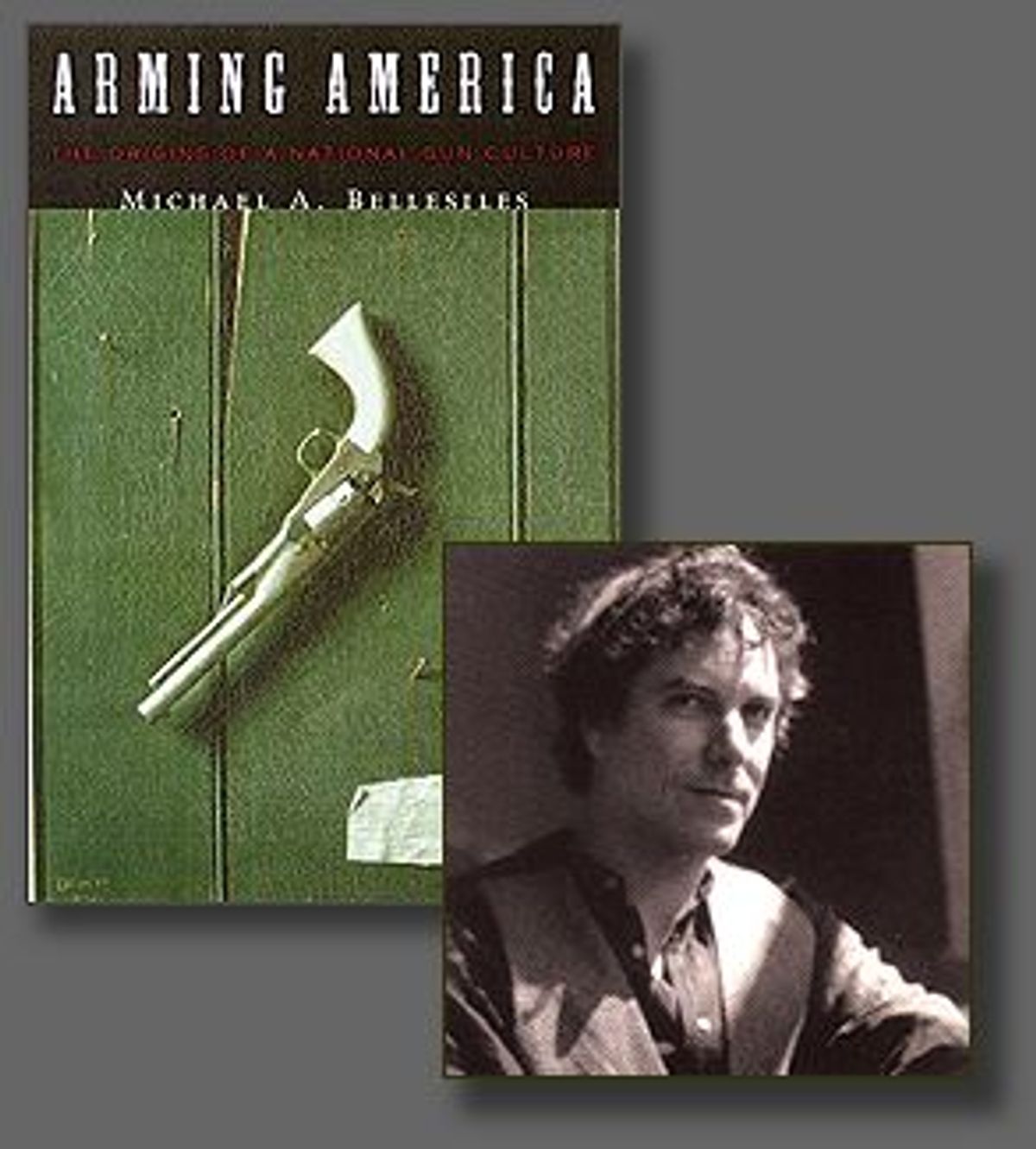
“There are 250 million firearms in private hands,” Bellesiles writes in his hefty new history, “Arming America: The Origins of a National Gun Culture,” “with five million new guns purchased every year.” The NRA would have us believe the nation was founded by gun enthusiasts, but Bellesiles maintains that Americans only fell under the spell of guns after the Civil War, when war-weary Yanks and Rebs returned home toting pistols and rifles.

Contrary to what Bellesiles calls popular “mythology,” gun violence isn’t deeply ingrained in American society or an essential part of our national character. In colonial times, muskets were clumsy to shoot and in short supply. Native American tribes were not conquered by gunpowder, but by Europeans forming alliances with opposing tribes. And the Redcoats were not felled by hundreds of patriot snipers welding muskets. Bellesiles relates that Brits searching the Wild West for shootouts found their Americans uncouth and drunk, rather than trigger-happy.

It’s assertions like this that make Charlton Heston and his NRA cronies apoplectic. As far as they’re concerned, Bellesiles is just another liberal undermining the Second Amendment. Not that Heston has read “Arming America.” If he did, he’d realize the book was, in fact, a 578-page love letter to firearms. Salon interviewed Bellesiles by telephone about his peculiar position.

Do you have a political agenda or are you just into guns?

I am into guns. I am also a historian trying to uncover an aspect of American history. That’s what historians are supposed to do. I’m not agenda driven. I’m not trying to convince anyone to take a policy position. I am fascinated by firearms and I’m very interested in their history.

You’re in charge of the Center for the Study of Violence at Emory University in Atlanta. What’s that?

An undergraduate program. What has long fascinated me as a historian is the discontinuity between modern violence and historical violence. We think the way we live now is the way it’s always been and that’s not the case at all. On a relative scale, the America Revolution was a very nonviolent event. Those who study murder found that murder rates in early America up until the 1920s were remarkably low. Compared to New York circa 1840, Paris was a far more dangerous place to live.

I was disappointed to learn in your book that Billy the Kid only shot three people.

The numbers attached to his name are outrageous. The only true serial killer that we know of from the Wild West is John Wesley Harding. He was employed by large ranchers to get rid of small ranchers. Butch Cassidy almost never carried a gun and he never shot anyone — except for maybe that final event down in Bolivia.

What’s it like having Charlton Heston gunning for you?

I wrote him an open letter because he wrote an editorial in Guns & Ammo attacking my research from a very postmodern perspective: Evidence doesn’t matter. He said I had too much time on my hands. I pointed out that I write history and what use people make of it is their business, not mine.

He ended his attack with these words: “Just for the sake of debate, let’s say the colonists didn’t own many firearms. So what? It’s irrelevant! Very few had printing presses, television stations or Internet access either. By the same ‘logic,’ would that make freedom of the press or freedom of speech any less important to our way of life?”

No, of course not. Framed that way. There is no relationship at all between gun ownership in the 18th and 19th centuries and today. And the reason it matters to Charlton Heston is because the NRA has long associated itself with an imagined history of America in which those who love freedom always owned firearms. And if that imagined history is demonstrated not to hold, they have to be doing what they should be doing — which is basing their current political position on current political necessity instead of on an imagined past.

You say Paul Revere didn’t own a gun because it wasn’t mentioned in his will, but Heston says Revere was just worried about the government confiscating it.

I’d like to know what his evidence is. When Professor Heston gets his Ph.D. and does the research, I might be open to persuasion. This is one area of law that in colonial America was far stricter and much more rigorously enforced than it is today. Cheating on probate was a very great crime because resources were thinly stretched. When someone died, every single item owned — everything, even broken things — was recorded. Guns had to be listed. So unless Charlton Heston can come up with evidence that they made an exception for guns, he should keep quiet. The British Common Law saw guns as belonging to the state. The state had all priority rights over firearms. They could appropriate them at any time without recompense. There was actually greater value placed on recording firearms than any other single item.

A really wonderful substory in your book is the development of guns into an efficient weapon.

Thank you. The most interesting part of the story is how the technology of firearms improved over time. The production of them. The ability of a gun manufacturer to teach an amateur how to use a firearm.

How long did it take to fire a musket?

There’s a great deal of disagreement on this. Those who use modern black powder can fire a second shot within 60 seconds. And yet you see some references to how it was possible to fire four shots in a minute. I don’t see how anyone arrives at this figure; 18th century gun manuals allowed 90 seconds to fire and reload.

How many shots does an automatic like the Kalashnikov fire in a minute?

You can empty a 15-shot magazine in three seconds. The question is how quickly can you put on another magazine. Conceivably, 90 shots in a minute. Easily. Did you know Kalashnikov himself just died? An amazing man. He held until the end that his weapon was one of the greatest inventions of human history because it gave anyone the power to be a revolutionary. Isn’t that good?

So 90 shots in a minute vs. one shot in a minute. The Second Amendment has absolutely no bearing on the present. We might as well be talking about Star Trek phasers. James Madison could never have imagined the Kalashnikov.

That’s the whole point. Their context was a national crisis in the Revolution. They didn’t have sufficient firearms. The majority of Americans didn’t know how to use firearms. They had no domestic firearms manufacturer and the militia was a disaster. The Second Amendment was conceived by Madison in that context. It would be a very different story if we were to rewrite the Second Amendment today from the perspective of a gun enthusiast. It would probably be exactly what they claim it is: That the individual’s right to own firearms will not be infringed under any circumstances. But that’s not what the Second Amendment says.

Now there is a counter argument to your observation: Original intent does not matter; it should be original meaning. Take the concept of free speech. Obviously the framers of the Constitution didn’t want to extend free speech to their slaves. That’s their original intent. But the meaning of freedom of speech is a universal right which with time has been extended. That’s in keeping with the hopes of the framers.

Using NRA logic, American citizens should have the right to own cannons, right? But not even Charlton Heston goes that far, does he?

That was an issue when I taught at Stanford last year. There was a guy who lived above the university who bought himself a Scud missile launcher. In fact, there is no law against it. It’s up to Congress to specifically restrict the owning of any particular firearm and they had never specifically banned Scud missiles. Similarly, you may know that there was this gun called a Street Sweeper. When it was specifically outlawed by Congress in 1994, the manufacturer simply changed a few little details and changed its name so it became the Tech DC (which everyone said stood for “District of Columbia”). So, yeah, you can own a cannon. And cannons don’t kill. Scud missiles don’t kill. People kill.

Yet people didn’t bring home cannons after World War II.

Not to my knowledge.

Didn’t anyone think of it?

I think you’ve framed it exactly right. I don’t think it occurred to anyone until rather recently that any person would have the slightest desire to own a bazooka or Scud missile. Since the 1960s, there are people who want to own these things. Guns & Ammo — which is a fascinating magazine — has articles from time to time on this heavier weaponry. Some of the columnists have argued that there is nothing that forbids you from mounting a machine gun on your SUV — if Congress wants to restrict mounting a machine gun on [an] SUV, they must repeal the Second Amendment. I think that is judicially incorrect.

It’s interesting that the NRA has gone through dramatic changes in the last 20 years. Back in the 1960s, they were a sporting association. Their emphasis was on conservation, on maintaining preserves for hunters and on shooting ranges out in the open country for people to use. Since 1976 at the “Cincinnati Coup” (I think it’s called) when the more conservative — I use “conservative” in its true meaning — leadership was overthrown by the reactionary leadership, it’s changed dramatically. It’s become very politically oriented. Back in 1968 the president of the NRA appeared before Congress to support limitations on firearms and to support outlawing the interstate shipment of firearms. Go back even further, to the 1930s, and the NRA supported the Federal Firearms Act. They supported outlawing machine guns.

When members of the NRA go to sleep at night, do they fantasize about how modern weapons could have changed history? If you sent Arnold Schwarzenegger with some “Terminator” machine gun back in time to the Battle of Bull Run, could he single-handedly have won it for the Union?

Not unless he aimed for Robert E. Lee. But he would have to be close to do that with a submachine gun. One extremely well-trained rifle unit could turn the tide of battle. The classic example is the second battle of Freeman’s Farm, when Daniel Morgan’s rifle company, 210 soldiers all trained in the use of the rifles, were given the order to target the British and German officers. They did so effectively. They killed General Phillips, commander of that wing of the British army. They destroyed the command structure of the British forces. This allowed the Americans to take advantage of the confusion and win the battle. [Pause.] Well-trained, that’s the key phrase. Well-trained usage of advance technology almost always wins.

Have you yourself ever fired a gun?

Yes.

In a controlled situation?

I own firearms. I like to skeet shoot.

Yet people accuse you of being anti-gun.

This is a very strange thing. It’s as if I were writing a history of the auto industry and mentioned the opposition of car manufacturers to safety features — they did that, you know. That wouldn’t make me anti-car. I’m glad that my fascination with firearms shows through.

I’ve never shot a gun. I would love to. Are you more of a man than me because you shoot and own guns?

[Laughs.]

Explain this manhood stuff.

That’s another big topic. There is no doubt that American society equates gun ownership with masculinity. It’s clear that American males have bought into it. The Sports and Hunting Trade Association states that 92 percent to 96 percent of guns in the United States are purchased by men. The NRA has been targeting women as consumers for the last six or seven years. According to the statistics, they have succeeded in increasing the number of women who own firearms by 50 percent.

I wrote a novel called “Bunny Modern” that glorified women with handguns. How culturally responsible am I and Arnold Schwarzenegger for America’s obsession with guns?

This is way outside my field, but I’m impressed by Dave Grossman’s argument that we are succeeding in training our young people to be violent. I don’t see how you can see it any other way. If you familiarize any person with the use of violence in any form as a good thing, again and again, and repeat it in every medium, it’s going to have an impact. They take civilians and turn them into soldiers by surrounding them with weapons, making guns second nature. I do martial arts. I’m very fond of aikido and karate. Each uses muscle memory. I think it’s the same way that we train ourselves to see violence as a natural response. Our culture has done that.

So where do you stand on gun control?

I don’t.

No?

I don’t. I don’t have …

A stand?

I don’t have a stand.

OK. Take automatic weapons — should the Kalashnikov be restricted?

That’s up to the representatives of the people of the United States. I’m not one of them. I’m not a representative.

Won’t bite, eh? So when you’re interviewed, people try to get you to take a stand?

Yes. But I won’t. I’m a historian.

Do you have a historical position on automatic weapons?

[Laughs.] I’ve used them. They’re exciting.

So does Charlton Heston know you’re a historian who has a personal love affair with guns?

I don’t know. He doesn’t want to ask. I hope at least the difference between me and Charlton Heston is I have a sense of humor about all this. I’m not convinced that anyone in the NRA does. I don’t like humorless people, I will be honest about that.

David Bowman is the author of the novel "Bunny Modern" and the nonfiction book "This Must Be the Place: The Adventures of the Talking Heads in the 20th Century."

Our guns and butter economy

America has two favorite new exports: Firearms and obesity

  • more
    • All Share Services

Our guns and butter economy (Credit: ChinellatoPhoto via Shutterstock)

With the economy still struggling and the debates over how to fix the problem more intense than ever, one word still evokes bipartisan consensus: exports. “I want us to sell stuff,” said President Obama, summing up the bipartisan sentiment.

That nebulous word “stuff” is significant. It asks us to see all exports as the same and to refrain from making nuanced value judgments about what exactly we’re shipping overseas. In this coldblooded view, a job-creating export is a job-creating export, and that’s as far as any conversation should go.

At first glance, such reductionism seems logical, rational, even boringly uncontroversial. But two recent news items highlight how in a globalized economy, there are troubling consequences that come from the particular kind of export economy we’re building.

The first bit of news came from the Washington Post, which this week reported that “the Obama administration is crafting a proposal that could make it easier to export firearms and other weapons.” Though the Homeland Security and Justice Departments say the new rules could make it easier for terrorist and drug cartels to further arm themselves, the White House is nonetheless citing the “stuff” theory of exports to ignore the objections.

This is part of a larger pattern since President Obama took office. During Obama’s first year in the White House, he began to gut the Pentagon’s approval process for arms exports, weakening controls on what could and could not be sold. Later, diplomatic cables uncovered by WikiLeaks showed, as Fortune magazine put it, “American officials act(ing) as de facto pitchmen for U.S.-made weapons.”

The result is that America has become the true “Lord of War,” as the arms dealer motto goes. We are the leading arms supplier to the developing world and we are responsible for the majority of all weapons sales across the globe. Yes, we are so committed to selling instruments of death to the rest of the planet that military industries have almost tripled their share of the U.S. economy in just a decade.

The second bit of news came from the Institute for Agriculture and Trade Policy, whose new study shows that America is exporting our obesity crisis to Mexico. Coupling health statistics with U.S. export data since the North American Free Trade Agreement tore down Mexico’s agriculture trade barriers, researchers found that the Mexican market was flooded by American agribusinesses’ taxpayer subsidized commodities (corn, soybeans) and their processed derivatives. According to the report, that quickly wiped out Mexico’s local food economy, leaving its food system exactly “like the industrialized food system of the United States — characterized by the overabundance of obesogenic foods.” Not surprisingly, Mexican obesity rates have consequently skyrocketed.

Taken together, these export booms represent what could be called America’s new Guns and Butter economy. We are so desperate to export any “stuff” we can, we are now fattening up the world and arming it for permanent bloodshed.

Seeking to short-circuit any objections to this trend, President Obama has said simply that “we’re at a moment where necessity has tempered the old debates” over exports and economic policy. In terms of history, he’s not wrong — during the previous century, America witnessed fevered fights over what constitutes a moral farm policy, and in the 1930s the U.S. Senate’s Nye Committee held almost 100 hearings into “greedy munitions interests” that were unduly influencing public policy. Sadly, Obama is correct – those debates have been silenced.

But should they be? Should we simply say that any exports — no matter their moral, ethical, environmental or health implications — are inherently good? Does “necessity” really mean that “stuff” for stuff’s sake must be the basis of our export economy?

Washington and profit-at-all-cost industries certainly say yes — but that doesn’t mean it’s the right answer.

Continue Reading Close
David Sirota

David Sirota is a best-selling author of the new book "Back to Our Future: How the 1980s Explain the World We Live In Now." He hosts the morning show on AM760 in Colorado. E-mail him at ds@davidsirota.com, follow him on Twitter @davidsirota or visit his website at www.davidsirota.com.

ALEC: We will stop being gun nuts now

Right-wing legislation drafting house refocuses on business issues following bad press and boycotts

  • more
    • All Share Services

ALEC: We will stop being gun nuts nowGeorge W. Bush speaks to the American Legislative Exchange Council in Philadelphia in 2007. (Credit: Chris Greenberg)

The American Legislative Exchange Council, or ALEC, is a group that helps major industry players write their own legislation that Republicans then pass in state legislatures across the country. Traditionally, ALEC would draw up and promote bills limiting labor organizing rights and weakening workplace safety regulations and environmental protections, because those things anger the Market Gods. Fewer of those things means more money for ALEC’s funders! Recently, though, ALEC also began dabbling in things that wouldn’t make anyone any money but that happened to be right-wing political priorities.

ALEC is now shutting down its “Public Safety and Elections” task force. ALEC’s Public Safety and Elections task force’s goals were twofold: to improve “public safety” by making it easier for citizens to carry guns everywhere they go and to shoot certain people without fear of arrest or prosecution, and to improve elections by making it harder for politically undesirable types to exercise their right to vote. (Why were gun rights and voter disenfranchisement the purview of one task force? Those two issues really have very little in common besides being of supreme importance to paranoid white people.)

What happened is, people suddenly noticed that self-defense laws had recently become much more “robust” (slash-”insane”) in lots of states after this guy in Florida named George Zimmerman shot and killed an unarmed black teenager named Trayvon Martin and then somehow was not arrested. These new self-defense laws were widely blamed for the police reaction, or non-reaction, and while the NRA had predictably lobbied for them in the various states where they passed, it turned out that ALEC had been instrumental in drafting these laws and others like them that had nothing to do with being “pro-business” but everything to do with quietly remaking the nation into a right-wing paradise.

So major corporations began abandoning ALEC, because they hadn’t signed on for the full right-wing culture war. While Coca-Cola has a vested interest in, say, stopping public health initiatives, there’s no compelling profit-based reason for it to support the dismantling of gun control legislation. People do not get thirstier when they are carrying concealed firearms, as far as I know. Kraft does not, as a company, have any interest in making it more difficult for poor people to vote.

So! ALEC is giving up on the items of its agenda not directly related to helping giant corporations make as much money as possible without fear of lawsuits or union agitation. Because those are less “hot-button” issues.

Continue Reading Close
Alex Pareene

Alex Pareene writes about politics for Salon and is the author of "The Rude Guide to Mitt." Email him at apareene@salon.com and follow him on Twitter @pareene

AZ state senator: Herman Cain has not sexually harassed me, even though I am attractive

One (crazy) woman's defense of the scandal-plagued candidate

  • more
    • All Share Services

AZ state senator: Herman Cain has not sexually harassed me, even though I am attractive Arizona state Senator Lori Klein, who has never been harassed by Herman Cain (Credit: YouTube/Fox News)

Arizona state Sen. Lori Klein is Herman Cain’s Arizona state chairman and also the sinking candidate’s single best asset. If I were him, I’d immediately start booking Klein on cable TV as a campaign surrogate, because her impressive spin work is right now being sadly wasted.

Lori Klein, an Arizona state Senator and Cain’s Arizona state chairman, told CBS News she stands by Cain.

Says she has known him for 12 years and he’s “never been anything but a gentlemen – and I am not an unattractive woman.”

That’s a slam-dunk argument, right there. And she’s not even done!

Klein suggested that if Cain is innocent he should sue White for libel and went on to attack the media for digging up the allegations. She also said that in politics, “we want a virgin to do a hooker’s job.”

Yes! Herman Cain is a hooker. But a hooker with a heart of gold, and the constitution to resist harassing or assaulting Lori Klein, a noted attractive woman!

Klein is, of course, an expert in what constitutes appropriate, professional behavior among adults, as she proved when she took a loaded gun out of her purse and pointed it at a newspaper reporter who was attempting to interview her in a state Senate lounge.

Lori Klein is a rising star in the GOP. Remember her name. Or she’ll shoot you, for being a Mexican.

[Via Ben Smith]

Continue Reading Close
Alex Pareene

Alex Pareene writes about politics for Salon and is the author of "The Rude Guide to Mitt." Email him at apareene@salon.com and follow him on Twitter @pareene

The NRA guns for Holder

Lax U.S. laws help arm the Mexican drug cartels. So who does the U.S. gun lobby blame?

  • more
    • All Share Services

The NRA guns for HolderAttorney General Eric Holder (Credit: AP/nrailadonate.org)

While an apologetic Attorney General Eric Holder Jr. went before a Senate committee this week to talk about a failed gun-walking program, the National Rifle Association was gearing up its campaign to get Holder fired.

In a new, slick 1 minute and 55 second television ad flush with with Fox News footage, the NRA expressed outrage over the Bureau of Alcohol, Tobacco and Firearm’s gun-running operation known as Operation Fast and Furious. Under the supervision of ATF officials, the operation let guns get into the hands of criminals on both sides of the Mexican border. The NRA claimed Holder perjured himself before Congress and lied about what he knew about the operation and urged the White House to fire Holder. Holder has adamantly denied lying.

The NRA has homed in on Operation Fast and Furious in order to advance its agenda of undermining not just Holder but the president. The misguided operation, run by ATF officials reporting to the Justice Department, encouraged Arizona gun dealers to sell weapons to “straw purchasers,” with the hopes of tracing the weapons to the Mexican cartels. ATF lost track of many of the guns, and some surfaced at crime scenes on both sides of the Mexican border, including one involving the murder of Border Patrol agent Brian Terry last year in Arizona.

Bent on getting this latest ad circulated, the NRA is soliciting funds to air it, and has posted this on the website:

“Watch the video and see how Eric Holder’s lies are destroying freedom and costing lives. Please make a donation to help NRA-ILA air this video across America. And please, forward this video to family and friends!”

The group’s  outrage over guns getting into the hands of the bad guys under Fast and Furious would be slightly more plausible if the NRA ever expressed any concern about U.S. gun laws that effectively armed the Mexican drug cartels with heavy weaponry.

The NRA’s critics note that the powerful gun lobby, based in northern Virginia, has essentially accomplished the same evil as Fast and Furious by lobbying hard — and taking legal action if necessary — to water down tough U.S. gun laws and regulations. The NRA is particularly determined to undermine its nemesis, the Bureau of Alcohol, Tobacco, Firearms and Explosives, which enforces gun laws.

The NRA has adamantly fought ATF regulations that require gun dealers in four Southwest border states to report sales of two or more assault weapons to one person within five days. The NRA also helped derail the confirmation of  Obama nominee Andrew Traver for director of ATF, which has been in dire need of stability. The NRA opposes strict handgun control laws in such cities as Washington that have high rates of gun violence.

“I think the NRA has to have something to scare their members about and attacking Obama and more specifically Holder is part of that plan,”said Kristen Rand, legislative director for the Violence Policy Center in Washington.

Rand says the NRA has conveniently homed in on the guns in Operation Fast and Furious, while ignoring “the hundreds of thousands of other guns that have flooded Mexico and killed tens of thousand of Mexicans.”  And she noted that the  NRA has been mum about news in recent days that  a similar ATF gun-walking operation — Operation Wide Receiver — was pursued under the Bush administration and Attorney General Mike Mukasey.

“They’re not upset about that,” she said.  “They’re directly threatened by another Holder-Obama administration,” and using it to help fundraise.

Few contest the downside of Operation Fast and Furious.

“This operation was flawed in concept, as well as in execution,” Holder told the Senate Judiciary Committee on Tuesday. “And, unfortunately, we will feel its effects for years to come as guns that were lost during this operation continue to show up at crime scenes both here and in Mexico. This should never have happened. And it must never happen again. ”

“The American public needs to know the whole truth on this,” said NRA president Wayne LaPierre  in a video last June. “The fact is, that brings us to the consequences, these guns are now, as a result of what they did, in the hands of evil people and evil people are committing murders and crimes with these guns against innocent citizens.”

The whole truth is that lax U.S. gun laws — supported by the NRA — are what have helped the Mexican drug cartels to arm themselves and slaughter law enforcement officers, rivals and innocent people.

“The NRA has been devoted to assure that our gun laws remain anemic, ” said Dennis Henigan, acting president of the Brady Campaign to Prevent Gun Violence.  ”The NRA is not really interested in stopping the gun trafficking.”

Continue Reading Close

Arizona’s very Arizonan armed library guard debate

Do libraries really need to be guarded by private security officers with guns? One county says yes!

  • more
    • All Share Services

Arizona's very Arizonan armed library guard debateMari Morneau, of Gilbert, shoots at Caswells Shooting Range Tuesday, April 6, 2010 in Mesa, Ariz. On Monday, April 5, 2010, Gov. Jan Brewer has signed into law two bills supported by gun-rights activists. One of the bills signed Monday would broaden the state's current restrictions on local governments' ability to regulate or tax guns and ammunition. The other bill declares that guns manufactured entirely in Arizona are exempt from federal oversight and are not subject to federal laws restricting the sale of firearms or requiring them to be registered. (AP Photo/Matt York)(Credit: Matt York)

Do libraries in Maricopa County, Ariz., need to be guarded by private security officers with guns? Yes, probably, because everyone should be armed at all times, especially when they are defending our library books or collecting late fees. Only then will we be free, and safe.

Apparently Maricopa County has guards — private security firm employees, not county employees, with guns — proper guns — at most of its libraries.

“In large buildings with multiple rooms and lots of people, you need to have some feeling among the staff, as well as the public, that it’s a secure place, particularly where it’s used a lot by children,” said library-district director Harry Courtright, who retired Friday.
[...]
In his 12 years with the district, Courtright said there have been no incidents of a guard drawing a gun.

“And they shouldn’t have to, because they have the training. But that gun makes a difference to the people who are coming in the building who might want to do something that could be bad; they see an armed guard, and the reality is they back off and they don’t do things – it’s a preventative thing,” he said.

Right! Which is why all large libraries in big cities have armed private guards in them. Right, Phoenix libraries?

Interviews with officials at city-run libraries in the Valley that don’t belong to the county district indicate that armed guards are uncommon.

In Mesa, library-security guards are unarmed. The topic of arming them has never come up, said city spokeswoman Lily King-Cisneros.

“If there is a problem, they call the police,” she said.

Chandler’s libraries have a simple behavior policy to follow up on negative behavior, Manager Brenda Brown said.

Chandler employs security guards sparingly: Park rangers help during high-traffic times at the Downtown Library, while at Hamilton and Basha branches, both located on school campuses, security guards are present for a few hours following schools’ closing times. None is armed.

“Most of our behavior issues take place downtown, and police are less than a block away. We call them quite often and quite frequently,” Brown said, adding that stolen bikes are a common problem but threats to librarians are rare.

Phoenix, which has 16 libraries, trains its own guards, who are city employees and unarmed.

Incidents are rare even at the Burton Barr Central Library, where the surrounding neighborhood has a high number of homeless people, said Lupita Barron-Rios, acting deputy director for public services.

“For the most part, we don’t have a lot of incidents that require calling the police,” Barron-Rios said.

Barron-Rios said police are called when a patron’s car or bicycle is stolen.

Of course, none of these minor behavioral issues and occasional thefts would happen at all if literally every person in that library, from the children to the librarians to the homeless people, was carrying a clearly displayed handgun. It’s just a fact.

Is this armed guard program controversial? It wasn’t, until one library made a fuss.

Doesn’t Southwest Regional Library in Gilbert, Ariz., look like a lovely place? Looks can be deceiving! This library is suffering from a rash of “hostile encounters with irate patrons over late fees and other issues,” which is why the town decided to reinstate the guards they let go for funding reasons last year. But! “Town officials contend that the library district never told them of the plans to arm the guards once funding was restored …” I feel like town officials should’ve understood that they’re dealing with Maricopa County, here. There were going to be guns involved, no matter what.

[Via Michel Marizco]

Continue Reading Close
Alex Pareene

Alex Pareene writes about politics for Salon and is the author of "The Rude Guide to Mitt." Email him at apareene@salon.com and follow him on Twitter @pareene

Page 1 of 27 in Guns