Children
Erotica mama
I love writing about sex, but don't believe in telling kids things they aren't ready to handle.
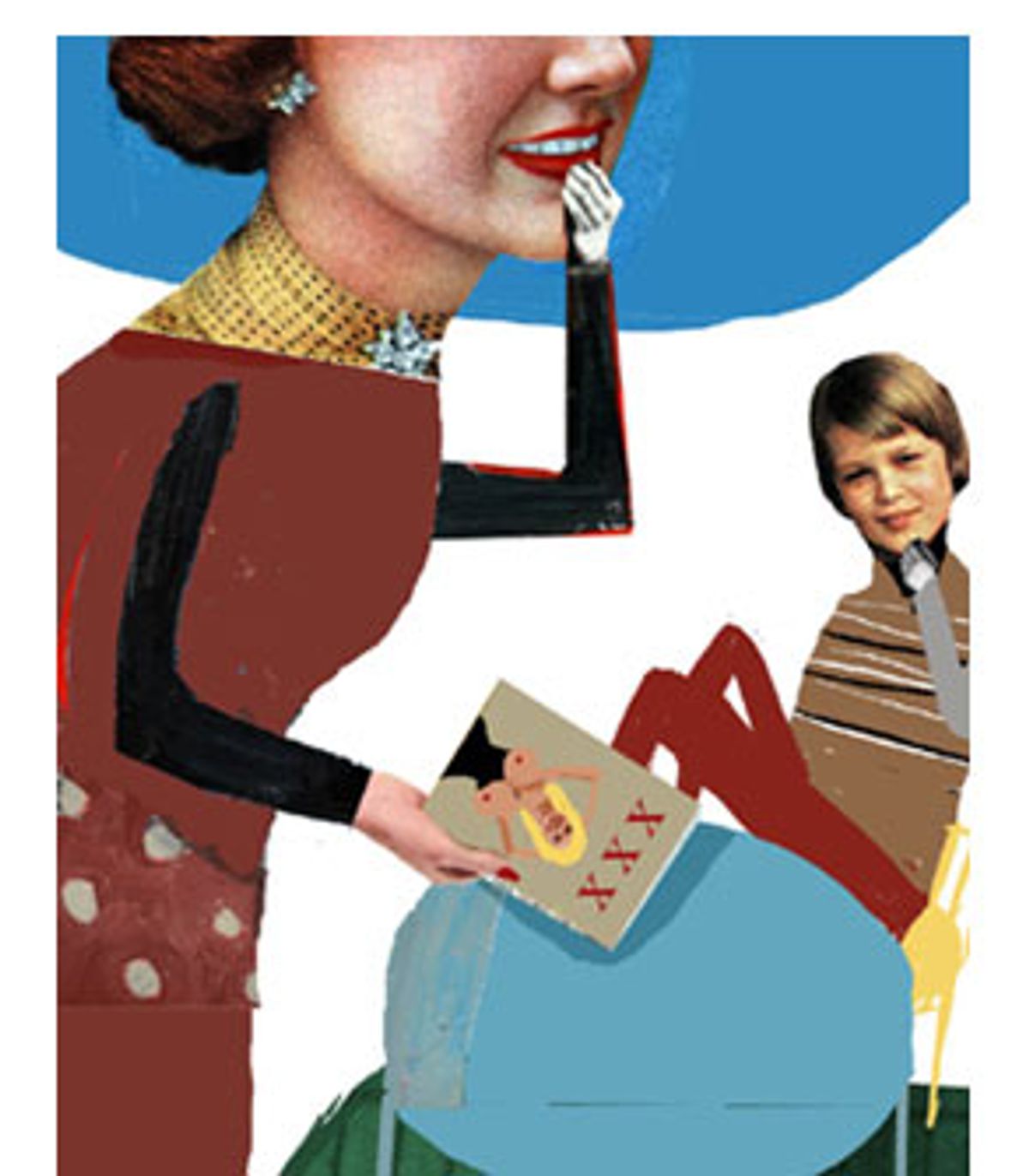
The first time my 12-year-old son asked me if I would buy him a Playboy magazine, I offered him one from my stash. “I just happen to have a copy,” I said casually, sneaking in my closet to get it for him. I was glad that he felt free to ask me, but I had to offer my standard grown-up-woman/feminist lecture. “The articles are good,” I said, as if I really thought he was going to read them, “but you must realize that real women simply don’t look like those pictures. Those girls are airbrushed to perfection, and most of them have fake breasts.”
“Fake? Really, Mom? How can you tell?”
The generation gap widened. In his age of Jenny McCarthy/Pamela Anderson/perfect MTV babes, puffed-up beach balls on women’s chests look normal to him. I mumbled a few words, trying to describe the difference. Fortunately he did not ask me to sort out the naturals from the pretenders, and to my relief he took the magazine to the privacy of his bedroom.
As a writer of erotica and a woman who grew up in sexual ignorance, I don’t believe in censorship for children. But I also don’t believe in tossing smut at them before they’re ready, either in print or on the Web. So I have no problem with Playboy being kept out of view in convenience stores, or with erotic Web sites having adult-warning pages. Kid-filtering software is a little iffier to me; it seems like a good idea, but too many parents I know who have this in place are the more clueless ones who need better communication and more time with their kids — kids who then have to hang out at other people’s houses to learn things.
Like my house. Six months after the Playboy incident, my son was sitting in his bedroom with a couple of friends, sharing dirty magazines, while I was around the corner, out of sight, putting laundry away. “We should close the door so your mom won’t catch us,” one guilty-sounding kid said while ogling the centerfold.
“Oh, it’s no big deal,” my son responded, with a matter-of-fact confidence that concerned me. “My mother reads Penthouse.”
I didn’t stick around for the response, slinking away to reconsider my parenting skills for a moment. I am a soccer mom and a PTA parent, but I also read and write smut with a serious passion. No matter how liberal and open I think I am, there’s still a fine line to walk as a parent. I believe in the idea that when kids are ready to know something, it should be made available to them, in a smart and honest way. It’s just hard to keep hiding my own stuff.
The question of how to live with children as an erotic writer tails me every day. I can deal with the fact that I own a riding crop and other sex toys — those are private and easily hidden, not unlike my stash of dirty movies. (Maybe when they ask … I don’t know.) But I spend hours and hours writing, and they know this, and I’m proud of what I publish. I just don’t want them to read it. When we talk about it, I say it’s a “little racy” and they smile, but they ask no questions — yet. I read an interview with Molly Jong-Fast recently in which she said she has never read any of her mother’s books (Erica Jong, the queen of erotic writing when I came of age).
This fascinated me — if Jong-Fast, who is 21 and a writer herself, still can’t bring herself to read her mother’s dirty words, maybe my kids will never read my erotic stories.
But their grandma does. Yes, in this multigenerational smut family, even my mother has gotten in on the act. This conservative woman in her 70s, who had never even looked at a Penthouse in her life, has suddenly developed a great interest in my writing. The first story that I tentatively showed her in a magazine earned only the comment “Wow, that’s almost … pornographic!” But within the year she was reviewing all my stories for me, providing helpful insight on characters and questioning factual sexual information: “Do people actually do that?”
Of course she has to hide the stuff from my father.
I made my collection of erotic books and magazines available to my two sons not long after the Playboy incident, pointing out the shelves where I kept them in case they wanted to read them, and gave each of them the gift of “Changing Bodies, Changing Lives: A Book for Teens on Sex and Relationships,” the best book around about sexuality for teenagers. Actually, I made everything available except one book, which I hid: “Macho Sluts” by Pat Califia. I can’t remember why, and today it’s on the shelf with the rest, but I think at the time that I read it I was shocked by it (and loved it), and somehow thought this one book might be too much for my kids.
Not that they ever read these books. They’re teenage boys — they want pictures, music, action. I’d like to think my kids are growing up reading Henry Miller, Susie Bright, Pauline Reage and Robert Olen Butler, but it hasn’t happened yet. I have pointed them to Web sites like Scarleteen and Go Ask Alice, and I know they’ve passed the information along to friends, so perhaps some interesting sexual words are being absorbed in spite of everything.
There are problems with complete honesty with kids. Noted conversations from the front: “Mom, would it be OK with you if I have some friends over after school on Friday and we make hash brownies?” Answer: “Uh, no.” And another: “You know, boys, I believe that everyone is born bisexual. Whether you grow up to love women or men or both, it will be OK by me.” Answer: “Oh, yuck, Mom.”
Still, the erotic-disclosure conflict remains for me. My son’s “Details” magazine subscription arrived earlier this year, and as I was flipping through it before he’d seen it, there it was — an excerpt from my story in “The Best American Erotica 2000″ — in my kid’s magazine. I debated: He’d probably never notice it if I didn’t show him, and, yes, it included X-rated writing. But I’m human, and my name was in his magazine, so I showed him. I think he blushed a little bit after he read it, but still, every parent knows you’ve got to impress your kids with your coolness when you get the rare opportunity.
My oldest son is 16 now and hardly even looks at magazines like Playboy, preferring to spend his time reading about snowboarding and music. Is this healthy? Was it healthier, not to mention sexier, to grow up repressed, as I did, shocked into eroticism every time I got a sneak peek at something dirty? I lived through that and ended up as an adult who sees the world through a sexual haze, never tiring of writing out all of my wildest fantasies. My mother grew up in a repressed era and ended up as a senior citizen who gets a secret kick out of erotic stories. Will my kids be jaded by things sexual before they’re 21, or will all of this openness mean less agony and healthier relationships for their futures? Only time will tell, but I hope for the latter. In the meantime, though, I look forward to the possibility of their acquiring their own brand of grown-up outrageousness, and hearing them say to their own teenagers someday about me, “Your grandmother writes smut.”
Susannah Indigo is a freelance writer. More Susannah Indigo.
A death that was also a birth
As a midwife, I've spent the last 30 years taking care of women in pregnancy. But nothing prepared me for this
(Credit: Clara via Shutterstock) The call came early in the morning. The 3-month-old granddaughter of my neighbor had finally succumbed to the illness she was born with. I am a midwife, but this call wasn’t about a birth. This time the call was from the mortuary.
I have spent the last 30 years taking care of women in pregnancy, birth and beyond. I use my hands to help bring life into this world. Over the past few years, however, I found myself using those very same hands in the performance of a Taharah, a Jewish ritual that prepares a dead woman for burial. Birth, life, joy, beginnings vs. death, decay, finality. Such a contrast! What could be more different? And yet, somewhere in my consciousness, there was a commonality. Caring for a woman in her life, preparing a woman for birth had a parallel in preparing a woman for burial. The act of helping a woman and her baby through their many transitions seemed analogous to helping the soul transition from this plane of existence to the next.
Continue Reading CloseTova Hinda Siegel is a writer who lives in Los Angeles. More Tova Hinda Siegel.
“Why won’t you answer me?”
Kids' questions may be annoying -- but they're more crucial to learning than we've ever thought. An expert explains
(Credit: Bonita R. Cheshier via Shutterstock) Children can ask a lot of very annoying questions. Starting at about 2 years of age, they begin barraging their parents with endless queries, from “Are we there yet?” to “Why is the moon round?” — questions that often seem more like desperate ploys for parental attention than anything else. And, to make things worse, cooperative parents are often treated to a relentless barrage of follow-up questions, many of which involve one word: “Why?” Is this process infuriating? Yes. But is it crucial to their development? Far more than most of us think. And furthermore, the frequency and form of those questions can tell us a lot, not only about how children learn but also about cultural and class differences in America.
Continue Reading Close
Thomas Rogers is Salon's Arts Editor. More Thomas Rogers.
Child acting’s new golden age
From Chloe Grace Moretz to "Shameless," kids aren't just getting more roles -- they're actually good. What changed?
Chloë Moretz in "Hick" “Never work with children or animals” is an old W.C. Fields chestnut that, for a while in the ’90s and ’00s, everyone outside of children’s entertainment seemed to be holding sacred. Child actors were off on their own in a parallel entertainment universe created by Disney and Nickelodeon, while adults held down the fort in dramas and reality shows. There were some notable exceptions, like Haley Joel Osment and Christina Ricci, but by and large, children were almost entirely absent from grown-up entertainment.
Continue Reading CloseMichael Barthel is a PhD candidate in the communication department at the University of Washington. He has written about pop music for the Awl, Idolator, and the Village Voice. More Michael Barthel.
My dad’s 30-year coming out
I thought my father kept secrets because he was gay. Turns out all parents have a walled-off life -- and that's OK
Gideon Lewis-Kraus (Credit: Rose Lichter Marck) I must’ve been eight or nine the one time my dad took me along to meet Bart. This was somewhere near Tompkins Square Park. What I recalled was a shaggy shock of blue hair, and feelings of both elation and terror: On the one hand thrilled to be old enough to be taken along one night to the city to meet a guy with blue hair, and on the other frightened of the jagged dark in the Alphabet City of the late ’80s. In my memory Bart looked like Warhol, but maybe that was just part of the dream pedigree I had for my dad, the one that looked to White and Genet and not “Will & Grace.” But I did think that my dad once said he’d gone with Bart to sell drugs to Allen Ginsberg, so maybe in this case my retrospective fantasy — that if he’d had a secret life, it could at least have been an exciting one, something worth escaping his surface life for — was accurate. I remembered hearing for the first time about AIDS, and I remembered my dad walking around for some months, maybe years, as though accompanied by ghosts. It was selfish and obscene for me to look back and want his secrets, the secrets I’d come here to try to clear up, to have hidden amazing things: It meant I have at best ignored and at worst aestheticized the fact of what must have been unimaginable pain. Like any gay man of his age, he’d watched a great number of his close friends die of AIDS, but unlike many of those men, he was not able to talk about it to the people closest to him, the people he lived with. Maybe the reason he liked “Will & Grace” and not so much White and Genet — though, now that I think of it, I did give him “The Married Man” once and he told me it was the best novel he’d ever read — was that all he wants now is to be normal and happy. He wanted to marry Brett and drink boxed wine and take Yoshi out for walks and watch “Mamma Mia!” until their DVD player caught fire. I myself had never been less than loathsome on the subject of “Mamma Mia!” and I felt terrible about it, but I didn’t want to digress into overemphatic apology, and I would stand by my derision of “Mamma Mia!”
Continue Reading CloseGideon Lewis-Kraus is the author of "A Sense of Direction: Pilgrimage for the Restless and Hopeless." He has written for Harper's, the Believer, McSweeney's, Bookforum and other publications. More Gideon Lewis-Kraus.
When your child is gay
Kids are coming out at younger and younger ages -- and parents need to help them. Here's how VIDEO
(Credit: Benjamin Wheelock) When HuffPo blogger Amelia’s son came out to her, she went down to her city’s LGBT community center to inquire about any youth groups that might be open to him. “They told me, ‘We have a support group for ages 14 and up,” she recalls. “I said, ‘My kid is 7.’”
Even down at the local LGBT center, it’s still unusual to think of a young child as gay. Childhood is, after all, a fairly neutral time, one in which the concept of love is reserved largely for parents and ice cream. But just because a kid isn’t yet engaged in the stream of romantic attachment, it doesn’t follow that he isn’t developing his sense of self. Who you are is not a single adolescent rite of passage like a bar mitzvah or quinceañera. Every gay adult was once a child. And in every classroom and playground in America right now are our future gay adults. So how do we raise those children – and all our children — in a way that acknowledges and accepts that?
Continue Reading Close
Mary Elizabeth Williams is a staff writer for Salon and the author of "Gimme Shelter: My Three Years Searching for the American Dream." Follow her on Twitter: @embeedub. More Mary Elizabeth Williams.
Page 1 of 67 in Children