Michael Chabon

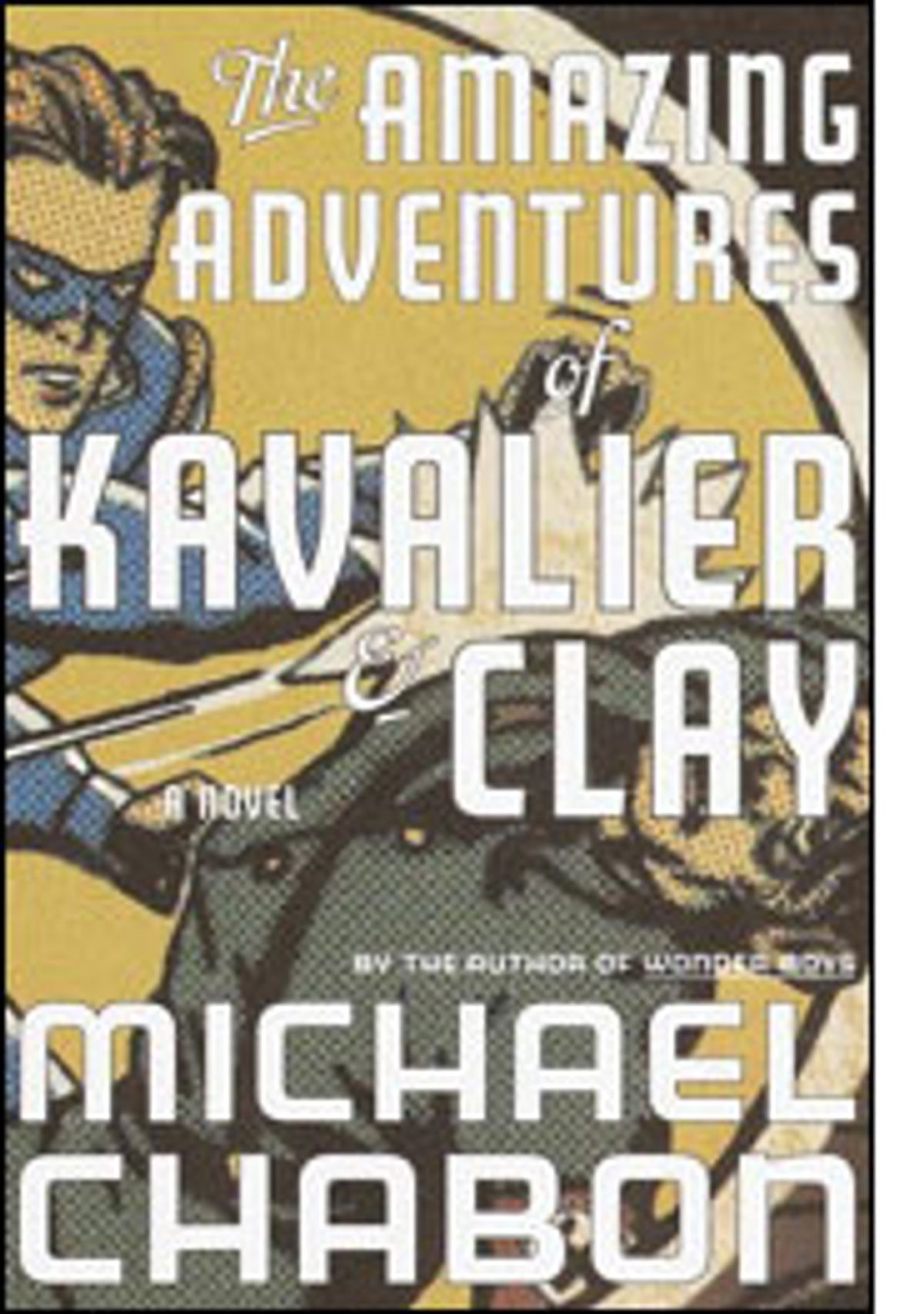
“The Amazing Adventures of Kavalier & Clay” by Michael Chabon

In the rapturous, panoramic new novel by the author of "Wonder Boys," two midcentury comic book writers battle evil and celebrate escape in all its forms.

Despite its heft — it weighs in at 639 pages — Michael Chabon’s “The Amazing Adventures of Kavalier & Clay” is a speedy, nearly effortless read. The action zooms along, with plot twists worthy of a pulp fiction potboiler and characters of delicious pumped-up proportions like the Mighty Molecule (a circus strongman), Tracy Bacon (a B-movie king with a lantern jaw and sonorous “string-bass” voice), Longman Harkoo (an art mogul) and the Saboteur (a sinister self-proclaimed Nazi guerrilla), delivered in Chabon’s flawless musical prose and punctuated — Bat! Bam! Bif! — with feats of physical prowess and derring-do.

It would seem like a guilty gorgefest, a sugary pop concoction, if, like pop art itself, it weren’t so heavily fortified with all the vitamins and minerals of true art.

The novel opens in 1939 as Sam Clay (ni Klayman) of Brooklyn, N.Y., a glorified errand boy and aspiring comic artist, meets his long-lost cousin, Josef Kavalier, who was smuggled out of Hitler’s Prague thanks to his apprenticeship as a Houdini-like escape artist, with a golem as his undercover ally. As the two cousins cobble together a cigarette out of stray flakes of tobacco, it becomes apparent that they can make something out of their combined talents and ambitions. With Joe as lead artist and Sammy as lead writer, the two fuse the stories of their past into their first comic book, one that will make their name and their fortunes, as well as give expression to their artistic desires and political rage. In the guise of the Escapist, a costumed superhero who “comes to the rescue of those who toil in the chains of tyranny and injustice,” they fight their own demons (personified, quite literally, by Hitler and Nazi Germany). Later, they introduce Luna Moth — called by a delighted publisher “the first sex object created expressly for consumption by little boys” — styled after Joe’s girlfriend, Rosa Saks, a Greenwich Village bohemian and later a comic book artist in her own right.

One feels at times that Chabon is so deeply in love with his characters that he can’t bear to do them harm. Wrapped in the teflon cloak of their author’s unconditional goodwill, Sammy and Joe take on nearly superhuman powers: Their harebrained schemes lead to fame and fortune, often in a matter of days. Their loves are requited. They hobnob with the likes of Orson Welles, Salvador Dali and Joseph Cornell (whom Joe is said to resemble, in that both are “striking out for the sublime in a vessel constructed of the commonplace, the neglected, the despised”). Stan Lee knows their name. Greedy bosses prove to be good men with the boys’ best interests in their hidden hearts of gold, and their enemies are foiled in the nick of time. This leads to some rather implausible last-minute saves, including one especially improbable sequence in which a well-timed phone call to Eleanor fucking Roosevelt (someone happens to have her number) saves the day.

Luckily, the reader loves Sammy and Joe, too. They are lovable. (In fact, reading this book makes one wonder why so many authors are so ready to saddle their creations with ennui, thwarted ambitions and disillusionment.) Their last-minute saves and superhuman luck and pluck, moreover, are central to the theme of the book, which is the beauty and necessity of escape in all its forms:

It was the expression of yearning that a few magic words and an artful hand might produce something — one poor, dumb, powerful thing — exempt from the crushing strictures, from the ills, cruelties, and inevitable failures of the greater Creation. It was the voicing of a vain wish, when you got down to it, to escape. To slip, like the Escapist, free of the entangling chain of reality and the straitjacket of physical laws … The newspaper articles that Joe had read about the upcoming Senate investigations into comic books had always cited “escapism” among the litany of injurious consequences of their reading, and dwelled on the pernicious effect, on young minds, of satisfying the desire to escape. As if there could be any more noble or necessary service in life.

Of course, the Forces of Evil, qua Hitler, prove to be more than a fair match for a scrappy young street tough with a demonic pencil of rage and a propensity for street fighting, as Joe discovers in the second half of the novel. Joe trades his pen for a sword — OK, a pistol — and goes out to fight the war against fascism by more traditional means. The boys’ golden period is effectively ended, and the novel obtains the requisite amount of pathos and gravitas, which renders its frenetic, cinematic (not to mention comic) climax atop the Empire State Building (one only wishes that Welles, Joe Kavalier’s idol, were around to execute the film version) all the more satisfying.

Each page is thickly iced with Chabon’s much-touted lyricism. At its best, it makes you realize just how gorgeous the edges of the world truly are.

At its worst, it functions more as analgesic than aphrodisiac. Take the sky. Most of us would agree that it is, more or less, blue. Yet in “The Amazing Adventures of Kavalier & Clay” we get dozens of metaphors for it, often trotted out at the rate of one per chapter: “The sky was shining like a nickel”; “the sky was as blue as the ribbon on a prize-winning lamb”; the sky was as “blue as a gas flame, with a flickering hint of carbon in the east.” It segues, predictably, to gray in the darker third of the novel: “Gray light was smeared across the sky like ointment on a bandage”; “the view out the windows was pure cloudbank, a gray woolen sock pulled down over the top of the building.” One is either startled by Chabon’s virtuosity or dulled by its repetitiveness. Certain readers may want to shout: Enough already! I know the sky is blue!

But this is a quibble about a book that does so much so well, and with such a light touch. Chabon carefully connects the lithography dots that he, though not his characters, knows will link the commercial art of the ’40s with pop art later in the decade. (His footnotes document, among other things, the selling prices fetched by the work of Kavalier and Clay in 1990s auction houses, and at one point a young Roy Lichtenstein is said to have visited Sam Clay’s studio.) Many contemporary issues — homosexuality, the role of women in the arts, censorship, anti-Semitism — are addressed, though never with the cloying revisionism that can bog down books that try to use history as a Parable for Our Time. This is definitely New York, the old-school version. In the fusion of dashing young men in fresh new $12 suits, the smell of newsprint and burned coffee and laundry, and the courage to face unrelenting evil with pluck and humor, Chabon has created an important work, a version of the 20th century both thrillingly recognizable and all his own.

Amy Benfer is a freelance writer in Brooklyn, N.Y.

The amazing adventures of an aspiring grown-up

In "Manhood for Amateurs," Michael Chabon recounts the glories and embarrassments of fatherhood -- and man purses

Michael Chabo

Though Michael Chabon’s fixation with DC comics, bisexuality and pink Polo shirts is not exactly “manly,” his life — as evidenced by an endearing new collection of short essays — has been a picture of modern American manhood. Whereas his last book, “Maps and Legends,” mounted a scholarly defense of the genre fiction that formed his literary tastes, “Manhood for Amateurs: The Pleasures and Regrets of a Husband, Father, and Son” charts the landscapes of his childhood and adulthood in a frank, visceral style. To read it is to understand the open line of communication Chabon keeps with his younger self; he seems to recall exactly what it was like to be a kid. Yet, as a father of four and the husband of novelist Ayelet Waldman (a former columnist for Salon), Chabon displays a deep investment in his role as a family man. He has an instinct for good old-fashioned moral righteousness in the face of trouble and temptation.

The funniest of these essays depict the author’s metamorphosis from a latent misogynist who takes himself too seriously into a serious man with feminist sympathies. “Cosmodemonic” is a brief portrait of the artist as “a little shit” — his 22-year-old head full of Henry Miller, recklessly lusting after his female classmates at the University of California at Irvine’s MFA program. “The Miller hero — my hero — does what he wants, when he wants, whether it makes sense or not,” Chabon writes. This pose is crushed after two years of exposure to “the hard-earned skepticism of grown women” in his workshops. Two decades on, in “William and I,” we see Chabon protesting the high standards of motherhood compared to the meager demands of being a good dad. And, as if to complete the transformation, “I Feel Good About My Murse” has the 45-year-old Mike proudly shouldering a suede man purse. “I seem every day to give a little less of a fuck what people think or say about me,” he confides.

Another of the book’s consistent motifs is the disappearance of childhood. With vivid access to his own, Chabon is able to contrast the ways in which his kids’ imaginations are imposed upon and pre-imagined by, for example, the “authoritarian nature of the new Lego” and “the orthodoxy of ‘Toy Story.’” To Chabon’s mind, these products lack the open-endedness of “crap” entertainment like the short-lived “Planet of the Apes” TV show of his youth, into whose shaky plotlines a child could more easily project himself. Still, he trusts in the innovative potential of the child psyche: “Kids write their own manuals in a new language made up of things we give them and the things they derive from the peculiar wiring of their own heads.” As a manual to Chabon’s own peculiar wiring, “Manhood for Amateurs” makes for an insightful and highly entertaining guide. 

Continue Reading Close

Jed Lipinski is an editorial fellow at Salon.

Salon Book Awards 2007

From an imaginary history of Alaskan Jews to a compelling glimpse of the CIA, we pick the 10 most pleasurable reading experiences of the year.

It’s been a tranquil year in the book industry: no big fabrication or plagiarism scandals, à la James Frey or Kaavya Viswanathan, and consequently no dramatic denunciations on “The Oprah Winfrey Show.” O.J. Simpson’s bizarre “hypothetical” confession, “If I Did It,” was finally published after the copyright had been transferred to the family of Ronald Goldman; in the end, it achieved little more than the destruction of the career of one of publishing’s premier carnival barkers, editor Judith Regan. (She’s now suing her former employer, Rupert Murdoch’s News Corp.)

But if the book world provided relatively little tabloid fodder in 2007, that doesn’t mean that graver problems aren’t afoot. The National Endowment for the Arts just released another of its depressing surveys of American reading habits, revealing that one in four of our fellow citizens had not read a single book in the preceding year. Meanwhile, the National Book Critics Circle’s Campaign to Save Book Reviews has been tirelessly documenting — and protesting — the withering away of book coverage in our magazines and newspapers.

What fragments can we shore up against this ruin? Well, there’s the single, powerful fact that in 2007, books remained the most consistently refreshing, illuminating, diverting, original and enriching sources of entertainment in our lives. This is Salon’s 11th best-books list, and it was as hard to whittle our short list of hundreds of titles down to just 10 as it has been every year for the past decade. And that’s after conflicts of interest obliged us to eliminate two terrific new books from former Salon editors — “Brothers: The Hidden History of the Kennedy Years” by Salon founder David Talbot and Scott Rosenberg’s “Dreaming in Code: Two Dozen Programmers, Three Years, 4,732 Bugs, and One Quest for Transcendent Software.”

Our criteria for this list have always been a little idiosyncratic. We leave it to other critics to try to suss out which titles will wind up on college syllabuses or cited in footnotes by future generations. To make our list, a book has to keep us up late and be the first thing we reach for when we open our eyes in the morning. These are the books we thought about on the way to work and rushed through our dinner dates to get back to at night, the books we blocked out whole weekends to read and propped up next to our bowls of breakfast cereal. However beautiful an author’s prose or important his or her subject matter, it doesn’t go on our list unless we sigh every time we close the cover and just can’t wait to open it again. We hope you’ll agree that these titles fit the bill.

Video: Laura Miller on literary marriages

“The Brief, Wondrous Life of Oscar Wao” by Junot Díaz

The title character of Díaz’ first novel is an obese Dominican-American geek living in New Jersey, with a baleful, dying mother, a devoted punkette sister and a heart full of thwarted romance. With grace and brio, Díaz conjures a world that encompasses everything from streetwise Spanglish to Dungeons and Dragons, campus politics to immigrant family saga. And guess what? It all fits perfectly, because, as it turns out, there is no better analogy for Rafael Trujillo, the fearsome real-life Dominican dictator, than Tolkien’s Sauron — no matter how far Díaz extends the metaphor, it keeps on working; “What’s more sci-fi than Santo Domingo?” Oscar asks. And what fantasy could be more heartbreaking than the yearning of an oddball “ghetto nerd” (or anyone else for that matter) for perfect love?

“Sacred Games” by Vikram Chandra”

At the beginning of Chandra’s vast, electrifying second novel, Mumbai’s most notorious gangster dies in a strange, cube-shaped bunker after a shootout with the police; the rest of the book tells us why. The man in charge of unearthing the truth is a courtly, middle-aged Sikh police detective named Sartaj Singh, who follows the trail through a dirty, maddening, glorious city that rivals Dickens’ London in ruthlessness and vitality. Mumbai may be violent and trashy, drunk on Bollywood dreams and choking on its own smog, but it’s the real hero of this story; Chandra clearly loves it to distraction even when it horrifies him. The villain is not a criminal, really, but fanaticism in all its forms, and the battle is literally between life and death, between those who understand that this world is necessarily chaotic, flawed and painful and those whose craving for order, calm and purity make them so very, very dangerous.

“Then We Came to the End” by Joshua Ferris

“We, too, thought it would never end,” say a group of ad agency employees in late-20th-century Chicago, speaking of the Internet- fueled economic boom. Joshua Ferris, a former adman himself, has written his first novel entirely in the first-person plural, capturing the way a bunch of mismatched strangers, when thrown together in an office, can learn to function as a single, organic entity. Or not. “Then We Came to the End” is a deeper, sharper, sadder version of that popular Thursday-night sitcom, filled with recognizable types — the office intellectual staying late to work on his novel, the conspiracy theorist, the woman who knows all the gossip, the guy everybody distrusts, the talented boss they all regard with slightly awestruck incomprehension. There are intrigues over Aeron chairs and paranoia once the layoffs begin, as well as intimations of tragedy throughout. Against the odds, and half the time against the will of the people involved, a single, organic entity does emerge, but what to do with it? Ferris has taken one of the unsung experiences of modern life and delicately exposed its complicated, conflicted heart.

“Tree of Smoke” by Denis Johnson

The Vietnam novel to end all Vietnam novels, Denis Johnson’s celebrated (and misunderstood) epic takes all the genre’s clichés, from the dangerously naive CIA officer to the feral tunnel rats to the cigar-chomping colonel who thinks he can win this thing, and runs them through a blender. The result recasts the war not as a tale of American hubris and Cold War skullduggery gone wrong, not even as a tragedy belonging to a specific place or time, but as a titanic clash between two fundamentally different ways of understanding the universe and how it works. That collision plays out through shattering battle scenes and sweaty afternoons in tin-shack bars, through the after-dinner philosophizing of deluded spies and the calculations of villagers just trying to make it to the next planting season. Johnson’s magnificent vision is less tragic than cosmic, the story of history repeating itself not because we don’t understand, but repeating itself whether we understand it or not.

“The Yiddish Policeman’s Union” by Michael Chabon

During World War II, the Roosevelt administration briefly considered resettling Europe’s Jewish refugees in Alaska. Michael Chabon’s soulful alternate-history novel dreams up what the world might have looked like if that scheme had played out. In a bustling, if well-bundled, Yiddish-speaking community in Sitka, a burnt-out homicide cop named Meyer Landsman investigates the death of a junkie chess-player who might have been the promised Messiah, and gets on the bad side of the district’s Hassidim-run organized crime syndicate. The novel offers lots of genre fun — snappy dialogue, action and suspense — yet it’s all seamlessly married to a searching consideration of Jewish identity. What would it mean to be a Jew in a world where the Holocaust never happened and the state of Israel didn’t exist? Are human beings the products of history, or does our essence transcend it? These are weighty questions for a book that’s so entertaining, but Chabon’s themes never overload his frame. Like the very best dancers and magicians, he makes it look easy.

“The Father of All Things” by Tom Bissell

The two books about Vietnam on our list this year prompt a question: When is a war truly over? Can a soldier ever really “get out”? Tom Bissell‘s engrossing memoir about his relationship to his father, a Vietnam veteran, offers a sobering illustration of how a war’s legacy can extend across generations. Tom Bissell wasn’t born until after his father returned from Southeast Asia, yet in his mind the collapse of South Vietnam and the crumbling of his parents’ marriage are “endlessly connected.” At the heart of “The Father of All Things” is a journey the two men took together to Vietnam, 40 years after Bissell’s father last set foot in that country. By turns hilarious, grief-stricken, perplexed and enlightening, Bissell’s account of that trip offers a new understanding of the war, one designed for all those Americans who, though too young to remember it, still live in its shadow.

“Gertrude Bell: Queen of the Desert, Shaper of Nations” by Georgina Howell

Born into Victorian wealth and propriety in 1860s Britain, Gertrude Bell abandoned convention in her 30s to become a mountain climber and explorer, crisscrossing the Arabian desert on her own in the years before World War I, excavating archaeological sites, befriending chieftains and sheiks and writing best-selling books about her adventures. Her political expertise and influence in the region were so prized by Winston Churchill that after the war she became, with T.E. Lawrence, the chief architect of modern Iraq. Unfortunately, her personal life was less successful; ill-fated love affairs and family tragedies took their toll. A woman of great physical courage, panache and intelligence (she spoke six languages, wrote and translated poetry, drew maps for the British Army and photographed ancient ruins), Bell is a dream subject for any biographer, and Howell turns her story into a ripping yarn, complete with detailed accounts of Bell’s early, life-and-death exploits while mountaineering in the Alps.

“Legacy of Ashes: A History of the CIA” by Tim Weiner

Before Sept. 11, most Americans (not to mention foreign nationals) would probably have described the Central Intelligence Agency as a puppet-master operation with eyes everywhere, skillfully manipulating world events from behind the scenes. Since the terrorist attacks of 2001, and the revelations of faulty intelligence contributing to the buildup to the Iraq war, we’ve caught a glimpse of a different but equally troubling CIA. Tim Weiner’s fascinating and masterfully reported “Legacy of Ashes” locks this new image in place. It reveals an agency chronically and often disastrously short on solid intelligence, and all too prone to embarking on half-baked covert operations with little concern for the long-term consequences (or even the short-term ones). Weiner, working from impeccable sources, documents that the CIA’s recent bumblings represent more than just a temporary difficulty adjusting to the post-Cold War world; incompetence has been a major problem since the agency’s inception. The implications of this story are scary (America is in desperate need of a decent overseas intelligence service), but the telling is never less than compulsively readable.

“The Long Embrace: Raymond Chandler and the Woman He Loved” by Judith Freeman

Raymond Chandler — the supreme master of hard-boiled prose and founder of the bruised-romantic school of noir heroes — is also the poet laureate of the seedy side of Los Angeles. Judith Freeman, a novelist fascinated by the intersection between Chandler’s detective fiction and his real life, became curious about the writer’s unusual marriage to a woman almost 20 years his senior. Material on Cissy Chandler’s life is scarce (her husband burned all her papers after her death), so Freeman decided to exercise her fiction-writer’s skills on the clues that remain: a long inventory Cissy kept of Ray’s collection of glass animals, a remark he made about his wife’s habit of doing housework in the nude, a handful of photographs and poems, etc. Most evocative are the excursions Freeman makes to houses and apartments the Chandlers rented throughout the city (the couple moved a lot), extended wanderings through a city that seems both lost and timeless. Her version of L.A. is as moodily unforgettable as Chandler’s, a fitting tribute to the “new kind of American loneliness” born there and the man who made it his muse.

“The World Without Us” by Alan Weisman

“Imaginative” is not a word customarily applied to environmental reporting, but Alan Weisman’s “The World Without Us” deserves that praise. Rather than trying to dent our apathy with dire images of melting glaciers and megahurricanes, he takes the opposite approach, describing how quickly and utterly the planet would be changed if the human race simply vanished. Within days, New York’s subway tunnels would flood, leading to the corrosion of steel supports and the eventual collapse of the streets: Lexington Avenue “becomes a river.” Suburban subdivisions fare no better, shattered by frozen pipes and devoured by mold and termites. Our cats would do just fine, but the dogs … not so much (too dependent on humanity and vulnerable to larger predators). The earth’s air and water would soon sweeten without us around to poison it, but our plastic crap, all those bottles and bags, will be sticking around until some microbe figures out how to turn them into lunch. For some reason, this doomsday scenario is more thrilling than depressing, perhaps because it beguiles us into doing what often seems beyond our power — picturing a much healthier planet — and considering a less drastic way to get there.

- – - – - – - – - – - -

What were your favorite books this year? Discuss them here.

Continue Reading Close
Laura Miller

Laura Miller is a senior writer for Salon. She is the author of "The Magician's Book: A Skeptic's Adventures in Narnia" and has a Web site, magiciansbook.com.

Jews on ice

Michael Chabon talks about Jewish identity, Chassids as hobbits, his love of Barack Obama and the joys of writing a Yiddish-Alaskan detective novel.

In an essay about the 1958 travel guide “Say It in Yiddish” in Civilization magazine, Michael Chabon contemplated a country where “I’d do well to have a copy of ‘Say It in Yiddish’ in my pocket.” Of course, not only had Chabon not found such a place but, he pointed out, “I don’t believe anyone has.”

Chabon, it seems, couldn’t get this phantom Yiddish-speaking nation out of his head, and now he’s gone and created the place himself. Welcome to Sitka, Alaska, the setting for his new novel, “The Yiddish Policemen’s Union,” where the only “American” spoken is swear words. In this imaginary world without Israel, Sitka plays temporary home to Big Macher department stores, a thriving Chassid mafia, and some 3 million very cold Jews.

If less epic than “The Amazing Adventures of Kavalier and Clay,” for which Chabon won the Pulitzer in 2001, “The Yiddish Policemen’s Union” is no less ambitious. In addition to being a Chandleresque murder mystery, it deals with the Messiah, a secretive cabal not unlike the apocryphal Elders of Zion, Jewish-American relations and the perennial question of what it means to be a Jew. If all this sounds like too much, you may be right. But, as is the case in most of Chabon’s novels, it is his characters, at once absurd and entirely familiar, that hold the story together. Here we have Meyer Landsman, a secular policeman with a bad case of the shakes, whose favorite daydream is to imagine the many ways he could take his own life; and his half-Indian partner Berko Shemets, a hammer-wielding gumshoe more devout than most of Sitka’s Yids. “These are weird times to be a Jew” is the refrain of those in Sitka, and so, one feels, has it always been. Coming from Chabon, it is perhaps unsurprising that a fiction set in a fantastical place, told in a dying language, poses some of the most poignant, difficult questions about the Jewish homeland.

Salon caught up with Chabon in New York, a place he still fancies as “‘Kavalier and Clay’ land,” where he spoke about why he likes being called anti-Semitic, what it’s like being married to another writer, and why he’s obsessed with Barack Obama.

The book is set in Sitka, Alaska, which you have made the temporary home to Yiddish-speaking Jews, in a world where Israel doesn’t exist. Why make it a detective story on top of all that?

I wanted to find a way, narratively, to range as freely as I could across the whole of this place and every level of this society. I just kind of felt it as an intuitive leap that a detective, a policeman with a badge, would be able to go everywhere, see everything. He would be informed, he would understand how the world operates — the written and the unwritten rules.

Some moment around the time that I was conceiving of this book I reread Isaac Babel’s short stories and I just felt like there was a stylistic link there between Babel and [Raymond] Chandler. Isaac Babel was a hard-boiled writer; he was tough and deliberately so. He almost wore his hardness as a badge of honor in a way that I felt like I recognized also from Chandler and [Dashiell] Hammett. And he was writing around the same time as Hammett and Hemingway; it just didn’t feel like a totally ridiculous comparison to make.

I was also reading a lot of Ross Macdonald while I was writing this and I noticed not only did he have short chapters but he would sometimes break a scene right in the middle into two chapters, right on a line of dialogue.

Which you do throughout the book, and which is oddly fitting with the Yiddish dialect — the interrupting, and the economy of speech. What is your own relationship with the language? Did your grandparents speak Yiddish?

Yes, I grew up hearing it. My grandparents both spoke Yiddish on my mother’s side and their siblings spoke it as well, my grandmother’s siblings, and my great-aunt got the Daily Forward in Yiddish. I heard the language all the time. I wasn’t intended to understand it and typically they would use it when they didn’t want us to know what they were saying. It was like Navajo Indian code talkers. [Laughs] So there was always this air of mystery and secrecy about the language.

You are perhaps the last generation to be familiar with the language.

I think the living native speakers of Yiddish who aren’t ultra-Orthodox, who use the language every day, are an ever dwindling number. I mean, it already had that quality for me of something a couple generations removed and I was sort of transfixed by the survival of it. Like when I was a kid they still had pneumatic delivery in department stores and pneumatic tubes that would deliver mail and things like that. They’re these almost antique but fully functioning systems that are still in use in little pockets of the world here and there, and when you encounter them you’re always struck by how well they function and you wonder what happened to them and why we don’t still use them. For me, Yiddish had a little of that quality.

You get at this idea, the otherworldliness of Yiddish, in the original essay you wrote about “Say It in Yiddish.” You wonder where this fantastic or magical place is where one would speak Yiddish. Now you have your place.

Yes. Sitka is a kind of fantasy land in a way. When I was a kid, what it meant to write books was to make maps and create chronologies and I was really into “Lord of the Rings,” for example; that was all about chronologies and charts and maps, and this novel is sort of my Middle-earth.

That’s a good way of looking at it — the Verbover Chassids as hobbits. Another analogy that’s been made is to “The Plot Against America,” an example of another Jewish-American writer — and we can talk about that title in a second — writing a counterfactual story of the Jews. Is there something about Jews and Jewishness that makes the “what if” story so appealing?

I don’t know. Certainly it’s hard to think of something that would be more focused simultaneously on the past and on the future than Judaism, because Judaism is all about history and what happened to us and how we got where we are. The patterns of our history and the crucial moments — the destruction of the temple, the expulsion from Spain, Kristallnacht, these key moments, these dates that both seem to change everything and yet merely were repeating, in some way, the last time.

And yet at the same time Judaism, in its truest form, is very focused on the future, on the coming of the Messiah, on the redemption of the world. To have that sort of simultaneous sense of looking backward and looking forward — I think it does definitely lend itself to the kind of speculative, hypothetical thinking of the counterfactual novel. You’re looking at history … and asking, “Where are the moments where things changed, where history forked and it could have gone this way?”

And even the whole “Next year in Jerusalem” refrain.

Absolutely. I mean, in a way the Messiah story is kind of the ultimate science fiction; it’s kind of a prediction of this brave new world that is always yet to come.

When the novel begins the Jews of Sitka are two months away from Reversion — when the land will return to the Alaskans. This is the perennial fear of the Jews, isn’t it? Why was the Reversion necessary to “The Yiddish Policemen’s Union,” which is otherwise a provincial detective story?

This story, I think, is about the status quo of the Jews, who are always on the verge of being thrown out, of being shown the door. I think that has been the Jewish story in every era there have been Jews, going back to the very beginning, certainly going back to Moses and the coming of Joseph to Egypt and the expulsion and the flight from Egypt. That’s the Jewish story and I guess what I came to realize in writing the novel is that it’s still the Jewish story. We may look at Israel, we may look at the incredibly secure-seeming position of the Jews in America today and think, “Well here we are. This is now, that was then, this is the end of Jewish history. It’s been fulfilled — we have Israel, that’s our homeland.”

I didn’t set out to do this when I started the book but what I ended up contending with is, because of the absence of Israel in the world of my book, the Jews are in that classic typical position of being guests, wherever they happen to be. That was the inevitable result of taking Israel out of the picture. And then having taken Israel out of the picture I felt I really had to confront head on the very real, omnipresent possibility of expulsion — of Reversion, as it’s called in this book. And I realized having written the book, it’s still the status quo for us today. We may feel secure, with Israel having the fifth-largest military force in the world. But I guess that sense of fragility, of always being on the verge of being expelled — at best — is something I think we’re still living with even if we prefer not to think about it.

So much of the new book is about Jewish identity and how Jews identify in relation to place. Is “Jewish-American” writer a title you embrace?

I guess in a way it’s a title I’ve sought and I’m proud to have, and in fact this little bit of controversy that’s already been awakened by this book and the thing that was in the New York Post last weekend, if anything it makes me feel all the more secure in my credentials as a Jewish-American writer. I don’t think you’ve arrived as a Jewish-American writer until you’ve been attacked for being self-hating and for airing our dirty laundry and making a chanda for the goyim.

Let’s talk about this claim of anti-Semitism. In the book there’s this cabal of powerful, secretive Jews and that obviously raises issues of stereotype.

Right. I mean, I don’t know, it was hard to interpret that Post thing. The claim was made that the most ugly thing in the book is that Jews are being depicted as being willing to massacre other Jews, which doesn’t happen in the book.

Indians are killed by Jews.

Right, exactly. I think ultimately the charge is always if you portray Jews as divided then you are playing into the hands of the enemies of the Jews. Or you are giving aid and comfort to the enemy. That is as bogus an argument for Jews to be making as it is for Republicans to be making about Democrats who are opposed to the war in Iraq.

When I heard about that Post thing last weekend I called my mom and she went and checked it out and you know her response was, “Congratulations, you’re in the club now.” It made me think of Philip Roth in “Portnoy’s Complaint.” You know, Roth is one of her favorite writers and she remembers very clearly all the outrage he has elicited at many times in his career starting with “Goodbye Columbus.”

You brought up Republicans so I want to ask you about your own recent political activism. You and your wife [novelist Ayelet Waldman] are raising money for Barack Obama, right?

Oh. Yeah, yeah. How did you know?

It was posted on gawker .

It was?! What was posted? What we sent out in the e-mail?

I guess you have the Web site — mybarack — and then your picture. And “help us raise $25,000 dollars for Barack Obama.”

Oh my god, that’s outrageous. [Laughing] Wow. We sent out an e-mail to pretty much everybody we had an e-mail address for who we felt like we had a right to pull on their sleeve. You can create this page through the Obama campaign where you solicit donations and people just click on the link and they can donate any small amount. It seemed like a really great way to raise money for Barack Obama, of whom I’m just completely enamored. I’ve been voting since 1984 and in every election I’ve always had to hold my nose, or at best I was all right with the idea of whoever it was I was voting for. I mean I’ve never been completely certain, completely passionate about a candidate in my entire life as a voter until Barack Obama and it’s such a strange, exciting feeling.

What is it about him that you like so much?

In addition to that he’s of my generation, he’s the same age I am and I feel like he speaks my language in some way —

Not Yiddish?

No, not Yiddish, at least as far as I know. For one thing the guy can write. He’s a really good writer and that means a lot to me and is not true of almost anyone else who’s ever run for office since I’ve been voting. I know that might seem silly, but that means something to me. But it’s not just that he can write, it’s that his writing, especially when he writes about America and American history, displays this sense of complete ambivalence. Of being fully conscious of both what’s great and what’s terrible about America and American history. The ills, the evils, the massacres, the injustices that have been done, and at the same time a sense of pride and faith and optimism that’s coupled with a totally clear-eyed sense of the grimness that’s there as well.

Changing tracks now, I want to ask how you feel when your wife writes about you, sometimes quite intimately?

Payback is a bitch. I’ve written about my parents, I’ve written about my ex-wife, my in-laws, my kids. I’ve made use both in fiction and in nonfiction of things that have happened to me. I’ve felt that I’ve had to do it and if I was going to be hurting somebody by what I was writing then I felt bad about that, but I also felt that I couldn’t help it, I needed to write what I needed to write.

But her writing hasn’t been negative or critical of you, quite the opposite.

No it hasn’t been, but it’s just a question of doing it at all. I wrote something about my dad a long time ago, about him giving me some old baseball cards, that to me I felt was a very loving thank you for his gift of these old baseball cards. He took it badly and it bothered him and I’m still not really sure why. It was a long time ago, we both got over it, but you never know. He thought I was making fun of him, I think. You never know how people are going to take things; you do it anyway, whether you think it’s going to go over well or not. Sometimes the things you think are going to go over well don’t. You can’t worry about that shit before you start writing. That’s the trouble with having a writer in the family. They’re vipers.

Before you go, can you tell me if the movie version of “Kavalier and Clay” is ever going to come out?

It had supposedly been green-lighted and key crew members were already on their way to London where shooting was to take place and it just all fell apart over a question of studio financing.

“Policemen’s Union” might actually work better as a film than “Kavalier and Clay,” which is so huge and takes place across time, and media, and distance…

I agree. I think because it has that detective novel structure, it would work in a film. Although the idea of trying to get a studio to pay for a movie that’s set in an imaginary Yiddish-speaking Alaskan-Jewish territory…

Continue Reading Close

Sarah Goldstein is an editorial fellow at Salon.

The lost adventure of childhood

Michael Chabon, author of "The Amazing Adventures of Kavalier and Clay," talks about his new kids book, "Summerland," and the freedom he fears is vanishing from children's lives.

Michael Chabon’s new novel, “Summerland,” is meant for kids, but it’s just as rangy, eccentric, dreamy and funky as his books for adults. Chabon, an avid reader in his own childhood of classic children’s fantasy series by such authors as Susan Cooper and C.S. Lewis, decided he wanted to try his hand at the genre and bring to it a set of American mythic motifs. “Summerland” takes baseball as its theme, a game full of heroism, but one also redolent of nostalgia and the sting of inevitable failure. The novel’s hero, Ethan Feld, is a reluctant player trying to please his baseball-smitten widower dad on a small island off the coast of Washington state. When he’s enlisted by a supernatural scout to help rescue this world and the magical world called the Summerlands from the schemes of the trickster god Coyote, Ethan has to step up to the plate in more ways than one. He gathers the necessary entourage of friends and sidekicks and sets off on an epic journey across the Summerlands, encountering thunderbirds, giants, ferishers (a roughneck breed of fairies), Sasquatch and a half-dozen tall-tale folk heroes along the way.

Chabon kicked off his literary career with the dazzling “The Mysteries of Pittsburgh” (1988), helped adapt his 1995 novel “Wonder Boys” into an acclaimed film in 2000 and won the 2001 Pulitzer Prize for fiction for “The Amazing Adventures of Kavalier and Clay.” He had been intending to write a book like “Summerland” for almost 30 years, but the many new fans the novel is sure to earn him won’t have to wait quite so long for the sequels. He recently signed a contract to write two of them. Chabon dropped by the Salon offices recently to talk with us about the creation of the Summerlands, his passion for baseball and the vanishing adventure of American childhood.

I was a little surprised by how much I enjoyed this book because when I started it I wasn’t sure about the baseball angle. You’re nodding your head as if you’ve heard that before.

Yes, I’m used to it. In a way it was similar to what happened with “Kavalier and Clay.” When people heard that was about comic books, I got a lot of “Oh, really? ‘Cause I thought I might be interested until I heard that.” I was aware there was going to be some initial resistance from some people.

I know you wanted to write a children’s fantasy novel that was grounded in America in the way classic British children’s fantasy is grounded in the land and mythology of that area. Tell me how you got to the baseball theme and some of the other elements of the novel.

I had the idea to do the fantasy part of it first. That had been with me for some time, since I was a kid. When I was 10 and 11 years old and deciding I wanted to be a writer when I grew up, the kind of books I wanted to write were something like Susan Cooper’s “The Dark Is Rising” sequence. That inspired me to want to write, and to write books like that. I wanted then to do with American mythology and folklore what she does in those books with Arthurian and Celtic mythology, but I went on to other things and never wrote it.

Then when I had kids of my own and started reading to them aloud at night I rediscovered a lot of those books that I loved so much, and started thinking again about writing fantasy for children. And I had this other idea of writing something about baseball because I could never find a book about baseball for kids that communicated what I thought was important about baseball and what I love about it. Most kids books that aren’t just out and out sports books — like “Batter Up!” or that sort of thing — use baseball as a backdrop or as window dressing for the story, but they didn’t get at baseball. I had these two ideas, and as soon as I started thinking about the fantasy and using American mythology it just seemed to me that baseball was part of that and was a natural fit. Somehow the novel was going to work in this world that was an American mythological universe and also a baseball universe.

Was it hard to put those two things together?

No, it just happened. It came very easy. In fact, baseball has an origin myth, like the city of London. There’s a myth of this guy, Abner Doubleday, who became a Civil War general, drawing lines in the dirt in Cooperstown, N.Y., and telling his friends where to stand. That’s just complete fabrication. There’s a mythic quality — which is something people have often said about baseball, but I think it’s really true. You have things like Cool Papa Bell, the great Negro Leagues player who they said was so fast that he could get in bed under the covers after turning off the light but before the light actually went out. That’s like something they’d say about Hermes. It just felt natural.

When you decided to base the book on an American mythology, what kinds of elements did you gather together? Did you already have in mind everything that you wanted to include?

It just grew. I’ve always loved the tall tales, the stories of Paul Bunyan and Pecos Bill and Old Stormalong and John Henry. As a kid, I started with “D’Aulaire’s Book of Greek Myths,” then I read their “Norse Gods and Giants” and then it seems like the next book I read was a huge book whose title I can’t remember, a treasury of American folklore. Those stories all completely blurred and blended in my mind. I didn’t really distinguish among them, and I have to say comic book superheroes were in there, too. When I was maybe 7 years old, there wasn’t too much difference for me between Superman, Paul Bunyan and Hercules. It was all part of the same thing. That putting together of popular stuff and classical stuff and American stuff, that’s how this book came to me. It wasn’t an artificial thing.

I think the only stuff that I deliberately introduced was the figure of La Llorona, the Southwestern figure [a ghostlike mother spirit who can be heard wailing for her lost children]. She wasn’t something I knew about as a kid. I just started reading about her about 10 years ago. All the other elements, as disparate as they seem, really come from the same place in my memory or my history as a reader, but she’s a recent addition. She worked her way into the story because she had to do with Ethan’s dead mother and his mourning for her. The rest of it just emerged from Ethan Feld, who is not that different from how I was at 11.

Except that he’s not interested in baseball.

No, not at all.

And were you?

I was a big baseball fan, but I was no more skilled on the field than he is. In fact, I was probably worse. The narrator says of Ethan that he was not a terrible klutz, and I was. I loved baseball. My father is a baseball fan. He grew up a Brooklyn Dodgers fan. There was an early taste of disappointment in my exposure to baseball. You’d think that would have discouraged me, but for some reason it didn’t. The first team I loved was the Washington Senators (I grew up in the D.C. suburbs), and they were taken and sent to Texas. They became the Texas Rangers when I was about 9 or 10. That just broke my heart. Then I transferred my love and affection to the Pittsburgh Pirates, particularly Roberto Clemente, their great player, and two years after that he was killed in a plane crash.

It’s a tragic thing.

It is. It’s always had this tragic element that’s carried me through a lot of crass, ridiculous, callous behavior on the part of owners and players over the years. There’s some essential sadness in the game for me.

Why did you make Ethan someone who doesn’t like baseball? Was he a stand-in for all the readers like me, who at first thought, Oh, great. Why don’t you just write a fantasy novel about bridge?

Yes. [Laughs] Hey, why didn’t I think of that? Well, there’s always a sequel. It was a way of handling what I expected would be a certain amount of reader resistance. I have this sense that kids today aren’t into baseball at all in the way they used to be, just as they’re not into comic books the way they used to be. Since this book was going to be for children, I thought, statistically speaking, that probably most of the kids who would read it might not really be into baseball. I thought that if I had a character who was a huge baseball fan that would be too hard to identify with. So I decided I’d have him not like baseball.

The instant I made that decision, all this other stuff clicked into place. His father would have to be a huge baseball fan, and he’s disappointing his father and that’s why he keeps doing it because his father wants him to.

But then I do have [Ethan's friend] Jennifer T. Rideout, who is a huge baseball fan, and that gave me the opportunity to approach the game from a kid’s point of view that was also very sympathetic to baseball.

Do either of your own kids like baseball?

Well, my daughter is almost 8 and I think 8 is the age when a kid really starts to like baseball. Because it’s hard to understand: It’s illogical, it’s complicated. There’s math involved. So 8 is the age and so far it doesn’t look like she’s heading toward baseball. My son is 5. I have hopes for him.

But my daughter played an important role in this book because she is extremely prejudiced against fiction that doesn’t have strong female characters. She hates books where the girl is just being rescued over and over again. She won’t let me read them to her and she won’t read them herself.

What books are like that anymore?

Well, you’d be surprised. Lloyd Alexander’s books. I loved them and brought them to her, but she always had a hard time with the figure of Eilonwy. She always speaks her mind and that’s good, but that’s about it. Other than that, she’s always in trouble, always needing to be rescued.

So with Jennifer T. Rideout I really tried to create a character that would get past her.

And what does she think?

She thought it was all right. I had this wonderful moment when I was reading to her and there was a sentence in there, which I should be able to quote verbatim, but it’s something like, “A baseball game is nothing but a great contraption to get you to pay attention to the cadence of a summer afternoon.” I read that sentence and paused before going on to the next paragraph and in that little gap she said, “Nice.”

I don’t think that at 8 I would have known what the word “cadence” meant. But kids are not as put off by things they don’t understand as adults are.

They leap over it. Or else they ask. It used to be a real pleasure for me to ask my parents what a word meant, because they usually knew and I liked that, that they would know the answer.

Did you worry about some aspects of the book being hard to understand? Did you write in a different way?

I tried to be conscious of vocabulary and to keep it more simple, relatively.

You’ve always chosen from a broad palette of words.

Yes, so I did narrow it, but not that much. I was aware sometimes of choosing a word that might not be superfamiliar, like “cadence,” but I just went with it. It wouldn’t have bothered me when I was 11, so I’m just trusting that it’ll be OK.

Along the same lines, there are more references to sex and …

Bodily functions?

Yes, and body parts, like the breasts of the Bigfoot character. Several characters notice them and are aware of them without dwelling on them. “Summerland” is a lot earthier than many children’s novels. Was that a deliberate choice?

I just felt that that’s how I write. I thought, if I’m an 11-year-old kid and I’m confronted with this big 9-foot female Sasquatch, I’m going to notice her big black breasts. I’m just going to notice them. I noticed them on pictures of gorillas when I was that age and I notice them now. Everybody notices them, so what’s the point of not talking about them? And I was thinking that if I wasn’t allow to do that, someone would tell me but nobody said anything.

There’s also alcoholism, a dead mother and a mother who runs away — elements that you think of as turning up more in nonfantasy fiction for kids, the kind of book that deals with issues. But this doesn’t feel like “issue fiction.”

You mean the kind of book where they say, “Now here’s the lesson about shoplifting”? Exactly. As a kid I loved fantasy, even out and out fantasy with no ties to the world around us at all, but I also liked realistic fiction like “Harriet the Spy” or “From the Mixed-Up Files of Mrs. Basil E. Frankweiler.” And what I really liked was stuff like Susan Cooper, where she does both at once. She has these very contemporary (for the time) British children having these adventures in this world of Celtic and Arthurian romance.

Did you run into any particularly big challenges in pulling this thing off?

What was hardest for me was that I had so many characters. I needed to get the number of characters up to where they could have a baseball team, nine players. It was a lot. I struggled with that, to make sure that I introduced the characters in good time, that I kept the pace going and also that when they did get introduced they’d be unique and interesting even though they couldn’t all be main characters. I still wanted them to feel vivid and alive. That was the hardest. But it wrote itself pretty quickly. This was the most fun, easiest writing that I’ve had in a long time.

Why do you think that is?

Partly because it had been sitting around inside me for so long waiting to be written. When I started letting it out, it just came out and it was ready. Also maybe because I was working on the screenplay for “Kavalier and Clay” at the same time and that was very hard, often tedious, repetitive, going over the same material, the same characters I’d been living with for four and a half, five years at that point. I’d finish a draft of that, which was always labor, and then turn to “Summerland” and it just felt so liberating. There was a sense of liberation that came from writing fantasy, too, I have to say. It was really hard to write the novel “The Amazing Adventures of Kavalier and Clay” because there are plenty of people around who were there and remember what New York was like in 1940 or ’44. I had to measure up to those people’s knowledge.

And that’s the kind of body of knowledge that some people are totally fanatical about. They’ll be all over your case if you say that the cellophane on the toothpicks at a particular deli was red when it was actually green.

Exactly, and I sweated that stuff a lot. With “Summerland” I got to make it up. People have asked me, “Isn’t that hard when you have to make everything up?” and I say, “No, that’s easy. Making stuff up is easy. Getting it right is hard.”

One thing I loved about “Kavalier and Clay” was the way the characters created heroes for their comic books whose superpowers compensated for the ways they felt inadequate in their own lives — the Escape Artist was invented by a man who couldn’t get his family out of Nazi Germany. Was there anything in “Summerland” that served that purpose for you?

There’s this appeal in stories with the idea of people being chosen. Especially in the Susan Cooper book “The Dark Is Rising” — which I think is the best of the sequence. It’s all about how this kid Will is really one of the Old Ones, even though he’s never known it until this moment.

Or Harry Potter.

Yeah, Harry Potter’s another one. The idea that you’re the special one, even though that seems so unlikely and you’ve never known it. That has a very strong appeal for a certain kind of kid, and maybe since Harry Potter has been so successful, for a lot of kids. That old fantasy of mine is definitely part of what’s going on in “Summerland,” with the idea that Ethan Feld is a secret champion even though everyone, even the person who’s scouted him to be a champion, is somewhat skeptical about it.

You have him go through this whole process with it where it doesn’t just happen. First he hears about it, then he thinks he’s failed at it, then he has to make it happen. He has an almost postmodern relation to the idea. It’s not an unexamined theme for him.

I guess it wouldn’t be that way. I have a lot of respect for what J.K. Rowling’s done in her books. They’re very pleasurable and enjoyable, but if I had a criticism of them it would be that Harry is too good and too talented too quickly and seems to take to the idea that he’s the special one too easily. It’s always about Harry winning. That’s what he does again and again, and if he ever gets into trouble it’s not because he’s weak or ineffectual and not up to the task, it’s because his opponents are so evil, or someone betrays him so he doesn’t stand a chance. I couldn’t do that. I couldn’t imagine that character because it’s not enough my own experience of childhood.

Especially if you’re writing a book about baseball, a game where there’s so much failure involved as a matter of course.

Right. Baseball is a game of failure. It just all fit. Ethan made the baseball work. For example, at the very beginning, when he’s railing that the fact that they keep track of errors in baseball seems so unjust to him. And yet I felt that was perfectly appropriate for Ethan Feld that this would be the sport that he would become involved with.

How about the missing mother theme, which is so prominent in this book and so many kids books? There’s Harry Potter, and Nancy Drew.

That’s why that Kelly Link story is so wonderful. I guess I felt it was part of the tradition, but people have pointed out to me that it’s been part of almost every one of my books. Joe Kavalier leaves his parents behind and they’re gone, and Grady Tripp in “Wonder Boys” is an orphan from childhood, and Art Bechstein in “Mysteries of Pittsburg” — his mother is dead. It might be that I was so deeply steeped in children’s literature and the whole idea of the absent parent that that was just inevitable. But what I really think is going on is that it’s just one less character to have to write.

That’s terrible! The structuralist explanation: It’s all about the lazy novelist.

But also, you know, a character works best when that character has a wound that needs to be healed, and one of the deepest, longest-lasting wounds that a person can have is to have lost a parent. I didn’t lose either of my parents, thank God. They’re both still living. But I guess because they were divorced when I was young — that’s a lesser wound but it’s given me access to imagining the greater wound.

Also, a child without a mother is not as closely supervised and is more on his or her own. It’s being forced to grow up too soon. And that’s another persistent theme of yours: youth, or boyhood — literally or figuratively …

Overgrown boys.

Yes. Even in “Kavalier and Clay,” one of them gets married, but the thing that they create, their art form, is for boys.

The idea of boys and boyhood is very strong in “Summerland,” too. There’s this bit about this defunct quasi-Boy Scout organization called the Braves of the Wa-He-Ta. There’s this official tribe handbook that Jennifer T. is given, and it comes in handy.

It’s so useful! I love that. It’s this hokey scouting handbook, but somehow just when you need it, it’ll tell you something like how to pick a lock.

Even though it was written by a guy named Irving Posner in Pittsburgh in 1926 or whatever.

What I came to see I was writing about, which is something that’s of great concern to me as a parent, is what I see as the lost adventure of childhood. I remember a childhood that was the kind of childhood that people had been having in the United States going back at least four or five generations before me. It was rooted in independence and freedom. I’d just go out in the morning on Saturday morning and say “Bye, Mom” and I’d be gone all day long.

She wouldn’t know where you were.

She would not have the faintest idea where I was, and I’d come home for dinner. And I’d get into a lot of trouble, no doubt about it, and probably almost died a couple of times, but still that’s the world. It dovetailed so completely with what I read, so when I went out to play I could go play in Narnia or I could go play in the Virginia wilderness of George Washington’s boyhood if I was reading a biography of George Washington. There was a seamlessness between the world of literature and fantasy and the world that I was living and playing in. That really mirrored what was going on in the fantasy worlds themselves, where there was a seamlessness and a porousness between, say, England and Narnia.

Or even something like Tom Sawyer. Even though I wasn’t a boy, there was a Tom Sawyer element to my childhood. Our mother didn’t know where we were half the time and there was so much more undeveloped land to play on.

There was more undeveloped land and so much more free space. And now so much of the space we put our children into is created by adults for children. It’s licensed by adults, patrolled and permitted by adults. There’s nowhere for them to disappear into. They’re under surveillance all the time. It’s that idea of that lost … that’s the Summerlands, to me, ultimately. That this is imperiled, or probably gone forever, is a very painful idea to me. Maybe that ties into the idea of a lost innocence or a lost boyhood.

In a way it’s not a lost innocence, though, because now children live in this artificially maintained innocence, the place where everything is safe.

It’s lost experience, I guess. On the other hand there’s all this pressure on them to grow up too quickly. A lot of homework. You don’t get to be a kid in the way that you once were automatically granted the right to be a kid. It’s a painful thing.

Why did you set “Summerland” in the Pacific Northwest?

I lived on an island there and for one year I was the scorekeeper for a Little League baseball team. I had never played Little League baseball, since my father wisely sought to protect me from my own failings. He didn’t even let me get near a bat, basically, because he was afraid of the consequences. So that was my exposure to the world of Little League. I got to see it both from the bench, ’cause I would sit on the bench with the kids, and also from the adult, parental point of view. I got to see what the parents were like. I got to see how the more talented kids treated the less talented kids. So when I was writing this it just seemed inevitable that I’d set it there on an island.

The Pacific Northwest is also a place where a sense of wildness still persists.

And the kids are allowed more freedom, as I think is still true for kids in rural settings. They’re granted more freedom than kids in urban or suburban settings. It’s true, I needed that. If I’d tried to set this in Berkeley, Calif. [where Chabon lives] it would have been a lot harder. Jennifer T. and Ethan would have been scheduling play dates with each other. It gave me the liberty to create the same kind of adventure that I grew up reading, which felt so much a part of my own experience then but I fear that for a lot of kids might feel somewhat remote.

You’re also writing screenplays, which is something that I think of as a job that novelists take on when they need to make some money. But you seem to be doing it out of choice.

Well, not entirely. I insure my family’s health through the Screenwriter’s Guild and you have to make a minimum amount every year as a screenwriter to keep your insurance up. I mostly do it for the insurance, actually. But this most recent one — I just got offered the chance to do “Spiderman II,” or to take a whack at it, I should say. I could have passed it up because I just finished the “Kavalier and Clay” screenplay, but I just couldn’t resist.

So you really wanted to do it?

It was just too good of an offer. I love Spider-Man. I grew up loving Spider-Man. I love Peter Parker, he’s a great character. Of all the things in that first film, what I liked best was the Peter Parker stuff. I thought Tobey Maguire was great, and the parts that had to do with this ordinary guy having to come to terms with having these amazing abilities. And even the freakishness about it. There were only hints of that in the first film but there was a freakish, almost Peter Lorre aspect to it, where those things are growing out of his skin. So how could I say no?

Continue Reading Close
Laura Miller

Laura Miller is a senior writer for Salon. She is the author of "The Magician's Book: A Skeptic's Adventures in Narnia" and has a Web site, magiciansbook.com.

Interview with Michael Chabon

The author of "Wonder Boys" talks about his new book, "Summerland," a children's fantasy story steeped in Native American mythology and -- of all things -- baseball.

Michael Chabon’s new novel, “Summerland,” is meant for kids, but it’s just as rangy, eccentric, dreamy and funky as his books for adults. Chabon, an avid reader in his own childhood of classic children’s fantasy series by such authors as Susan Cooper and C.S. Lewis, decided he wanted to try his hand at the genre and bring to it a set of American mythic motifs. “Summerland” takes baseball as its theme, a game full of heroism, but one also redolent of nostalgia and the sting of inevitable failure.

The novel’s hero, Ethan Feld, is a reluctant player trying to please his baseball-smitten widower dad on a small island off the coast of Washington state. When he’s enlisted by a supernatural scout to help rescue this world and the magical world called the Summerlands from the schemes of the trickster god Coyote, Ethan has to step up to the plate in more ways than one. He gathers the necessary entourage of friends and sidekicks and sets off on an epic journey across the Summerlands, encountering thunderbirds, giants, ferishers (a roughneck breed of fairies), Sasquatch and a half-dozen tall-tale folk heroes along the way.

Chabon kicked off his literary career with the dazzling “The Mysteries of Pittsburgh” (1988), adapted his 1995 novel “Wonder Boys” into an acclaimed film in 2000 and won the 2001 Pulitzer Prize for fiction for “The Amazing Adventures of Kavalier and Clay.” He had been intending to write a book like “Summerland” for almost 30 years, but the many new fans the novel is sure to earn him won’t have to wait quite so long for the sequels. He signed a contract to write two of them. Chabon dropped by the Salon offices recently to talk with us about the creation of the Summerlands, his passion for baseball and the vanishing adventure of American childhood.

A written version of this interview can be found here. To listen to this interview, please select your preferred media format below.

Continue Reading Close
Laura Miller

Laura Miller is a senior writer for Salon. She is the author of "The Magician's Book: A Skeptic's Adventures in Narnia" and has a Web site, magiciansbook.com.

Page 1 of 2 in Michael Chabon