Advertising

Chain saws, drugs and lesbians

Olympic advertising deserves a gold medal -- in confusion.

  • more
    • All Share Services

Topics: ,

Chain saws, drugs and lesbians

Tape delays. A bribery scandal. A gold medal snatched from under the nose of a snuffly Romanian pixie. These are not the attributes that the brand burnishers of corporate America want us to associate with the Olympic Games. No, what they have in mind is something a bit more rhapsodic. “We envision the Olympic attributes as ‘leadership,’ ‘competence,’ ‘fair competition’ and ‘being the best,’” says Joe Carberry, director of corporate affairs for Visa. “And the chief goal of our sponsorship is, obviously, to align those attributes with those of our own brand.”

The strategy, Carberry says, is working. Since 1986, when Visa first became a top-tier Olympic sponsor, “an interesting thing has happened,” Carberry says. “In focus groups, people now talk about Visa in the same way they talk about the Olympics. They talk about things like leadership, competence and acceptability … There’s been what we call an ‘equity transfer.’ That, to us, is proof of return on investment.’”

But should it be? Visa’s Olympic sponsorship has always made more sense than most, because of its association with a real benefit — the fact that Visa is more widely accepted than American Express, even at something as big, global and omnipresent as the Olympics. But Visa isn’t content to use its sponsorship of the Summer Games simply to convey a product benefit.

The real goal seems to be to align the Visa brand with an abstract set of Greco-Roman values — leadership, fair play, goodwill among men. In this, it is not alone. Officials of the other major global sponsors also believe that, through an amorphous process of feelings-leak, the spirit of the Summer Games will seep into their own brand. “We have been very excited about our sponsorship,” says Julie Davis, a spokeswoman for Bank of America. “We expect tangible, measurable improvements in attribute ratings as a result of our involvement … Just as you see Olympians as leaders, excelling in their chosen field, consumers will come to see us as leaders, providing a range of innovative financial solutions.”

“We know, based on the research we’ve done, that when you co-brand with the rings, there is a halo effect,” says Steve Burgay, vice president of John Hancock Financial Services Inc. “When you join your logo with the rings, your logo is enhanced. We know that for a quantitative fact.”

It’s not clear how one quantifies an emotional response to a logo, but never mind. It was for this reason, Burgay says, that David D’Alessandro, president and CEO of John Hancock, took to the airwaves during last year’s bribery scandal to urge International Olympic Committee president Juan Antonio Samaranch to clean house. “It had everything to do with protecting our business investment,” Burgay explains. “Our logic was: If the IOC does nothing, eventually the taint will spread beyond the IOC, and leak into consumer perception of the rings themselves. If that were to happen, the value of our investment would be diminished significantly.”

Hancock’s apprehension about its investment is understandable. This year, the Games’ 11 “global sponsors” paid upward of $55 million each for the right to display the Olympic rings alongside their own swirls, swooshes and orbital crescents — a staggering sum that doesn’t even include the media buy. Sponsors wishing to purchase airtime were asked to pony up $615,000 for a 30-second spot — a 40 percent increase over what they were charged in Atlanta in 1996. From an advertising perspective, sponsors have been miffed to discover that they have paid more for less. “As a longtime advertiser, we’re concerned,” says Nike spokesman Scott Reames. “We invested a lot of money in NBC, based on ratings we expected them to deliver. So far, those ratings have not been delivered. They haven’t reached anywhere near the numbers they promised … So we’re disappointed. And we’re concerned.”

Meanwhile, with the XXVII Olympiad poised to go down in history as the Olympics at which the most athletes tested positive for banned substances, the brand builders’ goo-goo-eyed view of the Games as a festival of togetherness seems more naive than ever. Rather than associating the rings with corporately minted virtues such as “leadership,” “excellence” and “quality,” 21st century viewers seem far more likely to associate the Olympic brand with, say, “chemicals” — hardly a fertile area for equity transfer, unless you are Monsanto. Hence the recent decision by IBM to end its 40-year history as a top Olympic sponsor. “The general cynicism the public has toward all institutions, they now have toward the Olympics,” an IBM marketing official told me. “There’s just a lot less trust … The sunny thought that [by sponsoring the Olympics], you get into people’s heads in this deep way … just seems awfully naive.”

Of course, there is one unquestionable thing that advertising during the Olympics does accomplish. “Our research shows that people will only consider doing business with an insurance company that is big, reputable and a leader in the industry,” says Hancock’s Burgay, with some satisfaction. “Those are the ‘price of entry’ attributes that we need to demonstrate to consumers … And those are precisely the attributes that our presence in the Olympics helps us establish.”

In other words, by advertising during the Olympics, what you’ve proved in an equity-transfer sense is that you have a whole lot of money. And indeed, it was this message that emerged as the unsubtle theme of this year’s crop of advertising. The spots I caught were massively overproduced, crammed full of verdant fields and indomitable oceans and people running with the sweat droplets coming off them in slow motion. “Why not cross?” intones a white-robed child in the Bank of America spots, as he marvels at the Golden Gate Bridge, the Spirit of St. Louis and other putative Bank of America projects. “Why not explore … Why not triumph?” Why not spend $50 million to tell viewers that the future is ahead of us, the past behind us?

“We all sort of want to be that child who questions,” explains a staffer at Bozell Worldwide, the ad agency for Bank of America. “It had to be ‘Why not?’ because someone had already taken ‘Why?’”

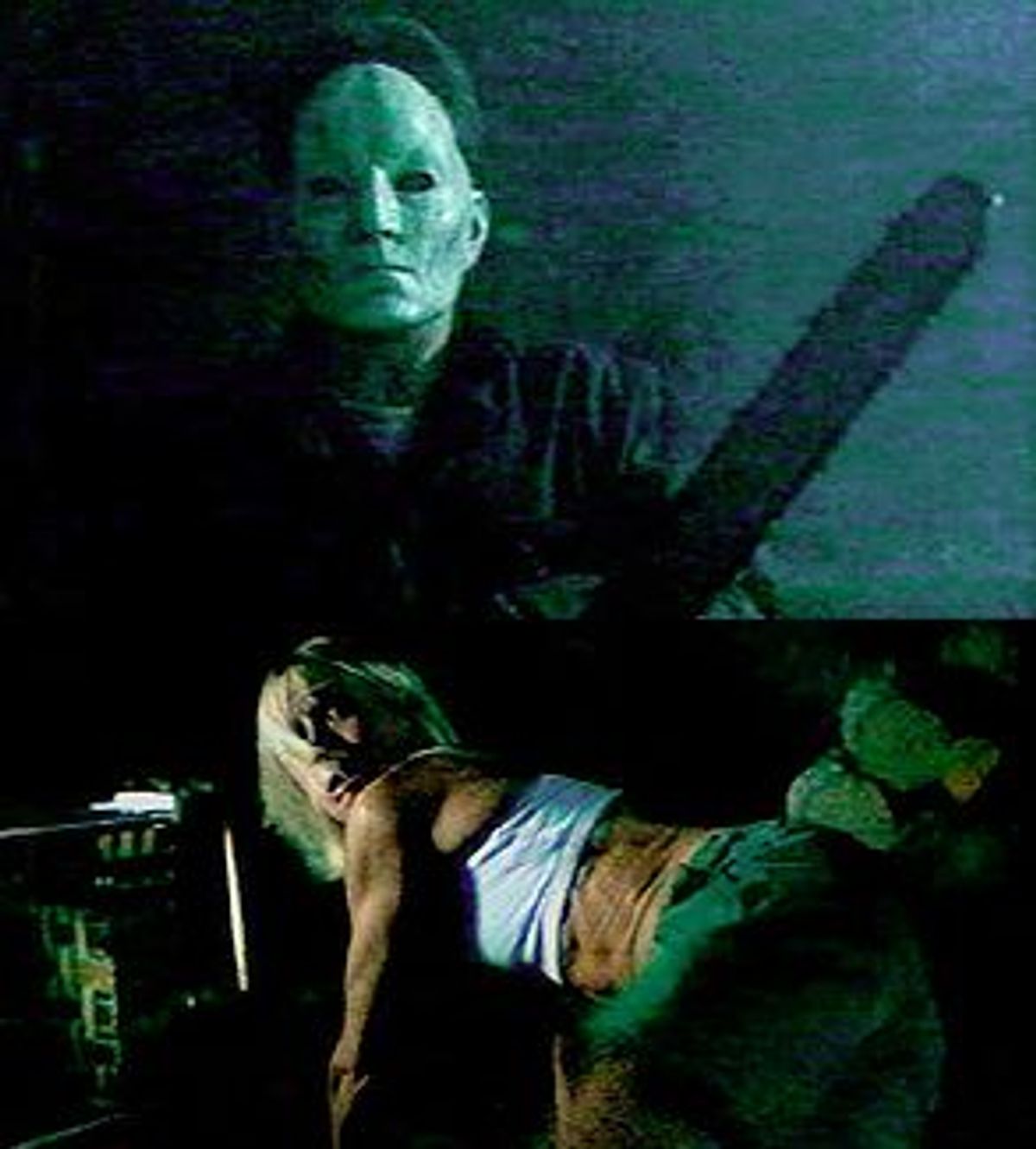
Chain-saw-wielding maniacs, butch pole-vaulters boasting about girly new hairdos, lesbian couples adopting Asian children — one can see why the question “why?” might have been in high demand. Many viewers were particularly curious in the wake of Nike’s chain-saw massacre parody, which featured Olympic runner Suzy Favor Hamilton using her speed to elude a masked pursuer. The ad, which debuted on the third night of the Olympics, was promptly pulled off the air by NBC after viewers protested that it made light of violence against women. Even after the cancellation of the spot, commentators continued to pile on, blasting the ad and denouncing Nike for its insensitivity.

“Stupid … ill-conceived … repellent,” declared Bob Garfield of Advertising Age. “A far cry from the inspiring and empowering ‘Just Do It,’” agreed the Washington Post. On Sept. 19, Stuart Elliott of the New York Times approvingly quoted a reader who labeled the ad “disgusting and misogynistic.” At a Women in Advertising awards banquet Wednesday, the ad was again singled out for setting back the cause of women. “The outcry still reverberates,” Elliott clucked.

Nike, meanwhile, was left to splutteringly defend itself against the charge of being a woman-hating brand. “This notion that we owe all women an apology is certainly open to conjecture” protests Nike spokesman Reames. “People are going berserk. They’re getting really emotional … They’re saying, ‘We get this. Nike doesn’t.’ When the reality is that women are e-mailing us in huge numbers saying, ‘I get this. I understand this. I understand what you were trying to do with this ad.’”

Personally, I thought the ad was funny. As Hamilton sprints through the woods, the killer gives chase, vrooming his chain saw in bloody anticipation. Soon, however, he finds he has to stop and rest. He squats on the ground, breathing hard. In his hand, the chain saw whirs uncertainly.

Finally, he whips off his hockey mask and heads home, clearly disgusted with himself. The last shot is of the sneaker-clad Hamilton vanishing into the moonlight. “Why Sport?” the title card asks. “You’ll Live Longer.”

Whew! While I liked the ad a lot, I don’t necessarily disagree with NBC’s decision to pull it. The ad is so powerfully shot that it evokes a primal response, thrusting viewers into a visceral experience not of their choosing. (They may have just wanted to watch a little rhythmic gymnastics.) But the shrillness of the response obscures a more interesting, and complicated, issue: the evolving gender politics of Nike advertising. As columnist Barbara Lippert points out in this week’s Ad Week, Nike has long employed a double standard in advertising its men’s and women’s brands. Until quite recently, the ads targeting men were loose, playful and cartoonish, often tweaking or making fun of the very athletes they used as their endorsers. The women’s spots, by contrast, were earnest, didactic, issue-oriented: “If you let me play …”

With the “Horror” spot, however, Nike seems to have stepped down from its soapbox. Hamilton is treated as an athlete rather than as a “woman athlete” who must be self-consciously fawned over and empowered. According to Russell Davis, planning director at Nike ad agency Wieden Kennedy, the shift in strategy is deliberate. “It’s one of those things we talk about a lot,” Davis says. “There’s definitely a shift going on … At one point, it felt like here was something that needed to be said about women’s role in sports. It was all about empowerment, and self-image, and ‘if you let me play’ … Now women’s sports are higher profile. They’ve got their own leagues, their own television deals. They’re much more on equal footing with men. And the advertising is starting to reflect that.”

While not all inequalities have been overcome, “we’re now in a position where that empowering, challenging message has become a bit of a clichi,” Davis says. “It’s become part of the vernacular of marketing … It’s lost its freshness a little bit, especially when used by a brand.” As a result, Davis says, “in the last year or so, we’ve injected a lot more humor, a lot more playfulness, in our treatment of women athletes. We treat Suzy Hamilton pretty much as we would treat Andre Agassi. The ads are fun. They’re meant to be humorous … It’s not a role-model, ‘go out and be like Suzy’ kind of thing. It’s more like: We have a bunch of athletes we love, and we want to put them in our communication. End of story.”

OK, so it’s a bit of a stretch for Wieden to spin a chain-saw-killer ad into a victory for postmodern feminism. Nonetheless, Nike’s evolution away from “Our Sports Bras, Ourselves” agitprop seems a milestone worth cheering — especially when you consider how mired other brands are in the same old first-wave formulas. Consider “I Enjoy Being a Girl,” the Visa ad featuring gold-medal-winning pole-vaulter Stacey Dragila. “When I have a brand-new hairdo … my eyelashes all in curls,” the voice-over warbles, as Dragila hoists her body over the bar. Get it? Dragila isn’t a stupid girly-girl who wears her hair in curls and has a boyfriend. No, she’s a powerful, strong, modern, athletic woman! In the final shot of the ad, Dragila slings her pole vault over her shoulder and walks off into the sunset. “Damn, I’m good!” she says. Quick, get out that chain saw!

While the sneaker company was risking the wrath of whither-feminism colloquies, another, white-shoe advertiser was weathering an Olympic controversy of its own. During the National Gymnastics Championships, John Hancock Financial Services unveiled a spot that was simultaneously hailed and denounced as the first depiction of lesbians in mainstream advertising history. In the beautifully directed spot, titled “Immigration,” two stylishly dressed women stand in an airport customs facility, cooing over an Asian infant.

“Do you have her papers?” the blond asks the brunet. “Yeah, in the diaper bag.” “The diaper bag — can you believe this?” says the blond. “We’re a family.” “You’ll make a great mom,” whispers the brunet. “So will you.”

Of course, John Hancock is hardly the first national advertiser to feature a gay couple in such a matter-of-fact way. Ikea did it years ago, showing a gem|tlich male couple feathering their love nest with inexpensive Swedish furniture. But whereas Ikea was looking to position itself as a young, modern, varied brand for young, modern, varied people, this was clearly not John Hancock’s aim. Having used the buzziness of lesbianism as a dramatic device to get attention, the company seemed unsure of where to go next. So it backtracked, implying it had all been an accident.

“It was never our intent to endorse or to dwell on a particular lifestyle,” explains Burgay, the company’s vice president. Complaints from Christian groups such as the American Family Association convinced Burgay that he “needed to retool the commercial, to help bring the focus on the child, rather than the issue of the child’s parents … We felt we could accommodate people’s concerns, and still have a hell of an impactful spot.”

Before making its Olympic debut, the ad was recut, with the final lines, which make the lesbian relationship explicit, snipped out. Burgay says the ad agency, Boston’s Hill, Holliday, was happy to help. “They understand our business,” he says appreciatively. “They understand that, at the end of the day, this is not art. This is a marketing tool … And if our marketing tool isn’t delivering the result we wanted — then it’s time to modify things. They felt very comfortable doing that.”

The creative folks at Hill, Holliday, not surprisingly, put it slightly differently. “There are people at this agency who fought really hard to get this made, and who fought really hard to keep it on the air,” says one agency staffer. “Now they’re tying themselves in knots to be able to say privately that they achieved a triumph … Of course there were compromises made. But it’s still a triumph. We put a lesbian couple on the air in the Olympics adopting a baby.”

Soon, however, the spot had to be recut a second time. The Joint Council on International Children’s Service protested the ad, on the grounds that it might prompt officials in China, where gay and lesbian adoptions are not permitted, to crack down on single-parent adoptions. So Hill, Holliday went back to the editing room.

“We came up with what we consider to be a very elegant solution,” an agency source tells me. “We very artfully ended up adding an announcement, making it clear that they were at the airport in Phnom Penh [Cambodia]. That way we don’t adulterate the commercial. And we’re sensitive to international adoption agencies in the process.”

“So,” I say lightly, “I guess Cambodians take a more laissez-faire attitude toward this kind of thing.”

“Well,” says the source, “we’re hoping that takes care of that controversy. But we’ll have to see. If issues arise [with the Cambodians], we’ll put other solutions under consideration. One solution might include masking the face of the child.”

Just as long as it’s not a hockey mask.

Continue Reading Close

Ruth Shalit is an account planner at Mad Dogs & Englishmen, a New York advertising agency. For more columns by Shalit, visit her column archive.

America’s road sign legends

Burma-Shave's rhyming ads turned highway billboards into poetry, and changed advertising -- and America

  • more
    • All Share Services

Topics: ,

America's road sign legends
This article originally appeared on Imprint.

ImprintIn a simpler time, when automobiles went slower and the pre-Eisenhower highway system in the United States was less developed, there was a popular advertising campaign that ran from 1927 until 1963. It consisted of rhymed messages sequentially staked on the right side of the road, all ending with the advertiser’s name, “Burma-Shave.”

Examples of vintage Burma-Shave road signs, including a blue South Dakota version. (Ray Crockett photo)

These red ads (one state, South Dakota, insisted that they be dark blue to keep them from conflicting with the red reserved for warning notices) usually consisted of five signs. For example: “DON’T PASS CARS/ON CURVE OR HILL/IF THE COPS DON’T GET YOU/ MORTICIANS WILL/BURMA-SHAVE.”

Some slogans touted Burma-Shave as a pre-aerosol “brushless” shaving cream—a cream you could scoop out of a jar and lather onto your face without relying on an old-fashioned brush and moistened soap in a mug.


("Thoroly"? I guess if the word doesn't fit the composition, change the spelling. . .)

In 1925, Clinton Odell, a Minneapolis lawyer, took the liniment his father created and transformed it into a brushless shaving cream. He named his company Burma-Vita—Burma, because most of the essential oils in the liniment were from the Burmese portion of the Malay Peninsula, and Vita from the Latin for “life”: “Life from Burma.”

Some of Burma-Shave’s primary “brushless shaving cream” competitors were Barbasol and Noxema.

The company was sold to Philip Morris in 1963, and all the signs were removed soon thereafter. As a testament to the campaign’s cultural significance, a set of signs was donated to the Smithsonian, where it still resides. But the brand eventually petered out. After being sold yet again (this time to the American Safety Razor Company) and then reintroduced in 1997, it never regained a hold in the market.

A history of the Burma-Vita Company, written by Frank Rowsome Jr. and illustrated by Carl Rose, was published by the Stephen Greene Press in 1963.

By the early 1960's, the rising costs of road-sign maintenance (as well as new and more effective ways of advertising) sounded the death knell for the Burma-Shave signs.

The following pages from Frank Rowsome Jr.’s book list all the road-sign Burma-Shave phrases produced from 1927 to 1963.

Continue Reading Close

7Up’s branding revolution

How "Bib-Label Lithiated Lemon-Lime Soda" became one of America's most popular soft drinks

  • more
    • All Share Services

Topics: , ,

7Up's branding revolution
This article originally appeared on Imprint.

ImprintI became interested in pop bottles (I grew up in the Chicago area where we all said “pop”) and related stuff when I was about 12 years old. I had gone inside an old garage that was attached to a neighborhood house that was being torn down and inside was a cache of un-returned pop bottles that must have dated from the 1940-’50s period. I took one of each type home (about 20 of ‘em) and yes, still have them to this day. I really got off on all the different labels and colors of glass and because I used to like to read old magazines I actually recognized most of the brands that were no longer around or had changed their design. I’ll go into this more in a future post, but wanted to lay some sort of a foundation for this piece, which is exclusively on 7Up, with a special focus on their branding efforts of the 1950s.

The soft drink that would be known as 7Up was created in 1929 by Charles Leiper Grigg in St.Louis as part of his “Howdy” line of sodas and was originally called “Bib-Label Lithiated (it contained the mood stabilizer lithium citrate until 1950) Lemon-Lime Soda.” It was almost immediately re-labeled “7 (7 natural flavors) Up Lithiated Lemon-Lime,” and then finally just “7Up”.

The first 7Up logo from 1929.

In terms of logos, an original winged trademark soon gave way to the red squared logo that lasted until the late 1960s that coincided with that period’s brilliant “Uncola” re-branding campaign. I always felt they had GOLD in that Uncola moniker. . .

A 1935 7Up label before the Howdy Company's name was changed to 7Up in 1936, followed by two Howdy beverage labels.

By the late 1940s 7Up was the third most popular soft drink in the United States. By the time the 1950s rolled around, the company had employed extensive branding techniques to keep the momentum going. The following three binders contain examples of what was offered to the bottlers and distributors to reinforce the product’s presence.

A catalog of 7Up sales/marketing items circa 1954.

This page includes tipped-in glossy paint chips.

These next three pages would NEVER fly with the HR Dept in 2012. . .

Before everyone had TV's in their home, it was common to go out to watch television.

7Up Sales & Promotion Merchandise Catalog circa 1954 - 59.

(would love to have those binders. . .)

Actual cloth swatches included.

More swatches.

1959 "Salesmakers" Catalogue

2 actual decals using the older logo with the woman reaching for bubbles- love the way the color is broken down into separate shapes and levels.

Actual booklet attached.

"Fresh Up Freddie" was the 7Up mascot created in 1957 by ad agency Leo Burnett and Walt Disney to help sponsor the Disney "Zorro" TV series.

Here’s a link to more info on “Freddie”: http://www.cartoonbrew.com/disney/fresh-up-freddy.html

Remember, it's from 1959. . .

Ditto. . .

2 mid-1930's 7Up bottles.

Left: 1940's bottle with 8 bubbles on label. Right: 1950's bottle 7 bubbles.

"Like" was introduced in 1963 as a diet version of 7Up. It contained Calcium Cyclamate which was determined to be a carcinogen in 1969. "Like" was discontinued in that same year and Diet 7Up was introduced in 1970 sans the Cyclamates. This bottle is dated 1964.

Late 1960's/early 1970's can.

"The Uncola".

As a final footnote, I was lucky enough to work on spots for 7Up International using the Susan Rose/Joanna Ferrone character “Fido Dido”! Here’s one of my favorites done while I was at the Ink Tank Studio in N.Y.: http://www.youtube.com/watch?v=8JpHjeGXyw8

Copyright F+W Media Inc. 2012.

Salon is proud to feature content from Imprint, the fastest-growing design community on the web. Brought to you by Print magazine, America’s oldest and most trusted design voice, Imprint features some of the biggest names in the industry covering visual culture from every angle. Imprint advances and expands the design conversation, providing fresh daily content to the community (and now to salon.com!), sparking conversation, competition, criticism, and passion among its members.

Continue Reading Close

Pepsi’s creepy Jackson revival

A ghoulish new campaign brings him back from the dead. Maybe it's time to stop looking backwards

  • more
    • All Share Services

Topics: ,

Pepsi's creepy Jackson revivalMichael Jackson (Credit: Reuters/Kimimasa Mayama)

As if Michael Jackson wasn’t creepy enough when he was alive. The self-proclaimed King of Pop, who died nearly three years ago, is making a return via a new Pepsi campaign. The fabulously un-self-aware tagline? “Live for Now.”

The corporation is set to festoon one billion cans of Pepsi around the world – that’s one billion cans – with the singer’s unmistakable silhouette. It’s a bold move for a company whose most famous association with Jackson is that back in 1984, his hair caught fire filming a commercial for them. Jackson’s estate orchestrated his sponsorship resurrection, and a family spokesperson confirmed to the Wall Street Journal Thursday that “more such marketing agreements are planned.” Did anyone else just feel that collective shudder of revulsion?

Even dead, Jackson is a massive draw. He’s currently the subject of a global Cirque du Soleil tour with the horror movie title “Immortal.”  And Pepsi knows that overseas – especially in markets like Asia — his brand is as ubiquitous and American as well, cola.

Bringing back the dead is a peculiar – if increasingly common – gambit. Now that the earth has run out of living celebrities, they’ve had to revive Tupac to perform at Coachella  and Grace Kelly to make kissy face with Charlize Theron to sell perfume.  They even had to dig up Martin Luther King Jr., to pitch for Mercedes-Benz.

There comes a time when a celebrity passes into our iconography. Today, seeing the images of Elvis and Marilyn and James Dean in different pop culture contexts barely seems any stranger than fake Abraham Lincolns selling cars in February. And why wouldn’t Jackson’s people wring a few more opportunities out of his incredibly lucrative image? Somebody’s got to pay for all those $10 million mansions.

Senior PepsiCo marketing executive Frank Cooper told the WSJ that the new campaign will be both “respectful” and “forward looking.” It may be respectful. But there’s nothing “forward” about the dead. Jackson’s image survives as an easy symbol of pop music, but the man whose life ended from propofol intoxication three years ago, whose doctor is currently serving time for involuntary manslaughter, couldn’t seem less like the right spokesman for the notion of “living for now.”

Continue Reading Close
Mary Elizabeth Williams

Mary Elizabeth Williams is a staff writer for Salon and the author of "Gimme Shelter: My Three Years Searching for the American Dream." Follow her on Twitter: @embeedub.

Ashton Kutcher’s brownface fail

The actor's racist ad is pulled -- but what's left isn't much better

  • more
    • All Share Services

Topics: , ,

Ashton Kutcher's brownface failAshton Kutcher

Somewhere, Charlie Sheen is laughing and saying, “At least I never did that.” This week, we learned what’s even less funny than Ashton Kutcher: Ashton Kutcher in brownface.

In an ill-advised Popchips ad spoofing online dating that launched Wednesday, the “Two and a Half Men” star appeared as a variety of love-hungry “World Wide Lovers” vying for your affection. In a spectacular display of racial tone-deafness, one of them included “Raj.” Raj, all darkened skin and heavy accent, is “a Bollywood producer looking for the most delicious thing on the planet.” He’s looking for something “Kardashian hot … I would give that dog a bone.” He brags that he once won a milking contest, and he does a little dance that will haunt your nightmares.

Shockaroonie, some people found this offensive. The ad went the wrong kind of viral, with a social media explosion of negative feedback. It’s not that comedy with a racial element is always wrong wrong wrong. The Jewish Hank Azaria is currently in his third decade of playing the Indian Apu Nahasapeemapetilon on “The Simpsons,” and nobody seems to be outraged about this. Kutcher’s incredibly unnuanced performance isn’t that, though. On his blog, writer Anil Dash explains it perfectly –  “a fake-Indian outfit and voice” constitute “the entire punchline” of the clip. And, as he eloquently put it, “I can’t imagine I have to explain this to anyone in 2012, but if you find yourself putting brown makeup on a white person in 2012 so they can do a bad ‘funny’ accent in order to sell potato chips, you are on the wrong course. Make some different decisions.”

And so that’s what Popchips is trying to do. On Wednesday, in a “message from Keith” on the company’s website, its founder, CEO and foe of proper capitalization Keith Belling wrote, “we received a lot feedback about the dating campaign parody we launched today and appreciate everyone who took the time to share their point of view. our team worked hard to create a light-hearted parody featuring a variety of characters that was meant to provide a few laughs. we did not intend to offend anyone. i take full responsibility and apologize to anyone we offended.” That’s a constructive, self-aware response to a potential public relations disaster. (Kutcher, who in recent months has been tainted by his hasty Twitter support for Penn State coach Joe Paterno and a divorce that featured rumors of unprotected extramarital sex, has so far had no comment on the problematic ad campaign.)

It’s a positive thing that Popchips understood its mistake and made an immediate effort to rectify it by pulling the ad. That step forward is mitigated somewhat, though, by the a large number of “get over yourself” responses on Anil Dash’s blog. We’ve still got much work we need to do in this country around issues of stereotypes and sensitivity, folks.

You don’t have to look any further than the entire Popchips campaign to see what I mean. Its remaining “World Wide Lovers” include the stoner Brit “Nigel,” who’s “seeking higher planes of consciousness” (GET IT????), the effeminate German “Darl” — a swishy riff on openly gay designer Karl Lagerfeld — and the dumb redneck “Swordfish.” In the end, there’s also regular old, newly single Kutcher, who describes the other guys in the club as a “freak show.” Hey, geniuses at Popchips – you’re still perpetuating gross generalizations. Also: They’re not funny. It’s a great big snack-loving country. Being cool about brown people – and gay people, and people others would call “white trash” – shouldn’t be such a crunch.


Continue Reading Close
Mary Elizabeth Williams

Mary Elizabeth Williams is a staff writer for Salon and the author of "Gimme Shelter: My Three Years Searching for the American Dream." Follow her on Twitter: @embeedub.

FCC takes on super PACs

The commission voted to require stations to post political ad data online -- but it won't be searchable

  • more
    • All Share Services

Topics: , ,

FCC takes on super PACs (Credit: Screenshot from American Crossroads anti-Obama ad)
This originally appeared on ProPublica.

The Federal Communications Commission voted 2 to 1 this morning to require broadcasters to post political ad data on the Web, making it easier for the public to see how as much as $3.2 billion will be spent on TV advertising this election.

The files — which, among other information, detail the times ads aired, how much they cost, and whether stations rejected ad buy requests from campaigns — are currently available only on paper at stations.

The FCC rejected a push by the industry to water down the measure. But the rule as passed also has serious limits. For example, the data will not be searchable or uploaded in a common format.

The rule will first apply to affiliates of the four major networks (ABC, CBS, NBC and Fox) in the top 50 TV markets. All other stations will have until July 2014 to come into compliance.

“[L]arge areas of some swing states, like Virginia, Missouri, Wisconsin and Michigan, could see an influx of advertising in markets outside of the top 50,” the Sunlight Foundation noted in an analysis today. It was also not immediately clear exactly when the rule will go into effect for the top 50 markets.

Then there’s the crucial question of the format in which the files will be available. FCC spokeswoman Janice Wise told ProPublica that the commission is not creating a searchable database of the political ad files.

“We’ll accept whatever [file] format they provide,” she said in an email.

That will make it much more difficult to analyze the information.

Wise said there are no specific plans to make the database searchable.

By opting to allow stations to submit political data in any format, the commission departed from a recommendation made last year by in an FCC working group report.  The report called for the political file to be put online and that “as much data as possible [be] in a standardized, machine-readable format” that “could also enhance the usefulness and accessibility of the data.”

Also not clear is how the broadcast industry, which vigorously lobbied against the rule, will react.

“[W]e will be seeking guidance from our Board of Directors regarding our options,” the National Association of Broadcasters said in a statement decrying the vote.

In March, the industry group submitted a filing with the commission raising “serious questions about the FCC’s authority” to require stations to put political ad data online.

“That was written as a legal memorandum, which is code for, ‘We’ve lawyered up and we’re ready to sue over this,’” says Andrew Schwartzman, a longtime FCC watcher at the Media Access Project.

The broadcasters’ group declined to comment beyond its statement.

On a Thursday earnings call for Belo Corp., one of the companies that has been fighting the disclosure measure, CEO Dunia Shive suggested that broadcasters would continue to fight the new disclosure rule.

“I don’t think the conversation is over with respect to being able to continue talking about if we will ultimately have to include ad rates online,” she said, Broadcasting & Cable reported.

Belo spokesman R. Paul Fry told ProPublica that the company merely “want[s] to continue the dialogue on this subject.”

The FCC also said today it would review the new rule after a year to see if any changes need to be made before all stations will be required to come into compliance in July 2014.

Continue Reading Close
Justin Elliott

Justin Elliott is a reporter for ProPublica. You can follow him on Twitter @ElliottJustin

Page 1 of 66 in Advertising