
David Mitchell
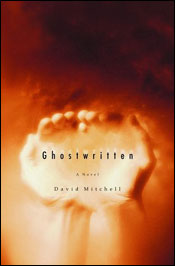
“Ghostwritten” by David Mitchell
The latest, much-hyped attempt at a wild, supercharged fictional ride proves that minimalism may finally be dead, but true eccentric geniuses are few and far between.
Ten years ago, when a young, eager, but not particularly well-developed writer produced a first novel, it was almost certain to be a tale of family distress — divorce, say, or cancer — told in stoic, stripped-down prose that shied away from any hint of excess. (David Leavitt’s highly enjoyable new autobiographical novel, “Martin Bauman; Or, a Sure Thing,” relates the early career of one such writer.) Piles of these books got published, and certain critics (I was one) pitched fits over the trend, calling it monotonous and enervated. What had happened, we cried, to invention, to brio, to intellect, to humor, to the kind of ambition that makes writers want to color outside the lines?
While David Mitchell’s “Ghostwritten” doesn’t quite represent an example of why even critics should be careful what they wish for, it does constitute a strange case. For when it was unfashionable to write adventurous and brainy fiction, the only people who did it were those who had to. It simply wasn’t an option for authors like Angela Carter or Thomas Pynchon to write any other way. With “Ghostwritten,” we have a kind of elective boldness, the spectacle of an artist who may not be particularly original trying his hand at the wildly imaginative.
The novel is a series of nine episodes, each about a different character in a different city: a young record store clerk in Tokyo, a British investment banker in Hong Kong, an old woman running a noodle shop on the side of a holy mountain in China, a former courtesan turned art thief in St. Petersburg, a philandering ghostwriter in London, an Irish scientist hiding out in her hometown, a Manhattan DJ, a demented follower of a Japanese doomsday cult and even a disembodied entity that travels from one human host to another via touch. These people don’t know each other, but they’re linked by a web of glancing connections — shared acquaintances or sexual partners, a ride on the same boat, a brief meeting on the street. One character almost accidentally saves another’s life; one witnesses another’s death.
About a third of the way through, an underlying thread emerges, a somewhat half-baked scenario involving a manmade (but not man-mastered — oh, no!) superintelligence grappling with humanity’s self-destructive tendencies. This story line turns up too late to unify what’s essentially — like Richard Linklater’s film “Slacker” — a variation on Arthur Schnitzler’s “La Ronde,” the sort of literary game that, to be fair, is devilishly hard to pull off: How do you make purposely random segments feel like part of a whole? (Linklater did it by making his characters part of a subculture that he wanted to document.) And some of the chapters in “Ghostwritten” do work on their own, for Mitchell has a genuine aptitude for storytelling.
Too often, though, even the enjoyable segments of “Ghostwritten” bring to mind other writers (who tend to be more accomplished with the sort of material at hand): The Tokyo episode feels like Haruki Murakami, the London bit like Nick Hornby, and midway through the disembodied entity chapter I thought, “Hey, wasn’t this a Denzel Washington movie?” The apocalyptic superintelligence plot itself appears courtesy of a zillion science fiction stories and films. The result is often readable, but never inspired, a peculiar effect considering the project is the kind of thing usually only attempted by eccentric geniuses following fiercely individual visions. It’s as if a B-plus architecture student decided to build his own interpretation of Antonio Gaudm’s Sagrada Familia.
And like Mark Z. Danielewski’s “House of Leaves” (published earlier this year), “Ghostwritten” injects pop attitude into what were once frustratingly cryptic or dauntingly cerebral postmodern experiments. But, unlike Danielewski, who grafted Borgesian ontological puzzles onto a Stephen King plot, Mitchell doesn’t yet seem to have invented a cocktail that really packs a wallop — though perhaps someday he will. “Ghostwritten” feels like the product of a sensibility that’s still unformed and still too easily swayed by literary influence, yet it is often entertaining. It may be bubble-gum DeLillo, but it does prove one thing: Underripe maximalism beats underripe minimalism any day of the week.
Laura Miller is a senior writer for Salon. She is the author of "The Magician's Book: A Skeptic's Adventures in Narnia" and has a Web site, magiciansbook.com. More Laura Miller.
At the gates of a hermit kingdom
The author of "Cloud Atlas" presents an ingenious adventure story set in 19th-century Japan
David Mitchell A precocious novelist, David Mitchell has the misfortune to be muddling toward his best work after being canonized as a genius by an ardent fan base. “Cloud Atlas,” the book that established his cult, was an ingenious puzzle box of a novel, composed of pastiches of other writers’ styles arranged in a nesting-doll configuration and containing at its center a vaporous puff of Zen. Its structure makes the book seem “difficult” without its actually being so, and as a result it lets its readers feel smart without unduly taxing their faculties. Perhaps the cleverest thing about “Cloud Atlas” is that it is not too clever.
Continue Reading Close
Laura Miller is a senior writer for Salon. She is the author of "The Magician's Book: A Skeptic's Adventures in Narnia" and has a Web site, magiciansbook.com. More Laura Miller.
“Black Swan Green”
David Mitchell's follow-up to "Cloud Atlas" is a dark, intimate novel that remembers teenage humiliation -- and Thatcherite Britain.
David Mitchell’s first three novels –”Ghostwritten,” “Number9Dream” and “Cloud Atlas — have been literary Sudoku, intricate puzzles that appeal to the kind of reader who likes to study dense works for half-hidden clues and correspondences. You can be sure, however, that if you’re reasonably bright and moderately observant, you will eventually plumb all the secrets of Mitchell’s books. In the end, none of his meanings will elude you, and so his novels have had more in common with high entertainment, like the TV series “Lost,” than with eternal and idiosyncratic enigmas like “Gravity’s Rainbow,” or even “Twin Peaks.”
Continue Reading Close
Laura Miller is a senior writer for Salon. She is the author of "The Magician's Book: A Skeptic's Adventures in Narnia" and has a Web site, magiciansbook.com. More Laura Miller.
What to Read
Exotic Labor Day destinations: David Mitchell's post-apocalyptic "Cloud Atlas," Arthur Phillips' addictive saga of Egyptology, Michelle de Kretser's tale of murder in Ceylon, Patrick McGrath's yarn of debauchery in the tropics, and John Searles' unputdownable thriller.
Summer isn’t over for another three weeks, right? We all know that’s not really true, except to the calendar. After this weekend, work and life, even in the book biz, assume a newly frenzied urgency. So we thought we’d grab a moment, before you head to the beach or the lake for Labor Day, and call your attention to some of the summer’s best fiction, both books the other critics have missed and some they haven’t.
David Mitchell’s “Cloud Atlas” might be the summer’s big book, as our Laura Miller reports. An uncategorizable blend of dystopian sci-fi, Herman Melville and James Joyce, it’s also — like all the books we review this month — an endlessly intriguing literary puzzle. Michelle de Kretser’s “The Hamilton Case” spins a tale of a Ceylonese Sherlock Holmes and the devolution of his violent, schizophrenic nation, while Arthur Phillips’ “The Egyptologist” manages to combine a detective story with the glamorous field of ancient Egyptian archaeology.
Continue Reading Close“Cloud Atlas” by David Mitchell
From 19th century seafaring yarn to nuclear-power muckraking to a cloned servant in the cyberpunk future, this dazzling series of interlocked narratives is one of the summer's biggest books.
David Mitchell is a spookily protean writer. His favored technique — he used it in his first novel, “Ghostwritten” — is to build a long narrative out of shorter ones, stories told in vastly different voices and styles, then cinch the whole patchwork together with some supernal device that reveals their underlying connections. In “Ghostwritten,” he couldn’t manage to pull off that final, unifying gesture, but his third novel, “Cloud Atlas,” is far more convincing, a genuine and thoroughly entertaining literary puzzle.
Continue Reading Close
Laura Miller is a senior writer for Salon. She is the author of "The Magician's Book: A Skeptic's Adventures in Narnia" and has a Web site, magiciansbook.com. More Laura Miller.