Baseball

Ted Williams

Almost 60 years ago, the greatest hitter who ever lived hit over .400 and no one has done it since.

  • more
    • All Share Services

Ted Williams

At 1999′s All-Star Game at Fenway Park in Boston, Major League Baseball showcased its All-Century team. It was expected to be a sweet history lesson for baseball fans, a reminder of the names and stats of yesteryear. But it turned into an almost religious experience the second Ted Williams rolled onto the field in a golf cart.

Today’s baseball biggies — Ken Griffey Jr., Cal Ripken Jr., Mark McGwire — gathered around Williams, basking in their hero’s glow. Each wanted his own special moment with the last man ever to bat .400, and many, including Williams, were moved to tears. No one wanted to leave the field.

“It was kind of funny,” Boston shortstop Nomar Garciaparra told the Associated Press. “When the announcer asked everybody to go back to the dugout, everybody said no. It didn’t matter. What time was the first pitch? Nobody cared.”

Why did Williams — more than Yogi Berra, Sandy Koufax or Mike Schmidt, who were also on the field that night — inspire such an emotional tribute? Look to his full-throttle energy, his stated dedication to being “the greatest hitter who ever lived” and the clear drive he had to make it so; his absolute refusal to bow to media pressure and the fact that when Williams makes a promise — to himself or others — you better believe he’s going to follow through on it. And don’t forget his nearly mythic status as one of the game’s wildest characters.

This is the man who has worn a necktie only a handful of times in his 82 years, because he can’t stand the things. This is a man who has had the finest Chesapeake oysters and bayou crayfish flown to his home in Hernando, Fla., because he refuses to eat second best. This is the guy who, when he was drafted in World War II (he served in the military for four and a half years), set a still-standing gunnery record in training. This is the guy who refused to ever tip his cap to Boston fans from his second season with the Red Sox onward, no matter how much they begged, and who can’t let an argument go. If he doesn’t like the outcome of a conversation, he’ll spend a week gathering information until he decides he’s ready to pounce again. This talent led Sports Illustrated to name him the last man to “hit .400 and argue 1.000.”

Hitting .400, of course, is Williams’ biggest claim to fame. When he hit .406 in 1941, he joined 17 other big hitters in the history books, including Rogers Hornsby, who batted .424 in 1924. And, of course, although a few talented fellows have come close, no one’s done it since. Hornsby, who also made the All-Century team, gave Williams a piece of advice early in his career: Be patient; wait for your pitch. It became a Williams mantra.

Although he gained fame for his rages against the Boston press, Williams managed to remain patient at the plate and rode Hornsby’s advice to six batting titles, two American League MVP awards, 18 All-Star appearances and an induction into the Hall of Fame in ’66. He also used the tenet as the cornerstone for his bestselling 1970 book, “The Science of Hitting,” written with John Underwood. That book may be single-handedly responsible for raising the collective batting average of generations of Americans.

Of course, Williams’ killer 20/10 eyesight played a big role in his batting prowess, though he’d never admit it. When he took his physical for World War II, the examining physician called in a colleague to marvel over Williams’ visual acuity. A couple of other things that didn’t hurt the 6-foot-4, 198-pound string bean in his quest for greatness: He didn’t drink, hated smoking and was always in by curfew. He also disliked parties; he wasn’t interested in standing around “listening to a lot of bullshit,” he told Esquire’s Richard Ben Cramer in 1986.

But what truly brought him such a sweet swing was his devotion: He spent his whole life swinging a bat. As a child, he’d go out in the yard at night when everybody was sleeping and swing, swing, swing at an imaginary ball. His nocturnal ritual continued when he turned pro. In fact, his Red Sox road-trip roomies would often be awakened by Williams swinging a bat, a newspaper, a pillow, anything, and accidentally hitting something: a wall, a bureau, a bedpost.

Williams would also spend hours working over his bats to make sure they were precisely the proper weight (between 32 and 33 ounces). He kept his bats off the ground so they wouldn’t pick up moisture and put on excess ounces. Just to be certain, he’d take them to the post office to weigh them.

Williams no doubt inherited his extreme enthusiasm from his mother, May Williams, known to all in his San Diego hometown as Salvation May. A dedicated Salvation Army missionary, she spent her days and nights in the bars and bordellos of San Diego and Tijuana, Mexico, tambourine in one hand and collection plate in the other. When Williams was a child, his mother took him on her proselytizing parades; he recalls trying to hide behind the pounding bass drum.

Salvation May’s zeal would haunt Williams even after he signed with his first team after high school, San Diego’s Pacific Coast League Padres. May Williams would show up at games, ask spectators for cash and point out her son on the field. Deeply embarrassed, Williams asked her to knock it off and even gave her money to stop. She took the cash and kept passing the plate at his games anyway.

One of the few things Teddy Samuel Williams’ father, Sam, gave him was his name (Teddy, not Theodore, though Williams hates being called that). Sam Williams, known for rarely cracking a smile, had spent time in the Philippines with Teddy Roosevelt’s Rough Riders. Busy running a tiny photography shop or working as a prison inspector in Sacramento, Calif. — or, more often than not, drinking — Sam was seldom around. Williams didn’t hear much from him until the scouts started coming around, talking big money.

Williams was a star even before high school. Neighborhood kids would finish up their paper routes and go watch him hit at North Park. He would go there every day after school (and sometimes during) and take pitches from playground instructor Rod Luscomb, a former minor leaguer and one of the slugger’s many surrogate fathers. Later, Williams led Hoover High to the state championship and, on the way home, ate 18 Popsicles to celebrate.

Williams started playing with the Red Sox in 1939. His first season he could do no wrong. Everybody loved him. What’s not to love when the new kid is having the best rookie season (31 homers, 145 runs batted in and a .327 batting average) of all time?

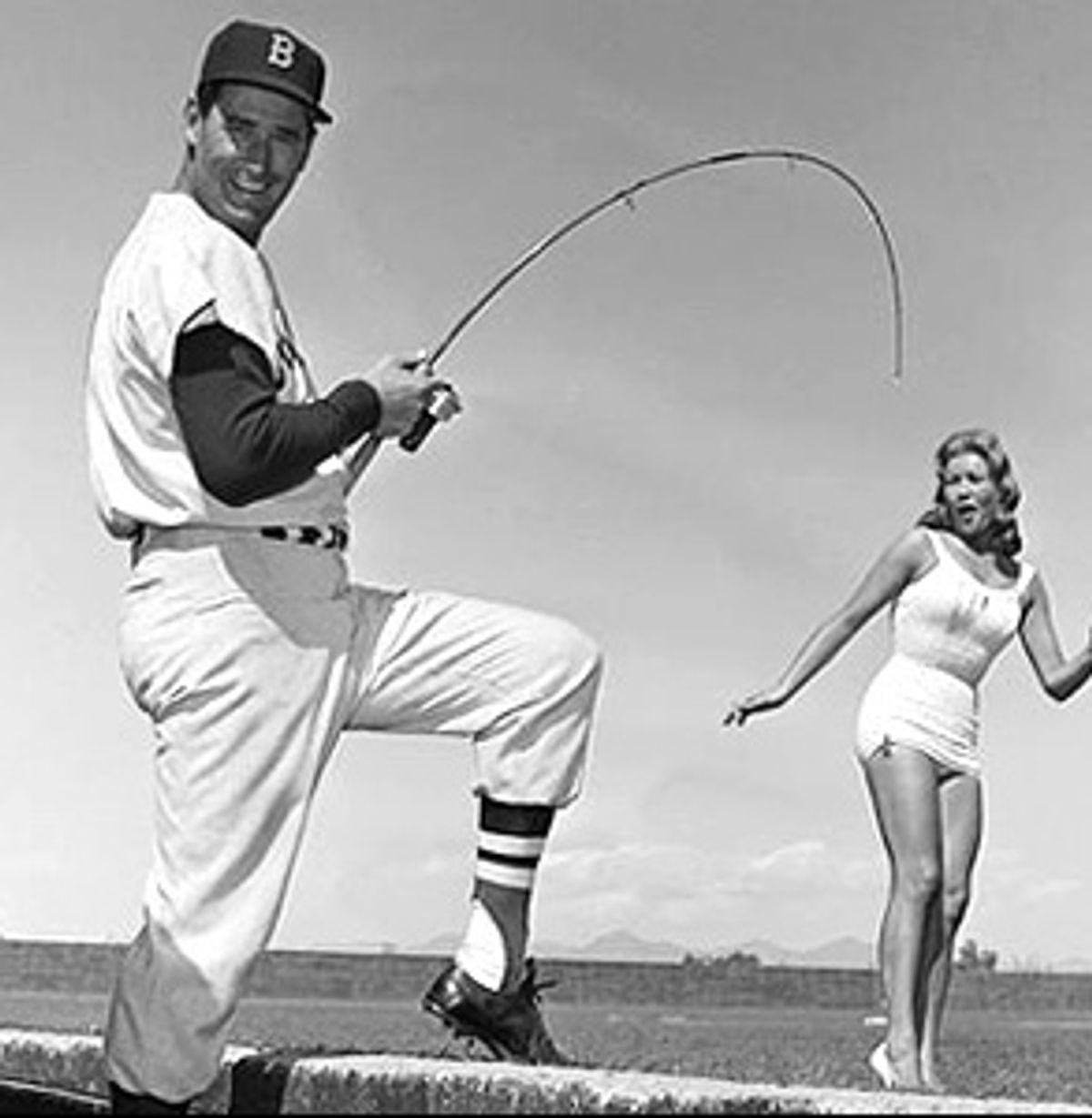
Outside the stadium, adoring kids followed Williams around. Occasionally, he gathered them together, took them to a local amusement park and rode the roller coaster with them. Sometimes, he took the whole team fishing, a passion of his. On other days, the 19-year-old would come to the park early and shoot pigeons in the outfield with Sox owner Tom Yawkey. Once, he just went ahead and shot out the scoreboard’s ball, strike and out lights. What the hell! He gladly tipped his hat after big plays in 1939. Life was good.

But that winter, his parents divorced and he wanted none of that mess. So instead of going home to California, he spent the off-season with a girlfriend in Minneapolis, Doris Soule (whom he later married; they had a baby girl, Bobby Jo, in 1948, and divorced in 1955). He started the 1940 season slow. For the first time in his life, Williams couldn’t hit the baseball. Fans wondered what had happened to the golden boy, and the press started writing about his sophomore jinx.

While Williams was out of town with the team, one writer finished a screed against him with the following: “Whatever it is, it traces to his upbringing. Can you imagine a kid, a nice kid with a nimble brain, not visiting his father and mother all of last winter?” The seven other ultracompetitive Boston papers went nuts for this story, with none of them digging up the real dirt. Williams returned to Boston as public enemy No. 1. Oh, that burned him. So he let members of the press know they were on notice, that he didn’t trust them one iota — and he wouldn’t ever again. And Williams is a man of his word.

Later, when reporters came into the locker room, he yelled, “Hey, what stinks? Hey! Something stink in here? Oh, it’s you. Well, no wonder with that shit you wrote.” The sportswriters kept on him, and fans eventually followed suit. Their incessant heckling, despite his consistent batting feats, led him to his self-imposed no-cap-tipping rule. He’d show them. Finally, late in the year, Williams told a reporter he didn’t like Boston anymore; he wanted out, which the fans and the press just loved. As he grossly understated in his autobiography, “My Turn at Bat” (also written with Underwood), “I am certainly in the upper bracket of sensitivity, maybe the top 3 percent.”

This sensitivity burned Williams’ teammates. Fellow Hall of Famer Jimmie Foxx called him a “spoiled child,” and Lefty Grove threatened to punch him in the nose if he didn’t get his act together. But the left-fielder railed on. And as the years progressed, other Boston players stopped talking to the press, too, out of reverence for his ball-playing prowess.

Despite eventually having a great year at the plate in 1940 (.344, 23 homers, 113 RBIs), Williams had blown it with Boston. Who would let their kid ride a roller coaster with this bum? Nobody. In fact, he began spending more time alone, going to movies during the day, sometimes three at a time, tying fishing flies into the night and giving extra time to his beloved bats.

He did nothing to solve the media problem in the ensuing years, and that cost him an MVP award (voted on by sportswriters) in 1947. One Boston writer left Williams off the ballot that year simply because he didn’t like him. The “Splendid Splinter” lost the MVP by one point to Joltin’ Joe DiMaggio. Ouch.

Even in the short speech he gave before his final game, Williams made sure to mention that he didn’t appreciate the treatment he had received from the “knights of the keyboard,” as he called them. The lowest point in their relationship came when Williams hit his 400th home run (of an eventual 521) in 1956. He deviated from his usual trot around the bases, which John Updike once described in the New Yorker as “hurriedly, unsmiling, head down, as if our praise were a storm of rain to get out of.” This time, Williams created a storm of his own when, after the ball had safely cleared the fence, he paused and spat toward the press box. He spat again after he crossed first base, second, third and then — in case you missed it the first four times — on his way back to the dugout. Williams doesn’t do anything halfway.

America’s entry into World War II, in 1941, immediately followed one of the best baseball seasons of all time. DiMaggio had captured the nation’s attention with his 56-game hitting streak (still unmatched) and Williams had finished the year with his ever-famous .406. At season’s end, with one more double-header to play the next day, Williams’ batting average stood at .39955. Manager Joe Cronin offered to let him sit out the games in order to guarantee the rounded-up .400 average. Williams and clubhouse boy Johnny Orlando walked the streets of Philadelphia that night and just talked about hitting, the A’s pitchers he might face and whether he should play the game. Williams finally said, “The record’s no good unless it’s made in all the games.” And so he played, batting 6 for 8 and bringing his average up to the now seemingly insurmountable .406. The Splinter had taken home his first batting title and had conquered the Boston media, the fans, the world.

The euphoria didn’t last long, of course. With World War II breaking out, Williams’ draft status was 1-A. He requested — and received — a deferment because his mother was dependent on him. By the time he got to spring training in 1942, his press pals were making his “un-American” life miserable. The fans crucified him. It was becoming increasingly popular in New England to hate Ted Williams. The heckling got so bad that, in one early-season game, Williams intentionally hit foul balls into the stands in attempts to hit one vociferous verbal attacker. Eventually, Williams relented and enlisted in the Navy Reserve, where he spent the next three years discovering a new love: flying.

He never made it into battle and returned to the field in 1946 with a vengeance, jawing at journalists and striking poses at the plate, hitting the first pitch he saw for a homer. That year, he had a new problem to deal with: a new defense, designed specifically for him by then Cleveland Indians manager Lou Boudreau. The “Williams shift” consisted of the opposing team moving right, leaving the left side of the field open, since Williams rarely hit there. It proved fairly successful until Williams clinched Boston’s first pennant in 28 years with an inside-the-park homer poked up the left side — away from the dreaded shift. Still, it was a tool managers used sporadically and effectively for years against Williams. Once, in an exhibition-game joke, nearly the entire opposition went and sat in the right-field bleachers when Williams came to bat. Even with the shift, Williams took the American League MVP that year (.342, 38 homers, 123 RBIs).

Finally, Boston was in the World Series and Williams had a chance to prove himself on higher ground. He bombed, batting .200 with one RBI. The poor numbers are mostly the result of an extremely swollen elbow from a league-demanded exhibition game. But the Boston press didn’t care. Williams failed them.

Around this time, he had his first real temptation to tip his cap. Sox catcher Birdie Tebbetts nearly convinced him that when he did it, the crowd noise would be so loud he could say whatever he wanted to the fans — “You goddamn SOBs!” — and nobody would ever know. As Williams wrote in his autobiography, “That kind of appealed to me.” When he hit his next homer at Fenway, he took the bases slowly, but he was still turning the idea over in his mind when he reached home plate. He took another batting title in 1948 (.369) and missed one by two-thousandths of a point in the 1949 season. He had to settle for just MVP that year.

In the ’50s, Williams spent his time fighting a war in Korea, attempting to stay off the injured list, spending endless hours with kids with cancer and occasionally having lunch with Vice President Richard Nixon.

Williams’ involvement with kids with cancer began through the Jimmy Fund, which raises money for research and for a Boston hospital. “I love kids, that’s all, it’s no virtue. A guy likes kids, he has to hope their lives are going to be good, that they will avoid the pitfalls he had. I think one of the greatest things ever said is that a man never stands so high as when he stoops to help a kid,” he wrote in his autobiography.

Williams particularly enjoyed making speeches and visits to sick children without the media’s attention. As former Jimmy Fund chief of security Mort Lederman told Ed Linn, author of “Hitter,” a Williams bio: “Unlike most celebrities, Williams never had a demand. He doesn’t care about getting into front door, back door, special car, special food, special spot. He never saw himself as a celebrity. He was a back-door guy, and I admired him for that.” Perhaps because his brother had died of leukemia in 1960 or solely for his love of the cause, Williams didn’t stop his work with the Jimmy Fund when he stopped playing ball. He is still sending plenty of checks, publicity and goodwill the fund’s way.

As for Nixon, he began calling Williams’ D.C. hotel to ask for lunch dates whenever the Sox were in town to take on the Washington Senators. What did they talk about? Well, Williams’ passion, the Jimmy Fund, of course.

The Korean War put Williams in contact with quite a different kind of American celebrity: John Glenn or, as his war pals called him, Old Magnet Ass, because of the number of anti-aircraft artillery always coming after him. Glenn, who became an idol for Williams, chose Williams to fly at his wing and the pair went through some harrowing times together. While Williams earned a slew of medals, he also lost part of his hearing (resulting in his booming voice gaining even more volume), contracted a mysterious virus that stuck with him for years and had a couple of near-death experiences as he crammed his tall body into the tiny cockpit for 39 missions.

He was discharged in the summer of 1953, and he didn’t think he ever wanted to play ball again. But the league invited him to throw out the first pitch at the All-Star Game and he was welcomed like the hero he was. So he started working out and he was back in action for the last 37 games, hitting .407. You couldn’t make this guy stop hitting — except when he got hurt.

Williams broke his elbow in the 1950 All-Star Game going up for a Ralph Kiner fly ball. Everybody thought he was done. He was back in two months. In 1954, his first full season back from Korea, he broke his collarbone in the first 10 minutes of spring training. He missed six weeks after getting a pin put in his shoulder. According to Updike, he forever looked like “a Calder mobile with one thread cut” after this. When Williams returned to the lineup against Detroit, he hit two homers, a double and four singles in a doubleheader. Yankees manager Casey Stengel said, “I’m going to have all my players put pins in their shoulders.”

Through the late ’50s, he battled injuries, but the real problem was his mind-set. Even though he kept up his hitting feats (.388 in 1957!), the old man grew increasingly disappointed. His team, after all, was one of the worst in baseball. In 1959, he had his worst year ever, hitting .254, the first time he had ever gone below .300. Owner Tom Yawkey asked the paunching Splinter if he wanted to hang ‘em up, but Williams couldn’t go out that way. Not only did he not quit, he asked for a huge salary slash — from $125,000 to $95,000 — possibly the first and last time that’s happened in professional sports.

The 1960 season, his last, ended up being a decent year: He batted .316, drove in 72 runs and hit 29 homers. The last of those homers came in his final at-bat in Boston. While the crowd heaped huzzahs on him, he decided by second base that he couldn’t tip his cap. It just wasn’t his style. He ran right into the dugout and out of baseball and wouldn’t come out again. His teammates prodded him to go take a bow. The umpires waved at him to get his 40-year-old ass back on the field. And the fans howled for him. But he couldn’t do it. He just sat in the corner of the dugout with a huge smile on his face and said, “Fuck ‘em.”

Which is pretty much what he said in the ensuing years: He fished, hunted and cooked (another love) to his heart’s content. He married and divorced two more women. One was a socialite model from Chicago, Lee Howard, who thought she was marrying a celebrity and instead got a dedicated fisherman who got up at 4 a.m. and disappeared for the day. The other was a former Miss Vermont, Delores Wettach, who had never heard of Ted Williams. They had two children: John Henry, born in 1968, who handles most of his father’s business dealings these days and runs Hitter.net, and Claudia, who was born in 1971.

In 1966, he was inducted into the Hall of Fame. He went up to Cooperstown, N.Y., gave his speech, took his plaque and went home. He didn’t even go inside.

He made a splashy reappearance in the majors in 1969, managing the Washington Senators. He earned manager of the year that first season, but those good times were short-lived. “I could see it was the kind of job you suffer through,” he wrote in “My Turn at Bat.” And suffer he did through three more seasons as the team moved from D.C. and became the Texas Rangers. Still, they lost. He finished out his contract and moved on.

Since then, he has started his Ted Williams Museum and Hitters Hall of Fame in Hernando, Fla., a pilgrimage destination for young players. He met another woman, Louise Kaufman, whom he never married (he’s not the marrying kind anymore), but she stayed with him longer than the rest, at least 20 years. She died three years ago. Williams isn’t in the greatest shape, either. Since 1994, he’s had two strokes and a broken hip, and his once-stellar vision is eroding rapidly. These days, he stays at home and receives visits from his family and close friends. And, of course, he still follows the Sox. He can’t get them out of his system.

But it’s not the ailing Ted Williams that America will remember. We’ll remember his smooth, sweet swing flickering in sharp black and white; his long, thin figure turning with his lethally lightweight bat; that unsmiling, “just doing my job, ma’am” way he put his head down and took off for first base after he slapped another one over the wall. It’s all been permanently tattooed onto the American sports consciousness. We’ll remember him yelling, “Goddamn, what the hell stinks in here?” (even though we never witnessed it). And we’ll remember him for his absolute passion for a boy’s game.

In 1991, 50 years after Williams had hit .406, Fenway Park hosted Ted Williams Day. He got up and gave a little speech that started with the following: “I realized about 42 years ago I was playing for super-great fans. I had a love affair with them, but I never showed it. When I finally consented to do this, I started to think, ‘What am I gonna say?’ Then I thought it might be nice to tip my hat.” And he did just that.

Mark Miller is a writer in Brooklyn, N.Y. He has written for ESPN magazine, MTV.com and the Washington Post.

Guillen’s pro-Castro candor

The Miami Marlins' manager is lucky to get a suspension. Not so long ago, he might have received a car bomb.

  • more
    • All Share Services

Guillen's pro-Castro candorA contrite Miami Marlins manager Ozzie Guillen gestures at a news conference on Tuesday. (Credit: AP/Lynne Sladky)

There’s not much reason to doubt that baseball manager Ozzie Guillen admires Fidel Castro. He said so five years ago in an interview with Men’s Journal. When asked to name the toughest man he knew, Guillen replied, “Fidel Castro. He’s a bull—- dictator and everybody’s against him, and he still survives, has power. Still has a country behind him. Everywhere he goes, they roll out the red carpet. I don’t admire his philosophy; I admire him.’’

No one cared about that macho thought because Guillen was skipper of the Chicago White Sox at the time. As the newly hired manager of the Miami Marlins, Guillen repeated the notion to Time last week–”I respect Fidel Castro,” he said. “You know why? A lot of people have wanted to kill Fidel Castro for the last 60 years, but that [expletive] is still there”–and he found himself on the brink of unemployment.

As Miami’s Cuban-American talk radio hosts whipped up a storm of protest, the Marlins denounced Guillen and suspended him for five games. On Tuesday the chastened manager repudiated his statements, said Castro was a bad man, and apologized “on my knees.” With Guillen’s job hanging in the balance, most sportswriters attributed the controversy to his big mouth: He is known for insulting gays and admitting he likes to get drunk often.

But Guillen’s real problem is Cuban Miami, where enforcing the anti-Castro party line is a more popular pastime than baseball, not the least because the Marlins owners arranged to stick the city’s taxpayers with the bill for their new $640 million ballpark in Little Havana while depriving local residents of legal parking spaces. The combination of Guillen’s candor, Miami politics, and the Marlins’ arrogance is what has brought the Cooperstown-bound skipper to the brink of being fired.

The city has never shown much tolerance for people who say nice things about Castro. In 2000, Jim Mullin, editor of the city’s alternative weekly New Times, compiled a chronology of violent intolerance that has few parallels in modern America. In 1975 a Cuban American man was murdered after advocating closer relations with Castro’s Cuba. In 1978, an anti-Castro talk radio host had his legs blown off by a car bomb because he dared criticize his fellow exiles for resorting to violence. In 1983, the Little Havana branch of a Miami bank was bombed because one of its executives had negotiated with the Castro government for the release of 3,600 political prisoners. In 1998, a bomb threat emptied a concert hall during a performance by Compay Segundo, a 91-year-old musician made famous by the movie “The Buena Vista Social Club.” All told, Mullin found more than 40 instances of bomb threats and explosions directed at people who had somehow offended the anti-Castro orthodoxy.

A 1994 Human Rights Watch report on the sorry state of free speech in Miami concluded,  the city is “dominated by fiercely anti-Communist forces who are strongly opposed to contrary viewpoints.” The HRW reports linked these forces to “acts of repression ranging from shunning to violence.” The reports found “significant responsibility” by the government at all levels, including “direct harassment by the government and government support of groups linked to anti-free speech behavior.”

That tradition continued this week when two local politicians injected themselves into the controversy by calling for Guillen’s firing. The call was echoed by a vigilante group known as Vigilia Mambisa, which describes itself as “a hard-line, right wing, Anti-Castro, Anti-Communist group of dedicated Cuban-American demonstrators … known for their rapid response to calls for protest aired on Miami Spanish-language stations.”  The group is calling for a boycott of the Marlins until Guillen is fired.

The problem is Miamians are already boycotting the Marlins. The team ranked 28th out of 30 major league teams in attendance last year. Dario Moreno, a professor of political science at Florida International University, said, “I don’t think this is a free speech issue. There’s a lot more tolerance than there was 30 years ago.” Moreno noted that south Florida’s three Cuban-American congressional representatives and the state’s Cuban-American senator have not called for Guillen to be fired.

“This has more to do with the Marlins and a community that invested large sums of money in their stadium over the objections of lots of people,” Moreno said. “The promise was that they would bring the community together and give us something to be proud of. It’s not working out very well.”

Moreno says he thinks Guillen may be able to keep his job if the Marlins muzzle Guillen (good luck with that) and reach out to the community. “The baseball fans are willing to let this one go by if he just promises to not talk politics,” Moreno said.

“As a Christian, I accept his apology,” said Alberto Muller, a former newspaper columnist who spent 15 years in a Cuban prison. “But in Miami, not everybody is a Christian.” Muller thinks Guillen will be fired.

A Miami Herald online reader survey found 57 percent of 2,500-plus respondents saying Guillen’s five-game suspension was sufficient punishment. If Guillen only loses his job for expressing admiration for Fidel’s toughness, it will be a sign of civic progress. Not long ago, he might have lost his legs or his life.

Continue Reading Close
Jefferson Morley

Jefferson Morley is a staff writer for Salon in Washington and author of the forthcoming book, Snow-Storm in August: Washington City, Francis Scott Key, and the Forgotten Race Riot of 1835 (Nan Talese/Doubleday).

The year of the baseball book

From a treatise on Yankee hating to a "people's history," a number of great books covered the national pastime

  • more
    • All Share Services

The year of the baseball book
This article appears courtesy of The Barnes & Noble Review.

A simple and unsettling calculation reveals to me that this year marks the 40th anniversary of my coming to New England and setting up shop as a Red Sox fan. How innocent I was in that distant day: how little I understood the faces etched with pain, the haunted eyes, the lips that writhed in uttering “Yankees.” It did not take long to become afflicted by the same symptoms and, in my time here, certain Yankee-related events have been so traumatic that they are best designated by numerals alone: 1978 and 2003. The ALCS of 2004 (when the Red Sox came from a 0-3 game deficit to vanquish the evil ones) changed the region’s mental landscape — as, of course, did the subsequent World Championship(s). Since then, Yankee hating has become more of a pleasant pastime than a crippling mental and spiritual disorder.

Barnes & Noble Review
It is in this happier frame of mind that I turn to “Damn Yankees: Twenty-Four Major League Writers on the World’s Most Loved (and Hated) Team,” edited by Rob Fleder. Among the two dozen pieces is the funniest consideration of Yankee hating I have ever read. “Take Me Out to the Oedipal Complex” is illustrator and writer Bruce McCall’s confession that, because his father was a Yankee fan, he himself embraced hating the team, leaving little anti-Yankee pamphlets of his own making around the house for his father to stumble upon. It was his own “unique form of patricide” and constituted his identity: “We Yankee-haters, by God, knew who we were. We were losers. We also knew that the devoted Yankee fan, wallowing in his smug prosperity, betrayed a contemptible character flaw. He was not only a front-runner but also a weakling and a sissy and a stranger to the humiliation and failure that toughens the spirit, readying you for more humiliation and failure.”

All-out Yankee attacks are actually few in this book, Frank Deford’s may be summed up succinctly: Y$a$n$k$e$e$s, and Nathaniel Rich’s more forlornly: Mets fan. Charles Pierce, though a Red Sox supporter from birth, writes sympathetically of the proud ethnic divisions in his native Worcester, which — thanks to Joe DiMaggio — put an island of Italian-American Yankee fans in the middle of Massachusetts. Among the other contributors, who range from Jane Leavy to Colum McCann, are Peter Dexter with a mean-spirited, humblebragging consideration of Chuck Knoblauch, and Dick Telander with an appreciative one of Jim Abbott. Economist James Surowiecki provides an excellent assessment of George Steinbrenner’s contribution (marketing genius). Derek Jeter has two big fans in Roy Blout Jr. and Tom Verducci, while Bill James asks the question that may — or may not — have given you sleepless nights: “Did you ever find yourself wondering which season was the greatest ever by a Yankee catcher?” I will reveal the season (1950) and the player (Yogi Berra) because that is only the beginning. James, a driven man, pushes on, with amusing commentary, to rank the 100 best seasons for Yankee catchers.

The catcher who appears most often in high places on that list is also the costar of Harvey Araton’s “Driving Mr. Yogi: Yogi Berra, Ron Guidry, and Baseball’s Greatest Gift.” Guidry, who had played for the Yankees during Berra’s time as a coach and last tenure as manager, has, for over a decade, picked up the ancient backstop every spring at the Tampa airport to drive him to the Yankee training camp. Around that annual journey are spun a number of tales including the story of Berra’s mighty fourteen-year umbrage at a highhanded George Steinbrenner, which was finally resolved in a July 1999 celebration of Berra’s return to Yankee Stadium. The event was elevated by the perfect game pitched that afternoon by David Cone — triumphantly bringing back the memory of Berra’s own role in Don Larsen’s perfect game in the 1956 World Series. We find here too the introduction of frogs’ legs by the Louisianan Guidry into Berra’s diet and a sense of the deep friendship between two great baseball men.

The title of Tim Wendell’s “Summer of ’68: the Season That Changed Baseball, and America, Forever” is one that could be used, mutatis mutandis, as we say around the farm, for any number of seasons. Nonetheless, outside the park, 1968 was a doozy, marked by assassinations, riots, an increasingly unpopular war, and a violent Democratic Convention in Chicago. The effects of this were felt inside the park as racial tensions increased and a number of players had to interrupt their time on the field for military training. As for the game itself: it was a season of phenomenal pitching, with the magnificently fearsome Bob Gibson emerging with a preternatural 1.12 ERA (and 1.67 in the World Series). Alas, the season’s hurling greatness changed the game forever: the next year saw the mound lowered by six inches and the designated hitter appear in the American League. The book includes excellent photographs and is strongest when it concentrates on baseball.

The “gentlemen’s agreement” that banned black players from organized profession baseball was struck behind closed doors toward the end of the nineteenth century. In “Conspiracy of Silence: Sportswriters and the Long Campaign to Desegregate Baseball,” Chris Lamb shows that the ban was maintained in great part by its existence never being acknowledged. The book is a chronicle of bad faith, on the part of owners and organizational big bugs, and of a press that remained generally silent on the subject. It is also an absorbing account of how that silence was finally broken. Key to this were a few white sports reporters, a few black ones from the black press, and the (Communist) Daily Worker, a paper that, until the Nazi-Soviet Pact of 1939 was far more influential than most of us can quite take in today. The entrance of the United States into the war against a racist regime made baseball’s own racial hypocrisy increasingly untenable, which fact was increasingly reflected in the formerly circumspect mainstream press. In the largest sense, Lamb shows how pivotal the desegregation of baseball was to that of the nation as a whole.

Mitchell Nathanson claims that “A People’s History of Baseball” “is baseball history from an alternative point of view,” and to that end it visits some of organized professional baseball’s most notorious institutions and episodes, among them segregation; the Reserve Clause; the banning of players from the game without due process; the blind eye turned by club owners to “performance-enhancement drugs” and subsequent scapegoating of a few players; and the battle over who owns baseball statistics. Nathanson’s goal is to reclaim baseball and its story from those who have spun a falsely uplifting version, first among the guilty being Henry Chadwick (a.k.a. the Father of Baseball), who promoted ideologically skewed statistics (in Nathanson’s opinion) and offered baseball as an edifying example of individual sacrifice and teamwork (bad). To offer Chadwick as villain is a real stunner to my way of thinking, but in this case even more so as his success in making statistics integral to baseball made possible what Nathanson considers — most eccentrically — to be the means of restoring the game to both players and fans. That is fantasy baseball: the game that takes the actual game out of baseball.

Continue Reading Close

The Marlins’ bizarre new look

The team's revamped logo involves a whimsical rainbow swoosh. The effect is anything but intimidating

  • more
    • All Share Services

The Marlins' bizarre new look

So far the biggest story to come out of baseball’s early off-season isn’t some splashy free agent signing or the abrupt retirement of St. Louis Cardinals manager Tony LaRussa, but that of the logo and uniform redesign of the Florida Marlins. The new look was officially announced on Friday, and if you haven’t seen them already, you might not believe your eyes. In fact, when some of the images of the new logo were leaked there was such shock and disbelief by the baseball world, most people assumed it was a farce, calling the look everything from “Hawaiian Shaved Ice” to “Push-up Pop” to “Rainbow Bright.”

Florida Marlins

The rebrand was planned as part of the team’s big move to their new stadium, New Marlins Ballpark (which also sports a logo with a rainbow motif), a baseball-only park with a retractable roof to keep the tropical rains away. With a name like New Marlins Ballpark, the powers-that-be decided the team needed a new identity as well. So not only are the uniform colors radically different, but the team will now be called the Miami Marlins.

Gone is the teal, silver and black color scheme the team has worn since its inception in 1993 (and in which it won two World Series), and in its place, as you can see, is a curious combination of oranges, yellows, blues and assorted other bright hues. Gone too is the detailed illustration of the eponymous fish, bursting around and through the logo with furious determination. Instead there is now a whimsical suggestion of a marlin swooshing from some unclear source out of the Aztec-influenced M letterform. Whatever its origin, one thing is sure: The overall effect is anything but intimidating.

In addition to the new logo and color scheme, new uniforms will also be revealed. Again, this look isn’t certain to be the one unveiled on Thursday (and in light of all the backlash, it’s entirely possible the Marlins’ design team has gone back to the drawing board) but this is what has been floating around the ether and seems to make sense based on the logo. White home jerseys with black caps. Away grays with a radically out of place blue cap (that strangely echo the original Tampa Bay Devil Rays uniforms). And some assortment of combinations for Fridays and other games.

Apparently the team’s (and stadium’s) colorful new look is meant to reflect the multicultural heritage of the many diverse ethnic groups living in the area. But you have to wonder if the Marlins’ head honchos learned nothing from the atrocious Houston Astros uniforms of the mid-1970s (known as the “rainbow era”) that made even Nolan Ryan and J.R. Richard, at left (two of the era’s most dominating pitchers), look a tad sheepish.

Not to say orange is a bad choice for a sports team (the Giants, Orioles and Tigers pull it off pretty well), but it does require some tasteful design skill and a healthy grasp of workable color palettes.

Perhaps it’s not the worst logo ever (for some ideas on that front click here); there are always the Chicago White Sox shorts and collared unis from the ’80s to claim that distinction. But if this is indeed the look of the new Miami Marlins, my guess is it won’t be around long.

Copyright F+W Media Inc. 2011.

Salon is proud to feature content from Imprint, the fastest-growing design community on the web. Brought to you by Print magazine, America’s oldest and most trusted design voice, Imprint features some of the biggest names in the industry covering visual culture from every angle. Imprint advances and expands the design conversation, providing fresh daily content to the community (and now to salon.com!), sparking conversation, competition, criticism, and passion among its members.

Continue Reading Close

Exonerating Bill Buckner

25 years after the Red Sox infielder's infamous World Series error, we look at what really happened that October

  • more
    • All Share Services

Exonerating Bill Buckner (Credit: AP)

Bill Buckner’s error in the 1986 World Series – 25 years ago today, a day of infamy for Red Sox fans — is one of the two most famous plays in World Series history. (Willie Mays’ catch in the 1954 fall classic is the other.)

Like Mays’ over-the-shoulder catch, Buckner’s booboo is entrenched in American folklore. Jimmy Fallon’s Red Sox fanatic in “Fever Pitch,” distraught over breaking up with his girlfriend, watches Buckner’s play over and over on his VCR. During congressional hearings in 2008, U.S. Rep. John Yarmuth, D-Ky., called former Treasury Secretary John Snow, then-SEC chief Christopher Cox and former Federal Reserve Chairman Alan Greenspan “three Bill Buckners.” On “Curb Your Enthusiasm” this season, Larry David loses a softball game when a ball rolls between his legs; his coach screams, “You Buckner-ed me!”

Everyone knows that Buckner lost the 1986 World Series for the Red Sox. But what everyone knows is wrong.

At the time, the Red Sox were burdened with 68 years of frustration; their last championship was in 1918. Leading three games to two against the New York Mets, Boston was ahead by a score of 5-3 in the bottom of the 10th inning. Red Sox pitcher Calvin Schiraldi got two quick outs. In the Sox locker room the champagne was iced, and the scoreboard flashed “Congratulations Red Sox.”

Gary Carter, Kevin Mitchell and Ray Knight all singled, and the score was 5-4 with Mitchell on third. Reliever Bob Stanley came into the game to pitch to Mookie Wilson and threw a wild pitch that brought Mitchell home and tied the score. But it’s the next play that still has Red Sox fans screaming in the middle of the night.

Stanley threw a sinker-ball, designed to produce ground balls to infielders. What was supposed to happen did happen—Mookie Wilson tapped a slow grounder at Buckner at first base. But the ball rolled between Buckner’s legs, and the Mets won in the most incredible finish to a World Series game ever. (See it with commentary by the inimitable Vin Scully.)

Buckner’s career changed in an instant. Up to that moment, he was one of the game’s great unsung hitters. He’d batted better than .300 seven times in his career, winning the 1980 American League batting title. He led the league four times in assists. During that crucial September 1986 playoff run, he carried the team, hitting .340 with eight home runs. All that was soon to be forgotten.

The scholar Stephen Jay Gould (in Natural History magazine) called him “a gallant first baseman and a veteran with a long and distinguished career.”

“For weeks,” wrote Gould, “manager John McNamara had been benching Buckner for defensive purposes during the last few innings of games with substantial Red Sox leads, but after a long and hard season, Buckner’s legs were shot … he could hardly bend down.”

Plagued with chronic ankle soreness—he was the first player to wear high-top baseball cleats to ease the pain— Buckner had been relieved in three previous series games by Dave Stapleton. Why was he still playing when Wilson hit the ground ball? Because McNamara was sentimental; he wanted his regulars on the field when the Red Sox won the series.

But Buckner’s error did not lose the championship for the Red Sox; it didn’t even lose Game 6 for them — the Red Sox had already blown their two-run lead. Two nights later, with another chance at the ring, Boston lost 8-5.

(Buckner, incidentally, had two hits in four at-bats and scored a run in Game 7.)

Red Sox fans cried “Curse of the Bambino”—the punishment Boston supposedly merited for selling Babe Ruth to the Yankees in 1919—but the focus of the curse that season was Buckner. Yet Buckner did not put the tying runs on base. He didn’t throw the wild pitch that made it 5-5. He did not make the decision to keep his defensive replacement on the bench. Had he made the play, the Red Sox could have lost the game anyway.

When so many others contributed as much or more to the Red Sox defeat, why has history made Buckner the goat? Perhaps Gould said it best when he suggested that in the collective minds of Red Sox fans, “If Buckner fields the ball properly, the Sox win their first World Series since 1918 and eradicate the Curse of the Bambino. In this scenario, Buckner’s miscue marks the unkindest bounce of all, the most improbable trivial little error sustained by a good and admired man. What hath God wrought?”

What God wrought, perhaps, was a curse on both teams. The New York Mets have not won another World Series since; their greatest stars on that 1986 team —pitcher Dwight Gooden and slugging outfielder Darryl Strawberry—saw their careers cut short by drug abuse. In 2007 and 2008, the team crumbled down the stretch and missed the playoffs. And this year, the Red Sox, who seemingly broke the Curse by winning the World Series in 2004 and 2007, suffered the all-time worst collapse in baseball history, losing 20 of their last 27 games.

But that was kid’s play for what God had in mind for Donnie Moore. Red Sox fans were quick to forget that they never would have had a crack at their own little tragedy had it not been for Donnie Moore. Boston made it to the World Series by beating the then-Anaheim Angels in the American League Championship Series. After four games, they were in better shape against the Red Sox than the Red Sox ever were against the Mets.

On Oct. 12, 1986, playing in Anaheim, the Angels were up three games to one with a 5-2 lead going into the top of the ninth. Then, a real curse revealed itself. Don Baylor hit a two-run homer to make it 5-4. Moore had been a fine relief pitcher that season, tallying 21 saves. With two outs and the tying run at second, Moore got two strikes on Dave Henderson, then tried to slip a fastball by the Red Sox outfielder. The pitch changed his life. Henderson slammed it to deep left field for a two-run homer. On TV, Al Michaels screamed, “Unbelievable! Astonishing! With one strike away Anaheim Stadium was one strike away from turning into Fantasyland! You’re looking at one for the ages here!”

Like Buckner, Moore was damned for losing the big one. What was forgotten is that the Angels came back to tie it, and Moore, still in the game, induced Jim Rice to ground into a double play. But in the 11th, the Red Sox scored another run off Moore on a sac fly by – of course – Dave Henderson. The Angels lost 7-6.

But that still left them with two chances to win their first-ever pennant and trip to the World Series. The Sox blasted the Angels pitching for 19 runs over two games and went on to meet their destiny against the Mets, without the slightest thought that they owed a great big ugly debt to sheer luck – one that would soon be repaid with interest.

Still, to Angels fans, it had all come down to the pitch that Donnie Moore threw to Dave Henderson. All the subsequent chances that they lost were the evil spawn of that one pitch.

For the next two years, Moore couldn’t walk out on the field without being booed, crushed and heckled. When he left the ballpark, fans were lineup to scream insults, even when he won. Moore began to drink heavily and his talents eroded. On July 18, 1989, Moore got into a shouting fight with his wife at their home in Anaheim Hills. He went to his closet, got an automatic pistol and, in front of his children, shot his wife and one of his daughters. The daughter drove herself and her mother to the hospital; they survived. Moore did not. Back in the house, with his son pleading for him to drop the gun, Moore shot and killed himself.

Now that is tragedy. That puts Bill Buckner’s error in perspective. It’s only a game, unless you choose to regard it as something more.

Meanwhile, the infamous Buckner ball, once owned by Charlie Sheen, is up for auction on eBay, asking price $1 million. The bid will close at the exact minute of the 25th anniversary of the play.

Now a successful businessman, Buckner has lived down the error by turning the joke on himself. On “Curb Your Enthusiasm,” he won the cheers of a New York crowd by catching a baby dropped from a burning building.

In 2008, he threw out the first pitch of the Red Sox home opener and got a standing ovation from the sell-out crowd. Somewhere, one has to feel, the Bambino himself was applauding.

Continue Reading Close

Allen Barra's next book is "Mickey and Willie -- The Parallel Lives of Baseball's Golden Age," from Crown.

What baseball tells us about racism

Most home-plate umpires are white -- and they seem to be hurting the careers of minority pitchers

  • more
    • All Share Services

What baseball tells us about racism

Despite recent odes to “post-racial” sensibilities, persistent racial wage and unemployment gaps show that prejudice is alive and well in America. Nonetheless, that truism is often angrily denied or willfully ignored in our society, in part, because prejudice is so much more difficult to recognize on a day-to-day basis. As opposed to the Jim Crow era of white hoods and lynch mobs, 21st century American bigotry is now more often an unseen crime of the subtle and the reflexive — and the crime scene tends to be the shadowy nuances of hiring decisions, performance evaluations and plausible deniability.

Thankfully, though, we now have baseball to help shine a light on the problem so that everyone can see it for what it really is.

Today, Major League Baseball games using QuesTec’s computerized pitch-monitoring system are the most statistically quantifiable workplaces in America. Match up QuesTec’s accumulated data with demographic information about who is pitching and who is calling balls and strikes, and you get the indisputable proof of how ethnicity does indeed play a part in discretionary decisions of those in power positions.

This is exactly what Southern Methodist University’s researchers did when they examined more than 3.5 million pitches from 2004 to 2008. Their findings say as much about the enduring relationship between sports and bigotry as they do about the synaptic nature of racism in all of American society.

First and foremost, SMU found that home-plate umpires call disproportionately more strikes for pitchers in their same ethnic group. Because most home-plate umpires are white, this has been a big form of racial privilege for white pitchers, who researchers show are, on average, getting disproportionately more of the benefit of the doubt on close calls.

Second, SMU researchers found that “minority pitchers reacted to umpire bias by playing it safe with the pitches they threw in a way that actually harmed their performance and statistics.” Basically, these hurlers adjusted to the white umpires’ artificially narrower strike zone by throwing pitches down the heart of the plate, where they were easier for batters to hit.

Finally, and perhaps most important, the data suggest that racial bias is probably operating at a subconscious level, where the umpire doesn’t even recognize it.

To document this, SMU compared the percentage of strikes called in QuesTec-equipped ballparks versus non-QuesTec parks. Researchers found that umpires’ racial biases diminished when they knew they were being monitored by the computer.

Same thing for high-profile moments. During those important points in games when umpires knew fans were more carefully watching the calls, the racial bias all but vanished. Likewise, the same-race preference was less pronounced at high-attendance games, where umps knew there would be more crowd scrutiny.

Though gleaned from baseball, these findings transcend athletics by providing a larger lesson about conditioned behavior in an institutionally racist society.

Whether the workplace is a baseball diamond, a factory floor or an office, when authority figures realize they are being scrutinized, they are more cognizant of their own biases — and more likely to try to stop them before they unduly influence their behavior. But in lower-profile interludes, when the workplace isn’t scrutinized and decisions are happening on psychological autopilot, pre-programmed biases can take over.

Thus, the inherent problem of today’s pervasive “post-racial” fallacy. By perpetuating the lie that racism doesn’t exist, pretending that bigotry is not a workplace problem anymore, and resisting governmental efforts to halt such prejudice, we create the environment for our ugly subconscious to rule. In doing so, we consequently reduce the potential for much-needed self-correction.

Continue Reading Close
David Sirota

David Sirota is a best-selling author of the new book "Back to Our Future: How the 1980s Explain the World We Live In Now." He hosts the morning show on AM760 in Colorado. E-mail him at ds@davidsirota.com, follow him on Twitter @davidsirota or visit his website at www.davidsirota.com.

Page 1 of 81 in Baseball