
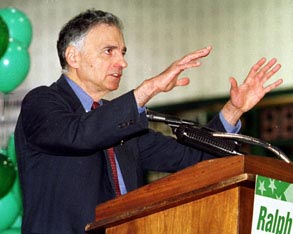

The Gore–Bush contest has been as uninspired as it is overfinanced, a spectacle as tedious as it is dumbed-down (sorry, “on message”). So we arrive at that quadrennial moment when the disgruntled get tired of hitchhiking and look to their own vehicles. As citizen-viewers stream away from the presidential debates wishing out loud that they could vote for someone — anyone — other than the major party candidates, enter Ralph Nader on the Green ticket, apparently safe at any speed. No one accuses Nader of taking funny money, phonying his résumé, being out of his depth, talking down or making himself over too frequently. He bashes corporations like nobody’s business, more rightly than wrongly.
I’m the sort of voter who ought to be flocking to him. I was the third president of Students for a Democratic Society, active in New Left politics thereafter, frequently critical of Clinton-Gore politics from the left. I think the drug war is a disaster, the Colombia intervention wrongheaded, insurance companies and HMOs cruel and unnecessary punishment, big-money giveaways to media tycoons indefensible, free trade oversold, labor underprotected. Oh yes: Along the way, I stayed out of the 1968 vote — and therefore, in the light of unforgiving history, did my tiny bit to help Nixon win, and all for the best of reasons, namely, emotions in revolt, disgust for Humphrey’s pro-war position, and willful blindness about the left’s marginality and the political payoff that could be expected for going it alone.
Here we go again. The arguments for Nader’s campaign are dubious, a vote for him reckless and the consequences of building him up severe and possibly irreversible. As I write, Nader strength in Oregon and Minnesota looks like enough to move those states into the Bush column; Nader could also matter in Wisconsin, Michigan, Washington, even California. The outcome might well be, with a few other states, catastrophic — and not only for the next four years. Just as much of the ground lost to Reagan in the 1980s has never been regained — repeat, never: not in 20 years, not on labor policy, not on the environment, not on income and wealth inequality, not on support for military goons in the poor countries — the ground to be lost by a Republican victory is likely to stay lost. As for the arguments about what’s to be gained by a big Nader turnout, they dissolve on inspection.
What kind of case is made for the Nader vote? We hear, first of all, the notion that Gore and Bush, or Democrats and Republicans, are essentially the same — two names for the same Republicrats. Yet how a thoughtful person can think the differences are negligible boggles the mind.
I have not even mentioned the limited (but scarcely unimportant) issues the candidates talk about: the Social Security hoax Bush wants to perpetrate; the Bush tax cut that Puts Billionaires First; affirmative action, which Bush wants to end, not mend; campaign corruption (sorry, “finance”), the auctioning off of access and bias at which W. is so spectacular that he did not even need the Lincoln Bedroom — he could offer an entire government.
And none of this is to mention the person whom Nader stands poised to tip into power — the lazy, intellectually slovenly Bush, the Bush who sneers at the “Buddhist temple” (would he denounce a church fundraiser with quite that curl of the lip?), the fumbling, evasive, thickheaded Bush, the disingenuous Bush, the deceiving, dynastic Bush who aims to ratify stupidity as a qualification for high office.
We come to the claim that a Nader vote is costless because his candidacy creates its own constituency, bringing masses hitherto demobilized (and rationally so) out of the woodwork. Turnout is surely important, especially for the unregistered blue-collar voters, but waiting for a rescue mission from suddenly lefty voters is the political equivalent of the beam-me-up wishfulness practiced by millennial cults — and it has the same function. The trouble is, there’s no persuasive evidence that large numbers of voters have been staying home because they’ve lacked a left-wing alternative. That’s not the country we’re living in.
We have some recent and relevant experience to consider. Liberals supported (rightly) the motor voter bill to make registration easier, a bill that George H.W. Bush vetoed twice and President Clinton signed, not just on principle, but in the hope that the poor would register and vote to the left. That hope was more vain than not. It didn’t happen. Most scholars who’ve studied the subject believe that people who don’t vote have the same views as people who do. In the real world, Nader is plainly picking up support from Gore (not least because of Gore’s lummox debate performances). Minnesota is one state where, last week, Bush had, surprisingly, crept ahead of Gore in a statewide poll, and, according to the Minneapolis Star-Tribune, “Nader has eroded Gore’s base of support by attracting one-fifth of liberals, young voters and independents — and one in 10 Democrats.” Maybe it’s not true in other states. Maybe it is. Maybe it’s true enough in the right (or wrong) states to throw the election to Bush.
In limited and belated recognition that there are real costs to a Green vote, some now propose “strategic voting” and urge people who live in states where Gore-Bush poll margins are great to cast their ballots for Nader believing that they will not thereby be spoiling Gore’s electoral vote. This is supposed to be a free vote, but there is no such thing as a free vote. That calculated vote is both morally problematic and politically short-sighted. Letting the polls make up your mind for you conditions a moral choice on the presupposition that polls are reliable (when in fact they are swinging all over the place), and amounts, moreover, to a sudden burst of pragmatism from people who ordinarily despise the pragmatism of Gore support.
Then, on practical grounds, we hear that a Nader vote builds up popular support for the Greens so they can get to 5 percent and therefore receive federal funds in 2004. Suppose, for the sake of argument, that Nader does get 5 percent, and the Greens get federal funds in future elections. Then what? On the off-chance that the Greens can avoid breaking into warring camps, à la the Reform Party, what they can realistically look forward to is someday becoming, say, an 8 percent party. And then? After at least one term of Republican rule, with its unambiguous passion for big oil, against a nuclear test ban, for Star Wars, against labor organizing, for HMO’s, for kindness toward the Pinochets of the world, etc., maybe eight years on we get to — 9 percent? 11 percent? The odds are for shrinkage, not increase, in a third party. This is a doomed enterprise. The Constitution is decisively tilted against it. In parliamentary systems, a single-digit party can win seats, enter governments, make policy — as witness the Greens in Germany and elsewhere in Europe. But in the American winner-take-all presidential system — which is not going away — the payoff for a third-party effort is the chance to be a spoiler again.
There’s worse. The so-called strategic vote, by lowering Gore’s popular vote, helps undermine his popular mandate if he does win, thus dashing the prospects for progressive hopes — as Clinton’s 43 percent victory in 1992 weakened his own popular base for egalitarian policies like “don’t ask, don’t tell.” Like Bush, Nader supporters choose to forget that many of Clinton’s stronger initiatives — even his small, earnest “stimulus package” of 1993 — banged up against a Republican wall in Congress. Had Clinton been bolstered by an electoral majority — not to mention a better Congress, many of whose Democrats were barely that — he could have made better use of the bully pulpit. (He should have tried anyway.)
Does voting for a third party contribute to “building a movement”? Claims of this sort are always made by charismatic figures. The results are never — never — delivered. The claim amounts to feel-good rhetoric to rationalize a heady campaign. Tomorrow never comes. It is a parochial fantasy.
Nader’s claim that he’s not the spoiler is bad faith. Perhaps he knows it, perhaps not. But there is a deeper force at work. What is at work in the Naderite camp, what lies behind the fantasy that the masses hanker for radical change, is a purist approach to politics. There are Nader supporters — as well as Democrats of the left like Michigan’s John Conyers — who have urged Nader to drop his campaign in the states where he might throw the race to Gore. He’s refused. He shows no inclination to deal. (Neither, unfortunately, does Gore.) But deal-making is how politics happens.
At bottom, Nader’s all-or-nothing gambit is not politics, it is moral fundamentalism — as if by venting one’s anger, one were free to remake the world by willing it so, despite all those recalcitrant people who happen to live here.
The arrogance of this “worsism” — the worse, the better — is chillingly expressed by a Nader voter in Portland, Ore., interviewed in Friday’s New York Times: “If Bush gets in, I feel that it might bring things to a head much more quickly. Pollution’s going to increase in the short term, but I think that will bring a lot more people into the environmental movement a lot more quickly. Sometimes you’ve got to hit bottom before you come back up.” Notice how the means — “a lot more people into the environmental movement” — has become the end. Notice the spurious assumption that the masses will rise up if things come “to a head.” It didn’t happen after Reagan’s depredations on the environment. It won’t happen now. As for the Nader movement, it’s well-meaning and broad but an inch deep. In Eric Alterman’s trenchant words in the Nation, Nader’s “nascent leftist movement has virtually no support among African-Americans, Latinos or Asian-Americans. It has no support among organized feminist groups, organized gay rights groups or mainstream environmental groups. To top it all off, it has no support in the national union movement. So Nader and company are building a nonblack, non-Latino, non-Asian, nonfeminist, nonenvironmentalist, nongay, non-working people’s left: Now that really would be quite an achievement.”
On Earth, the only land ahead is the compromised land. Politics means satisfactions and dissatisfactions, not redemptions. There is this truth: We are condemned to share the Earth with people we dislike, even despise. In a democracy, we are condemned to share power with them. A large party — any large party — is a coalition of interests. Imagine the Democrats away and replace them with a left-wing party, and it would still be a coalition of interests heading for disappointment. The question about the actually existing Democrats is this: How to make them more green, more labor-friendly, less punitive? And the prerequisite — not the guarantee, but the prerequisite — is a vote for Democrats, starting with Al Gore.
True enough, after getting a boost from his “the people vs. the powerful” convention speech, Gore moved fitfully toward the center, and one can fight against his position on capital punishment and prisons, his trimming on gun control — dispute all this and more far more effectively if he is president than not. If Nader had run in the primaries, or half the Naderite energy went to organizing a Million Human March to welcome Gore to Washington the day after he’s inaugurated, we on the left would stand a reasonable chance of seeing a Gore more to our liking. He is, as his fans and enemies all agree, a politician. No one accuses the man of being inflexible.
Of course the parties are corrupt fundraising machines. Of course corporate lobbies run amok. Of course the Democrats need pressure. The question is, Whom do we want to put in a position to press? The choice of who will write the agenda, appoint the judges, negotiate (or tear up) the treaties, starting Jan. 20, 2001, is not between Al Gore and Jesus Christ, or, in fact, between Al Gore or Ralph Nader. In America, we’re not going to get a president better than Gore. We may well get a lot worse: a country-club airhead whose occasional rhetoric of compassion obscures the fact that his deepest, most abiding, most consistent compassion is for untrammeled business. We could slam a lot of doors. Consider the choice uninspiring, but there it is, and will not be wished away — not by fulminating against corporations, not by imagining a mass movement, not by assuming that one shirks responsibility for bad consequences because others have a monopoly on evil while we, we noble ones, we happy new, are pure, as George W. Bush would say, of heart.
