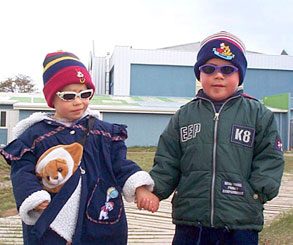

Below an expansive sky that stretches on forever, hundreds of 4-year-olds tucked into puffy winter coats hold hands and file eagerly into an elementary school auditorium. Though it is barely 45 degrees outside, the preschoolers are here to learn about the dangers of the sun.
Paul the Penguin, a 7-foot-tall mascot, appears onstage accompanied by two friends in beach clothes. They warn him that the sun will turn his skin red but that if he douses himself in Eucerin sunblock, he can play outdoors as long as he likes. After the show, the preschoolers line up once again, giggling and squealing, to receive free trial-sized bottles of Eucerin, courtesy of the cosmetic company that makes it. As they grab their gifts and file out, they look like giggling children anywhere — even though they’re not.
The festive setting, complete with beach balls sporting Eucerin’s name in big black letters, belies the grim reason they have all gathered. Like the “duck-and-cover” classroom exercises during the Cuban missile crisis, and Los Angeles’ smog alerts in the 1980s, which cautioned students not to go outside when pollution levels were high, today’s presentation is teaching a generation of kids in the southern tip of Chile how to accept the unacceptable — how to survive under the expanding ozone hole the rest of the world has created.
“It’s very sad,” says Eduardo Mortiric, a 15-year-old with pale skin and cheeks so sun-kissed it looks like he has rouge on. “I can’t go outside and ride my bike, play soccer anymore or go walking. I burn easily.”
Welcome to life in Punta Arenas in the ozone depletion age.
This port city of 120,000 people, at 53 degrees south latitude, has always been known more for its proximity to other places — five hours from Patagonia’s Torres del Paine, an hour from a penguin colony, a boat ride to Antarctica — than as a destination in its own right. But as ground zero of a global ecological catastrophe, Punta Arenas is becoming famous, or infamous, as the city that has squatted directly under the gaping hole in the earth’s ozone layer. What’s happening down here on the edge of nowhere is an uncontrolled science experiment: exposing human beings in their natural habitat to long-term doses of potentially deadly ultraviolet radiation.
It may take years before the results are in, before we know the full toll in vision problems and skin cancers, illness and death. Until now the rest of the world has watched from afar, complacent in the conviction that it has largely addressed the problem. But it might be a good idea to pay closer attention to what happens down here, because scientists fear that — in the future — regions farther from the poles could be hit by a thinning of the ozone layer.
Contradictions abound in this small city. On many days in September and October — the spring months when the ozone layer is at its thinnest — Punta Arenas officials warn residents to stay inside between 11 a.m. and 3 p.m. or risk a severe sunburn. Yet most don’t listen. The regional health minister in charge of disseminating this advice to the public appears at official events with a deep tan from a recent skiing trip. People here complain about the ecological disaster the rest of the world has inflicted on them — then they complain that foreign visitors draw too much attention to the problem. Doctors warn patients of the need to wear protective hats sturdy enough to withstand the powerful wind down here — but know that the gear must be attractive enough so fashion-minded Chileans will actually wear them. Officials acknowledge the critical need to address the problem — but claim they won’t be able to afford $180,000 for an ozone- and radiation-measuring instrument after Punta Arenas scientists return the only one they have later this month to the institute in Brazil from which they borrowed it.
And Punta Arenas is where Beiersdorf, a German cosmetics company, markets itself by sponsoring a play for preschoolers featuring an adorable penguin who slathers the firm’s sunblock over himself from head to web.
Though scientists once thought they had a handle on the problem, the ozone hole reached its largest dimensions yet in September, stretching across an area of 11 million square miles — a distance three times the size of the United States. And it has subsequently wandered all the way from its icy seasonal home of Antarctica to this port city. In Punta Arenas, according to local measurements, the residents are exposed to levels of UVB radiation 40 percent greater than normal when the ozone hole is above.
The worsening situation has so alarmed Chilean officials that, for the first time ever, they are demanding help from the international community to help finance research on the effects of ozone depletion on ecosystems and human health. Chile’s ambassador to the United Nations, Juan Gabriel Valdes, is addressing the U.N. General Assembly on the issue this month.
But Chilean officials are concerned because asking for assistance affronts their pride and sense of self-sufficiency. “I am not like the guy in ‘Jerry Maguire,’ saying, ‘Show me the money! Show me the money!’” says Rodrigo Alvarez, a congressman for the Magallanes region, where Punta Arenas is located. “This is a problem that we didn’t create. There is an international responsibility to this southern region — Australia, Argentina, Chile. The [ozone hole] was created by the whole world.”
The ozone layer lies in the stratosphere more than 10 miles above the Earth’s surface. Because it absorbs most of the sun’s sometimes deadly, DNA-destroying ultraviolet B radiation, or UVB, it enabled life as we know it to thrive on earth. “It’s like a bulletproof vest — if you start thinning out the lead, you let more bullets through,” says Ed DeFabo, research professor of dermatology at George Washington University Medical Center and chairman of the International Arctic Science Committee’s panel that examines the impacts of increased UVB radiation.
Scientists discovered the hole in the ozone layer — more accurately, a thinning of the layer — in 1982. They linked it to the widespread use of manmade chemicals like chlorofluorocarbons (CFCs) and hydrochlorofluorocarbons (HCFCs) in such products as aerosol sprays, refrigerants and solvents. Once released, these substances rise to the stratosphere, where the sunlight causes them to break apart into chlorine and other elements. In the Southern Hemisphere, the depletion occurs largely in the spring because rising temperatures and the presence of ice crystals atop the polar stratospheric clouds facilitate complex chemical reactions between ozone molecules and the CFC and HCFC components.
In 1997, more than 140 countries signed the Montreal Protocol, in which they agreed to phase out the use of these chemicals. However, because the CFCs and HCFCs can take years to rise high enough to start causing the damage, scientists believe that it will be decades before the ozone layer can replenish itself and return to normal.
More recently, however, evidence has mounted that global warming, not just the CFCs and HCFCs, can also cause ozone depletion. Virtually all members of the reputable scientific community believe that much of the current trend of global warming can be attributed to human use of non-renewable sources of energy. And they believe that many of the bizarre ecological and climatic phenomena of the past few years — the record high temperatures and the shrinking of the polar ice caps, for example — can be attributed to global warming.
The situation is not likely to improve any time soon. According to a report released recently by the United Nations Intergovernmental Panel on Climate Change, average global temperatures could rise as much as 11 degrees Fahrenheit over the next century. That also means that ozone depletion could get worse — much worse — before it gets better.
“This could mean a truly torrid world in many areas and frightful extremes of weather,” says Arjun Makhijani, president of the Maryland-based Institute for Energy and Environmental Research.
So far the problem has mostly affected large swaths of the Southern Hemisphere. In some ways the situation might ultimately be worse in places like Australia and New Zealand, where higher temperatures prompt people to spend more time outdoors wearing far fewer clothes. But some researchers ominously predict “ozone hole creep” as the century progresses. Jonathan Shanklin, one of the scientists who discovered the Antarctic hole, announced just last week that a second hole above the Arctic, which has generally been smaller than the one over the southern pole, could grow to the same size by 2020 because of global warming.
Some scientists also fear that there could be increased ozone thinning across the globe, not just at the poles. This could be particularly dangerous for places like Miami and San Diego, since regions closer to the equator already experience relatively high natural levels of UVB radiation even without ozone depletion. But double doses from a thinning ozone layer could push these sun-belt cities well into the danger zone.
Given the stark differences in environmental policy between the two presidential candidates, next week’s election could have a significant impact on the situation. Though President George Bush memorably mocked Al Gore as “Ozone Man” during the 1992 campaign because of Gore’s long-standing interest in the environment, the fate of the ozone layer itself has not been an issue in the current presidential race. But global warming has entered the debate.
Gore has pledged to sign the 1997 Kyoto Treaty, which calls for countries to reduce their use of fossil fuel to stem global warming and is the subject of a gathering of world leaders in The Hague later this month. Texas Gov. George W. Bush opposes the treaty and maintains — against virtually all the available evidence — that the jury is still out on the causes and impact of global warming.
Far from the rhetoric of Washington and the presidential campaign, Nelson Paredes sits behind the registration desk at Punta Arenas’ public hospital on this frigid Sunday afternoon. Paredes, the hospital supplies manager, needs no words to describe how harsh the sun’s springtime dose has become. His face reads like a textbook on the current state of the environment in Punta Arenas.
Paredes looks older than his 48 years. His face is blotchy, like a ragged quilt with interlocking patches of natural coffee-colored skin and big, white scars. He explains that one sunny day last October, he attended a sports event and stood outside for four hours. That night he could feel “despidir” — fire — on his face. “I was surprised because that night I couldn’t open my eyes, they were so inflamed,” he says. “Nothing like this ever happened before.”
Though the pain lasted for three months and the effects of the burn remain highly visible today, Paredes, like many residents here, does not always remember to put on his protective lotion. Nor does he keep up with the official day-to-day media alerts about levels of radiation. On this particular afternoon, he explained as music blared in the background, he had forgotten to look at the newspaper that morning and, once at work, was caught up listening to the radio.
When he got sunburned last year, Paredes sought out Dr. Jaime Abarca, a dermatologist at the public hospital in Punta Arenas. Paredes was one of 31 patients who came to him with sunburns last year. In the previous 13 years, says Dr. Abarca, only one person would generally arrive each season with a sunburn. “It’s a fact that not only here in Punta Arenas but in the rest of the world, we are going to have more skin cancer due to the ozone depletion,” Dr. Abarca says. “That’s what happens after about 50 years of intermittent severe exposures to the sun.”
The sun’s touch in Punta Arenas feels gracious, not harsh, but its aftereffects are punishing. Though I have slathered myself with SPF 45 constantly since I arrived here, after two days my cheeks are slightly sunburned. I don’t need to worry about the rest of my body, since I am covered from head to toe in winter wear. The cold was once considered a curse down here, but now people are grateful for it, since it forces them to cover up just to survive the temperatures. Now their clothes also help to protect them against the harmful effects of ozone depletion.
UVB is known to affect the skin, eyes and immune system, but there is no immunologist in town. And the local health minister, Lidia Amarales, has been granted scarce resources — just $30,000 a year from the regional government — to educate people about the problem. “It is impossible to give the sun cream to everyone in Punta Arenas because it’s expensive,” says Amarales. “We have other priorities, like cancer, diabetes, hypertension, adolescent and mental health, and respiratory diseases.”
Amarales has focused her efforts on what she calls “education and prevention,” but her policy boils down to little more than warning the residents to protect themselves by wearing sunblock that many can’t afford, wide-brimmed hats, long-sleeved shirts and sunglasses offering protection from UVB rays. She has also proposed a plan to require all students to take a class on the ozone layer, and has pushed for the local newspaper, La Prensa Austral, to receive daily radiation projections.
Since earlier this year, the projections have become, like the horoscope, a daily feature of the newspaper. On the last page, a picture of a traffic signal, with colors corresponding to the level of radiation for that day, from red (the worst) down to orange, then yellow, then green. There have been 13 red alerts so far this year. The radiation levels are collected by Claudio Casiccia, the harried geophysicist who single-handedly monitors the depletion levels from the rooftop of Punta Arenas’ University of Magallanes. A red alert means that the radiation level is so high that it can cause some people’s skin to burn within five minutes.
And yet when you ask many people on the street about that day’s color alert — including the hotel receptionist, as I did morning after morning — they simply don’t know. Sometimes they guess, raising their inflection on the last syllable to transform their statement into a question — “na-ran-JA?” (orange), for example, or “roJO?” (red). Or else they may confide knowingly, like an impoverished woman who works in a fish cannery and lives near the town port, that a red alert indicates that a big storm is about to blow in.
“I think a lot of people are going to die in the future,” says Alvarez, the congressman from the region. “People at the refinery, the fisherman, I think a lot of people are not going to change their way of life and many will suffer and risk dying.” Alvarez is backing a bill that proposes to use public funds to subsidize the cost of protective gear for those who can’t afford it. The cheapest glasses with UV-B protection at the local optometrist shop cost around $33; sunscreen with SPF 15 is about $12.
While the much-applauded Montreal Protocol addressed the problem of the ozone-destroying chemicals, it did not establish any type of fund for researching the long-term biological effects or for helping those countries on the front lines. There has also been no other international initiative to deal with the problem; as a result, the people in the world’s southern regions — like Chile, Argentina and Australia, where ozone depletion is the most severe — have little information as to what will really happen to them after many years. “The industrialized countries have been mainly responsible for emitting ozone-depleting compounds, but they haven’t taken responsibility for the health and ecological damage that their emissions may cause to third parties, like Chile,” says environmental researcher Arjun Makhijani. “As we see health effects emerge, there’s no way to hold people accountable for the damages and no one has stepped up to the plate and said, ‘We will help you if there are damages.’”
The effects of the UV radiation on the ecosystems and animals in the area are also not known. Sheep, which dot the pastures like cotton candy, are so prevalent that Magallanes is called the “region granadera,” or cattle region. “We don’t know how the animals feel — maybe they feel something,” says Carlos Rowland, a veterinarian and director of the regional branch of the national Agricultural and Cattle Services. “But the sheep live for four to five years and then the farmers send them to be killed. The sheep don’t live long enough to see if they are developing problems with their eyes and skin.”
Every morning at 7, Maria Teresa Argüelles, an unassuming kindergarten teacher, arises and applies sunburn cream and then reminds her 11-year-old son Daniel to put on his hat and lotion. She has bought Daniel sunglasses but is afraid to let him take them to school because they are expensive and she fears he will break them. And like many kids, he often just shoves his hat in his bookbag. “I think the problem is that people in general aren’t conscious of the sun’s effects,” she says.
Argüelles points upward with her index finger and explains that the sky looks no different than when she was a child. But it certainly feels different. “It now stings my skin,” she says as she touches her cheeks with both hands and scrunches up her face.
She worries, too, about her students. They come in with rosy cheeks after outdoor playtime — one child recently burned himself severely and had to stay out of school for several days. And her husband Jorge Asencio, a security guard for a 7-Up factory who works outside for much of the day, comes home complaining of headaches when the sun’s been particularly bright.
Two weeks ago, he came home complaining about vision problems. “I think it’s because of the sun,” she says about his right eye, which is completely bloodshot. Asencio says he has problems seeing up close, but he can’t afford to go to the doctor until the end of the month, when he gets paid.
“These people are not accustomed to much radiation and suddenly, they are getting more,” says Dr. Juan Honeyman, head of the department of dermatology at Santiago’s University of Chile Medical School. “The problem is, with the switch, people can get burned — the acute effect of UVB radiation.”
While there have been noticeable health changes in the people of Punta Arenas, as Honeyman has documented in new research, the effects haven’t been as severe as might have been expected. He compared two studies, one from 1992 and one last year, that examined the health of similar groups of people — middle-aged hospital employees and outdoor workers like farmers and fishermen. Honeyman found a 28 percent increase in cheilitis (fissures and cracks around the mouth); a 16.4 increase in conditions like solar spots (small patches of sunburn); and a 3.6 percent increase in benign skin conditions like facial hyperpigmentation (a darkening of the skin), herpes simplex type 1 and photoaging (a premature aging and wrinkling of the skin).
Only a few days after I left Punta Arenas, I felt the first tingle of a cold sore forming in the right-hand corner on my upper lip. Was this because I forgot to put on my SPF lip balm after the first day? Despite my hyperawareness of the issue — the whole reason I came was to learn about the ozone hole’s effects — I behaved no differently than most of the people who live here.
On the first day, I bundled up completely and looked as if I’d been dressed by an overprotective mom, with a baseball cap pulled down to shade my face, sunglasses, lip balm and sun cream. But gradually I shed my concern and went about my business as if nothing was amiss — even though I knew everything was. I stopped using my hat because the face-slapping wind kept blowing it off, and I tired of constantly transferring my sunglasses between my eyes and my purse.
While I saw some people completely bedecked in protective clothing, Honeyman confirms the sense I got walking around the streets that few bother. According to his most recent study, 64 percent of people have never used sunburn lotion to protect themselves despite official warnings, and 41 percent have never worn sunglasses in their entire lives. But he stresses that he found no significant change in rates of skin cancer or pre-malignant cancer. According to the local health minister Amarales, the incidence rate of skin cancer is 6.3 per 100,000 people, although she has no figures for the rate 10 years ago. Only recently were doctors required to start reporting cases of skin cancer the way they report cases of infectious disease.
Many of the officials here make it sound like it will be a simple task to convince people to suddenly change their daily habits. Amarales seems naive, and a little flippant, as he talks about how easy it is to remain in the shadows of trees or tall buildings on high radiation days, even though it’s freezing here and even colder in the shade. After a few days in Punta Arenas, I found myself crossing the street to walk in the sun’s path and bask a little in the warmth — and I was highly motivated not to, and knew I was leaving soon.
The fact is that not everyone has the luxury of choosing whether or not to be in the sun. How can farmers stay out of the sun, when their animals are scattered across thousands of acres and their days start at 7 a.m. and continue until dusk? And how about the construction workers I passed on a Saturday morning, burly men shoveling gravel in the middle of the street in direct sunlight? Their foreman, Juan Aguilante, directed them from the shade while wearing his protective clothes. “No, none of them are wearing sunblock,” he says. “They can’t afford it.”
But Amarales remains confident she can get her message across. “Changing people’s habits is the most difficult thing in the world, but I think I am optimistic because the people in our region are easy to educate,” she says.
Of course, there are a few signs that the message is reaching the populace. Some people on the street stroll past wearing sunglasses and baseball caps; locals say no one did in the past. A taxi driver who is standing outside his cab waiting for customers says he became concerned just this year. Every day now, he says, he listens to the reports on the radio and scans the alerts in the newspaper so he can dress appropriately.
Yet people here can be prickly and defensive when the subject arises. Even Dr. Honeyman, whom everyone appears to regard as an expert on the subject, says that more UVB radiation falls on sunny Santiago, the country’s capital and most populated city. And on many days this is true. The ozone layer is naturally thinner closer to the equator; over the poles it is usually thick until the seasonal depletion occurs. (The problem, of course, is that people living closer to the equator are more used to dealing with the effects of the sun — and as the ozone layer thins, the problems in those hotter cities will worsen.)
They also express irritation at the foreign reporters who are so interested in their fate. More than once, people told me to consider the situation in my own country, in places like Florida and Southern California, where people strut around in bikinis and trunks for months at a time with the sun glaring down on them.
And many people still don’t believe there’s a problem. Long before Dolly, the infamous Scottish lamb that claimed her 15 minutes of fame by being the first animal to be cloned, there was another picture of what happens when you mess with Mother Nature — the Sheep of Punta Arenas. Apocalyptic reports from local farmers of sheep that had gone blind from the sun with cataracts circulated across the globe. But the reports were found to be untrue.
That was several years ago, but the false report has long lingered in some residents’ minds, bolstering their sense that all this talk of ozone doomsday is just an exaggeration, as overhyped a threat as the Y2K bug. Jurgen Schulmeister, a 45-year-old German expat, is one of the skeptics. Atop a hill just outside town, he lives with his Chilean wife and two children in a house with its own indoor swimming pool. “Ten years ago, some tourists gave me an article from German scientists saying that yes, there is a big problem and that plants and animals will die. And now I live here, and there’s no problem with plants, animals, cancer. Ten years later people work normally, they live, with no problem.”
Of course, scientists like Honeyman say that it’s the cumulative effects of the sun that will cause the real damage, and that it may take years before the consequences become apparent. Until then, the people here continue with their lives, taking each day as it comes, adapting their behavior accordingly — or not — and wondering what the bright yellow disc in the sky will do to them and their children.
Maria Arguelles is one of those who worries. As she sits by her living room window and watches the fierce wind rip clothes off the laundry line, she says sadly that she feels helpless against the elements. If the situation does get worse in the next few years, she says, she and her family will probably leave town.
“But at that point, wherever you go, you take your health problems with you,” she says. “Now all I can do is wait.”
If the world can be seen in a grain of sand, watch out. As Wisconsinites are learning, there’s money (and misery) in sand — and if you’ve got the right kind, an oil company may soon be at your doorstep.
March in Wisconsin used to mean snow on the ground, temperatures so cold that farmers worried about their cows freezing to death. But as I traveled around rural townships and villages in early March to interview people about frac-sand mining, a little-known cousin of hydraulic fracturing or “fracking,” daytime temperatures soared to nearly 80 degrees — bizarre weather that seemed to be sending a meteorological message.
In this troubling spring, Wisconsin’s prairies and farmland fanned out to undulating hills that cradled the land and its people. Within their embrace, the rackety calls of geese echoed from ice-free ponds, bald eagles wheeled in the sky, and deer leaped in the brush. And for the first time in my life, I heard the thrilling warble of sandhill cranes.
Yet this peaceful rural landscape is swiftly becoming part of a vast assembly line in the corporate race for the last fossil fuels on the planet. The target: the sand in the land of the cranes.
Five hundred million years ago, an ocean surged here, shaping a unique wealth of hills and bluffs that, under mantles of greenery and trees, are sandstone. That sandstone contains a particularly pure form of crystalline silica. Its grains, perfectly rounded, are strong enough to resist the extreme pressures of the technology called hydraulic fracturing, which pumps vast quantities of that sand, as well as water and chemicals, into ancient shale formations to force out methane and other forms of “natural gas.”
That sand, which props open fractures in the shale, has to come from somewhere. Without it, the fracking industry would grind to a halt. So big multinational corporations are descending on this bucolic region to cart off its prehistoric sand, which will later be forcefully injected into the earth elsewhere across the country to produce more natural gas. Geology that has taken millions of years to form is now being transformed into part of a system, a machine, helping to drive global climate change.
“The valleys will be filled… the mountains and hills made level”
Boom times for hydraulic fracturing began in 2008 when new horizontal-drilling methods transformed an industry formerly dependent on strictly vertical boring. Frac-sand mining took off in tandem with this development.
“It’s huge,” said a U.S. Geological Survey mineral commodity specialist in 2009. “I’ve never seen anything like it, the growth. It makes my head spin.” That year, from all U.S. sources, frac-sand producers used or sold over 6.5 million metric tons of sand — about what the Great Pyramid of Giza weighs. Last month, Wisconsin’s Department of Natural Resources (DNR) Senior Manager and Special Projects Coordinator Tom Woletz said corporations were hauling at least 15 million metric tons a year from the state’s hills.
By July 2011, between 22 and 36 frac-sand facilities in Wisconsin were either operating or approved. Seven months later, said Woletz, there were over 60 mines and 45 processing (refinement) plants in operation. “By the time your article appears, these figures will be obsolete,” claims Pat Popple, who in 2008 founded the first group to oppose frac-sand mining, Concerned Chippewa Citizens (now part of The Save the Hills Alliance).
Jerry Lausted, a retired teacher and also a farmer, showed me the tawny ridges of sand that delineated a strip mine near the town of Menomonie where he lives. “If we were looking from the air,” he added, “you’d see ponds in the bottom of the mine where they dump the industrial waste water. If you scan to the left, you’ll see the hills that are going to disappear.”
Those hills are gigantic sponges, absorbing water, filtering it, and providing the region’s aquifer with the purest water imaginable. According to Lausted, sand mining takes its toll on “air quality, water quality and quantity. Recreational aspects of the community are damaged. Property values [are lowered.] But the big thing is, you’re removing the hills that you can’t replace. They’re a huge water manufacturing factory that Mother Nature gave us, and they’re gone.”
It’s impossible to grasp the scope of the devastation from the road, but aerial videos and photographs reveal vast, bleak sandy wastelands punctuated with waste ponds and industrial installations where Wisconsin hills once stood.
When corporations apply to counties for mining permits, they must file “reclamation” plans. But Larry Schneider, a retired metallurgist and industrial consultant with a specialized knowledge of mining, calls the reclamation process “an absolute farce.”
Reclamation projects by mining corporations since the 1970s may have made mined areas “look a little less than an absolute wasteland,” he observes. “But did they reintroduce the biodiversity? Did they reintroduce the beauty and the ecology? No.”
Studies bear out his verdict. “Every year,” wrote Mrinal Ghose in the Journal of Scientific and Industrial Research, “large areas are continually becoming unfertile in spite of efforts to grow vegetation on the degraded mined land.”
Awash in promises of corporate jobs and easy money, those who lease and sell their land just shrug. “The landscape is gonna change when it’s all said and done,” says dairy farmer Bobby Schindler, who in 2008 leased his land in Chippewa County to a frac-sand company called Canadian Sand and Proppant. (EOG, the former Enron, has since taken over the lease.) “Instead of being a hill it’s gonna be a valley, but all seeded down, and you’d never know there’s a mine there unless you were familiar with the area.”
Of the mining he adds, “It’s really put a boost to the area. It’s impressive the amount of money that’s exchanging hands.” Eighty-four-year-old Letha Webster, who sold her land 100 miles south of Schindler’s to another mining corporation, Unimin, says that leaving her home of 56 years is “just the price of progress.”
Jamie and Kevin Gregar — both 30-something native Wisconsinites and military veterans — lived in a trailer and saved their money so that they could settle down in a pastoral paradise once Kevin returned from Iraq. In January 2011, they found a dream home near tiny Tunnel City. (The village takes its name from a nearby rail tunnel). “It’s just gorgeous — the hills, the trees, the woodland, the animals,” says Jamie. “It’s perfect.”
Five months after they moved in, she learned that neighbors had leased their land to “a sand mine” company. “What’s a sand mine?” she asked.
Less than a year later, they know all too well. The Gregars’ land is now surrounded on three sides by an unsightly panorama of mining preparations. Unimin is uprooting trees, gouging out topsoil, and tearing down the nearby hills. “It looks like a disaster zone, like a bomb went off,” Jamie tells me.
When I mention her service to her country, her voice breaks. “I am devastated. We’ve done everything right. We’ve done everything we were supposed to. We just wanted to raise our family in a good location and have good neighbors and to have it taken away from us for something we don’t support…” Her voice trails off in tears.
For Unimin, the village of Tunnel City in Greenfield township was a perfect target. Not only did the land contain the coveted crystalline silica; it was close to a rail spur. No need for the hundreds of diesel trucks that other corporations use to haul sand from mine sites to processing plants. No need, either, for transport from processing plants to rail junctions where hundreds of trains haul frac-sand by the millions of tons each year to fracture other once-rural landscapes. Here, instead, the entire assembly line operates in one industrial zone.
There was also no need for jumping the hurdles zoning laws sometimes erect. Like many Wisconsin towns where a culture of diehard individualism sees zoning as an assault on personal freedom, Greenfield and all its municipalities, including Tunnel City, are unzoned. This allowed the corporation to make deals with individual landowners. For the 8.5 acres where Letha Webster and her husband Gene lived for 56 years, assessed in 2010 at $147,500, Unimin paid $330,000. Overall, between late May and July 2011, it paid $5.3 million for 436 acres with a market value of about $1.1 million.
There was no time for public education about the potential negative possibilities of frac-sand mining: the destruction of the hills, the decline in property values, the danger of silicosis (once considered a strictly occupational lung disease) from blowing silica dust, contamination of ground water from the chemicals used in the processing plants, the blaze of lights all night long, noise from hundreds of train cars, houses shaken by blasting. Ron Koshoshek, a leading environmentalist who works with Wisconsin’s powerful Towns Association to educate townships about the industry, says that “frac-sand mining will virtually end all residential development in rural townships.” The result will be “a large-scale net loss of tax dollars to towns, increasing taxes for those who remain.”
Town-Busting Tactics
Frac-sand corporations count on a combination of naïveté, trust, and incomprehension in rural hamlets that previously dealt with companies no larger than Wisconsin’s local sand and gravel industries. Before 2008, town boards had never handled anything beyond road maintenance and other basic municipal issues. Today, multinational corporations use their considerable resources to steamroll local councils and win sweetheart deals. That’s how the residents of Tunnel City got taken to the cleaners.
On July 6, 2011, a Unimin representative ran the first public forum about frac-sand mining in the village. Other heavily attended and often heated community meetings followed, but given the cascades of cash, the town board chairman’s failure to take a stand against the mining corporation, and Unimin’s aggressiveness, tiny Tunnel City was a David without a slingshot.
Local citizens did manage to get the corporation to agree to give the town $250,000 for the first two million tons mined annually, $50,000 more than its original offer. In exchange, the township agreed that any ordinance it might pass in the future to restrict mining wouldn’t apply to Unimin. Multiply the two million tons of frac-sand tonnage Unimin expects to mine annually starting in 2013 by the $300 a ton the industry makes and you’ll find that the township only gets .0004% of what the company will gross.
For the Gregars, it’s been a nightmare. Unimin has refused five times to buy their land and no one else wants to live near a sand mine. What weighs most heavily on the couple is the possibility that their children will get silicosis from long-term exposure to dust from the mine sites. “We don’t want our kids to be lab rats for frac-sand mining companies,” says Jamie.
Drew Bradley, Unimin’s senior vice president of operations, waves such fears aside. “I think [citizens] are blowing it out of proportion,” he told a local publication. “There are plenty of silica mines sited close to communities. There have been no concerns exposed there.”
That’s cold comfort to the Gregars. Crystalline silica is a known carcinogen and the cause of silicosis, an irreversible, incurable disease. None of the very few rules applied to sand mining by the state’s Department of Natural Resources (DNR) limit how much silica gets into the air outside of mines. That’s the main concern of those living near the facilities.
So in November 2011, Jamie Gregar and ten other citizens sent a 35-page petition to the DNR. The petitioners asked the agency to declare respirable crystalline silica a hazardous substance and to monitor it, using a public health protection level set by California’s Office of Environmental Health Hazard Assessment. The petition relies on studies, including one by the DNR itself, which acknowledge the risk of airborne silica from frac-sand mines for those who live nearby.
The DNR denied the petition, claiming among other things that — contrary to its own study’s findings — current standards are adequate. One of the petition’s signatories, Ron Koshoshek, wasn’t surprised. For 16 years he was a member of, and for nine years chaired, Wisconsin’s Public Intervenor Citizens Advisory Committee. Created in 1967, its role was to intercede on behalf of the environment, should tensions grow between the DNR’s two roles: environmental protector and corporate licensor. “The DNR,” he says, “is now a permitting agency for development and exploitation of resources.”
In 2010, Cathy Stepp, a confirmed anti-environmentalist who had previously railed against the DNR, belittling it as “anti-development, anti-transportation, and pro-garter snakes,” was appointed to head the agency by now-embattled Governor Scott Walker who explained: “I wanted someone with a chamber-of-commerce mentality.”
As for Jamie Gregar, her dreams have been dashed and she’s determined to leave her home. “At this point,” she says, “I don’t think there’s a price we wouldn’t accept.”
Frac-Sand vs. Food
Brian Norberg and his family in Prairie Farm, 137 miles northwest of Tunnel City, paid the ultimate price: he died while trying to mobilize the community against Procore, a subsidiary of the multinational oil and gas corporation Sanjel. The American flag that flies in front of the Norbergs’ house flanks a placard with a large, golden NORBERG, over which pheasants fly against a blue sky. It’s meant to represent the 1,500 acres the family has farmed for a century.
“When you start talking about industrial mining, to us, you’re violating the land,” Brian’s widow, Lisa, told me one March afternoon over lunch. She and other members of the family, as well as a friend, had gathered to describe Prairie Farm’s battle with the frac-sanders. “The family has had a really hard time accepting the fact that what we consider a beautiful way to live could be destroyed by big industry.”
Their fight against Procore started in April 2011: Sandy, a lifelong friend and neighbor, arrived with sand samples drillers had excavated from her land, and began enthusiastically describing the benefits of frac-sand mining. “Brian listened for a few minutes,” Lisa recalls. “Then he told her [that]… she and her sand vials could get the heck — that’s a much nicer word than what he used – off the farm. Sandy was hoping we would also be excited about jumping on the bandwagon. Brian informed her that our land would be used for the purpose God intended, farming.”
Brian quickly enlisted family and neighbors in an organizing effort against the company. In June 2011, Procore filed a reclamation plan — the first step in the permitting process — with the county’s land and water conservation department. Brian rushed to the county office to request a public hearing, but returned dejected and depressed. “He felt completely defeated that he could not protect the community from them moving in and destroying our lives,” recalls Lisa.
He died of a heart attack less than a day later at the age of 52. The family is convinced his death was a result of the stress caused by the conflict. That stress is certainly all too real. The frac-sand companies, says family friend Donna Goodlaxson, echoing many others I interviewed for this story, “go from community to community. And one of the things they try to do is pit people in the community against each other.”
Instead of backing off, the Norbergs and other Prairie Farm residents continued Brian’s efforts. At an August 2011 public hearing, the town’s residents directly addressed Procore’s representatives. “What people had to say there was so powerful,” Goodlaxson remembers. “Those guys were blown out of their chairs. They weren’t prepared for us.”
“I think people insinuate that we’re little farmers in a little community and everyone’s an ignorant buffoon,” added Sue Glaser, domestic partner of Brian’s brother Wayne. “They found out in a real short time there was a lot of education behind this.”
“About 80% of the neighborhood was not happy about the potential change to our area,” Lisa adds. “But very few of us knew anything about this industry at [that] time.” To that end, Wisconsin’s Farmers’ Union and its Towns Association organized a day-long conference in December 2011 to help people “deal with this new industry.”
Meanwhile, other towns, alarmed by the explosion of frac-sand mining, were beginning to pass licensing ordinances to regulate the industry. In Wisconsin, counties can challenge zoning but not licensing ordinances, which fall under town police powers. These, according to Wisconsin law, cannot be overruled by counties or the state. Becky Glass, a Prairie Farm resident and an organizer with Labor Network for Sustainability, calls Wisconsin’s town police powers “the strongest tools towns have to fight or regulate frac-sand mining.” Consider them so many slingshots employed against the corporate Goliaths.
In April 2012, Prairie Farm’s three-man board voted 2 to 1 to pass such an ordinance to regulate any future mining effort in the town. No, such moves won’t stop frac-sand mining in Wisconsin, but they may at least mitigate its harm. Procore finally pulled out because of the resistance, says Glass, adding that the company has since returned with different personnel to try opening a mine near where she lives.
“It takes 1.2 acres per person per year to feed every person in this country,” says Lisa Norberg. “And the little township that I live in, we have 9,000 acres that are for farm use. So if we just close our eyes and bend over and let the mining companies come in, we’ll have thousands of people we can’t feed.”
Food or frac-sand: it’s a decision of vital importance across the country, but one most Americans don’t even realize is being made — largely by multinational corporations and dwindling numbers of yeoman farmers in what some in this country would call “the real America.” Most of us know nothing about these choices, but if the mining corporations have their way, we will soon enough — when we check out prices at the supermarket or grocery store. We’ll know it too, as global climate change continues to turn Wisconsin winters balmy and supercharge wild weather across the country.
While bucolic landscapes disappear, aquifers are fouled, and countless farms across rural Wisconsin morph into industrial wastelands, Lisa’s sons continue to work the Norberg’s land, just as their father once did. So does Brian’s nephew, 32-year-old Matthew, who took me on a jolting ride across his fields. The next time I’m in town, he assured me, we’ll visit places in the hills where water feeds into springs. Yes, you can drink the water there. It’s still the purest imaginable. Under the circumstances, though, no one knows for how long.
Ellen Cantarow’s work on Israel/Palestine has been widely published for over 30 years. Her long-time concern with climate change has led her to investigate the global depredations of oil and gas corporations at TomDispatch. Many thanks to Wisconsin filmmaker Jim Tittle, whose documentary, “The Price of Sand,” will appear in August 2012, and who shared both his interviewees and his time for this article.
Continue Reading
Close
This document was found on the computer of "Ecotopia" author Ernest Callenbach (1929-2012) after his death.
It originally appeared on
TomDispatch.com.
To all brothers and sisters who hold the dream in their hearts of a future world in which humans and all other beings live in harmony and mutual support — a world of sustainability, stability, and confidence. A world something like the one I described, so long ago, in “Ecotopia” and “Ecotopia Emerging.”
As I survey my life, which is coming near its end, I want to set down a few thoughts that might be useful to those coming after. It will soon be time for me to give back to Gaia the nutrients that I have used during a long, busy and happy life. I am not bitter or resentful at the approaching end; I have been one of the extraordinarily lucky ones. So it behooves me here to gather together some thoughts and attitudes that may prove useful in the dark times we are facing: a century or more of exceedingly difficult times.
How will those who survive manage it? What can we teach our friends, our children, our communities? Although we may not be capable of changing history, how can we equip ourselves to survive it?
I contemplate these questions in the full consciousness of my own mortality. Being offered an actual number of likely months to live, even though the estimate is uncertain, mightily focuses the mind. On personal things, of course, on loved ones and even loved things, but also on the Big Picture.
But let us begin with last things first, for a change. The analysis will come later, for those who wish it.
Hope. Children exude hope, even under the most terrible conditions, and that must inspire us as our conditions get worse. Hopeful patients recover better. Hopeful test candidates score better. Hopeful builders construct better buildings. Hopeful parents produce secure and resilient children. In groups, an atmosphere of hope is essential to shared successful effort: “Yes, we can!” is not an empty slogan, but a mantra for people who intend to do something together — whether it is rescuing victims of hurricanes, rebuilding flood-damaged buildings on higher ground, helping wounded people through first aid, or inventing new social structures (perhaps one in which only people are “persons,” not corporations). We cannot know what threats we will face. But ingenuity against adversity is one of our species’ built-in resources. We cope, and faith in our coping capacity is perhaps our biggest resource of all.
Mutual support. The people who do best at basic survival tasks (we know this experimentally, as well as intuitively) are cooperative, good at teamwork, often altruistic, mindful of the common good. In drastic emergencies like hurricanes or earthquakes, people surprise us by their sacrifices — of food, of shelter, even sometimes of life itself. Those who survive social or economic collapse, or wars, or pandemics, or starvation, will be those who manage scarce resources fairly; hoarders and dominators win only in the short run, and end up dead, exiled, or friendless. So, in every way we can we need to help each other, and our children, learn to be cooperative rather than competitive; to be helpful rather than hurtful; to look out for the communities of which we are a part, and on which we ultimately depend.
Practical skills. With the movement into cities of the U.S. population, and much of the rest of the world’s people, we have had a massive de-skilling in how to do practical tasks. When I was a boy in the country, all of us knew how to build a tree house, or construct a small hut, or raise chickens, or grow beans, or screw pipes together to deliver water. It was a sexist world, of course, so when some of my chums in eighth grade said we wanted to learn girls’ “home ec” skills like making bread or boiling eggs, the teachers were shocked, but we got to do it. There was widespread competence in fixing things — impossible with most modern contrivances, of course, but still reasonable for the basic tools of survival: pots and pans, bicycles, quilts, tents, storage boxes.
We all need to learn, or relearn, how we would keep the rudiments of life going if there were no paid specialists around, or means to pay them. Every child should learn elementary carpentry, from layout and sawing to driving nails. Everybody should know how to chop wood safely, and build a fire. Everybody should know what to do if dangers appear from fire, flood, electric wires down, and the like. Taking care of each other is one practical step at a time, most of them requiring help from at least one other person; survival is a team sport.
Organize. Much of the American ideology, our shared and usually unspoken assumptions, is hyper-individualistic. We like to imagine that heroes are solitary, have super powers, and glory in violence, and that if our work lives and business lives seem tamer, underneath they are still struggles red in blood and claw. We have sought solitude on the prairies, as cowboys on the range, in our dependence on media (rather than real people), and even in our cars, armored cabins of solitude. We have an uneasy and doubting attitude about government, as if we all reserve the right to be outlaws. But of course human society, like ecological webs, is a complex dance of mutual support and restraint, and if we are lucky it operates by laws openly arrived at and approved by the populace.
If the teetering structure of corporate domination, with its monetary control of Congress and our other institutions, should collapse of its own greed, and the government be unable to rescue it, we will have to reorganize a government that suits the people. We will have to know how to organize groups, how to compromise with other groups, how to argue in public for our positions. It turns out that “brainstorming,” a totally noncritical process in which people just throw out ideas wildly, doesn’t produce workable ideas. In particular, it doesn’t work as well as groups in which ideas are proposed, critiqued, improved, debated. But like any group process, this must be protected from domination by powerful people and also over-talkative people. When the group recognizes its group power, it can limit these distortions. Thinking together is enormously creative; it has huge survival value.
Learn to live with contradictions. These are dark times, these are bright times. We are implacably making the planet less habitable. Every time a new oil field is discovered, the press cheers: “Hooray, there is more fuel for the self-destroying machines!” We are turning more land into deserts and parking lots. We are wiping out innumerable species that are not only wondrous and beautiful, but might be useful to us. We are multiplying to the point where our needs and our wastes outweigh the capacities of the biosphere to produce and absorb them. And yet, despite the bloody headlines and the rocketing military budgets, we are also, unbelievably, killing fewer of each other proportionately than in earlier centuries. We have mobilized enormous global intelligence and mutual curiosity, through the Internet and outside it. We have even evolved, spottily, a global understanding that democracy is better than tyranny, that love and tolerance are better than hate, that hope is better than rage and despair, that we are prone, especially in catastrophes, to be astonishingly helpful and cooperative.
We may even have begun to share an understanding that while the dark times may continue for generations, in time new growth and regeneration will begin. In the biological process called “succession,” a desolate, disturbed area is gradually, by a predictable sequence of returning plants, restored to ecological continuity and durability. When old institutions and habits break down or consume themselves, new experimental shoots begin to appear, and people explore and test and share new and better ways to survive together.
It is never easy or simple. But already we see, under the crumbling surface of the conventional world, promising developments: new ways of organizing economic activity (cooperatives, worker-owned companies, nonprofits, trusts), new ways of using low-impact technology to capture solar energy, to sequester carbon dioxide, new ways of building compact, congenial cities that are low (or even self-sufficient) in energy use, low in waste production, high in recycling of almost everything. A vision of sustainability that sometimes shockingly resembles “Ecotopia” is tremulously coming into existence at the hands of people who never heard of the book.
- – - – - – - – - – - – - – - -
Now in principle, the Big Picture seems simple enough, though devilishly complex in the details. We live in the declining years of what is still the biggest economy in the world, where a looter elite has fastened itself upon the decaying carcass of the empire. It is intent on speedily and relentlessly extracting the maximum wealth from that carcass, impoverishing our former working middle class. But this maggot class does not invest its profits here. By law and by stock-market pressures, corporations must seek their highest possible profits, no matter the social or national consequences — which means moving capital and resources abroad, wherever profit potential is larger. As Karl Marx darkly remarked, “Capital has no country,” and in the conditions of globalization his meaning has come clear.
The looter elite systematically exports jobs, skills, knowledge, technology, retaining at home chiefly financial manipulation expertise: highly profitable, but not of actual productive value. Through “productivity gains” and speedups, it extracts maximum profit from domestic employees; then, firing the surplus, it claims surprise that the great mass of people lack purchasing power to buy up what the economy can still produce (or import).
Here again Marx had a telling phrase: “Crisis of under-consumption.” When you maximize unemployment and depress wages, people have to cut back. When they cut back, businesses they formerly supported have to shrink or fail, adding their own employees to the ranks of the jobless, and depressing wages still further. End result: something like Mexico, where a small, filthy rich plutocracy rules over an impoverished mass of desperate, uneducated, and hopeless people.
Barring unprecedented revolutionary pressures, this is the actual future we face in the United States, too. As we know from history, such societies can stand a long time, supported by police and military control, manipulation of media, surveillance and dirty tricks of all kinds. It seems likely that a few parts of the world (Germany, with its worker-council variant of capitalism, New Zealand with its relative equality, Japan with its social solidarity, and some others) will remain fairly democratic.
The U.S., which has a long history of violent plutocratic rule unknown to the textbook-fed, will stand out as the best-armed Third World country, its population ill-fed, ill-housed, ill-educated, ill-cared for in health, and increasingly poverty-stricken: even Social Security may be whittled down, impoverishing tens of millions of the elderly.
As empires decline, their leaders become increasingly incompetent — petulant, ignorant, gifted only with PR skills of posturing and spinning, and prone to the appointment of loyal idiots to important government positions. Comedy thrives; indeed writers are hardly needed to invent outrageous events.
We live, then, in a dark time here on our tiny precious planet. Ecological devastation, political and economic collapse, irreconcilable ideological and religious conflict, poverty, famine: the end of the overshoot of cheap-oil-based consumer capitalist expansionism.
If you don’t know where you’ve been, you have small chance of understanding where you might be headed. So let me offer a capsule history for those who, like most of us, got little help from textbook history.
At 82, my life has included a surprisingly substantial slice of American history. In the century or so up until my boyhood in Appalachian central Pennsylvania, the vast majority of Americans subsisted as farmers on the land. Most, like people elsewhere in the world, were poor, barely literate, ill-informed, short-lived. Millions had been slaves. Meanwhile in the cities, vast immigrant armies were mobilized by ruthless and often violent “robber baron” capitalists to build vast industries that made things: steel, railroads, ships, cars, skyscrapers.
Then, when I was in grade school, came World War II. America built the greatest armaments industry the world had ever seen, and when the war ended with most other industrial countries in ruins, we had a run of unprecedented productivity and prosperity. Thanks to strong unions and a sympathetic government, this prosperity was widely shared: a huge working middle class evolved — tens of millions of people could afford (on one wage) a modest house, a car, perhaps sending a child to college. This era peaked around 1973, when wages stagnated, the Vietnam War took a terrible toll in blood and money, and the country began sliding rightward.
In the next epoch, which we are still in and which may be our last as a great nation, capitalists who grew rich and powerful by making things gave way to a new breed: financiers who grasped that you could make even more money by manipulating money. (And by persuading Congress to subsidize them — the system should have been called Subsidism, not Capitalism.) They had no concern for the productivity of the nation or the welfare of its people; with religious fervor, they believed in maximizing profit as the absolute economic goal. They recognized that, by capturing the government through the election finance system and removing government regulation, they could turn the financial system into a giant casino.
Little by little, they hollowed the country out, until it was helplessly dependent on other nations for almost all its necessities. We had to import significant steel components from China or Japan. We came to pay for our oil imports by exporting food (i.e., our soil). Our media and our educational system withered. Our wars became chronic and endless and stupefyingly expensive. Our diets became suicidal, and our medical system faltered; life expectancies began to fall.
And so we have returned, in a sort of terrible circle, to something like my boyhood years, when President Roosevelt spoke in anger of “one third of a nation ill-housed, ill-fed, ill-clothed.” A large and militant contingent of white, mostly elderly, Anglo-Saxon, Protestant right wingers, mortally threatened by their impending minority status and pretending to be liberty-lovers, desperately seek to return us still further back.
Americans like to think of ours as an exceptional country, immune through geographical isolation and some kind of special virtue to the tides of history. Through the distorted lens of our corporate media, we possess only a distorted view of what the country is really like now. In the next decades, we shall see whether we indeed possess the intelligence, the strength, and the mutual courage to break through to another positive era.
No futurist can foresee the possibilities. As empires decay, their civilian leaderships become increasingly crazed, corrupt, and incompetent, and often the military (which is after all a parasite of the whole nation, and has no independent financial base like the looter class) takes over. Another possible scenario is that if the theocratic red center of the country prevails in Washington, the relatively progressive and prosperous coastal areas will secede in self-defense.
“Ecotopia” is a novel, and secession was its dominant metaphor: how would a relatively rational part of the country save itself ecologically if it was on its own? As “Ecotopia Emerging” puts it, Ecotopia aspired to be a beacon for the rest of the world. And so it may prove, in the very, very long run, because the general outlines of Ecotopia are those of any possible future sustainable society.
The “ecology in one country” argument was an echo of an actual early Soviet argument, as to whether “socialism in one country” was possible. In both cases, it now seems to me, the answer must be no. We are now fatally interconnected, in climate change, ocean impoverishment, agricultural soil loss, etc., etc., etc. International consumer capitalism is a self-destroying machine, and as long as it remains the dominant social form, we are headed for catastrophe; indeed, like rafters first entering the “tongue” of a great rapid, we are already embarked on it.
When disasters strike and institutions falter, as at the end of empires, it does not mean that the buildings all fall down and everybody dies. Life goes on, and in particular, the remaining people fashion new institutions that they hope will better ensure their survival.
So I look to a long-term process of “succession,” as the biological concept has it, where “disturbances” kill off an ecosystem, but little by little new plants colonize the devastated area, prepare the soil for larger and more complex plants (and the other beings who depend on them), and finally the process achieves a flourishing, resilient, complex state — not necessarily what was there before, but durable and richly productive. In a similar way, experiments under way now, all over the world, are exploring how sustainability can in fact be achieved locally. Technically, socially, economically — since it is quite true, as ecologists know, that everything is connected to everything else, and you can never just do one thing by itself.
Since I wrote “Ecotopia,” I have become less confident of humans’ political ability to act on commonsense, shared values. Our era has become one of spectacular polarization, with folly multiplying on every hand. That is the way empires crumble: they are taken over by looter elites, who sooner or later cause collapse. But then new games become possible, and with luck Ecotopia might be among them.
Humans tend to try to manage things: land, structures, even rivers. We spend enormous amounts of time, energy, and treasure in imposing our will on nature, on preexisting or inherited structures, dreaming of permanent solutions, monuments to our ambitions and dreams. But in periods of slack, decline, or collapse, our abilities no longer suffice for all this management. We have to let things go.
All things “go” somewhere: they evolve, with or without us, into new forms. So as the decades pass, we should try not always to futilely fight these transformations. As the Japanese know, there is much unnoticed beauty in wabi-sabi — the old, the worn, the tumble-down, those things beginning their transformation into something else. We can embrace this process of devolution: embellish it when strength avails, learn to love it.
There is beauty in weathered and unpainted wood, in orchards overgrown, even in abandoned cars being incorporated into the earth. Let us learn, like the Forest Service sometimes does, to put unwise or unneeded roads “to bed,” help a little in the healing of the natural contours, the re-vegetation by native plants. Let us embrace decay, for it is the source of all new life and growth.
Continue Reading
Close