"Oh my God! That movie was sooo gay!"
"How can a movie be attracted to another movie of the same gender?"
(Long pause) ... "You're, like, a lesbian!"
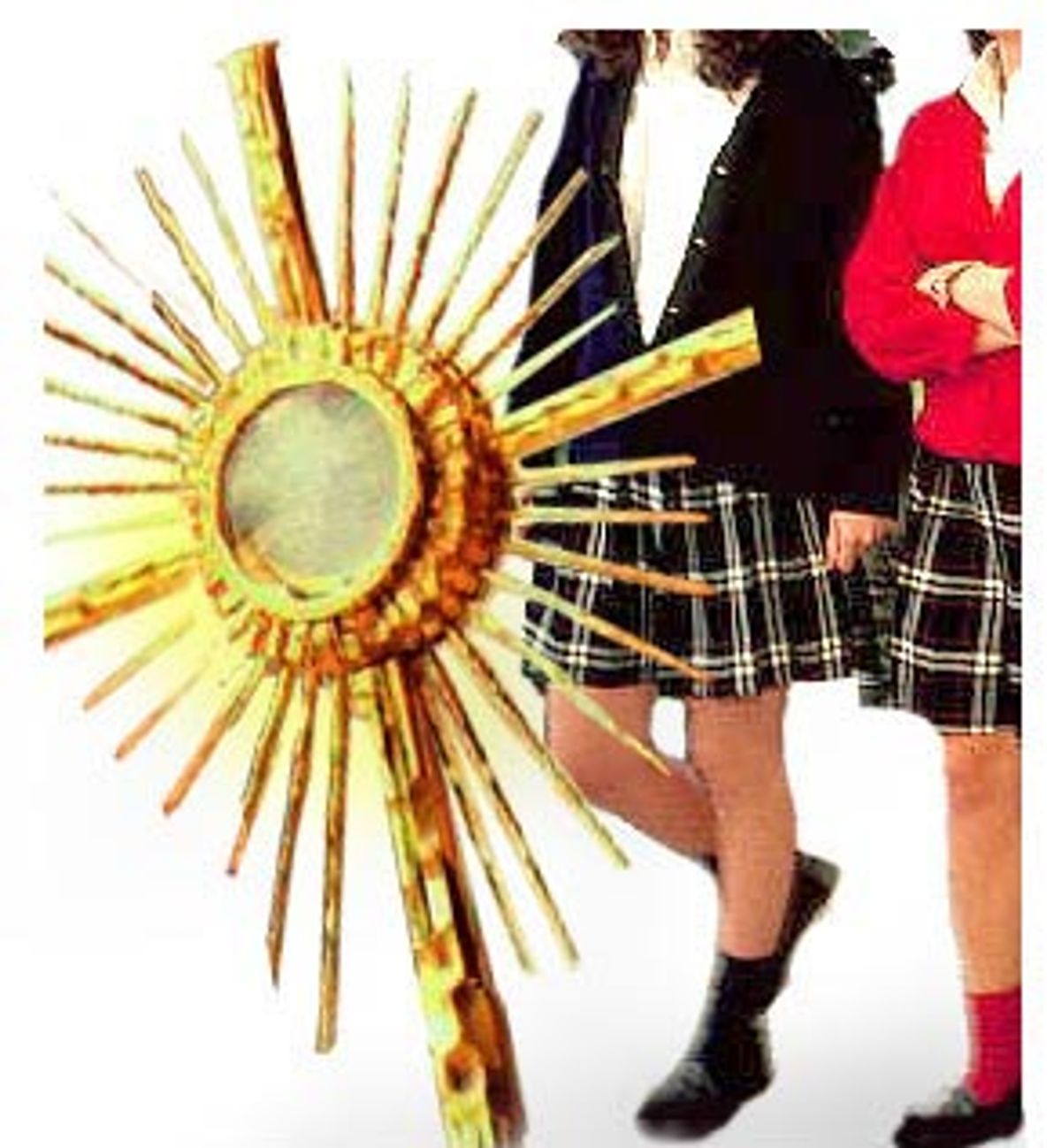
How many times has this conversation been repeated in the halls of my Catholic high school between me and one of my peers? The worst possible thing that could ever be said about a person, a movie or even an item of clothing is that it's "gay." God help you if you ever question this idea, or you'll be labeled a "fag" or a "dyke" (a stigma that can follow you for years, as I've found at my school).
It occurs to me regularly that for a supposedly tolerant and loving religion, Catholicism seems to foster quite a bit of hatred toward gays and lesbians. Take, for example, the religion text my class read last year, which told us that God hates the sin of homosexuality because it is immoral and an abomination in his eyes. The Catholic school system drills it into teenagers that homosexuality is evil, and that homosexuals are "perverts" and "deviants."
Perhaps this is not the best idea. Last spring, there was a list circulated at my school titled "Top Ten Gays at Saint Angela's." A few of the kids on the list were beaten up and had to be pulled out of school for a couple of weeks to recover. The school continued to have us read the same religion text, with no changes. I tried to bring it up in one of my classes, but was immediately shushed and threatened with detention if I didn't stop talking. I know a few kids at my school who are gay, and I can only imagine the fear and pain they must go through every day, hearing slurs like "faggot," "rugmuncher" and "fudgepacker" tossed carelessly through the air like Frisbees. There is no doubt in my mind that these intolerant attitudes contribute greatly to teen depression and suicide, and can escalate into hate crimes. If gays and lesbians are deviant, and Catholics are taught to reject and despise what is not "morally right," then it would only make sense that Catholic teens pick up this idea of "If Jesus hates fags, religious leaders (e.g., Jerry Falwell) hate fags, then I can hate fags too!"
I talked to a friend of mine about the topic of church-fueled hatred of gays (she comes from a strongly Catholic, Italian-American household). She said that although she disagrees with intolerance and prejudice toward minorities, she excused the Bible's condemnation of homosexuals as a "product of its time." I found that a lot of my friends agreed with her. I also noted that a common mind-set among Catholic teens is that homosexual acts are not only disgusting, but also that supposed homosexuals are to be avoided at all costs.
I learned this lesson firsthand. In homeroom one day last year, I noticed two very popular girls giggling and pointing at me. My first thought was that I had something in my teeth, so I self-consciously ran my tongue along them. Still, the giggling continued. I figured there must be something wrong with my clothes -- a bra strap showing, a button undone -- so I went to the bathroom to check. There was nothing wrong or out of place at all. On my way out of the bathroom, I ran into a friend. I told her about what had happened in class. She gingerly explained that there was a rumor (for the record, untrue) flying around the school that I was a lesbian.
I asked a friend of mine what she would think if she saw a gay couple kissing or holding hands in public. She said she would be "grossed out," and that they shouldn't show any affection for each other (including holding hands) because "some people might be offended by it, and their kids might get the wrong idea." I asked her if she thought it was OK for straight couples to hold hands, or even make out in public. She thought that this was OK, because "that's normal. That's how everybody is; that's what everyone does."
When people discuss the two major sexual issues surrounding the Catholic Church, they are almost always referring to homosexuality and abortion (or "the pelvic issues"). The Catholic Church's stand on abortion is, depending on your view, pro-life or anti-choice. No matter how you phrase it, it amounts to one thing: anti-abortion. The church believes that life begins at conception and that abortion is tantamount to murder. The recent FDA approval of RU-486 has made abortion an even hotter issue.
As you may have guessed, most of my peers, male and female, are anti-abortion. However, when asked why, they almost always spout a tired Catholic tag line like, "It's murder" or "It's God's gift." When pressed further, they will usually repeat one of the above tag lines.
In school, we don't learn about the medical aspect of abortion; one student told me, "They reach in there and pull it out." They also don't like to tell us that abortion, when done properly in a sterile environment, is the safest invasive medical procedure in North America, or that a woman is more likely to die during childbirth than during abortion. No, they'd rather skip around the cold, hard facts and instead go right to teaching us that adoption is the key, rather than abortion. Never mind the fact that there are millions of unwanted kids in North America waiting for a home, and never mind the devastating effect carrying an unwanted baby can have on a woman.
It seems that there is no gray area when it comes to Catholic teens' opinions on abortion. Either they say that it is a personal decision (and this is a small majority) or they proclaim that it is the worst possible thing a woman could do. One girl I spoke with felt particularly strongly about the immorality of abortion; she said: "It's absolutely disgusting, and it should be illegal. If you get one, you are so going to Hell." It should also be noted that none of the teens that were anti-abortion made any exceptions in cases of rape, incest, the life of the mother or severe defects in the baby, and almost all wanted abortion to be illegal. However, none of the teenagers I spoke to were against contraception.
Of course, the pope has spoken out against abortion (and contraception as well) many times. The Catholic Church's ideal world would look like this: Abortion is illegal, only married people have sex and, since contraception promotes promiscuity and interferes with God's will, it is also illegal. Teenagers, single people and widowed people have all suddenly lost their sex drives and have sworn off sex forever. The only people having sex are married couples who use the rhythm method. As we all know, the rhythm method is probably the least effective method of birth control out there (next to "pulling out"), so -- continuing this ideal Catholic fantasy -- most families have 11 kids. And since most families cannot possibly provide for 11 kids and a woman may not want 11 kids, the wife may decide, on discovering that she is pregnant with her 12th child, that her body simply cannot tolerate another birth. So she now has two options: Go for an unsafe, illegal abortion or take a chance and risk dying in childbirth.
At the very least, teenagers of all faiths know that the only way to get pregnant in the first place is sex, which brings me to the question that infested the media in 1998 as a result of the Lewinsky scandal: Define "sex." I was very curious as to how my Catholic friends would define sex. One girl told me, "It only counts if it goes in your vagina." I asked her what oral/anal/manual sex counted as. Her response? "Making out."
I shouldn't be surprised at this. We live in a sexually charged culture, and even at my Catholic, uniform-enforcing school, I see couples necking in the hallways and at dances every day, with hands wandering almost everywhere. When another kid said that the Bible "teaches them about the bad parts of sex," I recalled an interview I'd read in a teen magazine with 20-year-old pop singer Jessica Simpson, a self-proclaimed virgin (and proud of it). She is constantly touting the virtues of God and abstinence, but her debut song, "I Wanna Love You Forever," includes the following lyrics: "Pour yourself all over me/And I'll cherish every drop/Here on my knees." Hmmm. I don't know if Jesus would like that one too much, Jessie.
I know a girl who last year was dating a guy known for his sexual experience. It got around to me (through a leak in the "friendship chain") that she had given him a blow job, a hand job and let him feel her up and "digit" her. I was talking about it with a group of girls, and I was surprised when one of them said, "Yeah, but at least she's still a virgin." Well, I suppose if we're going to define sex strictly as a penis-in-vagina thing, then gay men and lesbians aren't really having sex. A guy could have anal sex with as many men as he wants to, and is still considered a virgin by this standard. Another one of my friends confided in me that she gave her (now ex) boyfriend head on the first date, and then said, "Yeah, but I didn't have sex with him until two days later."
I figured that most teenage boys would feel the same way, and my suspicions were confirmed upon discussing it with a few guys. (Most teen boys will tell you anything you want to know about sex if you can convince them that you'll never tell anyone.) There was one exception, however. He put it very ... eloquently when he told me that "a hole is a hole."
In case I haven't made my position clear, it is this: pro-tolerance, pro-choice and once you get the genitals involved, your virgin status goes out the window. Believe me, I've been involved in some pretty heated discussions about my opinions in and out of school. I am also a feminist, which none of my friends are. To them, feminism is about (to quote Phyllis Schlafly, founder of the ultraconservative Eagle Forum) "baby killing and lesbians." Apparently, the concept of fighting for equal rights to be extended to women all over the world escapes them.
So it would seem that the average Catholic teen finds homosexuality "gross," opposes abortion and will do "everything but" and still be considered a virgin by the majority of their peers. Now that you know this, remember that there are exceptions to this (me, for example), but for the most part they feel this way. One can't help but wonder how much of their opinions are based on facts, life experience and statistics, and how much on the opinions of their parents and teachers, and the vision of human sexuality projected in the Bible. Don't question it out loud, though; that'd be, like, so gay!
Shares