Kevin Berger

Sam Shepard

He's become a legend over the last three decades, but the elusive cowboy of American theater is not going soft on us -- for damn sure.

  • more
    • All Share Services

Sam Shepard

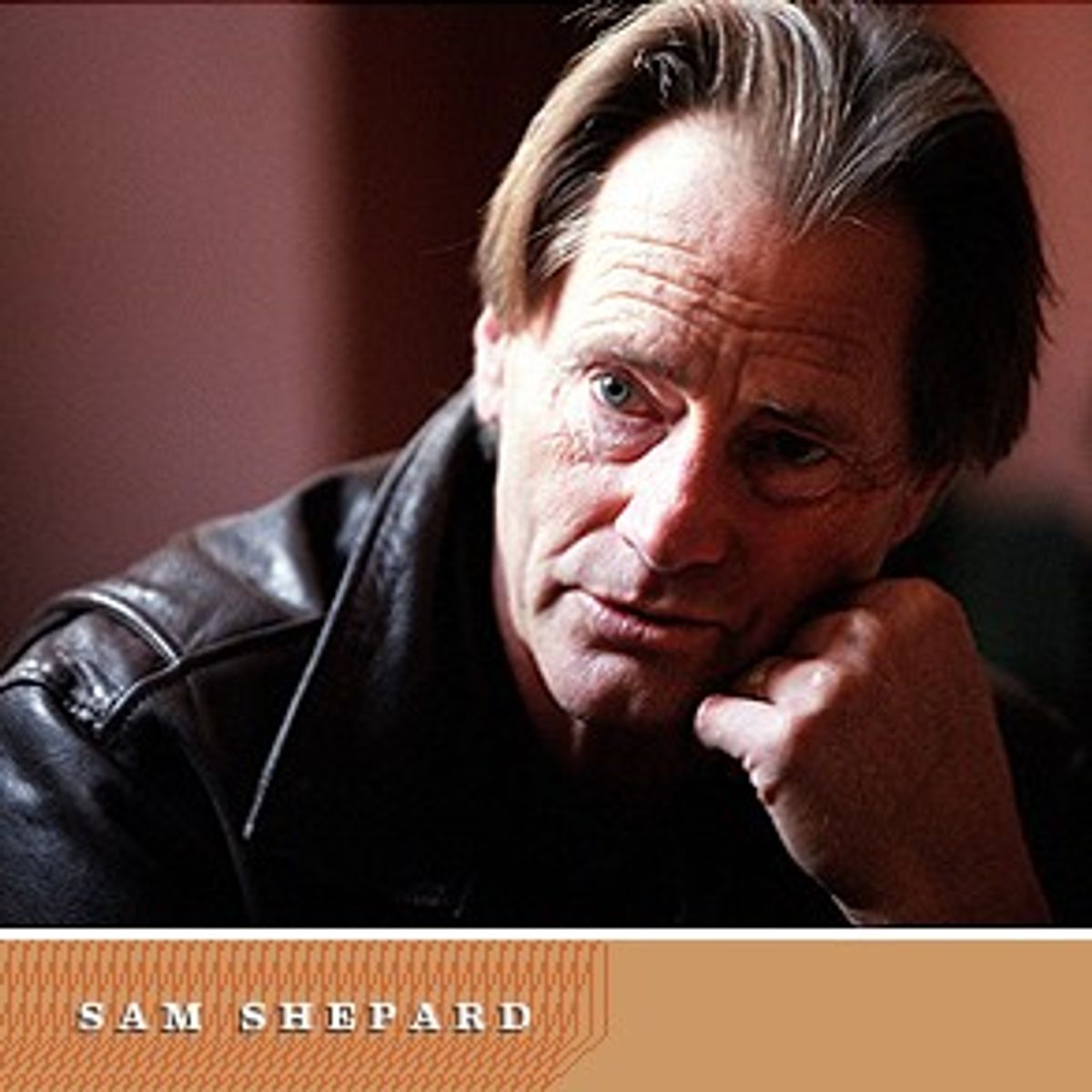
Sam Shepard is wearing black slacks, a black mock-turtleneck sweater and a glossy black leather jacket. The legendary cowboy of American theater looks dressed up. Like he’s heading down to the chapel on Main Street. In fact, what he’s doing is looking nice for the theater donors milling about this San Francisco party, located in a chic restaurant on an industrial slice of the bay.

Outdoors on the patio, under an unusually clear night sky, Shepard stands by a heater that glows like a street lamp and chats with a covey of Armani-clad socialites. It’s a stunning sight, really. For not only has Shepard steered clear of the public since gaining renown as the second coming of Gary Cooper in “The Right Stuff,” he has made the pitfalls of fame a critical theme in many of his four dozen plays. After his “Buried Child” won the Pulitzer Prize for drama in 1979, he said he “got a greater feeling of accomplishment and pride of achievement” from winning a roping contest in a rodeo.

After three decades in the theater business, though, the 57-year-old playwright knows firsthand that private donations are what keep regional stage doors open. He knows a little celebrity glad-handing seems to loosen the purse strings of the well-to-do, especially the new media-doused generation of the young and the rich here in Yahooland.

Besides, he holds a genuine affection for San Francisco’s Magic Theatre, which produced his new play, “The Late Henry Moss,” and where he worked as playwright-in-residence in the late ’70s, when he wrote his famous “family” plays: “Curse of the Starving Class,” “Buried Child” and “True West.” But even if this party is making him think he would rather be home on his Minnesota horse ranch with his partner Jessica Lange, their teenage daughter, Hannah, and son, Walker, he has plenty of celebrity support

As promised, the dream cast of “The Late Henry Moss” is here, too: Sean Penn is play-wrestling with his kids near a banquet table; Woody Harrelson is chatting up a female journalist as he lifts a beer off a waiter’s tray; and Nick Nolte, decked out in a knee-length seersucker coat and ratty Panama hat, looking like he just washed out of a Thomas McGuane novel, is holding court with a story about, if my eavesdropping is accurate, the thrills of cross-dressing.

As the party swells with San Francisco’s requisite band of stars — Robin Williams, Don Johnson, Bob Weir — it grows positively giddy with that strange celebrity vortex that sucks people toward the famous but stops us short of actually talking to them. As fans, our greatest fantasy about celebrities is that they would really dig us as friends if they could get to know us in casual conversation in some cedar Montana bar. But rather than risk discovering that Sean Penn or Sam Shepard doesn’t care one way or the other whether we too love Cormac McCarthy and John Ford, we don’t dare breach their personal spaces — their auras, really. It would be too humiliating. It’s safer to leave them framed in fantasy. And in most cases, rather than deal with the predictable anxieties of their audiences, celebrities prefer to circle in their own orbit.

Again and again, Shepard has written brilliantly about being trapped by the images others have given him, that he has given himself. “Keep away from fantasy. Shake off the image,” lectures the gangster rock star Crow in “The Tooth of Crime.” The inability to connect with others through the skeins of our illusions is a driving theme of Shepard’s passionate, violent work.

But — outside of his plays, anyway — he has done little complaining or explaining about his image. Which is one reason why he remains such a magnetic presence in person. It’s sentimental, a little hagiographic, probably, to call artists mysterious. But as Shepard drifts through this party, it’s precisely his elusiveness that makes it so hard to take your eyes off him.

My curiosity finally gets the best of me and I walk over to Shepard to ask how he’s holding up as the evening star. Besides, I have a special passport to cross the fan-celebrity threshold: A week before, I had interviewed Shepard on the telephone, so I have a painless excuse to introduce myself.

“Oh, pleased to meet you,” he says in his dulcet, country-and-western drawl, remembering, I think, our previous conversation. At the time, he was staying at the Four Seasons Hotel in Beverly Hills, taking a break from playing a small role in a John Travolta spy movie called “Swordfish.”

Up close, Shepard is tall, gaunt as an aging rancher and still as classically handsome as the moment he appeared on-screen as the laconic, fatally ill wheat farmer in “Days of Heaven.” His hair is thinner now, more of his forehead is revealed, and his sharp nose and high, Native American-like cheekbones, along with the lines in his weatherworn face, deepen the wisdom of his sad blue eyes.

As friendly and accommodating as Shepard seems, though, his conversational manner is clearly schooled by his spiritual mentor, Samuel Beckett. Yes, he agrees, the celebrity thing does feel a little off the charts tonight. But he doesn’t mind it for a while. “I think Armani put up a lot of money for the party,” he says. Don’t blame him, though, for jump-starting the celebrity machine to gain attention for his new play. “I didn’t set out to cast movie stars,” he says. “It just happens that every single one of them is a dynamite actor. The fact that they’re movie stars is something else.”

“The Late Henry Moss” hasn’t opened yet. So I tell Shepard from what I’ve read about its plot — two rival brothers trying to piece together the details of their alcoholic father’s death in the New Mexico desert — that it sounds like a dramatization of one of the stories from his collection, “Cruising Paradise.” In that story, set in New Mexico, the author’s father staggers out of a bar into the middle of a road and is killed by a car. Later, the author finds, among his late father’s belongings, a pile of unmailed letters, one of which is addressed to him. It concludes: “See you in my dreams.”

“Did that really happen?” I ask. “It did, yeah,” Shepard responds. The 1989 story was indeed a blueprint for “The Late Henry Moss,” which was inspired by his father’s death in 1984. “It took me five years to even consider writing about it,” he says. “Finally, I came to the point where I thought that if I don’t write about it, some aspect of it may be lost.”

Since the stories in “Cruising Paradise” aren’t labeled as autobiographical, but read as if they’re lifted out his journal, I can’t help asking Shepard about the hilarious “Spencer Tracy Is Not Dead.” The most underrated quality of Shepard’s writing is that it is really, truly funny. So was he really driven to a movie shoot in Mexico in a metallic blue limo by a German named Gunther, who was wearing a tuxedo, cummerbund and fluffy shirt? Did they really get pulled over for speeding in El Paso and have the car stripped by the drug police?

Shepard smiles, crow’s feet spreading across his temples. “Yeah. They let the air out of all the tires so we couldn’t go anywhere. Popped the hubcaps. Went through all of our luggage. Yeah, that’s true.” The shoot was for the movie “Voyager,” based on the novel “Homo Faber” by Max Frisch. “Have you read it?” asks Shepard. “I think Frisch is one of the best modern writers.” In fact, I have. But before I say anything, I see Shepard is looking across the patio. “Well, I gotta go meet Sean,” he says. “Nice talkin’ to you.”

As the party wears on, Shepard remains insulated by friends, eating dinner with Philip Kaufman, who directed him in “The Right Stuff,” and talking with musician T-Bone Burnett, whom Shepard has known since 1976, when they were both members of Bob Dylan’s Rolling Thunder Revue. “He’s the only one on the tour I’m not sure has relative control over his violent dark side,” Shepard would write about Burnett. “He’s not scary, he’s just crazy.”

Toward the end of the night, Shepard and the lanky Burnett join the dinner jazz band, the Randy Scott Trio. A drummer since he was a wayward California teenager, Shepard gets behind the kit; Burnett commandeers a microphone and they knock out a version of the novelty country hit “Long Tall Texan.” As the remaining partygoers head out the door for home, Shepard bangs his way through Chuck Berry’s rickety classic “Too Much Monkey Business.”

“I was never one to live in the past” is the first and last line of “The Late Henry Moss.” In between, Shepard has crafted his most moving, certainly most tender attempt to resolve a son’s agony over his abusive, alcoholic father’s death.

The play actually caroms between two brothers who, contrary to their opening and closing line, live trapped in the past. One is pinched, nasty and repressed (Penn), the other sodden, pitiful and ultimately loving (Nolte). Their drive to piece together the arc and fall of their father’s final bender is a desperate desire to spring themselves from the traumatic memories of him viciously beating their mother — memories they blame for shaping the estranged courses of their own wanton lives.

“The Late Henry Moss” is fueled by Shepard’s curt, charged dialogue and a boisterous, comic-relief performance by Harrelson as a bewildered taxi driver with clues to the patriarch Henry Moss’ final days on a fishing trip. As Moss himself, who appears through flashbacks, veteran stage and movie actor James Gammon literally is the damaged alcoholic looking into the spiritual emptiness of his guttersnipe life. “I thought I’d killed her,” he finally confesses of beating his wife. “But it was me I killed!”

In many ways, “The Late Henry Moss” reprises themes, characters and stage devices that have long defined Shepard’s writing. But despite the critics who pounced on the parallels to bolster their dim opinions that Shepard was treading old ground, the play represents a beautiful, elegiac summary of the themes that have tortured Shepard to create one of the most prolific and original careers in the American theater.

“The Late Henry Moss” is not Shepard’s best play. Penn either misinterpreted the role of Ray Moss, badly underplaying his simmering resentment, or Shepard needs to sharpen Ray’s portrait as a control freak on the edge. The character never catches fire and so when he does erupt in anger the effect is a dud.

But no matter. Nolte’s and Gammon’s final showdown is spectacular. It begins as a squonking duet of guilt and regret and takes flight on a simple melody of forgiveness. The smoky, gravelly timbre of Gammon’s and Nolte’s voices is so eerily similar that during their emotional sparring they seem to change sides, to transpose into one another. The son becomes the father and in the process discovers his own heart.

After the anger and recrimination between them ebbs, Gammon collapses in bed. With what seems like his own last breath, an exhausted Nolte asks his father if he wants something, “a blanket, maybe?” It’s heartbreaking. Earlier, Gammon had posed, “Peaceful, that would be something, wouldn’t it?” But a son’s peacefulness is what we take away from the theater, a gift from Shepard that has been a very long time in coming.

The New Yorker’s John Lahr, who has written about Shepard for more than two decades, was alone among critics in pointing out that Shepard’s fictionalized father made his first appearance in 1969 in “The Holy Ghostly,” when he was called Stanley Moss. Lahr doesn’t state as much, but “The Holy Ghostly” and “The Late Henry Moss” serve as perfect bookends of Shepard’s plays. In between lies the evolution of the playwright’s art, a search through pain and illusion, memory and history, for transcendence and peace.

“The Holy Ghostly’s” plot can be summarized as: “Father? Yes, son? I want to kill you.” With its loopy songs and syncopated language, mad witches and mean motherfucker sons, it’s wonderfully representative of Shepard’s early plays, the huge batch of one-acts that seemed to pour out of him before he settled into the more complex and reflective “Buried Child” in 1978.

Living in a cold-water flat on the Lower East Side and bussing tables at the Village Gate, Shepard at 26 years old was living and writing close to the bone. He didn’t care if his work was perceived as autobiography. From the mouth of the horn-mad son to the father, who cries out that he’s dead inside, these were the words that the young writer just had to say in “The Holy Ghostly”:

For eighteen years I was your slave. I worked for you hand and foot. Shearing the sheep. Irrigating the trees, listening to your bullshit about “improve your mind, you’ll never get ahead, learn how to lose, hard work and guts and never say die” and now I suppose you want me to bring you back to life. You pathetic creep. Hire yourself a professional mourner, Jim. I’m splitting.

Before he does, though, he pulls out a gun and shoots his father in the stomach.

Shepard these days advises fans not to get too excited about his early plays. Says he in “Sam Shepard: Stalking Himself,” a fine video documentary that made the PBS rounds in 1998: “They were chants, they were incantations, they were spells, or whatever you want to call them. You get on ‘em and you go. To say they were well-thought out, they weren’t. They were a pulse.”

And the erratic heartbeat in most of them was pumped by Shepard looking back in anger at his 1950s childhood on a small avocado ranch in Duarte, Calif., a town outside of Pasadena that was no more than a suburban remnant, thrown up with leftover building materials that developers had little use for. Duarte “was a weird accumulation of things, a strange kind of melting pot — Spanish, Okie, black, Midwestern elements all jumbled together. People on the move who couldn’t move anymore, who wound up in trailer parks,” Shepard told Rolling Stone’s Jonathon Cott in 1986.

Shepard’s parents had always been on the move. His father was raised on an Illinois farm and later joined the Army Air Corps. Shepard was born Samuel Shepard Rogers IV in Fort Sheridan, Ill., in 1943. Following the birth of his two younger sisters, the family moved to South Dakota, Utah, Florida, Guam and South Pasadena before settling in Duarte. Shepard’s mother was a teacher and his father held a series of odd jobs while he attended night school to also be a teacher.

“My father had a real short fuse,” Shepard told biographer Don Shewey. “He had a really tough life — had to support his mother and brothers at a very young age when his dad’s farm collapsed. You could see his suffering, his terrible suffering, living a life that was disappointing and looking for another one. It was past frustration; it was anger.”

More often than not, Shepard was the brunt of that anger. So when he read about a small traveling theater coming through Duarte, Shepard, who had become smitten with acting in high school, and had scratched out poems about despair in his dead-end town, signed on for the ride. Performing Thornton Wilder plays in New England churches? Sure, why not? When the Bishop’s Company Repertory Players landed in New York, Shepard got off the bus.

Perhaps the one thing to know about Shepard’s maturation as a writer is how diligently and obsessively he worked. It’s something that seems to get obscured in all the romantic stories about his affair with blooming rock poet Patti Smith and their collaboration on the play “Cowboy Mouth,” his stint as a drummer in the acid-dipped folk band the Holy Modal Rounders, in, really, all the ink spilled over Shepard’s Hollywood image as an “intellectual loner,” as “Voyager” director Volker Schlondorff described him.

In New York in the ’60s, Shepard lived with the son of the great jazz bassist, Charlie Mingus Jr., who had also grown up in Duarte. “He never stopped writing,” Mingus said of the times when Shepard wasn’t reading Beckett, Pirandello, Edward Albee and Harold Pinter. Shepard “would walk into a room and close the door, with the clacking of the typewriter and all. Then he would come out with a play in a box that the paper came in, a ream of paper.”

Dennis Ludlow, who helped build horse fences and a barn on Shepard’s small Northern Californian ranch during the ’70s (and who played supporting roles in Magic Theatre productions of “Buried Child” and “Fool for Love”), tells me his most indelible memory of Shepard is of the restless playwright writing in a pocket-size notebook. “He was always writing down what he heard in bars, stores, everywhere,” says Ludlow. Later, one of Shepard’s playwriting classes presented him with a carton of the tiny writing pads.

Still, Shepard’s early plays were scintillating rock riffs without accessible verses and choruses until he met New York director and acting teacher Joseph Chaikin. He “had a tremendous influence on Shepard,” writes Shewey. “The values he espoused — his steadfast faith in the priority of art over glamour, show business, wealth, and fame” — left a lasting impression. Shepard told the Paris Review that Chaikin helped him understand there’s “no room for self-indulgence in theater; you have to be thinking about the audience.”

Under Chaikin’s counsel, Shepard began doing something he had never dreamed of before: rewriting. “Joe was so persistent about finding the essence of something,” says Shepard. “He’d say, ‘Does this mean what we’re trying to make it mean? Can it be constructed some other way?’ That fascinated me, because my tendency was to jam, like it was jazz or something. Thelonious Monk style.”

Chaikin’s influence blossomed in Shepard at about the same time the playwright was tiring of his ragged band of pop culture outlaws: drugstore cowboys and gunslinger rock stars, bluesy swamp rats and speed-freak gamblers. In the mid-’70s, after living for a year in London, Shepard settled in countrified Marin County, Calif., with his wife O-Lan, an actress, and young son Jesse. They shared a house with O-Lan’s mother, Scarlett, and Scarlett’s husband, photographer and writer Johnny Dark. With Magic Theatre actors and directors, writers and musicians coming and going, Shepard felt at home in this “very strong community of artists,” he tells me. “It was energetic and intense in a way that I had missed from New York. I don’t think I’ve really come across that situation again. There was something really great about the Magic experience.”

At home on fertile new artistic ground, and committed to a new seriousness in his writing, Shepard stopped heeding every impetuous urge and began listening to voices arising from a deep and wide rift in his heart — the emotional space surrounding his family, “particularly around my old man,” he says. “I was a little afraid of it, a lot of that emotional territory. I didn’t really want to tiptoe in there. And then I thought, well, maybe I better.”

Of course, Shepard didn’t exactly tiptoe in there. As everyone knows who has seen his trilogy of family plays — “Curse of the Starving Class,” “Buried Child” and “True West,” which he wrote in a creative burst of three years — Shepard ripped the door off the hinges, smashed the toasters and exposed an incredible torment at the core of postwar American families. Sons and fathers, mothers and daughters, aunts and uncles — all were splintered by a never-ending race for never enough money, by base sex and ambition, by inevitably mounting layers of frustration. At least that’s how it felt as we sat, awestruck, in the theater.

Most remarkably, Shepard forged his own concentrated, explosive language. The fury was still there, but now the words were stripped of pretension. Shepard created a colloquial poetry of exposure, rhythms rising in an endless crescendo. Here, in the crucial moment in “Buried Child,” the diffident Tilden is telling his son’s girlfriend about his sickly father Dodge:

Tilden: We had a baby. He did. Dodge did. Could pick it up with one hand. Put it in the other. Little baby. Dodge killed it….

Dodge: Tilden? You leave that girl alone!

Tilden: Never told Halie. Never told anybody. Just drowned it.

Dodge: Tilden!

Tilden: Nobody could find it. Just disappeared. Cops looked for it. Neighbors. Nobody could find it.

Dodge: Tilden, what’re you telling her! Tilden!

Tilden: Everybody just gave up. Just stopped looking. Everybody had a different answer. Kidnap. Murder. Accident. Some kind of accident.

Dodge: Tilden you shut up! You shut up about it!

Tilden: Little tiny baby just disappeared. It’s not hard. It’s so small. Almost invisible.

In 1983, Shepard could admire the critical and popular success of his family plays. John Malkovich and Gary Sinise had mounted a daring production of “True West” that he truly loved. His romantic affair with Lange was deepening, and he was nominated for an Academy Award for best supporting actor in “The Right Stuff.” At the same time, from the set of “Country,” which he was filming with Lange in Iowa, he wrote Chaikin a letter: “Something’s been coming to me lately about this whole question of being lost. It only makes sense to me in relation to an idea of one’s identity being shattered under severe personal circumstances — in a state of crisis where everything that I’ve previously identified with in myself suddenly falls away.”

When he lived in London, Shepard became enamored with the writings of Russian spiritual master G.I. Gurdjieff. So his sharp sense of being lost, of having his identity shattered, no doubt represented to him a kind of pure state of inner being. It is an empty place, a chaotic and frightening one, but it is a place free of illusion, a place where everything a public artist, a celebrity, has been told he is doesn’t hold. The one predominant and enduring theme in Shepard’s work is the agonizing struggle to fill that empty space with love.

Listen to him in his story, “You I Have No Distance From”: “I can’t remember what it was like before I met you. Was I always like this? I remember myself lost … But you I have no distance from. Every move you make feels like I’m traveling in your skin.”

The evolution of Shepard’s personal life is shown in technicolor in the tract homes and desert huts of his plays. In the absence of love and connection, the booze flows; relationships come crashing down. The explosive “Fool for Love,” in which lovers and half-siblings May and Eddie rage at each other in jealousy — “You know we’re connected May. We’ll always be connected” — can easily be seen as the end of Shepard’s marriage. Indeed, that year (1983), he permanently left O-Lan to move in with Lange. His divorce was final in 1984.

Given the tempestuous turns his characters have taken under endless emotional storms, it’s no wonder he has remained a relatively private man. The search for love and transcendence is a fragile business in the public world of movies and popular theater. Someone always wants to tell you where to go. The allure of Shepard’s elusive nature is that he has never stopped searching alone.

And we can only admire his devotion. He tells me he acts in movies only to support his writing. “No way,” I say. “You’re Sam Shepard.” Says he: “You can’t make a living as a playwright. You can barely scrape by.” He does at times enjoy sinking into a role, but, just the same, he would rather be on his ranch sinking fence posts, playing with his kids or writing in his small room next to the barn.

Like his characters in “The Late Henry Moss,” Shepard is “not one to live in the past.” He has not resolved the anguish that fathers and sons heap upon themselves, but he has peeled away a great deal of the despair, exposing an “ember of hope.” Clearly, Shepard has traveled a long way from blasting his fictional father with a revolver to comforting him quietly with a blanket.

But at 57, the angular, elusive cowboy is not going soft on us. He is still riding alone across a mesa, it’s just that now he believes that out there, somewhere, is a deep, enduring peace. In his great 1985 play “A Lie of the Mind,” he seemed to doubt he would ever find it. But now, it appears, the winds of change have worked their wonders. “You know, those winds that wipe everything clean and leave the sky without a cloud. Pure blue. Pure, pure blue.”

The beauty and terror of science

Romantic poets and scientists tapped the marvels of nature and sounded a clarion alarm that can transform us today

  • more
    • All Share Services

The beauty and terror of scienceAn exuberant portrait of adventurer Joseph Banks after his triumphant return from the Pacific.

It’s always fascinating to read about science before the big three discoveries: evolution by natural selection, the theory of general relativity and the DNA molecule. Swept back in time by a sensational writer like Richard Holmes, we see driven men and women chasing the light of nature’s fundamental laws, like explorers crossing night seas toward treasured shores. But that’s what makes their stories compelling. With their magnificent questions and ingenious inventions, they slowly pushed science forward. Was the night sky fixed in place by a divine creator? How could it be? Astronomers with powerful new telescopes in the 18th century revealed the universe was in constant motion — stars were busy being born or busy dying.

A good history of science unreels like the practice of science itself. It wends through a world of experiments until a new reality arises. But the more layered story of that journey is that science is not just a process but is the men and women performing it. In his radiant new book, “The Age of Wonder,” Holmes treats us to the amazing lives of the pioneering sailors and balloonists, astronomers and chemists of the Romantic era. Making good on the book’s subtitle, he takes us on a dazzling tour of their chaotic British observatories and fatal explorations in African jungles, showing us “how the Romantic generation discovered the beauty and terror of science.”

That’s an exceptional insight. After all, this was the time when William Wordsworth wandered lonely as a cloud along England’s lakes and John Keats told us all we need to know on earth is “beauty is truth.” To this day, Romantic poets and scientists are not supposed to be seen together. “Romanticism as a cultural force is generally regarded as intensely hostile to science, its ideal of subjectivity eternally opposed to that of scientific objectivity,” Holmes writes.

What’s superlative about “The Age of Wonder” is that Holmes, author of vivid biographies of Shelley and Coleridge, takes the air out of the terms “subjectivity” and “objectivity” and reveals the ways in which the artists were as enveloped in science as the men and women in the labs around them. In a harmony of scientific and artistic sensibilities, he shows, the Romantics tapped the marvels of nature and sounded the infinite benefits of science. It’s a song, if we can hear it, that can transform us today.

In Holmes’ keen focus, the Romantic era is the Age of Aquarius in science. There was something in the water then — a tonic of wonder, as he sees it. The austere fellows of the previous age, Descartes and Newton, were too obsessed with etching new sciences in stone to gaze beyond the mechanics of their labors. But as the Enlightenment marched on, scientists began to look up from their desks and into themselves. They became self-conscious. Doubts cracked the cold calculations before them — doubts, Holmes writes, that “favored a softer dynamic science of invisible powers and mysterious energies, of fluidity and transformations, of growth and organic change.”

Holmes’ Moses of Romantic science, its guide to a new promised land, was Joseph Banks. A dashing young naturalist, mad about botany, Banks’ lived by his own credo: “To explore is my wish.” In 1769, Banks ventured to Tahiti with Capt. James Cook on a mission whose primary goal was to observe the Transit of Venus. The Pacific Island provided a front-row seat to the rare occurrence of Venus passing directly between the sun and Earth. Banks wanted to study trees.

On the island, things changed. Banks quickly established his independence from Cook and his conservative crew by falling in love with the native people. Rather than colonize them, Banks wanted to understand them. He mastered some of their language, danced with them, had sex with them, and wrote candidly of the light and dark sides of their natures. They could be open and generous one day and thieves and strange sorcerers who practiced infanticide the next. Banks journeyed to Tahiti as an Enlightenment botanist determined to catalog shrubs and flowers and returned to England a Romantic adventurer who journeyed into the heart of human nature and helped pioneer the science of anthropology.

Back in England, Banks became a cynosure of London society with his exotic Tahitian tales. His fame and intelligence led to his appointment as president of the Royal Society, the influential body of philosophers and scientists, who directed and funded the country’s scientific endeavors. As the man in charge for the next 42 years, mired in politics, navigating whimsical kings and religious leaders, Banks never abandoned the adventurer inside him. “His body may have been chairbound, but his spirit was increasingly airborne,” writes Holmes.

The first great discovery under Banks’ watch in England was made by German transplant William Herschel, a musician who learned to read the stars like music. An obsessive inventor, Herschel designed and built large “reflector” telescopes, which captured and concentrated starlight with unprecedented intensity and clarity, allowing him to plunge deeper into space than ever before. Herschel also devised a meticulous math for scanning the skies.

Just as impressive was Herschel’s unfailingly humble and devoted sister, Caroline, who worked around the clock at her brother’s side. Without a formal education, she became nearly as schooled in the way of the skies as her brother, though she would never say so (and neither would he). Caroline would discover numerous comets herself, making her one the first women scientists to win official acclaim from Banks and the Royal Society. (Caroline and her comets were a hot topic in popular magazines.) Holmes sketches the relationship of William and Caroline with heartbreaking, Thomas Hardy-ish skill. The domineering William, we learn, could never quite overcome his condescension toward his sister.

In 1781, after weeks of painstaking observation, Herschel identified a new planet in the solar system, Uranus. The discovery, the first of a new planet since ancient times, guaranteed Herschel’s eternal fame and electrified the populace.

Finding Uranus also underscored a verity of science that belied another myth about Romanticism. As much as the world wanted to believe in a Eureka moment, the truth was Herschel’s discovery arose from laborious work. But mere mortal that he was, Herschel could not refrain from romantically refining his story. As Herschel grew older, Holmes writes, he would tell listeners that he spotted Uranus in “a single wondrous night, the inspired work of a few ‘glorious hours.’”

Despite that embellishment, or perhaps because of it, Herschel embodied the ebullient tenor of the era. News of his discovery, and those of his fellow scientists, raced around the continent. Science and wonder, it seemed, had reached their apogee. Holmes goes so far as to say, “This moment of scientific optimism coincided with the political optimism in Britain and France. In 1789 the Bastille would fall, and the Rights of Man would be declared.”

At the same time, the astronomer augured a profound discontent. With his refined telescope, Herschel showed his generation that galaxies existed far, far away. Given the time it took light to travel, that implied enormous periods of time. He observed that stars and nebulae underwent constant changes over time. The universe was evolving. What Herschel saw through his telescope was a radical affront to the Bible and churches, which held that God created a fixed universe about 6,000 years ago. Beholding deep space and contemplating vast gulfs of time was, in Holmes’ phrase, “disabling with awe.”

And people were feeling it. John Bonnycastle, a popular science writer, wrote in 1786, “Astronomy has enlarged the sphere of our conceptions and opened to us a universe without bounds, where the human Imagination is lost. Surrounded by infinite space, and swallowed up in an immensity, man seems but as a drop of water in the ocean, mixed and confounded with the general mass.”

The awe of the universe was mirrored with acuity by the poets. Of all the masters of the era, Coleridge most often faced the immensity with wonder. Ever since he was a young boy gazing at the stars, he wrote, his “mind had been habituated to the Vast.” And in one of his late poems, “Limbo,” he imagined himself as a blind old man, gazing at the moon: “His whole face seemeth to rejoice in the light!”

Byron visited Herschel and described looking through his telescope as a religious experience. “I viewed the moon and the stars,” he wrote, “and saw that they were worlds.” Later, though, he tapped into the terror of the experience. In his poem, “Darkness,” he wrote: “The bright sun was extinguished, and the stars/Did wander darkling in the eternal space.”

But all was not lost. The mixture of beauty and terror in science took a colorful turn with the era’s balloonists, notably Vincent Lunardi. The boisterous Italian was a born entrepreneur. He charged an admission fee to see his balloon in a theater, took his dog and cat on flights and sold the exclusive rights to his aerial tales to newspapers. “With ballooning,” Holmes writes, “science had found a powerful new formula: chemistry plus showmanship equaled crowds plus wonder plus money.”

With their boisterous personalities, resplendent canopies and test flights that nearly always ended in dramatic crashes, the mad balloonists boosted the popularity of science. It was just that, despite some some significant research into hydrogen gas, air currents and clouds, few serious observers, including Royal Society president Banks, could figure out the long-term benefits of the spectacle.

Gothic novelist Horace Walpole, observing the flights, delivered one of the most prescient comments ever about the dark side of science. “Well! I hope these new mechanic meteors will prove only playthings for the learned and idle, and not be converted into new engines of destruction to the human race — as is so often the case of refinements or discoveries in Science,” he wrote. “The wicked wit of man always studies to apply the results of talents to enslaving, destroying, or cheating his fellow creatures. Could we reach the moon, we should think of reducing it to a province of some European kingdom.”

Holmes charts the grim side of science in an engaging chapter on Scottish adventurer Mungo Park. Inspired by Banks, Park traveled to Africa to map the Niger River and explore the legendary city of Timbuctoo. Unlike Banks, though, Park did not dance with the native people; he was attacked and imprisoned by them. Park’s book “Travels In the Interior of Africa,” a rending account of his travails and epiphany among nature that stirred him to survive, inspired the pantheon of Romantic poets, and later Joseph Conrad. On a second trip to Africa in 1805, Park, on a boat in the Niger River, was ambushed by local tribesmen. He either drowned or was killed when he came ashore.

Doubts that thrilling science lacked social benefits began to creep into Romantic culture. They lodged in the person of gregarious poet and chemist Humphry Davy, who was crazy about nitrous oxide (laughing gas). At the “Pneumatic Institute,” a kind of prototype clinic for experimental treatments, Davy  performed countless experiments with the gas on himself. After one of his first forays out of his head, he wrote that nitrous oxide “made me dance about the laboratory as a madman, and has kept my spirits in a glow ever since.”

In no time, Davy convinced his friends, including poets Coleridge and Robert Southey, and medical doctor Peter Roget, to give the gas a go. In a funny anecdote, Holmes relates that Roget, the compiler of Roget’s Thesaurus, couldn’t find the right words to describe the feeling of ecstasy. “I felt myself totally incapable of speaking,” he said. Davy’s experiments ended mostly in ridicule; unfortunately, he couldn’t quite make the intellectual leap to realize nitrous oxide could revolutionze surgery as an anesthesia.

Davy, though, went on to produce “one of the great demonstrations of scientific ‘Hope,’” Holmes writes, one that revealed applied science could be a force for good and alleviate human suffering. Coal miners were dying from underground explosions ignited by the candles and oil lamps they carried. By surrounding the flame with a metallic mesh, Davy created a lantern that illuminated dark mineshafts without sparking explosions. The “Davy safety lamp” also foreshadowed a fixture of science in later generations. Another lantern maker accused Davy of plagiarizing his design. The charge was proven baseless but it hounded Davy for years.

As the turn of the century dawned, and brilliant new chemists and astronomers arrived on the scene, an encroaching sense that scientists were gaining control over human nature clouded the cultural skies. The fear was epitomized in Wordsworth’s line, “We murder to dissect.” Holmes limns the darkness with a scintillating chapter on Mary Shelley and “Frankenstein,” describing how her novel arose out the popular “Vitalism” debates between physicians who argued that human life was animated by some external force like electricity, and those, such as fearless young doctor William Lawrence, who argued there was no such thing, that the “human body is merely a complex physical organization,” Holmes writes.

Holmes, who understands the Romantic generation as well as any historian, and writes with a journalistic verve more engaging and personal than most scholars, offers a wonderfully fresh and insightful reading of “Frankenstein.” Because the movies have obscured the subtleties of Shelley’s original work, Holmes reminds us that the real tragedy of the Creature, who was articulate and self-aware, was his sense that he and his creator had lost their souls. “I shall no longer see the sun or stars, or feel the winds play on my cheeks,” laments the Creature.

As the 19th century raced on, a sense of alienation from nature deepened. Artists felt their enthusiasm draining and their pessimism rising. In a letter to Coleridge, Southey wrote, “I wish it were not true, but unfortunately it is, that experimental philosophy always deadens the feelings; and these men who ‘botanize upon their mothers’ graves’” — a reference to another Wordsworth line — “may retort and say, that cherished feelings deaden our usefulness; and so we are all well in our way.”

It is necessary for scientists to hone their objectivity to “discern objects clearly” and shun “intellectual mists” and “absurd fables,” argued Lawrence. And so it is. But in the process, scientists, and the generations they represent, cut themselves off from the “magnificent, the sublime and the beautiful,” in Davy’s words. Our deadened feelings spurred us to commit atrocious acts with the tools of science, symbolized by the mushroom cloud over Hiroshima.

Today, we are still chasing the laws of nature, with surgical new technology, and writing the history of science. But we stand again at a crossroad, facing new environmental and geopolitical dangers. As Holmes writes, “The old rigid debates and boundaries — science versus religion, science versus the arts, science versus traditional ethics — are no longer enough. We should be impatient with them. We need a wider, more generous, more imaginative perspective.” The Romantics gave us that perspective. Now we just have to live by it.

Continue Reading Close

Neko Case is an animal

On her new album, "Middle Cyclone," the feral songstress sounds like a minstrel along Cormac McCarthy's apocalyptic road.

  • more
    • All Share Services

Neko Case is an animal

Neko Case is living in her own private Vermont. Where her metaphors connect with the world is known only to her. “She is the centrifuge that throws the spires from the sun, the Sistine Chapel painted with a Gatling gun.” This comes in the forested middle of her apocalyptic new album, “Middle Cyclone.” But I believe in Case. She engages the world with her imagination. Life finds meaning in dream images that burn, etched in the 3 a.m. of her soul. You won’t find a “Guernica” in most singer-songwriters. They make us feel the world as we already do. This is not art. This is not rock. Case is bravely alone.

 Honky-tonk and ingratiating three-chord pop, courtesy of her tenure with the hook-crazy New Pornographers, come easily to Case. Now, in studio album No. 5 with her own band, she continues to widen and hone her musical vocabulary, with echoes of New Orleans soul and Berlin cabaret, to create bold art songs. With the voodoo reverb dialed down for a change, she orchestrates warm guitars and pianos, spiced by organ and percussion, into melodies that fly and dive and hover over sorrow. Her voice, an earthy tenor with edges that cut, is propelled by a mind that never comes to rest, like an insomniac. Her emotions rise and fall and forever reverberate. When you give in to her personal apocalypse, you hear an artist striving to say one true thing. “I choke it back, how much I need love.” And then, of course, “The next time you say ‘forever,’ I will punch you in the face.”

 I keep saying apocalypse and I mean it. In her literal and figurative move across the country, from suburban Washington state to small-town Vermont, Case — who first found her way in country-punk bands, in the shadow of those hurricane furies, Sleater-Kinney — now sounds like a minstrel along Cormac McCarthy’s road. In “Fever,” which staggers like a junkyard blues — love the prickly Hawaiian guitar — Case sees gas pumps and jackknifed trucks and “sea birds choked in fishing line.” Sleeping in an open field, “marching ants across her temple,” she envisions death with “his schything arms.” Fear takes hold and she finds relief in a fragile mantra: “My dove is home, her breast is warm, my dove is home.”

 I will say one more thing about the Case of “Middle Cyclone.” She is an animal. She sings so in a song called “I’m an Animal.” Do you know the Edward O. Wilson notion of biophilia? “Humanity is exalted not because we are so far above other living creatures but because knowing them well elevates the very concept of life,” writes Wilson. On an album that is a lyrical menagerie of elephants, killer whales, vultures, mollusks and whippoorwills (nice reference to Hank Williams), Case exalts our innate relationship with other creatures. It’s a beautiful turn but it doesn’t rest in folky piety. In Case’s “Middle Cyclone,” we are killing ourselves. In her minatory world, the mockingbird sings “screaming car alarms.” Although it’s true the pop-happy chorus of “People Got a Lotta Nerve” — “I’m a man-man-man-eater” — bops along with levity.

So you recollect “Middle Cyclone” in haunting solitude and while listening feel only the music’s dazzling glow. I am tempted to compare the new album to Case’s second, the rough-cut masterpiece “Furnace Room Lullaby,” nothing but simple country hooks and full-throated love crashing and burning into stinging whiskey hangovers. But the comparison isn’t quite fair. Case has moved on musically, finding new tempos and styles to reflect her searing imagination, and it’s working with charm. For all the thought poured into the construction of the new songs, they don’t feel finished. Like life. I bet that’s Case’s intention. Just as it’s no doubt her view that one day the earth will be done with humans and there will be, as there is at the end of “Middle Cyclone,” only the sound of crickets.

Continue Reading Close

The other side of Rick Steves

He may seem like Mister Rogers. But in a revealing interview, the travel guru shares his daring views on Iran and terrorism, spoiled Americans and the best places to smoke pot in Europe.

  • more
    • All Share Services

The other side of Rick Steves

Rick Steves has ruined Europe, I tell you. You can’t stay in any of the great boutique hotels in Paris, London or Rome anymore because they are booked by Americans who have studied Steves’ guidebooks like Sanskrit scholars. Nor can you find solitude in cafes in pastoral Austria or Switzerland because they are peopled with Steves’ tours.

Author Timothy Egan told a funny story in the New York Times last year about having lunch in Vernazza, in the Italian Cinque Terre, “watching waves of people pour into the tiny village to look for their serendipitous Stevesian encounter while clutching his guidebook. A sudden outburst came from my 7-year-old son: ‘Rick Steves has got to be stopped!’”

Steves laughed out loud when he read that line, he told me. But see, that’s the problem. He’s so good-natured and devoted in his PBS travel specials to showing places that Fodor’s would never send tourists to in their floral shirts that he’s created a monstrous new travel industry. He’s the apotheosis of the anti-Carnival Cruise crowd.

Oh, well, what are you going to do? I’ve used his books in Europe myself. But there’s an activist side to Steves that many of his fans may not be aware of. Behind his abnormal geniality thrums a daring political agenda. Not a didactic one, mind you, but a Rick Steves one.

In short, Steves wants Americans to get over themselves. He wants us to please shed our geographic ego. “Everybody should travel before they vote,” he has written. We should be represented by politicians who want America to act as a good global neighbor.

Steves’ agenda is epitomized in his recent TV special on Iran. At the request of a friend in the United Nations to help “build understanding between Iran and the U.S.,” Steves has produced a loving portrait of the demonized country. Characteristic Steves-on-the-street interviews open closed minds to the sophistication of Iranian citizens and their lack of antipathy toward Americans. In one scene, a man in a car pokes his head out the window and says to Steves, “Your heart is very kind.” Steves is incredibly proud of his Iran film and is offering the DVD for $5 to any community group that wants to discuss it.

I recently caught up with Steves while he was killing time in the Tulsa, Okla., airport, where he had just given a talk about Iran, and was heading home to Washington state. In conversation, he was as ebullient as ever, fearlessly spelling out his views on globalization and terrorism, the scourges of tourism and the importance of decriminalizing marijuana.

Conservatives continue to harp that the U.S. shouldn’t negotiate with Iran, and call Obama weak for even appearing agreeable toward the country. What can your Iran show say to American hard-liners?

When I made the show, I was not interested in endorsing or challenging the complaints we have about Iran’s government. Maybe they do fund terrorism, maybe they do want to destroy Israel, maybe they do stone adulterers. I don’t know. I just wanted to humanize the country and understand what makes its people tick.

When I came home after the most learning 12 days of travel I’ve ever had in my life, I realized this is a proud nation of 70 million people. They are loving parents, motivated by fear for their kids’ future and the culture they want to raise their kids in. I had people walk across the street to tell me they don’t want their kids to be raised like Britney Spears. They are afraid Western culture will take over their society and their kids will be sex toys, drug addicts and crass materialists. That scares the heck out of less educated, fundamentalist, small-town Iranians, which is the political core of the Islamic Revolution and guys like Ahmadinejad.

After all, this is a country that lost a quarter of a million people fighting Saddam Hussein, when Iraq, funded by the United States, invaded Iran. And they remember the invasion like it was yesterday to them. It’s amazing: They have a quarter of our population and they lost a quarter of a million people, fighting Hussein. That’s a huge scar in their society.

I just feel we underestimate the spine of these people. They will fight and die to defend their values. And their values are not to destroy America and Israel. Their values are to defend their way of life against Western encroachment. Because of recent history, they have grounds to think America threatens them. So it would be dangerously naive to think we could shock and awe them into any kind of submission.

Do you want your film to have a political impact in the U.S.?

Well, yes. I talked to 2,000 people in Tulsa today. After I explained this to them, I am convinced they now have a little less self-assuredness in thinking that Iran is the evil our government wants us to think it is. I was actually scared to go to Iran. We almost left our big camera in Athens and took our little sneak camera instead. I thought people would be throwing stones at us in the streets. And when I got there, I have never felt a more friendly welcome because I was an American. It was just incredible. I was in a traffic jam in Tehran, a city of 10 million people, and a guy in the next car saw me in the back seat and had my driver roll the window. He then handed over a bouquet of flowers and said, “Give this bouquet to the foreigner in your back seat and apologize for our traffic.”

Did you edit out any scenes that might have portrayed Iranians in a negative light?

No. I was very upfront in the show that I wasn’t there to do things like visit nuclear plants. Some people say, “You’re just being duped, you got a minder, he’s only going to show you the good parts of the country.” But we went through streets with angry anti-American posters. We showed that. You see the “Death to America” thing.

I do want to make clear that Iran is not a free society. They traded away their freedom for a theocracy, out of fear. It’s just like Americans. We don’t want to torture people, we want to have civil liberties, we don’t want our government reading our mail. But when we have fear, we let fear trump our commitment to our civil liberties and decency. We allow torture, we allow the government to read our mail. It’s not because we’re bad, it’s because sometimes fear is more important than our core values. And Iran is afraid. They’ve given up democracy because they know a theocracy will stand strong against encroaching Western values.

In your 2004 essay “Innocents Abroad,” you wrote: “To even consider the terrorists’ concerns (U.S. military out of Islam, Arab control of oil, security for Palestine) is out of the question in today’s America. But the passions are strong enough and technologies of mass horror are accessible enough that radicals/heroes/terrorists/martyrs from angry lands … will certainly strike again if no one listens to their concerns.”

Oh, yeah. I just feel more strongly about that than ever.

That sounds like you were being sympathetic to terrorists. Were you?

No. I’m trying to be empathetic to what motivates them. We think they’re terrorists, but we have to remember that 96 percent of the planet is not American. And most of them look at us like an empire. When I write about us being an empire, it touches a nerve more than almost anything else I write. I get so much angry feedback.

But I don’t say we’re an empire. I say the world sees us as one. I say there’s never been an empire that didn’t have disgruntled people on its fringes looking for reasons to fight. We think, “Don’t they have any decency? Why don’t they just line up in formation so we can carpet bomb them?” But they’re smart enough to know that’s a quick prescription to being silenced in a hurry.

We shot from the bushes at the redcoats when we were fighting our war against an empire. Now they shoot from the bushes at us. It shouldn’t surprise us. I’m not saying it’s nice. But I try to remind Americans that Nathan Hales and Patrick Henrys and Ethan Allens are a dime a dozen on this planet. Ours were great. But there’s lots of people who wish they had more than one life to give for their country. We diminish them by saying, “Oh, they’re terrorists and life is cheap for them.” They’re passionate for their way of life. And they will give their life for what is important to their families.

As a travel writer, I get to be the provocateur, the medieval jester. I go out there and learn what it’s like and come home and tell people truth to their face. Sometimes they don’t like it. But it’s healthy and good for our country to have a better appreciation of what motivates other people. The flip side of fear is understanding. And you gain that through travel.

But even saying you’re trying to understand terrorists’ motives still grates. Don’t you think?

Yeah, people don’t like to hear that. They think it’s showing weakness to the terrorists. But we have to think more carefully about why we are angering so much of the world. I’m just trying to say, Hey, look, we’re 4 percent of this planet, we’ve spent as much as everybody else together on the military, and we’ve got military bases in 130 countries. Yet only we can declare somebody else’s natural resources on the other side of the planet are vital to our national security. Only we can be pissed off if they elect a government that nationalizes their own natural resources.

We wonder why didn’t God give us those resources. I don’t know what motivates us to think we’ve got rights to their natural resources. This is poignant stuff, and a lot of Americans don’t want to hear it. But I just want to come home and remind my neighbors that we’ve got to work with this world. Our military and economy is not strong enough to have a unilateral foreign policy. We’re not strong enough to go it alone.

You’ve lamented that 80 percent of Americans don’t have passports. And yet we almost had a vice president who didn’t have one until 2006, and in fact criticized passports as a sign of elitism.

I remember that. She put travelers down as a latte-sipping crowd.

What would it have done to America’s reputation abroad if John McCain and Sarah Palin had won the election?

People cut us some slack for electing Bush the first time. He was an unknown quantity. But the second time we elected him, people just shook their heads and said, “There is no excuse for this.” They knew he was a unilateralist — our way or the highway. And so what if we’re outvoted in the United Nations 140 to 4? Don’t you know that’s because the four nations — the United States, Israel, Marshall Islands and Micronesia — are the compassionate, enlightened coalition, and everybody else is clueless? That kind of thinking astounds our friends abroad.

If we had a terrorist event six months ago, we would have McCain for president today. Because fear would have driven us to the hard-liner on the right. And thank goodness we didn’t have fear raging in our society during the election, so we could elect somebody who wants to talk with the rest of the world. The irony is we make the future more dangerous by not talking to the rest of the world. We can be a part of the family of nations. We don’t need to be a pushover. We can promote our values in a respectful, civilized way. That’s just more pragmatic and more productive.

So if McCain and Palin had won, what would we have seen abroad?

More and more Americans wearing Canadian flags.

What are the international consequences of Obama’s victory?

We’re part of the family of nations again. If you go to Europe wearing an Obama T-shirt this summer, you’re going to get free drinks all around. I’m just so excited that America can provide leadership again. When we opt out of these things, we’re not providing leadership. We think we can coerce people into going along with us, but all we do is isolate ourselves. And the world moves on without us. If the world moves on without us, one day we’ll wake and we’ll find we’re rich only in weaponry, and everybody else is rich in other ways. Then our little house of military cards will collapse on itself, and we’ll be a second-rate nation.

What’s the most important thing people can learn from traveling?

A broader perspective. They can see themselves as part of a family of humankind. It’s just quite an adjustment to find out that the people who sit on toilets on this planet are the odd ones. Most people squat. You’re raised thinking this is the civilized way to go to the bathroom. But it’s not. It’s the Western way to go to the bathroom. But it’s not more civilized than somebody who squats. A man in Afghanistan once told me that a third of this planet eats with spoons and forks, and a third of the planet eats with chopsticks, and a third eats with their fingers. And they’re all just as civilized as one another.

Do you think Americans are more provincial or racist than people in other countries?

The “ugly American” thing is associated with how big your country is. There are not just ugly Americans, there are ugly Germans, ugly Japanese, ugly Russians. Big countries tend to be ethnocentric. Americans say the British drive on the “wrong” side of the road. No, they just drive on the other side of the road. That’s indicative of somebody who’s ethnocentric. But it doesn’t stop with Americans. Certain people, if they don’t have the opportunity to travel, always think they’re the norm. I mean, you can’t be Bulgarian and think you’re the norm.

It’s interesting: A lot of Americans comfort themselves thinking, “Well, everybody wants to be in America because we’re the best.” But you find that’s not true in countries like Norway, Belgium or Bulgaria. I remember a long time ago, I was impressed that my friends in Bulgaria, who lived a bleak existence, wanted to stay there. They wanted their life to be better but they didn’t want to abandon their country. That’s a very powerful Eureka! moment when you’re traveling: to realize that people don’t have the American dream. They’ve got their own dream. And that’s not a bad thing. That’s a good thing.

Echoing Paul Bowles’ famous line, what’s the difference between a tourist and a traveler?

I’ll give you an example. A few years ago, my family was excited to go to Mazatlán. You get a little strap around your wrist and can have as many margaritas as you want. They only let you see good-looking local people, who give you a massage. There’s nothing wrong with that. But I don’t consider it travel. I consider it hedonism. And I have no problem with hedonism. But don’t call it travel. Travel should bring us together.

That same week, I was invited to go to El Salvador and remember the 25th anniversary of the assassination of Archbishop Oscar Romero. I thought, “I’m not going to be any fun on the beach in Mazatlán, I have to go to San Salvador.” So I went down there and I had a miserable, sweaty dorm bed, covered with bug bites. We ate rice and beans one day, and beans and rice the next day. But it was the richest educational experience. It just carbonated my understanding of globalization and the developing world, and Latin America. I was in hog heaven. And I’ve been enjoying souvenirs from that ever since. Whereas my wife just gained a few pounds on the beach in Mazatlán.

Do you think tourism gets in the way of experiencing a foreign place?

Oh, yeah. But if you’re savvy, you understand the tourism industry just wants to dumb you down and go shopping. So you have to be smart. I was just in Tangiers, which is where all the people go from Spain’s Costa del Sol resorts for their one day in Africa. It’s a carefully staged series of Kodak moments. They have a lunch. They see a belly dancer. They see the snake charmers. They buy their carpet. And they hop back on the boat to Spain. When I see them, I can’t help but think of a self-imposed hostage crisis. They put themselves in the control of their guide and never meet anybody except those who want to make money off of them. It’s a pathetic day in Africa.

Did you ever read the Don DeLillo novel “The Names,” which takes place in Greece?

No.

I always remember this line from it: “Tourism is the march of stupidity.”

That’s a great line. And that’s my challenge. I write somewhere in one of my books that my kind of travel fits the industry like a snowshoe in Mazatlán. That’s our challenge: to offer Americans, who are thoughtful and curious, a way to be thoughtful in their travels.

Of course, that’s also your own consumer brand.

Yes, it’s been quite a publicity stunt! If all I was doing was selling timeshares in Mazatlán, I would not be getting anywhere near the exposure, generating the business I’m doing. And, on the serious side, getting Americans to think about Iran or drug policy.

How did the decriminalization of marijuana become such a passion of yours?

We’re blowing $10 billion a year criminalizing a drug that’s no more dangerous than alcohol or tobacco. Nobody is saying drugs are good. People are just saying it’s smarter to treat drug abuse as a health problem instead of a criminal problem. Some societies measure the effect of their drug policy in incarceration; others measure it in harm reduction. America’s into incarceration, Europe’s into harm reduction. I just bring the European sensitivity home to America.

Was there one experience that opened your eyes to the issue?

A lot of my outlook and writing have been sharpened by enjoying a little recreational marijuana. If you arrested everybody who smoked marijuana in the United States tomorrow, this country would be a much less interesting place to call home.

The fact is, the marijuana law in the U.S. is a big lie. It’s racist and classist. White rich people can smoke marijuana with impunity and poor black people get a record, can’t get education, can’t get a loan, and all of sudden go into a life of desperation and become hardened criminals. Why? Because we’ve got a racist law based on lies about marijuana.

There’s 80,000 people in jail today for marijuana. We arrested 800,000 people in the last 12 months on marijuana. Even in my rich little white suburban community of Edmonds, Wash., 25 percent of police action is marijuana-related. Everybody knows it’s silly. I’m not saying I’m pro-drug. I’m just saying it’s parallel to alcohol prohibition. When they rescinded the laws against alcohol, nobody said booze is good, they just said it was stupid to make it a crime, that you’re creating organized crime and people are dying.

Where’s the best place to smoke marijuana in Europe?

With good friends. I love the ambience in a little vegetarian restaurant in Copenhagen. Or coffee shops in small-town Holland. The big city coffee shops — the menus look like a drug bust — are full of people who are pierced and tattooed and dreadlocked. That’s not my crowd. But go to a small-town coffee shop and you end up talking about philosophy and music with 50-something locals who just drop in to chat and relax. It’s like a pub.

Given the lousy economy, can we still afford to travel?

These economic times are scary and who knows where we’re heading. But it’s dangerous to measure where we’re at today by the unrealistic high a year ago, which was the result of years of goosing our economy to make us believe we’re wealthier than we are. I could say our tours are down 30 percent. And they are. But that’s not really true. Our tours are below the impossible height they reached last year. But they shouldn’t have been that high anyway. We’re taking 8,000 people instead of 12,000 people to Europe this year. And that’s OK.

A headline today said, “Americans lose 18 percent of their wealth.” Well, no, it wasn’t real wealth, it was a bubble. You’re down 18 percent? You’re not. It shouldn’t have been up there in the first place. So get over it. Shut up. Go to work, produce stuff that has value. I really think the days are gone, I hope, when people can rearrange the furniture and get rich on it. You got to produce something.

The interesting thing is we’re all in it together. What I’m sad about is that when America catches a cold, the developing world catches pneumonia. And that’s happened now. And a lot of Americans are feeling sorry for themselves because they can’t have that fancy whatever-they were-going-to-get. But they have to remember that the gap between the haves and have-nots is even more pronounced and more desperate now. You’re suddenly worried about how much is in your retirement account, but other people are worried about how much is on their dinner plate tonight. That’s the reality.

So your advice is to keep travel in the budget?

I never met anybody who was a good traveler and invested time and money in a trip and regretted it. It’s a great life experience. And if you can’t afford it, I understand. But remember, life is short. The good old days are here now. If you spend your whole life thinking the good old days are ahead of you, you’re going to wake up with regrets that life passed you by. Of course, I sell tours and guidebooks. So I need to talk it up!

Continue Reading Close

“If I’m blaspheming, it means I’m doing my job”

Who would dare turn Jewish saints into whores, murderers and false messiahs? Jonathon Keats explains what inspired "The Book of the Unknown," his entrancing new collection of fables.

  • more
    • All Share Services

I don’t know what’s gotten into Jonathon Keats, 37, the San Francisco writer, Salon contributor, Bret Easton Ellis booster and conceptual artist, who once sat in an art gallery next to a naked woman, silently pondered, and then offered his thoughts for sale to bewildered art patrons. But whatever inspired this most cerebral artist to pen the warm and humane “The Book of the Unknown,” certain to be one of the most original novels released this year, that should be conjured and sold in art galleries.

“The Book of the Unknown” is a collection of pre-modern tales — picture “The Princess Bride” without the gloss — that do an imaginative number on Judaism. They read as if a mischievous and slightly mad young scholar took up a secret residence in an ancient library and composed his own samizdat version of sacred Jewish texts. In fact, says Keats, “I wrote a number of them at the MacDowell Colony, where I had my own wood-burning oven. Every evening I would smoke myself out and in my delirium the tales would come. I mean, who doesn’t like hallucination?”

Each tale follows a humble outcast. They include an idiot fisherman, a clumsy trapeze artist and a hapless gambler, who, unknown to themselves, act as saints, the fabled Lamedh-Vov from the Talmud, and ultimately show their fellow townsfolk “how to live.” In one of the 12 tales, a saturnine thief, newly in love, stands in the dark and seems to see for the first time: “Desire burned in everything, sometimes less, sometimes more, kindled by the beholder. But while children could perceive that flame plainly, adults felt it only indirectly, as the heat of envy.”

The following is drawn from an onstage interview I conducted with Keats inside a cavernous landmark building in downtown Berkeley, Calif., future home of the Judah L. Magnes Museum, which sponsored the talk. We spoke on the top floor, which features Keats’ latest public artwork: stained-glass windows patterned as cosmic microwave background radiation, the so-called space between the stars in the universe. “The Atheon,” as Keats calls it, is a “secular temple devoted to scientific worship.” I was tempted to ask about the Atheon because I know Keats intends it to stir up arguments about science and religion, but I held back because I didn’t want to get him started down the wrong path. We were here to talk about “The Book of the Unknown.”

This is an amazing turn for you, Jonathon. These are simple and wonderful and magical stories — not things you would associate with a conceptual artist who sells real estate in the 11th dimension, as string theory would have it, or who plays recorded religious prayers to fruit flies, and who …

You mean my attempt to genetically engineer God? Actually, that was part of a larger project, a sort of thought experiment undertaken in a laboratory. I was trying to discover God’s place on the phylogenetic tree, but I was unable to obtain God’s DNA, so genetic engineering seemed like the most practical approach to the problem. I worked with geneticists at U.C. Berkeley. In scientific terms, the basis was a process called continuous in vitro evolution, which has been used successfully to genetically engineer bacteria so that they’ll consume oil spills. The underlying idea is to hijack the process of natural selection by …

Keep it short, would you? We’re supposed to be talking about your new book.

Well, briefly, given that people pray to God, I figured maybe there’s a way in which God metabolizes worship. Playing prayers to various species as they evolved over many generations, I could see which ones thrived more than others. The species genetically closest to God would require the least mutation to exploit worship.

I see. Anyway, in “The Book of the Unknown,” the contemporary fictional scholar — very Nabokov of you — writes in the forward that each of the tales follows one of the Lamedh-Vov, the saints who don’t know they’re saints. You were drawing from the Talmud, right?

Yes, I plagiarized everything I could misremember, and a lot of what I misremembered was Jewish legend. The Lamedh-Vov are the 36 righteous, according to Hebraic lore. They are anonymous, unknown to everyone, even to themselves. Were one to know that he or she was amongst the 36, he or she would no longer be one.

Why not?

Traditionally, the Lamedh-Vov are the least expected people: the chimney sweep or the water carrier, rather than religious and political leaders. So that’s the simplest answer. Another way of thinking about it is in terms of a line from Talmud that I use as my epigraph: “Despise no man and deem nothing impossible, for every man has his hour and every thing its place.” That passage is not specifically about the Lamedh-Vov. But I think it’s crucial in terms of suggesting the way in which there are limitations to our ethics. Where saints typically stand as moral guides in the absolute sense, these 36 serve as a check on our judgment. Also, these stories were written during the Bush administration, when self-righteous judgment was rampant beyond anything I’d ever experienced in my 37 years.

In one of your stories, “Yod the Inhuman,” one of the saints is a golem. She is made out of mud by a Jewish scholar, who teaches her to experience pain and pleasure, and then he has sex with her. Later she becomes a whore to the whole town. I take it none of the original Lamedh-Vov from the Talmud were golems.

Well, there’s no way for us to know, given their anonymity, but I will say that even to make a golem female is pretty uncommon. As far as I’m aware, all the golems in Jewish legend were burly men. They were obedient brutes, useful in a pogrom, but hardly models of righteousness.

I’m not a Jewish scholar, but “Yod the Inhuman” sounds pretty blasphemous to me. Does it worry you that you may be blaspheming Jewish tradition and sacred texts?

If I’m blaspheming, it means I’m doing my job as a writer, and also, I believe, being true to the deepest value in Judaism, which is the value of questioning. Some people won’t agree with me, and not only the Hasids who commit the ultimate sin of religious fundamentalism. My ancestors founded one of the first Orthodox shuls in New Jersey, and I’m sure that many of these stories would mortify them. They probably wouldn’t like Yod’s aggressive sexuality, and would be even more upset that my Lamedh-Vov include a gambler, a thief, a murderer and — God forbid — a false Messiah.

But to write about each of these was a test for me, to see whether I could let go of conventional judgment, to broaden my understanding of evil and goodness. So we’re back to the notion of thought experiments: Is there a possible world in which a murderer might serve some noble purpose? Well what if, once upon a time, long ago and far away, there were a city so remote that it was overlooked by the angel of death?

Have you been a good Jew in your own life?

I butchered the Hebrew language at my bar mitzvah. And, when it comes to liturgy, I’m emphatically agnostic. But I think that at some deep level my Judaism has informed the way I live my life: the sorts of questions that I ask, and the sort of emphasis that I put on questions in their own right.

Your first novel, “The Pathology of Lies,” was about a female magazine editor who kills her boss and sends his body parts to the magazine’s subscriber list. Are you doing penance with “The Book of the Unknown”?

Probably not in the way that you mean. “The Pathology of Lies” was written in the spirit of contemporary literary fiction. It was satirical, and fundamentally modernist in the sense of being fractured, a narrative structured like life rather than with the internal coherence of an old-fashioned tale. If I’m doing penance with “The Book of the Unknown,” it’s by committing the literary sacrilege of breaking with modernism.

Why would you want to do that?

There’s nothing harmful about modernism per se, but it is rather retrograde. Life is fractured and confused, there’s no denying that, yet in their efforts to mimic those qualities, the modernists and their postmodernist imitators abandoned the very reason for telling stories, which is that stories reconceive life. Myths and folk tales and fables are alternate realities, simplified and stripped of current events, microcosms that we can enter into completely while recognizing their artifice. They are akin to the philosophical thought experiments that motivate my conceptual art. The modernist assumption is that people used to be too “primitive” to realize that their tales were unrealistic. In truth, the pre-moderns were ahead of us in that they had greater force of imagination.

Well, I don’t mean to criticize your artwork, Jonathon, but the stories feel so much warmer. They’re alive with love and jealousy and loss and reconciliation. Are you showing us a new side of yourself?

It’s a fair question, and if you see me differently through this new work, I’m not going to contradict you. But speaking from my own perspective, the underlying motivation — curiosity about the world in all its peculiarity — is the same in both cases, as is the fabulistic what-if approach to life. If the feel of this fiction is different, it’s because storytelling is a different mode of inquiry, and I think that one of the reasons why I value writing and art equally is that each has its own inherent qualities. Taken together, they allow me to reflect on the world in stereo.

Would you say you’re a spiritual person?

If you can define spirituality for me, I might be able to tell you. Probably my answer would be yes and no. I don’t buy into crystals and gurus, or practice Bikram yoga, but I do write stories. And that’s a spiritual pursuit in that it demands a suspension of disbelief; it demands a total commitment to figures who are, in literal terms, fictional. Yet I believe in them completely, and I believe in them because I have to believe in them, not because I want to do so. So I think that in that sense, yes, I must be spiritual. Also, I’m rather superstitious. A hat on a bed really disturbs me. Maybe imagining the fate of the hat’s owner is what made me into a writer.

Don’t you think reading is also an act of faith?

Absolutely, and especially when reading fiction. In recent years, fiction has been largely abandoned in favor of nonfiction, which of course is half made-up in its own right but carries the imprimatur of truth so that the reader need not apply any imagination. The decline of fiction has weakened our faith — our ability to suspend disbelief — and has created an imaginative vacuum exploited by religious dogma and intolerance. Maybe that’s what motivates me to write tales as simply as I can, so that they can be read by anyone, anywhere, even aloud. This is one of the unrecognized virtues of short stories, and perhaps a sign of the novel’s obsolescence. Fiction ought to be an everyday encounter, not because it’s informative or useful, but because it isn’t.

————————-

Jonathon Keats reads from “The Book of the Unknown” March 11, Strand Book Store, New York; March 12, Brookline Booksmith, Boston. Read the tale “Alef the Idiot” here.

Continue Reading Close

How was the poem?

Elizabeth Alexander delivers for President Obama.

  • more
    • All Share Services

It was wonderful. Amid the grand pageantry, Elizabeth Alexander evoked the individual, without blatant symbolism, every politician’s favorite ploy, and her Inauguration Day poem was all the more powerful for it.

Its simple images — “Someone is stitching up a hem, darning a hole in a uniform, patching a tire” — were as pungent as Jacob Lawrence’s paintings of the black Diaspora from the South, and every bit as moving. Yes, she carried the big theme of black America’s struggle, but carried it lightly. With a black president about to call the White House home, she conjured the “dead who brought us here, who laid the train tracks, raised the bridges, picked the cotton and the lettuce.”

After Obama’s ministerial eloquence, her reading, stressing the poem’s meter, may have seemed choppy to some. Not true. That’s how poetry works, distinguishes itself from prose, from preaching. In her rhythmic delivery, her images held. (Not that the TV cameramen had a clue. They blunted the poem’s impact by constantly taking the camera off Alexander and scanning the uninterested crowd.) I guess I wish Alexander didn’t veer off her dirt roads into an exposition of love in the end, where she seemed to spin her tires in sentimentality. But I heard her faint echo of Walt Whitman nonetheless.

Yet the poem’s end quickly fades and what remains are two images that capture the promise of the new president with indelible beauty. “A farmer considers the changing sky/ A teacher says, ‘Take out your pencils, begin.’”

Continue Reading Close

Page 1 of 9 in Kevin Berger