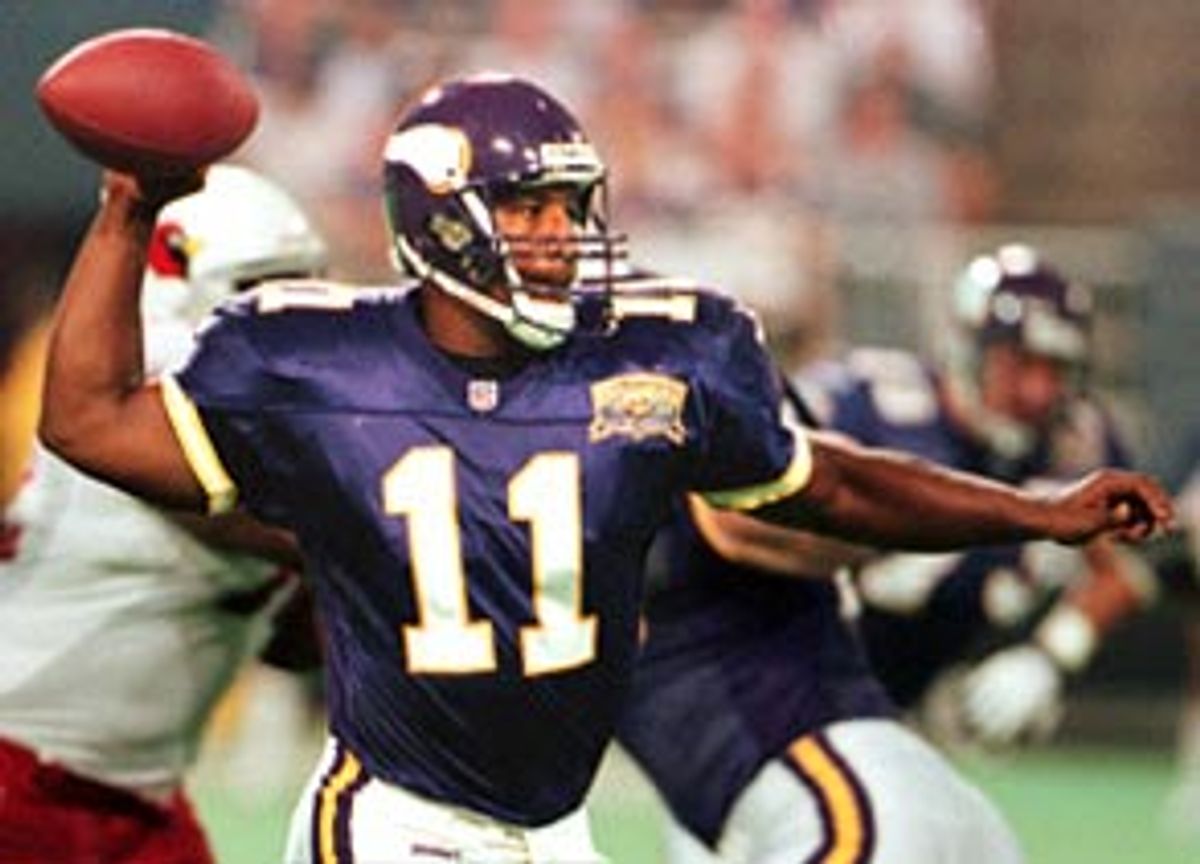
Here we go again. Sports fans can't turn on the tube or open the morning paper without yet another soft-edged commentary about "Black quarterbacks scoring in the NFL" (Los Angeles Times) or the "Change in QB thinking" (Gannett News), as if a black pro football quarterback is a recent phenomenon. Didn't we go through this in 1999 when two of the top three players in the NFL draft were stripling black quarterbacks? Remember Randall Cunningham? Wasn't Doug Williams the Super Bowl MVP in 1988?
This time, we are told, it's different.
The story line for this weekend's NFL playoff games revolves around five "minority" quarterbacks: four blacks (and a Jew). That may read like the first line of a "walks into a bar" joke, but there is something important going on here, though the sports cognoscenti seem determined to miss it. According to their measure, this breakthrough can be summed up in two themes that run roughly like this:
There's truth in both statements -- black quarterbacks were indeed held back for decades because of racism -- but they miss the real story. The real story is that race still plays a major role in football, and racial prejudice has not gone away, it's just taken new and subtle forms. Forget the blather about crumbling race barriers; there is a color line in pro football, and it's getting bolder every year.
The NFL is dominated by African-Americans, who make up 75 percent of the league's players (and most of its stars), though only about 13 percent of the American population is black. On one playoff team, the Philadelphia Eagles, 20 of the 22 starters, including all 11 on defense, are black.
The underlying assumptions of racism's new form are reflected in almost every article about black quarterbacks. According to the common wisdom, black domination of football (and indeed other major sports, such as basketball and running) can be explained away by two factors: 1) Blacks succeed in sports because it is their only vehicle out of the ghetto; 2) whites don't work as hard or are intimidated by the "racist myth" that blacks are naturally faster. Thus, rather than finding careers as, say, businessmen, lawyers or teachers, African-Americans are channeled into sports, which is further encouraged by the images, and earnings power, of superstars such as Randy Moss and Ray Lewis.
The noxious cultural stereotypes of desperate poor blacks and athletically lazy whites are new racial myths created as an overreaction to old, equally pernicious, ones: Blacks do not have the intelligence and leadership finesse to guide a team.
Intelligence, whatever that means in football, is one of the great mysteries of the game. When linked to the words "black quarterback," it has been a huge controversy. Consider Cincinnati's Akili Smith, one of the bumper crop of '99 draft picks that yielded Philadelphia's Donovan McNabb and Minnesota's Daunte Culpepper. "Akili" is Swahili meaning "creativity, power, intelligence." There is some irony in this, for Smith's intelligence was a controversial subject. He had put up phenomenal numbers as a late-blooming starter at the University of Oregon. "Rifle arm. Explosive. Elusive. Can improvise and make things happen when the play breaks down." The scouting reports were universally glowing, save one caveat. He was considered "raw," a common characterization of African-American quarterbacks.
With the average NFL playbook resembling the Manhattan Yellow Pages, there are always questions about whether a quarterback can master the complex schemes that separate college prospects from NFL standouts. No one is looking for a Rhodes scholar, but coaches at the pro level don't have the luxury of taking on projects, especially No. 1 draft picks.
Prior to 1999, only three black quarterbacks had been drafted in the first round of the NFL draft, none among the top few picks. As recently as the early 1980s, the NFL routinely ignored black college quarterbacks (Warren Moon toiled first in the Canadian Football League to make a name for himself) or shuffled college stars off to other positions that required "speed" and "agility." (Tampa Bay coach Tony Dungy was converted into a defensive back after he broke most of the passing records at the University of Minnesota.)
In the rare instances that blacks got a look, it was invariably a quick one. "Blacks get two types of opportunities to play quarterback in the NFL," said James Harris in 1974, when he was the lone black NFL starting quarterback, playing for the Los Angeles Rams, "a chance and a 'nigger' chance." When blacks didn't become stars overnight -- and quarterbacks rarely do, black or white -- there was always talk of shifting them to traditionally "black positions," where their "natural athleticism" would serve them better. (Pittsburgh's Kordell Stewart, for instance.)
It may be hard for some to accept that hard-nosed Vince Lombardi, George Allen or even your garden variety coach acquiesced to racist notions to deny talented blacks a chance to play the premier "thinking position." After all, owners like to make money and coaches want to stay employed. Winning all but guarantees both. But the racist system that long prevailed in football -- and make no mistake, blacks were denied opportunities to quarterback for no other reason than the color of their skin -- ran very deep. It cut off opportunities well before talented young black quarterbacks could make their way through the gauntlet of mostly white colleges to even get that look at the professional level.
The so-called inverse relationship between athletic ability and intelligence -- the belief that elite athletes, who are increasingly African-American, necessarily have a lower I.Q. -- is supported neither by any data nor by logic. What precisely constitutes "thinking" or intelligence is always a knotty question anyway, and in a not particularly self-critical medium like athletics, it is even more difficult to decipher. "The only thing I'm concerned about is how the guy has performed on the field," says Minnesota Vikings coach Dennis Green. "Culpepper reads defenses," he says of his emerging star. "Culpepper puts up the numbers."
Despite all the brouhaha about the historical lack of black quarterbacks, the number of black quarterbacks has only looked meager in recent years when set against the outsize black representation in football and many other sports. The more interesting question is why blacks dominate so many sports in which the social barriers are lowest. And does that answer shed any light on the sudden ascension of the black quarterback?
What can be said with certainty -- but rarely is, because such statements are regarded as racist -- is that evolution has conferred athletes of primarily West African ancestry (which means virtually all African-Americans) with more explosiveness and speed, on average (individuals vary enormously), than other population groups, be they East Africans, Asians or whites. It just so happens that the quarterback position in today's NFL requires that kind of elusive quickness far more than it did in the past.
African-Americans are ideally suited biologically for quick bursts of speed because of a number of factors, such as lower natural body fat, more-efficient metabolism and muscle fiber type. "It's a strong genetic component what type of muscle fiber you have, either slow or fast" says Bengt Saltin, director of the Copenhagen Muscle Research Center, long considered the world expert in this field. "And West Africans [almost all African-Americans trace their primary ancestry to West Africa] have already 70 or 75 percent of the fast type when they are born."
Saltin is still hearing the political correct braying in reaction to his September cover story in Scientific American, "Muscles and Genes," which addressed many of these issues. The question of whether there are innate differences between races is customarily dismissed outright as racist. After all, aren't we all born equal, blank slates for culture and the environment to write on? "Very many in sports physiology would like to believe that it is training, the environment, what you eat that plays the most important role," says Saltin "But we argue based on the data that it is 'in your genes' whether or not you are talented or whether you will become talented ... The basis is in the genes of these runners. There is no question about that. The extent of the environment can always be discussed but it's less than 20, 25 percent. It's definitely a dominant factor how they are born ... I don't see this as a racist issue."
The emergence of black quarterbacks has less to do with the end of racist slotting of players (although quarterbacking is the last vestige of that prejudice) than with the need to respond to the increased speed and quickness of NFL defenses dominated by players of primarily West African ancestry. Race has been a factor, "but less and less over the years," agrees Tampa Bay coach Dungy. White quarterbacks who didn't fit the mold, such as Buffalo's Doug Flutie, never got much of a chance either, and were often forced to prove themselves north of the border. Dungy has been around the game long enough to recognize that the race question is often mediated through other issues.
"For a long time, the NFL had a mold that quarterbacks had to fit," he says. "Everyone was looking for a drop-back passer with a cannon arm who was relatively tall. If you didn't fit that mold, black or white, you didn't get much of a look. The few blacks who got a chance, like Doug Williams, fit that prototype."
The days when a classic drop-back passer like Roman Gabriel, Sonny Jurgenson -- or Doug Williams -- could sit in the pocket are over (with notable exceptions, of course, such as Kurt Warner). All the coaches are looking for "athleticism" -- a word that not too many years ago resonated with racial undertones, including "less intelligent."
"That used to be a code word to describe a black quarterback whom a coach wanted to shift to receiver or defensive back," says Minnesota coach Green, who is black. "Now, with the speed and strength in the game, we all need athletic quarterbacks. Every coach is looking for mobility. It's just not a black-white thing anymore." That means more Steve McNairs, Donovan McNabbs, Daunte Culpeppers -- and Jay Fiedlers (Miami's white Jewish quarterback). Overall, the pool of such quarterbacks is overrepresented among blacks, but only blacks of West African ancestry.
We may not be in a golden age of race relations in sports, but there is every reason to believe that racism is less and less a factor in who plays and flourishes at what position in football -- even as race remains important. On average, different populations have different anatomies. Continued white domination of the offensive line reflects the bio-mechanical reality that whites have the musculature for more potential upper-body strength. That's not to say it's true that blacks are fast and whites are strong: Kenyans and other East Africans are neither blazingly fast nor meaty and strong, but are great distance runners as a result of their ectomorphic bodies.
With racism on the wane, African-Americans are getting more opportunities because the people making decisions in the NFL have changed, the way the media talks about black quarterbacks has changed and the position itself requires more athleticism. And more than anything else, sports is a business. The bottom line is performance.
Success in sports is best understood as a biocultural phenomenon. Think of genes as the foundation of a house; culture and the environment are the furniture that give a home character and individuality. But while biological differences stretched across an entire population may help explain the trends in who is more likely to become a sprinter, wide receiver or mobile quarterback, they say little about the success of any individual athlete. While potential is 100 percent genetic, individual accomplishment mostly reflects drive, courage and luck.
Still, this remains a taboo subject, as the tone of recent articles on black quarterbacks underscores. That won't change until we as a culture are more willing to openly discuss the social and genetic factors that shape human diversity. That may be a long time coming. A few years ago, I was attending a sports sociology conference discussion on this very subject, racial profiling in football. Despite voluminous evidence that the practice had all but disappeared, most of the academicians were loath to abandon what had been a fundamental belief in sports sociology for three decades.
In the midst of this insular discussion, a massive black hand shot up from the rear. Sitting by himself was a man the size of a defensive lineman. "I've been listening to this nonsense going on half an hour," he said. "I've been a coach at Ohio State, and I can tell you that there is no way we would let stacking go on. This is just bull. At Division I or in the pros, to survive coaches have to recruit the best players and we damn well better play them at the optimal positions. We don't care if a player is white, black or striped. The pressure to win is immense. If we don't, we will be out on our ass."
The audience, evenly split between blacks and whites, was startled by the even-voiced vehemence of this massive black presence. It says something of the subject's explosiveness that the one-time Ohio State assistant asked not to be identified.
Shares