Oprah Winfrey

St. Anna

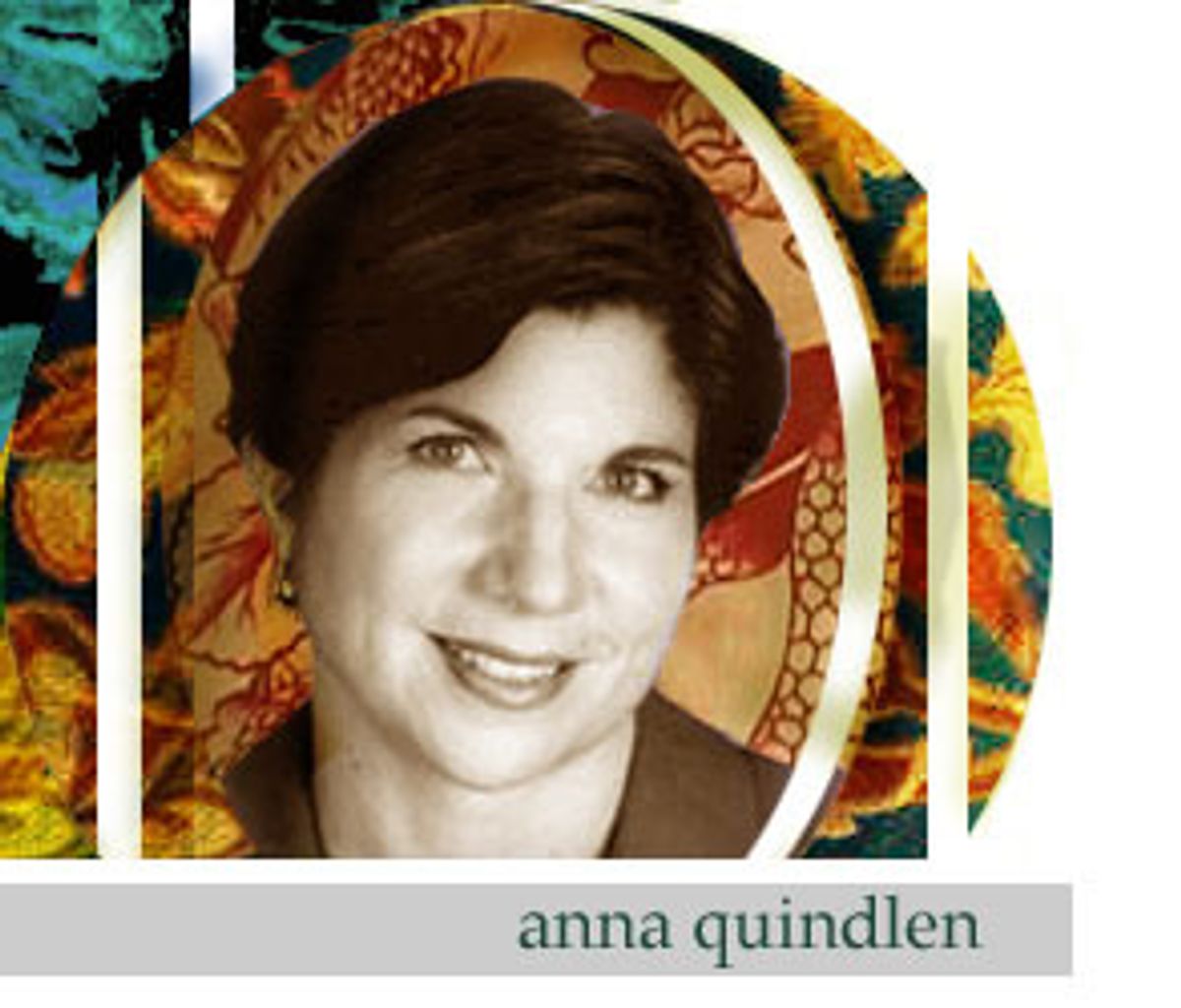
With her cloying new inspirational book, Anna Quindlen joins Martha and Oprah as the latest example of a secular savior.

  • more
    • All Share Services

St. Anna

For a saint, Anna Quindlen is exceptionally modest. In the first line of her new book, “A Short Guide to a Happy Life,” she confesses that she’s “not particularly qualified by profession or education to give advice and counsel.” She then adumbrates her unfitnesses: “I’ve never earned a doctorate, or even a master’s degree. I’m not an ethicist, or a philosopher, or an expert in any particular field. I can’t talk about the economy, or the universe, or academe, as academicians like to call where they work when they’re feeling grand.”

You know, I don’t think I’ve ever heard an academician use the word “academe,” at least not seriously. Nor have I heard one use the word “academician.” But that fancy-talkin’ egghead is just the sort of straw man Quindlen needs to set off her ensuing credo:

“I’m a novelist. My work is human nature. Real life is really all I know.”

Well, look who’s feeling grand now! Quindlen’s work is human nature, thank you very much. Every morning, you will find her marching into the foul rag-and-bone shop of the heart — that place where academicians fear to tread — armed with nothing but a laptop and a cup of chamomile tea. Don’t bother thanking her. She will simply shake her head and say, “Real life is really all I know!”

Is there a less humble, more transparent way of saying “I know everything”? Probably not. But this begs the question of what precisely Quindlen does know. Having just read her book — it took me several minutes — I can safely report that her wisdom consists of “You are the only person alive who has sole custody of your life” and “This is not a dress rehearsal” and “Today is the only guarantee you get” and “Life is glorious” and “You have no business taking it for granted.” Oh, and “Life is short. Remember that, too.”

In a truly just world, such threadbare banality, stretched to mini-book length by the strategic insertion of photographic tableaux, would be given the reception it deserves. That is to say, it would be left to molder on the remainder table while anyone in dire need of a carpe diem infusion would be instructed to rent “Harold and Maude” or “Auntie Mame” or check out the local-theater production of “Our Town.”

But things have come to a different pass, and Quindlen’s e-mail enclosure currently sits at No. 3 on the New York Times Advice, How-to and Miscellaneous bestseller list (right behind the “Guinness Book of World Records” and “Who Moved My Cheese?”). And so, in the face of this weighty cultural endorsement, we must stop, regroup and begin looking at Quindlen in a new light — as the latest encrustation of a strange and relatively new phenomenon that I will call secularized idolatry.

The plain fact is that people who swallow Quindlen’s rice cake of a book are consuming not so much the message — which is indistinguishable from the mottoes on a box of herbal tea — but the messenger. They’re immersing themselves in Anna-Quindlen-ness. And if they can’t be a Pulitzer Prize-winning New York Times columnist and the author of well-compensated novels, they can at least merge with the persona behind those works: the radiant earth mother, the levelheaded avatar of liberal family values whose occasionally self-deprecating anecdotes serve only to demonstrate how effortlessly grounded she is. It is this idealized vision of modern woman — this airbrushed Hillary Rodham Clinton — that is Quindlen’s truest and most lasting work, and it confirms her as the most recent novitiate in the growing order of secular saints.

At one level, we can see Quindlen and her ilk as simply carrying on work that began a long time ago. Haven’t women’s magazines spent some 150 years providing prescriptions for better living? Haven’t gurus from John Gray to Marianne Williamson to Tony Robbins made a fortune cramming our minds and malls and airwaves with moral-fitness regimens? Haven’t generations of evangelists tried to rouse us from the slumber of habit and exigency?

But today’s secularized saint represents a departure. For one thing, she invokes no deity, other than Maya Angelou. She undertakes no field research and offers no particular expertise; indeed, she scorns the whole notion of expertise. (Academicians, be gone!) What she offers is simply herself, in all her twinkling mediagenic splendor: a savior masquerading as a seeker.

Perhaps, as with so many noisome trends, we can lay the blame on Martha Stewart. Who, after all, has done more to encourage her own worship? Leave aside for a moment the stupendous vanity productions of her television empire. Simply leaf through any one of her books or magazines. You can’t jump very far without landing on the waxy, graven image of the Blessed Martha — as hallowed and ubiquitous as Virgin Mary icons in a Russian Orthodox cathedral. One could argue, of course, that this iconography has been applied not to a moral but to an aesthetic end: the greening of our homes. But listen again to Stewart’s famous catchphrase, the one that concludes so many of her televised sermons:

“It’s a good thing.”

Not a pretty thing. Not a nice thing. A good thing. Conspicuous consumption ingeniously married — in four short words — to Puritan values. And when strained through the pop promiscuity of Stewart simulacra, the message that emerges is not “Do what I do” (which is, of course, the message of any advice columnist or armchair shrink) but “Be what I am.” Be me.

If Stewart helped inaugurate pop idolatry, no one has raised it to higher, more sacramental levels than that Mother Seton of secular saints, Oprah Winfrey. I say this with some sorrow because, for a long time, I got a real kick out of Oprah — until that fateful moment several years back when she decided to transform her television show into a vehicle for positive and life-affirming messages. Amid all the approving publicity that ensued, no one seemed to question the assumption behind this metamorphosis: that Oprah, and Oprah alone, was the person best suited to lead us from our caves into the blinding light of revelation.

This self-ordained ministry now rests as snugly as a surplice on her waxing and waning body. She is, as they say, a multitude, and when I try to call up memories of a past show, I keep circling back to her. If, for instance, I try to remember the woman who lost two children to a rare illness and then learned her youngest child had the same disease, I can’t do it. All I can remember is Oprah laying her hand on the crying woman’s shoulder and standing there like a special-delivery angel, unmoving and serene, a pure conduit for God’s antibiotic energy. Heavenly Father, heal this wounded sinner!

The hagiography becomes even more pronounced in Winfrey’s gaseous new magazine, O, which manages the not-inconsiderable feat of making everyone it profiles or publishes — Bette Midler, Amy Tan, Joyce Carol Oates, Vaclav Havel — sound exactly like Oprah Winfrey. And just in case the message gets too diluted in translation, we get it from the horse’s mouth herself when Winfrey weighs in with her monthly exhortations: “This year, resolve to pay close attention to your life. Be open to what it is trying to tell you. Your life speaks to you in every moment, every encounter, every feeling. By listening and making responsible choices, you can reinvent your life each day.”

Like any good secular saint, Winfrey takes the sting off her own perfection by telling us what a fallible person she was before being permanently ennobled by trauma. In this context, disastrous events — an unhappy childhood, abusive men — become merely the alchemic media by which mortal dross is reconfigured into philosopher-queen. In Quindlen’s case, the transformative trauma was losing her mother while still in college. “Something really bad happened to me,” she writes, “something that changed my life in ways that, if I had a choice, it would never have been changed at all. And what I learned from it is what, today, sometimes seems to be the hardest lesson of all. I learned to love the journey, not the destination.”

Oh, yes, the journey. (Winfrey loves to talk about that, too. In the January issue of O, she approvingly quotes author Gary Zukav: “Your life is a journey to learn about yourself.”) Now, if I understand the concept correctly, we are all making roughly the same journey; the secular saints are just the lucky ones who get to vault ahead. Not to worry, though: Their spiritual superpowers give them a deep sense of obligation toward the rest of us. “I learned to look at all the good in the world,” Quindlen writes, “and try to give some of it back, because I believed in it completely and utterly. And I tried to do that, in part, by telling others what I had learned, even though so many people may have thought I sounded like Pollyanna.”

Let’s not dwell too much on Quindlen’s syntax — the redundancy of “completely and utterly” — or the irony of fulfilling a higher calling by penning aggressively promoted mass-market volumes. (We’ll give her the benefit of the doubt and assume the royalties are earmarked for charity.) Let’s just look for a moment at the message that Quindlen feels so duty bound to bring us. It is best summarized, I think, in the following direct quote: “C’mon, let’s be honest. We have an embarrassment of riches. Life is good.”

I have no doubt that life is good for Quindlen. I do wonder, though, if she has ever tried to convey that message to, say, a manic-depressive (I have; it doesn’t get you very far) or to someone whose life isn’t quite so Anna Quindlen-esque, someone who doesn’t live in a nice part of New York, get book royalties or have time to “sit in the backyard with the sun on your face,” because, hell, she doesn’t have a backyard.

For all their soul scouring, what the secular saints fail to realize is that their happiness — the very luxuriance of their quest for happiness — is inexorably tied to their privilege. Their “moral vision” is wreathed in silk. And I’m not just talking about Stewart, with her origami nesting boxes and stenciled eggs and pistachio valentines. Check out Winfrey on the cover of the latest O, wearing Ralph Lauren Sport pants and a Ferragamo sweater and cashmere gloves, and clutching the whitest, roundest, prettiest snowball you’ve ever seen. (Stewart must have helped.) Or listen to Quindlen, that purveyor of life’s simple verities, enumerate her laundry list of pleasures: “the snowdrops, the daffodils … fettuccine Alfredo; fudge; ‘Gone with the Wind,’ ‘Pride and Prejudice.’” These women aren’t selling a way of life, they’re selling a lifestyle — to which non-Jane Austen readers need not apply.

No matter what form (or gender) the secular saints take, they are, in the truest sense, false idols because they want us to do something that is both offensive and impossible. They want us to live their lives — when in fact we can only live the lives we have, and we can only learn about life by living it. If I could be a secular saint for a day, my message would run as follows: “Stop up your ears, and close your pocketbook. Go home, and do the best you goddamn can. And for God’s sake, don’t tell anyone about it.” I promise I won’t charge a dime.

Louis Bayard is a novelist and reviewer. His books include "Mr. Timothy" and "The Black Tower."

NBC comedy stars keep themselves relevant after finales

Alec Baldwin and John Krasinski shill baseball hats in viral ads, "Community" character gives Emmy picks, and more

  • more
    • All Share Services

NBC comedy stars keep themselves relevant after finalesYankees vs. Red Sox, Baldwin vs. Krasinski, or "30 Rock" vs. "The Office": who is your favorite?

What do the stars of NBC’s Thursday night comedy lineup do during their summer vacation? Keep themselves fresh, of course. Sometimes it’s a little hard to tell if these guys can separate themselves from their characters, but who’s complaining if there’s a real Ron Swanson or Jack Donaghy walking around?

“30 Rock’s” Alec Baldwin and “The Office’s” John Krasinski have figured out what they’re doing with their off-season, and that’s punching each other in the face about baseball. No, seriously. In this series for New Era Caps, Baldwin goes head to head with Jim Halpert over their Red Sox/Yankees rivalry. So far there have been three spots, and if you play them in succession it’s kind of like watching a crossover episode between the two shows.

Meanwhile, Amy Poehler isn’t the only cast member of “Parks and Recreation” keeping herself in the spotlight. While the comedian is off giving speeches at Harvard, her costar Nick Offerman (who plays her boss and meat-lover Ron Swanson) has been wooing Oprah to come play his first ex-wife next season.  As he told the Huffington Post:

“I think Oprah would be the only, she’s the only person we can think of that might be intimidating to Megan Mullally. It would be so good.”

He then added, “I can assure you if it’s not Oprah, I will quit.”

And while that’s doubtful, Oprah should actually consider it. She did cameo on “30 Rock,” so it’s only fair.

Rounding out the news cycle is Danny Pudi, who plays Abed on “Community.” Anyone who still thinks that show isn’t being taken seriously should check out Variety right now, where “Abed” has been given a column in-character for Emmy season. He’s predicting who will win the awards based solely on his extensive knowledge of television and film (despite never having seen the shows in question), as well as his more savant-like tendencies:

I sort the last four into two groups: a) shows that have won an Emmy, so it seems like they’ll win again, and b) shows that haven’t won yet, so it seems like their turn. Sorting every winner since “I Love Lucy” in 1953:

 B A B B A B A B B AA B B AB B A A B B AA A B A A B B A B B A B AB                              A A B B A A A A B B B B B B A B B A A B

The “ABBA” pattern emerges soon and repeats often, as people’s urge to shake up a system always results in systemic shaking. I totally get it: I once missed a week of school by trying not to touch my chin 7,000 times. The stretches of non-ABBA you see are “cable scares,” like when we just kept giving Emmys to “Frasier” until “Larry Sanders” went away. Think of TV as Rain Man getting through HBO’s smoke alarm by chanting “I like the guy from Cheers.”

The whole article is amazing, and by far my favorite post-finale offering from an NBC comedy actor. Then again, I’m a little biased.

Continue Reading Close

Drew Grant is a staff writer for Salon. Follow her on Twitter at @videodrew.

Pop Torn: 10 pieces of culture we’re feeling iffy about

From "True Blood" to Mark Zuckerberg killing a goat to a purse made out of jerky, this week is all about meat

  • more
    • All Share Services

Pop Torn: 10 pieces of culture we're feeling iffy about

Memorial Day weekend, you guys! I know that I will be happy to wear all my white clothing again, because nothing says “I’ve been to a summer barbeque” like visible condiment sauce all over my clothing.

And with this warm weather comes tons of pop culture news stories that are just to the right of funky. We’ve rounded up some of the stranger stuff that we missed this week, and leave it up to you to decide if maybe being raptured wasn’t such a bad idea.

1. People who think the Onion’s headlines are real: Oh, it happens. And now it’s a Tumblr. (Expect a book deal in the near future.)

2. Abed from “Community” shows up on “Cougar Town”:

Easter egg for the super fans and the people who love Subway.

3. OWN picks up new series, “Don’t Tell the Bride“: Groom and future wife are separated for a month before the wedding; he has to make all the decisions about planning the event. Hope she likes nachos and a boob-shaped cake.

4. Student makes Chanel bag out of beef jerky:

(Photo by Nancy Wu)

Oh what? It’s all cowhide, no matter which way you look at it. Calm down and take a bite.

5. Museum-going men are happier than their counterparts: That 2 percent of the male population must be having a blast.

6. This mommy kitten is hugging her baby kitten:

Yes, dear, it’s very, very cute. Please let me go back to bed now, I have work in the morning. Well, if it’s so great, take a video of it! I’ll watch it later.

7. “Pop-Up Video” is coming back to VH1: Though now it’s just called “tweeting during music videos.”

8. “Jersey Shore’s” Ronnie and the Situation get into a fistfight in Florence: Really, guys? Really? Italy was ready to boot you out before you even showed up, and this is how you show your good behavior?

9. Mark Zuckerberg, woodsman: The Facebook CEO will only eat food he kills himself. His private message to friends on FB just read: “I just killed a pig and a goat.” And not on FarmVille.

10. “True Blood’s” fourth season trailer:Oh great, now I have to deal with witches?

Our thoughts exactly.

Continue Reading Close

Drew Grant is a staff writer for Salon. Follow her on Twitter at @videodrew.

Conan’s Oprah fan taxonomy

O'Brien's guide to Oprah's audience rounds up familiar types, from "The Weeper" to "The Man Who Rocks and Claps"

  • more
    • All Share Services

Conan's Oprah fan taxonomy

Last night, Conan O’Brien celebrated Oprah Winfrey’s final show by honoring “the people who made the The Oprah Show truly special” over the years: her audience members. His team compiled a jokey Oprah-fan classification, encompassing all sorts — from “The Jumping Clapper” and “The Face Fanner” to “The Extremely Alarmed Grandma” and “The Man Who Rocks and Claps.”


Continue Reading Close

Emma Mustich is a Salon contributor. Follow her on Twitter: @emustich.

Oprah’s warm, funny, self-aggrandizing goodbye

Winfrey ends her show with a 42-minute monologue that encapsulates her many baffling contradictions

  • more
    • All Share Services

Oprah's warm, funny, self-aggrandizing goodbye

Oprah Winfrey’s final show summed up everything she’s been about for a quarter century. It was funny, warm, sweet and informative, and felt easygoing even though it was clearly written and rehearsed within a millimeter of its life. The episode had sharing and oversharing, confessions and anecdotes, photographs of Oprah in unfortunate clothes and hairstyles, and callbacks to shows and guests that made a big impression on the host during her journey toward self-knowledge — which, she assured us, was what her boundary-breaking, influential, astoundingly popular stint on daytime was truly about, anyway.

No, wait, scratch that. Her show wasn’t truly about Oprah at all. It was about you. All of you. But especially you, the individual sitting there watching her “every day,” as she said.

She had a message for you, the individual. Several messages, actually — and they were all intertwined: Take responsibility for your life. Be honest with yourself and others. Be responsible for the energy you put out in the world, because that energy comes back around eventually. Also: There is a God, or a life force, and you should get to know him/her/it, because he/she/it can improve your judgment and guide your life.

There was a clip reel of people admitting things on TV that they had never told close friends and family members. They said they were alcoholics or drug addicts, that they had HIV, that they had endured or inflicted spousal abuse. The confessions had a snowball effect and became collectively cathartic, Oprah said: “Little by little, we started to release the shame.”

One of the clips was of Oprah herself circa 1986, revealing that she herself had been sexually abused as a child. Another clip referenced the recent broadcast in which actor-director Tyler Perry said he’d been sexually abused as a child, then led an audience of 200 fellow sexual abuse survivors, all men, while they stood together holding pictures of themselves as kids.

Long sections of Oprah’s final syndicated broadcast, which amounted to a 42-minute monologue interspersed with video clips, suggested a church service, though precisely what kind varied from moment to moment.

Sometimes it felt like Sunday school for kids. Other times it felt like a sermon, or the opening remarks of a self-help group leader opening a meeting in a church basement.  “Don’t wait for anybody else to fix you, to save you or complete you,” she said. “‘Jerry Maguire’ was just a movie. [But] no one completes you. We have seen that with guest after guest. When you accept that you are responsible for your life, you…get….free.”

Still other times the broadcast evoked the famous sequence in “The Adventures of Tom Sawyer” where Tom Sawyer and Huck Finn, presumed dead, attend their own funeral service and hear themselves eulogized. But here was Oprah doing the eulogizing. In an especially unfortunate moment, she suggested that God was responsible for the meeting of her father’s sperm and her mother’s egg. That may very well be true, but if so, it’s true for every other human being as well — and when you put it in the words that Oprah chose, it can’t help but sound oddly messianic.

Oprah’s last words before exiting stage left were, “to God be the glory.”

She talked about how, deep down, she really wanted to be a teacher, and near the end of the broadcast, she introduced her very first mentor, her fourth grade teacher Mrs. Mary Alice Duncan, who was sitting there in the audience, tearing up and grinning.

She said that her guests taught her that there was “no need to feel superior to anybody” because “there is a common thread that runs through all of our pain and all of our suffering, and that is unworthiness, not feeling worthy enough to own the life that you were created for…Your being here, your being alive, makes worthiness your birthright. You alone are enough.”

She said that within each person, no matter what his or her race, creed, color or life experience, is a little voice that asks, “Do you see me? Do you hear me? Does what I say mean anything to you?” That voice, Oprah said, was what she hoped to answer, encourage and embrace over the course of 25 years and 4,561 shows.

It would have been nice if, at some point during the telecast, even a single audience member had been permitted to utter one syllable. There was no dialogue, only monologue interspersed by cheers, laughter and applause. The key to Oprah’s success, she assured us, is that she knows that deep down, everyone wants to be heard. But in this last broadcast, nobody else got a word in edgewise.

It was a final summation in a career which, judged in terms of social good and emotional healing, required no defense. Oprah is a force for good, period. She may inspire love, loathing, bafflement, amusement, irritation, you name it, but there is no possible way to evalute the sum total of her career on TV without concluding that the world is a somewhat better place because she was in it. And yet here she was making a case for herself, Oprah Winfrey for the defense, as if she wasn’t worthy of all this attention and acclaim. As if she didn’t get her own memo. It was poignant in ways she herself probably didn’t intend.

She left her stage, her classroom, her pulpit, unfinished. A work in progress.

Continue Reading Close

Celebrities flock to Oprah’s penultimate show

From Jamie Foxx to Maria Shriver, the stars turn out to celebrate and honor daytime's favorite talk show host

  • more
    • All Share Services

Celebrities flock to Oprah's penultimate showOprah and Maria Shriver.

Oprah Winfrey’s final show airs tomorrow, and today’s second part of her “Farewell Spectacular” saw celebrities turn out in full force, a touching tribute to the woman who has been America’s best friend for 25 years.

Oddly enough, Oprah spent most of her show not trending on Twitter, though “surprise” guests like Tom Hanks, Michael Jordan, Maya Angelou, Jerry Seinfeld, Jamie Foxx, Stedman and Gayle all did. I use quotation marks because there are no surprise guests for Oprah … if Obama himself had taken the stage to wish her well, it would not have been that unexpected.

So perhaps the biggest surprise of today was a heartfelt speech by Oprah’s silent partner Stedman Graham. Looking nervous, Stedman said that he didn’t know of anyone else who could change so many people’s lives and also bring a bagged lunch to work.

Meanwhile, Dr. Maya Angelou’s contribution to the ceremony was a new poem, which she read accompanied by Alicia Keyes on the piano:

“Unplanned and unrehearsed, this big-eyed black girl from Mississippi, showed the world how to look at itself … She listened to the rich and the poor, the famous and the infamous … For 25 years she listened. … She said, ‘Be strong, be kind, and call me Oprah.’ I can. I will. And I shall. Be Oprah. I am. Oprah. Oprah. Oprah.”

Of course, not everyone took the same approach to honoring the living legend. Jerry Seinfeld used his five minutes to complain about his marriage, women in general, and how it’s Oprah’s fault that ladies mock their husbands. Then Jerry took his seat, directly next to Oprah, because they are best friends anyway.

Simon Cowell introduced a musical number where Rosie O’Donnell sang a reworked version of “Fever,” with special appearances by Dr. Phil, Nate Berkus and Dr. Oz (the last of which said Oprah’s gift to the world was teaching everyone about S-shaped poop). Usher, Kristin Chenoweth and Aretha Franklin filled out the non-ironic singing portion of the show.

The oddest moment of the episode was when Maria Shriver joined Oprah onstage with Gayle King to thank her friend for “giving me  … the most important gift of all … telling me the truth.” It was a loaded moment, though if Arnold was watching, the camera didn’t cut to him. This was Oprah’s day, after all.

Continue Reading Close

Drew Grant is a staff writer for Salon. Follow her on Twitter at @videodrew.

Page 1 of 24 in Oprah Winfrey