John Dicker

The other new economy

Folk artist Gary Greff wants to save his gasping small town with giant roadside animals. Is he nuts?

  • more
    • All Share Services

The other new economy

To an outsider, Regent, N.D., seems a place one would visit only under extreme circumstances, perhaps to bury a relative or repossess a vehicle. Drivers approaching the town from Interstate 94 encounter few fellow motorists, only a vast expanse of brown prairie grass, rusted farming equipment and abandoned houses. The sudden appearance of a 40-foot grasshopper is as menacing as it is delightful — Tim Burton meets John Mellencamp. The grasshopper is surrounded by 20-foot-tall blades of metal wheat that sway in the fierce prairie winds.

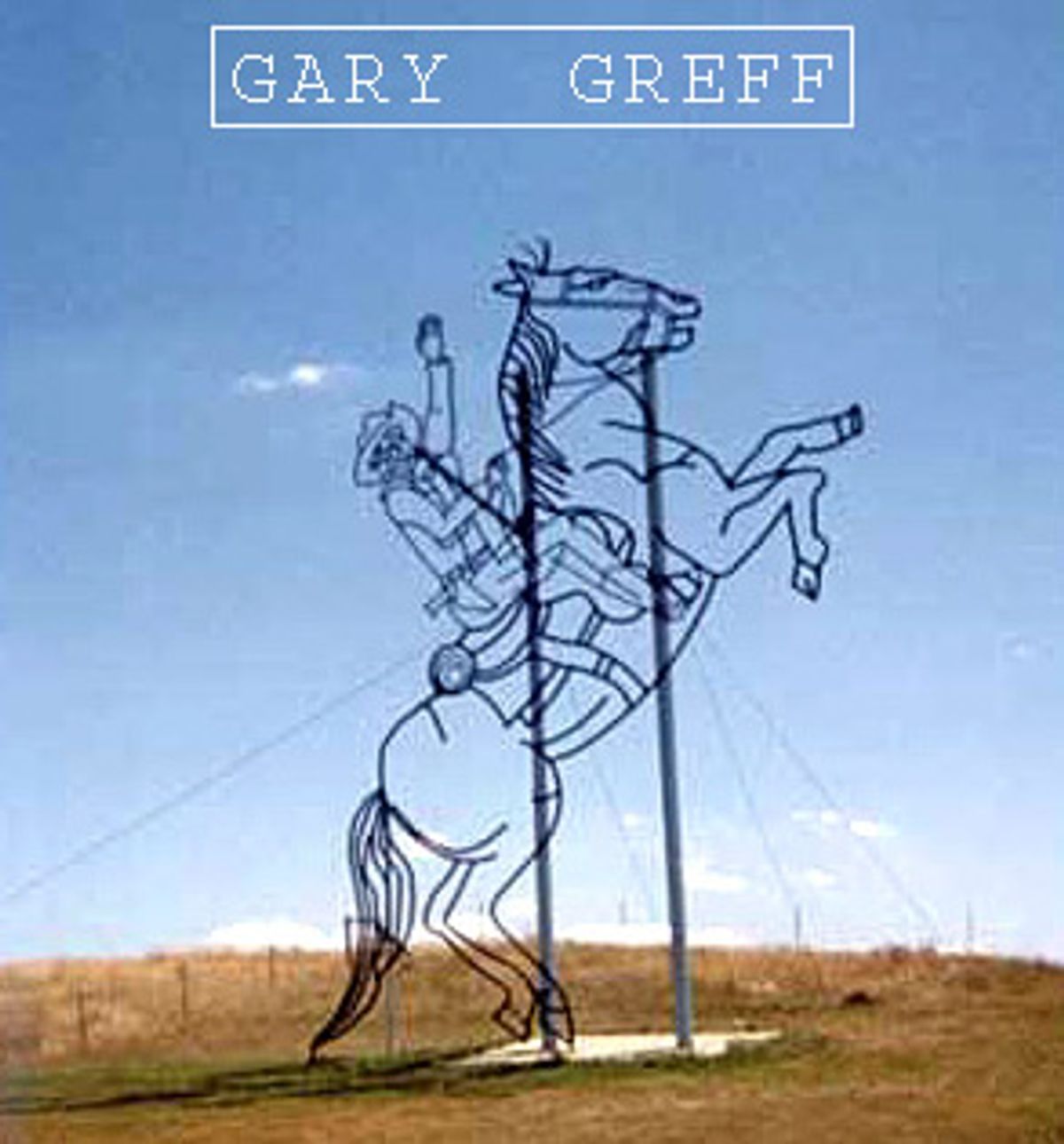
Gary Greff is transforming his hometown of Regent into the “metal art capital of the world.” His vehicle for the journey is the inchoate “Enchanted Highway”: a series of four (out of a planned 10) colossal metal sculptures on the two-lane county road connecting Regent to the interstate 30 miles north. Greff’s aim is for the Enchanted Highway to eclipse the “western” town of Medora, complete with its “pitchfork fondues” — every summer evening, folks gather on a bluff and fork slabs of steak into kettles of boiling cooking oil — as the premier tourist attraction in the state.

If you want to make Greff cringe, call him an artist. Though he receives grants from both the National Endowment for the Arts and the state arts council, Greff considers himself an entrepreneur. So long as the temperature stays above zero, he can be found on the side of a prairie road, welding abandoned oil wells into sculpture — what his funders classify as “folk art.” Though his lifestyle is as austere as any bohemian’s, Greff hardly fits the starving artist stereotype.

At 51, this retired school teacher lives in a trailer, does seeding work for a farmer each spring and makes it through the winter with the help of state fuel assistance, groceries brought to him by his parents and the bones his brothers throw him, quite literally, in the form of meat from their nearby ranch. “My ends don’t meet very often,” Greff laughs.

In addition to the grasshopper, Greff’s Enchanted Highway offers a flock of four-story pheasants in various pecking poses, a family of tin people (soon to talk) and everyone’s favorite rough-riding imperialist (and former state resident), Teddy Roosevelt, on horseback. Each sculpture site includes a small parking lot and a picnic table. Greff wants to make the highway family friendly and is paving the way for what he hopes will be a metal-art theme park complete with rides and a metal golf course.

Decorated at three-mile intervals, the highway capitalizes on one of North Dakota’s greatest resources: space. The view from any of the four sculptures is not of strip malls or convenience stores; the view is not much of anything. Such spaciousness abets the illusion, however brief, that maybe towering pheasants do frolic in Regent, their very own home on the range.

Greff was a visionary even before he created the sculptures. The manufacture of “tearless” onions was his first entrepreneurial venture. According to Greff, the pre-sliced onions could be jarred and stored for up to three months, similar to pre-minced garlic. The product was tested and approved in Canada, received attention from CNN and “Good Morning America” and spent several months on grocery shelves in Minneapolis. Unfortunately, Greff did not have the capital necessary to market the product, and he abandoned the venture in favor of the demands of the highway (though he still holds the patent).

North Dakota was one of three states to decline in population during the otherwise booming ’90s. Regent once had two grocery stores and three bars, and it was common for farming families to have 10 children. “This state has always relied solely on agriculture, and we failed to respond quick enough when we saw that it wasn’t working anymore,” Greff says. “It became clear that my small town was going to be dead if I didn’t do something.”

Despite rumors to the contrary, the Enchanted Highway was not the result of Alan Greenspan’s taking hallucinatory stimulants. The idea came to Greff when a farmer placed a makeshift sculpture of a farmer hoisting a giant bale of hay and people began stopping by the side of the road to check it out. North Dakota has its share of similar attractions. Salem Sue, the world’s largest Holstein cow, towers above I-94 in homage to the region’s dairy farmers. Dunseith houses a turtle made from 2,000 wheel rims and the world’s largest buffalo resides in Jamestown. “People are not going to stop for normal,” says Greff.

Most roadside attractions celebrate the cultural life of a region or leech onto an existing tourist infrastructure. Greff’s Enchanted Highway is a metallic rain dance for an economy to come. Even before the decline in Midwestern family farms in the ’70s and ’80s, Regent was a town of just 500. In the past three decades, the population has been cut in half as young people moved to larger towns like Dickinson, 40 miles west, or cities like Bismarck and Fargo. Seniors make up the bulk of the citizenry. Regent has not had a police officer in 12 years and its children travel 45 minutes each way to school.

The Enchanted Highway is a community effort. Each of the sculptures sits on private land that Greff leases from local property owners at $1 dollar for 20 years. The funds for the first two sculptures were raised through a series of “family fun” days, bingo nights, card tournaments and raffles. The Lions Club donated nearly $3,000, with other civic organizations and individuals contributing in kind. The highway wouldn’t have gotten off the ground without the support of the town, says Brenda Wiseman, manager of Regent’s Consumers Co-op. Wiseman has helped Greff raise funds since the project’s inception. The first two sculptures priced out at nearly $20,000, which, she notes, “is a lot of money for a town of 265 people.”

Roger Warbis of Farmer’s Union Oil, Regent’s gas station, says people are divided on whether the highway will help revitalize the local economy. “Once you see the sculptures, there’s nothing else to do in Regent,” notes Warbis, who has seen an additional two or three visitors a day since the highway began attracting attention. “They don’t usually buy gas; mostly they come in to use the bathroom,” he observes. Nevertheless, his station includes a small gift store that peddles, like most of Regent’s other businesses, Enchanted Highway key chains, cups and T-shirts. He has even drawn up plans to adorn the station with metal art. Warbis describes himself as “cautiously optimistic” about the highway’s potential.

“When I first started,” says Greff, “sure there were people who thought I was nuts. A lot of people still think I am. But once they saw the sculptures getting completed and realized that I wasn’t a fly-by-night, then attitudes began to change. No one has ever built a statue to a critic.” Jan Webb, executive director of the North Dakota Arts Council, concurs. “Initially I thought he was a bit strange, but after working with him I realized he’s just enthusiastic.” Webb and others credit Greff for generating publicity for the town in People magazine, the Wall Street Journal, Minnesota Public Radio and the occasional Web site.

But if Greff builds it and they come, then what? Greff speaks of a metal theme park, but he is too busy welding, fund-raising and promoting to strategize. While two new sculptures will go up this year, Greff doesn’t think the project will be completed before 2006. For now, hawking Enchanted Highway tchotchkes will have to do for the few local businesses. The Regent Café may get a few more lunchtime visitors and Warbis may sell a few more gallons of gas, but the highway seems unlikely to stem the tide of migration by Regent’s youth. Although few question Greff’s motives, this town of dogged, “cautiously optimistic” admirers may have produced a visionary sculptor without a visionary strategist to match.

“I’ve definitely bled the turnip dry here in town,” says Greff, whose two most recent sculptures cost a total of $58,000. Greff tapped out his own savings nearly a decade ago, spending the bulk of the money left over from his tearless-onion venture on metal and paint. Currently, state Sen. Byron Dorgan is courting larger individual and corporate donors whose names have yet to be made public. Last year, the highway received $3,000 from the city of Regent as well as grants from the National Endowment for the Arts, the North Dakota Arts Council and the Hettinger County job development authority.

With the exception of a one-time gift of $10,000 from Cellular One in 1999, funds have come primarily from grass-roots sources. Civic organizations like the Knights of Columbus, the Lions and booster and commercial clubs have pitched in, as have the city councils of nearby towns. The raffles, carnivals and auctions Greff runs with the support of local business owners usually net him about $1,500 each. “I know there’s a person out there who has the money, that can share the dream and see that this will, someday, make money,” laments Greff. Until he finds his benefactor, Greff diligently cranks out grant proposals on his typewriter.

At about 50 tons, 90 feet tall and 150 feet wide, “Geese in Flight,” Greff’s latest work, is set to take off in July. The sculpture features 10 geese silhouetted in flock formation behind a bursting sun. Ever the optimist, Greff hopes the geese will go down in the Guinness Book of Records as the world’s largest metal sculpture — which might save Regent from becoming the world’s smallest town.

Continue Reading Close

Wal-Mart needs a date

Giant retailer seeks hottie with incentives.

  • more
    • All Share Services

Wal-Mart needs a date

Name: Wal-Mart Stores Inc.

Age: 42

Hometown: Bentonville, Ark.

Occupation: Behemoth

Education: $256 billion in annual sales and you care about a degree?

Religion: Everyday Low Prices, Cornpone Populism

Height/Weight: 1.5 million associates in more than 4,300 stores in 9 countries on four continents. But I’m not fat, I swear!

Hobbies: Some days I’m all about squeezing my suppliers; other days all I want to do is cut my payroll. But one thing’s for sure: I’m always up for frisbee golf!

Turn-offs: Labor unions, zoning laws, and drivers who dont use their blinkers.

In 10 Years, I See Myself… Turning $600 billion in annual sales with 20 percent of the domestic retail market, expanding into banking, gas, auto, air travel, healthcare, etc… And hopefully NOT STILL SINGLE!!! LOL.

You Should Get to Know Me Because: I will own you.

Last Great Book I Read: “Chicken Soup for the Class-Action Defendant’s Soul”

Celebrity I Resemble Most: Some say Kmart, others Target. I kinda think Kevin Spacey.

Favorite Onscreen Sex Scene: Tie between “Bankrupt Municipalities Gone Wild Vol. 3″ and “Porky’s” (the shower scene, duh!)

Best or Worst Lie I’ve Told: “We’re not anti-union, we’re pro associate.”

If I Could Be Anywhere at the Moment I’d Be: Penetrating the fertile markets of India, China and your heart.

Song That Puts Me in the Mood: Billboard’s Top 20. I know that’s vague, but I control 10 percent of domestic music sales.

Most Humbling Moment: Kathy Lee Gifford

The Five Items I Can’t Live Without: My legal team, my political action committee, politicians acquired through my political action committee, my satellite-based communications system, and my legal team

In My Bedroom You’ll Find: Everyday low prices — if you’re lucky.

Fill in the Blanks: “1.4 million people screaming your name a letter at a time while wiggling their asses” is sexy; “Halle Berry doing it at your shareholders meeting” is sexier.

More About Me: Wow, I can’t believe I’m actually doing this. All my friends say they don’t understand why I’m still single! Anyway, I value honesty, efficiency and public subsidies. I’m as comfortable running a ballot initiative to circumvent local government authority as I am snuggling up at home with a DVD. I’m fiscally if not socially responsible, hardworking, and I don’t sweat the small stuff (provided you’ve signed an agreement not to sue me).

Who I’m Looking For: Call me old-fashioned, but what does a fella have to do to find 20-25 acres on the periphery of a growing exurb? Hello!

While I don’t have a type, you have to be near a major regional roadway or Interstate or it just won’t work out. No head games or mandated economic-impact studies, please.

When responding, please include color photo, all pertinent tax incentives and signed nondisclosure agreement. Understand that I reserve the right to terminate our relationship at any time based on quarterly same-store sales figures, and that it’s totally not personal, OK?

Can’t wait to meet you!

Continue Reading Close

Getting uppity in suburbia

Have some tea with your Brandywine at Thornbury? A little Anglophilic branding will make all your insecurities go away.

  • more
    • All Share Services

Topics:

While the sun has long since set on the British Empire, its legacy lingers at a cul-de-sac near you.

“You have people like me to blame for that,” confesses Gary Stefanoni, director of sales for Pulte Homes’ New Jersey market. They know that northern New Jersey bears little resemblance to the Yorkshire Dales and that Detroit-upon-Michigan is a far cry from Stratford-upon-Avon, but judging from the names of these so-called “communities,” they don’t care. Want to snuggle up with royalty? Head to Buckingham at Queensbridge in Las Vegas, Nev., or Regency at Kingsgate in Woodstock, Ga. At a crossroads in your life? Try Southwyke at Victoria Crossing in Manassas Park, Va., or Canterberry Crossing in Parker, Colo. (But don’t go looking for canterberries; they don’t exist.)

These are the American suburbs, served up by Pulte Homes, K. Hovnanian Companies, Ryan Homes, Toll Brothers, Inc. and a handful of other corporations responsible for America’s McMansion housing developments. “Aristocratic British names are popular, they’re safe, no one complains about them,” says Stefanoni. “With ethnic names there’s problems with pronunciation. Usually we try to use something that relates to the area. We try and find out who owned the property, if there was a manor or estate, we look at old maps. We might spend three months researching a name.” Stefanoni took this formula to New Jersey and came up with “Brettonwoods of Paramus.” “Well, there’s woods nearby,” he explains, “and I found the name of an old English estate in a book.”

Despite the snarling anthems of the Sex Pistols, the stark social realism of contemporary filmmakers like Ken Loach and Mike Leigh and literature from D.H. Lawrence to Hanif Kureishi — despite all this and the Spice Girls, Americans still associate status, wealth and propriety with all that is English. Anglophilia runs deep in American culture, but it’s been particularly useful in helping Americans lay out a fantasy for how they want to live, a measure of wealth and success that’s guided urban planners for a century. But as companies like Toll Brothers and Pulte Homes consolidate the business of suburb building — much the same way McDonald’s consolidates the business of hamburger making — Anglophilia has graduated from cultural tradition to powerful branding tool.

We anoint our suburbs with the names of invented British estates out of insecurity, nostalgia and a love of fantasy. America’s Buckingham at Queensbridges and Canterberry Crossings are, in the words of “Geography of Nowhere” author Jim Kunstler, “only part of the growing abstraction that is necessary to sell the suburbs. It’s a place without a past and without a future that leads to anxiety and depression. It’s through those cracks in the damage, that the marketers fill a void.”

But marketers fill this void haphazardly. Take for example Brandywine at Thornbury, a K. Hovnanian property in West Chester, Pa. The name is a hybrid of a nearby street and a famous local battlefield; the development’s black-and-white logo features a line of 18th century soldiers firing volleys into the sky. Are they colonial patriots or the king’s henchmen? The logo does not specify. It doesn’t matter that the Battle of Brandywine was one of George Washington’s bloodiest defeats and that it led to the British capture of Philadelphia. Two hundred and twenty-five years after the Declaration of Independence, America’s quaint revolution resonates as a marketing gimmick first and a historical reality second.

British names give suburbs an air of, well, suburbanity — the promise of a retreat from city life, with a connotation of the landed class. This association has been selling subdivisions since the 19th century. Take this excerpt from the original promotional pamphlet for Riverside, Ill., America’s first suburban development, designed in 1869 by Frederick Law Olmsted:

“A life at Riverside involves no banishment from all that is good in city life, but is rather the elegant culmination of refined tastes which cannot be gratified in the city, and is the proper field for the growth of that higher culture which finds in art, nature, and congenial society combined a greater variety of pleasures than can be found between the high walls of city houses.”

This notion — that the city is not a place for the wealthy to live — was born out of the Puritan revolution in England, when wealthy citizens fled the filth and fires of London for a purer country life. Meanwhile, those who couldn’t flee the city developed similar tastes, thanks to urban planners like Olmsted who brought the countryside downtown, dotting urban America with Central Parks — a slab of British countryside in the middle of midtown Manhattan.

In the late 20th century, suburbs promised more than just the fantasy of life in an English manor; they offered peaceful distance from America’s racial strife. “The suburbs have always traded on fear of the inner city,” says Andrew Ross, chairman of the American studies program at New York University and author of “The Celebration Chronicles.” Americans fled the city to places where racial conflict, poverty and other urban realities didn’t exist. And they gave them names to match.

Steve Katz, a former real estate marketer and founder of the Congress for the New Urbanism, says the English names are a way of masking our uncomfortable proximity to each other. “Everyone is in denial, pretending we’re living in splendid isolation in some English manor when we’re really existing cheek by jowl next to our neighbors.” It’s an advertising white lie that’s become increasingly handy to developers as suburbs — between the traffic problems of sprawl and the paltry lot size of individual homes — live up less and less to their original promise of a rural idyll.

Houses aren’t sold on names alone, but a good one helps. Pseudo-British fantasy names don’t just convey a class association and a history, they settle themselves in our brain just like any other brand, and like loyal consumers, we come back to them. “You would be surprised how many people in their 40s are buying their seventh home,” notes Stefanoni. It’s easier to keep a customer than find a new one. So cementing a brand name helps keep the houses filled. Residents of Ryan Home developments like The Hamptons at Victor in upstate New York feel a certain sensation of homecoming upon encountering another Ryan development called The Estates at Windsor Forest in South Carolina.

Real estate branding guru David Miles says, “When a customer identifies with the personality of a home or community and finds it attractive, he or she transfers that personality by buying and using that product.” The British names merely function as part of the corporate personality, just as names like Beverly Hills or the Upper East Side add brand equity and recognition, but don’t affect the actual appearance or amenities of the individual home. Who cares that your bathtub is in the kitchen, when you’re living in the hipster headquarters of the East Village?

But according to Miles, this endless rehashing of pseudo-British estate names reveals little more than a lack of creativity. “We don’t need any more Willow Creeks in the world,” he complains.

America may not need another Willow Creek, but it does need, according to Miles, a “Trailmark” (with a logo stamped in leather for a rugged western flavor) a “Reunion” and a “Provenance.” The message here isn’t British landed gentry so much as “Little House on the Prairie,” but it serves the same need: Miles’ names reflect a longing for a collective past, one that’s probably fictional (how exactly does one have a Reunion with a structure still reeking of plaster and paint?) but whose associations are potent.

Say we kicked the Anglophilia and gave our suburbs names that more accurately reflected their surroundings. Would people drive home to Arby’s Overlook? Balmoral-upon-Interstate 90? Probably not; we name places after our highest hopes for them; they reflect our faith in the American dream of upward mobility. Gretchen Gerzina, professor of English at Vassar College, speculates that moving into a development like Cheltenham Estates is an American version of purchasing a title. Buying into the Anglophile’s Brit fantasy satisfies a longing for historical and cultural rootedness, a social structure that cements our unfixed class distinctions and gives us a narrative to replace the one we’d rather forget.

“No Logo” author Naomi Klein describes branding as a corporate strategy wherein commodities “divest [themselves] of the world of things.” When we convert a flat stretch of former farmland into row houses and christen our creation “Tuscana” (an archaic rendering of “Tuscany” cribbed from an antique map), the farmland, the flatness and the miles of geography, culture and history that divide this former American Indian hunting ground — this Civil War battlefield, this cotton plantation — from scenic northern Italy no longer matter. All that matters is our hope for this new place, our latest vision of a new American destiny, packaged and up for sale.

Continue Reading Close