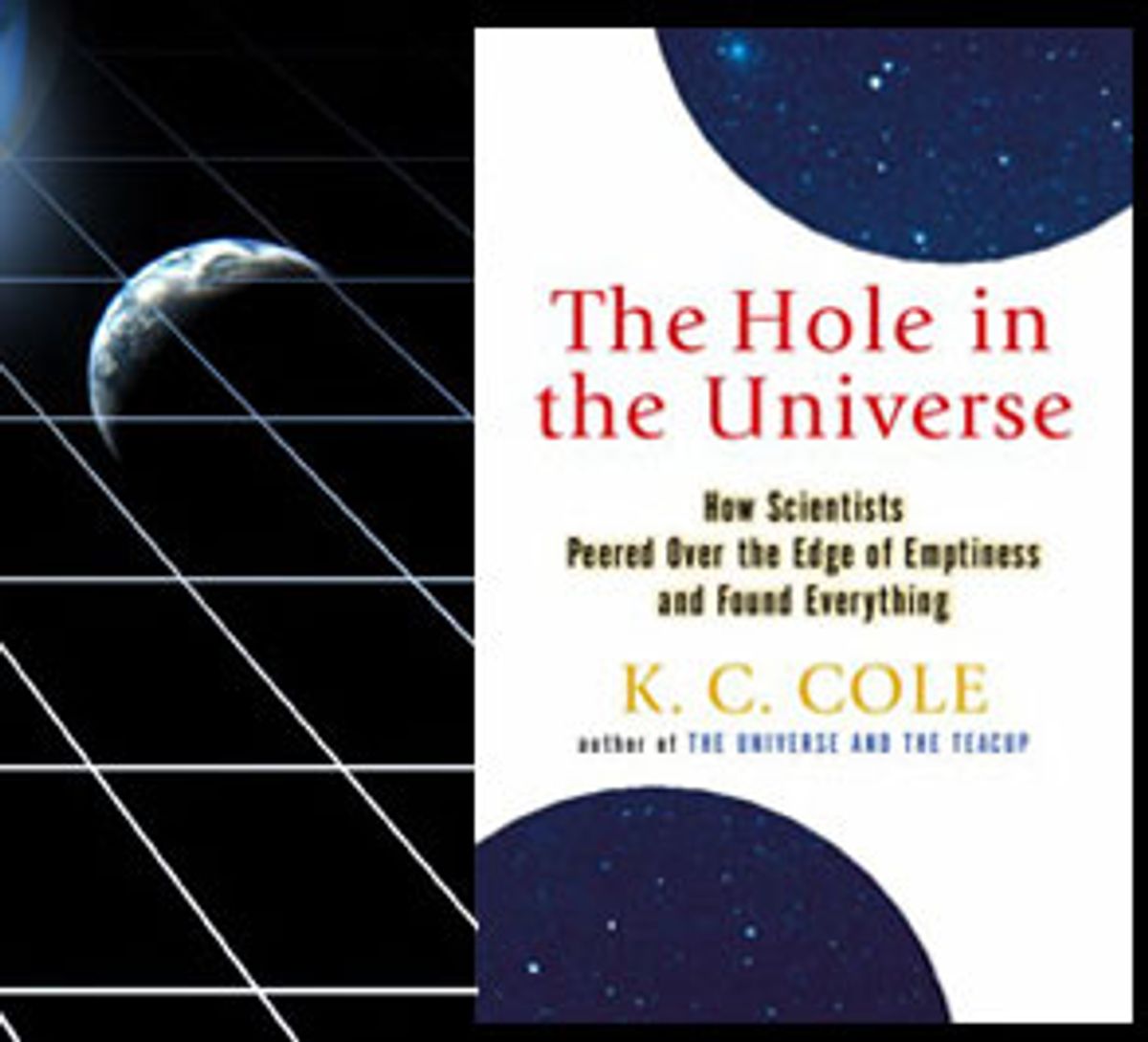
K.C. Cole’s new book is about nothing. “Nothing is far and away the most difficult subject I have attempted to pin down on the pages of a book,” she writes in a foreword. “Grasping ‘nothing’ requires resisting the temptation to follow it wherever it leads, getting lost in the semantic thicket of Nothing puns, or simply bouncing the idea around on one’s knee, stringing together curious facts and ancient history — taking it for a pleasurable, if rather pointless, trip.”
Cole resists two out of three temptations. “The Hole in the Universe” covers current physics and cosmology in simple, energetic prose, without much knee-bouncing or idle following; but Cole indulges in such a tangled thicket of overly cute nothing puns in the first chapter that I’m tempted to say the real book starts on Page 25. Only then does she get down to explaining, clearly, why the vacuum of space is a deep modern riddle.
She starts with a brief, engaging history of zero as a mathematical idea. (The ancient Greeks avoided it; the Italian Fibonacci introduced it with the Arabic number system to Europe, in 1202, where “it was promptly denounced as ‘heathen.’”) Then she details the 19th century notion of a luminiferous ether, which Einstein discredited. “To physicists of Newton’s time and after,” Cole writes, “the ether was the necessary mode of transportation for waves of light. After all, if light was a wave — as most people at the time thought — then there had to be some medium for it to wave through.” The luminiferous ether supposedly filled the vast reaches of space like an ocean.
Einstein disposed of it, though, by proving that light acts as a particle as well as a wave. “Light didn’t need a carrier, or even space, to travel through,” writes Cole. By clarifying the nature of light (and matter), Einstein simplified a mess of contradictory theories and worked a revolution that physicists are still trying to understand. The result, ironically, is a modern version of the old ether, a vision of so-called empty space cluttered with neutrinos, dark matter, antigravity and multidimensional strings. The fact that the void of space doesn’t act like a void is the problem (Einstein predicted it wouldn’t); and modern physics has a menagerie of strange theories to explain why.
One of the strangest, of course, is superstring theory, or M-theory, which Cole explains in a brief, lucid chapter. “As described by M-theory, the entire universe arises from the harmonics of vibrating strings, membranes, and blobs in eleven dimensions.” These strings underlie particles as fundamental building blocks of the universe, meaning their “mode of vibration” determines the identity of a particle (electron, proton, etc.). My favorite part of this chapter is the segment titled “Strings of what?” I was happy to see a science writer pose this question point-blank. But then Cole quotes the Harvard string theorist Andrew Strominger: “You’re not allowed to ask that question. That’s it. It’s just the thing.” Oh.
String theory makes sense only because it solves certain insoluble problems. In the last five years it’s moved from the faddish fringes of science to a more central, respectable place, mainly because it “resolves the glaring mismatch between the laws that rule the large-scale cosmos (Einstein’s theory of gravity) and those that run the microcosmos (quantum mechanics).” No one claims to understand it fully; string theory just seems to work.
One extension of it by Stanford’s Lenny Susskind proposes to explain the universe we know as a holographic projection (via vibrating strings) from a lower, simpler dimension.
“It would mean [writes Cole] that if you want to describe the universe and everything in it — gravity, particles, planets … — the correct information you need to do that lies not on the three-dimensional ‘interior’ we take to be the real physical world. Instead, it is encoded on a lower-dimensional surface. Like a hologram, the universe is a projection of the information on this boundary into space.”
This sounds suspiciously like Hindu dogma to me, but Susskind stumbled on the theory while he was studying something else, and the mathematics have been worked out in detail by the Harvard physicist Juan Maldecena. “Most of us think it’s an absolute fact,” says Susskind.
“A Hole in the Universe” covers roughly the same territory as Stephen Hawking’s “A Brief History of Time,” with the benefit of 10 years’ additional research. Since Cole is a science columnist for the Los Angeles Times, not a physicist, her style is breezier and less exact than Hawking’s. She goes in for too many of the nothing puns and uses certain analogies that aren’t airtight, but overall the book is a strong and sometimes mind-blowing introduction to the edges of modern physics. Its real problem is the tantalizing, unfinished state of physics itself: The book leaves behind so many baffling contradictions that the most glaring void, by the end, seems to be the lack of a present-day Einstein to make it all make sense.
Stephen Hawking is the world’s most famous living scientist for two reasons that (despite his own wishes in the matter) are impossible to disentangle. The first is his disability, a motor neuron disease related to amyotrophic lateral sclerosis (ALS, often referred to as Lou Gehrig’s disease) that, beginning in his late teens, has rendered him severely disabled. Most people, when diagnosed with ALS, live only a few more years; Hawking has survived for 49, turning 70 on Jan. 8. The second source of renown is his work as a theoretical physicist and cosmologist, particularly on the nature of black holes and the origin of the universe.
Even people with no inclination to tackle the brain-bending concepts Hawking outlines in his bestselling 1988 book, “A Brief History of Time,” find his personal story inspiring. In that light, scientific preoccupations they might dismiss as arcane and impractical in an able-bodied person become a metaphor for the human ability to transcend limits. As Hawking himself says in the three-part documentary series “Into the Universe With Stephen Hawking” (you can stream it on Netflix), “Although I cannot move, and have to speak through a computer, in my mind I am free.”
Kitty Ferguson’s “Stephen Hawking: An Unfettered Mind,” as you might be able to guess from its title, fully subscribes to this view, and who can blame her? It is largely the truth about Hawking’s remarkable life. This is the second biography of Hawking that Ferguson has written — the first was published in 1991. A former neighbor of the scientist and his family in Cambridge, England, she also assisted him with his 2001 book, “The Universe in a Nutshell.” “Stephen Hawking: An Unfettered Mind” has both the advantages and the disadvantages of a biography written from such close quarters.
A popular science writer, Ferguson shines at explaining Hawking’s theories, the jovially competitive academic world in which they are hammered out and her subject’s distinctive and evolving intellectual style. One signal Hawking trait is his “robustly healthy history of pulling the rug out from under his own assertions.” This is perhaps most boldly illustrated by the biography’s framing device, Hawking’s inaugural lecture as the Lucasian Professor of Mathematics at Cambridge in 1980. At 38, he foresaw the impending obsolescence of his own field with the discovery of a “theory of everything” that would explain “the universe and everything that happens in it.” By the end of the book, he has decided that such an understanding may finally be unattainable, replaced by a “family of theories,” known as M-theory, that form a patchwork description of the universe we inhabit.
Another characteristic of Hawking’s thought is a move away from “rigorous mathematical proof” toward hunches, or what his longtime friend, physicist Kip Thorne, describes as “high probability and rapid movement towards the ultimate goal.” To catch up on Hawking’s more recent work is to enter a trippy dream landscape, filled with multiple tiny curled-up dimensions and “baby universes” that are “constantly coming into existence all around us, branching off everywhere, even from points inside our bodies, completely undetected by our senses.”
When Hawking was writing “A Brief History of Time,” his colleagues cautioned him that every equation he included would cut the book’s sales in half. There are no equations here, but there are several diagrams, and at one point Ferguson takes the unusual step of informing her readers that her illustrated explication of one of Hawking’s important theories (which is that the universe is finite but has no boundaries, something like the interior surface of a balloon) can be skipped by anyone who finds it too difficult. She also adds that Hawking has approved its accuracy as a simpler description than the one he offered in “A Brief History of Time.” That endorsement shows the advantage of working so closely with one’s subject.
Ferguson is at her best, however, when sorting through the philosophical implications of Hawking’s ideas, especially those in his most recent book, “The Grand Design,” which tackles such classic conundrums as why there is something instead of nothing, why the universe operates according to this particular set of laws instead of another, and why we exist. God comes into these discussions a lot, but since Hawking himself is forever invoking the subject, it is not without justification. Hawking seems to take an impersonal, Spinozan view of the matter, in which the laws of the universe are equated with God (a feeling Einstein shared), but his public pronouncements dance back and forth over the line between theism and atheism.
This could be because Hawking knows how just to tweak the public’s interest in him as an oracular figure, or it could be a genuine affinity, reflected by the fact that he twice married believers. The intersection of Hawking’s personal and scientific life is clearly difficult for Ferguson to get into: for the most part, he adamantly refuses to discuss intimate matters. Hawking’s first wife, Jane, wrote an acrimony-free memoir about their 26 years together, and she also seems to be a friend of Ferguson’s. His second marriage, which lasted 11 years and ended under a murky cloud of abuse accusations (denied by Hawking himself), remains essentially mysterious. Ferguson seems to think the less said about it the better.
Of course, Hawking’s personal struggles can’t be separated from his fame. “It wasn’t unreasonable to suggest that Hawking’s scientific achievement alone would not have made him a celebrity or sold all those books,” Ferguson admits at one point. Hawking himself has suggested that his disability, in denying him physical movement, has intensified his ability to hold and solve problems entirely in his mind. But because he (understandably) does not wish to be defined by it, and because he surely owes much of his success to refusing to dwell on what he can’t do, the fascinating and perhaps fruitful intersection of his disability and his genius goes largely unexplored here.
Even without a more searching treatment of his character, however, Hawking’s remains an irresistible story. His puckish humor and exuberance for life and for ideas are infectious even at a remove. And the ideas themselves could not ask for a better elucidator, not even, dare I say it, Hawking himself. As much as he has relished his celebrity — the cameo appearances on “Star Trek” and “The Simpsons,” the opportunity to travel the world with entourage in tow, the millions of copies of “A Brief History of Time” sold — it is his work as a theoretical physicist that matters most to the man. Giving the rest of us a glimmer of the wonders swirling inside his head is no small feat, and may be the truest portrait of all.
The immense Andromeda galaxy, also known as Messier 31
In his 1977 film “Annie Hall,” Woody Allen depicted his autobiographical avatar, Alvy Singer, at age 9, in the office of a child psychologist. The kid has stopped doing his homework, his mother complains, because of something he read. “The universe is expanding,” Alvy moans to the shrink. “The universe is everything, and if it’s expanding, someday it will break apart and that would be the end of everything … What’s the point?” (“Brooklyn is not expanding!” his mother shrieks back.)
If he’s kept up with the science section, then presumably the past four decades have been a roller coaster for poor Alvy, with astronomers and astrophysicists speculating that the universe would eventually start contracting again (it figures he could never permanently escape Brooklyn), and then deciding that it would go on expanding forever, in fact, that it’s expanding faster and faster. Also, the universe is flat, at least the part of it we can see, which isn’t much. As Richard Panek explains in his lively new account of 20th-century (plus a little 21st-century) cosmology, “The 4 Percent Universe: Dark Matter, Dark Energy and the Race to Discover the Rest of Reality,” 85 percent of everything consists of stuff that’s undetectable to the human senses and profoundly mysterious. And we’re not talking about Staten Island.
“The 4 Percent Universe” is largely an account of the uneasy alliance between astronomers and particle physicists in the quest to grasp what the astronomer Alan Sandage called “the only two numbers to measure in cosmology,” that is, how fast the universe is expanding right now and at what rate that expansion is changing over time — otherwise known as the deceleration parameter. These two figures can tell you how old the universe is and when it will come to an end. But figuring out what those numbers are and above all why they are what they are has been no easy task.
Impetus from the explosion known as the Big Bang (when the universe went from being one very tiny, unimaginably dense particle to, well, everything) seemed to be what was making the universe expand. However, gravity — the attraction between masses — should be exerting a countervailing influence to slow down the force of the Big Bang and eventually cause the universe to suck itself back in. This changeover, however, doesn’t seem to be on the menu, as astronomers discovered during the past 100 or so years, as they developed more and more sophisticated and sensitive instruments with which to make observations. (When the 20th century opened, for example, we were wondering if ours was the only galaxy. Now we’ve identified hundreds of thousands of others.)
Astronomers like Vera Rubin, studying the behavior of galaxies and galaxy clusters (they tend to clump up), noticed that they behaved weirdly, at least as long as you assumed that the only stuff in them was the stuff you could see. It’s as if your breakfast of cinnamon toast arrived at the table looking like nothing more than a spiral of cinnamon floating over the plate. The bread holding it in formation might not be visible, but from the configuration of that cinnamon, you could deduce it was there.
The existence of invisible “dark matter” was first inferred by the Swiss astronomer Fritz Zwicky in the 1930s, but inferring is not the same as demonstrating, and the quest to actually measure a particle of dark matter is ongoing. (“The 4 Percent Universe” follows the story right up to the present day.) Much of Panek’s book is taken up with describing the pitched rivalry between two teams working on methods to determine Sandage’s famous numbers. One, working out of the Lawrence Berkeley National Laboratory and headed by Saul Perlmutter, was oriented more toward physics, while the other, more astronomically minded team was a looser coalition of scientists who chose the Australian Brian Schmidt as their leader.
According to Panek, physicists and astronomers have pretty different working styles, and it’s hard not to root for Schmidt’s team (the High-Z SN Search program), as it bucks the hierarchical customs by which “big gun” senior scientists take credit for the work done by junior team members. Nevertheless, if Perlmutter’s team, the Supernova Cosmology Project (SCP), was less democratic, it still got important results. Both groups independently arrived at the conclusion that the expansion of the universe is accelerating (further evidence for the existence of both dark matter and dark energy), and the race was neck and neck all the way. (Essentially, it was a tie, but you wouldn’t want to say so to a member of either team in a bar.)
They did this by observing supernovae, high-energy stellar explosions that, unlike most other cosmic events, take place over a period of time short enough that mere human beings can watch them unfold. Over the course of the century, astronomers have developed more and more exquisite ways to spot and analyze supernovae in order to determine how far away they are (that is, were — since what we’re really seeing is the light produced by events that happened billions of years ago) and how fast they’re moving.
These efforts have been complicated by the discovery that there are several kinds of supernovae, and by the meddling of factors like cosmic dust. For example, the redness of the light emitted by a supernova can tell you how fast it’s moving away from you (this is a distortion of light waves like the Doppler effect that you hear in sound waves as a siren drives past), but it could look redder than it really is if there’s red dust between the telescope and the supernova.
The backbone narrative of “The 4 Percent Universe” is the story of how High-Z and SCP arrived at their discovery, with the astronomers talking trash about the physicists (and vice versa), duels over who gets time on the Hubble Space Telescope and more than a few dust-ups in the scientific press. The book is as much about how the science got done as about the science itself, and sometimes the false leads and wild goose chases can be confusing to the astronomical novice. Nevertheless, Panek, who has written early accounts of these matters for the New York Times, is a wondrously clear explicator of some thorny concepts, and by the end even cosmological dilettantes will chuckle knowingly upon learning of an e-mail Schmidt sent to one of his team in 1998, that read, “Well Hello Lambda!”
So yes, Alvy, the universe is still expanding, even Brooklyn, and it may indeed break apart someday. But until then, there is still the thrilling mystery of dark matter and dark energy to plumb, so in the meantime, for God’s sake: Do your homework.
A multicolored Perseid meteor striking the sky just to the right from Milky Way.
If you’re able to escape the pervasiveness of city lights in the next few days (or if you live somewhere with actual sky above it) you’ll have the chance to check out the most startling example of “shooting stars” visible to the naked eye — the Perseid meteor shower. Every August the leftover bits of the Swift-Tuttle comet zoom through our atmosphere, producing up to 60 streaks of light an hour, and the peak of the astro-activity is expected after midnight Wednesday night through pre-dawn on Friday.
Fox News has an excellent explanation of the Perseids for laymen, while the Christian Science Monitor covers the pre-shower fireball (actually a tiny meteor) spotted over Alabama this week. NASA scientists compare meteor showers to bugs splatting on your car windshield, and MSNBC has tips on how to enjoy the display effectively. Check out this brief night-vision footage of 2007′s Perseids:
A huge ball of brightly burning gas drifting through a neighboring galaxy may be the heaviest star ever discovered — hundreds of times more massive than the sun, scientists said Wednesday after working out its weight for the first time.
Those behind the find say the star, called R136a1, may once have weighed as much as 320 solar masses. Astrophysicist Paul Crowther said the obese star — twice as heavy as any previously discovered — has already slimmed down considerably over its lifetime.
In fact, it’s burning itself off with such intensity that it shines at nearly 10 million times the luminosity of the sun.
“Unlike humans, these stars are born heavy and lose weight as they age,” said Crowther, an astrophysicist at the University of Sheffield in northern England. “R136a1 is already middle-aged and has undergone an intense weight loss program.”
Crowther said the giant was identified at the center of a star cluster in the Tarantula Nebula, a sprawling cloud of gas and dust in the Large Magellanic Cloud, a galaxy about 165,000 light-years away from our own Milky Way.
The star was the most massive of several giants identified by Crowther and his team in an article in the Monthly Notices of the Royal Astronomical Society.
While other stars can be larger, notably the swollen crimson-colored ones known as red giants, they weigh far less.
Still, the mass of R136a1 and its ilk means they’re tens of times bigger than the Earth’s sun and they’re brighter and hotter, too.
Surface temperatures can surpass 40,000 degrees Celsius (72,000 degrees Fahrenheit), seven times hotter than the sun. They’re also several million times brighter, because the greedy giants tear through their energy reserves far faster than their smaller counterparts.
That also means that massive stars live fast and die young, quickly shedding huge amounts of material and burning themselves out in what are thought to be spectacular explosions.
“The biggest live only 3 million years,” Crowther said. “In astronomy that’s a very short time.”
Small lifespans are one of several reasons why these obese stars are so hard to find. Another is that they’re extremely rare, forming only in the densest star clusters.
Astronomers also have a limited range in which to look for them. In clusters that are too far away, it isn’t always possible to tell if a telescope has picked up on one heavyweight star or two smaller ones in close proximity.
In this case, Crowther’s team re-examined previously known stars to see if they could find an accurate measurement of their weight. The team reviewed archival data from the Hubble Space Telescope and gathered new readings from the European Southern Observatory’s Very Large Telescope at Paranal in Chile.
Scientists who weren’t involved in the find said the results were impressive, although they cautioned it was still possible, although unlikely, that scientists had confused two very close stars for a bigger, single one.
“What they’re characterizing as a single massive star could in fact be a binary system too close to be resolved,” said Mark Krumholz, an astronomer at the University of California, Santa Cruz.
Both he and Phillip Massey, an astronomer with the Lowell Observatory in Arizona, also cautioned that the star’s weight had been inferred using scientific models and that those were subject to change.
But both scientists said the authors had made a strong case, arguing that the solar material being thrown off from feuding stars in a binary system would produce much more powerful X-rays than have been detected.
Crowther acknowledged that R136a1 could have a partner, but he said it was likely to be a much smaller star, meaning that the star’s its birth weight was still considerable — perhaps 300 solar masses instead of 320.
“I think I can safely say that nobody understands quantum mechanics,” wrote Richard Feynman, and given that he won a Nobel Prize in physics, why should you or I want to take a shot at it? Not that you or I could plausibly claim to understand the weird, protean, paradoxical subatomic world that quantum science describes, but anyone reading Manjit Kumar’s “Quantum: Einstein, Bohr and the Great Debate About the Nature of Reality” will surely feel they’ve gotten a bit closer. It’s an exhilarating, if also disorienting, sensation.
“Quantum” orbits around the celebrated fifth Solvay conference, held in Brussels in 1927, a gathering of the greatest minds in 20th-century physics. It was at Solvay that Werner Heisenberg and Max Born presented the theory of quantum mechanics they had been working on for several years under the informal leadership of Niels Bohr. Their understanding of subatomic reality came to be called “the Copenhagen interpretation” (after the location of the Institute of Theoretical Physics, which Bohr ran), and its champions proclaimed it a “closed theory, whose fundamental physical and mathematical assumptions are no longer susceptible of any modification.”
Albert Einstein, also present, disagreed, and the following decades saw a series of intense, if friendly, arguments between Einstein and Bohr — who, as Kumar notes, had a diagram of one of Einstein’s most famous thought experiments up on his office chalkboard on the day he died in 1962. That experiment, which involved the imaginary weighing of a “box filled with light” before and after a single photon is allowed to escape, is an example of the surreal mental territory that “Quantum” explores. Reading it is a bit like lifting the hood of your mind and moving the working parts around; it’s challenging and trippy — as only the Dr. Seuss realm of the quantum can be.
Kumar, a science writer in Britain (where this book was first published, two years ago), makes a point of playing up the collaborative aspects of the evolution of quantum theory, as well as the conflicts; the two can’t really be separated. He begins with Max Planck’s reluctant invention of the “quanta” — an indivisible unit of energy — in 1900. He insisted it was a mere theoretical, most likely temporary “trick,” designed to get certain formulas to work properly. When, five years later, Einstein, during a period of astounding scientific creativity that included his famous paper on special relativity, suggested that light might be made up of “particle-like quanta” (later called photons), he thought of it as his most daring break with the classical physics of Newton. Light, like other forms of energy, had long been believed to flow in continuous waves, not in tiny chunks.
It was in the 1920s that quantum mechanics as we know it was born, with physicists like Heisenberg, Wolfgang Pauli, Erwin Schrödinger and Paul Dirac scrutinizing each other’s proposals, seizing upon weak spots to investigate, discovering little-known laboratory data or mathematical methods that might provide a solution and writing important papers only to find that some theoretician in the hinterlands had gotten there first. It was, as Kumar puts it, “a golden age … unparalleled since the scientific revolution in the 17th century led by Galileo and Newton.” The dollops he offers of these scientists’ personal lives and youths emphasize the importance of teachers, mentors and patrons, as well as those rare individuals, like Bohr, whose tact and generosity aided in keeping things collegial. (By contrast, 17th century science was impeded by the paranoia and secrecy of Newton.)
That it can be hard to wrap your brain around the principles of the subatomic world is a given. It’s a strange kingdom, full of things that don’t exist or exist in two opposite conditions at once until somebody looks at them, particles that influence each other instantaneously despite being separated by lightyears and electrons that move from one place to another without traveling through the space in between. Books on the subject rely on good metaphors, clearly explained, and Kumar delivers them, but “Quantum” is not for the complete novice or those timid souls who quail at the sight of an equation. (I can’t claim to understand the few equations Kumar includes myself, but they don’t scare me away, and I found this book is perfectly intelligible even though I can’t do the math.)
Much of the debate between Einstein and Bohr revolved around Einstein’s intuitive rejection of the implication of the Copenhagen interpretation — which is that objective reality, independent of any observer, doesn’t really exist. Bohr, by contrast (and sounding a lot like Wittgenstein), insisted that physics isn’t concerned with what is but solely with what we can say about it. Not only were these two geniuses battling over where to draw the line between the familiar, cause-and-effect world of classical Newtonian physics and the quantum Wonderland, they were sketching, erasing and resketching the boundary between science and philosophy, debating the nature of reality itself.
Einstein was for many years regarded as a stubborn, even senile holdout against the quantum gospel, but Kumar finds that view simplistic. “Quantum” concludes by surveying developments since the deaths of Bohr and Einstein, such as Bell’s Theorem and the many worlds interpretation, some of which point to critical problems that the Copenhagen interpretation left unresolved. (One is how the phenomenon of the universe came to be in the first place if there was no one to observe the Big Bang.) All of this, the author maintains, has led to “a reconsideration of the long-standing verdict against Einstein in his long-running debate with Bohr.” Instead, he paints Einstein as a partisan of that most precious of scientific tools: the question. That’s why he ends with one of the physicist’s favorite quotations, from the German philosopher Gotthold Lessing: “The aspiration to truth is more precious than its assured possession.”