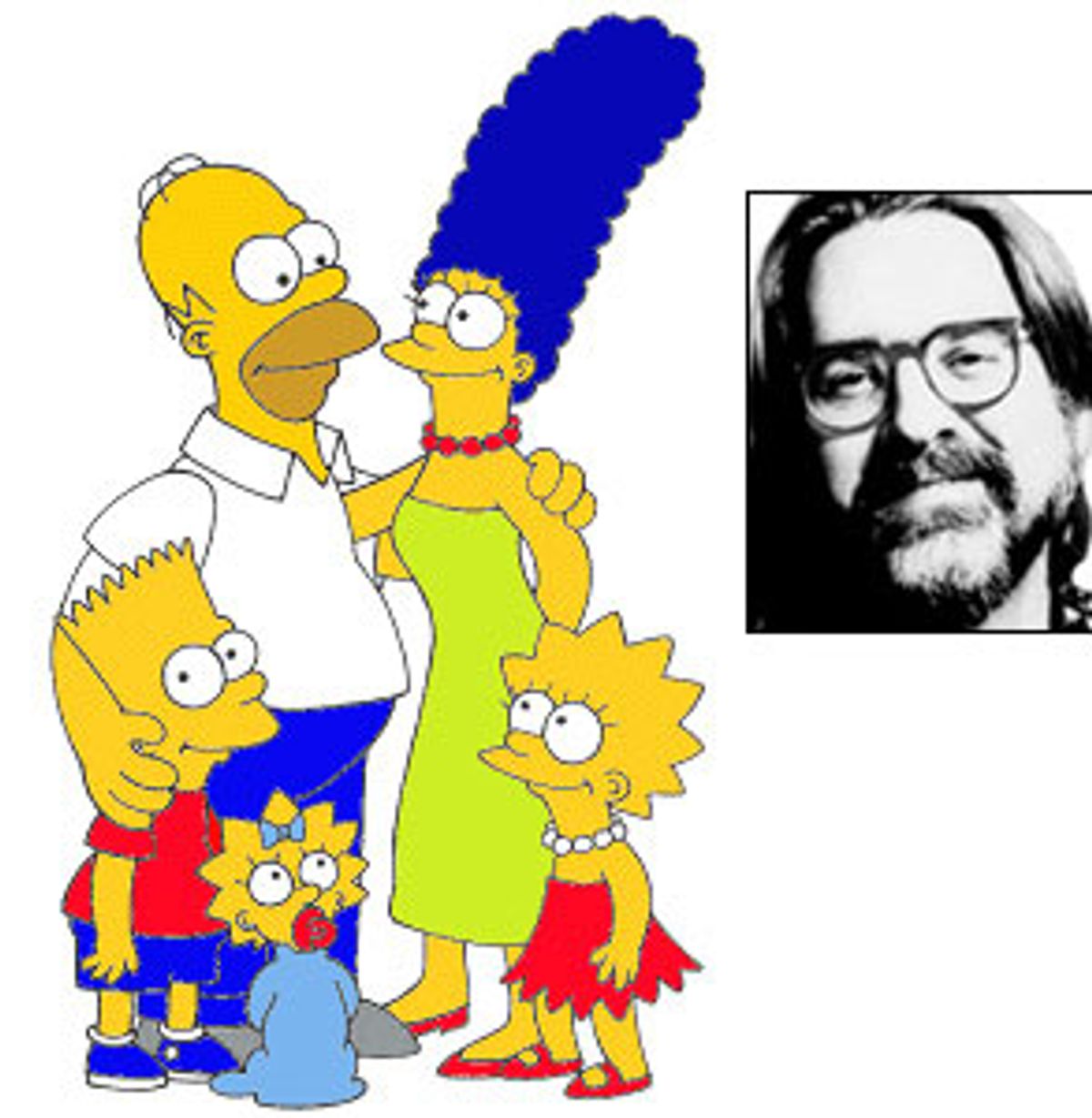
The Simpsons

Matt Groening

"The Simpsons" has made him the ultimate industry insider, but it's the inane decisions and petty betrayals of clueless network executives that keep his trenchant satire fresh.

  • more
    • All Share Services

Matt Groening

Before proceeding to the informational portion of this essay, please take a moment to complete the following questionnaire:

1) Are you disillusioned?
2) Disappointed?
3) Disgusted?
4) Disagreeably damp and jittery?
5) Are you worried you might have accidentally minimized your potential?
6) Are you trapped in a loveless cubicle?
7) Do you question authority when authority is out of earshot?
8) Does this fill you with shame and guilt and cheese puffs?

If you answered yes to one or more of the above questions, you are probably a fan of Matt Groening. If you answered no, you are also probably a fan of Matt Groening. Bush family aside, who is not a fan of Matt Groening? Ever since his syndicated comic strip “Life in Hell” — that series of nihilistic but cuddly dispatches from the epicenter of gloom — first appeared in 1980, Groening has been raising the dampened spirits of the fashionably alienated by dunking Binky, his rabbity, buck-toothed proxy, into a weekly bog of self-pity, anxiety and existential despair. As Flaubert might have said, “Binky, c’est tout le monde.” But mainly, he is Matt Groening.

Or rather, he is the struggling, penurious pre-“Simpsons” Matt Groening. “I judge my life by how miserable it used to be,” Groening told an interviewer last year, speaking of his early days as a lowly alternative cartoonist. “If I could pay my rent, I was deliriously happy. Now I’m deliriously happy all the time.”

But before delirium set in, Groening spun a lingering bad mood and an “accidental” cartooning career into a billion-dollar print, broadcast, merchandising and licensing empire. Some seven years after Binky and his one-eared son, Bongo, first began delving into their epic disaffection, and the heroically insecure (but enterprising) gay twins Akbar and Jeff opened the first of their reprobate money-making “huts,” “The Simpsons,” the first animated series to hit prime time in 20 years, made its television debut.

His mission, Groening has said, was to create a sofa-centric sitcom about a typical American family and turn it upside down in retaliation for all the bad TV he watched as a kid. The message? “That your moral authorities don’t always have your best interests in mind,” he told Mother Jones magazine. “Teachers, principals, clergymen, politicians — for the Simpsons, they’re all goofballs, and I think that’s a great message for kids.” (Statements like these, of course, set off fits of right-wing apoplexy, much to the amusement and delight of everyone else. George Bush once famously regaled the nation with the suggestion that American families should aspire to be “more like the Waltons and less like the Simpsons,” prompting Bart to retort, “But we’re just like the Waltons — we’re both praying for an end to the depression.”)

“The Simpsons” premiered in 1990, and eventually became the most popular, most widely broadcast and one of the longest-running shows in television history. “The Simpsons” has earned Fox’s parent company, Rupert Murdoch’s News Corp., well over a billion dollars, and its role in the network’s growth has been incalculable. The show is watched by more than 60 million people weekly in more than 60 countries around the world — beating out even the lowest-common-denominator friendly “Baywatch” as the world’s most-watched show.

“Simpsons” executive producer Mike Scully, who took over as show runner, or head writer, in 1996, has said that in order to write for “The Simpsons,” a writer must have “a healthy disrespect for everything Americans hold dear.” And judging from the success of “The Simpsons,” what Americans hold most dear is disrespect itself. Nowadays, you can’t throw a rock at a TV set without hitting an irreverent animated social satire. But for a few brief moments in the early ’90s, the idea that anything “alternative” could suddenly overtake the mainstream was still surprising. In 1991, the newly wealthy Groening still seemed to struggle with the central paradox of his career. “I’m a fan of counterculture — of which there is very little right now,” he told Fortune magazine. “What’s happened is that mainstream culture has gotten so good at marketing pseudo-hipness that it overwhelms other choices that are out there.”

Ten years later, at the age of 46, Groening is responsible for a comic strip syndicated in 250 newspapers, more than 25 books, two prime-time animated series and untold containers full of valuable merchandise. And for a guy whose career has been dedicated to skewering television, crass commercialism, “evil billionaire tyrants” (how boss Rupert Murdoch described himself in a cameo on “The Simpsons”) and brainless consumers, Groening sure does love his merchandise. Images of “The Simpsons” have been licensed to sell everything from T-shirts to toys to potato chips to cheese, suggesting that mainstream culture has gotten pretty good at marketing genuine hipness as well.

Twenty-four years ago, Groening was just another unrecognized genius driving to Los Angeles in a crummy car with a coat hanger for a radio antenna. Sometime after midnight on the day of his arrival, his car stalled in the fast lane of the Hollywood Freeway in 100 degree heat. On the radio, a drunken DJ wept a final farewell to his job. It was Groening’s first day in hell. So the story goes, and it has, as they say, legs. The broken-down car has alternately been described as a ’63 Dodge Dart and a ’72 Datsun. The details may vary, but the story, like most of the stories Groening tells about the defining moments in his life, reads like a fairy tale. This one is a Cinderella story: humble beginings, the insidious discouragement of petty authority figures, the unexpected intervention by fairy godproducer James L. Brooks and the eventual (stormy) marriage to a wealthy potentate (Rupert Murdoch’s Fox network).

Groening grew up in Portland, Ore., with a father named Homer, a mother named Marge and sisters named Maggie and Lisa. In high school, he drew cartoons for the school newspaper until he was kicked off the staff. He ran for student body president on the “Teens for Decency” (“If You’re Against Decency, What Are You For?”) platform, and regretted his victory immediately. Later, Groening attended Evergreen State College in Olympia, Wash., which was known for its extremely liberal (no grades, no core requirements) liberal arts program. He befriended fellow cartoonist Lynda Barry and, finding no real authority to rebel against, he turned to cartooning in earnest.

Choosing Los Angeles because it was the place where a writer was most likely to be overpaid, Groening answered a “writer/chauffeur wanted” ad in the L.A. Times. Soon, he was driving an 88-year-old movie director around by day and ghost-writing his autobiography by night while living upstairs from a nocturnal rock lover (whose ceiling light he eventually dislodged with a plunging cinderblock). After graduating to a job at a record store called Licorice Pizza, whose gimmick it was to give away licorice to its customers (but whose employees often found themselves providing free licorice meals to the indigent instead), Groening began drawing “Life in Hell,” a self-published, xeroxed comic book starring Binky, a lonely, alienated rabbit living in low-income Hollywood hell. Groening started sending the comic back home to friends in Portland in lieu of doleful letters about his miserable life. By installment No. 6, the list of recipients had grown from 20 to 500. “Life in Hell” was also sold in the punk corner of the store, where the punks sometimes ripped them up.

“I showed it to the editor of the Los Angeles Reader,” he once told an interviewer, “and he hired me immediately — to deliver newspapers.” Groening worked at the Reader for six years, as a typesetter, editor, paste-up artist and rock critic. The paper offered him a cartoon strip in 1980, and, surprised, Groening accepted. “I never saw anything as crude as my stuff getting published,” he has said.

Six years later, after Groening penned an angry letter to the editor over the dismissal of a writer, the paper fired him by replacing his strip with another cartoonist’s work while Groening was out of town on a book-signing tour for “Work Is Hell.” Groening found out the way everybody else did, by picking up the paper. By then, however, “Life in Hell” was running in several other alternative weeklies, and soon the L.A. Weekly brought him on board. In 1987, Groening married fellow Weekly staffer Deborah Caplan. A few years earlier they had set up their own syndicate, ACME Features, to distribute the strip. A self-published anthology of “Love Is Hell” led to a deal with Pantheon Books, and eventually Caplan began running Life In Hell Inc. The goal of the company, she told Newsweek, was to “keep the machine of Matt going.” (After 13 years of marriage, Caplan filed for divorce in March 1999, the same month as Groening’s second show, “Futurama,” premiered. They have two sons, Homer and Abe, now 13 and 10.)

In the mid ’80s, renowned producer James L. Brooks approached Groening about using the characters from “Life in Hell” on a new show he was developing for comedian Tracey Ullman. Groening knew this would have meant losing ownership rights to his characters, so he decided to start from scratch. As Groening told Spin magazine. “Who knew if this TV thing would pan out?” Needless to say, it panned out.

Groening’s success owes as much to his own work as it does to the work of a slew of others, including co-creators James Brooks and Sam Simon, and “The Simpsons’” writing staff. Though Groening has continued to churn out his comic strip every week, it’s been about a decade since he wrote an episode of “The Simpsons.” The daily task of writing the show is left to a team of writers, whom he calls his “Harvard-grad-brainiac-bastard-eggheads.” In fact, when “Simpsons” writers wax elegaic, they tend to do so about George Meyer, a writer who first became involved with the show late in 1989, a few months before its Fox premiere. Executive producer and show runner Mike Scully once told the New Yorker, “People are always asking why ‘The Simpsons’ is still so good after all these years, and, at the risk of pissing off all the other writers, I think I’d have to say that the main reason is probably George.” Ian Maxtone-Graham, another writer on the show, has said in an interview, “I would rather make George Meyer laugh than get an Emmy.” Groening has said that due to his limited drawing ability, it’s unlikely he could get a job as an animator on “The Simpsons” today. Perhaps, were he to walk in off the street, he could get a job as a writer on the show. But in any case, Groening allowed the series to evolve under the tutelage of his writers, the undisputed champions of television comedy.

Brooks’ and Simon’s hand in shaping the show was significant. It was thanks to Brooks’ reputation that “The Simpsons” was granted a level of autonomy not normally given to television shows — especially one as risky as “The Simpsons” seemed at the time. Simon was also responsible for hiring the writing staff, who shaped the characters into what they are today.

In the 10 years since the debut of “The Simpsons,” however, Groening had gone from semifamous alternative cartoonist to iconic powerhouse. A fan of science fiction, he had been thinking about creating a show about the future for some time. And the idea of creating a show on his own appealed to him. “I think Matt likes the fact that this is more his baby,” Rich Moore, supervising director of Rough Draft, the company that animates “Futurama,” told Spin magazine. “That there’s no Jim Brooks around. I think he kind of wants to prove, maybe to no one but himself, that he can do it without those guys.”

“Futurama” moved away from the family sitcom structure and into dysfunctional workplace territory, a subject that had long inspired Groening. A thousand years in the future — a wry, bleak version of a future where suicide booths and celebrity heads preserved in jars are part of the landscape — work is still hell. The show centers on Fry, a pizza-delivery man who is accidentally frozen in a cryogenics lab and defrosted 1,000 years later. He winds up working for an intergalactic delivery service, with a crew of misfits including Leela, the ship’s one-eyed alien captain and Bender, a corrupt, vice-addled, disgruntled robot. Needless to say, the life-affirming executives at Fox worried that the show was too dark and negative.

Despite the unprecedented success of “The Simpsons,” the process of getting “Futurama” on the air has been described by Groening as “the worst experience of my adult life.” When he and former “Simpsons” show runner David X. Cohen (now the show runner on “Futurama”) first approached Fox with the new idea, the network went into instant paroxysms of ecstasy. Then, no sooner had they ordered 13 episodes than the doubts set in. The network resisted giving Groening the autonomy he needed and plied him with notes. As to the autonomy he’d enjoyed with “The Simpsons,” Groening was told, “We don’t do business like that anymore.”

Not that Fox isn’t grateful: “If you go back 10 years ago, we didn’t have a lot of successful shows on the air,” 20th Century Fox Television co-president Gary Newman told Daily Variety in January 2000, about nine months after the debut of “Futurama.” “To many divisions of this company, ‘The Simpsons’ was the shining light that kept us motivated and believing that our division would grow. What may never happen again is another show that comes along and had the overall importance to a particular company like ‘The Simpsons’ has had for News Corp.”

Groening was outspoken about his criticisms of Fox’s business practices and its inexplicably shabby treatment of him and his new show. “I guess I shouldn’t have been surprised, because this is how everyone is treated [in Hollywood],” he told Mother Jones. “But I thought I would have a little bit more leeway since I made Fox so much money with ‘The Simpsons.’”

Sharing one inane series of meetings, he told the magazine, “I said, ‘Look, I told you “Futurama” is not going to be bland and boring like “The Jetsons.” And it’s not going to be dark and drippy like “Blade Runner.” And they said, ‘Don’t make it like “Blade Runner”!’ I said, ‘It’s not going to be like “Blade Runner.”‘ They said, ‘Make it like “The Jetsons”! You know, “Meet George Jetson. His son Leroy.”‘ And I said, ‘I think it’s Elroy.’ They said, ‘It doesn’t make any difference!’”

The pilot episode of “Futurama” was scheduled to air in the coveted slot between “The Simpsons” and “The X-Files” on Sunday night, and was watched by 19 million viewers. Then Fox moved “Futurama” to Tuesday night, and audiences fell to about 8 million. The show, according to Groening, was “buried.” Eventually, it was moved to Sundays at 8 p.m., but although Fox recently ordered 18 more episodes for next season, Groening, thinking like the businessman that he is, still feels the show could benefit from more aggressive promotion and a better time slot.

Still, it’s clear that Groening’s satire feeds on frustration and the stupidity of others. Were it not for the clueless executives, the inane network decisions, the petty betrayals at the hands of people who benefit from his success, he might have stagnated by now. Despite his status as an ultimate insider, Groening’s writing has always been that of an outsider. In interview after interview, he has recalled his youthful vow never to forget what childhood was like — a gauntlet of petty rules and restrictions that exist only to be broken. When he’s not telling the Cinderella story, the story Groening tells about himself is a David and Goliath story; and the older and more powerful he becomes, the bigger and more powerful the lumbering naysayers standing in his way. From teachers who forced him to rip up his cartoons in front of the class, to the petty tyranny of bosses (“I was told that I would never get a job in the Pacific Northwest in journalism after my disgraceful stewardship of the Cooper Point Journal,” Groening told the graduating class in a commencement address at his alma mater, Evergreen State College. “Hey, they were right!”), to the narrow mentality of newspaper editors (even “alternative” newpaper editors “hated” his approach to obscure rock criticism) to the “timidness” of network executives trying to subject him to “corporate deflavorizer,” to his famous battles with network censors, Groening’s life reads like a series of epic adventures more Quixotic than Homeric in their details. He casts himself as the avenging underdog tilting at windmills, but, in the end, he always returns the conquering hero.

Groening’s position is an interesting one for a satirist to find himself in. He made a name exploring his own alienation and a fortune exposing the absurdities and hypocrisies of our culture, and nowadays, Groening is as powerful an insider as they come. Groening is a guy who lunches with Rupert Murdoch and finds him congenial. And yet he speaks like the kid who just made it big, who still can’t believe his luck. “Do people who don’t have cockroaches and can afford their rent, are they happier?” he said in a Mother Jones interview. “I wake up every morning thinking how lucky I am.”

When asked by Mother Jones if he has ever considered funding “noncommercial enterprises,” he responds, “I knock myself out as a commercial artist, and people come to me all the time with proposals for money-losing endeavors … I like the idea of trying to be successful on some level, at least reaching an audience enough so that you can sustain it and keep on going.” As to his position on the “Simpsons” voice actors’ recent contract negotiations, he told Mother Jones, “I have sympathy. They are incredibly talented, and they deserve a chance to be as rich and miserable as anyone else in Hollywood … Hold out for as much money as you can get, but make the deal.”

Groening himself has always made the deal. “The success of the show,” he has said, “has gone beyond my wildest dreams and worst nightmares.”

Carina Chocano writes about TV for Salon. She is the author of "Do You Love Me or Am I Just Paranoid?" (Villard).

The Simpsons save Halloween, again

Slide show: "The Simpsons'" Halloween special has managed to get better with time. Here are my favorite segments SLIDE SHOW

  • more
    • All Share Services

The Simpsons save Halloween, again

View the slide show

“The Simpsons” airs its latest installment of “Treehouse of Horror” this Sunday — a long-standing tradition that lets an already formally daring cartoon show let its imagination run wild. The “Treehouse” segments have been the show’s most reliably inventive during its second decade; while composing this list of my personal favorite segments (not entire episodes) I was pleasantly surprised by how many installments from the later years ended up claiming slots.

What else is there to say? Oh, right: If you’re wondering where “Dial Z for Zombies” is, it’s No. 11, which means it’s not on here. I love it — especially the immortal line “Is this the end of Zombie Shakespeare?” — but I like these just a little bit more. List your own favorites in the Letters section. To quote Marge in “The Shinning,” go crazy.

View the slide show

Should comedy worry about its shelf life?

A Salon piece about how pop culture references date sitcoms sparks rebuttals -- and "Simpsons" celebrations

  • more
    • All Share Services

Should comedy worry about its shelf life?Homer, Marge and Sideshow Bob in "The Simpsons."

When a comedy builds a lot of its identity around pop culture references, is it hastening its own irrelevance? I asked that question last week in a TV column centered on a handful of new series (mainly “Glee,” “Community” and “Chuck”) and a classic show, “The Simpsons,” 22 years old and counting. The piece sparked many rebuttals, excerpts from which are collected here.

The piece started with an anecdote about watching a fourth-season episode of “The Simpsons,” “Krusty Gets Kancelled,” with my kids. Upon hearing me laugh at a particular gag — action star Rainer Wolfcastle telling “Springfield Squares” host Kent Brockman about his new film, in which a man visits his son at college and is horrified to discover that he has become a nerd — my 7-year-old son laughed, too. Then he asked, “Dad, why is that funny?” I realized my reflexive laughter was generational. I’m in my early 40s, and the joke presumed thorough knowledge of pop culture made within my lifetime, much of it arcane. I realized the entire episode — one of the greatest of all “Simpsons” episodes, without question — was so strongly rooted in pop culture trivia that “if it were a poem, it would need to have nearly as many footnotes as ‘The Waste Land,’” and that “the further away from its original air date we get, the truer that’s going to be.”

So many sitcoms from the post- “Simpsons” era are like that: “Seinfeld,” “Friends,” “Family Guy.” I called them “footnote shows” — programs built around references that feel universal and timeless to viewers of a certain age only because it’s what they grew up with. 

Comedy writers needn’t feel obligated to make every joke and every episode a monument to the eternal verities; sometimes the audience is just looking to unwind after a long day, and a Britney Spears impression or a Charlie Sheen joke is all they want or need, and that’s fine. And pop culture references are not an inherently bad thing, of course, and I said that in the piece. And yes, it’s true, all entertainment — all art — dates eventually. We don’t look at a Rembrandt painting or listen to a Miles Davis record and assume they were made last week.

But hopefully there’s something about the work that transcends the time in which it was created, otherwise it’s ephemeral, disposable. I probably singled out “The Simpsons” because it’s considered a pantheon series, a great and presumably lasting work. And during the first half of its run, it did have certain timeless qualities. The pop culture references were dense and sometimes deep, but there also frequent references to mythology, ancient history, biblical scripture, opera, Broadway musicals, painting and literature: Shakespeare, Vincent van Gogh, Gilbert and Sullivan, Edgar Allan Poe, Mark Twain, you name it. And the best episodes weren’t just a bunch of riffs strung together. There was a coherent, often scathingly funny vision of American life at the core of the series, as well as an intuitive, honest portrait of family and community and human nature; the gags were just wonderful embroidery. But in the last decade, the embroidery has taken over “The Simpsons” — and just about every other TV comedy of any profile that came after it. The only hugely popular half-hour comedy that escaped this fate is CBS’ “Everybody Loves Raymond,” which modeled itself on pre-1970s comedies and consciously strove to avoid topical references altogether.

In a piece titled “Rest Assured, Your Kids Will Get ‘The Simpsons,’” Atlantic blogger Ray Gustini offered a list of five episodes he believed would not date, including “Das Bus,” which Gustini describes as “‘Lord of the Flies’ recast with the children of Springfield elementary. Without the book, we wouldn’t have the episode, which means we wouldn’t have the best last line in any fictional work, ever. Luckily, William Golding is still required high school reading.”

But other writers took issue with the implication that comedy should strive to be anything but funny in any way that it can, using whatever material is handy. 

“Worrying about whether future generations will find a joke funny seems like the perfect way to stifle anyone’s ability to produce something hilarious,” wrote Halle Kiefer of SplitSider. “Beyond that, the value of comedy specifically has often been its immediacy; why wouldn’t we want writers to make jokes that are relevant to their current audience? The reality is that comedy, or any kind of art, doesn’t have to be enduring to be worthy. Additionally, we’re selling kids short by assuming that not understanding a comedic reference will ruin their enjoyment of an entire episode, or movie, or cultural moment in time.”

A couple of writers thought my anecdote about “Krusty Gets Kancelled” disproved my own point. They said the mere fact that I was watching a 1993 episode of “The Simpsons” in 2011 and laughing at it with my 7-year old proved it was, if not timeless, then certainly durable, pop culture references and all.

In a Macleans article titled “Everything Gets Dated,” Jaime Weinman says there’s almost “nothing” TV series creators can do to keep a show from seeming dated, because “almost everything is an era artifact to some degree or another … They become period pieces anyway. Carl Reiner likes to boast about how he kept topical jokes to a minimum on ‘The Dick Van Dyke Show,’ but that show is the ultimate Kennedy/Johnson era time capsule for the hair, the look, and the attitudes encoded into it (like the unquestioned assumption that a talented performer like Laura will give up performing once she gets married).”

Chris Holden of Charge Shot!!! wrote, “The worst sin of the pop culture nerd is to automatically assume that something is funny by mere fact that there’s an obscure cultural reference,” and cited “Family Guy and “South Park” as frequent offenders. But he went on to take issue with the idea that the pop culture references, however plentiful, would necessarily overwhelm a comedy episode, and speed its march toward irrelevance.

“I don’t buy Seitz’ argument that this encyclopedic brain is necessary to understand these jokes on ['Krusty Gets Kancelled']. For one thing, these jokes come so quickly that, even if you miss one, there’s going to be three more in the next ten seconds. Background knowledge of Arnold Schwarzenegger and ‘Kindergarten Cop’ would certainly extend the appreciation of the gag, but it’s certainly not necessary.”

Holden adds, “I’ve been rewatching old ‘Seinfeld’ episodes, and while there are references to Murphy Brown and C. Everett Koop, Kramer’s physical comedy remains funny regardless of what era he’s in.”

The headline of a piece by Entertainment Weekly’s Darren Franich asked, “Will ‘The Simpsons’ still be funny when no one gets the references?” His conclusion: “Short answer: Yes, with an ‘if.’ Long answer: No, with a ‘but.’” Franich continues:

“The ’90s-era ‘Simpsons’ episodes weren’t funny because of the references — they were funny because the writing was snappy, the characters were fully-realized, and the individual episode plots were structured so well. There was wordplay, and farce, and topical satire. (There was also just outright silliness — see Sideshow Bob getting hit by all those rakes.) The references were the icing, not the cake. Also, it’s worth considering that not all referential humor is created equal. Most episodes of ‘Family Guy’ are filled with scattered pop culture tangents, which can bring a pleasant ‘A-Ha!’ feeling if you’re aware of what’s being referenced. But the Christmas episode of ‘Community’ was funny even if you had never seen the claymation ‘Rudolph, the Red-Nosed Reindeer,‘ because the show had a point to make: About Christmas, about friendship, and about Abed’s specific character arc.”

Todd VanDerWerff, a columnist for the Onion A/V Club and a former colleague of mine at The House Next Door, discovered that some of my concerns about “The Simpsons” also applied to the wonderful Simon Pegg-Jessica Stevenson-Edgar Wright sitcom “Spaced,” which VanDerWerff sees as the forerunner to NBC’s pop-culture-saturated and very self-aware “Community.” Fans of ‘Spaced’ have taken VanDerWerff to task for “not sufficiently putting myself in the headspace of someone who was watching the show for the first time in 1999 or 2001.” He continues:

“And, yeah, I haven’t been doing that. Part of that has been because this series is putatively about someone watching the show for the first time in 2011 and seeing how it holds up (quite well, thank you). But another part of that is because no one can ever experience some piece of pop culture all over again and feel the impact of what it was like at the time when it first came into being. I can remember the hubbub that surrounded ‘The Matrix’ or the ‘Star Wars’ prequels. I can remember just how big ‘The X-Files’ was at the time. But I can’t re-experience those emotions, nor can I suddenly feel what it was like to stumble upon ‘Spaced’ in the middle of the night on the tube and realize that these people were talking directly to you. ‘Spaced’ now comes with expectations—expectations a British friend of mine argues have damaged the show, since it creates the idea that this is something more than just a silly comedy—and it’s impossible to entirely set those expectations aside, to pretend it’s 1999 or 2001 all over again.”

Continue Reading Close

Five signs we’ve reached the era of ’90s nostalgia

"Beavis and Butt-Head" are coming back to MTV, but that's only the tip of this baggy jean iceberg

  • more
    • All Share Services

Five signs we've reached the era of '90s nostalgiaThe 90s are back? As if!

Approximately halfway through every decade, we take a look back at the era that preceded us and think, “What the hell was going on back then?” It seemed inconceivable in 1995 that anyone would suffer from ’80s nostalgia when we were too busy scrubbing the Reaganomics out of our Mohawks. But come 2011 and enough time has passed to make the choices of 20 years ago seem pretty cool. Now everyone is getting misty-eyed thinking of John Hughes movies, “Battlestar Galactica” was revived, and we were all talking about New Wave as if we just discovered it.

So it only stands to reason that the next decade to look forward — er, back — to is the ’90s, which last time I checked was a bastion of huge hair, terrible fashion choices, and crappy rave music. But there must have been some good stuff that happened last decade, or this new nostalgia kick wouldn’t be in full swing. Here are five signs that we are all going to be wearing fluorescent-colored fanny packs and talking about Jordan Catalano sooner rather than later.

1. Trend pieces: You know how newspapers are usually the last ones to catch on when something’s cool? That means that by the time a new cultural movement is getting reported on, it’s already too late to stop it. So yesterday’s piece in The Daily about a ’90s comeback is just an arbiter of the re-pre-millennial explosion. Expect the New York Times to figure this out in about 10 months when they write their own trend story … at which point the ’90s won’t be cool anymore.

2. ’90s reprogramming: Announced today, Nickelodeon’s TeenNick will be launching “The 90s Were All That,” a new time slot from midnight to 2 a.m. that will focus exclusively on the retro shows of the station’s heyday. The lineup so far includes “Clarissa Explains It All,” “Kenan & Kel,” “Pete & Pete” and “Rugrats.” What, no “Are You Afraid of the Dark?”

3. Boy band reunions: When New Kids On the Block joined up with Backstreet Boys for a tour last summer thousands of 20- and-30-somethings were suddenly glad they never threw out their Donnie Wahlberg dolls. Irony went out the window around the same time these concerts sold out. Maybe that’s why Justin Bieber recruited Boyz II Men for his Never Say Never tour … even if he was just a baby when the R&B group was selling out stadiums, he knew the power of the ’90s.

4. “Simpsons” love: For awhile in the aughts, Matt Groening’s beloved cartoon had lost its place in the cultural dialogue. While “Family Guy” and “South Park” took center stage with their pop-relevancy, “The Simpsons” seemed content to die a slow death. (Even Groening’s move in creating “Futurama” was taken as a sign that “The Simpsons” had jumped the shark.) But Homer and the gang hung in there, and eventually we got sick of “South Park’s” preaching and “Family Guy’s” predictable cutaways. Matt Zoller Seitz’s new essay on the number of pop culture references in “The Simpsons” further proved that no matter how far we stray, we always come back to our favorite yellow family.

5. “Portlandia”: Fred Armisen and Carrie Brownstein’s sleeper hit “Portlandia” needed more than six episodes on IFC to fill the need it created in our twee little hearts for putting birds on things, Aimee Mann, and a mayor played by Kyle MacLachlan. “Portlandia’s” opening scene is a huge musical number about a magical world that’s stuck in the ’90s (“The tattoo ink never runs dry! All the hot girls wear glasses!”); an epic love song to a decade of coffee shops and pseudo-intellectualism.

Viva la ’90s! Or is it livin’ la vida ’90s?


Continue Reading Close

Drew Grant is a staff writer for Salon. Follow her on Twitter at @videodrew.

Will future generations understand “The Simpsons”?

When shows like "Glee" and "Community" make pop culture references, are they writing their own death certificates?

  • more
    • All Share Services

Will future generations understand Clockwise from left, stills from "Community," "The Simpsons," "Chuck" and "Glee"

I recently rewatched “Krusty Gets Kancelled” from Season 4 of “The Simpsons” with my 13-year-old daughter and 7-year-old son. Krusty the Klown was on “Springfield Squares,” a game show hosted by moonlighting Springfield newsman Kent Brockman and featuring special guest Rainer Wolfcastle, the action film icon. Brockman introduced Wolfcastle as the star of the new movie, “Help, My Son is a Nerd!”

Wolfcastle: “My son returns from a fancy East Coast college, and I’m horrified to find he’s a nerd.”

Kent Brockman: “Ha, ha, ha! I’m laughing already!”

Rainier Wolfcastle: “It’s not a comedy.”

I laughed at this. My son laughed, too — but after a moment he asked, “Dad, why is that funny?”

I told him it was too complicated to explain, because it was.

Wolfcastle was “The Simpsons”‘ stand-in for Arnold Schwarzenegger, a wildly popular movie star circa 1992-93, when that episode first aired. Schwarzenegger built his fortune on bloody action thrillers, but had recently begun playing against type in such dumb but harmless comedies as “Twins” and “Kindergarten Cop.” The movie Wolfcastle was promoting was obviously in that vein, but the plot evoked the 1986 Rodney Dangerfield comedy “Back to School.” Wolfcastle’s line, “It’s not a comedy” was also a joke at the expense of phony ’80s macho; the very idea of nerdiness would horrify a gym-muscled dolt like Wolfcastle.

There were a couple of marginal jokes in the scene, too. Brockman’s moonlighting on “Hollywood Squares” acknowledged a long tradition of newscasters working as game show hosts and commercial pitchmen on the side (see Wallace, Mike). And “Springfield Squares” is a sendup of 1970s game shows in the vein of “Hollywood Squares” and “Tic Tac Dough.” The rest of the episode contained references to the 1929 film “The Great Gabbo,” Eastern European animation, Joey Bishop, “Howdy Doody,” Ed Sullivan’s censoring the lyrics of the Doors’ “Light My Fire,” the 1968 “Elvis” TV special, the Red Hot Chili Peppers’ penchant for nudity, and Bette Midler serenading Johnny Carson during his final week on “The Tonight Show.”

Do all or even most of these gags connect with a viewer under 25 who isn’t a 20th century pop culture junkie? I doubt it. Granted, some of the jokes were inside even for 1992-93 – ”The Great Gabbo” and the Eastern bloc cartoon “Worker and Parasite,” for instance. But most weren’t. They referred to things that were current or that felt that way, thanks to syndication or shared childhood viewing experiences. Circa 2011 that’s no longer the case. “Krusty Gets Kancelled” is one of the greatest of all “Simpsons” episodes, but if it were a poem, it would need to have nearly as many footnotes as “The Waste Land” – and the further away from its original air date we get, the truer that’s going to be.

So much post-”Simpsons” comedy is in that vein: “Seinfeld,” “Friends,” “South Park,” “Family Guy” and its spinoffs. Not to mention such recent arrivals as “Community,” “Chuck,” “Parks and Recreation,” “Glee,” “30 Rock” and the American version of “The Office.” They’re all footnote shows: amusing and perhaps hilarious right now, but likely to be dated in five years, quaint in 10, and borderline impenetrable in 20. Or inadvertently poignant. Or chilling.

Remember Bart and Lisa watching the “School House Rock” parody “I’m an Amendment to Be” in a 1996 episode “The Day the Violence Died“? “It’s one of those campy ’70s throwbacks that appeals to Generation X-ers,” Lisa says. “We need another Vietnam to thin out their ranks,” Bart says coldly — a line that would be a lot funnier if the United States had not, in fact,  gotten involved in another Vietnam seven years later.

Comedies saturated with pop culture references can be a lot of fun, and on a few recent occasions I’ve even used them as a way to connect with my kids. These shows are virtual museums of pop culture history, honoring certain entertainers and works and perhaps introducing them to future generations. After the Madonna and “Rocky Horror” episodes of “Glee,” my daughter and I watched bits of the source material being referred to, and had a fun conversation about appropriation and theft and whether there was any real difference between them. The Madonna episode was especially interesting because it referenced Madonna’s “Material Girl” video, which in turn was a parody of Marilyn Monroe’s “Diamonds Are a Girl’s Best Friend” — which made the “Glee” number a spoof of a spoof.

But all things considered, if I want to bond with my daughter I’d rather take her to lunch or the park. If the first half of “The Simpsons’” endless run has held up, it’s because of the characters and stories, the timing of certain lines and sight gags, and the phenomenal voice work. (When my daughter was an infant, Krusty’s voice used to make her laugh hysterically.) Most episodes of “The Simpsons” made after 1998-99 — the last consistently watchable season — are gag-fests based around Homer’s escalating stupidity and selfishness, and fast-and-furious “SNL”-style pop culture references. “The Simpsons” used to mix highbrow and lowbrow gags, and timeless and timely humor, but that rich mixture was simply too difficult to sustain. So it became a pop culture reference factory, not unlike “The Family Guy” — a consistently ruder, funnier show that was nonetheless never as rich as “The Simpsons,” and that looted Matt Groening’s cartoon like a department store during a blackout.

This season’s “Homer the Father” seemed to acknowledge the show’s tiredness by having Homer become obsessed with a TV Land-style cable channel showing repeats of “Thicker Than Waters,” a fictional 1980s sitcom written by David Mamet. Homer wore an early-’80s-style “Cosby Show”-type sweater the entire time, and when the episode was about to cut to a commercial, Homer said that Bart’s exit line “could be a hell of an act break” but “could use a button.”  That’s the default mode of TV comedy now: Reference-o-Rama. 

You can see it exemplified on NBC’s “Community,” which never met a reference, or a meta-reference, that it didn’t want to embrace and that — like “The Simpsons” — already seems torn between character-and-story-based comedy and something flashier and more disposable. This season’s “Basic Rocket Science” episode  — which lampooned “Apollo 13,” ”2001,” 1980s video game graphics, KFC and TV product placement, among other subjects — was fitfully amusing but quite shallow and forgettable. The Christmas episode — which was built around 1970s-style Rankin-Bass puppetoon imagery — was more surprising, weirder and darker, and ultimately more about the psychology of one major character, Abed Nadir (Danny Pudi), than any of its marginalia. On March 24 the series is airing a sendup of “Pulp Fiction.” How much you wanna bet there’ll be a joke about the choice of subject being very mid-’90s?

The show’s heart often plays like “heart” — much more so than NBC’s “Parks and Recreation,” a more earnest and authentically warm series that has more to do with observable reality than pop culture riffing. Where “Parks and Rec” expertly balances in-the-moment character comedy and reference-based humor (such as Mark’s “I Fell in the Pit” from Season 1, a sendup of pompous early-’90s grunge rock), “Community” is so acutely self-aware that it comments on its own jokes, comments on the fact that it’s commenting on its own jokes, and preemptively guesses how viewers might try to describe it. But the most self-consciously self-conscious episode of “Community” is less shallow and gimmicky than NBC’s “Chuck,” which really does feel like a long “Saturday Night Live” sketch — specifically one of those loopy, half-baked sketches that airs right before the final signoff when nobody’s watching. It’s the “Family Guy” of live-action comedy — which is to say if it were a person, it’d be that kid in the fourth grade who did the same funny catchphrase over and over and always made you laugh until you spit milk through your nose.  It’s a pleasure to know that kid, but his humor doesn’t travel well.

To varying degrees, all these shows have given me joy, and no, I don’t think self-aware comedy is an inherently less worthy form than any other. But there’s a downside: a lack of durability.  Some of the most buzz-worthy TV comedies of the last 25 years have proved as sturdy as tissue paper. Even the great ones from the ’90s (“The Simpsons” and “Seinfeld”) are starting to seem as era-specific as high-top fades and Koosh balls. “I Love Lucy,” ”The Andy Griffith Show,” ”The Mary Tyler Moore Show,” ”Cheers” and other pre-’90s sitcoms didn’t start to seem dated or irrelevant for decades, probably because they kept the pop culture references to a bare minimum; the more recent hit comedies are starting to exude that expired fish stench while they’re still on the air.  Can a show still call itself a comedy if you have to explain why it’s funny?

Continue Reading Close

“Cedar Rapids”: “The Office” meets “The Hangover” in Iowa’s sin city!

In "Cedar Rapids," John C. Reilly and "The Daily Show's" Ed Helms take one raunchy, often-hilarious trip to Iowa

  • more
    • All Share Services

Ed Helms in "Cedar Rapids"(Credit: Zade Rosenthal)

Relentlessly cheerful and arguably a bit too zany, “Cedar Rapids” takes the dudely, profane comic tradition of movies like “The Hangover” and nudges it toward the Middle American mockery of Mike Judge or Matt Groening. Whether you think director Miguel Arteta and writer Phil Johnston are making cruel sport of the motley crew assembled in Iowa’s second-largest city (“City of Five Seasons,” proclaims the municipal website!) for the fictional American Society of Mutual Insurance convention, or laughing along with their flawed but human characters, is exactly the tension that drives the movie.

Either way, “Cedar Rapids” is often hilarious, although I found it so amped-up and overly broad that I was exhausted before the movie was over. Ed Helms of “The Hangover” and TV’s “The Office” stars as the severely unworldly Tim Lippe, a small-town Wisconsin insurance agent whose mettle will be tested in the crucible of Cedar Rapids. If the resulting movie resembles those two influences a bit too much, at least those aren’t bad starting points. Tim is 30ish without so much as a pet, and doesn’t seem to grasp that his clandestine liaisons with his one-time middle-school teacher (a nifty cameo for Sigourney Weaver!) are cougarish recreation, and not the pathway to matrimony.

Tim is well liked by clients, but as his slime-bucket boss (Stephen Root) at BrownStar Insurance tells him, “When I first hired you, I thought: ‘This is a kid who might be going somewhere.’ And then you just didn’t.” But when BrownStar’s studly star agent is felled by a tragicomic calamity, it’s Tim’s turn to step up, go to Cedar Rapids, and come home with ASMI’s “prestigious Two Diamond Award” (almost always described with that epithet) that represents exemplary service to clients, community and God.

Fortunately, right about the time I was getting truly sick of Helms’ Gomer Pyle act and Tim’s implausible, overplayed innocence, he goes to Cedar Rapids and gets sucked into the orbit of the notorious Deanzie (John C. Reilly), ASMI rebel, party animal and all-around speaker of truth to power. Reilly’s enjoyable in almost anything, but Deanzie is a masterwork, from the pitch-perfect Upper Midwest accent to the feverish, disheveled divorced-dad hedonism. Throwing his arms around their third roommate, Ronald (Isiah Whitlock Jr.), who appears to be the only black person at the ASMI meeting, Deanzie crows to Tim, “Haven’t you ever seen a chocolate-vanilla love sandwich?”

That’s only one of several ambiguous gags surrounding Ronald, a buttoned-down, soft-spoken agent from St. Cloud, Minn., who is unmarried and mentions antiquing and community theater among his favorite leisure activities. No one seems to notice, and indeed Deanzie later jocularly accuses him of being scared to show love for another man (either before or after urging the gang toward what he calls the “all-you-can eat pussy buffet”). Whitlock, who once played a state senator on “The Wire,” is also called upon for some pseudo-gangsta talk late in the movie, while extricating Tim from a scrape. So Ronald is the focus of all the racial and sexual anxiety of “Cedar Rapids,” which is asking a lot from a Minnesota insurance salesman. Again, this is how the movie works: Arteta and Johnston try to push us right to the point of total discomfort with their reckless storytelling, and then make us laugh about it.

I suppose it’s progress that this trio of guys is joined by a woman just as bawdy and eager to do shots of Jäger in suburban sports bars as they are. That would be Anne Heche as ASMI femme fatale Joan Ostrowski-Fox (the name is just perfect, isn’t it?), a married woman who actually tells Tim, “What happens in Cedar Rapids stays in Cedar Rapids.” Heche’s delicate performance is in many ways the film’s moral center, and I actually wish her character were explored more fully. Of course, there’s also Bree (Alia Shawkat), the convention hotel’s resident hooker, who introduces Tim to chemical substances and sexual practices he’s never even heard of before — but really, I’m getting ahead of myself. Johnston has a good ear for the quasi-inspirational language of sales culture, and “Cedar Rapids” features a bunch of essentially lovable characters who have to face the most morally compromised situation of all — being American adults. If it resembles an inflated pilot episode for a raunchy sitcom more than a motion picture, at least it looks like a show that won’t bore you or insult your intelligence. 

Continue Reading Close

Page 1 of 16 in The Simpsons