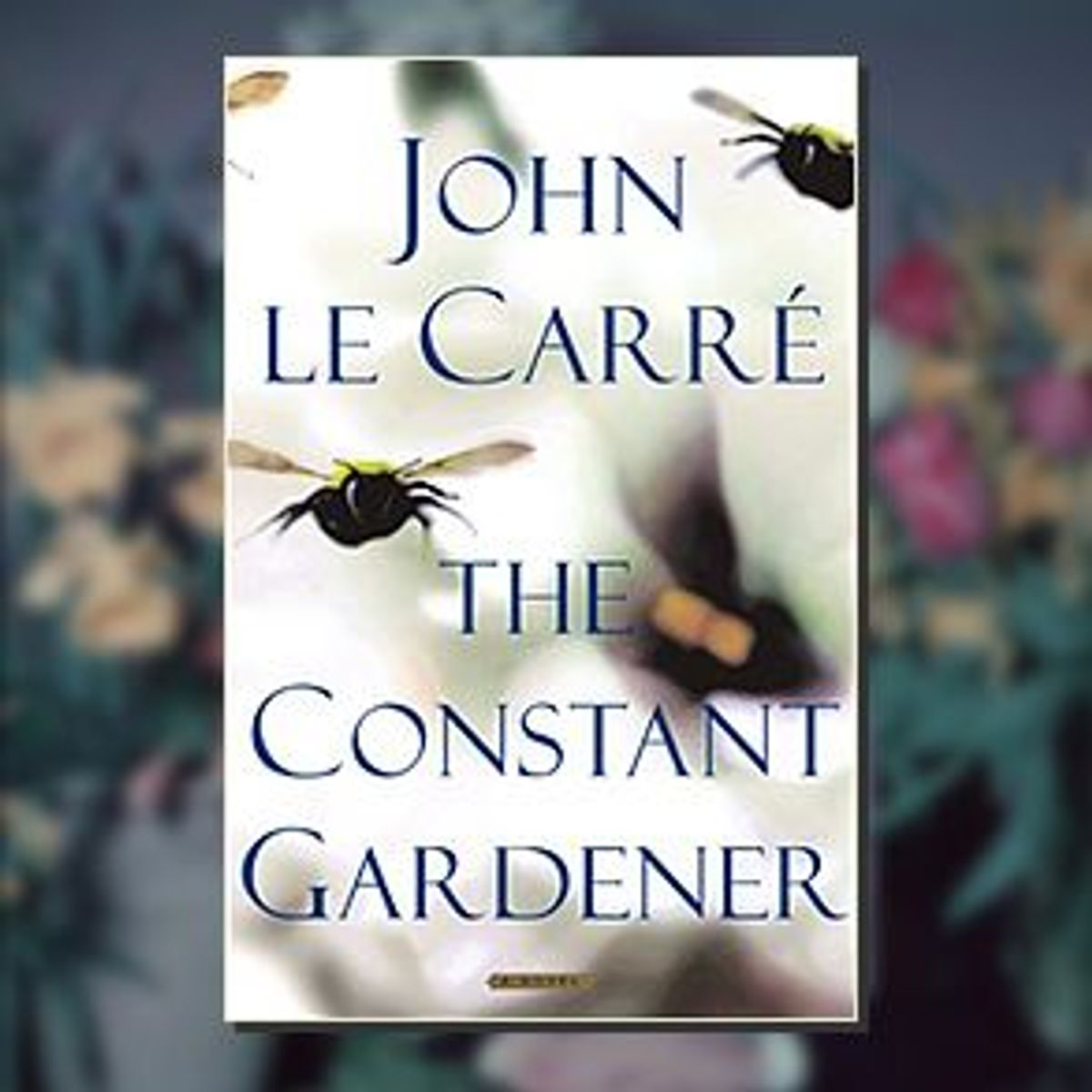
John Le Carre
“The Constant Gardener” by John le Carr
In his darkest novel yet, the master of literary espionage pits a mild-mannered diplomat against a greedy pharmaceutical company that tortures and murders its critics.
The Dostoevskian pessimism that has marked the greatest work of John le Carré reaches a new level in his latest book, “The Constant Gardener.” And once it’s over, the reader is astonished to read this disclaimer in an afterword from the famously opaque author: “By comparison with the reality, my story [is] as tame as a holiday postcard.”
In the book, a pharmaceutical conglomerate tests an unstable new drug on a large number of Africans, with deadly results; crushes opposition from doctors who question the testing process; suborns the governments of nations large and small; operates its own secret service; and, not least, creatively tortures and murders those who might work against it.
This Robert Ludlum-scale conception is tame? It may be true that certain international pharmaceuticals are behaving this badly, but this unthrilling thriller so lacks momentum and grace that it’s not going to force the issue into the public consciousness.
I’m going to discuss the plot in detail, so stop reading if you don’t want it ruined. Le Carré’s message, unsubtle here, is despairing: that in the face of such nefarious corporate power there’s little to be done. Indeed, even the hero of a spy novel — in this case, Justin Quayle, a minor British diplomat stationed in Nairobi, Kenya — can’t hope to compete.
The book opens with the report that Quayle’s wife has been found murdered in a remote northern outpost of the country. She and an activist African doctor had been investigating the deleterious effects of a new tuberculosis drug on patients. The British government, ensnared with the pharmaceutical companies, declines to investigate, leaving the death to look like the to-be-expected end of a political troublemaker on a sex sojourn with a black doctor. Her husband ends up going AWOL and roams the world trying to track down her killers.
That’s the basic story, but it’s much more confusing than that, even by le Carré’s standards. We see the first act through the eyes of Woodrow, another British diplomat. Woodrow is a mess of angst, desire and guilt — he’d written the dead woman a love letter. Woodrow turns out be a red herring, but his persona is vivid enough that when the somewhat indistinct Quayle becomes the tale’s focus, the book seems to drift; it’s difficult to accept his feckless persona as the major character. The wife’s relationship with the doctor is a red herring as well. (There’s nothing wrong with red herrings, of course, but here they are handled bloodlessly: Just a few pages go by, for example, between when Quayle finds the love letter and when he learns that his wife had rejected the advance.)
We know from the start the pharmaceutical company is the culprit, so there’s no suspense to the tale; le Carré thinks we’re going to be so fired up by the polemic this novel disguises that we’ll forgive him the lack of a true narrative arc. Some of his former strengths seem, suddenly, weaknesses. The ironic patois so many of his characters in the past have affected here seems to be in everyone’s mouth; it’s like pushing through a population of hyperverbal character actors. The Dickensian panorama of previous le Carré books might have better set off Quayle’s limpidness; here, it is not made more interesting by contrast with the character of his dead wife, who is a martyred angel. The plot of the book goes something like this: Angel is murdered; milquetoast investigates in milquetoasty way, and gets killed too. Bad guys win.
It’s plain that le Carré is trying to do something important with the latter days of his career. Where his heroes of the past squirmed in the grip of Manichaean forces working on a Cold War scale, they are today loners who stand up and walk into oblivion. “Our Game,” le Carré’s 1995 novel, ventured into the almost nihilistic world of Russia’s war in Chechnya. In the depraved pointlessness of the conflict, the dubiousness of the rebels themselves, the fact that no one outside the region really cared in any case, le Carré found a symbol for the forgotten in an age of globalism. And at the end of that book he created an image to match the theme — an image of philosophical surrender in the face of enormity — that stays with the reader; after the first genocide, he seemed to be saying, there is no other.
Quayle’s end is something else. Having discovered that the battle is being truly engaged in the Western political capitals, he instead returns to Kenya — in effect to give up. He’s symbolic only of a failed career and of marriage to a wife of whom he never seems to have been worthy. While it’s true that the pharmaceutical companies wield too much power, le Carré has sent out to fight them someone who can’t hold down a novel — the chump, you might say, who came in from the cold.
Bill Wyman is the former arts editor of Salon and National Public Radio. More Bill Wyman.
“Killer Elite”: Jason Statham and Clive Owen's dark, stylish thriller
Trashy, semi-coherent and amoral, "Killer Elite" is an enjoyable dose of bewildering '80s espionage
Jason Statham I somehow keep forgetting that the spy thriller called “Killer Elite” actually exists and that I’ve seen it. That probably reflects the fact that it’s a generically enjoyable action film with a bit of hardboiled based-on-a-true-story-ness about it, and since it’s set in the ’80s and feels like an ’80s movie, it seems a lot like something you must have seen years ago. This is shaping up as an awfully tepid endorsement, isn’t it? But I had a reasonably good time, on the whole; if you’d enjoy watching Jason Statham and Clive Owen blow things up, and the idea of a movie that splits the difference between, say, Statham’s “Transporter” films and the cynical espionage universe of John le Carré’s “Tinker Tailor Soldier Spy” appeals to you, then this is a highly viable Saturday night option. Put that on your poster!
Continue Reading Close“Our Kind of Traitor”: Has John le Carr
The latest book by the "The Perfect Spy" author is exquisitely written -- but is the espionage writer out of ideas?
It’s hard enough when presidents younger than you get elected. Imagine the day in almost every popular writer’s career when he starts writing heroes younger than he is. That day came long ago for John le Carré, who used to write about older men, like his famous spymaster George Smiley. Now, turning 79, le Carré creates mostly more youthful protagonists, like the brilliant, idealistic, naive amateur spy Perry Makepiece in his 22nd novel, “Our Kind of Traitor.”
Continue Reading CloseNEA Literature Director and former San Francisco Chronicle book critic David Kipen directs The Big Read, and blogs about it from the road at http://www.arts.gov/bigreadblog/. The author of "The Schreiber Theory: A Radical Rewrite of American Film History," he can be reached at kipend@arts.gov. More David Kipen.
“A great country is being propelled by the wrong forces”
John le Carre talks about his new war-on-terror novel, the "medieval stupidity" of the Bush administration's misuse of intelligence, and why he wound up marching against the war in Iraq.
Spy novels are supposed to be a form of escapism, and most still feature cardboard characters, easy moral decisions and reasonably tidy endings. But a separate vein in espionage fiction, with its roots in novels by Joseph Conrad and Graham Greene, takes the spy — an assumer of false identities and a trader in information, compelled by circumstances to betray his own values — as an exemplar of the modern man or woman: just like us, only more so. John le Carré is today’s master of the unromantic espionage novel. In “Tinker, Tailor, Soldier, Spy” and his other books, hardly anyone is glamorous and by the end you can’t always be sure who, if anyone, is on the side of right. As a result, le Carré never runs out of timely material, no matter what the geopolitical situation may be.
Continue Reading Close
Laura Miller is a senior writer for Salon. She is the author of "The Magician's Book: A Skeptic's Adventures in Narnia" and has a Web site, magiciansbook.com. More Laura Miller.
John Boorman
The director of "The Tailor of Panama" talks about his movie, James Dickey, John le Carri, J.R.R. Tolkien and brothel etiquette.
The 19th century French decadent Octave Mirbeau once wrote that the only thing more mysteriously attractive than beauty was corruption. Were Mirbeau around today, he’d probably smack his lips at British director John Boorman’s latest film, “The Tailor of Panama.” Based on the bestseller by John le Carri, the picture revels in the seedy, humid orgy of Panama in the late ’90s and the various international intrigues surrounding that country’s famous canal.
Continue Reading CloseStephen Lemons is a freelance journalist and regular contributor to Salon. He lives in Los Angeles. More Stephen Lemons.
“The Tailor of Panama”
John Boorman tries on John le Carr
Watching “The Tailor of Panama” feels a little like seeing some strange, exotic bird alight in front of you. John Boorman’s film of the John le Carré novel is a sophisticated, subtle adult entertainment that is also a compliment to the audience — it expresses faith that it will be at home with the tricky, shifting tone.
As strange as it is amid the surrounding fauna, this bird has a lineage. Le Carré’s 1996 novel is itself a gloss on Graham Greene’s “Our Man in Havana”; Boorman’s film recalls Carol Reed’s marvelous 1960 film of the Graham book. They’re both about innocents who cause chaos in a setting of tropical corruption. Graham’s story was about a vacuum cleaner salesman (played in the film by Sir Alec Guinness) recruited by British intelligence. He’s desperate for the extra money the part-time spying brings his way but he can find nothing to report on. So he makes up stories and feeds them to his intelligence handlers. The arrangement works well until his stories lead to real intrigue and real death.
Continue Reading CloseCharles Taylor is a columnist for the Newark Star-Ledger. More Charles Taylor.
Page 1 of 2 in John Le Carre
