Salon Home
Topic

Television

Monday, Feb 5, 2001 6:41 PM UTC2001-02-05T18:41:00Zl, M j, Y g:i A T

I want my XTV!

Since the XFL went large, Vince McMahon has brought his patented mix of action, sex and violence to basketball, "Millionaire" and "Sesame Street."

I want my XTV!
Topics:

The XFL, the in-your-face football league co-owned by wrestling impresario Vince McMahon and NBC, has changed the face not only of American sports but of television as well. The football league’s claim that fans were tired of the NFL’s “pantywaist” version of the game struck a chord with viewers, and the XFL became a sensation, sparking a broadcast revolution.

Here are some of the new sports leagues and shows that have flourished in the XFL’s wake:

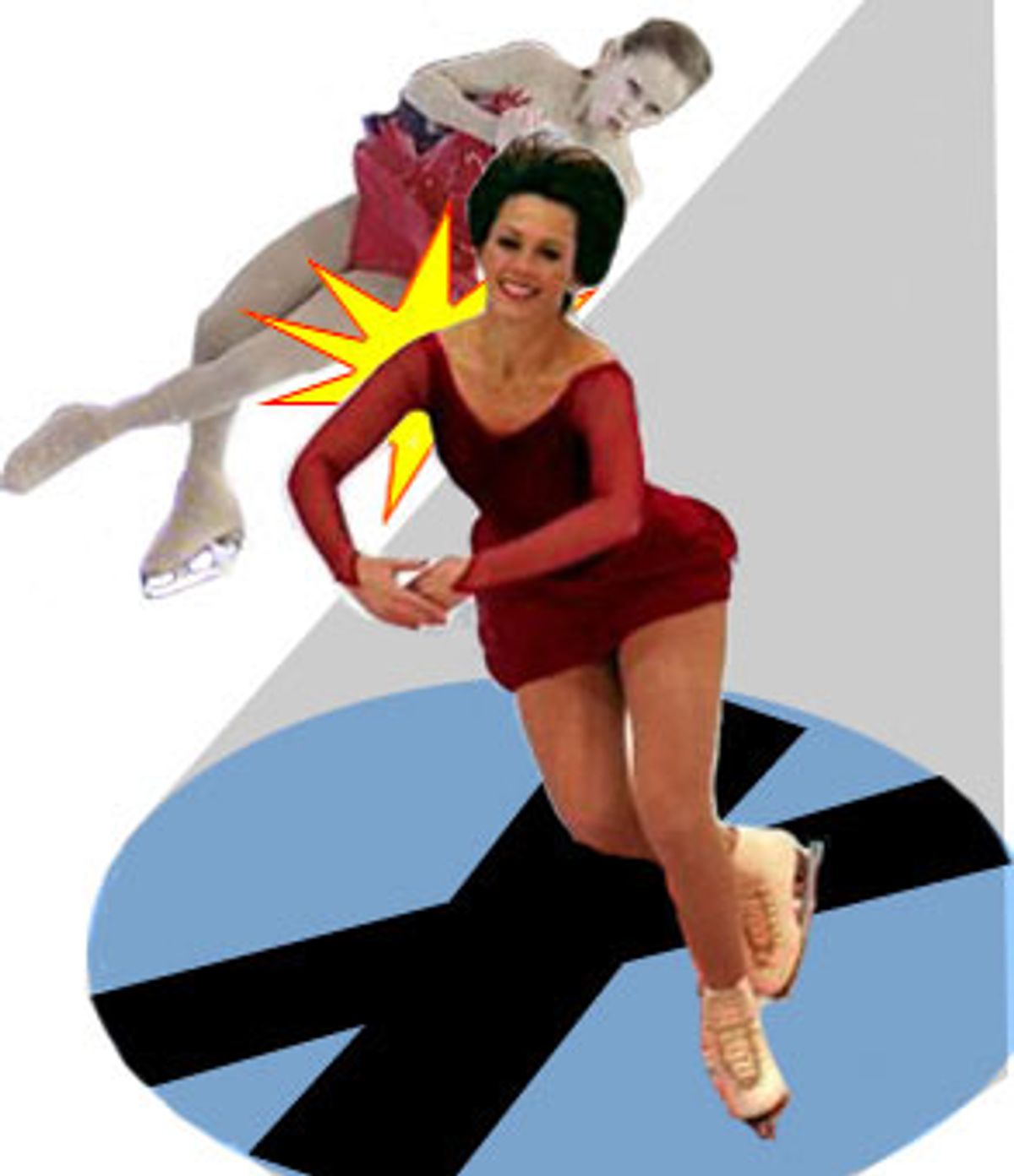
  • “Figure Xkating” “Who watches figure skating?” McMahon asked rhetorically when this “extreme” version debuted. “Chicks. Well, chicks are great, but we’re interested in doing something for the dudes.” And “Figure Xkating” has indeed been a success in the all-important 12-to-24 male demographic, with ratings higher than the NFL and “The Cindy Margolis Show” combined.

  • The XBA “People are tired of the pantywaist NBA and its boring rules,” says director of competition Bill Laimbeer, the former Detroit Pistons star. The XBA has liberal — but strictly enforced, Laimbeer notes — rules on traveling (more than eight steps is walking) and fouls (no blindsiding players who aren’t actually on the court, but otherwise all’s fair). These combine for end-to-end action and a tough, “smashmouth” brand of defense that has kept scores down. “In the NBA,” Laimbeer says, “you breathe on a guy funny and they call a foul. It’s boring. In the XBA, you almost never hear a whistle. The fans get their money’s worth. They get to see action.”

    Like the XFL, the XBA is an “all-access” league, with microphones and cameras on the court, in the team huddles and in the locker rooms. Cheerleaders interview the players during the game. This recent exchange, after Charlie Johnson of the New York/New Jersey Meth Dealers hit a 3-pointer to beat the 10-second clock, is typical:

    CHEERLEADER: Whoa, Charlie! Great shot! What’s up?
    JOHNSON (trying to play defense): Hey, baby (puff, puff). It’s (pant) all about (puff, pant) (unintelligible), you know (puff, puff, pant)? Switch! Oof!
    CHEERLEADER: Whoa! Great screen! Back to you, guys!

  • “Who Wants to Be an X-illionaire” In McMahon’s entry into the game-show market, the cameras swoop above, around and under the contestants in thoroughly confusing ways, and sideline interviewers chat sympathetically with contestants who have just blown a half-million bucks by failing to name the capital of Texas. “People were tired of that pantywaist ‘Who Wants to Be a Millionaire,’ with all those boring questions about boring stuff and those monochrome shirt-tie combos Regis wears,” says host Carmen Electra, whose outfits are quite, uh, colorful.

    Some losing contestants have complained that they’ve been kicked off the show despite answering correctly. Loser Marge Glickson of Reno, Nev., sued after Electra said her answer to a question about why plants need light (“photosynthesis”) was wrong. Producers maintain their answer — “Because Stone Cold says so” — is correct.

    Other contestants have complained about questions that stray from the realm of fact (“What’s the best birthday present a man can get from his wife?” Answer: A threesome) and about the distractions of Electra’s cleavage, the show’s cheerleaders and the constantly “woofing” audience.

  • “X-ame Street” “Kids were tired of those pantywaist kid shows,” says host Gary Coleman. “They want some smashmouth learning.” This first product of McMahon’s Smackdown Television Workshop features many of the same types of characters and situations made famous by “Sesame Street,” but with a twist.

    Big-ass Fowl is a pimp given to wearing feathered hats and teaching kids important life lessons in song, from “Never Trust a Ho” to “Always Keep Your Benjamins on the Outside of the Roll.” In a running joke, a grouch character who lives in a dumpster routinely beats up the “guest” host, who is always former “copy guy” Rob Schneider. Every show is “brought to you by” the letter X, the number 69 and Tequiza beer.

  • The XGA “The element that’s always been missing from golf, the one thing that all the other great sports have,” says director of competition Tonya Harding, “is defense.”

    The sport’s first star was an old friend of Harding’s: Shane Stant. “I’ve always been good with a club,” Stant said after winning the XGA “Misters” tournament.

  • Continue Reading

    King Kaufman is a senior writer for Salon. You can e-mail him at king at salon dot com. Facebook / Twitter / Tumblr  More King Kaufman

    Tuesday, Feb 14, 2012 6:45 PM UTC2012-02-14T18:45:00Zl, M j, Y g:i A T

    Do we still need Black History Month?

    Three great documentaries air, including "More Than A Month," where one filmmaker explores his conflicted feelings

    A still from "More Than a Month"

    A still from "More Than a Month"

    Black History Month is an idea that filmmaker Shukree Hassan Tilghman finds passé. In his documentary “More Than a Month,” which premieres Thursday on PBS’ “Independent Lens,” he walks around with a signboard that says END BLACK HISTORY MONTH and receives plenty of dirty looks. But he also gets more support than he suspected — after he explains that history should be part of the American story, told even during months with more than 28 or 29 days.

    Continue Reading

      More Roger Catlin

    Sunday, Feb 12, 2012 8:00 PM UTC2012-02-12T20:00:00Zl, M j, Y g:i A T

    Ricky Gervais: My conscience never takes a day off

    In a Salon exclusive, the comedian answers critics, explains his hilarious new HBO show, and talks "Office" sequels

    Warwick Davis and Ricky Gervias in "Life's Too Short"

    Warwick Davis and Ricky Gervias in "Life's Too Short"

    Ricky Gervais is not listening to those who say he should pick on someone his own size.

    “Life’s Too Short,” which begins next Sunday on HBO, is a mockumentary that follows Warwick Davis, a real-life showbiz dwarf with a very real small-man syndrome. Like David Brent on “The Office” and Andy Millman on “Extras,” Davis suffers a mean case of self-delusion, even as his career tanks, his wife leaves him and a massive unpaid tax bill comes due. He compares himself to Martin Luther King Jr., while also talking about the importance of his dignity, all while falling out of his SUV or asking strangers to press doorbells he can’t reach.

    Continue Reading

    David Daley is the senior culture editor of Salon.  More David Daley

    Saturday, Feb 11, 2012 2:00 PM UTC2012-02-11T14:00:00Zl, M j, Y g:i A T

    “Walking Dead” creator: Get ready for breakneck pace

    Robert Kirkman heard fans' howls about Season 2 being dull, and promises to bring the action starting Sunday

    The Walking Dead

     (Credit: AMC/Gene Page)

    “The Walking Dead” returns Sunday to AMC to finish its second season, with sheriff Rick Grimes’ revolver still smoking from the first half’s shocking finale. While audience numbers have stayed high, the show has run into problems other than the packs of drooling undead. Showrunner Frank Darabont left for unspecified reasons, the pace of action noticeably dropped – to what creator Robert Kirkman admits now was “a little bit slower than it should” — and the zombies, when they did appear, seemed to be moving a lot faster than you’d expect from a group called walkers.

    Continue Reading

      More Roger Catlin

    Thursday, Feb 9, 2012 1:00 PM UTC2012-02-09T13:00:00Zl, M j, Y g:i A T

    The civil rights battle ignored by the U.S. media

    The documentary "Black Power Mixtape" tells a counter-history of the 1960s, through the eyes of foreign journalists

    A still from "The Black Power Mixtape 1967-1975"

    A still from "The Black Power Mixtape 1967-1975"

    It was tough enough to track the social and political upheaval of the 1960s through domestic news coverage, let alone to pay attention to what the rest of the world was reporting. But journalists from abroad were fascinated by the roiling changes — and often saw it quite differently.

    Though U.S. network coverage of civil rights cruelties helped rally the country against the worst offenders in the South, coverage of revolutionary groups such as the Black Panther Party more often took J. Edgar Hoover’s extremist stance that it was the most dangerous internal threat to the U.S. Rarely did it look at the accomplishments of its free breakfast programs, community organizing and determination to stand up to police harassment and brutality.

    Swedish newsmen and filmmakers who didn’t follow the FBI line came to America to learn what they could, looking at life in largely segregated black America, talking frankly and seriously with black leaders and closely following their trials.

    Footage of the era, said to have been sitting in a Swedish basement for three decades, became the eye-opening documentary “The Black Power Mixtape 1967-1975” making its U.S. television debut on PBS’ “Independent Lens” Thursday night as part of its Black History Month series.

    The modernist title owes in part to filmmaker Göran Hugo Olsson using modern-day commentary, from musicians in many cases, to accompany the found footage. Talib Kweli, Erykah Badu and Ahmir “Questlove” Thompson of the Roots add their contemporary revolutionary musing among commentaries by professors and historians.

    The wealth of Swedish footage owes in part to the Panthers’ desire to see their movement as an international one, or one that certainly relied on support from outside the U.S.

    It is the Panthers’ Embassy in Algeria where Eldridge Cleaver holds court, for example, far from the threat of FBI invasions. Martin Luther King Jr.’s visits to Stockholm to meet King Gustaf VI Adolf that are well preserved, and King’s traveling partner Harry Belafonte recalls the meeting.

    Some of the earliest footage in the film shows a young Stokely Carmichael speaking in Stockholm in 1967, stating in the simplest terms the recent history of black movement in the U.S., carefully stepping beyond the nonviolent action approach by King.

    “In order for nonviolence to work, your opponent has to have a conscience,” he points out coolly. “The United States has none.”

    In some ways, it is the footage of Carmichael, the Student Nonviolent Coordinating Committee and honorary “prime minister” for the Panthers, that is the revelation of “The Black Power Mixtape.” How suppressed has his voice been over the years, even at a time of black history mining?

    It’s certainly eye-opening for modern-day commentator Kweli, who exclaims, “He has so much passion and fire inside of him,” yet remains quite cool. “He seemed like a regular dude.”

    After telling reporters in Stockholm, “I’m not as patient as Dr. King,” Carmichael takes over a Swedish interview of his own mother in Chicago to get to the point: The family’s struggles and limited opportunities can be boiled down to the fact that they are black.

    One gets the sense that Swedish journalists enjoyed visiting black ghettos, where they tried to get a taste of life as they paused for interviews with Huey P. Newton and Kathleen Cleaver.

    The coverage was noted in the U.S. as well, when TV Guide in a cover story complained about its negativity. Swedish reporters interviewed the story’s writer, balancing it with the view of director Emile de Antonio, who dismisses TV Guide as “an absolute nothing magazine.”

    Officially, Sweden had been so critical of America’s role in Vietnam that the U.S. pulled its ambassador from Stockholm in 1968 and ended diplomatic relations with the country altogether for a time in 1972, after Prime Minister Olof Palme compared the bombings of Hanoi with the worst atrocities of Nazis.

    Whatever the diplomatic relations, Swedish journalists certainly took the black revolutionaries more seriously and were plainly excited to be the first TV reporters to talk to an imprisoned Angela Davis. Still, because they worked from the same script, the question soon boiled down to: Do you have to use violence to reach your goals? Davis, receiving her first media visitor, was plainly annoyed by this, in just about the only footage that’s in color rather than black-and-white.

    “When somebody asks me abut violence, I just find it incredible,” she says. “What it means is that the people who ask have no idea what people have gone through, what black people have experienced in this country since the time the first black person was kidnapped from the shores of Africa.”

    The revolutionary tone of the film may provide grist for those on the right who erroneously see PBS as some kind of government-funded left-wing propaganda machine. When was the last time Louis Farrakhan was given a forum to talk about white devils?

    But “The Black Power Mixtape” qualifies as a social history of a revolutionary movement, one quashed by a mid-1970s drug infusion to black neighborhoods that film participants are quite sure was caused by the government.

    More than that, the modern voices in the film are resolute that lessons of the past need to be learned as the struggle goes on.

      More Roger Catlin

    Monday, Feb 6, 2012 3:40 PM UTC2012-02-06T15:40:00Zl, M j, Y g:i A T

    “Smash”: An irresistible take on Marilyn, musicals

    A much-hyped musical -- maybe you've noticed the promos -- pays off big, even for non-theater fans

    Smash

    Katharine McPhee as Karen Cartwright, Megan Hilty as Ivy Lynn  (Credit: NBC/Mark Seliger)

    Topics:,

    I’m a bad gay. I don’t like musicals. I am not a “Gleek” (though I am awestruck by “Glee’s” bold portraits of gay adolescent life  — I’d have given anything to watch a show like that when I was 15). I have trouble suspending disbelief when people spontaneously break into song; I get squirmy and my eyes dart around as if the singer is prancing naked in front of me, and I’m trying to give her privacy, whether or not she wants it.

    So I am not exactly the ideal audience for “Smash,” the new series NBC has been promoting like crazy (the pilot is already posted on Hulu), by playwright Theresa Rebeck (“The Understudy,” “Seminar”), about the making of a Broadway musical about Marilyn Monroe. (That’s this season. If the show gets renewed, we will watch another musical develop throughout the next season — a sort of musical-theater procedural. “Law & Order: The Musical!”) The pilot opens with “American Idol” runner-up Katharine McPhee belting “Somewhere Over the Rainbow,” daydreaming of her Broadway debut while auditioning before an underwhelmed director: For a curmudgeon like me, that has skin-crawl written all over it. Except that I was absolutely, instantly bewitched. By the writing. By the acting. By the story and the stories within the story. Even by — especially by — the music. That credit goes to the Tony-winning team Marc Shaiman and Scott Wittman (“Hairspray”), who wrote more than a dozen original songs for the series, classically great musical-theater numbers that recall Jule Styne, even a little early Sondheim, and are performed only by those striving to be on the stage (no, Debra Messing will not break into song, nor will Anjelica Huston) — at auditions, or practiced at home, or in fantasy sequences — with lyrics that masterfully mirror both the theatrics of musical in progress and the goings-on of the actors’ lives.

    Continue Reading

    Kera Bolonik is a freelance writer. She lives in Brooklyn, N.Y.   More Kera Bolonik

    Page 1 of 495 in Television

    Currently In Salon

    Other News