Language Police

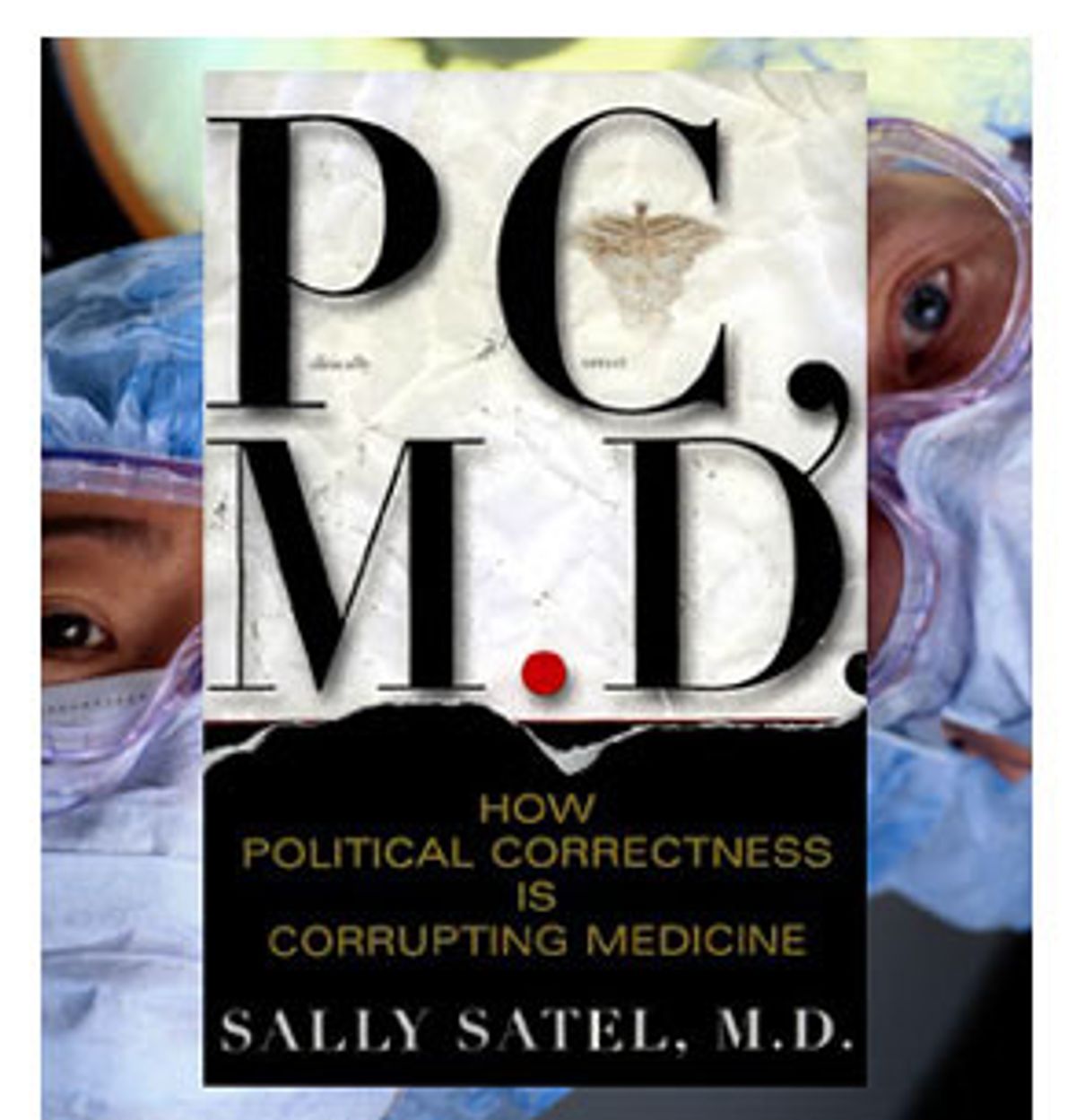
“PC, M.D.” by Sally Satel

A doctor argues that affirmative action and ignoramus patients organizations are ruining American healthcare.

In 1986, Yale surgeon and author Sherwin Nuland was sitting on a bioethics committee that was hearing the case of a heart surgeon who wouldn’t operate on a patient with AIDS because he had abused intravenous drugs.

The patient needed a lifesaving procedure to replace one of the badly infected valves in his heart, but the surgeon said he couldn’t justify the operation for an intravenous-drug user. He rank-ordered patients with HIV, he said unapologetically: He would operate on hemophiliacs who had contracted the disease through blood transfusions and on gay men who had contracted the disease through sex, but he wouldn’t operate on drug abusers who had contracted it through dirty needles. Dumbfounded, Nuland realized at that moment that, for doctors, “the lives that have the most value are those with which we most identify.”

Not much has changed in a decade and a half, and a growing number of studies suggest that perceptions, race and gender do have an effect on the care provided to patients. When I show up in an emergency room with my inevitable heart attack, a number of studies suggest that I will have a much better chance of receiving lifesaving therapy than a white woman, a black man or a black woman, in that order, does. Hispanics in Los Angeles and blacks in Atlanta were much less likely than whites to receive pain medication when they came to the emergency room with broken legs, according to other studies. When they leave the hospital, according to a recent study, many minority patients can’t find the powerful painkillers they need in their neighborhood pharmacies. The disparities, including those in organ transplantation, go on.

But Sally Satel, a practicing psychiatrist, isn’t worried. In her new book, “PC, M.D.,” she dismisses these studies and others as seriously flawed outgrowths of a politically correct movement that’s taking over medicine and threatening to put patients in danger. Satel is more worried that patients are being discouraged from taking greater responsibility for their health. They’re no longer being counseled about improving their diets, taking preventive measures against sexually transmitted diseases or quitting drugs; instead they’re being encouraged to accept their status as victims of an unjust healthcare system founded on racism and sexism. By claiming oppression, groups from nurses to former psychiatric patients are overrunning medicine and championing causes — “therapeutic touch,” “multicultural counseling” and affirmative action in medical school admissions, among others — that are at odds with good patient care. “At best, they create distractions and waste money; at worst, they interfere with effective treatment,” Satel writes

To be sure, there are problems with some of the studies that suggest that racism exists in medicine. For example, a study on differences in the treatment of lung cancer between blacks and whites never asked whether black patients, who fared more poorly, showed up at doctors’ offices later in the course of the disease. But pointing out flaws like this doesn’t make the studies completely invalid. Many studies have flaws; we still base clinical decisions on them. When the sheer mass of studies, each with minor flaws, points in a certain direction, we act on them. When a whole bunch of studies says basically the same thing, we should probably be worried about it.

Most damning to Satel’s argument, however, is that she doesn’t try to deny that minorities don’t have the same access to care that whites do. She just says that the studies fail to prove that these inequalities are due to racism. Unfortunately for her, that’s a pretty major concession. Even if we can accept that all Americans don’t have equal access to country clubs, most of us believe that we should have equal access to healthcare. The data says we don’t, and whether that’s a result of conscious racism, institutional racism or no racism at all, it’s a reality that decent people want to remedy.

Satel also has a real problem differentiating fringe academics from in-the-trenches doctors, or even mainstream doctors. For example, she dwells at length on Brown University public health professor Sally Zierler, whose theories on HIV seem to eschew practical prevention (i.e., condoms) in favor of victimology (i.e., those who don’t use condoms are “seeking sanctuary from racial hatred through sexual connection”). That sounds scary, and it is. But who’s listening? No practicing doctors I know, and Satel doesn’t provide any evidence for any, either.

If Satel’s statistical deconstruction of studies of racism in medicine is convincing to some, she fails completely in her attempts to show that the menace posed by political correctness to medicine is anywhere near as serious as she contends. (“Indoctrinologists,” as Satel terms “politically correct practitioners” of medicine, have “infiltrated” respected academic journals. I think the ghost of Sen. Joe McCarthy is smiling.)

In only a few places in the book does Satel bother to provide any quantitative evidence that “political agendas … are diverting resources from vital clinical tasks” or that political correctness can have “life-or-death consequences.” In one, we learn about a $200,000 teaching grant from the Department of Health and Human Services and a $355,000 research grant from the Department of Defense — both on the subject of a very questionable technique known as therapeutic touch. The technique is crap, as I’ll readily acknowledge; Satel points out, correctly, that a 9-year-old was able to debunk it in a study published in the Journal of the American Medical Association. A similar debunking was posted to Medscape General Medicine, an online medical journal, just last month. But with each department’s annual budget on the order of hundreds of billions of dollars, I just can’t get that exercised about these small grants.

Nor could I get excited about “$40 million in grants [made] available to applicants who wanted to develop trauma programs for women” in 1999, although at least in that case it’s a slightly more substantial sum of money when compared with the $2 billion to $3 billion budget of the grant-making federal agency, the Substance Abuse and Mental Health Services Administration. Even if one agrees with Satel that such grants are a bad thing (hardly self-evident, since in addition to the questionable trauma claimed by many, there is real trauma faced by battered women), she doesn’t say whether the grants were actually made; they were only “made available,” which often means unclaimed.

It would be useful to compare the funds spent on all of the studies and programs Satel finds flawed or useless with the total healthcare budget or some segment of it. That would help determine just what part of the healthcare budget was siphoned off, according to Satel, by the $5 million awarded by New York, the $1.6 million awarded by New Jersey and the $1.2 million awarded by Tennessee to “consumer-run” health organizations in 1995.

Satel’s backup material is sloppy elsewhere as well. In trying to counter the charge that women aren’t included in clinical trials of drugs, rather than find real numbers, Satel simply relies on a professor of psychiatry at Yale and the former head of a Food and Drug Administration division who told her that “women were routinely included” in studies of antidepressants in the 1950s and 1960s. No counts. No data. She lists the percentages of women overall in government-sponsored trials, but the important question is how much of medicine being practiced on women today is based on trials performed on men years ago — and she doesn’t address that.

Satel’s lack of attention to total costs — and to real analysis of data like the number of women in trials — is unacceptable in any sort of rigorous argument. Search high and low for evidence of a larger trend, and all you’ll find is Satel suggesting that “the anecdotal cases I have uncovered are probably the tip of the iceberg.” Simply attacking what Satel considers common-sense health programs can get you painted with the same politically correct brush as the true wackos. In Charleston, S.C., in 1989, police and health officials created a harsh policy that basically equated drug use during pregnancy with child neglect or delivery of drugs to a minor. Of course, the ACLU and other groups were up in arms. Satel launches a tirade against those who opposed the policy, seeming to forget that putting pregnant women in jail is a pretty horrible idea, and that the basis of the policy — that a fetus is a minor — violates Roe vs. Wade.

When Satel decries affirmative action in medical school admissions, she sounds a typical conservative alarm filled with tautologies presented as stunning conclusions. For example, because of fewer opportunities at the high school and college level, minority students admitted to medical school are less prepared for the curriculum, so they do relatively poorly in their courses (and some fail and have to drop out). Then, of course, they do poorly on medical board exams. None of these revelations seems particularly earthshaking, and dwelling on them ignores the intangibles that are probably equally as important as grades in being a doctor — intangibles that Satel spends just a page and a half on. And she offers without comment the idea that women are not rising more quickly through academic medical ranks because they’re taking time off to raise families. It’s 2001. Most reasonable people agree that husbands can and do now shoulder some of that burden.

The thought control Satel is trying to promote seems more dangerous than the wacky ideas of a few public health school faculty members. Satel is trying to wrest control of medicine back from patients, whom she sees as ignoramuses who can’t possibly know what’s good for them. Big, paternalistic government is bad, according to conservatives, but paternalistic medicine is evidently good, according to Satel, who doesn’t seem troubled by the contradiction between diminishing patient autonomy and encouraging patients to take responsibility for their own healthcare. She’s arguing for a remarkable sort of paternalism.

This all fits in nicely with managed care’s plans for the world: Cut down the amount of time doctors can spend with patients, who will then run to the Internet for medical advice. But there they’re more likely to find charlatans and snake-oil salesmen than reasonable medical opinions. Managed care, which presents more clear and present danger to the public’s health than anything denounced in Satel’s book, is barely mentioned. When it is, it’s praised for cutting down lengths of stay in long-term mental hospitals and defended against charges that minorities aren’t well represented in physician rosters. Similarly, Satel ignores the influence of politics on the medical arena when she agrees with certain policies, such as those against abortion.

Satel’s thesis would be less troubling if she presented a clear vision of how to equalize the inequities in healthcare, which she acknowledges, even though she doesn’t think they’re the result of sexism or racism. She seems at one point to encourage “cultural competency” — defined by the American Medical Association as familiarity with the “beliefs, values, actions, customs, and unique health needs of distinct population groups” — although this itself is a politically laden term and her message is muddled.

Satel approvingly cites Anne Fadiman’s “The Spirit Catches You and You Fall Down,” the well-received 1997 book about the cultural clash that resulted when the immigrant parents of a young Hmong girl with severe epilepsy resisted American doctors’ attempts to treat her. “In this account there are no villains,” Satel writes. That’s what the reviews all said, but has Satel actually read the book? While I agree that the book is a more balanced and powerful account of such a story than can be found elsewhere, I finished reading it with the distinct impression that the doctors were the villains, even if well intentioned. (That impression was only bolstered by hearing Fadiman at a recent conference refer to the girl’s persistent vegetative state as being the fault of a medical mistake.)

Satel is a conservative ideologue in a doctor’s white lab coat. Unfortunately, her voice is likely to carry a lot of weight among those who will be setting health policy in the Bush administration. Even Satel agrees that there is a problem in the delivery of healthcare to minorities. Rather than lambasting those who are trying to identify the source of the problem, conservatives should join liberals in trying to figure out how to solve it.

The audacity of “hopefully”

The AP Stylebook makes a change -- and breaks our hearts

It was bad enough last year when Oxford edged toward edging out that most beloved and sensible of punctuation marks, the Oxford comma. This week, the venerable AP Stylebook has decreed that “Hopefully, you will appreciate this style update, announced at #aces2012. We now support the modern usage of hopefully: it’s hoped, we hope.” To which a million language nerds replied, Noooo!

Perhaps you are the sort of person who wasn’t aware that saying things like, “Hopefully, it won’t rain this weekend” has long been considered a grammatical faux pas. One hopes that you received a deeper language-arts education than that. “Hopefully” is an adverb. An adverb, I tells ya, one that means to do something in a hopeful manner. For decades, however, the word has also been a common shorthand for “I hope.”

Those of us who work with words grapple daily with the issue of where we slide and where we take a hard line. I die a little every time I see a “gonna” or “gotta,” and I’ll jump through linguistic hoops to avoid using “they” or “their” for the singular when the gender isn’t specified. There’s nothing like a note – from a teacher, for God’s sake – commanding that “Every child should bring their lunch” to make me want to switch exclusively to Latin. Yet I’m lax about ending sentences with a preposition, treat phrases like sentences for dramatic effect and use “rapey” and “stabby” and other made-up words on a regular basis. And I start half my sentences with conjunctions.

If I take no umbrage with creative punctuation and fanciful adjectives, why am I so distraught over the acceptance of a word already commonly accepted? Why, when I once had an editor insert a “hopefully” in one of my stories, did I react with such shock and horror? Why do I groan when someone says “hysterical” when they mean “hilarious” or “nauseous” instead of “nauseated,” even though I know I’m being far more conservative than even modern grammarians? They’re such small things, after all, little deaths in a world where text and email increasingly make written communication look like old Prince lyrics.

Language is meant to be subverted. (Note bold use of passive voice!) Geniuses like Joyce, Eliot and Cummings didn’t need any stinkin’ AP Stylebook to tell them what to do. The rest of us take what works and is effective and leave the rest, like Cafeteria Catholics of the Elements of Style. But there’s a difference between bending the rules and flat-out sloppiness. There’s a distinction between a layperson willfully playing with language and the guys who are supposed to be in charge throwing in the towel.

That’s what kills about this. It’s the way Associated Press deputy standards editor David Minthorn told the Washington Post Wednesday, “We batted this around, as we do a lot of things, and it just seemed like a logical thing to change. We’re realists over at the AP. You just can’t fight it.” The AP Stylebook can’t fight it? The AP Stylebook? What hope is there, then? First they came for “hopefully” and we said nothing. Who will stand up when they come for “literally”? Who will speak out when someone writes the next “between you and I”? When modifiers dangle, who will smack them back into place?

Writing in the Baltimore Sun,  John E. McIntyre crows this week over this new triumph over “the tribe of Harrumphers” and insists, “Vogue usages tend to irritate purists, because they are popular with the Wrong People.” I don’t think that’s it. Maybe for some, the outrage over the new official recognition of “hopefully” is mere snobbery, but I suspect it’s simple grief for grammar in general and its degradation in classrooms and newsrooms. There’s a sense that rules are no longer being bent; they’re never being learned in the first place. I want an AP Stylebook that I can flout, not one that throws up its hands because nobody cares about it any longer anyway. Language keeps evolving, and that’s fine and natural. Yet as it does, I’ll still gaze hopefully toward a world in which we battle over our words and our rules because we know them so well, and love them so much.

Continue Reading Close
Mary Elizabeth Williams

Mary Elizabeth Williams is a staff writer for Salon and the author of "Gimme Shelter: My Three Years Searching for the American Dream." Follow her on Twitter: @embeedub.

The loud American I swore I’d never be

When I moved from Canada people mocked me for my "aboots." I promised I wouldn't change. I was wrong

(Credit: dundanim via Shutterstock)

If you met me after I moved to America, you would likely notice a few things. I’m tall. I wear a lot of flannel. I have questionable taste in shoes. And I sound absolutely adorable. I know this because I have been told it over and over since I moved from Canada five years ago. “You sound adorable,” said a neighbor in my East Village walk-up during my first week in New York. “Adorable,” said a classmate at grad school orientation, right before he told me that Canadians all seemed dreadfully boring.

I had no idea I even had an accent, let alone that I sounded adorable, before I moved here. But in learning about the way I spoke, I ended up learning a lot about my adopted country — and about myself.

For most Americans, it’s almost impossible to tell a Canadian accent from a Midwestern one. And to be fair, the differences are pretty subtle. We pronounce some of our vowels like the British (something linguists call “Canadian shift”), and raise our diphthongs before voiceless consonants (called “Canadian raising”). But most people identify us by our different ways of pronouncing “au” sounds — which, to some people, sounds like “oot” and “aboot” — and our tendency to say things like “eh” and “heh” at the end of tentatively declarative sentences.

To make it more confusing, most Canadian celebrities seem to lose their accents as soon as they become even mildly famous. You’d never think that Rachel McAdams or Jim Carrey both hail from Ontario by listening to them. The Canadian of the moment, Ryan Gosling, has famously shifted from a Cornwall, Ontario. accent to a butch Brooklyn truck driver accent over the course of his career. There are even companies that specialize in teaching Canadian actors to start talking like Americans.

The thing is, when it comes to accents, the way we perceive them has little to do with the way people actually talk, and everything to do with our prejudices. Italian accents sound sensual because we think of Italians as sensual. German accents sound brusque because we think Germans are cold and calculating.  And, for the longest time, all Americans sounded to me like aggressive jerks.

When I was younger — and living in Edmonton, a frozen city in Western Canada with the world’s largest cowboy boot — family and friends spoke disdainfully about America, and their lack of politeness and deference. They resented the “brain drain”; that so many Canadian professionals were being lured south of the border by big paychecks and prestigious jobs. And I had been repeatedly told about the many ways that America had mistreated Canada over the course of history, from the war of 1812 to NAFTA.

Based on Idaho news reports that were beamed across the border, America seemed like a more dangerous version of home, with a lot more chain restaurants and less firearm safety. I didn’t understand why Canadians would want to move to America. Canada had universal healthcare, and safe cities and an enormous sculpture of a pyrogy on a fork. All anybody seemed to do in Idaho was get shot in a TGI Fridays.

After college, I worked on Canadian TV shows and in strange service jobs in Toronto. I considered opening up a video store with a friend. And then I came across a graduate program in, of all places, New York City. I had been to New York a couple of times as a teenager, and found it both fascinating and unnecessarily pushy. I had traumatic memories of a woman yelling at me when I accidentally touched her purse in a grocery store. I couldn’t imagine myself fitting in there and yet, the graduate program sounded perfect. So I applied, and to my surprise, I got in. I convinced myself that if I went I wouldn’t be a real traitor — it would only be for two years, then I’d move back to Toronto. And I wasn’t going to let America change who I was.

Then the mockery began. As it turns out, to American ears, British people sound smart; French people sound sophisticated; but Canadians sound like teenagers with a learning disability. When I said “about” in graduate seminars, I would hear my classmates snicker. A prospective employer teased me about my accent in a job interview. A man from New Jersey tried to hit on me in a bar by asking me to “say aboot.” When I demurred, he asked me again, three more times. ”I’d like to see someone try this with a Frenchman,” I thought.

The implication was clear: Canadians are pushovers. I had always been quiet and shy, and was used to feeling uncomfortable in social situations, but this rankled. “Americans are self-important,” I would tell my friends back home, “and they laugh whenever I pronounce ‘sorry’ or Regina.” While other transplants were falling in love with the city, convinced they never would want to leave again, I was scrambling to avoid any commitment whatsoever.  I barely decorated my apartment; I tried not to make too many close friends; I eschewed dating. I refused to use anything but the Celsius scale when talking about the weather.

My accent was one of my key forms of resistance, and I started to exaggerate it. I would cartoonishly draw out my “oot” sounds when I met strangers, and I started punctuating my sentences with “eh,” something I had never done before, but everybody seemed to think I should do, since they had seen Canadians do it in movies. My accent became a parody of what it was supposed to sound like, or what I sounded like back home. I was like a German speaker imitating the cast of “Fargo.” A stranger I met in an airport asked me if I came from Alabama, because I sounded “so Southern and proper.” Someone else thought I was South African.

My two-year anniversary in New York came and went, and somehow, I ended up staying. After finishing school, I found a job, and a work visa, and then another one. It wasn’t a conscious choice, but it made sense, and my feelings about New York began to shift. I began to see those trademark American qualities from a new perspective. It wasn’t that New Yorkers were aggressive or insensitive, they were assertive. They could ask for what they wanted. They weren’t self-entitled so much as self-confident. They got things done.

And I started to want those qualities for myself. Now I would complain if my waiter got my order wrong, instead of eating whatever meal he brought me. I started standing my ground against my landlord. I would fight for a place in a crowded subway instead of getting pushed out. At one point, some Swedish tourists were blocking the doors of the subway at my stop. “Excuse me,” I said, without any success. “Get out of my way!” I said again. When that didn’t work, I yelled, “Get the fuck out of the way!” They scattered.

As I left that subway car, I was in shock: Did I really just swear at a group of middle-aged Swedes? Something had fundamentally changed — I wasn’t a polite Canadian anymore. I was something else: An asshole, maybe, but also mostly an impatient New Yorker. I felt like a new, assertive person. And, as time went by, I stopped noticing the fact that Americans spoke differently than me. The jokes about my accent dwindled. Despite my best intentions, I started to belong.

A few weeks ago, my friend Steve came to visit New York for the first time. We had grown up together in Edmonton, and we hadn’t seen each other in a long time. Midway through our dinner, he said, “Thomas, you sound like an American. I can’t hear your Canadian accent anymore. On top of that, you speak so much more aggressively. It’s like you’re always yelling.”

“WHAT ARE YOU TALKING ABOUT?!” I screamed.

Over the last five years, my accent’s makeover has mirrored my own transformation from shy, deferential Canadian into a moderately assertive American. I suppose it’s a very mild version of what other immigrants go through upon their arrival in the United States — the thousands of non-English speakers who face culture shock and widespread discrimination every year — but it proves that whenever we arrive in a foreign place, we all have to figure out who we are and what we want to be. Our prejudices shatter and shift. It’s not a sign of weakness — it’s a sign of growth.

When I visit home, I may no longer sound like the person I expected I would be. I sound like the person I am. And that’s just fine with me.

Continue Reading Close
Thomas Rogers

Thomas Rogers is Salon's Arts Editor.

Concise Oxford Dictionary adds “sexting,” “woot”

"Current English" lexicon welcomes words that range from "cyberbullying" to "jeggings"

In 1911, Henry and Frank Fowler published “a completely different kind of dictionary, one that sought primarily to cover the language of its own time” — the first Concise Oxford Dictionary. This year, the 12th edition of the popular lexicon hits shelves, complete with several hundred new entries.

The “Concise” differs from its behemoth cousin, the OED, in philosophy as well as size. As the following promotional video explains, the shorter work aims to provide an accessible guide to “current English” — the language as it is actually used day-to-day — rather than a survey of its words’ historical meaning. (Where size is concerned, it’s worth noting that the new COD boasts just over 240,000 words and phrases, compared to the 20-volume OED‘s 600,000.)

The dictionary’s centenary edition has adopted words from the technological sphere — such as “cyberbullying,” “cloud computing” and “sexting” (even the exclamation “woot” can now celebrate its lexicographical coming-out) — as well as others more descriptive of lifestyle, e.g., “domestic goddess,” “cougar,” “carbon footprint” and “jeggings.” (If all these newfangled terms make you nervous, you may want to bypass the new volume and purchase a facsimile of the 1911 edition.)

At the Oxford University Press blog, Angus Stevenson provides some history, pointing out notable entries from the original edition of the “Concise”:

[In 1911, the Fowler brothers] stated that ‘we admit colloquial, facetious, slang, and vulgar expressions with freedom, merely attaching a cautionary label.’ Among the slang words they included were flapper, ‘girl not yet out [in society]‘, foozle, ‘do clumsily, bungle, make a mess of’, mag, ‘halfpenny’, piffle, ‘talk or act feebly, trifle’, and potty, ‘trivial, small.’

Dictionary compilation is a necessary, but probably largely thankless, task; we can’t resist sharing this clip from “Black Adder the Third,” in which the show’s creators imagine the agonies Samuel Johnson experienced in the course of his own lexicographical efforts.

Continue Reading Close

Emma Mustich is a Salon contributor. Follow her on Twitter: @emustich.

Abusing the word “rape”

The use of it as a punchline and lazy shorthand for awful experiences is a reminder that language matters

Just yesterday, I wrote critically about the push to use the term “birth rape” to describe abusive experiences during labor. Today, the U.K. Guardian kicked off a related debate with an excellent piece about “the rise of rape talk.”

Kira Cochrane writes that “the use of the word ‘rape’ to describe all kinds of bad experience — from getting beaten up in a boxing match, to having your hairdo completely ruined — has recently become usual, average, shruggable.” She compares this linguistic shift to how “the word ‘gay’ has been twisted by pop culture, used to refer to someone or something a bit uncool” — rape is “now regularly used where ‘nightmare’ or an apt expletive would previously have been in order.” She gives some familiar examples: “Twilight’s” Kristen Stewart comparing being hounded by paps to being raped, that controversial scene in “Observe and Report” and the usual vitriol from Glenn Beck and Rush Limbaugh. Cochrane also gives a more startling personal example:

Coming out of an exercise class recently, a guy turned to one of my friends, sweating and breathless, and heaved a sigh of satisfied exhaustion. “Wow, that was just like being raped, wasn’t it?” he said. My friend stood motionless, blinking back at him.

I sat motionless, blinking back at my computer screen after reading that.

Rape isn’t just casually used as a synonym for nightmarish experiences — it’s also relied on as an easy punch line. A few months back, I found myself co-judging a San Francisco literary competition, an event less focused on books than, you know, boozy good times (hence my being qualified to judge, wah-wah). One of the performers, a dude, read a humor piece that used a male rape scene as a comedic climax, so to speak. When it came time to evaluate the performance, a fellow female judge and I were like: Dude, making fun of male rape is lame. That mild statement got us booed.

Some people really love their rape jokes! I can understand, in a way. Hyperbole and political incorrectness are among comedians’ favorite tricks. Make someone squirm and you just might also make them laugh. It’s also true that language is fluid and there’s a legitimate place for dramatic wordplay. Even if you don’t consider rape to be comedic gold or a useful synonym, there is still a reasonable argument against censorship. But I have no interest in unilaterally policing language and personal expression. I do, however, reserve the right to pass judgment about how other people use language. So, go forth, express yourselves freely — but maybe first consider what anti-rape activist Sandy Brindley tells the Guardian: “Rape is so particularly traumatic and so meaningful in so many ways, that there’s something about using the word in other contexts that diminishes the reality of it, and the impact it has on women’s lives.”

Continue Reading Close
Tracy Clark-Flory

Tracy Clark-Flory is a staff writer at Salon. Follow @tracyclarkflory on Twitter.

The ridiculous “$#*! My Dad Says” controversy

The title of CBS's new fall TV show is drawing complaints, but hiding that swear word isn't going to protect kids

CBS officially refers to it in print as “$#*! My Dad Says.” In promos, it’s “Bleep My Dad Says” — not “[bleep sound] My Dad Says,” but “Bleep My Dad Says.” And its identifying image, of William Shatner with tape over his mouth, makes it clear this sitcom is well aware of that which cannot be said. It’s shit. As in, the Twitter phenomenon Shit My Dad Says, the thing that turned into the best-selling book “Sh*t My Dad Says,” now watered down even further into a series of nonsensical characters to become a prime-time sitcom on the Tiffany network.

But even the mere suggestion of profanity is enough to set concerned viewers reaching for the smelling salts and threatening to boycott the show’s advertisers. On Monday, the Parents Television Council informed the world that CBS is “on notice,” stating, “Unless or until CBS chooses a different title for this program, we are urging advertisers to avoid sponsoring such an abomination purported to be lighthearted fun.” Bitch, please.

As James Poniewozik observed in his Time blog Wednesday, the outrage seems to be having less effect on advertisers than the apparent banality of the show itself.  He further astutely points out that the concern isn’t entirely baseless — and separating adult- and child-friendly content is unenviably challenging when it comes to the title of a show or a movie, as last spring’s tap dancing around “Kick-Ass” proved.  

I don’t think life has to be one big potty-mouthed free for all, even if my own frequently resembles a Mamet play directed by Quentin Tarantino and starring a cast of Teamsters who’ve just stubbed their toes. The nuances of audience and intention are key. A person’s ears and eyes – and those of that person’s children – are entitled to the courtesy of reasonable moderation. Yet when I see Dollar Sign Hashtag Asterisk Exclamation Point My Dad Says, I do not think, you haven’t sufficiently protected my family from this “abomination,” CBS! My main concern for my children is that now I have to explain the damn reasoning behind it. Sorry, kids, some people are offended by certain words, so they came up with this bullshit way of symbolizing it without saying it. Which is how my kids wind up learning the word “bullshit.”

In trying to use profanity while not technically articulating it, we wind up in a loophole realm of self-aware absurdity.  Just look at the gleeful way programs like “The Daily Show” and “South Park” lavishly throw around the bleep button. That’s not avoiding the words — it’s brattily getting around them, in a gambit as old as a chorus of “Miss Lucy.” What point does a bleep or a series of dashes make, when all it does is dress a word in a sexy, see-through protective layer, the better to be unwrapped in your own mind? Oh, F-word,  I know what a nasty little thing you really are when you get together with your last three letters. You are not boinking or canoodling or doing the do, are you? No, you’re the reason nobody ever asks, What the “make love”?

I don’t get ruffled about run-of-the-mill cursing, and I think Goldman Sachs’ recent edict that employees not use cuss words — even if they judiciously throw in the asterisk — is hilarious. (Also hilarious — that the company won’t tell its staff outright what those verboten words are.) But I do understand the tremendous power of words to be truly hurtful and offensive. There are a handful with a long, rich history of demeaning and belittling others, and I don’t have enough hate within me to apply them to anyone else. Yet even then, does it mean they can’t be said?

This summer, the news media’s twisting of itself into contortions to report the content of Mel Gibson’s alleged tirades without coming out and repeating the words he used has been a spectacle unto itself. When I’ve written about the controversy, I’ve used them without equivocation, because they are the crux of the story. And there’s got to be a difference between being the guy who calls his girlfriend a “cunt” and being the person who says, “that guy called his girlfriend a cunt.”

There wouldn’t be much point in having ostensibly naughty words if they didn’t make us feel so good saying them — and if there weren’t anybody around to get pissed off when we do. That’s precisely why CBS opted not to call its new series “Stuff My Dad Says” – where’s the mischief in that? Yet when my daughters sing along with Avril Lavigne’s “Girlfriend,” changing the lyrics to “Bleep yeah I’m the mother bleeping princess,” I don’t think I’ve done my job to shield them from foul words. I just think they’ve watched enough television to catch on to the cleverest bad word the English language evolved. I’m not fooled. And as an all-purpose mot juste, “bleep” can kiss my ass.

Continue Reading Close
Mary Elizabeth Williams

Mary Elizabeth Williams is a staff writer for Salon and the author of "Gimme Shelter: My Three Years Searching for the American Dream." Follow her on Twitter: @embeedub.

Page 1 of 4 in Language Police