Computers

Bunker fever

Y2K never quite happened. When you're paranoid, that's a tough pill to swallow.

Cynthia Beal, a natural-foods grocer in Eugene, Ore., assures me that she was never one of those “Y2K doomers” — the Chicken Littles predicting the end of the world as we know it. Instead she counted herself among the “alarmists” — people who were “working to fix the problem, and admitted they had no idea how bad it would be but were erring on the side of caution.”

And as concern about the year 2000 computer bug grew throughout the buildup to New Year’s Eve, “it became increasingly clear that the problem was larger than anyone was admitting readily. It was a formula for grounded paranoia, and put me in mind of the old saying ‘Just because you’re paranoid doesn’t mean they aren’t out to get you,’” Beal says.

Grounded or not, paranoia was our collective reaction to the year 2000 problem. You didn’t have to cower in a bunker with your kerosene and gun stockpile to feel a jittery unease at that weird moment when the government, the media, all the experts and even geeks admitted that they just didn’t know what was going to happen. But after the rollover passed without planes falling out of the sky, mass power outages or nuclear meltdown, Y2K fears just faded into a fond memory of laughable “millennial hysteria.”

But not for everyone. Beal’s of the opinion that we still don’t really know what happened and we may never: “With Y2K, we still don’t know if we fell out of a plane and walked away from a haystack, or simply tripped over a crack in the sidewalk. Heck, we don’t even know if we’re still in free fall or not,” she says.

More than a year after the rollover, it’s not over for some of the community activists, organizers and technologists who dedicated themselves to confronting the Y2K bug for months or years of their life. For the Y2K faithful, it wasn’t over on Jan. 1, 2000, and it wasn’t over on Jan. 1, 2001. Many think that, today, the Y2K bug still walks among us, and as a society we haven’t even begun to realize the damage it has caused. The absence of utter chaos on Jan. 1, 2000, didn’t assuage their fears — it just confirmed their convictions that the truth about Y2K is still being kept from us.

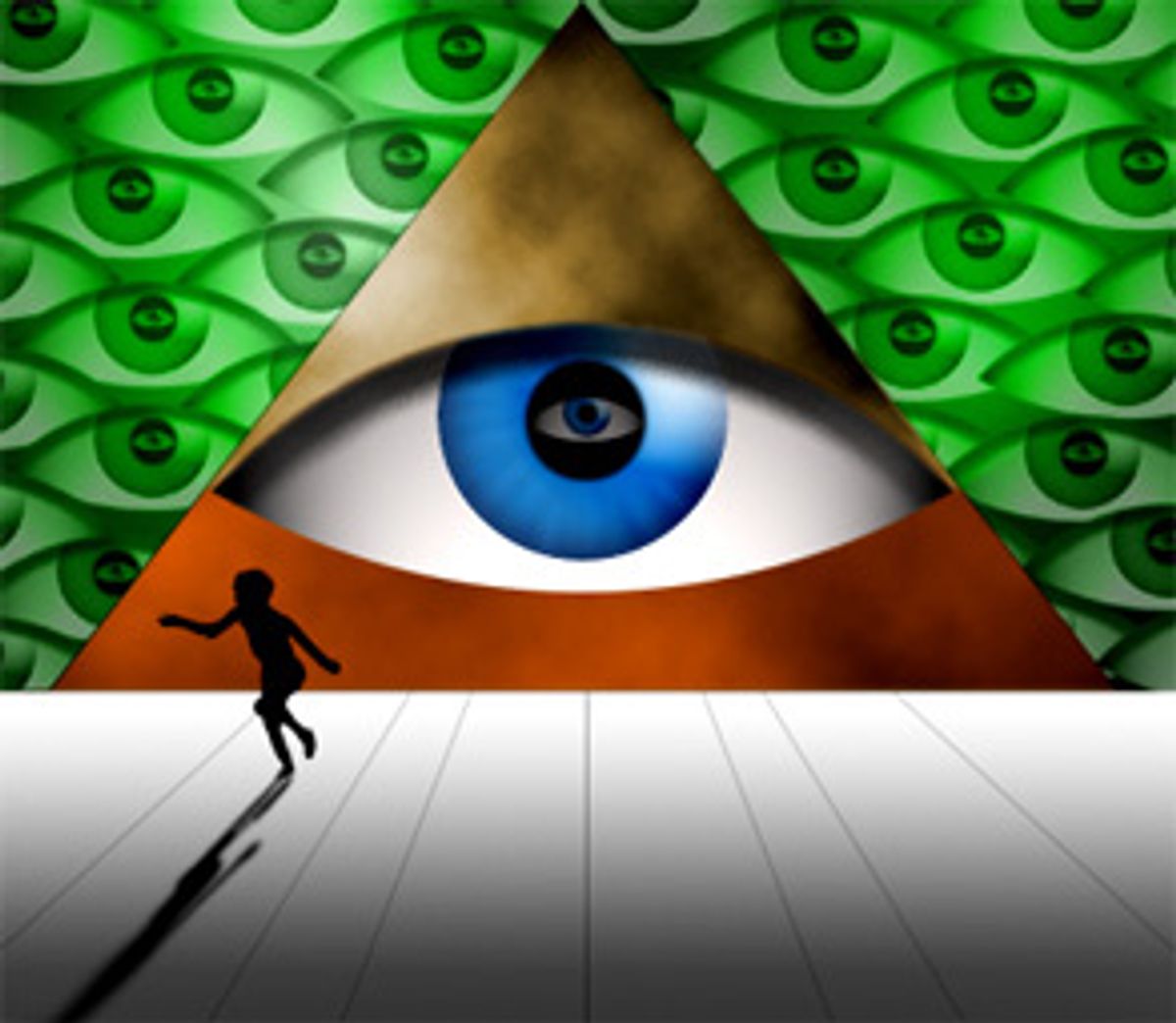
The Y2K faithful are a great example of just how deep paranoia runs in our culture. They want to believe that there’s a coverup, that the real truth is being hidden from us by a corrupt media, government and business elite. Even when confronted with hard evidence that the world is intact — and not just evidence reported by the media, which scoured the globe in search of Y2K meltdowns — they refuse to give up the fears.

Today, if you’re a little bit paranoid, you’re normal. If you’re very paranoid, you’re a prophet or a philosopher, a seer standing in a cloud of burning sulfur, speaking the dark truth that no one wants to hear. Paranoia has such cachet that it often ceases to be paranoia.

On message boards at TimebombY2000, a conversation rages about how much damage Y2K really did, and what lengths companies and the government have gone to keep the real costs of this calamity from the masses. On Jan. 31, “Mountain Mike” invited fellow visitors to the site to rank on a scale of zero to 10 what they think the ultimate impact of Y2K will be, with zero being “no real impact” and 10 being “collapse of the U.S. government; possible famine.”

Many of the respondents, some 38 percent, answered in the five-to-seven range, indicating that they think Y2K will ultimately be responsible for recession, political crisis and supply and infrastructure problems. But others put the fallout from the Y2K bug at Armageddon levels — giving it a full 10 or, as they put it, “Total Doomer!”

Mountain Mike wrote: I “cannot understand those who pontificate that there has been zero impact. I ask myself if they really believe that, or if they are just trying for a reaction. Sure, impacts have accumulated slowly, and in ways some of us didn’t expect, but they are real. Frankly, I think the worst is yet to come.”

NASDAQ meltdown? Impending recession? Power crisis in California? They’re all a part of the Y2K fallout. And those of us who don’t see it are just Pollyannas, too ignorant or happy-go-lucky to consider the mounting evidence.

Jan Nickerson of Wayland, Mass., would give us a four on the Y2K damage scale, meaning she thinks that it will ultimately be responsible for “economic slowdown; rise in unemployment; isolated social incidents.” She’s no wild-eyed survivalist who spent New Year’s Eve making her own lye soap in preparation for the meltdown. Nickerson’s a technology businesswoman who runs her own consulting firm, Prosperity Collaborative. But before the year 2000 rollover she became so concerned about the Y2K bug that she stopped all her consulting activities to create a card game called Y2K Connections, in an effort educate people about the issue. “I wanted to create a game that would do for sustainability of humanity on the planet what Monopoly did for capitalism,” she says. Her goal was for the game to help people shift their thinking about Y2K from “‘That’s not a problem’ to ‘That’s not my problem’ to ‘It really could impact me.’”

The fact that this problem didn’t quite impact us doesn’t diminish Nickerson’s enthusiasm for the project. “I took a beating financially, but in terms of the impact that the game had with those who played it, it was extremely rewarding,” she says. For Nickerson, the game’s messages about the fragility of the infrastructure still hold up.

Our Y2K fears were fueled by a conviction that there are fundamental flaws in the world around us — in our political structure, government, media, infrastructure or general sanity. So it’s not that big a leap to think that the problems will ultimately manifest themselves in catastrophe. Y2K was the perfect receptacle for this generalized fear. That it never actually brought us to our knees didn’t shake people’s faith that some kind of crisis remains imminent.

Beal told me, “We’re facing Y2Ks every day: climate change, disease, technological innovation, social organization, meteors, resource transfer — any number of things could tip the balance and shock our complex system into a sequence of adjustments that we might find unpleasant, if not downright hostile.” What could be more rational than fear, except mounting a reasoned response in preparation?

Although Nickerson stresses that she never advised anyone on what would happen as a result of Y2K — only what might happen — she says that she herself was “stunned, absolutely stunned” when the rollover occurred without major and obvious problems. But since the night of Jan. 1, 2000 (she watched the celebrations on TV from a cabin a few hours from her home), she has come to think of the Y2K bug differently: not like an “ice storm, but like a flood.”

“An ice storm comes and goes,” she explains. “The current thinking is that Y2K is more like a flood, but the waters are still seeping out. It’s not over; we’re still seeing some ripple effects.”

For the true Y2K faithful, this is the cornerstone of their logic. Y2K didn’t turn out to be what many people thought it would be, but that doesn’t mean that it didn’t have serious effects. The threat has simply changed forms, becoming a seeping, creeping threat that’s causing problems all around us right now. Nickerson cites the increase in pipeline explosions in 2000 and electricity supply issues as possible forms of Y2K fallout. “If people thought that there might be an ice storm, and a flood happened instead, they’re apt to say that there was no ice storm, and to miss that water is trickling out and getting deeper.”

So why don’t we notice that we’re standing in ankle-deep water? It has been covered up.

The hardcore Y2K doomers — the ones who fled to caves — were like biblical prophets predicting a calamitous future. But the Y2K faithful, the people still paranoid about Y2K, are seers from a different paradigm. Like the philosopher of Plato’s Cave, who realizes that we’re all living among shadows that the rest of us can’t recognize, they see the truth. It’s an insight that sets them apart from the corruption, decline and ignorance of the society around them. They are a knowing elite, an enlightened few.

“People are fearful of talking about the number of [post-Y2K] breakdowns,” Nickerson says, “[when] it could cost them their job security or their stock market’s value or litigation.”

If you had a genuine Y2K problem at your company, for example, and you were in charge of resolving it, wouldn’t it be in your interest to try to hush it up and cover your ass? It’s conspiracy-theory logic that makes sense. After all, paranoia is not about raving lunacy but raving rationality. Yet in the circular logic of Y2K paranoia, the logical corollary to the notion of a coverup is deemed irrelevant: Didn’t a lot of people — from Y2K pundits to well-intentioned communitarian activists — have much to gain by sounding the warning alarms about Y2K?

Nickerson doesn’t see it that way. “For me, Y2K was strictly a wake-up call,” she says. “‘Hey, guys, wake up! Look around! See what’s happening.’ Most people chose to put their hand on the snooze button. People find evidence to support what they already believe,” she adds, in a moment of true self-consciousness and also radical relativism. “Y2K is a fascinating example of ‘whatever you believe, you can find your truth in it.’”

And this is the ultimate defense of the Y2K faithful. To them, I seem smug and willfully ignorant in my acceptance of what reality serves up to me. To me, their convictions about Y2K are just the legacy of a fear-everything, trust-no-one culture that runs from the JFK assassination right on up to “The X-Files.” Y2K — you can find your truth in it.

It’s a terrible thing to ask someone if they realize that they sound paranoid. It’s like banging on the walls of their self-contained version of reality. The question admits that you’re not one of them — you’re just another person who refuses to believe the truths that they have so naively imparted to you. Worse, you seem out to get them.

Many of the people whom I talked to about Y2K did not speak to me again after the subject of paranoia came up. But each person was quick to assure me that he or she wasn’t one of those alarmist Y2K wack-jobs who’d intoxicated a sensationalistic media around the turn of the century. In fact, the other enemy of truth in the Y2K-faithful universe is the media, which in the absence of planes falling from the sky on New Year’s Day is now conspiring to make them look ridiculous.

“I certainly never expected that the legitimate concerns of thousands of people would be so resoundingly scoffed at in public, but solicited so desperately in private by top CEOs and government officials,” Beal wrote to me. “I witnessed a very crazy-making treatment of some of the best citizens I’ve ever had the honor of talking with, as they were dissed by the average Joe (who was taught to dis them by the media machinery) when they had only the best of intentions at heart.”

Among Y2K-ers, ridicule from the press confirmed the conviction that they knew a truth that the masses refused to recognize, or that their untrusting government thought the masses couldn’t handle. They still feel this way. My conversations with them assumed the dimensions of a confidence game: I wasn’t one of those exploitative reporters trying to sensationalize this misunderstood issue, was I?

But after I spent an hour on the phone with Michael Brownlee of Tucson, Ariz., I couldn’t help confronting him with a sense of how he might seem to someone outside the Y2K orbit: paranoid.

Brownlee dedicated “the better part of two years” to Y2K. He and his partner, Marie Hanthorn, ran seminars, called “Y2K: The Opportunity of Our Lifetime” in Tucson, Phoenix and Santa Fe, N.M. The classes, which cost $65 and ran for three hours on a Friday night and all day Saturday, aimed to help people cope with the year 2000 rollover. Brownlee sought to move them “from a place of fear to a place of creativity, so they could positively respond instead of being stuck in fear or denial.” The couple even published a book, “Just in Case: Dispatches From the Front Lines of the Y2K Crisis.”

While Brownlee’s glad that Y2K didn’t cause more problems, he’s disappointed that the vast uncertainty of it didn’t serve to enlighten more people. “Y2K could have been a wake-up call. Our technologically based society still plunges headlong forward without really carefully considering the consequences of what we’re doing to our environment, for instance, what we’re doing to our psychospiritual environment, not appreciating the fragility of our life systems, our infrastructure, our technological infrastructure.”

Overall, Brownlee comes across like a sincere, if somewhat opportunistic, seeker — the kind of guy interested in confronting those “big picture” issues, and evangelical about helping others to do the same. That is, until he started talking about aliens. His new cause is coping with the “incursion of an extraterrestrial presence on the planet.”

“We have huge evidence that the American government has a great deal of information about this incursion that it has been withholding ostensibly because they don’t want people to panic, much like Y2K, but their ability to withhold that information is diminishing,” Brownlee says. “There are numerous people who are directly involved in the coverup who are now willing to come forward with their testimony — the testimony of hundreds of people is now being videotaped and will soon be made available to the public.”

He went on to tell me about his own family’s encounter with an alien when he was a child, and the encounter of a neighbor in his childhood hometown of Yuma, Colo., who’d received an implant. It was this neighbor’s story that galvanized Brownlee’s interest in aliens. Now, he and his partner are working on an e-book about “alien incursion” and developing a related seminar.

When I broached the paranoia question over e-mail, Brownlee had a reasoned response: “Since I was clearly drawn to both the Y2K and E.T. issues out of an interest in their transformation potentials rather than out of fear of what might happen, it seems a bit of a stretch to say that I am paranoid. Attentive and alert, yes, but hardly fearful.”

But paranoia isn’t just about fear; it’s the feeling that you have special knowledge that others don’t share. Not infrequently, this feeling is accompanied by delusions of grandeur about your role in bringing this essential information to the elite few who can comprehend it.

“When we were involved in Y2K,” Brownlee tells me, “we would say to each other, ‘This is just training. This is a training exercise to get us ready for something.’ And we didn’t know what that was. We had that intuitive feeling all along, and now we have a better sense of what that was for.” Paranoia is as much about the belief that you are chosen to bring a misunderstood reality to light as a fear of what that reality might mean.

When our conversation ended, Brownlee offered a disclaimer about alien incursion. “It’s so easy to make light of this subject and call it fringe and say it’s nothing but crazy people,” he said. “And God knows there’s been a lot of crazy people who have been involved in this field … but serious investigators are beginning to be involved in this field and look at what’s been going on.”

Paranoia finds its own support, and renders its critics close-minded skeptics who refuse to see the truth. Even in a case like Y2K, where the threat theoretically evaporated with New Year’s Day, the reason to sound the alarm lives on.

Dennis Ritchie: The geek Prometheus

The co-creator of Unix and the C programming language created the tools that built our modern digital world

Dennis Ritchie(Credit: Vincent van Haaff)

Dennis Ritchie created no gadgets to entrance the lustful desire of hundreds of millions of well-heeled consumers, built no companies that bestride the corporate world like Colossus, and made no billions from his revolutionary contributions to the world of computer science. I would venture to guess that less than one-hundredth of 1 percent of the number of people who took shocked notice of the passing of Steve Jobs would even recognize his name. Time magazine will not rip apart its next issue to put the news of his death earlier this week, at age 70, on the cover.

But the co-creator (with Ken Thompson) of the Unix operating system and author of the C programming language deserves more than just a moment of silence from programmers everywhere. The modern digital world is built out of the tools that he created, and their descendents. A lifetime employee of Bell Labs and its various corporate spawn, Ritchie was a geek Prometheus. His gift of fire was code that worked on all kinds of different machines and made possible the interconnection of, well, everything. Unix and C are embedded in the deep structure of the Internet and the entire networked computer domain. The world owes Ritchie an awful lot.

“Everything we’ve got,” wrote Paul Adams at Popular Science, “Internet servers, telephone backbones, the microprocessor in the keyboard I’m using to type this — emanates from Ritchie’s work.”

Moments ago, I pulled out a copy of Peter H. Salus’ “A Quarter Century of Unix” and scanned it to see if it would jog any memories of revealing anecdotes about Ritchie. My attention was caught by a picture dated 1986. Bearded, his hair thinning at top, Ritchie is sporting horn-rimmed glasses and a fantastic, jovial grin. He’s also wearing a T-shirt bearing the image of a vaguely Princess Leia lookalike peering out from under the classic symbol for “no” — a circle with a slash through it.

From the picture alone, it’s impossible to parse the T-shirt’s code. Maybe there’s a snappy one-liner beneath the image or on the back of Ritchie’s shirt that explains all. But I didn’t need it. The entire presentation simply screamed out Deep Geek — proclaiming gleeful membership in a Chinese-food-eating hacker tribe that delights in awful puns and ironic juxtaposition, that sees the world a little bit off-kilter from the rest of us iPhone-twiddling drones, from all the billions of  inhabitants of the networked world that people like him made possible. I don’t know what the shirt means, but on Dennis Ritchie’s 55-year-old chest, it looks iconic. Let’s put it this way, if the characters in the sit-com “Big Bang Theory” had to bid against each other on eBay to buy that shirt, the price would be in the hundreds of thousands of dollars within minutes. And why not — geeks like Ritchie built the Internet!

And they did it, not because they wanted money, or even necessarily to foist something “insanely great” on the general public. They did it because that’s what they were interested in, because it in some way improved their own lives and they wanted to share the results.

There’s a great quote from Ritchie at the end of “A Quarter-Century of Unix” that captures the essence of his contribution perfectly:

Some people have the impression that the original Unix work was a bootleg project, a “skunk works.” This is not so. Research workers are supposed to discover or invent new things… We always had management encouragement… Our intent was to create a pleasant computing environment for ourselves and our hope was that others liked it.

The greatest danger to good computer science research today may be excessive relevance… Another danger is that commercial pressure of one sort or another will divert the attention of the best thinkers from real innovation to exploitation of the current fad, from prospecting to mining a known lode.

If we can keep alive enough openness to new ideas, enough freedom of communication, enough patience to allow the novel to prosper, it will remain possible for a future Ken Thompson to find a little-used CRAY/1 computer and fashion a system as creative, and as influential, as Unix.

What a wonderful credo! Death to excessive relevance! Geekier words were never spoken!

Continue Reading Close
Andrew Leonard

Andrew Leonard is a staff writer at Salon. On Twitter, @koxinga21.

When mourning goes viral

The 2.5 million tweets after Steve Jobs' death prove just how profoundly social media have transformed mourning

A man uses his iPhone to photograph image of Steve Jobs (Credit: AP/Sakchai Lalit)

Soon after news of Steve Jobs’ death emerged Wednesday, millions of hashtags, posts and YouTube videos erupted on Facebook and Twitter to memorialize his life and express sadness for the loss of a technology visionary. Twitter alone was overrun with 2.5 million tweets about Jobs in the 12 hours after he died. As someone who revolutionized the digital world, it seems eminently appropriate that mourners took their grieving online — especially since social media has, in many ways, helped reinvent the way we approach death in modern society.

First, it gives people who have something to say an unprecedented audience that’s both instantaneous and quintessentially democratic. The eulogy is no longer the preserve of the great and the good. Online, anyone can be a broadcaster, a commentator or a curator of news and information.

Social media has also awakened the newshound in many of us. We want to be the first to comment, and when it comes to death, we no longer have to sit back passively and wait for the obit in the next morning’s newspaper. Moreover, we can be part of a popularity contest, as blogs listing the “10 most quoted tweets about Steve Jobs” demonstrate.

Using death as a competition to produce the fastest tweet or the post with the most hits might seem a little self-serving and, frankly, insensitive. But there’s more to this than just a race to be first. Collective mourning is important in any society. It unites us and gives us permission to contemplate personal loss — to pull those deep reserves of grief out from their hiding places. Social media assists this process. More of us can engage when, rather than having to walk to a remembrance site (or an Apple store) with a yellow ribbon or drive to a roadside shrine with flowers, we can sit at home and tap out our feelings.

When it comes to grieving, social media gives us instant, global connectivity as well as a rich palette for expression. Online, text, photographs, audio and video mean we can easily share memories and broadcast public reflection. Essentially, technology is turbo-charging the process of collective mourning.

However, social media also returns to us things we’ve lost — a few rules, for a start. Today’s secular society gives little guidance on how to deal with grief. In the absence of traditional mourning rituals, we struggle in the face of death. What should we say? What should we do? In societies where ritual remains strong, no one needs to ask how to express loss or honor the dead. Specified times and places for grieving are part of carefully defined of cultural conventions. The rules allow for emotion but set boundaries for mourners, preventing unfettered anguish from being let loose.

If rituals provide ways of containing our grief, online formats do something similar. They give us room for creativity but they also set limitations (in the case of Twitter, that’s 140 characters). Whether it’s Facebook’s wall, an online newsfeed or a tweet, online formats establish the kinds of frameworks that help us hold it together when we feel we’re falling apart.

Technology also gives us back convening power. For death has never — at least until recently — been a solitary affair. You still see it in the Jewish tradition of sitting Shiva, with friends and neighbours visiting the bereaved during the seven-day mourning period. In New Guinea, the moment someone from the Mafulu tribe of dies, all the men start shouting loudly — or at least they did in 1910, when ethnologist Robert Wood Williamson, recorded details of their death rites. This was partly to scare off evil spirits, but as the chain of shouts moved from village to village, residents from surrounding valleys poured into the home of the deceased as word spread that the community had just lost one of its members.

Obviously, this isn’t so easy today. Friends and family are dispersed more widely than ever. In this globalized world, we need to find ways of shouting about our dead and places in which to gather to express empathy and support. And if we can’t do that physically, we can do it online. As humans, we’re hardwired to form communities and to unite at our most significant moments. So while in volume, speed and global reach, what we saw on Wednesday in the wake of Steve Jobs’ death was new, in some ways it was nothing more than a high-tech version of a practice that’s been going on for centuries — the practice of getting together to say goodbye.

Sarah Murray is author of “Making an Exit: From the Magnificent to the Macabre — How We Dignify the Dead” (St Martin’s Press, October 11, 2011); www.makinganexit.net, @makinganexit, makinganexit.tumblr.com

Continue Reading Close

Diebold voting machines can be hacked by remote control

Exclusive: A laboratory shows how an e-voting machine used by a third of all voters can be easily manipulated

(Credit: iStockphoto/dcdp)

It could be one of the most disturbing e-voting machine hacks to date.

Voting machines used by as many as a quarter of American voters heading to the polls in 2012 can be hacked with just $10.50 in parts and an 8th grade science education, according to computer science and security experts at the Vulnerability Assessment Team at Argonne National Laboratory in Illinois. The experts say the newly developed hack could change voting results while leaving absolutely no trace of the manipulation behind.

“We believe these man-in-the-middle attacks are potentially possible on a wide variety of electronic voting machines,” said Roger Johnston, leader of the assessment team “We think we can do similar things on pretty much every electronic voting machine.”

The Argonne Lab, run by the Department of Energy, has the mission of conducting scientific research to meet national needs. The Diebold Accuvote voting system used in the study was loaned to the lab’s scientists by VelvetRevolution.us, of which the Brad Blog is a co-founder. Velvet Revolution received the machine from a former Diebold contractor

Previous lab demonstrations of e-voting system hacks, such as Princeton’s demonstration of a viral cyber attack on a Diebold touch-screen system — as I wrote for Salon back in 2006 — relied on cyber attacks to change the results of elections. Such attacks, according to the team at Argonne, require more coding skills and knowledge of the voting system software than is needed for the attack on the Diebold system.

Indeed, the Argonne team’s attack required no modification, reprogramming, or even knowledge, of the voting machine’s proprietary source code. It was carried out by inserting a piece of inexpensive “alien electronics” into the machine.

The Argonne team’s demonstration of the attack on a Diebold Accuvote machine is seen in a short new video shared exclusively with the Brad Blog [posted below]. The team successfully demonstrated a similar attack on a touch-screen system made by Sequoia Voting Systems in 2009.

The new findings of the Vulnerability Assessment Team echo long-ignored concerns about e-voting vulnerabilities issued by other computer scientists and security experts, the U.S. Computer Emergency Readiness Team (an arm of the Department of Homeland Security), and even a long-ignored presentation by a CIA official given to the U.S. Election Assistance Commission.

“This is a national security issue,” says Johnston. “It should really be handled by the Department of Homeland Security.”

The use of touch-screen Direct Recording Electronic (DRE) voting systems of the type Argonne demonstrated to be vulnerable to manipulation has declined in recent years due to security concerns, and the high cost of programming and maintenance. Nonetheless, the same type of DRE systems, or ones very similar, will once again be used by a significant part of the electorate on Election Day in 2012. According to Sean Flaherty, a policy analyst for VerifiedVoting.org, a nonpartisan e-voting watchdog group, “About one-third of registered voters live where the only way to vote on Election Day is to use a DRE.”

Almost all voters in states like Georgia, Maryland, Utah and Nevada, and the majority of voters in New Jersey, Pennsylvania, Indiana and Texas, will vote on DREs on Election Day in 2012, says Flaherty. Voters in major municipalities such as Houston, Atlanta, Chicago and Pittsburgh will also line up in next year’s election to use DREs of the type hacked by the Argonne National Lab.

Voting machine companies and election officials have long sought to protect source code and the memory cards that store ballot programming and election results for each machine as a way to guard against potential outside manipulation of election results. But critics like California Secretary of State Debra Bowen have pointed out that attempts at “security by obscurity” largely ignore the most immediate threat, which comes from election insiders who have regular access to the e-voting systems, as well as those who may gain physical access to machines that were not designed with security safeguards in mind.

“This is a fundamentally very powerful attack and we believe that voting officials should become aware of this and stop focusing strictly on cyber [attacks],” says Vulnerability Assessment Team member John Warner. “There’s a very large physical protection component of the voting machine that needs to be addressed.”

The team’s video demonstrates how inserting the inexpensive electronic device into the voting machine can offer a “bad guy” virtually complete control over the machine. A cheap remote control unit can enable access to the voting machine from up to half a mile away.

“The cost of the attack that you’re going to see was $10.50 in retail quantities,” explains Warner in the video. “If you want to use the RF [radio frequency] remote control to stop and start the attacks, that’s another $15. So the total cost would be $26.”

The video shows three different types of attack, each demonstrating how the  intrusion developed by the team allows them to take complete control of the Diebold touch-screen voting machine. They were able to demonstrate a similar attack on a DRE system made by Sequoia Voting Systems as well.

In what Warner describes as “probably the most relevant attack for vote tampering,” the intruder would allow the voter to make his or her selections. But when the voter actually attempts to push the Vote Now button, which records the voter’s final selections to the system’s memory card, he says, “we will simply intercept that attempt … change a few of the votes,” and  the changed votes would then be registered in the machine.

“In order to do this,” Warner explains, “we blank the screen temporarily so that the voter doesn’t see that there’s some revoting going on prior to the final registration of the votes.”

This type of attack is particularly troubling because the manipulation would occur after the voter has approved as “correct” the on-screen summaries of his or her intended selections. Team leader Johnson says that while such an attack could be mounted on Election Day, there would be “a high probability of being detected.” But he explained that the machines could also be tampered with during so-called voting machine “sleepovers” when e-voting systems are kept by poll workers at their houses, often days and weeks prior to the election or at other times when the systems are  unguarded.

“The more realistic way to insert these alien electronics is to do it while the voting machines are waiting in the polling place a week or two prior to the election,” Johnston said. “Often the polling places are in elementary schools or a church basement or some place that doesn’t really have a great deal of security. Or the voting machines can be tampered while they’re in transit to the polling place. Or while they’re in storage in the warehouse between elections,” says Johnston. He notes that the Argonne team had no owner’s manual or circuit diagrams for either the Diebold or Sequoia voting systems they were able to access in these attacks.

The  team members are critical of election security procedures, which rarely, if ever, include physical inspection of the machines, especially their internal electronics. Even if such inspections were carried out, however, the Argonne scientists say the type of attack they’ve developed leaves behind no physical or programming evidence, if properly executed.

“The really nice thing about this attack, the man-in-the-middle, is that there’s no soldering or destruction of the circuit board of any kind,” Warner says. “You can remove this attack and leave no forensic evidence that we’ve been there.”

Gaining access to the inside of the Diebold touch-screen is as simple as picking the rudimentary lock, or using a standard hotel minibar key, as all of the machines use the same easily copied key, available at most office supply stores.

“I think our main message is, let’s not get overly transfixed on the cyber,” team leader Johnston says. Since he believes they “can do similar things on pretty much every electronic voting machine,” he recommends a number of improvements for future e-voting systems.

“The machines themselves need to be designed better, with the idea that people may be trying to get into them,” he says. ” If you’re just thinking about the fact that someone can try to get in, you can design the seals better, for example.”

“Don’t do things like use a standard blank key for every machine,” he warns. “Spend an extra four bucks and get a better lock. You don’t have to have state of the art security, but you can do some things where it takes at least a little bit of skill to get in.”

————

The video demonstration and explanation of the Diebold “Man-in-the-Middle” attack, as developed by Argonne National Lab’s Vulnerability Assessment Team, follows below. Their related attack on a Sequoia voting system can be viewed here.

* * *


Continue Reading Close

Investigative journalist and broadcaster Brad Friedman is the creator and publisher of The BRAD Blog. He has contributed to Mother Jones, The Guardian, Truthout, Huffington Post, The Trial Lawyer magazine and Editor & Publisher.

Today’s must-see viral videos

Watch: The mystery of the Hampton Jitney (in song form), robots baking cookies, and Katy Perry's "Friday"

David Hasselhoff for the NOH8 Campaign, protesting the ban on gay marriage

1. “Rise of the Planet of the Apes” vs. regular apes:

Someone made a mashup of this weekend’s CGI blockbuster and footage of actual gorillas in the wild.

  Now I can sleep peacefully, knowing a giant monkey will never try to commandeer my helicopter. Or at least, not yet.

2. Humanoid robot learns to love bake:

Is this really the best idea that the greatest scientific minds of our century could come up with when they were dreaming up an android?  “Forget that Isaac Asimov stuff, I want my robot to make me delicious cookies!”

Good job, science.

3. The wonders of the Hampton Jitney:

Musician/comedian Nina Katchadourian sings about a life deprived of the magical machine that takes New Yorkers up to their summer homes

She sounds so much like Joni Mitchell that the alternate title of this song could be “They paved paradise so we’d get up to Montauk.”

4. A celebrity plea to the president regarding gay marriage:

President Obama, will you say ‘I Do’?” features Larry King, David Hasselhoff, Mini-Me (Verne Troyer) and more, as part of the NOH8 campaign.

I thought the protest against California’s repeal of gay marriage was a silent project?

5. Katy Perry brings out special star for duet:

Aw, I feel like Katy is Rebecca Black’s protective older sister; taking the “Friday” singer under her wing and protecting her against the haters.  Here are the two of them singing Black’s much-loathed single during Perry’s concert in L.A. last week.

Continue Reading Close

Drew Grant is a staff writer for Salon. Follow her on Twitter at @videodrew.

Once bitten: Charlie Sheen’s death rumor still a computer virus

Don't click that link! How a rumor of the actor's demise turned out to be a malware scam ... again

Charlie Sheen: Dangerous to your computer's health.

Charlie Sheen: the gift that keeps on giving. Sadly, herpes is no longer the only virus you can catch from the former “Two and a Half Men” actor: Now even reading about him can lead to an infection. You won’t need penicillin, but this nasty computer bug uses your Facebook account to perpetuate itself and potentially install malware onto your hard drive. And this isn’t even the first time this scam has worked or a Charlie Sheen death hoax has gone around.

How did this happen? Early today, stories began popping up on Twitter and other social-networking sites hinting at the actor’s demise, with links promising “breaking news” on the event. To be fair, considering where we left the warlock, it wouldn’t be unreasonable to wonder whether his winning luck had run out.

Fortunately for Sheen, he’s not dead. He’s just been taking a really long nap, according to a recent tweet from the actor’s account.

Unfortunately, clicking that link from your friend’s Twitter or Facebook page leads you to a site that looks exactly like YouTube. According to Mashable — who wrote an article about this in March, when the virus was first discovered — clicking on any part of this clone page causes the link to post on your own Facebook page, perpetuating the worm. And it doesn’t end there:

Then, the user is asked to complete a survey before viewing the video, which adds a lead-gen layer to the click-jacking scheme. Finally, some folks are reporting being infected with malware after visiting the site, as well.

Mashable gives some good advice on how to protect yourself against these kinds of social-media bugs, but for those already infected, it’s cold comfort. On the plus side, Charlie Sheen can rest easy tonight, knowing that the latest terrible event with his name attached to it doesn’t involve his live show.

Continue Reading Close

Drew Grant is a staff writer for Salon. Follow her on Twitter at @videodrew.

Page 1 of 9 in Computers