Basketball

The Tournament, Day 1

A view from a couch: Three buzzer beaters highlight a day of underdogs hanging around, and sometimes winning.

  • more
    • All Share Services

Topics: ,

The Tournament, Day 1

I’ve laid in groceries and appeased my couch-potato conscience with a 7:30 a.m. run, and now I’m ready for 12 hours of NCAA Tournament basketball, the first of four consecutive days of enough hoops to choke Dick Vitale. If I were half the man I am, I’d be half-dead halfway through it.

The day starts, of course, with the pregame show, “The Road to the Final Four.” I’m generally not big on pregame and halftime studio shows, but I have to admit that Greg Gumbel and Clark Kellogg are pretty good together. They do have a certain … well, I guess I’d call it a certain … a certain … zzzzzzzzzzzzzzzz.

Huh! I’m awake! Let’s go.

I’ve filled out a bracket, but I’m not in any pools, so I can safely root for the guys in the road uniforms, the lower seeds, the underdogs. Rooting for the underdog, as noted in Salon Thursday by Andrew Leonard, is what the opening rounds of the Tournament are all about.

So I’m a Holy Cross Crusader! The Tournament kicks off with the 15th-seeded boys from Worcester, Mass., looking for an East Regional upset over No. 2 Kentucky in front of a lot of empty seats at Nassau Coliseum on Long Island. The Crusaders hang around for a while — I notice the numbers on their uniforms are in the same font as Kansas’, and every time the announcers mention point guard Ryan Serravalle, I think of former Salon columnist Sarah Vowell — but the Wildcats go on a 9-0 run to lead 21-14, and it looks like Holy Cross is overmatched.

But wait! Here they come! The Crusaders pull to within three before the Wildcats do that thing good teams do: They go on a run at the end of the half without even seeming to, and at the buzzer they have their biggest lead of the game, 36-27. Oh well.

Hang on just a second. Holy Cross gets back into it in the second half. Despite up-and-down, full-court action that would seem to favor Kentucky, the Crusaders pull to within five. Meanwhile, Utah State is hanging around with favored Ohio State in another East Regional, this one in Greensboro, N.C. Dang, I had Georgia State as the upset of the morning, in the West, but Wisconsin’s pounding them.

With about seven minutes to go Holy Cross rallies to within 58-56, and the crowd, which has filled in, is now wildly behind them, as am I. The game goes to the wire. Kentucky leads by five but Sarah Vowell cans a three with 12 seconds left! I mean Serravalle! I’m so hungry! When am I supposed to eat?

Not yet. Kentucky hangs on for a 72-68 win, and CBS switches immediately to Ohio State-Utah State. They’re starting overtime tied 60-60. It’s a 5 seed vs. 12 seed game. Every year, at least one of those games is an upset. And this year, this is one of them. Utah State — hate those uniforms, with the sleeves — dominates the O.T. With less than a minute to go we switch again, to Wisconsin-Georgia State in Boise, Idaho. Look! Georgia State’s up by one with 12 seconds to play! Wisconsin’s Mark Vershaw misses two free throws with three seconds to go. Georgia State misses free throws too, but the Panthers hold on! The first upset of the Tournament (finishing seconds ahead of Utah State-Ohio State), and King called it! Hoop genius! Time to make a sandwich or something!

Now we go to Iowa vs. Creighton, back on Long Island. But after a few minutes we switch again, to UCLA-Hofstra in Greensboro, probably because I’m watching from the West Coast, where UCLA is important. It’s not much of a matchup, while Iowa-Creighton, though less glamorous, looks more like an even game, especially with Iowa missing injured star Luke Recker.

(Speaking of Recker, by the way, read this book: “Where the Game Matters Most” by William Gildea. It follows Indiana high school basketball during the final year of the single-class state tournament, which gave every school, no matter how small, a chance to win the one state title, as in the movie “Hoosiers,” which is based on a true story. The season happens to be Recker’s senior year, and reading the book might give you the idea that the NCAA Tournament should let in every single Division I team rather than just 64 of them.)

Hofstra’s never won a Tournament game, and it looks like it’s not about to. Announcer Kevin Harlan pretty much sums it up after UCLA pulls ahead 16-9. “They are just too big and too quick.” And also: Hofstra Pride? What kind of nickname is that? Anyway, I think I’ll open a can of tuna, do some dishes.

I come back, and the little scoreboard bug in the upper left corner of the screen says that 14th seed George Mason is leading No. 3 Maryland in the first half in the West Regional in Boise, and hang on, Hofstra has tied it, 25-25. And now a three for a 28-25 lead. Then another bucket for 30-25. Hofstra’s on a 16-4 run. Here we go again!

This is the great part, this rising and falling and rising again, your emotions like the tides, the story lines like opera, like life. You slowly get interested in a game between two teams you don’t care about. You learn about this guy’s jump shot and that guy’s personality. The tension and excitement build and build to that final-seconds crescendo as you try to will some dark-suited underdog to victory. And then as soon as the clock hits 0:00 you’re off to another game. Another mad finish. And then maybe another. Shot at the buzzer … good!!!! The screaming! The cheering! The joy! The crying!

And then, whoosh, you’re back to the beginning. New game. Two teams you don’t care about. Scores like 3-2 and 7-4. The favored team pulls out to a 10-point lead, but then — but then — here comes the underdog, and you’re hooked again!

Iowa holds off Creighton, while Hofstra cools off in the second half and UCLA pulls away at the end. CBS stays with that game a little too long, considering the outcome is no longer in doubt in the final minute and a half and George Mason and Maryland are separated by a point with seven minutes to go. We get there eventually, but we should have been allowed to see more of that game instead of the garbage-time foul shooting parade in Greensboro.

But who can complain? The UCLA and Iowa scores look a little more lopsided than they really were, and by midday there hasn’t been a bad game yet. And I’m 6-1, having picked all the winners except Utah State.

As the East Coast eats dinner and watches the news, there’s only one game being played, and most of the country doesn’t have to watch it. But since I’m in the Bay Area, I do. Stanford, the top seed in the West, beats UNC-Greensboro 89-60 in San Diego, and that’s all there is to say about that.

As the evening games commence (though it’s still only about 4:30 out here), we’re stuck with Duke vs. Monmouth. Duke’s the top seed in the East, Monmouth is 16th. A 16 has never beaten a 1, and if it’s ever going to happen, this isn’t going to be it. Why is CBS sticking us with this game when we could be watching Arkansas-Georgetown or Indiana-Kent State or even Boston College-Southern Utah, all of which afford at least a chance that the underdog will win?

Sure, I know Duke’s the favorite to win the Tournament. They’re my pick. But we’ll have other chances to see them. We can watch them Saturday when they play Georgia or Missouri, and we’ll probably have four more chances after that. The only thing to do is root for a blowout colossal enough to force CBS to cry “Uncle” and switch to one of the other games. Hate to root against a prohibitive underdog, but that’s the way it goes. Sorry, Hawks.

Duke obliges by jumping out to a 26-10 lead, and CBS jumps in like a boxing referee stopping a fight. Let’s go to Boise, Greg Gumbel says, where Arkansas and Georgetown are tied 8-8. They struggle through the first half evenly matched, and checking the scoreboard bug — well, lookee there — 14th seed Southern Utah is leading No. 3 Boston College in the East and Kent State is leading Indiana in the West. Should I eat again? What time is it? The games are starting to run together. I’m talking to the TV a lot more than I was this morning, and making sense a lot less.

As the early-evening games end with some good finishes — Boston College holds on, but dark-suited Georgetown and Kent State pull upsets — and the Duke blowout, I realize how much I’m enjoying CBS’s coverage. It’s wonderfully straightforward. CBS shuns the flashy graphics and sound effects and “interesting” camera angles so well loved by the other networks, particularly Fox. (By “interesting” camera angles I mean camera angles that TV people think are arty and cool, but from which it’s impossible to see what’s happening in the game.)

CBS keeps the camera at center court, with the ball — get this — more or less in the center of the screen. We’re not forced to look at endless shots of fans or coaches while the game’s going on. I’m not finding myself constantly yelling at the screen, “Show me the damn game!” If something happens on the court, we actually see it. Every time. It’s the damnedest thing, a truly radical idea. I heartily encourage the other networks to consider it.

The intriguing matchup in the late games is USC, an interesting, inconsistent (that is, beatable) sixth seed in the East, against sentimental favorite Oklahoma State, a No. 11 seed that lost 10 people close to its program, including one player, in a midseason plane crash. But alas, the Cowboys are completely out of sorts, and the Trojans are standing on their heads. USC opens up a 28-11 lead, and CBS bails out in favor of the decidedly unglamorous BYU-Cincinnati game in San Diego, and then as Cincinnati pulls away, the Georgia-Missouri game on Long Island, which pits the 8 and 9 seeds, respectively, in the East.

As Missouri builds a big lead in the second half I wonder why CBS doesn’t switch again, to the West, where 15th seed Hampton (Hampton?) is leading powerful No. 2 Iowa State in the second half. But I’m wrong. Missouri goes cold in the last four minutes and Georgia goes on an 11-0 run to tie it 68-68 with 16 seconds left. Missouri plays for the last shot, and Clarence Gilbert’s jumper from the right baseline goes in with 0.9 seconds left for the thrilling win. Meanwhile, Iowa State has things under control against Hampton. (Hampton?)

Hang on just a second! Hampton (Hampton? It’s in Virginia) is snarling back. They pull to within one. Tarvis Williams takes a dangerous pass in the lane from Marseilles Brown and tosses in a 4-footer with 6.9 seconds left. They’re going nuts in Boise, rooting for the guys in the blue suits. Iowa State’s Jamaal Tinsley dribbles the length of the floor, slices through traffic … and misses a layup, though it’s a tougher shot than that makes it sound. Hampton wins! Biggest upset of the day! A second seed, gone.

My picks have taken a mild beating in the evening because of Indiana, Arkansas, Oklahoma State and, especially, Iowa State losing. I go 11-5 for the day. (Ohio State was my other miss.) Here are my picks for Friday: Illinois, Butler, UNC-Charlotte, Arizona, Kansas, Mississippi, Syracuse and Notre Dame winning in the Midwest; Gonzaga, Temple (I see upsets early), Oklahoma, Florida, Michigan State, Providence, California and North Carolina in the South.

My Elite Eight had been Duke, Boston College, Stanford, Iowa State, Illinois, Arizona, Michigan State and North Carolina, but with Iowa State out I’ll go with Maryland. My Final Four had been Duke, Iowa State (now I’ll take Stanford), Arizona and Michigan State, and I have Duke beating Arizona in the final. We’ll see, won’t we.

And, oh, yeah. What’s for dinner?

Play of the day: Tarvis Williams’ game winner with 6.9 seconds left to give Hampton its shocking 58-57 win over Iowa, the No. 2 seed in the West. The key to the play is Marseilles Brown’s gutsy, dangerous pass to Williams in the paint.

Runners up:

  • Nat Burton’s game winner for Georgetown. With Arkansas and Georgetown tied 61-61, Burton drives the lane and lets the ball go with his left hand just as the shot clock — less than a second ahead of the game clock — expires. It goes in and he’s mobbed by his teammates. But with the horn inoperative, it’s unclear whether he had gotten the shot off before the shot clock expired. (The horn normally sounds automatically when the clock hits 0. The horn that had sounded as Burton made his shot was a hand-operated air horn.) The officials check a courtside monitor, which confirms their call: It’s good. Hoyas win.

  • USC’s Brandon Granville feeds Jeff Trepagnier for an alley-oop reverse dunk. This is the day’s most spectacular play, but it’s meaningless, as the Trojans already lead Oklahoma State 26-11.

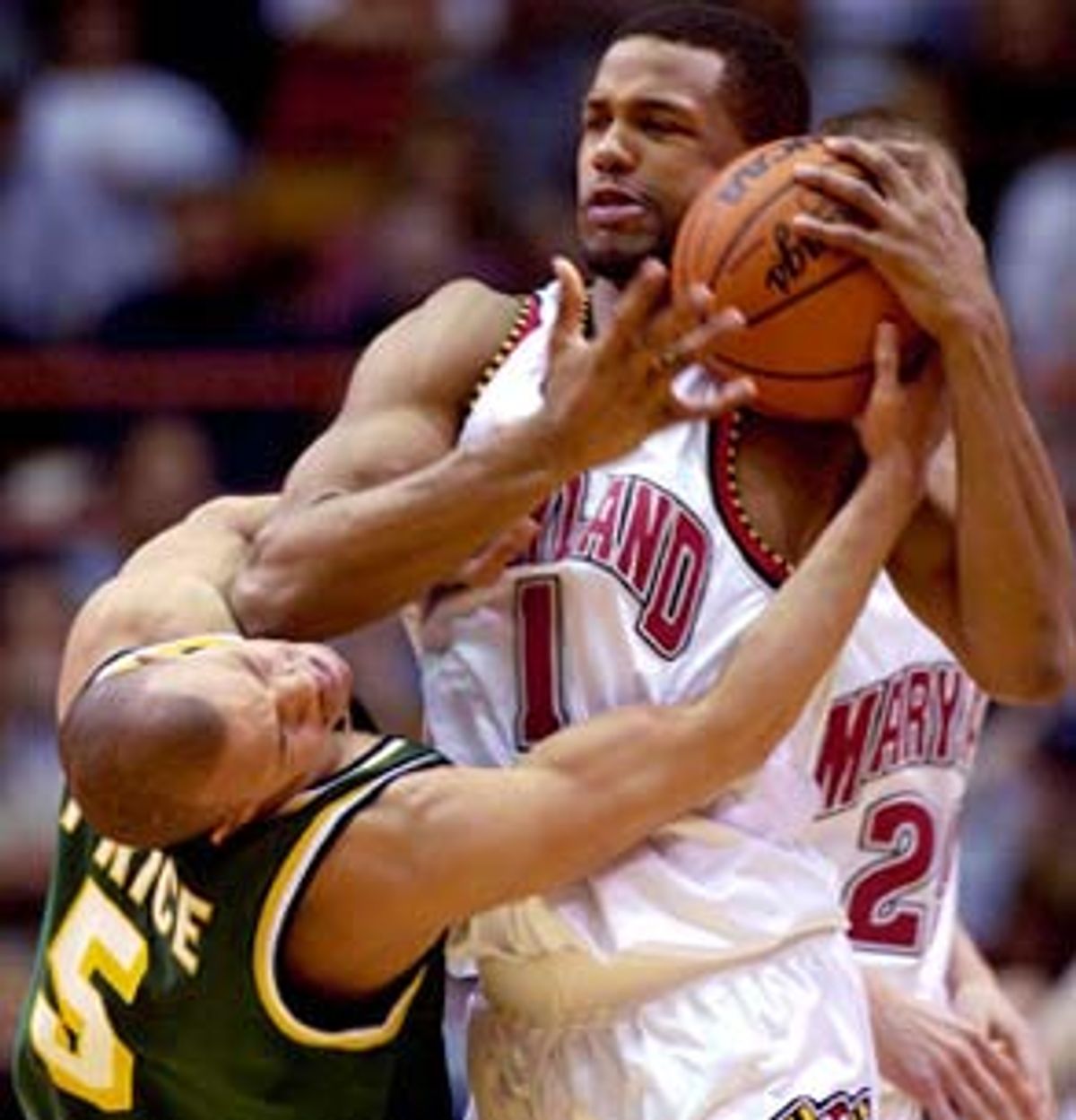
  • Maryland’s Juan Dixon gets the ball with four seconds left in the first half, splits two defenders with a behind-the-back dribble, pulls up from 25 feet and drills a three-pointer at the buzzer to bring the Terps to within three. They go on to win — by three.

  • Earl Watson of UCLA leaps at the sideline, grabs a ball that’s headed out of bounds and, in midair, calls timeout before landing on a table. This is notable as an example of the single worst rule in sports. Players shouldn’t be able to call timeout in the middle of the action to get out of trouble. They should have to be in no danger of turning over the ball if they want to call time. Kent State also benefits from this rule in the final seconds of the Golden Flashes’ upset over Indiana.

  • Southern Utah’s Jeff Monaco misses two three-pointers in a row against Boston College, but his teammates rebound both times and get the ball back to him. He spots up in the left corner and calmly drains his third try for a 63-63 tie with 1:30 to go.

  • Clarence Gilbert of Missouri swishes a game-winning jumper from the right baseline with less than a second to go against Georgia.

  • The Arkansas-Georgetown game is delayed nine minutes because the horn is stuck. Just like your annoying neighbor’s car!

    Best finish: Hampton’s comeback win over Iowa State, a stunning upset by a 15th seed.

    Almost as good: In descending order: Missouri over Georgia on Gilbert’s buzzer beater. Georgetown over Arkansas on Burton’s buzzer beater, Georgia State over Wisconsin, Boston College over Southern Utah, Kent State over Indiana, Maryland over George Mason, Kentucky over Holy Cross

    Best line: “Here we go! The madness begins with 7:07 to go!” — Gus Johnson, as the Uniondale, N.Y., crowd gets behind Holy Cross during a furious run that brings them within two points of Kentucky late in the second half of the Tournament’s opening game. He captured the moment beautifully. But every announcer who uses the word “madness” between now and April 2 should be banished to “BattleBots.”

    Second best: “There’s a man who just turned into a 3-year-old!” — James Worthy, watching Hampton coach Steve Merfeld go bananas in the aftermath of the Pirates’ incredible win over Iowa State.

    Worst line: “We’ve already seen one upset in this region.” — Kevin Harlan, every 30 seconds during the UCLA-Hofstra game, referring to Utah State over Ohio State.

    Second worst: “He’s done a lot of things that show up in the intangibles category.” — Worthy.

    Best doohickey: The little scoreboard bug in the upper left corner of the screen to keep track of other games is a great idea. At the beginning of the day, it switches between games every three seconds, which is distracting. I mean, we have short attention spans, but I think we can wait more than three seconds to see what’s up in that other game. After a while, it begins switching every 10 seconds. Much better!

    Best-timed “look-in”: CBS cuts to the Utah State-Ohio State game for the last few seconds of the half, just in time to see a lovely buzzer-beating alley-oop by Ohio State for a five-point lead that wouldn’t hold up.

    Weirdest officials’ call: Georgia State misses a free throw with 1.2 seconds remaining. Wisconsin rebounds and calls time with the clock showing 0.6 seconds. After a commercial, we learn the officials have reset the clock to 0.9. Can the refs really tell that the clock wound down three-tenths of a second too far?

    Worst uniform: Any of the teams that wear those cap sleeves rather than regular tank-top-style shoulder straps. Awful. But Utah State’s the worst offender. They look like a women’s softball team.

    Best paint job: The floor in Boise. The area inside the three-point line is blue on one side of the key, orange on the other, and the key is unpainted. The free throw circle is striped blue, orange and white and looks something like an ABA basketball. How retro! Very 1999.

  • Continue Reading Close

    King Kaufman is a senior writer for Salon. You can e-mail him at king at salon dot com. Facebook / Twitter / Tumblr

    The futile search for meaning in “Linsanity”

    Real fans aren't shocked at the sight of an Asian-American star. The hype is just New York being New York

    • more
      • All Share Services

    Topics: ,

    The futile search for meaning in (Credit: Reuters/Eduardo Munoz)

    About two weeks ago, my son asked me how a team with an imposing lineup like the New York Knicks could possibly have a losing record. “Because they have no point guard,” I said. They played like strangers. Either nobody wanted the ball or everybody did. Long intervals would pass without the Knicks putting up a decent shot — although being NBA players they often made enough bad ones to stay close.

    Well, as the world knows, they have a point guard now. The feel-good story of Jeremy Lin, the underdog Chinese-American player from Harvard, has made NBA fans of millions who scarcely know the 24-second clock from a goaltending call. Here’s hoping they stick around, because it’s a heck of a show. Meanwhile, how about if we dialed down the ethnic sensitivity meter until the kid settles in?

    As a lifelong basketball guy married to a coach’s daughter, I’m bewildered by people who say they love the college game but dislike the professionals. Around our house, the end of the NBA owner’s lockout was cause for celebration. It was going to be a long winter without “Da lig” as ESPN’s Hubie Brown pronounces it.

    Does my sainted wife ever wish I didn’t watch a NBA game most nights? Absolutely. But I’d also bet you $20 she can name the Boston Celtics’ starting five. As for my sons, well, freeloading off dad’s NBA Season Pass helps keep us together. Some families argue about politics and religion; we bicker about LeBron James and the Miami Heat.

    Anyway, from a strictly basketball perspective, what’s not to like about Jeremy Lin? The kid’s got a nice all-around game and an ideal point guard’s temperament; he’d sooner pass than shoot. He’s aggressive, but rarely forces plays that aren’t there. He’s got terrific court awareness and tactical smarts. He makes adjustments.

    If Magic Johnson says Lin’s the real thing, that’s good enough for me. Magic’s always diplomatic, but he doesn’t lie.

    However, Lin also commits too many turnovers. His on-ball defense is suspect. The New Jersey Nets’ Deron Williams recently lit him up for 38, shooting threes over him at will. Lin’s no Derrick Rose, Steve Nash or Rajon Rondo yet. We’ll see how his stamina holds up through a full NBA season; he’s wondered aloud about it himself. The Knicks need to find a backup; if Lin keeps playing 46 minutes every game, he’ll get hurt.

    As for the hype, if the Knicks had Ricky Rubio, the brilliant 20-year-old Spanish point guard for Minnesota, Spike Lee would be sitting at courtside in a bullfighter costume, and people would be writing dopey articles about the link between flamenco rhythms and basketball. It’s just New York being New York.

    “Linsanity” ain’t necessarily good for its object. There may be days when Lin wishes he could change places with Rubio.

    Few NBA fans are astonished at an Asian-American player achieving stardom. It’s been an international league for years. (Ivy Leaguers aren’t unknown in the NBA either. Remember Bill Bradley? He ran for president.) There are NBA players from all five continents and Australia. One could put together an all-star team from Spain, Germany, Turkey, France, Argentina, Brazil, Canada, Italy, Serbia and Great Britain that could compete against an all-American squad.

    All racial and ethnic theories of basketball are bunk.

    Religious ones too. Maybe the most absurd commentary came from the New York Times columnist David Brooks, who pronounced Lin an “anomaly” as “a religious person in professional sports.” Brooks, who evidently doesn’t own a TV set, has somehow missed all those jocks thanking their Lord and personal savior for hitting home runs and throwing touchdown passes, silly boys.

    Look, Jeremy Lin is a fellow fortunate enough to make a handsome living putting an inflated rubber ball through an iron hoop, as millions of his clumsier brethren dreamed of doing in our youth. Watching him gives the rest of us a playground break, sometimes with adult beverages and cute cheerleaders. It has no transcendental meaning. It’s a ballgame.

    New England Patriots quarterback Tom Brady probably said it best.

    “Look at the attention I get,” he said. “It’s because I throw a football. But that’s what society values. That’s not what God values. God could give a [bleep] … He didn’t invent the game. We did. I have some eye-hand coordination, and I can throw the ball. I don’t think that matters to God.”

    Meanwhile cueing up the MSNBC fake-outrage machine over a dumb ESPN headline about “a chink in the Knicks’ armor” doesn’t advance racial harmony. It impedes it. The phrase is what we pedants call a “homonym” — two unconnected words with identical pronunciation. It’s a hoary sports cliché having nothing to do with ethnicity.

    The dope who wrote it in a 2:30 a.m. haze has apologized, and Lin was gracious enough to accept. So should everybody else.

    Continue Reading Close

    Arkansas Times columnist Gene Lyons is a National Magazine Award winner and co-author of "The Hunting of the President" (St. Martin's Press, 2000). You can e-mail Lyons at eugenelyons2@yahoo.com.

    What everyone gets wrong about Jeremy Lin

    The NBA star does not transcend race. Instead of upending stereotypes, he owns them -- unapologetically

    • more
      • All Share Services

    Topics: , ,

    What everyone gets wrong about Jeremy LinJeremy Lin (Credit: Reuters/Adam Hunger)

    Last week, I wrote a Salon essay about my experiences with racial bullying growing up in northern Minnesota; particularly, a pair of girls who decided to sing “ching-ching-a-ling” and pull their eyes into slits when they saw me in seventh-grade gym class. It was painful to write, and — from the responses I received — pretty painful to read, especially by anyone who had experienced bullying. Thus, it felt almost as if counteracting forces in the universe were acting to promote Jeremy Lin’s farm-team-to-bench-to-global-superstar ascent in the basketball world. Finally! Being Asian American was cool, not something to be bullied over.

    I happened to be in New York at the apogee of Lin hysteria, and I stopped into a sports store near Times Square in hopes of scoring his jersey as a Valentine’s Day present for my husband. After swimming through a chaotic but amiable crowd, despite it being near midnight, I was dismayed to find only unwanted XXXXXXXL sizes. A clerk confirmed there were no more; in fact they’d just gotten their first shipment — and it had been decimated by feral shoppers.

    Lin’s appeal has been decoded for two weeks now, and much of what has been said is true: As an Asian American, my ethnic pride has me following his career when I don’t even like basketball. He went to Harvard. A handshake with a teammate involves books, glasses and pocket protectors. One signature of his game is that he passes to teammates and makes everyone better; he isn’t a lonewolf showboater. Lin not only upends the nerdy Asian stereotypes, he owns them.

    Yet I also hear white males unabashedly talk about weeping while watching him play. Other friends who, like me, don’t usually follow basketball know that he had a game on such-and-such night and scored more points that Kobe Bryant. The sports-store crowd in which I was displaying my Tae Kwon Do shopper skills was decidedly multiracial, multi-generational, multi-aged. We all want our Lin.

    No athlete of late — particularly an Asian American athlete — has caught our American imaginations like this. To be Lin-spired is to watch Jeremy Lin on the court and want a little bit of that for yourself — you don’t want to be him, necessarily, you want to be a little more yourself. That’s why, as opposed to the recent editorials crowing the tired, ready-made (and implicitly condescending) narrative that he “transcends” race, the reality is quite the opposite. He’s not an Asian American Tim Tebow. His appeal comes from his unapologetic owning of who he is, whether that encompasses being Taiwanese American, a baller, a Harvard grad, economics major, a Christian, a nerd. He projects his specific Lin-ness with such grace and aplomb, it’s impossible not to be a little awed by that, to want a little Lin-spiration for yourself.

    As a person who shares little of the above (just the nerdiness and the economics major) with Lin, when I watch him play, something deep inside me resonates, almost as if I am the one leaping like a gazelle and whisking in a three-pointer in the nail-biting last seconds of a tied game. This is I, graceful, unpressured, even as a person who cannot tie my shoes properly if someone is watching me.

    What ties me to Lin is seeing that he is doing what he is good at and exactly what he wants to be doing. Which is what we all strive to do. Watching the ferocious joy — and the peace — that suffuses his face as he plays, this is the same feeling I have when I, a professional writer, am writing a great sentence. Flannery O’Connor, when asked why she writes, explains, “because I’m good at it.” What is life if not to find our purpose, our skill, pursue it, and to go for broke, as Jeremy Lin has done?

    This week, the bloom is slightly off the rose. Not for Lin — he’s still on fire, still passing to his teammates. But deeply entrenched anti-Asian sentiments that lurk beneath the tectonic plates of society have to burp to the surface at some point (can we take a moment to remember that in the wide swath of American history, Japanese Americans were the only group ever to be interned on the basis of race/ethnicity?). There was ESPN’s sad and sadly predictable straight-from-the-bullies’-playbook “Chink in the Armor” headline about Lin done twice, both on its web site and spoken by an anchor. There was FoxSports.com’s Jason Whitlock’s “Some lucky lady’s gonna feel a few inches of pain” tweet, MSG’s airing the image of Lin’s head coming out of a fortune cookie, sportswriter Buzz Bissinger’s ingenious idea that Lin and Michael Vick should start a dog-meat (“Vietnamese-style”) restaurant, and the seemingly positive but still racially based “AMASIAN!” New York Post’s headline (just try substituting any other racial/ethnic group in there and see how that feels).

    But ironically, these events have only strengthened the Jeremy Lin magic. He gracefully forgave the ESPN commentators, accepting their explanation of an “honest” mistake (while to me, it sounds just like my bully claiming she had amnesia during junior high and thus could not remember bullying me). Perhaps even more importantly, ESPN took it seriously, fired the headline writer and suspended the commentator. This is a seismic change for Asian America. It was in 1982 when Vincent Chin, a young Chinese American out for his bachelor party in Detroit ended up dead, pelted by racial epithets, his head bludgeoned by a baseball bat by some out-of-work autoworkers who were mad at Japan (“It’s because of you … that we’re out of work!”). The two murderers served no time, and were fined $3,000. It is easy for white males like Buzz Bissinger to say racial epithets are no big deal, that Lin continues to play well despite them — but racial epithets are only a verbal expression of the poison that exists inside.

    I don’t necessarily feel ESPN hustled to punish the “Chink in the Armor” perpetrators out of a sense of racial justice, but even if not, Jeremy Lin, with his talent, popularity and his humanity has forced the people who cheer him on to acknowledge that he’s a person, as opposed to the way Asian Americans are so frequently seen as Wesley Yang wrote in New York magazine last year: “a mass of stifled, repressed, abused, conformist quasi-robots who simply do not matter, socially or culturally.”

    I endured months of racial bullying, two girls to my one.  It wasn’t until some “tough” girls took it upon themselves to stop the bullying, that I realized how pernicious my internalizing of the “ching-a-ling” trope. I thought I was ignoring the bullies, but what I was doing was not defending myself. By their action, the tough girls showed me I was worth defending.  Just yesterday, as I have been continuing to muse publicly on the sad spectacle of racism following in the wake of Jeremy Lin’s rise, I received an angry note from a white man saying “Be like Jeremy Lin and GET OVER IT!”  Now, I can tell him, yes, I try, but somehow I just can’t get over racism. Or having white men telling me how I should feel.

    But perhaps Lin-spiration can help us see we are all special selves, worthy of nurturing, cheering on, and defending. Indeed, it might take you from thinking, “…I wish I were a baller… I wish I were taller…” to a place where you might find a little more joy in being yourself, just a little bit better.

    Continue Reading Close

    Marie Myung-Ok Lee’s essays have appeared in The New York Times, The Atlantic, The Guardian, The Washington Post, and she is regular contributor to Slate. She is the author of the novel Somebody’s Daughter and teaches creative writing at Brown University. Find her on Twitter @MarieMyungOkLee and on Facebook.

    David Brooks: “I have heard of Jeremy Lin”

    Is it an "anomaly" for a professional athlete to be religious? (No)

    • more
      • All Share Services

    Topics: , , , , ,

    David Brooks: David Brooks

    David Brooks had to write a column about something, and his deadline was fast approaching, so he glanced at the sports page and saw something about New York Knicks phenom Jeremy Lin, and he was like, yeah, that works. Next stop, most-emailed list!

    Lin is a point guard who rocketed to near-instant celebrity when he came off the bench and had a series of monster games, dragging the Knicks to a .500 record while their two biggest superstars were sitting out games. His celebrity then became a “mania” in part because he’s Asian-American and a Harvard graduate, two rarities in the NBA. It also obviously doesn’t hurt that he plays for the dominant team in the nation’s biggest media market (also it’s the fallow period between football and baseball). That’s basically the whole deal, and if you’d like to learn more read Andrew Leonard’s account of the early social media explosion and Alexander Chee’s take on Lin and Asian-American identity. Whatever you do, don’t read David Brooks’ take on the Lin phenomenon, because David Brooks doesn’t understand basketball or social media or race or religion or American society in general.

    Here is Brooks’ first paragraph:

    Jeremy Lin is anomalous in all sorts of ways. He’s a Harvard grad in the N.B.A., an Asian-American man in professional sports. But we shouldn’t neglect the biggest anomaly. He’s a religious person in professional sports.

    Here is the next sentence:

    We’ve become accustomed to the faith-driven athlete and coach, from Billy Sunday to Tim Tebow.

    Haha OK. This is the point where you hit “select all” and then “delete” and start your column again. Brooks must’ve started this thing like 10 minutes before his deadline. (No time to edit it!)

    So, yes, a “religious person in professional sports” is like the least anomalous thing in the world, besides maybe “a racist comment under a YouTube video.” Or “an old white guy in political punditry.” (Also, minor note, but: I think there’s actually a decent number — enough to make Lin not particularly “anomalous” — of prominent Asians and Asian-Americans in professional sports, unless you’re only defining “Asian-American” as “of East Asian descent” and you’re only counting the “big four” leagues as “professional sports.” And you’re not really counting baseball.)

    While Lin’s Christianity is obviously of great importance to Lin, it honestly has barely anything to do with what made him an instant superstar, except for when hacks want to compare him to Tim Tebow, which is dumb, because Lin is suddenly famous because he’s really good at his sport while Tebow’s whole shtick is succeeding despite being awful at being a quarterback. (If Lin had been a college superstar and high draft pick who was famously inept at the fundamentals of his position, the Tebow thing would be an accurate comparison, but Lin is in fact the opposite of that.)

    Having contradicted his own faulty premise five sentences into his column, Brooks rambles on about how he has noticed that being good at sports and being pious is sort of contradictory, because being good at sports doesn’t involve much “humility” or “self-abnegation.” Then we have some boilerplate theological musings, about how sports is like modern society and how Abrahamic religious values contradict modern cultural values, especially regarding individual achievement. (YAWN.)

    But even while grappling with the tension between religious values and contemporary cultural values, which is basically well within Brooks’ wheelhouse, he demonstrates a hilarious misunderstanding of sports, and what sports are “about,” because Mr. Brooks has been spending far too much time in his cloistered elite liberal media ivory tower munching on brie and arugula and not enough time among Real Americans in their “Sporting Taverns” watching “The Big Game” over a pint of mass-market domestic lager.

    For many religious teachers, humility is the primary virtue. You achieve loftiness of spirit by performing the most menial services. (That’s why shepherds are perpetually becoming kings in the Bible.) You achieve your identity through self-effacement. You achieve strength by acknowledging your weaknesses. You lead most boldly when you consider yourself an instrument of a larger cause.

    I could be wrong, but “consider yourself an instrument of a larger cause” is basically step three of “how to be good at team sports,” after “be gifted physically” and “practice a lot.” (And acknowledging your weaknesses? Like when Magic would spend the off-season practicing “the weakest part of his game” until he improved it?)

    The “two moral universes” of religion and societal achievement may be “irreconcilable” — I am not a religious person and hence don’t care — but that has very little to do with Jeremy Lin, or basketball, or politics, which Brooks for some reason brings up in the last paragraph, because he wants to pretend this column has been about something other than extended free-associative riffing on the fact that a famous person is religious.

    In conclusion, the New York Times should probably consider having someone take a quick glance at David Brooks’ columns before they publish them.

    Continue Reading Close
    Alex Pareene

    Alex Pareene writes about politics for Salon and is the author of "The Rude Guide to Mitt." Email him at apareene@salon.com and follow him on Twitter @pareene

    Rooting for your own kind

    Jeremy Lin shows that we like to cheer for people who look like us -- and there's nothing wrong with that

    • more
      • All Share Services

    Topics: , ,

    Rooting for your own kindWhy so excited? (Credit: Reuters/Mike Cassese)

    Lin-sanity has broken out all over the world. The kid nobody in the NBA wanted, from an ethnic group about as associated with the NBA as bullfighters are with People for the Ethical Treatment of Animals, had just broken Shaquille O’Neal’s league record for the most points in his first five games as a starter. Adoring fans are holding up signs saying “To Lin-finity and beyond.” The Lin-ternet has broken under the strain of millions of tweets, many of them featuring even worse puns than “Lin-ternet.” Sports Illustrated put him on its cover.

    And, of course, Asian-Americans are going wild.

    I’m one of them. As a half-Japanese, half-white ex-jock, I’ve always followed and rooted for that tiny number of Asian-Americans who make it in any of my three favorite sports, the all-American Big Three of football, basketball and baseball. (There are lots of Asian baseball players, but not many Asian-Americans.) Half-Japanese players get even more points. The triumphs of Olympic speed skater Apolo Ohno had me feeling my half-breed oats. And when former Giants’ hurler Atlee Hammaker, a hapa like me, melted down in the 1987 playoffs, my inner mulatto got a lot more tragic.

    There’s no great mystery why I root for Asian-American jocks. It’s the same reason any member of a minority group pulls for one of their own: racial pride and solidarity. There are so damn few of “us” in the big leagues (I’m an “us” with an asterisk) that when one makes it, it’s cause for celebration.

    The first thing to note about Lin-mania is that America is basically just fine with it. The mainstream media features photos of Asian fans wearing Lin T-shirts and runs stories in which they are quoted as expressing racial pride. It is all deemed benign and heartwarming, a multicultural Cinderella story in which everyone wins. The Asian kid overcomes impossible odds and racial stereotypes – if white men can’t jump, Asian men are not even supposed to be able to hop – to make it in the NBA. Horatio Alger meets the Statue of Liberty in the land of the melting pot.

    But race is such a minefield in American society, and honest conversation about it is so constrained by politically correct politeness, that even the Lin story makes people tongue-tied, as if they thought that admitting that yes, people root for players because of their race would cause the Ku Klux Klan to rise again.

    Case in point: an ESPN panel’s reaction to boxer Floyd Mayweather’s now-notorious tweet in which he said, “Jeremy Lin is a good player but all the hype is because he’s Asian. Black players do what he does every night and don’t get the same praise.” The latter part of Mayweather’s comment, implying that black players are not praised the way Lin has been because of racism, is a total crock, another one of Mayweather’s heavy-handed attempts to provoke a race controversy. But his comment that the hype over Lin is because he’s Asian is clearly true. Not all the hype, but most of it – and the most interesting part of it – is precisely because Lin is Asian. Does anyone think SI would put Lin on the cover if he were black or white?

    This is so obvious that it strains credulity to think that anyone would even try to dispute it. And yet when four panelists on ESPN’s First Take were asked to comment on Mayweather’s comments, only one of the four, Bomani Jones, was able to forthrightly acknowledge it. Absurdly, sports reporter Beto Duran actually denied that Lin’s race had anything to do with the hype, saying it was simply because “he’s balling.” Eventually, they all admitted that race played a role in the hype, but their reluctance to go there spoke volumes about how radioactive all discussions of race in sports continue to be.

    And the Lin story is the most non-threatening possible race-in-sports story, one involving a societal minority group that is also so underrepresented in the NBA as to be positively exotic. If America has trouble admitting that it’s OK for Asians – or members of any other race, for that matter – to root for Jeremy Lin because he’s Asian, just imagine how it deals with the issue of white people rooting for athletes because they’re white. Even to suggest such a thing is considered way out of bounds.

    But there’s nothing wrong with it. I’ve been doing it for years. And it’s completely racially innocent.

    Just as the Asian part of me celebrates the unlikely success of Jeremy Lin, the white part of me celebrates the almost equally unlikely success of New England Patriot running back Danny Woodhead. Rooting for white players who break out of racial stereotypes is harmless. It does not mean rooting against black players or those of any other race. It’s fun. And I suspect a lot of other people do it, too.

    I’m not talking about Rush Limbaugh and his followers, most of whom I suspect are bigots who are rooting against black players as much as they are rooting for white ones. (In a brilliant, half-crazy 2003 essay in the New York Review of Books, “The White Man Unburdened,” Norman Mailer argued that one of the reasons Americans supported Bush’s Iraq war was that so many reactionary white men needed to regain a masculinity threatened when their white sports stars were replaced by blacks.) I’m talking about people who are able to acknowledge the reality that white running backs and cornerbacks are almost as rare as Asian point guards, and are sufficiently free from racial uptightness or self-consciousness to root for them for precisely that reason.

    I’ve never agreed with the quasi-official view, expressed in endless “diversity” seminars held by big corporations and piously promulgated in schools and universities, that everyone is to some degree a racist and needs to engage in constant Maoist “constructive self-criticism” to become more racially enlightened. That ortho-liberal view has always struck me as a sterile guilt-trip, a recipe for racial constipation that only breeds more racial animosity and misunderstanding. However, it does contain a grain of truth. Everyone is not a racist, but everyone is aware of race. Unfortunately, much of the time this awareness is lugubrious and heavy, both because of America’s long and painful history of racism and because we haven’t come up with any lighter ways of dealing with race. Sports offers one of those ways.

    When I root for white NFL players like Danny Woodhead or retired New York Giants’ cornerback Jason Sehorn, or white 2004 Olympic 400-meter gold medalist Jeremy Wariner, I’m not rooting against black athletes. In fact, the very fact white running backs or cornerbacks or 400 runners are so rare is a testament to the sheer dominance of African-American athletes at those ultimate bad-ass positions. It just makes my white-boy self happy to have a few Caucasians in that Olympian company. It’s exactly the same attitude expressed by Charles Barkley when he says, “Steve Nash is one bad white boy.” Is acknowledging this really going to make Lester Maddox rise from the grave, baseball bat in hand?

    I suspect that many of those white fans who do root for unlikely white stars are uneasy about acknowledging it for the same reason that they (rightfully) believe that only blacks can use the n-word. It’s the liberal racial double standard, which is predicated on the fact that racism, in particular bigotry against black people, is still very much alive. (Have you checked out the GOP primaries lately?) Charles Barkley is allowed to say “Steve Nash is one bad white boy,” but white people are not, because when they do, it could be construed as racism. White talk about race in America is governed by a priori semiotic censorship: Any statement that could be interpreted as racially suspect is ruled out.

    This prior restraint on white speech makes sense in some areas. If someone goes around complaining that white people are all discriminated against and black people get all the breaks, and celebrates some white businessman for that reason, he’s either a fool, a racist or a demagogue. (See above comment about the GOP primaries.) But cheering for white running backs or cornerbacks is different. They aren’t discriminated against. It’s just that 99 percent of the time, they aren’t good enough to play the position. That’s a fact. And when they do make it, it’s fun to identify with them.

    It would be stupid to make too big a deal out of this. It’s strictly lighthearted. It’s a holiday from racial politeness, a bit of benign tribalism. I don’t usually hold with tribalism, but we all have a little of it in us, and as long as it’s innocent, we might as well enjoy it from time to time. Besides, as someone who has covered three Olympics, I can attest that national tribalism trumps racial or ethnic tribalism. Every red-blooded American, of whatever race, watching the finals of the 4×100-meter relays at Sydney or Athens was for that moment an honorary black person.

    And anyway, it’s all changing. When I saw Chinese hurdler Liu Xiang win the 110 meter hurdles in Athens, I knew that the world of sports would never be the same again. Races and ethnicities are mixing more and more, old athletic stereotypes are dying, and great athletes are popping up in the most unexpected places. Right now, the Jeremy Lin show has captured the world. Tomorrow, a black hockey player will challenge Wayne Gretzky as the Great One, or a heavyweight champion will come from Iceland. The infinite diversity of the human race is displayed in all its glory in sports, and there’s nothing wrong with appreciating every last part of it. Even if it means rooting for a bad white boy.

    Continue Reading Close

    Gary Kamiya is a Salon contributing writer.

    The Jeremy Lin show

    America's conversation about race has been mostly black and white. An amazing Knicks point guard changed that

    • more
      • All Share Services

    Topics: ,

    The Jeremy Lin showFans of Jeremy Lin hold up signs during the second half of the New York Knicks/Toronto Raptors game on Tuesday. (Credit: Reuters/Mike Cassese)

    I have never cared about basketball, ever. Not once. Yet inside of the last two weeks I have learned what a point guard is, what he does and why it matters. I had a roller-coaster night Saturday, when I wanted to watch a New York Knicks game for the first time, then learned that a squabble between Madison Square Garden and Time Warner has left about 1 million fans without MSG Channel (including me). I didn’t even know how to start finding a bar with the game on — something I’ve previously resented, in fact — so I contented myself by watching the video diaries on Lin’s YouTube channel

    Days later, sometime yesterday, in fact, when I caught myself reading a post about the couch Jeremy Lin slept on before his first night as the Knicks’ new star point guard, I had two reactions. First, it didn’t look big enough for him. The next one: Wait, who am I — and more important, what is happening to me? It was like I was in a “Portlandia” sketch about Linsanity.

    The gated community that was the NBA has had a crasher arrive and jump the fence: JLin, the Linja, the Linsanity, Super Lintendo, the Yellow Mamba to Kobe Bryant’s Black Mamba. (Kobe learned this the hard way the other night, when the Knicks beat his Lakers, right after he had asked “Who is this kid?”) That nickname alone is as good a place as any to begin. Before Jeremy Lin arrived, there was not even the thought of a Yellow Mamba. There was no major Asian American NBA star who captured the hearts of fans. There were no fans wearing cutout masks of an Asian American player courtside as a group. Houston Rockets center Yao Ming may have been a forerunner, but he was an import, the beloved alien.

    The NBA, much like America’s conversation about race, has been something of a black and white ball — and Asian American stars were simply not invited to the dance. Consider the college coaches who overlooked him because they “didn’t have a frame of reference” for his talents, or the NBA teams that released Lin, suddenly red-faced as the moribund Knicks win six straight.

    Whatever screen you’re watching on, your phone, computer or TV, it’s the Jeremy Lin show now, and the whole country is tuning in. The boxer Floyd Mayweather insisting that Lin’s only getting attention because he’s Asian — do we think Floyd knows anything about basketball? There are Pinterest posts of his sixth-grade class photo and endless online nickname contests. He’s everywhere you look. When was the last time you saw a bigger crush of people trying to nickname a new star?

    This urge to nickname Lin is an effort by people to act like they know him. What we’re learning, however, is that he’s as difficult to pin down culturally as he is on the court. He continues to defy expectations. Maybe you thought there were no tall Asians, didn’t know about Asian Christians or didn’t think Asians could play basketball. Maybe you never cared about basketball, never cared about the Knicks. Or maybe you didn’t need a crash course on what a point guard does. Maybe you thought you were done with Christian sports figures. Either way, chances are you’ve learned something new watching Jeremy Lin, about him, yourself and other people.

    My first thought on seeing Jeremy Lin was that he reminded me of my cousins. Like many, I felt like I knew him. He’s a kind of kid I’ve seen my whole life — funny, smart, quick and brave. And Asian American. When I heard he was a Harvard grad, I thought: Of course, the first Asian American NBA superstar also had to go to Harvard and get better than a 3.0. And then: Way to raise the stakes on the Asian American overachiever. It’s still true that whatever color you are in America, if you’re not white you have to be twice as good to get half as far. But the Jeremy Lin paradox is that this champion — this skinny kid just out of college, this overlooked smiling Taiwanese American kid with, as we say, ‘the good Asian hair’ that is thick and stands straight up — he is making room for the rest of us. Part of the Jeremy Lin moment is America looking at an Asian American and realizing he’s just an American, too.

    The great irony to his moment is that Jeremy Lin as a national figure is so much better than anyone I might have dreamed up as a possible solution to a problem with a body count: Asian Americans are currently the No. 1 most bullied demographic in America. The same invisibility that kept Jeremy Lin outside the “frame of reference” of coaches also kept the two different units who hounded Cpl. Harry Lew and Pvt. Danny Chen to suicide last year with constant racist taunts and physical abuse from realizing they were well outside the limits of respectful internal military discipline.

    It would be laying way too much on Jeremy Lin to ask him to help turn this around, as if he didn’t have enough to do as point guard for the Knicks. But we don’t have to ask him — it is already just happening. Jeremy Lin’s getting slapped around a lot at Madison Square Garden, but it’s all love — when he drained that game-winning three-pointer in the last half-second against Toronto Tuesday night, he was covered in punches — the kind you can only give the hero who pulls it out of the bag. I still have a strange impulse when I see him, like I want to run out there, help on defense — me who has never played basketball! — or yell “Back up off the skinny kid!” even when they rush him with love. It’s just from a whole lifetime of watching bullying happen, a lifetime of people — white, black, Latin — coming up to me, my brother, my sister, my cousins, muttering under their breath “Ching Chong Ching Chong,” the prelude to a beating. But it’s only post-traumatic stress disorder; it’s not the present. No one on the Knicks is saying that to him. He has this.

    And while Jeremy Lin may not single-handedly make all of the bullying go away, somewhere in America, at least one Asian American kid right now is getting invited into a pick-up game instead of cornered and beaten. That’s the game that matters, more than anything you’ll see during a Knicks game. And Lin is helping win that one, too.

    Continue Reading Close

    Alexander Chee's essays have appeared at The Paris Review Daily, The Morning News, n+1 and Granta. He is the author of the novel Edinburgh and the forthcoming The Queen of the Night. Find him on Twitter @alexanderchee, on Facebook, or at his blog, Koreanish.

    Page 1 of 42 in Basketball