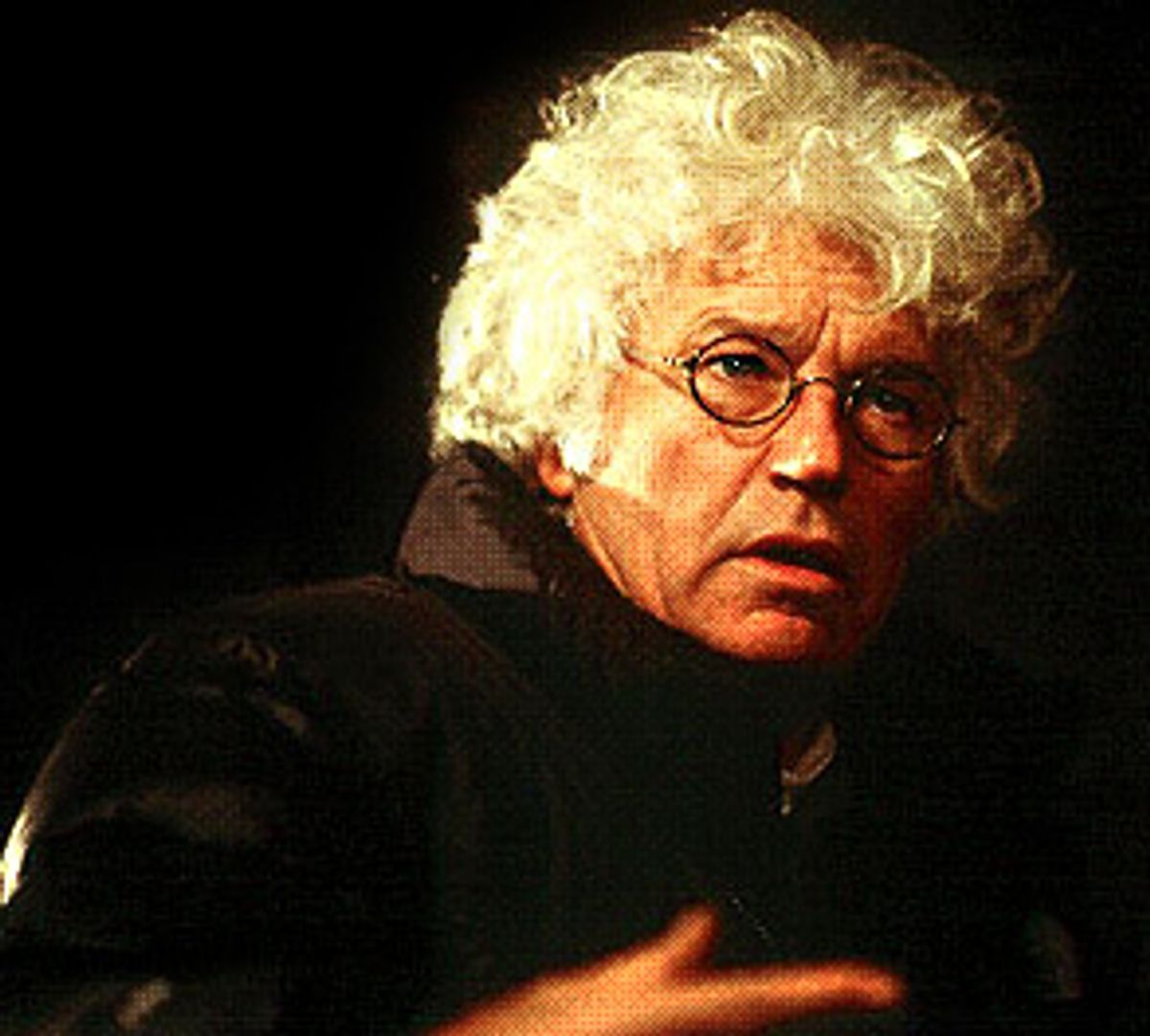
Loquacious and leonine with a mass of curly white hair, director Jean-Jacques Annaud is the embodiment of French conviviality. The 57-year-old Academy Award-winning filmmaker relishes conversation and especially delights in aggressive questioning. That's a good thing, because he's getting plenty of tough queries in regard to his latest film, "Enemy at the Gates," an $85 million World War II epic set during the 1942 Nazi siege of Stalingrad (now Volgograd).
German journalists were outraged by the film when it premiered at the Berlin International Film Festival earlier this year. They decried Ed Harris' cold, brutal portrayal of Maj. König, a German sniper on the hunt for his famed Russian counterpart, Vassili Zaitsev, played by Jude Law. Even some non-German reviewers boarded the bandwagon, criticizing the use of British actors such as Law, Joseph Fiennes and Rachel Weisz to depict Russian soldiers with British accents.
Still, if there's any justice, Annaud's brilliant, engrossing cinematic spectacle will be his greatest triumph yet. Reminiscent of both Stanley Kubrick's "Paths of Glory" and Sergio Leone's "Once Upon a Time in the West," "Enemy" is equal parts history lesson, action flick and torrid romance. Think of it as "Saving Private Ryan" with a far superior story, better acting and none of the schmaltz. But will it be blockbuster enough to turn a profit? Even Annaud is unsure, but he certainly enjoys entertaining the notion.
In America, we're not used to seeing Russians depicted as heroic, or Stalingrad portrayed as the turning point of World War II. Does that make this film a tough sell to U.S. audiences?
I remember watching "King Kong" in Africa, and there were people there who had never seen movies before who were cheering when King Kong was crushing the natives. They identified with the hero, King Kong, and I was in a native village! It's an interesting mental process. When you read about it, you may say, "I'm not going to like a Russian guy." But when you see Jude Law fighting against clear villains -- the Nazi invaders -- you identify with him.
That's especially true when you know what the Nazis did in Russia. They raped all the women, disemboweled the pregnant ones and took pictures in front of piles of dead children. All because they were told that the Russians were subhumans. I think that once you're in the cinema, you identify with the people who are the protagonists. True, it's not an obvious sell. But my movies have never been easy to market. So far, they've found enough people around the world who are interested in something different.
There've been countless World War II stories made into films. What drew you to this one?
I was fascinated by the true anecdote on which the story is based. That duel is extraordinarily famous in Russia. And Vassili Zaitsev is a national hero there. It has all the resonance of a lonely man fighting against the devil. That's why it captivated the imaginations of the Russians, and captivated mine.
This duel took place in the middle of this huge battle, where 5,000 people were dying every day. Why was it that suddenly that bullet was important? That bullet was important because it was made famous by the media, by the Russian propaganda system. It was important to the morale of the Soviets, and therefore to the outcome of the battle -- and that battle was pivotal to World War II. It's quite formidable to think that little guy was instrumental in the destiny of the world today.
Was that one of your intentions -- to comment on the nature of the media through this film?
I would not have done this movie if it had not been about propaganda and the making of a hero. The Russians needed a hero and, instinctively, they picked one who was handsome. The reality is that there was a sniper who was better than Zaitsev, but he was not good-looking. And beauty sells.
Stalingrad was such a huge battle because of its name. It was not in the plans to capture that city. It was just on the way to the oil fields. One morning, Hitler saw the name "Stalin-grad" on the maps, and he said, "I'm going to get that city; it carries the name of my enemy. It'll be a coup!" When Stalin realized that Hitler was going to capture the city that carries his name, he said, "No way!" It became a battle for a name, a symbol, one that reached down all the way to these two guys in the movie. Two million people were going to die in that battle. Why were these two guys important? Because they were carrying the flag for their sides.
It's the same thing today when, on the same day that a ferry carrying hundreds of people sinks, Lady Diana dies in a car crash. The press doesn't lead with the ferry, it leads with Lady Diana, because we can identify with one person. That problem of identification and propaganda was at the center of my interest.
The legend of this duel between Vassili Zaitsev and Maj. König is accepted as gospel in Russia, but is there a possibility that what you represent as a true story is actually fiction?
It's difficult to tell. There was this excellent book recently by a friend of mine, Antony Beevor, "Stalingrad: The Fateful Siege, 1942-43." In it he casts some doubt on the story. He doesn't say Zaitsev didn't exist or wasn't a hero, but he says the famous duel may have been propaganda. Everything else you read takes that duel for granted. In Volgograd, there's a big statue of Vassili Zaitsev. His rifle is exhibited there as a treasure, and in the Moscow museum, you have the scope from the rifle of Major König, with a note explaining the story. You have the old Vassili Zaitsev who, 10 years ago, stood in front of BBC cameras in Volgograd at the place he said he killed this German. He spent his whole life writing and doing interviews about this duel, which was at the epicenter of his fame. So it's difficult for me to say it's untrue. It's also difficult for me to guarantee that he has not been repeating propaganda. Like with Jesus Christ or Joan of Arc, who knows? Still, it's the most famous story of snipers ever told.
Was Rachel Weisz's character, Tania, a real part of that story or a plot device?
The character Rachel Weisz plays is described in the book "Enemy at the Gates." The author, William Craig, interviewed 200 survivors on the German side and 200 on the Russian side. One of those Russian survivors was Sgt. Tania Chernova, a member of that group of snipers under the leadership of Zaitsez. The reality is, she fell in love with him, as many other women fell in love with many other snipers.
Think of it, a million women were fighting with men on the front in Russia. So of course there were love affairs. There were so many excellent stories, especially when you mix that with the life expectancy being so short. In Stalingrad, for an ordinary soldier, the chances of living past one day were almost nil. It was three days for a corporal, 33 days for a general.
Some journalists have been critical of the fact that you shot the film in English, and that the main players, with the exception of Ed Harris, are British and have British accents. What's your response to that criticism?
Half of the market is an English-speaking market! If you give them actors who cannot speak English, it just doesn't play. And as a Frenchman, I can only direct in French or English; I cannot direct in Russian. There's no way you can do this movie in the Russian or German. You have to go with the original version in English. After that, you've got the choice of British, American or maybe Australian actors. I remind people that movies are made in the language of their audience. When Shakespeare did "Romeo and Juliet," he didn't do it in Italian, or even using English speakers with Italian accents. This applies as well to "Dr. Zhivago," which was set in Russia, but had English actors. It takes about five or 10 minutes to accept it, but once you're in the story, you forget that those people are English or American.
You shot most of this film in eastern Germany. Why not in Russia, in Volgograd even?
Russia today is an incredible mess. It's rackets, it's mafia -- not one, but a thousand. So if you make a deal with the mafia of the river, you have a problem with the mafia of the docks. It's endless. When you get a taxi in Moscow, he charges you $50 to go a few miles. You get in the cab and in 10 minutes he drops you in a suburb, and says, "I'll drive you if you give me $200." It's like that to the level of the whole nation. Everything is impossible -- it's an abomination. On top of that, I could not redestroy the city of Stalingrad. So, after scouting for locations, I ended up shooting this anti-German movie in Germany.
Has the film been shown in Russia?
Not yet. We're not in a rush to open there because we're going to be pirated. So we'll wait as long as we can. There's no state anymore in Russia. And if you have a movie like that, the second it gets on Russian soil, it's duplicated and sold. Maybe it already is, I don't know. But officially we're going to wait until July or something like that.
Why did the film open the Berlin International Film Festival? Was that a way of taking on the toughest audience first?
In a way, yes. We had to confront the situation of Germany. It used to be, some years ago, when you reminded the Germans of their horrible recent past, they would say, "Yes, we know, mea culpa, mea culpa." Now when you remind them of that past, they say, "Yes, we know. Fuck off." That's a real change.
Doing a movie like this, I cannot please the Germans. And I have no intention of trying. I was in Hamburg before coming here, and one journalist said to me about Ed Harris' character, "I had hoped that the German could win." He asked, "Would you have made the movie if the German had won?" I said, "Of course not. Because for me as a Frenchman it was not good news that Hitler started the war." Then I said, "I guess in a secret, hidden part of you, you would have preferred that Hitler won. But I'm sure that another part of you knows, as a democrat, that it was better that he did not." He agreed.
Of course, the new generation is not guilty of anything. But I'm rereading "Mein Kampf" because I found an old copy I had bought for research, and there is hate on every page. It's incredible that a nation like Germany could listen to this without reaction and by basically approving it. So the embarrassment is eternal for Germany. They can't get rid of it.
Isn't it ironic that you're in hot water with the Germans over this film, but that you had problems over your last film, "Seven Years in Tibet," because Brad Pitt's character, Heinrich Harrer, was revealed to have been a member of Hitler's SS?
They began to discover Harrer's past in Germany through the German press, basically because of hatred of what Brad represents -- Hollywood. So that started as a punishment of a Hollywood movie. But after that, you're right to say that there was a big shift. The controversy ended up in a very favorable way for the movie in Germany. This time, of course, it's going to be quite different. They cannot stand the fact that the Wehrmacht did not always behave nicely.
I would guess that the fact that you're French doesn't endear you to the Germans, either. Do they believe you have it in for them because of your nationality?
That's definitely part of it. It is true that I have great difficulty looking back into those times and believing that the Germans behaved nicely. My family went through all kinds of nightmares, and I'm not a Jew. They were just regular French people, neither collaborators nor resisters. Yet in my childhood, there was not one lunch or dinner without many descriptions of the German behavior in my country. And they behaved well in France compared to what they did in Russia. At the same time, I know the new Germany well, and I like the new Germany. I was astonished to discover how fresh that wound was.
You started out directing commercials and were very successful at it. What did you learn from directing commercials that helped you film something as grand as "Enemy at the Gates"?
I learned I was only happy directing things that came from my heart. Even when it was good, if it was selling something that was not reflecting my convictions, I was ashamed. So basically, by being a prostitute, I learned to be someone with integrity.
My first film, "Black and White in Color," was an absolute flop in France. But even though it was a disaster, I was happy. It was my movie, and it was OK if it wasn't perfect. What I couldn't stand was to be rich and famous for doing something I didn't like. Of course, that film went on to win an Academy Award for best foreign-language film, but that was only after it had failed in France.
It's too bad more directors aren't trying to make art instead of two-hour commercials.
It has to come from us, the screenwriters and directors. The screenwriters create crap for the executives, who think it is crap, and directors accept doing crap because the executives ask them to do crap. What is this? At least try once in a while to do something personal. Sure, if you fail with something personal, it's tragic. But if you fail with something that's not personal, that's terrible! I mean, if you want to write a bestseller and it doesn't sell, it's a catastrophe. It's better to go with your heart, I think.
Shares