Afghanistan
Save the children, or the Buddhas get it
Afghanistan's roving ambassador tells a Southern California student association why he was ready to "blow a statue" himself.
India offered to take them home for safekeeping. Muslim nations denounced their destruction as “un-Islamic.” Even most Afghans — including ranking members of the Taliban — opposed the pyrotechnic destruction of the Buddhas of Bamiyan, which were considered the greatest remaining examples of third and fifth century Greco-Indian art in the world until they were blown to bits last week amid scattered cries of “Allahu akbar” (“God is great”) and “Ma sha’ Allah” (“Whatever God wills”).
It was not the first time the world has responded to the Taliban’s actions with censure. But it was, strangely, probably the first time the world has demanded — and actually required — an explanation.
Citing the Islamic principle of the thing, Qadarullah Jamal, the Taliban’s minister of information, claimed the statues were destroyed because they were being worshiped as idols. This explanation was widely repeated, first by the Taliban’s leader, Mullah Mohammad Omar, then by Foreign Minister Wakil Ahmad Muttawakil and then by much of the Western press. On the surface, it explained everything. On reflection, it explained nothing. Not only are there are no Buddhists living in Afghanistan, but Muttawakil has allegedly assured the nation’s Hindus, Sikhs and single Jew — an elderly rabbi who stays in Kabul to protect a synagogue — that their temples will be protected.
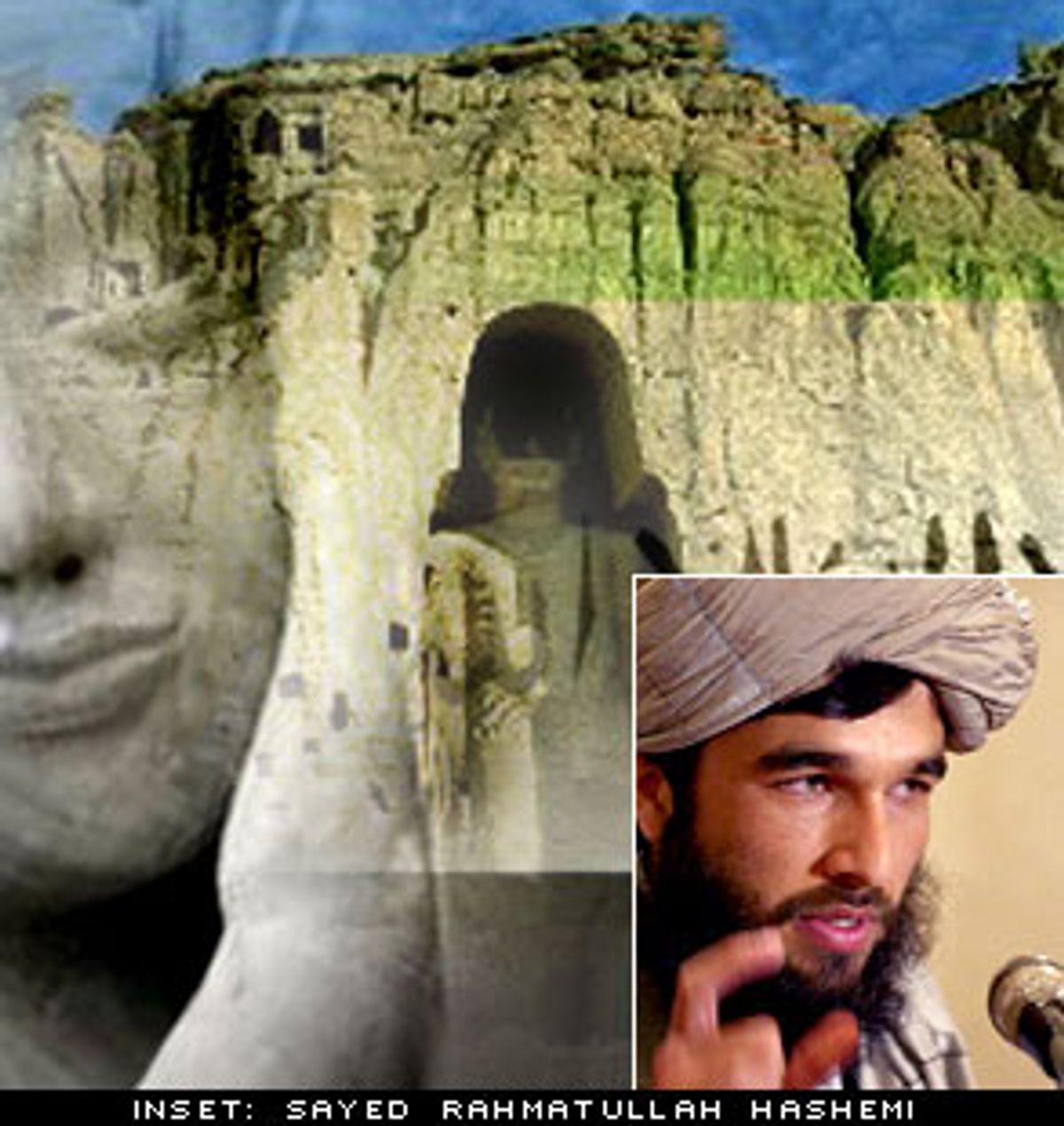
So the belated attack of religious fervor may have just been a handy religious metaphor for an entirely secular snit fit. Sayed Rahmatullah Hashemi, Afghanistan’s youthful ambassador-at-large, learned of the Buddha blitz while on a public relations tour of the U.S. designed to change the way we see the Taliban. He was forced to call his “headquarters” to confirm reports of the destruction, which were at first denied.
As Hashemi launched a serious charm offensive at the University of Southern California, UCLA and UC-Berkeley, his leaders launched antiaircraft missiles at two of the world’s wonders. A lesser publicist might have melted down. But the cool, unruffled and media-smart Hashemi instead spun his story into a contemporary parable of ironic iconoclasm. That the high-tech idol smashing — which has religious connotations for Christians, Jews and Muslims alike — should also function as a cautionary tale about modern-day secular idol worship seems fitting for a fundamentalist movement with a 24-year-old ambassador who peppers his lectures with statue jokes.
“We are not against Buddhists, absolutely wrong,” Hashemi told the audience at a recent lecture in front of the Muslim Students Association at USC. “We are not against any religion. There are Hindus living in Afghanistan; there are different religions. There is one man who is a Jew living in Afghanistan.”
[Audience laughs.]
“We are only concerned about Afghanistan. And please do not try to make assumptions. Ask me questions. In the Bay Area just yesterday, a journalist asked me, ‘Why do you hate women?’ And I told him, ‘Why do you beat your wife?’ And he said, ‘I don’t beat my wife.’ I said, ‘I don’t hate women.’”
[Audience laughs.]
He may have murdered them at USC, but Hashemi, who fled Afghanistan as a boy and returned six years ago to join the Taliban, is not your mother’s extremist foreign ideologue. Explaining that his leaders decided to “blow the statues” after “UNESCO and NGO from Sweden — or from one of these Scandinavian countries” — sent workers to repair the damage that decades of rain, neglect and war had done to the statues, Hashemi pointed out that Afghanistan itself has been worn down by decades of drought, foreign intervention, civil war and now sanctions.
“I know it is not rational and logical to blow the statues for retaliation of economic sanctions,” he said. “But this is how it is.”
“The council of people had told [the foreign agency restoring the statues] to spend that money in saving the lives of these children instead,” Hashemi said, explaining that 300 children have died since economic sanctions were imposed in January. “And these guys said no … The people were really pissed off. They said, ‘If you don’t care about our children, we are going to blow those statues.’”
Islam allows idols to be destroyed when they become harmful, Hashemi pointed out during another lecture, at the Beverly Hilton Hotel. The Buddhas, apparently, were spoiling it for everyone.
The roving envoy also criticized United Nations Secretary-General Kofi Annan for arranging to meet with a Taliban leader in Pakistan, saying he “never bothered to enter, to talk about these children … the 6 million refugees … the poverty of Afghanistan. He only goes to that region because of these statues. They only care about their picnic site one time. Maybe they’ll have a good picnic site there, seeing those statues.”
They may not have a good picnic site anymore, but if they hurry, they might still make the barbecue. Mullah Mohammad Omar ordered the sacrifice of 100 cows on Friday to atone for taking so long to destroy the two enormous Buddhas. And the beleaguered Hashemi, one presumes, is going to have a good deal more explaining to do.
“You know, really, I am asked so much about these statues that I have a headache now,” he said after the first question from the audience about the statues. “If I go back to Afghanistan, I will blow them.”
This really killed them.
Carina Chocano writes about TV for Salon. She is the author of "Do You Love Me or Am I Just Paranoid?" (Villard). More Carina Chocano.
Memorial Day’s lessons in amnesia
If nothing else, the holiday allows us to reflect on our commitment to forgetting bloody conflicts
(Credit: Carly Rose Hennigan via Shutterstock) It’s the saddest reading around: the little announcements that dribble out of the Pentagon every day or two — those terse, relatively uninformative death notices: rank; name; age; small town, suburb, or second-level city of origin; means of death (“small arms fire,” “improvised explosive device,” “the result of gunshot wounds inflicted by an individual wearing an Afghan National Army uniform,” or sometimes something vaguer like “while conducting combat operations,” “supporting Operation Enduring Freedom,” or simply no explanation at all); and the unit the dead soldier belonged to. They are seldom 100 words, even with the usual opening line: “The Department of Defense announced today the death of a soldier who was supporting Operation Enduring Freedom.” Sometimes they include more than one death.
Continue Reading CloseTom Engelhardt, co-founder of the American Empire Project, runs the Nation Institute's TomDispatch.com. His latest book, "The United States of Fear" (Haymarket Books), has just been published. More Tom Engelhardt.
Where the wounded are
Wars don't just cause casualties among soldiers, they drain medical staff. I traveled to see the costs firsthand
A soldier is prepared for an operation at Landstuhl Regional Medical Center. (Credit: Reuters/Kai Pfaffenbach) The weather’s getting warmer in Afghanistan and the war there is heating up again. That means – as it has meant every year for more than a decade — that the pace will quicken at the Landstuhl Regional Medical Center in Germany. More casualties will be brought to this largest American military hospital outside the United States. The Critical Care Air Transport teams and their C-17 Globemasters will fly in from “downrange,” as they call the Afghan battleground, and the injured will be brought by ambulance bus from nearby Ramstein Air Force Base to the hospital front door.
Continue Reading CloseMichael Winship is senior writing fellow at Demos and a senior writer of the new series, Moyers & Company, airing on public television. More Michael Winship.
NATO invites Pakistan to summit
A sign that Islamabad is ready to reopen its western border to NATO troops on their way to Afghanistan
Oil tankers, which were used to transport NATO fuel supplies to Afghanistan, are parked at a compound in Karachi, Pakistan, Tuesday, May 15, 2012. NATO on Tuesday invited Pakistani President Asif Ali Zardari to the alliance's summit in Chicago, after signs that the country could be moving to reopen its Afghan border to NATO military supplies. (AP Photo/Shakil Adil)(Credit: AP) ISLAMABAD (AP) — NATO on Tuesday invited Pakistan’s president to the upcoming Chicago summit on Afghanistan, the strongest sign yet that Islamabad is ready to reopen its western border to U.S. and NATO military supplies heading to the war in the neighboring country.
Pakistan blocked the routes in November after American airstrikes killed 24 of its troops on the Afghan border. The attack sent ties between Washington and Islamabad to new lows, threatening regional cooperation needed for negotiating an end to the Afghan war.
Continue Reading CloseAfghanistan, I can’t quit you
My mom pushed me to join the Marines. Now that she's gone, I'm still drawn to war zones
A child flies a kite in Kabul on Tuesday Mar. 27, 2012. (Credit: Geoffrey Ingersoll) The heat. That’s what I remember most. Shimmery and bright. Blinding. Stifling. Heeee-eeaat.
The kind that’s not just on you, wrapped around you, but balled up and pulsing inside you — a desert blanket with teeth. It’s a type of heat that makes your skin cry and your eyeballs sweat, even in the shade; heat like a predator you can’t run away from.
I notice it right as I get off the plane — not just the degrees but also the dust. Dust you can smell, kicked up by a thousand years of struggle. In a region this old, I’m sure each breath carries a dose of unintended history: Inhale, Alexander the Great; exhale, the Ottoman Empire; inhale, the USSR; exhale, the Taliban.
Continue Reading CloseGeoffrey Ingersoll is a freelance journalist, documentarian, writer, photographer, and veteran of Operation Iraqi Freedom. He is the recipient of the Sam Stavisky Award for Combat Reporting. More Geoffrey Ingersoll.
What Obama didn’t mention in Kabul
Just outside the Afghan capital, the Taliban is in control and preparing for a wider war
President Barack Obama addresses troops at Bagram Air Field, Afghanistan, Wednesday, May 2, 2012. (AP Photo/Charles Dharapak)(Credit: AP) MAHMUD RAQI, Afghanistan — The office of Kapisa’s governor sits high on a hilltop overlooking the provincial capital, Mahmud Raqi. It has a beautiful view of the river below and the mountains, trees and fields that stretch into the distance.
Beneath the tranquil surface, however, lies a grim truth. Just outside town roadside bombs are planted to target NATO convoys.
Page 1 of 122 in Afghanistan