Baseball
Opening Day
Mark Jupiter reads from Les Standiford's newly released e-book novella about baseball's Negro Leagues.
Les Standiford’s “Opening Day” is a captivating tale of baseball and the history of the Negro Leagues, released exclusively in digital and print-on-demand formats by the publisher LiveREADS on April 2, the starting week of the 2001 major league baseball season.
Reminiscent of Bernard Malamud’s “The Natural,” W.P. Kinsella’s “Shoeless Joe” and the film “Field of Dreams,” this novella comes with the kind of magic charm that transcends sport and rises to the level of heroic myth. When the owner of a downtrodden team in the AA Mid Florida League discovers that his aging groundskeeper, Buck Wilson, was once a star in the Negro Leagues, a public relations scheme is hatched. But what begins as a stunt leads to an astonishing outcome that no one, least of all the unassuming former great, could have predicted.
With historically accurate references to the glory days of baseball’s Negro Leagues, “Opening Day” is a contemporary tale with timeless relevance and comes with a wealth of information embedded in the e-book.
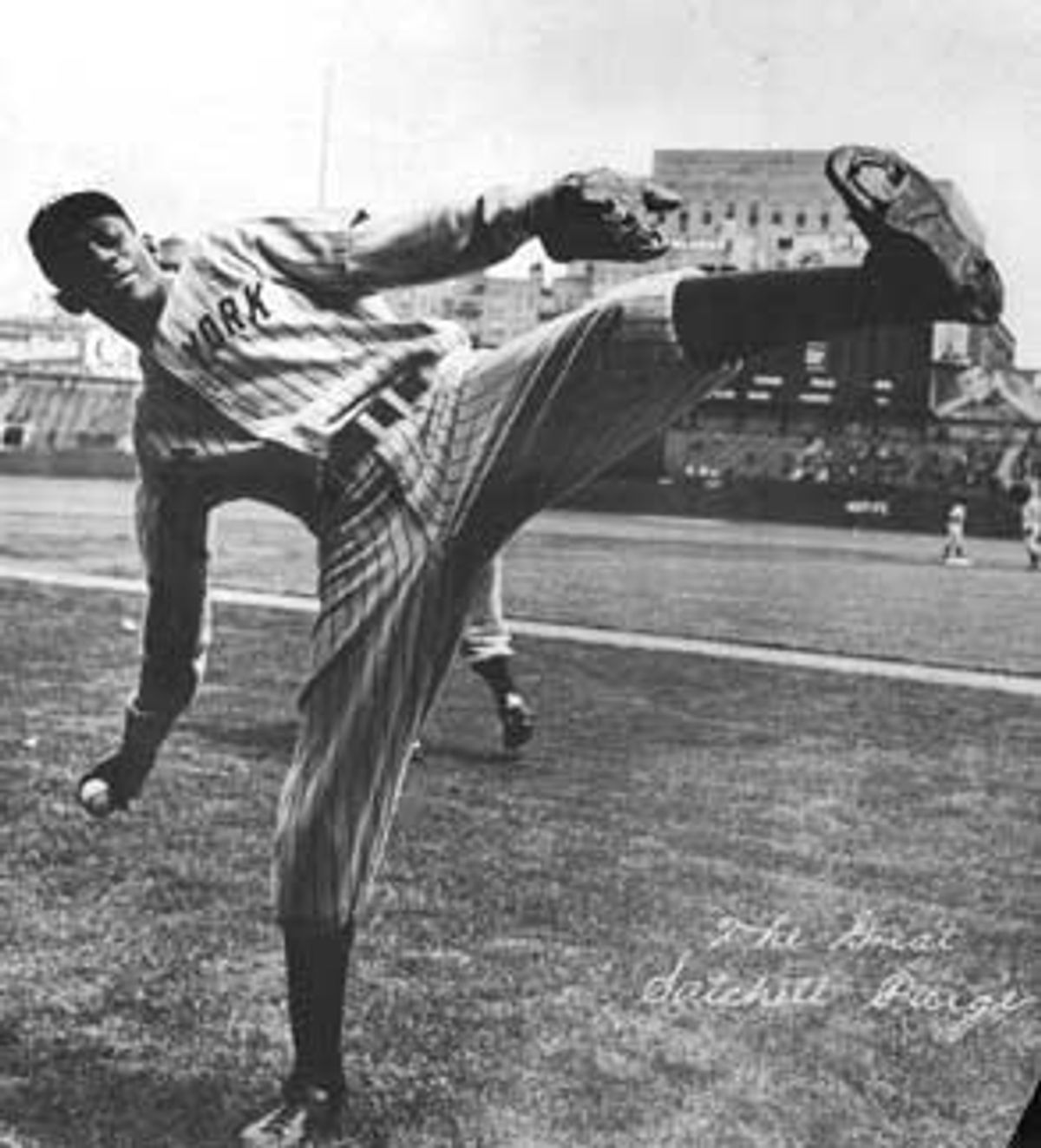
Les Standiford is the author of several novels, including “Done Deal” and “Black Mountain,” and also contributed to the multi-author national bestseller “Naked Came the Manatee.” He is a past recipient of the Frank O’Connor Award for Short Fiction and a National Endowment for the Arts fellowship in fiction, and is the director of the creative writing program at Florida International University in Miami. Standiford, a lifelong baseball fanatic, was fascinated with the Negro Leagues from his youth. He remembers watching Larry Doby and Luke Easter play for his beloved Cleveland Indians and still counts among his most prized possessions one of the first Satchel Paige baseball cards. Listen to Mark Jupiter read from “Opening Day.”
Guillen’s pro-Castro candor
The Miami Marlins' manager is lucky to get a suspension. Not so long ago, he might have received a car bomb.
A contrite Miami Marlins manager Ozzie Guillen gestures at a news conference on Tuesday. (Credit: AP/Lynne Sladky) There’s not much reason to doubt that baseball manager Ozzie Guillen admires Fidel Castro. He said so five years ago in an interview with Men’s Journal. When asked to name the toughest man he knew, Guillen replied, “Fidel Castro. He’s a bull—- dictator and everybody’s against him, and he still survives, has power. Still has a country behind him. Everywhere he goes, they roll out the red carpet. I don’t admire his philosophy; I admire him.’’
Continue Reading Close
Jefferson Morley is a staff writer for Salon in Washington and author of the forthcoming book, Snow-Storm in August: Washington City, Francis Scott Key, and the Forgotten Race Riot of 1835 (Nan Talese/Doubleday). More Jefferson Morley.
The year of the baseball book
From a treatise on Yankee hating to a "people's history," a number of great books covered the national pastime
A simple and unsettling calculation reveals to me that this year marks the 40th anniversary of my coming to New England and setting up shop as a Red Sox fan. How innocent I was in that distant day: how little I understood the faces etched with pain, the haunted eyes, the lips that writhed in uttering “Yankees.” It did not take long to become afflicted by the same symptoms and, in my time here, certain Yankee-related events have been so traumatic that they are best designated by numerals alone: 1978 and 2003. The ALCS of 2004 (when the Red Sox came from a 0-3 game deficit to vanquish the evil ones) changed the region’s mental landscape — as, of course, did the subsequent World Championship(s). Since then, Yankee hating has become more of a pleasant pastime than a crippling mental and spiritual disorder.
Continue Reading CloseThe Marlins’ bizarre new look
The team's revamped logo involves a whimsical rainbow swoosh. The effect is anything but intimidating
So far the biggest story to come out of baseball’s early off-season isn’t some splashy free agent signing or the abrupt retirement of St. Louis Cardinals manager Tony LaRussa, but that of the logo and uniform redesign of the Florida Marlins. The new look was officially announced on Friday, and if you haven’t seen them already, you might not believe your eyes. In fact, when some of the images of the new logo were leaked there was such shock and disbelief by the baseball world, most people assumed it was a farce, calling the look everything from “Hawaiian Shaved Ice” to “Push-up Pop” to “Rainbow Bright.”
Continue Reading CloseExonerating Bill Buckner
25 years after the Red Sox infielder's infamous World Series error, we look at what really happened that October
(Credit: AP) Bill Buckner’s error in the 1986 World Series – 25 years ago today, a day of infamy for Red Sox fans — is one of the two most famous plays in World Series history. (Willie Mays’ catch in the 1954 fall classic is the other.)
Like Mays’ over-the-shoulder catch, Buckner’s booboo is entrenched in American folklore. Jimmy Fallon’s Red Sox fanatic in “Fever Pitch,” distraught over breaking up with his girlfriend, watches Buckner’s play over and over on his VCR. During congressional hearings in 2008, U.S. Rep. John Yarmuth, D-Ky., called former Treasury Secretary John Snow, then-SEC chief Christopher Cox and former Federal Reserve Chairman Alan Greenspan “three Bill Buckners.” On “Curb Your Enthusiasm” this season, Larry David loses a softball game when a ball rolls between his legs; his coach screams, “You Buckner-ed me!”
Continue Reading CloseAllen Barra's next book is "Mickey and Willie -- The Parallel Lives of Baseball's Golden Age," from Crown. More Allen Barra.
What baseball tells us about racism
Most home-plate umpires are white -- and they seem to be hurting the careers of minority pitchers
Despite recent odes to “post-racial” sensibilities, persistent racial wage and unemployment gaps show that prejudice is alive and well in America. Nonetheless, that truism is often angrily denied or willfully ignored in our society, in part, because prejudice is so much more difficult to recognize on a day-to-day basis. As opposed to the Jim Crow era of white hoods and lynch mobs, 21st century American bigotry is now more often an unseen crime of the subtle and the reflexive — and the crime scene tends to be the shadowy nuances of hiring decisions, performance evaluations and plausible deniability.
Continue Reading Close
David Sirota is a best-selling author of the new book "Back to Our Future: How the 1980s Explain the World We Live In Now." He hosts the morning show on AM760 in Colorado. E-mail him at ds@davidsirota.com, follow him on Twitter @davidsirota or visit his website at www.davidsirota.com. More David Sirota.
Page 1 of 81 in Baseball


