Music

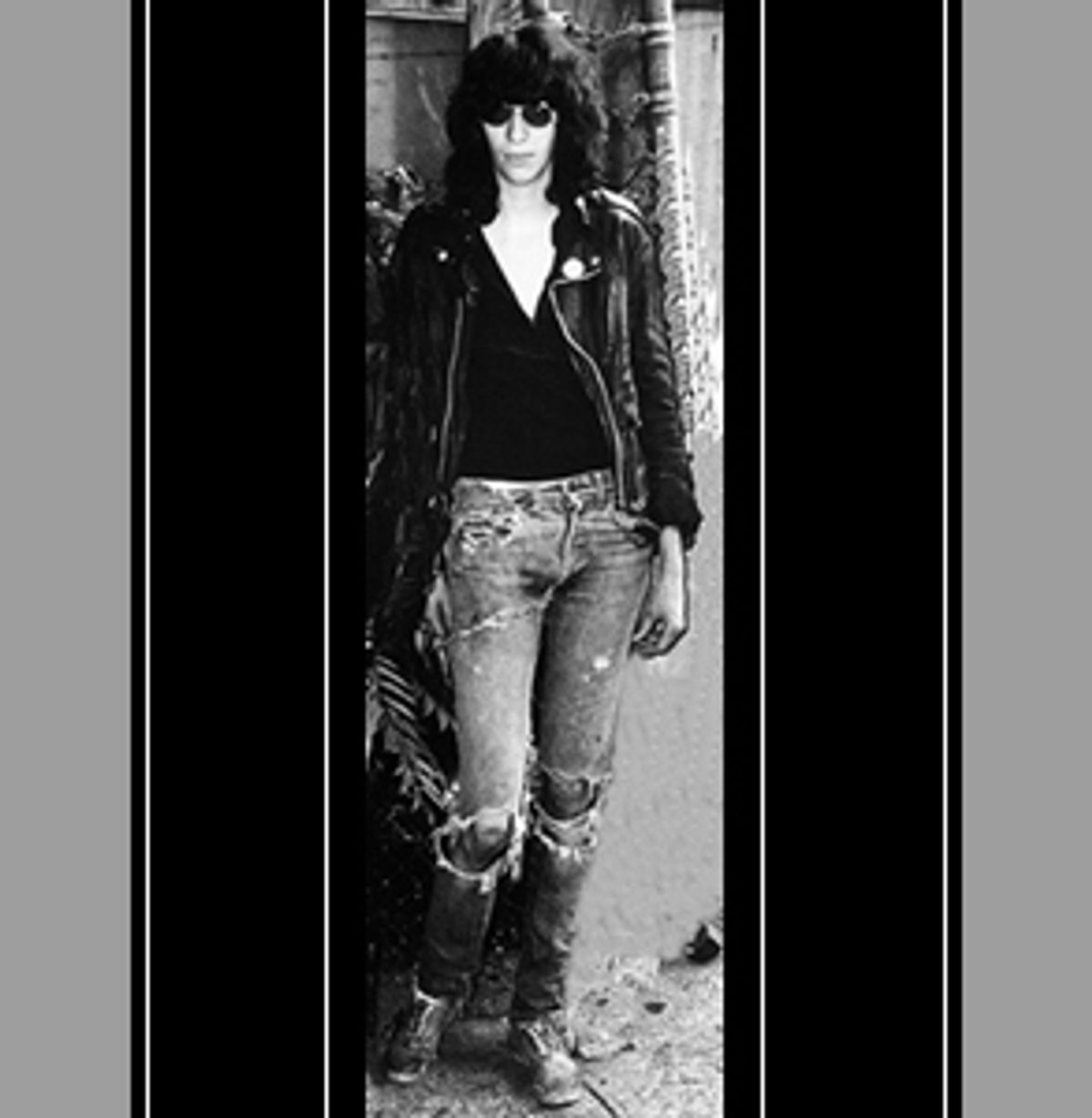
Joey Ramone, R.I.P.

He had no voice, no looks, no chest, butt or knees. But he kicked a generation in the ass, hard.

  • more
    • All Share Services

Joey Ramone, R.I.P.

Joey Ramone died Sunday. He had lymphoma, which is cancer of the body’s lymphatic system. He was 49 years old.

In the mid-1970s, Joey Ramone, whose real name was Jeffrey Hyman, had a disgusting mess of a head of hair and wore colored sunglasses. He was so thin he didn’t seem to have a chest, a butt or knees. And he didn’t sing so much as bleat.

He was a rock star.

If you were a rock-loving youth in America’s dreadful Sun Belt in the mid-1970s, the Ramones gave you your first taste of what a sensation was. They didn’t know how to play their instruments! Were they rock, really? They were dumb! They were Nazis!

They were an affront to everything our heroes — Led Zeppelin, Pink Floyd and Bruce Springsteen — stood for.

The band’s first record, “Ramones,” was a puzzle: Churning, uninterrupted guitar playing. A bass player who did nothing but hit the root note. And a singer with an impossible deadpan drawl of a voice who sang about death and drugs with virtually no nuance and could get excited only when the prospect of sniffing glue was mentioned.

It took a while, but over time it became apparent that “Ramones” was a well-disguised piece of rock criticism. (Once seen this way, in fact, it became a blisteringly didactic one.) Rock songs, the band argued, forcefully, don’t need to be much longer than 1:48. They should be funny, except when they were serious. (Ramones songs were both.) The Beatles and the Beach Boys and Chuck Berry, the band lectured, were great artists, but so were the Bay City Rollers.

Three chords, Johnny Ramone, the group’s guitarist, posited, were perhaps one too many.

And ballads were out.

These points raised difficult questions for a 15-year-old. The Ramones were, proudly, dumb; so why did they make us think? Why did they call themselves pinheads? Maybe … they weren’t! Maybe … the song meant something else. Maybe … they mean people who sing rock songs are pinheads!

Therefore, Rod Stewart is the real pinhead. Q.E.D.

When the first Ramones records were released, high school friends and I would sit in one of our rooms, huddled around the stereo. (Parents would yell if we turned it up.) We tried to parse the lyrics, the sounds, the meanings. We didn’t know much about pop history, but we could sense the sendups — “You’re Gonna Kill That Girl,” the title a slap at the Beatles’s “You’re Gonna Lose That Girl”; the indolent drawl with which Johnny sang the thing a slap at the indolent Mick Jagger.

Once we figured out the Zen of it, the world looked different. Bands like the Eagles and the Who sounded weak, Pink Floyd sounded mannered, Zeppelin almost flatulent. The Ramones seemed to understand all of that, even as they chipped chinks in the armor that would later allow for the blow that, while it did not kill the beast, made its mortality plain.

We started getting the nuances. The Ramones were an underground band playing underground music with a big-beat sound, the vocals mixed friendly and high. They weren’t trying to be obscurantists or art victims; they were pop-meisters. They wanted their lyrics to be heard and wanted to have a hit single. They even wrote one. “Sheena Is a Punk Rocker” was its name, and the fact that it was laughed off the American charts is beside the point.

Soon after, the band was writing ballads, good ones. The Ramones’ third and fourth albums, “Rocket to Russia” and “Road to Ruin,” in their own way, are as good as, say, “Beatles VI” or “Surf’s Up,” take your pick, and have songs that are played, today, more than 20 years later, with surprising regularity on rock radio. And everyone knows now that the Ramones invented punk in its most ferocious form: After them came the Pistols, and the Clash, and X-Ray Spex, and Joy Division, and X, and ….

Seven or eight years after we’d first heard the Ramones, one of those same high school friends came to visit me at college. We’d both read about, but hadn’t actually heard, a mysterious single the group had released in Britain — a sonic blast of a song, it was said, called “Bonzo Goes to Bitburg.” This, too, was confusing. By then we knew things about the Ramones we hadn’t before: that the early Nazi imagery was just a passing idiocy, but that Johnny was a Republican who had voted for Reagan. Politics for a band this dumb was obviously a minefield.

But Joey had turned up, oddly, on the “Sun City” single, and then there was an odd track on “Too Tough to Die” called “Howling at the Moon”; if you read it right, as I think I did, you could picture a paranoid Joey railing against a nightmare onslaught of guns and corporate power: “There’s no law/No law anymore/I want to steal from the rich/And give to the poor.”

Odd thoughts from the Ramones. Anyway, late one night, we found the single in a Berkeley, Calif., record store — a heavy 12-inch import that cost more than I could afford. It was after midnight when we got home, and since my roommates were asleep we were suddenly transported back a lifetime: sitting late at night, the turntable spinning, ears close to the speakers. We heard a revved-up guitar roar, then an almost Springsteenian change-up.

And then what sounded like a fucking glockenspiel.

What came next was a cry of betrayal. Disgust rose from Joey’s voice as he dissected a few seconds of image on the TV news: an American president laying a wreath in a cemetery where SS officers lay buried.

They, too, were victims, the president said.

I didn’t need to be told about Reagan at that time, but as we listened to Joey’s pained, pleading voice, as we heard Johnny lob guitar bombs and as we were swept away by the Spectorian, rushing production, we marveled again at the Ramones’ capacity to surprise.

And Joey finally found ferocity, howling his way through the group’s greatest song and his greatest vocal performance. The Ramones were never as dumb as they looked, but they weren’t geniuses either. But listening to Joey think his way through that particular political act in that particular song is a lesson in moral education that any of us can learn from.

Joey Ramone wasn’t the band. He had Johnny, for several years at once the best and worst guitarist in the world, by his side, and a smart guy named Tommy Erdelyi playing drums and helping produce the early records.

Still, there’s a legend near the tomb of architect Christopher Wren that applies to Joey Ramone as well: If you would see his works, look around you. He faced the truth where he found it and kicked a generation, hard, in the ass. I was part of that generation, and one of the things Joey Ramone taught me was that I didn’t have to wait around for him to surprise me again.

Bill Wyman is the former arts editor of Salon and National Public Radio.

Born in the U.S.A.: When the president met the Boss

Bruce Springsteen's politics were unformed in the '80s. When Ronald Reagan invoked his name, that changed fast

  • more
    • All Share Services

Born in the U.S.A.: When the president met the BossBruce Springsteen (Credit: AP)
Excerpted from "Bruce Springsteen and the Promise of Rock ‘n’ Roll" by Marc Dolan. Copyright © 2012 by Marc Dolan. With the permission of the publisher, W.W. Norton & Company, Inc.

In the same week that “The River” hit No. 1, in a seemingly unrelated event, Gov. Ronald Reagan of California was elected the 40th president of the United States, garnering a whopping 489 Electoral College votes, while incumbent Jimmy Carter received a mere 49. During the last days of the campaign, Bruce Springsteen and the E Street Band were on tour, of course, still promoting the month-old “River,” but they had election night off. The next night, on November 5, they played a concert at Arizona State University in Tempe that was virtually identical to the one they had played in Los Angeles the previous Thursday — except that it was longer. “All you guys in the aisle find your seats, OK?” Bruce announced three songs in. “There’s gonna be a real long show.”

That night Springsteen rambled, more than usual. Before the postindustrial triptych of “Independence Day,” “Factory” and “Jackson Cage” midway through the first set, he began a long monologue, although not about his father, whom he frequently talked about before “Factory.” Instead, Springsteen used this opportunity to talk about his love of pop music, about what it had meant to him growing up. Spontaneously, falteringly, he offered the most coherent argument he would ever make for the essential unity of the two distinct compositional strains that had flowed into “The River,” its idealistic and pessimistic “hearts”:

I never did good in school, never did good, and they always figured that if you’re not smart in school, it’s because you’re dumb. But I always felt that I never really learned anything, or learned anything that was important to me, till I started listening to the radio back in the early ’60s. And it seemed that the stuff that I was hearing off the radio in all those great songs was stuff that if they knew how, they’d be trying to teach you in school … but they just didn’t know how to. They always talked to your head, they could never figure out how to talk to your heart, you know. And it seems that, like all those singers and all those groups, there’s one thing that they just knew: what it was about. And when I started listening, I found out that the first time … that, instead of the fantasies that you have when you’re a little kid, I had dreams now and that they were different, it was different, and that if that was possible, that I didn’t have to live my life the way that I was, that things could be better. If you just go out, take a chance, find out what’s going on …

It was only toward the end of the first set in Tempe that Springsteen finally addressed the election. “I don’t know what you guys think about what happened last night,” he said as a transition between “The River” and “Badlands,” “but I think it’s pretty frightening. You guys are young, there’s gonna be a lot of people depending on you coming up, so this is for you.” When you listen to recordings of this concert, during this speech you hear scattered cheers from the crowd, but nowhere near as strong as when Springsteen actually started the next song.

Springsteen’s comments before “Badlands” in Tempe that night were virtually the first recorded statement he ever made about politics. At the MUSE concerts a year earlier, he was practically the most apolitical performer on the stage. He had played a small acoustic benefit for George McGovern’s campaign at the Red Bank Drive-In in 1972, but there is no other record of his ever endorsing a political candidate up to this point, or even expressing displeasure with one as he did in the wake of Reagan’s election. In subsequent interviews, he would admit that he had maybe voted once, but no more than that. Like the draft or Kent State, politics was something that happened outside of his life, to his life, while he was trying to make his dreams come true. And he was obviously not the only American who viewed politics that way, especially not in the fall of 1980. Ronald Reagan’s victory, much closer in the popular vote than in the Electoral College, reflected the will of about a quarter of the electorate; only a little more than half of those eligible to vote had done so that year. Like Bruce Springsteen, many other Americans at that point in our history were essentially apolitical.

But there’s a subtle difference between politics and ideology, between elected officials and the policies they enact on the one hand and the underlying principles that cause people to trust or distrust politicians on the other. You can live your life without ever having an opinion on any elected official or legislative body, but you cannot live your life as an adult without having some notion of what a better world would look like. In the late 1970s, as the two dominant political parties in the United States reacted to contemporary economic crises by dissolving into ever greater procedural disarray, such utopian visions of what might work better suddenly became far more important. In 1979, however, only the college professors called this “ideology.” The word that both First Lady Rosalynn Carter and the Reverend Jerry Falwell of the Thomas Road Baptist Church started using that year was “values.”

In 1979 and 1980, as Bruce Springsteen crafted “The River” and began touring to support it, his politics were virtually nonexistent, but his ideology — his “values,” if you must — was all over his songs. Springsteen believed in “freedom,” in as vague a sense as any American would define it, in the freedom to head out where you wanted when you wanted with whomever you wanted with no bossman or exaggerated patriarch telling you what to do. On Springsteen’s first four albums, his ideal world was the road, the way to the next great place but not necessarily the place itself, because all fixed places had the potential to trap you. In Springsteen’s songs, success was seldom material success (no matter how much the singer might want it in real life). In most cases, the success his characters dreamed of or attained was mere survival, making their stand in an environment that was constantly trying to grind them down.

Half of “The River” reinforced this view, not only such “Darkness” survivors as “Sherry Darling” and “Independence Day” but such newer songs as “Ramrod,” “Jackson Cage,” “Out in the Street” and “Cadillac Ranch” as well. There were also all the new songs about connection (“I Wanna Marry You,” “Fade Away,” “Stolen Car,” “The Price You Pay,” “Drive All Night,” and “Wreck on the Highway”), but they were about personal commitments rather than communal ones. Both these aspects of “The River” were undeniably ideological, but they were not political; they sought no help for their characters through governmental or collective action. Even in the album’s title track, the characters’ situation seems more mythic than political. In that song, Springsteen sings, “Lately there ain’t been much work on account of the economy,” but there is no sense here that these characters’ problems could be fixed by a government stimulus package or a cut in the mortgage rates. Their problems are synchronic rather than historical and must simply be endured.

But during this same period, as the nation around him felt adrift in an uncertain and uncommitted age, Springsteen was crafting his first specifically topical songs in almost a decade, since the trendy, epic antiwar songs he had written during the Nixon era. The most obvious of these was “Roulette,” written in a white heat during the first week after the event at Three Mile Island but by all accounts never seriously considered for the album. Almost a year later, toward the end of the “River” sessions, Springsteen had also written the little gem “Held Up Without a Gun,” which managed to turn the most pressing political issue of the late 1970s — the exorbitantly rising price of gasoline — into a rocking good joke.

Indeed, with the gas crisis of the Carter years, history practically forced Springsteen to consider the political implications of his apolitical, personal ideology. In his pre-1979 songs, as in rock songs since at least Chuck Berry, cars and motorcycles were the vehicles of the individualized freedom that he craved. In the late 1970s, however, ration-starved cars and motorcycles became much more specific cultural symbols, emblems of how Americans saw their personal freedom limited by current events. Gas prices had been rising since the beginning of the decade, and in one day, June 28, 1979, OPEC raised the price of a barrel of crude oil by 24 percent. That summer, as Springsteen labored at the Record Plant, blocks-long lines at gas stations became a common, even violent occurrence.

Suddenly, Springsteen’s favorite form of mindless fun had taken on economic, political, and even international significance. The two roadhouse numbers he and the band cut that fall, “Ramrod” and “Cadillac Ranch,” spoke about the sheer fun of driving, in purely sensual terms that were a world away from the desperate tales of escape he had trafficked in on his last two albums. Simultaneously, though, in songs like “Stolen Car” and “The River,” it was also becoming clear that cars could take you nowhere as well, that they could signify escape in the sense of avoidance rather than freedom. In many ways, the great lost album that Springsteen could have released but didn’t in 1980 was a single disc of songs about cars, taking in the freedoms and restrictions that they made possible for his fellow citizens. It would have been a perfect project to release during a year in which driving was an implicitly ideological act.

- – - – - – - – - – - -

Like many other Americans of his era, Springsteen was caught up in the “crisis of the American spirit” about which President Carter had spoken during that same brutal summer of 1979. This was another part of Springsteen’s dissatisfaction during the late 1970s, a more abiding need than could be solved by a simple Top 10 single. He knew that something was missing in his life, that just driving off into the night wouldn’t fill the absence he increasingly felt in his soul, but he was still nowhere near embracing Carter’s solution to this crisis: increased civic involvement. “In a nation that was proud of hard work, strong families, close-knit communities, and our faith in God,” Carter had declared, “too many of us now tend to worship self-indulgence and consumption.” Springsteen obviously believed in hard work, but the only community he had ever been a part of was the Upstage. Ever the proud individualist, he was innately suspicious of virtually all systems, structures, clubs, and experts, even if they claimed they were trying to help him.

In other words, Springsteen’s criticism of Ronald Reagan from the stage in Tempe was in no way a too-late endorsement of Jimmy Carter. It was simply a voiced suspicion of Reagan, who had been clearly labeled a public enemy of rock ’n’ roll since Jeffrey Shurtleff’s mockery of him at Woodstock at the absolute latest. Given his later admissions of political apathy during the 1970s, it is doubtful that Springsteen was acquainted with too many of the specifics of Reagan’s political platform. He just seemed like the kind of person who wouldn’t be too comfortable with “freaks.”

Nevertheless, there was more truth than Springsteen realized to his knee-jerk statement that he didn’t know what his fans thought about what had happened the previous night. What Springsteen probably didn’t know at that time, but would become clear once the 1980 election results were more closely analyzed, was that the youth vote broke slightly for Reagan, with many of the youngest baby boomers casting their first presidential votes that year for the former California governor. Moreover, Reagan received 49 percent of the Catholic vote, 40 percent of the union vote, and 24 percent of the votes cast by registered Democrats, all groups to which Springsteen had strong personal ties.

We will never know for sure, but statistically there is an excellent chance that many of the young women and men in Springsteen’s audience in Tempe who had voted the previous day had voted for Ronald Reagan. This may have seemed inconceivable to Springsteen, but if you weren’t listening carefully, it was surprisingly easy to be a fan of both men that fall. Like Springsteen (not to mention the pop singers of the 1960s whom he so admired), Reagan spoke to the heart, not the head; he “made sense of the world narratively”; and he thought that structures and institutions tended to get in the way of individual effort — all attitudes surprisingly consonant with the ethos of a song like “Out in the Street,” for example. The night before the election, Governor Reagan had even declared that he would be honored to lead what he called “the freest society the world has ever known.” Until Bruce Springsteen started telling audiences what he thought about the Soviet Union or the size of the federal budget — until he told them specifically what he found frightening about the president-elect, which he did not do that night in Tempe — it was perfectly understandable for his more casual fans to think that he might be a “Reagan Democrat” too.

- – - – - – - – - – - – - -

In 1980, Ronald Reagan ran for president mostly on what he considered the most important issues: lowering taxes, shrinking the federal government, rebuilding U.S. defense in the face of what he deemed a détente-emboldened Soviet Union. That year, his campaign aired cheap-looking TV spots in which the candidate spoke directly to the camera about soaring energy costs in front of a fake-looking shelf of books, as if he were a personal-injury lawyer looking for new clients. Four years later, however, after closely reading the poll data, in-house pragmatists like James Baker counseled the president that his long-standing supporters would vote for him no matter what. For the reelection campaign, Reagan’s team focused on images rather than issues, particularly in its advertising, which featured suburban homes, rural churches, forests, and gardens, all of them signifying a bucolic America that the ad copy suggested the president had restored. In 1980, the campaign had sold Reagan. Four years later, it was selling a putatively reborn America, in order to pull in voters who didn’t agree with the president already on specific political policies.

So, just as Bruce Springsteen and his advisers were plotting in the spring of 1984 to snag the broadest possible segment of the record-buying public, Ronald Reagan and his advisers were planning that same season in strategically similar ways to pull in the largest possible portion of the electorate. Reagan might be proceeding from the House Un-American Activities Committee-based right and Springsteen from the Monterey Pop-based left, but in 1984 each man was seeking to go beyond the loyal base that he had painstakingly built during the 1970s in order to capture the hearts and minds of the much wider American center. Viewed side by side, their relaunches look strikingly similar at points, particularly in terms of the visuals they presented. Like Springsteen’s “Dancing in the Dark” video, “Morning in America,” Reagan’s most famous 1984 reelection ad, was filled with pastels and variations on the American tricolor: pretty red roses, a true-blue sky over the District of Columbia, and dazzlingly bright white picket fences and wedding gowns. A casual observer might think that Springsteen was trying to cynically cash in on the contemporary rise in patriotism, but the reverse was actually true: Reagan and his team were, like Springsteen, trying to put on a good show. Walter Mondale might have sought to be the rock ’n’ roll candidate of 1984 by using a Crosby, Stills and Nash song in one of his advertisements, but the sad truth of that year’s presidential campaign is that Reagan knew how to throw a better arena-style concert than Mondale did. Skydivers, hot-air balloons, and forty thousand people chanting “U.S.A.!” may not have been how Franklin Delano Roosevelt would have kicked off a reelection campaign, but it did sound like one hell of a finale for a Van Halen concert.

Politically, Springsteen’s sympathies may have been more with the Democratic camp, but when Democratic politicians spoke about America, none of them seemed to describe the country found in Springsteen songs. At the Democratic National Convention in San Francisco in mid-July — a month after Bruce’s stand at Alpine Valley — Governor Mario Cuomo challenged Reagan’s invocation of John Winthrop’s “shining city on a hill” by speaking about “the other part of the city [where] there are more poor than ever, more families in trouble, more and more people who need help but can’t find it.” Two nights later the Reverend Jesse Jackson famously spoke to the convention of “our Nation [as] a rainbow.” What both Reagan and Springsteen understood in 1984, however, was that, after the last 15 or 20 years of battering national history, most Americans didn’t want their nation to be two or many. They wanted it to be one. As one Reagan aide remarked in a memo written on March 8 (while Arthur Baker was adding aerobic-friendly rhythms to the already synth-heavy “Dancing in the Dark”), “If we allow any Democrat to claim optimism or idealism as his issue, we will lose the election.”

Ronald Reagan’s most deeply held ideological tenet, far more important than any specific policy that might have grown out of it, was his belief that the United States was a nation of individuals. In his acceptance speech at the Republican National Convention, Reagan contended that the core change that his administration had made during the last few years was to shift the government from a philosophy of “statism” that only viewed “people in groups” to one that advanced “the ultimate in individual freedom consistent with an orderly society.” For the casual listener, how different was that from Springsteen’s current variation on the Elvis Presley freedom speech from four years before, now used to introduce “Born to Run” (in this case, in Largo, Maryland, two nights after Reagan accepted the Republican nomination)?

When I was a kid growing up, and I first heard the music of Elvis Presley, the main thing it did for me was it set my mind free a little bit. I could dream a little bit bigger than I had been. His music and the best of rock ’n’ roll always said to me “Just let freedom ring,” and that’s what we’re here for tonight. But remember you gotta fight for it every day.

For the most part, this was as political as Springsteen got in the summer of 1984. Despite the presence of two or three “Nebraska” songs every night, Springsteen’s most notable response to contemporary politics on this tour so far was his decision to cover the Rolling Stones’ “Street Fightin’ Man” during his encores many nights, as significant an addition on this tour as “Who’ll Stop the Rain” had been four years earlier.

That night at the Capital Centre in Largo, “Street Fightin’ Man” directly followed “Born to Run” during the encores, its first appearance after a two-week absence. In the audience that night was syndicated columnist George Will, who had been invited to the show by Max Weinberg’s wife, Rebecca, who was a fan of his tag-team punditry with Sam Donaldson on Sunday morning TV. For his first and only Springsteen concert, Will wore a bow tie, double-breasted blazer, and dress slacks rather than the increasingly de rigueur denim. At Rebecca’s suggestion, the columnist also stuffed cotton in his ears. In general, Will found Springsteen androgynous, noisy and surrounded by pot smokers, yet in the end he concluded that the singer was “a wholesome cultural portent.” As a political commentator, Will may not have cared about rock ’n’ roll’s future, but he did see Springsteen’s abundant success as an emblem of a robust American present.

Although his columns that year never made this clear, George Will was in fact an off-the-books adviser to the president’s reelection campaign. He seems to have come up with the idea of linking Springsteen with Reagan, but his genuine reaction to Springsteen’s concert was very much in keeping with the Reagan camp’s wider reelection strategy — don’t divide, co-opt. In attempting to seize many formerly liberal strains (even ones associated with the 1960s) and claim them for their own, Reagan’s advisers were piggybacking on a larger, hegemonic shift that had been building in U.S. society for the last year or two. In retrospect, historian Gil Troy has dubbed this shift “the Great Reconciliation,” which evidenced itself, in his words, “in the rise of the corporate activist, the consumer with a conscience, a society filled with people yearning to earn like Rockefellers, but occasionally live and sometimes even vote like Beatniks.”

Very much in this spirit, Will essentially announced in his column that rock was not rebellion. It was hard work. “Backstage,” he noted, “there hovers the odor of Ben-Gay: Springsteen is an athlete draining himself for every audience.” Moreover, he classified Springsteen’s brand of rock as a well-made American product, one that produced large profits and need not be shipped overseas (except on well-managed tours). “If all Americans,” Will continued, “—in labor and management, who make steel or cars or shoes or textiles — made their products with as much energy and confidence as Springsteen and his merry band make music, there would be no need for Congress to be thinking about protectionism.”

Whether it was just a lucky accident due to Will’s vacation schedule or a more purposeful delay to help out the president’s cause, Will’s column on Springsteen finally appeared in print on September 13: Over a month after the concert he had attended; a week or so into the official presidential campaign; as “Dancing in the Dark” sank down to no. 50 on the Hot 100, “Cover Me” rose to no. 15, and John Cafferty and the Beaver Brown Band’s ersatz E Street track “On the Dark Side” sat between the two genuine articles at no. 37. Less than a week later, Ronald Reagan made a scheduled stump appearance in Hammonton, N.J., a fairly rural community about an hour’s drive southwest of Freehold and half an hour northwest of Atlantic City. At this appearance, Reagan’s standard stump speech was altered as usual to include a local reference or two. In this case, the president noted, “America’s future rests in a thousand dreams inside your hearts. It rests in the message of hope in [the] songs of a man so many young Americans admire  —New Jersey’s own, Bruce Springsteen. And helping you make those dreams come true is what this job of mine is all about.”

Over the weekend, between shows, Springsteen tried to make light of Reagan’s comments, but the impression persisted that Reaganism and Springsteenism were one and the same. When you heard Springsteen extol unrestricted individualism as he did in the Let freedom ring rap before “Born to Run,” or speak about the Revolutionary War monument in Freehold as he frequently did before “My Hometown,” you could easily understand why. Generationally specific as Springsteen’s remarks before “My Hometown” might be, they were still stylistically in tune with the similarly honorific remarks that the president had made in France in early June on the fortieth anniversary of D-Day, not to mention the tribute to the Statue of Liberty with which he had concluded his speech in Dallas.

By the night of Springsteen’s next performance, at the Civic Arena in Pittsburgh on September 21, it was clear that the singer’s Reagan problem was not going away. That night, almost the first thing Springsteen mentioned to the audience was Reagan’s appropriation of his music. “Well, the President was mentioning my name in his speech the other day, and I kind of got to wondering what his favorite album of mine must’ve been, you know? I don’t think it was the ‘Nebraska’ album,” Bruce concluded, “I don’t think he’s been listening to this one,” and he led the band into their customary rave-up on “Johnny 99.”

Throughout the concert that night, Springsteen made his displeasure at the current administration known, as he had done briefly after Reagan’s election and during the VVA benefit. It’s important to note, though, that in the ensuing three or four years the specific fight that Springsteen had hinted at back then had never really come. In 1980 and 1981, Springsteen implicitly feared another culture war, like the one the nation had experienced during the early Nixon years. But in its rhetoric, the Reagan administration stressed unity rather than division, especially during this election year. Rock ’n’ roll was not a designated enemy for Ronald Reagan (as it might have been for a previous Republican like Spiro Agnew); pessimism was. Springsteen seems to have prepared himself for a fight that wasn’t even an open disagreement.

That night in Pittsburgh, in trying to definitively distinguish himself from Reagan, Springsteen went somewhere he had rarely gone before: Into the politics of class — not the division of the world into conformists and free spirits, but rather its division into haves and have-nots. Pushed to articulate his political convictions, Springsteen finally moved beyond his 1960s rock ’n’ roll individualism, back to the New Deal communalism he had instinctively absorbed from his parents. Now, as he once again reformulated the monuments story before “My Hometown,” he made his most directly anti-Reagan comment yet:

It’s a long walk from the government that’s supposed to represent all the people to where we [are now. It] seems like something’s happening out there where there’s a lot of stuff being taken away from a lot of people that shouldn’t have it taken away from them. Sometimes it’s hard to remember that this place belongs to us, that this is our hometown.

This was a start. If actively articulating his political concern for those less fortunate, those who might benefit from a larger federal government, was all it took for Springsteen to distinguish himself from the president, then a statement like this should have solved his problems of misperception.

But despite Springsteen’s increasingly explicit political statements as the tour rolled on, the ideological similarities between the two men remained. Springsteen could tell you better than anyone else that music speaks louder than words, and arrangements and setlists often speak louder than both. Every night, Springsteen took his audience on the same phased journey from the bad times of late 1981 to the good times of 1983-84, precisely the same historical journey on which President Reagan took his audiences during his stump speeches; from the “Nebraska”-esque days of “drift” and “torpor” to the promise of “you young people.” “[M]y generation,” Reagan declared near the end of his standard stump speech that fall (almost setting his audience up for a rendition of “Born to Run,” his allegedly favorite Springsteen song), “and a few generations between mine and yours . . . grew up in an America where we took it for granted that you could fly as high and as far as your own strength and ability would take you.” In the end, when you compared Springsteen’s fall 1984 tour with Reagan’s, no matter how different their political visions were supposed to be, their rhetoric seemed a lot alike.

Bruce put in more appearances that fall than the president, whose campaign had restricted his stumping to two or three well-chosen photo ops a week. Springsteen was still introducing “Born to Run” by saying “Let freedom ring” but now added “but it’s no good if it’s just for one. It’s gotta be for everyone.” More effectively, he started making room at his concerts for representatives of local food banks and political organizations, giving a shout-out from the stage of the Tacoma Dome to Washington Fair Share, a local coalition dealing with the results of toxic-waste dumping in the Northwest. By that point in the tour, the rock critical establishment (in the person of Jersey Shore-born soon-to-be MTV employee Kurt Loder) had stepped in to try and reburnish Bruce’s liberal reputation. As the tour made its way down the coast to Los Angeles, Loder conducted Springsteen’s first extended interview with Rolling Stone, giving him a widely distributed, rock-friendly forum in which to make his differences from the president clear.

None of it, though, made any difference, at least not in terms of the presidential race. On Sunday, November 4, two days before the election, Bruce and the band finished up a seven-night stand in Los Angeles, pulling out a rarely performed “Shut Out the Light” as a dedication for audience member Ron Kovic. Four days later, they were right back where they had been almost exactly four years earlier: onstage at Arizona State University in Tempe, looking ahead to four years of Ronald Reagan in the White House, this time elected by a wider margin than any nominee since Franklin Delano Roosevelt nearly half a century before. This time, Bruce didn’t say anything from the stage about the election.

Reprinted from “Bruce Springsteen and the Promise of Rock ‘n’ Roll” by Marc Dolan. Copyright © 2012 by Marc Dolan. With the permission of the publisher, W.W. Norton & Company, Inc.

Continue Reading Close

Marc Dolan is an associate professor of English and Film Studies at John Jay Colllege, CUNY, and the author of "Bruce Springsteen and the Promise of Rock ‘n’ Roll"

Trust me on this: David Bowie’s “Hunky Dory”

The Old 97's singer credits Bowie's brilliant "Hunky Dory" for rescuing his adolescence and inspiring his career

  • more
    • All Share Services

Trust me on this: David Bowie's (Credit: Benjamin Wheelock)
This is the second story in the Trust Me On This series, which runs through Father's Day. You can read the other entries here.

Dear Kiddos,

Hey, you turkeys. Listen up. I need you to listen for five minutes. I’m going to impart a little wisdom. You can take it or leave it. For what it’s worth, I’d rather you took it.

The advice is this: David Bowie’s “Hunky Dory” is a perfect album, and, since perfect albums are a rare commodity, it is worthy of deep and repeated listenings.

I’m listening to “Hunky Dory” as I write this. How many times have I listened to this, my favorite record? Like a million? And it never gets old.

I discovered “Hunky Dory” by accident. I was a sad, lonely little kid. Eleven years old and obsessed with Joan Jett, another artist I imagine you kids would enjoy. Back then, the radio was still a real thing that people listened to, believed in and learned from. I stayed up past my bedtime one Saturday night during the Christmas holiday to listen to a weekly show called “The King Biscuit Flower Hour” featuring a concert by my secret girlfriend, Joan Jett. At the end of the set, she played a cover of a song that would forever change the course of my budding musical tastes, “Rebel Rebel.” As it turned out, “Rebel Rebel” would never be one of my favorite Bowie tunes, but I could detect, within its lyric, a narrative voice to which I could relate. Like really relate.

I was a latchkey kid, a thing that no longer exists. Both of my parents worked, so every weekday after school, I had a few hours wherein I could do whatever the heck I wanted. What I usually wanted to do was go to Half Price Books & Records. The next Monday, released from the grim confines of Armstrong Elementary, I walked to Half Price where I found exactly one David Bowie album. I brought home “Hunky Dory,” marveling at its weird, androgynous cover. In those pre-Internet days, one was always left with questions. Is that David Bowie on the album cover? Is that person a guy or a lady? Is it a painting or some sort of artsy photo? Is this even rock ‘n’ roll, or is it some other kind of music, the name of which has been kept a secret from me?

It was just that, some other, new kind of music. New to me, anyway. This album, recorded when I had been less than a year old, opened doors for me. And I thought I caught a glimpse of my own future. My family’s house on Gillon Avenue was empty when the needle dropped on Side A. “Changes,” turned up to top volume, was my anthem from the first line of the first verse. “Still don’t know what I was waiting for,” indeed. This was what I had been waiting for. Putting up with all the cruel dullards in my grade school, all the teachers and coaches, all the stupid kids and mean adults, had been almost unbearable. Suddenly, I wasn’t alone.

“Hunky Dory” is not a kids’ record, but there is certainly a preponderance of imagery relating to childhood. “Changes” speaks of “these children that you spit on.” “Oh You Pretty Things” has the song’s object driving his “mama and papa insane.” In “Kooks,” the singer begs his own kid to stay, reassuring the lucky little guy that “we believe in you.” At the time, I needed to hear that sentiment.  I went back to it over and over again throughout the difficult years of adolescence. David Bowie was not my dad, but he was there in a pinch.

As the album goes on, it gets weirder. And deeper. And darker. “Quicksand” offers up an epic take on the human experience, turning on a phrase that would echo dangerously throughout those most perilous years of my youth, “knowledge comes with death’s release.” I didn’t understand, but I did understand, if you catch my drift. These were meditations on the difficulty of everyday life, and the insane nature of our very existence. Heavy, beautiful stuff.

Antidotes appear in the record’s latter portion. “Happiness is happening/dragons have been bled … fear’s just in your head,” Bowie proclaims in the goofy-but-right-on “Fill Your Heart.” Then he proceeds to introduce the listener to Andy Warhol and Bob Dylan. And then comes “Queen Bitch,” wherein we meet Bowie’s longtime foil, the most underrated guitarist in rock history, Mick Ronson. The riff in “Queen Bitch” hints at what is to come on Bowie’s next LP, “The Rise and Fall of Ziggy Stardust and the Spiders From Mars,” Bowie’s breakthrough album, but “Hunky Dory” is still pre-fame Bowie at his folkie best.

Finally, he leaves us with the epic poem that is “Bewlay Brothers.” As an 11-year-old, I played it repeatedly in an attempt to decipher this song’s meaning. I wrote out the lyrics in my journal, hoping to make sense of them. To no avail. I did know that something had gone horribly wrong, there was madness and sadness, and then the record was over. Just like that.

Again and again, I listened. Memorized. Marveled. Sang along. When I could take it no longer, I found a guitar teacher and learned how to do these things myself. Well, not exactly these things, but my own version thereof. My early songs were such a pale imitation of early-’70s Bowie, that I could have been sued — had anyone ever heard my early songs. It’s quite possible that I spent the whole of my teenage years singing with an English accent. As they say, mistakes were made.

I never got over Bowie. Especially “Hunky Dory.” Many of his other records have remained favorites: “Low,” “Ziggy Stardust,” “Station to Station.” But “Hunky Dory” was my first love. I caught a lot of grief for my borderline-obsessive Bowie fandom. Kids at school used it as ammunition in their attacks on my masculinity. Did I care? Sure. Did I care enough to throw Bowie under the bus and pretend to withdraw my admiration for this artist who set me on the path I knew I was destined to follow? Hell no. David Bowie was and is my hero.

Listen, kids: I want you to hear “Hunky Dory” because I think you will love it. Like I said, it’s a perfect record, and how often do those come along? But the real reason I want you to listen to “Hunky Dory” is because, in its 11 tracks, you will find the clues that will lead you to an understanding of me, your dad. You’ll see signposts pointing the way to the path I chose in life.

Making music for a living isn’t easy. Many things about it are tough as hell: The touring and its requisite absences; the self-absorption; the occasional financial insecurity; the mood swings one attributes to the “artistic personality.” This life, however, is what I was made for. This calling is the only one I’ve ever known. I’m not curing cancer or solving the global hunger crisis. I’m making music. But there is a certain hazy nobility in that vocation. Somewhere, an 11-year-old kid may be putting on an album of mine and discovering that the universe isn’t a meaningless jumble of coincidences, that there is purpose to be found in these three-minute constructions of music and lyrics. Some small but elegant meaning.

Heck, before you guys came along, that was all I had. The great thing is that now I have everything.

Continue Reading Close

Rhett Miller is the lead singer of the Old 97s. His latest solo album, "The Dreamer," will be released on June 5.

Illustrating the ’60s music revolution

How one book captured the spirit and art of the cultural transformation -- as it was happening

  • more
    • All Share Services

Illustrating the '60s music revolution
This article originally appeared on Imprint.

Imprint“When did music become so important?” That’s Don Draper from last week’s “Mad Men,” set in 1966. Later in the episode he turns off “Tomorrow Never Knows,” from the Beatles album “Revolver,” and walks out of the room.

art: Rick Griffin

There’s something happening here, but you don’t know what it is — do you, Mr. Draper? One year later, Rolling Stone magazine will make its debut, followed soon by “Rock and Other Four Letter Words.”

“Rock,” a 250-plus-page Bantam paperback, was published in January 1968 and subtitled “Music of the Electric Generation.” It was one of the first books of its kind, chronicling a cultural revolution that was still in the midst of its own creation. Crammed with black-and-white portraits of bands and musicians, it’s part oral history, part visual LSD trip. One of its fold-out spreads has an intricate, circuitlike diagram that connects over a hundred names, from the Butterfield Blues Band, the Beach Boys, and the Byrds to Busby Berkeley, Brubeck and Bach.

The editor-designer was a writer named J Marks. The photographer for most of the images was Linda Eastman, who went on to work for Rolling Stone and — oh, yes — marry Paul McCartney.

By the sheer force of its graphic presentation, ”Rock and Other Four Letter Words” conveys the mid-1960s music scene’s spirit, vitality and relevance.


Continue Reading Close

Protest music’s odd conservative turn

A 100-track, four-CD Occupy collection assembles generations of icons. So why does it sound shapeless and safe?

  • more
    • All Share Services

Protest music's odd conservative turn

“In this hour of the ever-changing season, may our tears not douse the fire in our hearts.”

That’s a guy named Michael Pless singing “Something’s Got to Give.” Even without hearing the song, you can surely imagine the essential elements: Plaintive acoustic strumming, an earnest vocal, and an air of polite outrage to match the stilted syntax and hoary platitudes. Welcome to “Occupy This Album,” the collection of protest-minded songs released by Occupy Wall Street. Sprawling across four CDs and a slew of bonus digital tracks, this behemoth set includes 100 (why not 99?) new and previously released tracks from artists representing a range of generations, genres, backgrounds, settings, and styles. Folkies join hands with rappers; ominous post-rock marches alongside peppy radio pop. There’s spoken-word poetry, tribal percussion, earnest singer-songwriter fare. Even a bit of jazz.

Especially with Occupy reaching a crossroads in summer 2012 — a time when it needs to reassess its ideals, its accomplishments, its methods and its artifacts — “Occupy This Album” plays like a state-of-the-field survey of the protest song. From Jeff Mangum covering the Minutemen to the anonymous drum circles that soundtracked the demonstrations in real time, music has been a constant presence in the movement, although it’s not quite clear what role it has played. The new album portrays a movement with a broad scope and an admirably varied constituency, but the same criticisms that have been leveled against Occupy can also be applied to “Occupy This Album:” There is general unease but no clear direction forward. There is outrage but no plan. There is deep feeling but no clear message.

Ostensibly, there should be something on “Occupy This Album” for everyone to love, but that also means there is more than enough here for everyone to hate. It’s an unwieldy tracklist, almost daring you play it front to back. Of course, it’s pointless to review a 100-track release the same way you would approach a studio album, where functionality and some sense of logical progression are crucial. But there’s no consistent development of political or musical ideas weaving these songs together, nothing to link them or to justify this particular sequencing. As a result, “Occupy This Album” cannot make a statement as an album. In one sense, this release mirrors the leaderless ethos of the movement, which stridently preserves the democracy of the demonstrations. While that idea has certainly energized the Occupy protest, it makes for an amorphous blob of music and a messy, often frustrating listening experience.

But they mean well, right? It’s a charity album after all, with each disc sold separately and with all proceeds benefiting Occupy directly. You’d probably be better off contributing directly to the cause and just making your own mix of politically minded music. You might even have some of these songs in your iTunes already, although why you’d want to include Lucinda Williams’ drippy “Blessed” or Mogwai’s interchangeable “Earth Division” is beyond me.

The music that actually is new — that purports to find direct inspiration in either the righteousness of the demonstrators or the plight of the 99 percent — is generally unimaginative, hokey, disappointingly safe. Most of these artists address these economic issues either through narrative or through high-minded rhetoric. The latter produces the most lackluster results: Jackson Browne’s “Which Side Are You On?” which he has been touting for several months now, turns out to be political white noise, a gentle fist bump to the like-minded that barely puts across either side of the debate. At least it’s better than My Pet Dragon’s epiphany on “Love Anthem”: “Only love can save us now.” To their credit, they sing it like they might actually believe it.

The storytellers have more success, if only because they’re willing to entertain a bit more grit, a bit less blind hope. Featuring Joan Baez and Steve Earle, James McMurtry’s “We Can’t Make It Here” sounds downright curmudgeonly as it surveys the state of the working class in an economy that regularly sends its manufacturing jobs overseas. The song, however, goes a bit overboard when the trio decry litterbugs and graffiti artists.

One of the true standouts among these 100 tracks is Richard Barone’s ditty “Can I Sleep on Your Futon?” about a veteran-turned-singer who couch-surfs from one generous soul to the next. The verses are specific and soulful, as through he’s derived them explicitly from lived experience, and in that regard, the song could function as commentary on the music biz. But Barone stumbles over that massively awkward chorus, “Can I sleep on your futon?” It’s hard to imagine a crowd of protesters singing along.

If there is one overarching theme here, it is, vaguely, “history.” The past informs and even defines this music. Even the very idea of this type of compilations seems like a throwback to the CD’s heyday in the 1990s, when seemingly every charity, from NARAL to the Red Hot Organization, had its own release. It’s an impression reinforced by much of the music, especially hip-hop tracks by Born I Music and George Martinez & the Global Block Collective, whose lyrics and beats sound like they were scavenged from 1994. (For a better example of how hip-hop can address political themes, check out Killer Mike’s new track “Reagan.”)

Of course, there is a lot of folk music on “Occupy This Album.” That style has proved one of the most politicized musical forms of the 20th century, as lefties in the 1930s and 1940s adopted labor songs as battle cries. Clean-scrubbed, buttoned-up folkies like the Kingston Trio had some chart success in the 1950s, but they were quickly rendered obsolete by the Village bohemians reimagining the music as a vehicle for countercultural sentiments. That’s the model so many Occupyers are reverently appropriating, never suspecting that it might not be a natural fit for 21st-century dissent. The folk revivalists of the 1960s drew from the past as well, but took pains to update the music to the times: The mere fact that Dylan wrote new songs in this old style was revolutionary, alienating an older generation of folkie purists.

“Occupy This Album” obviously represents a counterculture, but too many of the artists are too caught up in role playing the past, which seems like an especially boomer enterprise. Michael Moore (yes, that Michael Moore) performs the most chipper version of “The Times They Are A-Changin’” imaginable, one that seems wholly unaware of the gritty realities of 2012, much less of 1964. (The less said about his skiffle version of the song, a hidden track on disc four, the better.) Perhaps the one artist who understands how to plumb history for present-day relevance is Loudon Wainwright III, whose wry “The Panic Is On” updates an 80-year-old tune originally penned by Hezekiah Jenkins (the cover originally appeared on Wainwright’s album “Ten Songs for the New Depression”). It’s an unusual artifact from the early 1930s, but there’s a sneaky observation about class disparity that sounds more disgusted and potent than anything else on the album.

Perhaps the worst thing that can be said about “Occupy This Album” is that the music is deeply conservative. There are so few moments that grab your attention or make you see the world differently. When Occupy already seems to be in danger of losing momentum, it’s hard to say whether the movement has failed to inspire these artists or the artists have failed to document the movement.

Continue Reading Close

Donna Summer: Disco diva and rocker

If you only knew the singing sensation by her 1970s smashes, you barely knew her at all

  • more
    • All Share Services

Donna Summer: Disco diva and rocker

There is so much about Donna Summer that we didn’t know… and not just the cancer that took her life. Let’s start with her relationship to rock. Summer is quite understandably known as a disco singer, and quite rightly so. It was disco that made her, and she, as perhaps disco’s highest profile performer, who helped to shape the genre. But like a number of other disco artists — Nile Rodgers and Bernard Edwards of Chic, the vocal trio Labelle and Chaka Khan all come to mind — Donna Summer was also a rocker. Yes, she grew up singing gospel, but she began her professional career as a ’60s rocker. She would describe this as her Janis Joplin phase, and she did indeed sing in a group that performed at the Psychedelic Supermarket — Boston’s version of Bill Graham’s Fillmore. She then went on to play a hippie in the Munich production of the rock musical “Hair,” and sported an enormous Afro inspired in large part by her hero, the black radical activist, Angela Davis. Although the disco music that she made with producers Giorgio Moroder and Pete Bellotte, and engineer Harold Faltermeyer provoked a fierce backlash from some aficionados of rock, this was a foursome that, as critic Dave Mash pointed out, functioned as a rock band, one in which Summer played a pivotal role as singer and songwriter. And then there is her singing. Listen to her hit “Hot Stuff,” and tell me that Summer could not sing rock.

Summer, who was strikingly beautiful, made some very steamy — some would say X-rated — music, most memorably with her first hit, 1975’s “Love to Love You Baby.” With Summer’s groans, moans and gasps powering the track, it broke new ground in its sexual explicitness. Promoted by her record company in explicitly sexual terms, and giving performances that made Tina Turner’s look tame, Summer soon found herself tagged the “Linda Lovelace of pop music.” She had seen this coming. In fact, she had not wanted to be the singer on that track, and agreed only to record the demo, and only then in a blackened studio where she sang, imagining that she was Marilyn Monroe giving herself over to orgasmic ecstasy. After producer Moroder convinced her to let him use her vocal, her record label president, seeing its bedroom potential, demanded a long-playing version that left the media debating whether the singer came 22 or 23 times. Rock critic Robert Christgau poked fun at the record with a review that consisted of three questions, “Did you come yet? Huh? Did you come yet?” Other reviews were more disparaging. But “Love to Love You Baby,” like much of her music, put female desire front and center in a way that it wasn’t in most rock music. Indeed, Summer’s music is inseparable from second-wave feminism’s emphasis on women’s sexual empowerment.

There is so much to say about Summer, who could have been a full-fledged personality had she not been pigeon-holed and dismissed as a disco tart. I was once on a radio program with her and, believe me, she was nobody’s fool. She described the “star-making machinery” as well as anyone. After she had already became famous she told Rolling Stone that her career sometimes felt like “this monstrous, monstrous force, this whole production of people and props that you’re responsible for, by audiences and everything that rules you until you take it upon yourself to be a machine… And at some point a machine breaks down.” Fame, she observed, diminished her, making her feel like nothing so much as a “commodity.” After falling into a debilitating depression and attempting suicide, she took control of her life again through Christianity.

In a way, I think one hears Summer confront her own commodification on her marvelous record “Bad Girls.” Although the music in the final, released version suggests otherwise, Summer isn’t celebrating prostitution on “Bad Girls.” Rather, she is confronting what she shares with those streetwalkers. “Now, you and me are just the same,” she sings.  And if Summer sounds unusually exuberant as she yells out to a john, “Hey, mista, have you got a dime?” perhaps it’s because Summer understood what it meant to be made into a commodity and reduced to a seductive whisper. Tellingly, in a television interview some years later, Summer noted that “Bad Girls” marked the moment when she stopped being an object and became a subject. Let’s hope that in her death she inspires more writing that fully acknowledges the intelligent subjecthood of this disco diva and kick-ass rock and roller.

Continue Reading Close

Alice Echols, a professor of English, and the Barbra Streisand Chair of Contemporary Gender Studies at the University of Southern California, is the author of four books, including "“Hot Stuff: Disco and the Remaking of American Culture."

Page 1 of 284 in Music