Latin America

Treachery over the Andes

The downing of a U.S. missionary plane over Peru raises questions about whether we can trust our drug-war allies -- and the families of soldiers who died in Colombia say the answer is no.

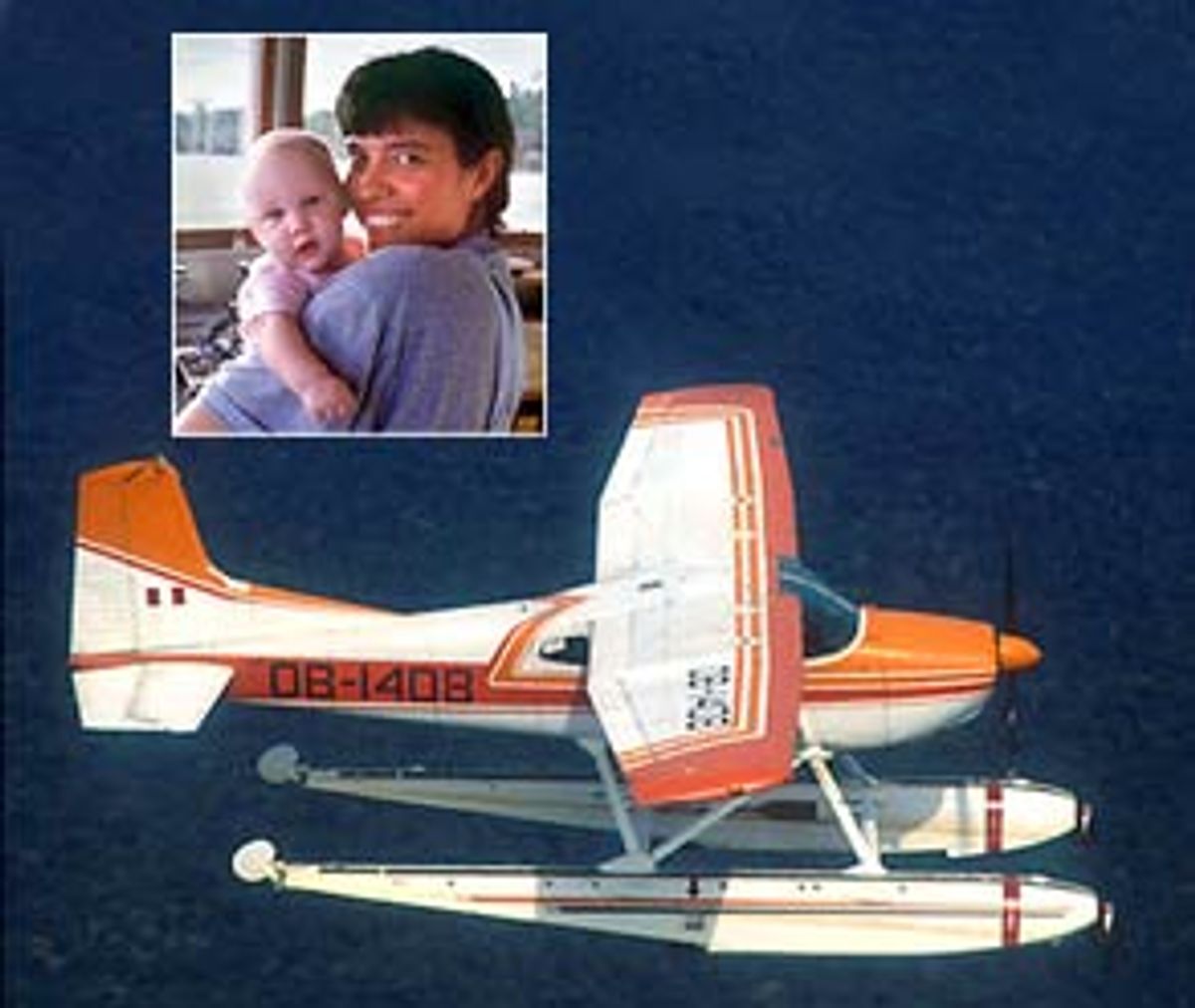
The killing of Veronica Bowers and her daughter Charity by Peruvian pilots who thought their Baptist missionary plane was part of a drug operation is just the latest tragedy to result from the controversial U.S.-backed drug war in the shadowy skies over the Andes.

Maybe the most mysterious aspect of the plane’s downing Friday was the role of a CIA drug surveillance team, which first notified the Peruvians that the Baptists’ plane was flying in airspace frequented by drug traffickers. Though the CIA team insists it warned the Peruvian officer who was riding along on the flight not to attack the plane without more information about its mission, the officer apparently gave the order for a nearby fighter jet to shoot at the single-engine Cessna.

Bowers and her daughter were killed by a single bullet; her husband Jim and son were rescued from the downed plane and survived, as did the pilot. Their distraught families are demanding answers from the U.S., which announced it would suspend such surveillance flights pending an investigation of the shooting.

“There was no communication,” says Jim Bowers’ older brother, Phil. “The planes flew by first, did some swooping, and then came in from behind and started shooting. Why didn’t they call and check the registration?” he said. “Sounds like a bunch of vigilante, hotshot pilots. Either that or someone higher up ordered the pilots to shoot.”

To some veterans of U.S. anti-drug operations in Colombia, and the families of those who have died there, such concerns about treachery will sound sadly familiar. A Salon investigation of several U.S. air units flying drug interdiction flights over Colombia shows American military personnel routinely worried about the trustworthiness of their local allies. They also complained of poor security, compromise of flight plans, and friction between U.S. military, CIA and local military personnel.

“It was bound to happen sooner or later,” said a former U.S. Special Forces soldier who served on several anti-drug missions in the region, including in Colombia. While he was flying a counternarcotics mission out of Haiti in 1995, he said, his Blackhawk helicopter was nearly shot down by a Venezuelan fighter because the chopper pilot had forgotten to activate the onboard IFF — the “friend or foe” signal that identifies the craft.

“Those guys are so trigger-happy, especially the fighter jocks. It doesn’t matter whether they’re from Peru, Colombia or wherever.” He said it was “entirely possible” that a similar mix-up downed the Cessna in Peru.

But in Colombia, problems of coordination and communication are only part of the problem, veterans say. There is also evidence that Washington’s host and ally in the Colombian drug war has been penetrated by the narcotics cartels. Pilots have complained that Colombian military personnel riding along on their surveillance flights notified drug traffickers of their whereabouts.

“In Vietnam, you called them Victor Charles, or Charlies,” said a 26-year-old former U.S. Army Ranger who served as an advisor in Colombia in 1997, referring to the nickname for the Communist Viet Cong. “We call them ‘Julios’” — drug traffickers and their agents inside Colombia’s military units.

There’s no evidence — yet — of such betrayal in the Bowers case. But the tragedy highlights the high cost of the inter-American war on drugs. Its expansion under the $1.3 billion Plan Colombia will only continue to spread those risks to neighboring states like Peru, and ultimately, as the Bowers family painfully learned, to the U.S.

Charles Odom felt the drug war’s sting in July 1999, when his wife Jennifer Odom’s U.S. Army spy plane crashed in Colombia, killing her, four other U.S. crewmembers, and two Colombian military “ride-alongs.”

“I’ll always believe that plane was shot down, and now because of Peru, maybe we’ll someday find out it was by one of our own,” said Odom, himself a retired Army colonel. Odom has long theorized that a drug cartel, tipped off to the spy plane’s movements by corrupt military personnel, was responsible for downing his wife’s plane, because she was constantly taking ground fire and had often been “lit up” by missile radar when flying over the coca fields.

The Army insists that Jennifer Odom’s four-prop Dehaviland-7 crashed into the Andes because the crew put faulty target coordinates into the onboard navigation computer. But her husband says the data was always provided by the U.S. Embassy in Bogota — a view backed up by other members of her unit, the 204th Military Intelligence Battalion, based in El Paso, Texas.

Moreover Odom, who won two citations from the Drug Enforcement Agency for helping down suspected narcotics flights, also worried about the reliability of the Colombians who often ride along, her husband says.

So did former crewmember Briana Krueger, a U.S. Army intelligence specialist who, unlike Odom, lived to tell about it herself. But Krueger’s husband Ray was not so lucky — he perished along with Odom on the fateful July surveillance mission. Like Chuck Odom, Krueger believes her spouse lost his life because officials within the Colombian military — and possibly even the U.S. military — were collaborating with drug traffickers.

Ironically, the deaths of Odom and Krueger helped lead to expanded use of for-hire civilian contractors — like the CIA-paid crew that first identified the Bowers’ plane, incorrectly, as a drug-trafficking suspect — in order to avoid more U.S. military casualties. But they have not led the U.S. military to admit that its Andean drug war, which has just claimed two more American lives, has spiraled out of its control.

Now, when she looks back, Briana Krueger realizes she was in more danger in Colombia than she knew at the time.

Nighttime spy missions over the Andes were always draining. Winds off the sheer mountains made the four-prop “Dash-7″ tremble like a leaf. The long hours hunched over a radio set in headphones eavesdropping on the telephone conversations of drug traffickers left her and the rest of the six-man crew exhausted. But one day in 1999 Krueger, an Army-trained Spanish-language linguist, learned something that terrified her: Two Colombian military officers riding along in her plane had been detected clandestinely communicating with drug traffickers on the ground. The unit’s flight path had been compromised — by enemy moles onboard working for the drug cartels. Krueger’s account, in an exclusive interview with Salon, makes public for the first time what U.S. personnel in Colombia have long taken for granted but generally kept to themselves: Our supposed allies in the Colombian drug war have been corrupted by the narcotics cartels.

Pilots from Krueger’s unit, the 204th Military Intelligence Battalion, based in El Paso, Texas, also tell stories of lackluster security and intense friction between U.S. and Colombia personnel at Apiay, the mountain base 35 miles south of Bogata where crews from the U.S. Army, the CIA and the Drug Enforcement Agency fly in and out.

The U.S. Army denies its spy flights have been infiltrated by Colombians working with drug traffickers, despite the embarrassing spectacle of discovering that the wife of its top counternarcotics official in Bogota was smuggling cocaine to New York with the help of her husband’s driver. Col. James Hiett, who was himself convicted last year for helping his wife Laurie launder profits from her drug sales, was routinely briefed on the 204th’s spy flights, including Odom’s doomed mission in July 1999.

The U.S. Army’s Intelligence and Security Command responded to a faxed query about corruption in the 204th with a statement that there was “no reliable evidence” that any missions had been compromised by Colombian ride-alongs on the flights.

Krueger’s detailed, on-the-record account, however, and more general comments by unit personnel about security problems in Colombia, belie the Army’s assurances.

Krueger was assigned to Odom’s unit, then based in the Panama Canal Zone. The unit conducts both electronic and photographic reconnaissance of the cocaine-producing regions of the Andes — Peru, Ecuador, Brazil, Venezuela and Colombia — spending long hours circling over the jungles and mountains.

Under terms negotiated with the U.S., the military personnel of Andean host countries usually rode along on the airborne intelligence missions. But in Colombia, the unit was also required to file flight plans with Bogota’s civil air authority, virtually insuring that drug traffickers knew where they were going before they lifted off the runway.

Right away, Krueger said, she got a bad feeling about Colombia.

“Most Latin American countries, you can get a feel if they’re gonna be fighting against drugs with you,” she said. “I didn’t get that feeling at all from Day 1 when I stepped into Colombia. It’s like, why work with people if they’re not gonna be helping us, they’re gonna be against us and we can’t trust them? It doesn’t make any sense.

“In Colombia, you didn’t know who to trust and who not to trust.”

Krueger’s fears were borne out in February 1999 after a routine review of mission tapes by intelligence analysts back at the Army intelligence headquarters in Fort Huachuka, Ariz. They had picked up something she’d missed: the voices of Colombian ride-alongs on her flight talking to drug traffickers on the ground.

“They had caught it on the tape,” Krueger said. The analysts played it back for the U.S. crew on the plane, she said.

“We heard the guys on the ground saying, ‘There’s a helicopter’ (one flying in tandem with her plane that day). And the guys on the plane were talking to them about us coming, and warning them (the drug smugglers) to get out of there — ‘We’re coming, we’re on our way.’”

“I mean, you could clearly hear (it),” Krueger continued. “I don’t know how we didn’t hear it while we were on the mission. I guess we were doing so many things at once. Everybody has their own sections of the country they have to [monitor] while we’re on the plane. Unless you pick up something and then everybody gets on one thing, then you’re doing your own thing.

“They asked questions of everybody that was on that mission,” she said, “and had us listen to the tapes again. Everybody was like, ‘whoa,’ because we didn’t catch it while we were flying. It was after the tapes were sent out that they caught it. That’s when we found out about it. We left (Colombia) early because of that.”

For a while after the leak was detected the flights were suspended, partly out of security concerns, but also because of constant equipment failures, she said.

“There were always problems with the planes, they were always messed up,” Krueger recalled. “The surveillance equipment. Lights weren’t working right. Some stuff with the fuel and the engines wasn’t working right. I mean, they were down a lot.”

In June of that year, meanwhile, she’d married Ray Krueger, another intelligence specialist in the unit, whom she’d dated for two years.

Then in July the company commander caused an uproar when he announced the crew would be resuming spy missions in Colombia.

“Nobody was even thinking about [going back to] Colombia,” Krueger said, “so when he said Colombia, there was a hush all over the room, like, ‘What? Why are we going back there?’ There was like a whole minute of silence. Then everybody was talking at once, like, you know, ‘Why are we going there?’”

The plane’s pilot, West Point graduate Odom, 29, was also leery of the Colombian ride-alongs.

“Jennifer said they were always suspect,” her husband said. “In that part of the world, they don’t know who to trust.” The Colombians are supposedly checked out and cleared by the U.S. Embassy, “but a quick background check down there doesn’t mean much.”

His wife had also quarreled privately with her commander, because the sad state of the equipment would require her to fly alone in Colombia, without the usual pairing with other aircraft. Since she was scheduled to take command of the unit in October, she argued that the unit should stand down and bring the aircraft up to snuff.

“The unit was overworked, undermanned, overextended,” said Charles Odom.

“She felt it foolish to deploy simply for a show of force, with one aircraft. Also she felt it was dangerous to fly only one aircraft in a normally three-ship, mutually supporting configuration.” Odom pressed for postponing the mission but was overruled. On July 13, she left for Colombia.

U.S. personnel at Apiay shared the base with Colombian air force and army units, who didn’t always appreciate the efforts of their mentors. Colombian officers deplored the practice of their counterparts sharing meals with enlisted personnel. The Colombian Air Force commander “was very rude and difficult with Jennifer,” a fellow pilot recalled, as well as with other U.S. pilots.

Another source of friction was that the Americans were under orders not to give the Colombians any intelligence they’d gathered on Marxist guerrilla groups while on counter-narcotics missions.

The rationale was — and remains — that the U.S. isn’t at war with the rebels, only drug traffickers, although the distinction is quickly lost on U.S. personnel. Drugs are to Colombia what secret bank accounts are to Switzerland: the country’s principal business, engaging every sector of the economy from transport to insurance. Government officials, army officers, leftist rebels and right-wing paramilitaries alike are entwined in the illicit trade.

Since U.S. policy required that American units maintain the appearance of noninvolvement in the civil war, however, intelligence gathered on rebels during anti-narcotics missions is thus denied to local Colombian commanders, sources said, and instead sent to Washington.

Appearances aside, however, the intelligence eventually got back to the Colombians after it was processed in Washington, via the U.S. Embassy in Bogota, where it was shared with counterparts, at least some of them corrupt.

The system prompted U.S. military advisors in Colombia to avoid the embassy like the flu, according to one Green Beret sergeant. He said his unit, the 20th Special Forces Group, an Army Reserve outfit in Maryland that rotates into Colombia on training missions, avoided sharing mission plans or other data with “the embassy pukes” because they considered the environment insecure. Any useful intelligence they gathered was channeled to their own command at Fort Bragg, N.C., circumventing the embassy.

The Americans’ distrust of the Colombians extended to training missions in the field, said the sergeant, who had also seen duty in Haiti and Somalia in the 1990s.

“The SEALs (U.S. Navy special operations forces) won’t even let the Colombians on their boats,” the sergeant alleged, on condition that his name not be disclosed, “and they’re supposed to be training riverines.

“We don’t have that choice, because there’s a certification process we have to go through.” (They must report to Washington that the Colombians have been trained and are aggressively combating drug traffic.) The sergeant said that in the field the Green Berets would camp several hundred meters from their charges because they didn’t trust the Colombians, who, in any event, rarely deployed sentries or mines at night.

The Green Berets also suspected that the Colombian major in charge of the 1st Marine Brigade, the unit they were training, was secretly doubling as a right-wing paramilitary leader in league with a drug cartel.

“He completely avoided attacking the cocaine refineries,” the sergeant said.

Meanwhile, spy plane crews at Apiay found themselves increasingly involved in a shooting war.

“I was just very uncomfortable about us going down there,” said Dawn Smith, an Army spy pilot in Colombia during 1999-2000, “because we were supposed to be [in a condition of] low intensity, period. We were not supposed to be in a high-intensity environment.” At night, she said, automatic rifle fire often crackled outside the perimeter. “And it was kind of primitive. They had just a low little barbed wire fence surrounding the grounds, and the place could’ve been overrun very easily. And we at first didn’t even have any weapons.”

But if the situation on the ground at Apiay was dicey, security in the air was hardly better, former unit personnel said. Increasingly, the spy planes were taking fire. More and more, they were being tracked through the night skies by ground-to-air missiles of the narco-guerrillas.

“Every time they came back from a mission,” Jennifer’s husband, Chuck Odom, recounted in a previous Salon story about her death, “there’d be small-arms bullet holes on the fuselage or the tail. I asked her about it, and she said, ‘It’s a dangerous place. We’re always getting shot at and lit up (by missile radar).’

“It wasn’t Colombian government radar,” declared Odom, who’d had many sensitive assignments during his own Army career. “It was a missile lock” by someone armed with advanced, U.S.-made Stingers or foreign equivalents.

Dawn Smith and other pilots say their flights were compromised even before their wheels lifted off the runway. For starters, Colombian civil aviation authorities required all aircraft — including spy missions — to file flight plans. Thus, air controllers broadcast their progress through the skies.

The situation was crazy, pilots said.

“One time coming back from another country, you could tell they were giving our call sign to somebody else,” Smith said. “We thought, ‘Who are they talking to on the air? Why are they saying anything about us?’ I didn’t know that much Spanish, but I knew they were talking about us. So we felt that their ATC (air traffic control) was definitely giving out information about us …”

In the end, Briana Krueger was able to avoid an assignment to return to Colombia in July of 1999, but her husband of one month, 20-year-old Ray, couldn’t, or wouldn’t, resist.

“I told him before he left that I didn’t want him to go,” Briana recalled. “We were talking about breaking his arms so he wouldn’t be able to go. I just felt really uncomfortable that he was going. He said, like, ‘Orders are orders.’”

On the night of July 30 the flight took off from a Colombian military base at Apiay. Its lone runway, set in a high meadow and buffeted by wind, rain and fog off the Andes, had a lot of customers, from the 204th’s Dash-7′s to CIA, DEA and U.S. Customs Service aircraft. Sometime after 3 a.m. that same night, Odom and her crew crashed into the side of a steep mountain near the border with Ecuador. All were killed. The plane wreckage, already pulverized by the crash, was blown up by a Delta team from the U.S. Embassy. The Army said neither of the two flight data recorders was working.

While the military disputes Chuck Odom and Briana Krueger’s theories about the role of Colombian drug collaborators in their spouses’ death, it’s clear the losses had one impact: Anti-drug generals in Washington have stepped up the recruitment of civilians to fight the war, to minimize the political fallout more U.S. military deaths could cause back home.

To some extent, the strategy worked: When three pilots employed by Dyncorp of Reston, Va., died in Colombia a few years ago, it hardly made the news. According to military sources, the U.S. employs about 70 “contractors” in Colombia, but there are many more in border regions, such as Iquitos in northern Peru, working as military advisors, mechanics and pilots. They’re coming in for more scrutiny now, however, thanks to the death of Veronica and Charity Bowers.

Since her husband’s death, Briana Krueger has left the military and is trying to get on with her life; she’d like to open a restaurant. When she thinks back on her time in Colombia, she says simply: “We’re just wasting our time doing this.”

Chuck Odom wishes the Bowers family well, trying to get to the bottom of the mystery surrounding its loved ones’ deaths, but his voice reflects his weariness. “You never get over something like this,” he says. “You learn to deal with it, to live with it … I just march along every day.”

Reflecting on the conflicting accounts of the Bowers tragedy coming from Peru and Washington, Odom said sadly, “It sounds like business as usual down there.”

The Associated Press contributed to this report.

Jeff Stein is the coauthor, with Khidhir Hamza, of "Saddam's Bombmaker: The Daring Escape of the Man Who Built Iraq's Secret Weapon." He writes frequently for Salon on national security issues from Washington.

The threat to Mexico’s machismo culture

As the nation's first major female presidential candidate, Vazquez Mota is challenging a slowly changing boy's club

Josefina Vasquez Mota (Credit: AP Photo/Alexandre Meneghini)
This article originally appeared on GlobalPost.

MEXICO CITY — At El Mirador, a cantina frequented by Mexico’s political and economic elite, you can see a fine selection of spirits and a menu that features dishes like pickled pigs’ feet and beef tongue tacos.

Global PostBut what you won’t see are women.

El Mirador, a relic from the country’s machista past, politely refuses to serve them. The bathroom has only a urinal and a sink.

So it may have come as a surprise to some when Mexico’s PAN party decided to nominate Josefina Vazquez Mota, a woman, for president – the first time a woman has ever been nominated by a major Mexican party.

Accepting her nomination, Vazquez Mota, a longtime government official, said, “I will be the first woman president of Mexico in history.”

Even if they are not yet welcome in the cantina at El Mirador, women are making noticeable inroads into other areas of Mexican political life.

With the real possibility that Mexico may join Latin American countries like Argentina, Brazil and Chile in electing a female to the highest office, her nomination marks a slow but steady erosion of Mexico’s macho culture, a way of life that lives on in the upper echelon of Mexican business world.

“Back in the 1950s all the cantinas in Mexico City were only for men. It’s the embedded machismo culture,” Ramon Peña-Franco, a former media analyst who worked for Mexico’s current leader Felipe Calderon.

Men gathered in cantinas to drink and play dominoes, while women stayed at home.

While the ban on women is not explicitly stated, it is enforced through the polite entreaties of waiters who explain the “tradition.” A woman in the men-only cantina might “make the other guests uncomfortable,” the Mirador manager said.

More than in the U.S. or the UK, the main stage of Mexico’s business arena continues to be dominated by men. However, more women have begun working in finance, information technology, media and manufacturing. Mexico has also seen an increasing number of female governors and cabinet members in the public sector.

And slowly, old social mores are beginning to evolve.

In 2006 many Mexican states updated the language used in marriage ceremonies, eliminating vows that asked men to treat their wives “with the magnanimity and generous benevolence that the strong should give to the weak,” and asked women to “give to her husband obedience [and] avoid awakening the most irritable and hard part of his character.”

Monica Morales, a financial analyst who was married in Mexico City in 2011, explained that the traditional language that was historically used in nuptial proceedings is too “macho.”

“Now, not even my grandmother would support it,” she said.

“Even my friends who want the most traditional weddings wouldn’t use it,” she said.

Some arenas of public life are evolving as well.

An electoral reform enacted in 2002 requires that major parties select female candidates for at least 30 percent of the seats they campaign for in the country’s congress. In 2003, the first election under the new rules, female candidates won 23 percent of the seats.

Now, women hold 30 percent of the seats in Mexico’s congress, compared to just 17 percent in the U.S.

Still, despite recent progress in the political arena, women have not yet broken through into the highest levels of Mexico’s corporate world.

Unlike in Mexico’s congress, very few seats in the country’s board rooms are filled by women. Only one of Mexico’s top 20 largest publicly traded companies has appointed a female board chair. Not one of Mexico’s largest companies has a female CEO.

When it comes to leading businesswomen in Mexico, Ramon listed “the owner of Grupo Modelo, Maria Asuncion Aramburuzabala. She’s the wealthiest woman in Mexico.”

“Other than that… I don’t think I can remember,” he said.

In July, Mexicans will vote to replace Felipe Calderon, whose six-year term has been plagued by violence from a five-year war on the drug cartels.

Many voters are ready for a change.

“This is a historic nomination, it has the potential to change the dynamics of the presidential race,” said Shannon O’Neil, a Mexico expert from the Council of Foreign Relations, a think-tank in New York.

It is still unclear whether Vazquez Mota, who has served both as secretary of social development, and later education, can convince voters to elect her.

Vazquez Mota’s main rival in the race to Los Pinos, the president’s office, is Enrique Peña Nieto, the candidate from the Institutional Revolutionary Party, or PRI.

The party ruled Mexico as a de facto autocracy for seven decades until it was ousted from the presidency by a candidate from the PAN in 2000, is campaigning hard as well.

Peña Nieto is currently leading in the polls, and most analysts consider him to be the favorite.

Peña Nieto, though, has faced a number of missteps so far in his campaign. At a recent event in Guadalajara, he couldn’t name three books that have influenced his life. After failing to correctly state the price of a kilo of tortillas, a staple in most families’ diets, he shrugged off criticism, saying, “I’m not the woman of the house.”

Vestiges of the macho culture, after all, are still very much present in everyday Mexico.

As the rules change, other aspects of the country’s public life have evolved with time. In 2008, for instance, Mexico City banned smoking in bars and restaurants.

The cantinas begrudgingly complied.

Seated at a table at the Mirador, Ramon said, “Machismo is rooted, so it’s been harder [to change] in Mexico than anywhere else.”

By the exit, there was a table of men in their seventies finishing a game of dominos, getting ready to leave.

“The role of women in political life is changing,” Shannon, the Mexico expert, said.

“The real challenge for women in Mexico, and elsewhere, is to increase the numbers and the breadth of their participation and say in the way things are run.”

Continue Reading Close

The man who could beat Chavez

A charismatic governor has emerged as the first legitimate threat to the Venezuelan president's 13-year tenure

Henrique Capriles Radonsk (Credit: AP Photo/Ariana Cubillos)
This article originally appeared on GlobalPost.

MAIQUETIA, Venezuela — An hour’s drive from Caracas, thousands of people gathered in this coastal barrio at Venezuela’s national airport, which was recently given the dubious honor of being the worst in Latin America.

Global PostClad in blue T-shirts and waving tiny red, yellow and blue flags, the lively crowd sang and danced, waiting for the arrival of the man who is the first serious threat to President Hugo Chávez in his 13-year tenure.

Henrique Capriles Radonski is the frontrunner for primaries due to take place on Sunday, in preparation for October’s presidential election.

For the first time in its disjointed history, the opposition he is about to command has finally united to take on the socialist president.

When he arrives, el pueblo — “the people,” as Chávez affectionately calls them — crowds around him.

The 39-year-old Capriles has risen up the political ladder in Venezuela over the last decade, once a mayor and now governor of the country’s second-most populous state, Miranda.

This gives him credibility among those he is trying to woo.

“He’s young, but he comes with experience,” gushed Theresa Carinero, 56, clad in a T-shirt and bandana emblazoned with the candidate’s name, and waving his flag.

Capriles’ support comes largely from people like Carinero, which offers him an advantage over previous opposition candidates.

Former competitor Leopoldo López, who has thrown his support behind Capriles, won the backing of wealthy expatriates, but largely neglected voters at home.

López in 2008 was banned from political office on a corruption charge that never went to court. He denied the allegations and took his case against the Venezuelan state last year to the Inter-American Court of Human Rights, which overturned the ruling. But Chavez’s government declined to honor it.

In the awkward position of being able to stand for elections but not hold office, López shifted his considerable momentum to Capriles just two weeks ago.

At the rally in Maiquetía, Lopez flanked the main man as he greeted the throngs of supporters.

“It’s not sufficient to just talk about the problems,” Capriles told GlobalPost. “We have to fight against poverty.”

Capriles has based his campaign on improving education, which he sees as a long-term solution to the country’s insecurity and deep poverty. Capriles’ methods are not to shout down Chávez — indeed, he praises many of the president’s ideas — but to change things little by little, on a case-by-case basis, he said.

But it will be extremely difficult, if not impossible, to unseat El Comandante, as his supporters know him. Chavez has been in power for 13 years. And with world oil prices pushing $120 a barrel, Chavez, head of an oil-rich state, has a full campaign war chest. This week, Venezuela’s state oil company reported a 35 percent increase in profits last year.

“Chávez has begun his campaign, spending a lot of money,” said Luis Vicente Leon, a local pollster.

The president also remains very popular, largely because of the vast number of social programs he has put in place, funded by Venezuela’s vast oil wealth.

According to recent figures from local polling firm Hinterlaces, Chávez is bathing in an outstanding 64 percent approval rating.

Housing, health and other programs have been the cornerstone of Chávez’s tenure.

Critics charge the programs offer only aid, and no new vision for the future. “Why doesn’t Chávez propose a real solution, rather than fixing the odd house just for publicity?” said 24-year-old Yesman Utrera, speaking in his own barrio in the east of Caracas.

He added: “Everyone has a friend of a friend who’s been helped by the government.”

It was a severe lack of wealth distribution that helped bring Chávez to power in the first place.

While Chávez was studying at Caracas’ military academy in the late ’80s and early ’90s, Venezuelans were growing increasingly disaffected with the authorities, pocketing all the oil wealth while bringing neo-liberal reforms to the masses. Chávez capitalized on the disaffection with his 1992 coup attempt against then President Carlos Andrés Pérez.

Despite ending up in prison as the coup failed, Chávez became a national hero, personifying the struggle against a corrupt elite. This would carry him to the Miraflores presidential palace six years later.

Venezuelans haven’t forgotten the Perez regime. Pablo Perez, who isn’t related to the former president, has campaigned under that old party’s banner. But he is still tainted by association. “Pablo Perez isn’t going to win the primary because he’s from the AD,” said Carlos Romero, a political analyst working at Caracas’ Central University of Venezuela, referring to the party’s Spanish initials.

“I’m not part of the old establishment,” Capriles said. He also takes pains to distance himself from any U.S. connection. Though he is fluent in English, he is reluctant to speak the language on camera, pre-emptively parrying attacks from Chávez on any sympathy for the “Yankee empire,” as the president describes Washington’s domain.

Demonstrating a broader shift in Latin American politics, Capriles is also taking a leaf out of the book of former Brazilian president Luiz Inácio Lula da Silva.

Lula, as Brazilians affectionately know him, has come to represent a more moderate Left, able to support the poor while also working with business and Washington — a shift from men like Chávez and Fidel Castro in Cuba, who position themselves as being against the West.

Lula managed to unite a free market economy with social projects which have given concrete aid to the poor. Brazil is now the world’s most powerful emerging market and Lula is considered responsible for this and the country’s 7.5 percent GDP growth in 2010.

Capriles’ admiration of Lula is evident in social projects in Miranda, the state which Capriles currently governs. For example, he’s sponsored cooking lessons for the poor to help them set up small businesses, in direct imitation of Lula’s Hambre Cero (Zero Hunger) projects in Brazil.

Ultimately, it is popular support through projects such as this that will win it for either Capriles or Chávez in October.

“I wish Chávez a long life,” said Capriles, referring to the president’s cancer scare last year, “so that he sees the change that is coming.”

Continue Reading Close

The roots of Bain Capital in El Salvador’s civil war

Romney tapped El Salvador's wealthy families, including one linked to right-wing death squads

Mitt Romney (Credit: Jessica Rinaldi / Reuters)

A significant portion of the seed money that created Mitt Romney’s private equity firm, Bain Capital, was provided by wealthy oligarchs from El Salvador, including members of a family with a relative who allegedly financed rightist groups that used death squads during the country’s bloody civil war in the 1980s

Bain, the source of Romney’s fabulous personal wealth, has been the subject of recent attacks in the Republican primary over allegations that Romney and the firm behaved like, in Rick Perry’s words, “vulture capitalists.”One TV spot denounced Romney for relying on “foreign seed money from Latin America” but did not say where the money came from. In fact, Romney recruited as investors wealthy Central Americans who were seeking a safe haven for their capital during a tumultuous and violent period in the region.

Like so much about Bain, which is known for secrecy and has been dubbed a “black box,” all the names of the investors who put up the money for the initial fund in 1984 are not known. Much of what we do know was first reported by the Boston Globe in 1994 when Romney ran for U.S. Senate against Ted Kennedy.

In 1984, Romney had been tapped by his boss at Bain & Co, a consulting firm, to create a spin-off venture capital fund, Bain Capital.

A Costa Rica-born Bain official named Harry Strachan invited friends and former clients in Central America to a presentation about the fund with Romney in Miami. The group was impressed and “signed up for 20% of the fund,” according to Strachan’s memoir. That was about $6.5 million, according to the Globe. Bain partners themselves were putting up half the money, according to Strachan. Thus the Central American investors had contributed 40 percent of the outside capital.

Back in 1984, wealthy Salvadoran families were looking for safe investments as violence and upheaval engulfed the country. The war, which pitted leftist guerrillas against a right-wing government backed by the Reagan administration, ultimately left over 70,000 people dead in the tiny nation before a peace deal was brokered by the United Nations in 1992. The vast majority of violence, a UN truth commission later found, was committed by rightist death squads and the military, which received U.S. training and $6 billion in military and economic aid. The Reagan administration feared that El Salvador could become a foothold for Communists in Central America.

The notorious death squads were financed by members of the Salvadoran oligarchy and had close links to the country’s military. The death squads kidnapped, tortured, and killed suspected leftists in urban areas fueling an insurgency that retreated to rural areas and waged war on the government from the countryside. The war, which lasted 12 years, triggered an exodus that brought more than 1 million Salvadorans to the United States.

There is no evidence that any of Bain Capital’s original investors were involved in these sorts of activities. But the identities of some of the investors remain secret, and there are family names that raise questions.

Four members of the de Sola family were among the original Bain investors, or “limited partners” in the company, the Globe reported. Their relative and “one-time business partner,” Orlando de Sola, was an important figure in El Salvador. A well-known right-wing coffee grower with an (in his words) “authoritarian” vision for the country, de Sola spent time living in Miami but was also a founding member of the right-wing Arena party, lead by a U.S.-trained former intelligence officer named Roberto D’Aubuisson.

Craig Pyes, an investigative reporter then with the Albuquerque Journal, wrote a series on the rightist death squads based on extensive on-the-ground reporting in El Salvador in the early 1980s with Laurie Becklund of the Los Angeles Times, while the death squads were still active.

Pyes, who has since won two Pulitzer Prizes and is now a private investigator in California, says that no one has produced any proof that de Sola directly funded death squads.

“However,” Pyes says, “he was in the inner circle of the group around D’Aubuisson at the time that D’Aubuisson was well known to be involved in the death squads. De Sola’s name appears in a December 1983 FBI cable as one of 29 people suspected by State Department officials of furnishing funds and weapons to Salvadoran death squads.”

De Sola’s name also turned up in a notebook, seized from an aide to D’Aubuisson named Saravia, that detailed the finances of D’Aubuisson’s terrorist network, according to Pyes.

The Saravia notebook, reviewed by U.S. officials, listed weapons purchases, payments, and what appear to be descriptions of violent plots by rightists, including the assassination of El Salvador’s Archbishop Oscar Arnulfo Romero in 1980. Asked about the notebook by the New York Times in the late 1980s, de Sola denied that he had ever helped finance political violence. De Sola could not be reached for comment for this story.

Romney, for his part, who was much more accessible to the press in 1994, told the Globe that year that “we investigated the individuals’ integrity and looked for any obvious signs of illegal activity and problems in their background, and found none. We did not investigate in-laws and relatives.” He also said that Bain had checked the names of the Bain investors with the U.S. government. Given the policy of the Reagan administration at the time, though, it’s not clear going to the government would have been the most effective vetting mechanism.

It’s impossible to fully explore the backgrounds of the original Bain investors because we don’t know all their identities, including the names of the four members of the de Sola family mentioned by the Globe. Neither the Romney camp, Bain Capital, nor Strachan — the Bain executive who recruited the Central Americans — responded to requests for comment.

During his first presidential bid in 2007, Romney more than once touted the Central American investors in Bain while trying to woo Hispanic voters. In a speech in March of that year to the Miami-Dade Lincoln Day Dinner, Romney actually specified five of the original “partners” in Bain Capital — but the de Sola family was not among those he named.

And that August he told the Miami Herald, “The investments for the company that I started, Bain Capital, came largely from Latin America. My largest single investors came from El Salvador, Ecuador, Colombia and Guatemala. And so I feel a deep kinship to people in Latin America.”


Continue Reading Close
Justin Elliott

Justin Elliott is a reporter for ProPublica. You can follow him on Twitter @ElliottJustin

Chavez reveals he is fighting cancer after surgery

Venezuela's president confirms that trip to Cuba was to remove a tumor

In this frame grab taken from Venezolana de Television, VTV, Venezuela's President Hugo Chavez delivers a televised speech aired from Cuba, Thursday, June 30, 2011. Chavez said he underwent a second surgery in Cuba that removed a cancerous tumor. It was unclear when and where the message was recorded. (AP Photo/Ariana Cubillos)(Credit: AP)

Venezuelan President Hugo Chavez revealed that he is fighting cancer after having a tumor removed in Cuba, raising uncertainty about Venezuela’s political future even as he assured his country he expects to fully recover.

Chavez was noticeably thinner and paler as he appeared on television Thursday night, reading from a prepared speech with a serious and at times sad expression. He said he is resolved to “be victorious in this new battle that life has placed before us.”

Chavez’s admission shook the political landscape of a country he has dominated for his more than 12 years in power, and who had vowed to win re-election next year and govern for another decade or more.

There is no obvious successor to the charismatic Chavez within his Bolivarian movement, and his illness may also affect his leadership within the ALBA alliance of leftist Latin American nations.

Chavez said he had two operations in Cuba, including one that removed a tumor in which there were “cancerous cells.” The 56-year-old president said the surgery was performed after an initial operation nearly three weeks ago to remove a pelvic abscess.

A military chief, Gen. Henry Rangel Silva, assured the country on Friday that Venezuela’s stability “is guaranteed.”

“President Chavez will continue because he hasn’t truly stopped exercising his functions as president,” Rangel Silva said on state television. He said Chavez was recovering smoothly and had been on top of his duties while in Cuba.

“He will be in our country soon,” Rangel said, without saying exactly when Chavez was expected to return.

Chavez said the tumor was in the pelvic region but didn’t say exactly where or what type of cancer was involved. He said he is continuing to receive treatment in Cuba but did not elaborate.

He said it was a mistake not have taken better care of his health through medical checkups.

“What a fundamental error,” he said at a podium, flanked by the Venezuelan flag and a portrait of 19th-century independence hero Simon Bolivar, the namesake of his Bolivarian Revolution political movement.

“Now I wanted to speak to you from this steep hill, from which I feel that I’m coming out of another abyss,” Chavez said. “I wanted to speak to you now with the sun of daybreak that I feel is shining on me. I think we’ve achieved it. Thank you, my God.”

Expressing confidence that he will continue to get better, Chavez said: “I invite you all to continue climbing new summits together.”

Chavez didn’t say how much longer he expects to remain in Cuba recovering, and there was no information on when or where his message was recorded.

His appearance came after days of anxious speculation among Venezuelans about Chavez’s health. State television on Tuesday had shown photos and video of Chavez chatting animatedly with Fidel Castro, but officials had been vague about the reasons for Chavez’s continued seclusion in Cuba.

Citing Chavez’s health, the government announced Wednesday that it was canceling a two-day summit of Latin American leaders that Chavez would have hosted next week on the 200th anniversary of Venezuela’s declaration of independence from Spain.

Chavez’s revelation, and the lack of any return date, is likely to further generate speculation in Venezuela about which of the president’s allies could potentially take his place if necessary. Vice President Elias Jaua has led government events in Chavez’s absence, and the leftist president’s elder brother, Adan, recently stepped up his public profile by rallying supporters at a weekend prayer meeting for Chavez’s health.

Chavez supporters gathered in Plaza Bolivar in downtown Caracas late Thursday chanting before television cameras: “Chavez, friend, the people are with you!”

There was no immediate reaction from the main opposition coalition, which earlier had demanded that the government provide details about Chavez’s condition.

Chavez said his first surgery took place June 11 for a “strange formation in the pelvic region that required an emergency operation due to the imminent risk of a generalized infection.”

He said when he arrived in Cuba after visits to Brazil and Ecuador, he had intended to have a simple checkup for a knee injury that had forced him to use a cane in recent weeks. But he said Castro had questioned him “like a doctor” and that tests confirmed the need for urgent surgery.

After that initial operation, Chavez said, doctors began to suspect other problems, and Castro gave him the news of the tumor. A series of tests “confirmed the presence of an abscessed tumor with the presence of cancerous cells, which made necessary a second operation that allowed for the complete extraction of the tumor,” Chavez said.

He didn’t say when the second operation was performed.

Chavez said his condition has been “evolving satisfactorily while I receive a complementary treatment to combat the different types of cells found, and thereby continue on the path to my complete recovery.”

After Chavez’s speech, the vice president appeared on television at the presidential palace, calling for support and unity among Venezuelans.

“There is no time for sadness, but rather for courage and for work,” Jaua said. “Unity is what’s needed at this time.”

Under Venezuela’s constitution, the vice president would take the president’s place during “temporary” absences of up to 90 days. And Jaua would serve the remainder of Chavez’s six-year term if the socialism-preaching president were to die or resign.

With a presidential election looming next year, it’s unclear who might step forward to run in Chavez’s place if the president were to pull out of the race.

During the past few weeks, Chavez has largely remained out of sight, and some of his opponents had accused the government of maintaining secrecy about his ailment.

Chavez last spoke publicly in a call to Venezuelan television on June 12, after his first surgery.

Some opposition politicians had called for the president to temporarily cede his duties to the vice president while recovering in Cuba.

Chavez’s allies, however, insisted he remained firmly in control of government affairs, even as he has been recovering.

The leftist leader has been in office for more than 12 years and plans to run for re-election in 2012. He did not address that issue on Thursday.

Venezuelan pollster and analyst Luis Vicente Leon said on Twitter that Chavez will likely enjoy an initial boost in his approval ratings due to public sympathy, but that “the political risks for Chavez are notably amplified” due to his condition.

In videos released Wednesday, Chavez smiled and discussed Latin American history and his days as an army paratrooper with Castro. Two of Chavez’s daughters and a granddaughter joined in the encounter.

Finishing his speech Thursday, Chavez recited a revolutionary slogan often used by Castro: “Forever onward toward victory! We will be victorious!”

Before finishing, he added: “Until my return!”

After his appearance, some of his closest allies went on state television. National Assembly president Fernando Soto Rojas, who days earlier had denied rumors that Chavez was diagnosed with cancer, said the president is in good hands in Cuba.

“We wish for him to get better soon! Onward, commander!”

Associated Press writer Fabiola Sanchez contributed to this report.

Continue Reading Close

Obama to leave Latin America early

The President will cut his trip short presumably due to the escalating situation in Libya

U.S President Barack Obama waves at the Centro Cultural La Moneda Palace before his speech to Latin America in Santiago, Chile, Monday March 21, 2011. Obama is in Chile as part of a three-country, five-day tour of Latin America. (AP Photo/Roberto Candia)(Credit: AP)

President Barack Obama is cutting his trip to Latin America short, and will leave Wednesday morning, hours before his originally scheduled departure.

The White House says Obama will leave El Salvador, the final stop on his five-day trip, after holding a conference call with his national security team to discuss the situation in Libya.

THIS IS A BREAKING NEWS UPDATE. Check back soon for further information. AP’s earlier story is below.

President Barack Obama opened the final leg of his Latin American tour Tuesday in El Salvador, a critical partner on immigration and narcotics wars, issues of increasing concern to the United States.

Obama, along with wife Michelle Obama and their two daughters, arrived in the capital San Salvador Tuesday afternoon under a blistering sun following stops in Brazil and Chile. After being greeted at the airport by children in traditional dress bearing candy, the president and first lady were welcomed at the national palace by El Salvador’s President Mauricio Funes and his wife Vanda Pignato. The two couples stood at attention in front of the flags of both their countries as the national anthems of El Salvador and the United States were played. Obama and Funes then headed into a private meeting at the palace, to be followed by a joint news conference.

Much of Obama’s five-day tour of Latin America has been overshadowed by events in Libya, where the U.S. and international partners are launching military strikes to protect civilians from attacks by Libyan leader Moammar Gadhafi. The White House said Obama was briefed on developments there by his national security team Tuesday during a conference call from Air Force One. He also spoke with British Prime Minister David Cameron and French President Nicolas Sarkozy while en route to El Salvador, to discuss NATO’s roll in the Libya offensive.

The White House shuffled Obama’s schedule in El Salvador, moving up a visit to the tomb of slain Roman Catholic Archbishop Oscar Arnulfo Romero, originally scheduled for Wednesday, to Tuesday evening. The move raised the prospect that Obama might return to Washington ahead of schedule.

Among the issues on Obama’s agenda in El Salvador –the only Central American country on his Latin America trip — is the rising crime south of the U.S. border, from which El Salvador is hardly immune. It has seen murder rates rise amid an influx of drugs and displaced traffickers from crackdowns in Colombia and Mexico.

El Salvador also has one of Central America’s highest rates of emigration, especially to the United States. About 2.8 million Salvadoran immigrants living in the United States sent home $3.5 billion last year, so laws that crack down on immigrants can significantly affect the Salvadoran economy.

Obama can offer little to fix El Salvador’s devastating crime and fragile economy. Fiscal pressures have limited the amount of money the U.S. government can provide as part of its drug-fighting efforts, and congressional politics have made it difficult to restart talks about overhauling the nation’s immigration laws.

In a broad-ranging speech in Chile on Monday that spelled out his policy in Latin America, Obama called on the region’s rising economies to take more responsibility and play a larger role both in the region and around the globe.

He also described U.S. initiatives in Latin America to help curb the proliferation of drugs. Congress approved $1.8 billion for the so-called Merida Initiative to fight drugs in Mexico. After complaints that Central America was shortchanged, Congress created a separate Central America Regional Security Initiative with a total of $248 million so far. Central American leaders say that has not been enough.

Obama also prodded the region to fight poverty, lauding countries that have pushed more of their population into the middle class.

“We’ll never break the grip of the cartels and the gangs unless we also address the social and economic forces that fuel criminality,” he said Monday.

Funes, who despite being elected with support from former Marxist guerillas has charted a moderate course in El Salvador, agrees with Obama that all countries in the region need to contribute to a solution.

Some Central American leaders have expressed annoyance that Obama chose to meet with Funes instead of a broader group of Central American leaders. But Latin America policy experts said it was important for Obama to endorse Funes’ pragmatic approach despite the leftist inclinations of his party.

Funes said he would raise the issue of security with Obama in regional terms. “Security cannot be seen as exclusively an issue in El Salvador, or Guatemala or Nicaragua,” he said recently. “Central American countries all suffer from the same problem.”

Obama conceded Monday that the United States also bears a burden when it comes to gun trafficking.

“Every gun or gunrunner that we take off the streets is one less threat to the families and communities of the Americas,” he said.

But Obama, in calling for a new discussion on guns, recently declined to endorse the very gun control measures he had supported in the past.

Continue Reading Close

Page 1 of 73 in Latin America