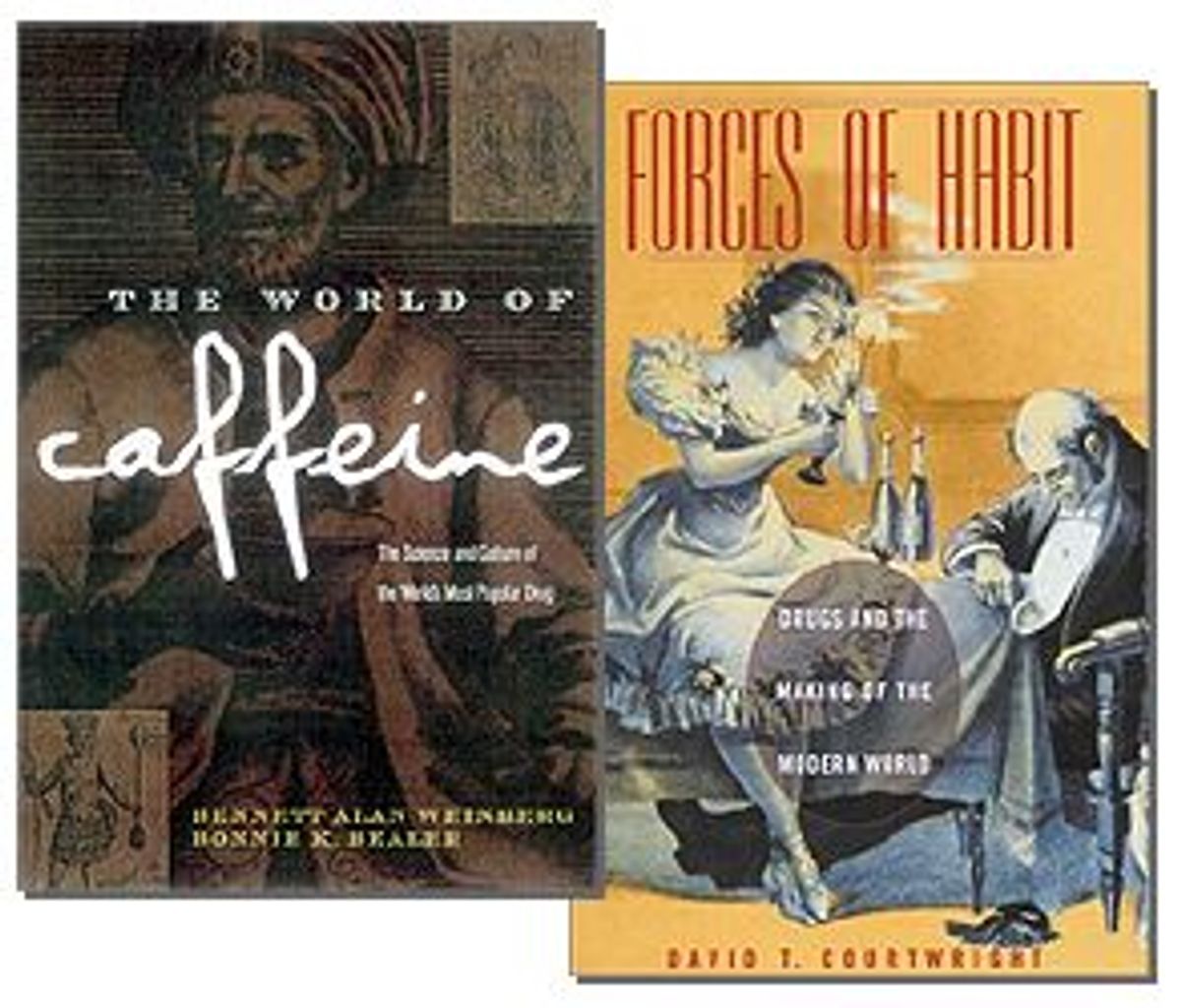
"Nature is parsimonious with pleasure," writes historian David Courtwright in "Forces of Habit: Drugs and the Making of the Modern World." Or, as we used to say in high school, "life sucks, and then you die." But human ingenuity has stepped in to lessen the miseries and add to the delights of earthly existence. Courtwright calls it "the psychoactive revolution": Compared with 500 years ago, people across the planet now have easy access to a, well, mind-blowing variety of consciousness-altering substances. The menu of options differs from culture to culture -- one man's vodka martini is another's kava brew -- but the drive to take a temporary vacation from our normal waking state has made some drugs into perhaps the only truly global commodities. Virtually every language on earth has words for coffee, tea, cacao and cola, the plants that produce caffeine. The 5.5 trillion cigarettes smoked each year in the 1990s represent a pack per week for every living man, woman and child.
Alcohol joins caffeine and tobacco to round out what Courtwright calls the "big three" of currently legal psychoactive drugs. As he sees it, modern civilization is practically unthinkable without this trio. But why have they fared so well while equally intoxicating substances -- like, say, marijuana -- are banned and stigmatized, and others -- like kava, khat and betel -- are popular only in distinct geographic areas? And why is tobacco currently falling in popularity, while alcohol and caffeine are holding their grip on us? These questions are only partly answered in Courtwright's otherwise excellent book, but that's not really his fault. Drugs are as deceptive and multifaceted as the human beings whose metabolisms they mess with; a history of drugs may be possible, but an analysis of their role in culture is bound to be incomplete and provisional. There are simply too many ways to tell the story.
Still, Courtwright's historical investigation is solid and fascinating: Once the big three caught on among European elites, they became crucial components in the ocean-crossing commerce and empire building that shaped modern economies. Tobacco, coffee, tea and spirits were lucrative; users quickly grew dependent on them, guaranteeing a steady demand for commodities that could be heavily taxed. These drugs have also always been an ideal way to control and pacify laborers, providing them with temporary relief from the fatigue and boredom of agricultural and, later, industrial life. Some of these workers -- such as those Eastern European peasants paid in vodka for the potatoes and grain they delivered to distilleries or West Indian distillery workers paid in rum -- found themselves caught in devastating economic traps.
As habits, the big three also work with and reinforce one another nicely. Had too much to drink last night? You'll be especially eager for that morning cup of coffee to clear your head. If you smoke, you'll need to pour another cup, since smokers metabolize caffeine more quickly than nonsmokers and must drink more coffee or tea to get the same buzz. Feeling too wired now? Time for a cocktail!
Over time, as you ingest more of these substances, your body's tolerance for each of them increases, so you need more and more to get the same result. These endless cycles, "Forces of Habit" suggests, not only tap into a vulnerability in the human psyche -- we're hard-wired to seek to mitigate pain and increase pleasure -- but are also the essential building blocks of capitalism:
The peculiar, vomitorious genius of modern capitalism is its ability to betray our senses with one class of products or services and then sell us another to cope with the damage so that we can go back to consuming more of what caused the problem in the first place.
The economic impact of legal drugs extends from barley farmers to bartenders to the social workers who run drug rehab clinics to the lawyers who defend drunken drivers to, Courtwright playfully acknowledges, the scholars who study the history of drugs.
But drugs are, of course, not just pleasurable and profitable -- they're also dangerous. Before the late 19th century, governments were aware of the destructive properties of a wide range of drugs, but the revenues to be had from taxing the drug trade were more compelling than the moral imperative to outlaw it. Gradually, as the booming print media made the downside of certain drugs more visible -- readers learned of desperate Chinese peasants enslaved to opium and crazed students overdosing in 1890s Berlin cocaine dens -- public demand mounted to ban some drugs outright.
The losers during this time were what Courtwright calls the "little three" -- opium, cannabis and coca. With narcotics like opium and cocaine, governments justified bans by pointing to extreme and visible health problems and social costs. Marijuana, however, appears to have been the victim of historical bad luck: Its health effects are no more dire than those of alcohol or tobacco, but over the centuries the plant lacked "international corporate backing or fiscal influence."
Unlike tobacco and alcohol, which was banned temporarily in the United States during Prohibition but was quickly reinstated to legal (albeit heavily regulated) status, marijuana never became part of "the personal habits of influential leaders and celebrities." (That makes sense, of course, given the go-go nature of capitalism and the traits required for success -- anyone who did make marijuana part of his personal habits would most likely not have become an influential leader or celebrity in the first place.) Instead, the mellow plant lodged itself first in peasant and then in youth subcultures, where it gained a reputation as a "gateway drug" to harder, harsher illegal substances like heroin and cocaine. (It is a gateway drug, but then so are nicotine and alcohol.)
Of Courtwright's big three, alcohol has the most fascinating and contradictory history, and the kinds of cultural questions that its history raises point up the limitations of Courtwright's project most obviously. Alcohol is as lethal as they come; its score on pharmacologist Maurice Seevers' famous 1957 "addiction liability rating" -- the degree to which a drug produces tolerance, emotional and physical dependence, physical deterioration and antisocial behavior in those under its influence or those withdrawing from it -- is 24, much higher than that of heroin (16) and cocaine (14), and ridiculously higher than that of marijuana (8). Yet alcohol is not just tolerated in many cultures, it's frequently exalted.
Courtwright points to the alcohol industry's "size and fiscal importance" to account for the drug's unassailable legality and social cachet. He does note that scientists have found moderate drinking to be healthful, and he observes that "humanity ... has long experience of alcohol, and has evolved all manner of rules and taboos to reduce the harmfulness of drinking." But human beings have done more than just ameliorate alcohol's negative effects. We've turned the making and drinking of alcohol into a venerable tradition, one that may depend on the high that alcohol delivers but one that also can't be reduced to a mere buzz.
Cartwright doesn't acknowledge it, but the process of making alcoholic beverages has given rise to sophisticated craftsmanship -- some might even call it art. To wine drinkers, the difference between a New Zealand sauvignon blanc and a California cabernet is vast and important, and matching them with the proper foods requires knowledge and imagination. And as he notes, in France, Italy and Spain, alcoholism rates are very low and public drunkenness is frowned on, yet nearly every adult drinks. In these cultures, alcohol has been integrated into the social fabric and is inextricable from the concept of "the good life."
In contrast to the array of alcoholic beverages that Western civilization has developed and matched to particular moments of life (champagne goes with celebrations, white wine goes with elegant fare, beer goes with watching football on the tube and so on), the distinctions between brands of cigarettes are mainly a matter of marketing. Perhaps that's partly why, of the big three, tobacco is faring the worst these days; its cultural roots are just not deep enough. With many municipalities banning smoking in restaurants and even bars, cigarettes have been largely exiled from the civilized table, where caffeine and alcohol have been prettied up by the gourmet delivery systems of wine and coffee. Connoisseurship disguises well the irresistible craving for a buzz. As Courtwright puts it, "Tobacco ... is becoming a loser's drug." While their caffeine-addicted friends can now find a Starbucks on every corner beckoning them in for a quick hit in a cozy environment, smokers are reduced to hopping around on freezing sidewalks outside office buildings.
No longer do cigarettes serve as "the small change of sociability," in Courtwright's phrase, or help a woman appear more independent and sophisticated, as they once did for countless Hollywood actresses. "I would date a woman who smokes," a male friend once told me, "as long as she doesn't walk down the street smoking." At first I thought he was making some sort of distinction between "feminine" and "unfeminine" behavior, but now I think his prejudice has more to do with the fact that a walking smoker announces the fact that she's addicted to nicotine, not just engaged in the elegant little social ritual of lighting up in a restaurant with friends or while lying in bed with a lover. Dragging on a cigarette while she's navigating the street, she lays bare the fact that she is an addict, engaged in the self-directed spiral of feeding her own high.
Stripped of its social trappings as it increasingly is, smoking is beginning to appear as nothing more interesting than a smelly, breath-fouling, teeth-staining, illness-causing personal addiction. That doesn't mean that the cigarette has gasped its last -- there still is, for many people, a surge of pleasure that comes from lighting up. That's not going away soon, but it certainly will become more difficult to get as regulation spreads from restaurants to outdoor spaces such as parks. What Courtwright calls the growing "lower-class concentration" of tobacco also makes it more politically vulnerable as well.
Caffeine, in Courtwright's book, emerges triumphant among its mind-altering brethren as the least harmful, most life-enhancing drug yet discovered. It's the earth's most widely used drug, with a per capita consumption of 70 milligrams a day. Caffeine alters brain chemistry in notable ways, producing euphoric effects such as a rush of energy and an elevation of mood. It's addictive in the sense that tolerance increases the more you use it and withdrawal can lead to symptoms such as headaches and lethargy. Nonetheless, the drug's negative side effects, however troublesome, are not dire; too much caffeine causes nothing worse than insomnia or tremors.
Precious few lives are ruined by caffeine, though intrepid researchers, Courtwright reports, have isolated a "syndrome" that affects some serious users -- a condition that would no doubt make an addict of any other substance laugh derisively: These people "go to extremes to obtain caffeinated drinks, use them in dangerous or inappropriate situations, and continue drinking them despite adverse health consequences and warnings by their physicians." The famously coffee-mad French novelist Honoré de Balzac is often used as an example; he died from heart disease apparently exacerbated by his habit. And doctors like to warn that the jury is still out on other potential health problems that may be caused by regular caffeine consumption.
Still, all in all, the social costs of our love affair with caffeine are remarkably low, and its role as a spur to productivity and an aid to coping with the more difficult, sad and painful aspects of life gives the plucky little molecule a strongly positive aura. Even more than the other players in Courtwright's "psychoactive revolution," it's hard to imagine the modern world without it. Yet like the well-behaved daughter who watches as her noisier, more unruly siblings suck up her parents' attention, caffeine mainly lingers in the margins of Courtwright's history.
Fortunately -- for hardcore caffeine aficionados at least -- another recent book, "The World of Caffeine" by Bennett Alan Weinberg and Bonnie K. Bealer, is very likely the ultimate compendium of the political and social history, science, lore and arcana of "the world's most popular drug," as the subtitle brags. This fact-packed book is the work of a science writer (Bealer) and a scientist (Weinberg), but it's written at such a fever pitch of interest in its subject that its authors appear to have been dipping into the research material with an extremely liberal hand. "Can there be any doubt that, if and when there are settlements on Mars, coffeehouses will be among the first amenities available to the emigres?" they enthuse.
There's much to be learned in this book about such mysteries as the chemistry that makes caffeine so effective, even if you have to wade through the authors' insistent, overblown and often repetitive prose. They come at you with such aggressively tumescent notions as "caffeine is like the air." As they explain that one, "You don't see it and usually hardly notice it, but it's there all the same, and it becomes part of you in a critical metabolic exchange that involves every cell in your body." If caffeine is really all this book cracks it up to be, demagogues looking to start a new religion should pay close attention: When science shades so easily into zealotry, you know you're in the presence of something truly powerful.
Shares