Johnny Depp

Christina Ricci

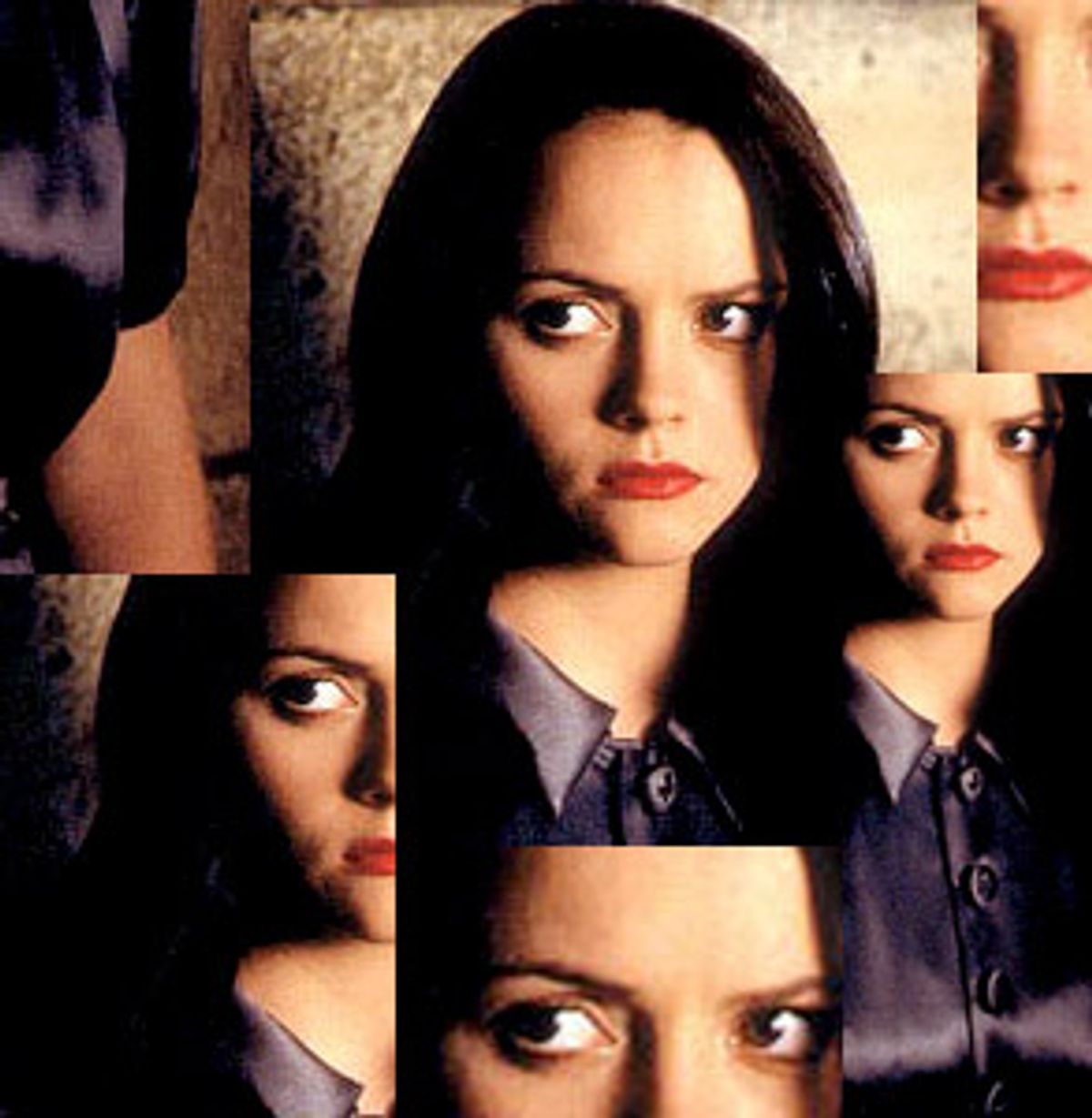
Her latest role, in "The Man Who Cried," casts her as a Jewish refugee during World War II who has a hot thing with Johnny Depp.

  • more
    • All Share Services

Topics:

Christina Ricci

Christina Ricci looks like she stepped right out of the cast of “Lord of the Rings.” With those big, spooky eyes of hers and a pair of little Vulcan ears that stick out when her hair’s bobbed, as it is today, it seems as if Ricci would’ve been a natural for a hobbit, an elf, something.

Still, the star of “The Ice Storm,” “Sleepy Hollow” and numerous indie hits like “Buffalo ’66″ and “The Opposite of Sex” has plenty on her platter, even without a gig as Frodo’s love muffin. With several movies in production, including the film adaptation of Elizabeth Wurtzel’s bestselling memoir, “Prozac Nation,” it’s easy to forget that Ricci just hit 21. She may have the C.V. of a seasoned Hollywood actor and her own production company, Blaspheme Films, to boot. But she doesn’t appear to have aged much since Disney’s ’97 remake of “That Darn Cat.”

In her latest effort, “The Man Who Cried,” directed by Sally Potter, Ricci ventures into relatively adult fare, playing a Jewish refugee from Russian pogroms in pre-World War II Europe. Her costars in the film are Cate Blanchett, John Turturro and Johnny Depp, as the Gypsy horseman she falls in love with.

In this film, your character, Suzie, is not exactly overloaded with dialogue, especially when compared to Cate Blanchett’s character, Lola. Do you have a preference between working with a lot of dialogue vs. a little?

I’m much more comfortable with silence. I don’t like a lot of talk unless there’s a very good reason for it. I just did a movie, “Pumpkin,” which my production company, Blaspheme Films, produced, and there’s a lot of very specific dialogue in a very affected way of speaking. That makes sense to me. But people don’t necessarily go around every second expressing how they feel all the time with words. We express how we feel through actions and things subconsciously that we’re not even aware of. So for me to verbally express to you how I feel is like kicking a dead horse.

Suzie seems far removed from your own experiences, growing up in Southern California. Did it require a lot of research on your part to play her effectively?

No. To be honest, I don’t usually do very much research, especially if I’m working with a director who also wrote the screenplay. They’ve usually done a ton of research. And they’ll tell you about it from their perspective, which is better than doing your own research, because they’ll present to you the information they want conveyed in the film. What you feel is important may not be what the director feels is important.

You’re not concerned that your body language will be out of touch with the period the film’s set in?

That has a lot to do with casting. A director should cast a person who fits into their script. You can consciously do a lot of that stuff, but for me if I do that, it’s going to seem false. If as an actor reading the script I don’t get the character and can’t play it without a huge amount of effort, then I probably shouldn’t be doing that part. Naturally, my body language changes given whatever environment I’m in. Obviously, I felt I understood enough about this character from the screenplay to do the part.

Why did you take the role in “The Man Who Cried”? Did the fact that it’s a more “adult” part enter into it?

Not really. I feel like I’ve been playing characters that are the age I am when I’m playing them for a long time now. I’m in no big rush to play “real” adults. I’m 21. I’m not itching to play 26. I took this role because it was different from anything I’d done. I felt like it was a chance to do straight drama, and to play a character who’s kind of sad. I haven’t played a teenager in a while. Maybe you could buy me as a teenager, I don’t know. For the most part, I’m playing college age these days.

This character and other characters you’ve played have often been outsiders for one reason or another. Is there any connection between the characters you choose and how you perceive yourself?

I don’t think I’m an outsider at all. I’m a successful actress who lives in Los Angeles. It would be horrible for me to be like [affecting a highfalutin accent], “Yes, I’m plagued.” [Laughs] I’ve been incredibly lucky in my life, and I don’t at all feel like an outsider.

Since I was a child, I’ve always been equipped to do this job, for some reason. The mentality I’ve always had since I was a kid was one of being able to deal with a lot of pressure, by not even comprehending that it is pressure. I’ve never taken anything that seriously in my life. A lot of that is the fact that I’ve always had a very easy life. But this character does have to learn to take things seriously, in a reasonably short period of time. She comes to really understand what’s going on around her, and where her place is and what’s happened to her in the past.

You’re reunited in this film with Johnny Depp, who was your costar in Tim Burton’s “Sleepy Hollow.” What was it like working with Depp again?

It’s kind of like in high school — if there was one person you always had in class with you for some reason, after four years of being in class with them, you would sit next to them and everything was comfortable and they knew your habits really well. It’s that kind of thing with Johnny and I. We each know how the other works. We like each other. We have fun together. It’s really more of a working relationship, which in some ways is more valuable than a friendship.

Did that make doing the love scenes with him awkward?

Actually, that’s where it really helped. He and I managed to laugh at those scenes because they’re kind of odd and violent. They’d call “Rolling,” and he’d say, “OK, you ready?” Then I’d say, “Sex in five, four, three, two, one.” He’d call himself a pedophile and I’d say, “Yeah, you are.” When I met him, he was 27 and I was 9. So it is getting into creepy-old-man territory. But there’s no sexual tension between us whatsoever. So we just had fun with it. Anyway, I don’t think you ever really deal with sexuality on-screen. There are, like, 50 people watching you, and you’re just, like, “Uh, I hope my ass looks good.” There’s no deep feeling there. It’s just embarrassing.

Your upcoming film, “Prozac Nation,” from the book by Elizabeth Wurtzel, is “eagerly awaited” as they say. What’s the status of that film and what drew you to that subject matter?

We had some reshoots I did last weekend, and they should be finished in the next two or three months. And then God knows when it’s coming out. The book was amazing. When you think about clinical depression, one of the main problems that people who suffer from this have is that it’s not an illness that’s easily explained to people who don’t suffer from it. It’s that thing we’ve all heard a million times — of how you just can’t shake it off and keep going. And people don’t understand that fully. The author managed to make you feel depression, the headiness, the weight, of it. Afterwards, you can understand it, I think, at least a little bit better. So I thought if we could do that with a film, that would be amazing.

Is depression something you’ve experienced yourself?

This is a real person’s story. This is what Elizabeth Wurtzel went through. She was so eloquent in telling her story but also in giving you a kind of perspective where you can see all of the bad things about her as well as the good things.

That’s not what I was getting at. You’ve spoken in other interviews about going to therapy and being prescribed Wellbutrin

[Interrupts] You were trying to find out if I’ve ever suffered from clinical depression, and I was avoiding the question. I feel that talking about my experiences takes away somewhat from the story of the film. I suppose at some point I’ll do a big exposé interview about it. I will say that “Prozac Nation” was a difficult film for me — it was not a happy character.

Is it true you shot your first nude scene for “Prozac Nation”?

People ask that like I was tied to a chair while all my clothes were stripped off me. But yes, that’s true. The director and I had decided that a nude scene was important for the movie. The movie itself is so exploitive of me. “Exploitive” has such a negative connotation, but there are some situations in which you exploit everything that you have, and I did for that movie. So for me, it was like, why not exploit me physically as well?

And yet both you and Depp are totally clothed during the sex scenes in “The Man Who Cried.”

Right, because in Gypsy culture nudity is considered obscene. So even a man and his wife would not take off their clothes when they had sex. It’s considered to be disrespectful to your own body. So you keep yourself covered.

Do you get annoyed with the press — with our stupid questions?

This may seem surprising, but I’m a shy person and sometimes that’s misinterpreted. I’ve been doing press since I was about 9, and I think I’ve always dealt with the press in a similar way. Certainly, at other times in my life, I probably came off as more defensive or a little strange. People say silly things. You’re bound to get some stupid questions. Then you just react.

What’s the stupidest question you’ve ever gotten?

When I was 13, I was doing the international round tables for “Addams Family Values.” This one woman asked me if I’d gone through puberty yet, and if I had gotten my period. And of course, me being a little smartass, I was like, “No, I’m going through menopause.” [Laughs] But still that sticks with me. I was like, “I’m 13, you’re asking me about my period?” Fortunately, I come from a very sarcastic family, so that’s usually how I deal with it.

Why did you name your production company Blaspheme Films?

It comes from the fact that people decided that’s what I was without knowing me — just the idea that you take something that’s outwardly offensive and you think that it really is offensive all the way down to its core. It’s just a word. Like God really cares what we say as opposed to what’s in our hearts. So I’ve always thought that blasphemy was a ridiculous concept, but that’s of course me being a really obnoxious teenager. I named it when I was, like, 17, so I was like, “Ha,” and took out my soapbox.

Now that you’re producing as well as acting, will the next step be directing?

When I was younger, I didn’t like the idea of having any responsibility. I liked being an actor because I liked acting, but also because if a movie was horrible, no one ever blames the actors. With producing you take a little more responsibility, but with directing, you’re screwed if the movie sucks. I’m still kind of safe with producing. I don’t think I’m ready for the kind of trauma that comes with directing.

Continue Reading Close

Stephen Lemons is a freelance journalist and regular contributor to Salon. He lives in Los Angeles.

Johnny Depp’s delirious “Dark Shadows”

Tim Burton's "Dark Shadows" blends a passion for the cult series with some hilarious '70s gags and good-bad acting

  • more
    • All Share Services

Topics: , , ,

Johnny Depp's delirious Johnny Depp in "Dark Shadows"

Early in Tim Burton’s “Dark Shadows,” Victoria Winters, the proper-looking aspiring governess played by lovely young Australian actress Bella Heathcote, arrives at the gates of Collinwood, a decaying family mansion in rural Maine. (She’s gotten there by riding Amtrak, while we listen to “Nights in White Satin,” which is somehow exactly right.) Vicky, whose real name is something else entirely, has always been a strange girl who sees things, and who is dramatically out of step with the pot-smoking, rock ‘n’ roll youth culture of today (and by today I mean 1972). A strange force has drawn her hither! Could it be the bizarre charisma of the undead monstrosity who (as we already know) lies entombed and enchained, almost beneath her feet? As the door to Collinwood creaks open revealing the idiot caretaker (Jackie Earle Haley, who is priceless), we glimpse a powerful, almost Proustian totem leaning against the front porch: A Schwinn kids’ bicycle, with a banana seat. I had already suspected I was going to love “Dark Shadows,” even before that moment. But that’s when I knew it for sure.

There’s no doubt that Burton’s “Dark Shadows” has issues, and it will probably be considered a misfire in many quarters. It’s so incredibly specific — in its detailed recall of the original late-’60s “Dark Shadows” soap opera (truly one of the strangest series in television history), its finely honed hambone acting by Johnny Depp, Michelle Pfeiffer and Helena Bonham Carter, and its campy but affectionate treatment of its Nixon-era setting — that it’s hard to tell who the intended audience is. Me, evidently, along with other relics of that era and longtime “Dark Shadows” fans who’ve been waiting — and waiting, and waiting — for Barnabas Collins to be exhumed yet again, along with his lugubrious extended family. (We’ll talk about the doomed 1991 series some other time, OK?) But I honestly don’t know what sense it will make to people who show up because Johnny Depp and Tim Burton made a vampire comedy and that sounds cool. This “Dark Shadows” clearly leaves the sepulcher door ajar — nay, gaping wide open — for potential sequels. But it’s such an odd movie and it’s facing the triumphalist superhero tidal wave of “Avengers.” Disaster is definitely possible, so I’m not holding my breath.

Anyway, here’s the principal issue I see with Burton and screenwriter Seth Grahame-Smith’s (he of “Pride and Prejudice and Zombies”) strange blend of nostalgia, farce and spooky-loo: Total delicious goodness! Oh, sure, it all comes unglued in the final 15 minutes, when like all Hollywood movies the story devolves into CGI fight scenes and stuff blowing up. But “Dark Shadows” offers potent atmosphere and delirious ’70s fashions and hilarious gags and some really terrific performances, none better than Pfeiffer’s triumphant return to the screen as a pitch-perfect family matriarch. This film seems to engage Burton’s attention and imagination as no movie has since — well, a very long time ago. You can definitely make a case for his 2007 version of “Sweeney Todd,” and the animated “Corpse Bride” is more enjoyable than most of Burton’s live-action films, but so much of his career — like that of Depp, his good friend and muse — has been expended on stylish resuscitations of moribund pop-culture properties that look great but just go through the motions, storytelling-wise.

That Schwinn bike outside Collinwood is a good way of explaining the delicate balance Burton and Grahame-Smith try to strike here. This “Dark Shadows” seeks to be just as melodramatic and claustrophobic and ridiculous as Dan Curtis’ original series — which only introduced its supernatural elements out of desperation, in an effort to raise abysmal ratings — but not exactly in the same way. Yes, the self-aware camp factor has been turned way up, and that will no doubt displease some original fans. When Depp’s Barnabas, an 18th-century gentleman vampire, is first loosed from his 200-year imprisonment by a road construction crew, he marvels at the towering luminescence above him, clearly the work of Mephistopheles (the golden arches of a McDonald’s). Later, upon glimpsing Karen Carpenter on TV, he is disturbed and beguiled: “What sorcery is this? Reveal yourself, tiny songstress!” Curtis’ show certainly never contained internal gags of that sort, but from the audience point of view, it was a camp object even at the time; its goodness and badness and creepiness and sex appeal were always intertwined and inextricable.

If you’re too young to have seen the original “Dark Shadows” — which remained a daytime staple, in reruns, well into the 1980s, and is now available on DVD in (almost) its 1,245-episode entirety — or just aren’t wired that way, explaining its importance may not be possible. The main thing to point out is the immensely different cultural context in which the show emerged. Barnabas Collins predates not just “Twilight” and “True Blood,” but also Anne Rice’s “Interview With the Vampire” and the entire rise of the Goth sensibility. In the 1970s, vampires were something that only marginal weirdos who went to science-fiction bookstores and watched Hammer films like “Dracula: Prince of Darkness” knew about. People like the teenage Tim Burton, in other words. (Christopher Lee, who played Dracula in seven Hammer movies, has a cameo role here, at least his fifth performance for Burton.)

Many of us unlucky enough to be conscious during the 1970s were desperate for markers of cultural difference, and “Dark Shadows” offered a big one in the years before punk rock. If you were into that show, you probably listened to records by Alice Cooper and the Rolling Stones and the Velvet Underground. You read Tolkien, and Harlan Ellison. You also watched “Star Trek,” an extremely different kind of show with some odd similarities. (Each became more popular after their cancellation; each starred a Canadian Shakespeare actor — William Shatner and Jonathan Frid, respectively — who took a low-paying TV gig that would define the rest of his life.) You probably knew the guy in your town who sold Acapulco Gold and Panama Red.

But I wouldn’t make an argument for “Dark Shadows” purely on context and significance, and Depp and Burton don’t either. Curtis’ show made a virtue out of poverty, and while that might not have been entirely new in pop culture, it sure felt that way. Wobbly sets, flubbed lines and wandering stagehands became part of its live-to-video appeal (nothing was ever shot twice), but the zero-tech effects, stilted dialogue and noodly score (by Robert Cobert) were often surprisingly powerful. After Barnabas was loosed from his coffin about a year into the series, the storytelling became increasingly unhinged and improvisational — there were werewolves, zombies, witches and time travel — and the show’s long arc featured two long detours into two different past centuries, along with parallel and contingent universes that might befuddle Stephen Hawking. It was all made up on the fly, of course, and didn’t necessarily make sense, but there’s no question it fired the imagination of a generation: Burton and Quentin Tarantino and Joss Whedon and J.J. Abrams and countless others.

Burton and Grahame-Smith essentially build a series of affectionate riffs on the characters and situations of the original series, and personally I can only wish there were a lot more of it. The aforementioned Vicky Winters bears an uncanny resemblance to Barnabas’ long-ago lost love, Josette, who was driven to suicide by Angelique (spectral French actress Eva Green, still awaiting her moment of Hollywood stardom), the comely witch he spurned who then sought gruesome revenge. Indeed, when Barnabas returns to 1972 Collinwood and divulges his secret to the resolute Elizabeth Collins Stoddard (Pfeiffer) and then to drunken, zaftig New York psychiatrist Julia Hoffman (Bonham Carter, hilariously mimicking the mannered performance of the late Grayson Hall in the original), he soon discovers that Angelique has endured into the 20th century as well — and, like all women, still wants him.

Is it inherently bizarre and pointless that Burton has spent millions of dollars on a studied, postmodern attempt to both emulate and parody something that was made on the cheap, and that essentially parodied itself at the moment of its creation? I dunno. If you rely on Susan Sontag’s famous definitions of camp, the original “Dark Shadows” would count as naive or “Pure Camp,” whereas Burton’s film can only be “Camp which knows itself to be Camp,” which Sontag says is less satisfying. I’m not sure these distinctions hold up, personally, and I see no moment of innocence in pop culture’s past. Burton and Depp have made this film out of a pure, deep passion for something that was created 40 years ago for entirely pragmatic reasons — a desire to keep a TV show on the air and get paid for it — and then fed on its own nuttiness and the public’s almost erotic appetite for something new. In so doing, they may have created a movie that’s meant for a mass audience, but that only a few people will enjoy the way they do. (The “Cable Guy” of vampire movies, perhaps.) A mistake, and a failure? Maybe. But isn’t that a wonderful twist to the tale?

Continue Reading Close

It’s time to Occupy Hollywood!

It's time to stop paying Johnny Depp "stupid money." Celebrities make too much -- and we can do something about it

  • more
    • All Share Services

Topics: ,

It's time to Occupy Hollywood! Johnny Depp (Credit: Reuters/Fred Prouser)

The great recession is not Johnny Depp’s fault. Johnny Depp did not decimate your 401K and your children’s college savings plans. He did not foreclose your home. He did not take away your health insurance when you got laid off. He did not start charging you new monthly banking fees while awarding himself a hefty bonus. All the guy’s ever done is dress like a pirate and entertain people.

Johnny Depp is not the problem. But the entertainment industry is so bloated and reckless that it can pay him $50 million in the last year alone. Depp just shrugs: “If they’re going to pay me the stupid money right now, I’m going to take it.” But in the midst of economic collapse, it’s time to stop paying Johnny Depp stupid money. It’s time to Occupy Hollywood.

Depp isn’t the only wildly overpaid person in America, of course, and actors aren’t the only mega-earners. Tiger Woods’ salary and endorsements will earn him about $62 million this year – which is actually a stunning comedown of nearly $30 million in the wake of his marital implosion. And thanks to hefty album sales and a smash tour, Lady Gaga will pull in roughly $90 million. That’s a lot of lobster shoes.

Our stars provide us something that Goldman Sachs never will. They’re not moving money around or playing games with high-risk securities that look a lot like fraud. Stars entertain and fascinate us; they unite us through a common love of their work; they offer every kid who ever sang into a hairbrush the dream of attaining similar fame and wealth. That’s free enterprise, and there’s nothing wrong with that. I don’t want Johnny Depp to stop making movies, or Lady Gaga to stop banging on the piano. But at a certain point, we as consumers need to consider what it means when any industry throws that much money at so few people.

As David Cay Johnston spelled out Wednesday, in 2010 “There were fewer jobs and they paid less, except at the very top where the number of people making more than $1 million increased by 20 percent over 2009.” Meanwhile, half of American workers earned less than $26,400. In other words, everybody is making less, except the millionaires.

We like to think of the 1 percent as evil bankers — oh, and they totally are. But it is also our movie stars and television icons, and their fans are making that inequity possible. As Brent Cox explained for the Awl last month, even adjusted for inflation, Hollywood has never before paid the kind of psycho money it’s hemorrhaging on its stars now. In 2011 money, Marilyn Monroe would have clocked in at a modest under $2 million for “The Misfits.” Leonardo DiCaprio, in contrast, stands to make $50 million for “Inception.”

To pay for the stars, studios have gutted the number of movies they make by 20 percent. And while Depp earns enough to buy himself a small planet, Jack Sparrow’s home at Disney is laying off hundreds of employees. This is the same studio whose sense of proportion is so out of whack that it prides itself on sticking to a $215 million budget for a remake of “The Lone Ranger,” starring, of course, Johnny Depp. In a harrowingly grandiose statement of out-of-touchness, Jerry Bruckheimer told the Hollywood Reporter this week, “For the smaller scenes [we] laid off the extras, the effects people, the makeup people … We bunched together scenes with Tonto and the Lone Ranger, so we had a much smaller crew. We saved about $10 million just by doing that.” Wait, that’s how you saved money? Laying off effects people?

Now imagine a studio looking at its bottom line and saying to a star, “Yeah, maybe $10 million bucks and a small cut of the profits is plenty for this one, pal.” Honest to God, what, aside from Will Smith’s or Angelina Jolie’s pride, would make that insulting? And in the meantime, with more funds freed up, Hollywood could go about the business of taking risks and nurturing new talent and making more movies. That we audiences might even support. With our money. Because we’d have some freaking jobs.

And what if we invested in ourselves once in a while, too? If we put the price of a movie ticket toward helping someone in need? You can text REDCROSS to 90999 to donate $10, right from your phone. What if we gave that ticket price to Donors Choose, to help a school fund a dream project or get needed supplies? What if, instead of spending an hour watching “NCIS,” for which Mark Harmon will earn $13 million this year, we spent that hour working with the local outpost of Habitant for Humanity?

It’s crazy, I know. But haven’t the last few weeks shown us that this business of wild ideas is catching on? That too many of us are hurting, and we need no longer accept that we’re powerless to change that? It’s not all or nothing. It’s not bleak austerity. It’s a few drops in the bucket, an acknowledgment that the things that connect us are not just the “Pirates of the Caribbean” franchise. And if the choice as a consumer comes down to crazy or Johnny Depp’s “stupid” money, I’ll take crazy.

Continue Reading Close
Mary Elizabeth Williams

Mary Elizabeth Williams is a staff writer for Salon and the author of "Gimme Shelter: My Three Years Searching for the American Dream." Follow her on Twitter: @embeedub.

Has the price of Silver gone up?

The new movie version of the classic western will star Johnny Depp as Tonto -- and cost $215 million. Why? VIDEO

  • more
    • All Share Services

Topics: , , , , , ,

Has the price of Silver gone up?The durable myth of the Lone Ranger -- pictured here in a comic by Brett Matthews and Sergio Cariello -- will be the subject of a $215 million Hollywood movie starring Johnny Depp. (Credit: Dynamite)

Apparently Disney has given “Rango” and “Pirates of the Caribbean” director Gore Verbinski and his star, Johnny Depp, a greenlight to shoot a new feature film version of “The Lone Ranger,” budgeted at $215 million. That might seem an exorbitant price tag for a concept that ran for years on TV in the 1950s, despite Ed Wood-level production values. But it’s a reduced price compared to what Verbinski originally envisioned; Disney pulled the plug on the project a couple of months ago because its initial price tag, $250 million, was deemed too high.

Where is the money going, you ask? Well, originally it was going to pay for all the werewolves.

Yes, werewolves.  The Lone Ranger and Tonto were going to fight werewolves.

When Disney spiked the project, citing worries about recouping its massive cost, there was an online outcry about how mind-bogglingly inappropriate it was to add frickin’ werewolves to the Lone Ranger myth, Verbinski and Depp agreed to salary cuts and went back to the drawing board, and supposedly the new film won’t have any werewolves.

But it will, apparently, have $215 million worth of production values.

My question is: Why?

I haven’t read the new script, but I’m having a hard time imagining why “The Lone Ranger” would need to cost $215 million. Are Depp’s Tonto and the Masked Man (played by “Social Network” costar Armie Hammer) going to extinguish the great Chicago fire at the end of the movie? Or battle a giant mechanical spider? Or defend Pandora against a military counterattack?

As a boy, I was enthralled by reruns of the 1950s TV version of “The Lone Ranger.” It had no production values to speak of. It didn’t need them. The show — like creators George W. Trendle and Fran Striker Jr.’s original radio plays and comics scripts — weren’t deep, but they were tremendously exciting, and their excitement had nothing to do with scope.

They were all about plot, characterization and in-the-moment decisions. They were action-packed morality plays that pivoted on choices. The Ranger and Tonto were the moral rocks that the bad guys dashed themselves against. The heroes and villains were surrounded by supporting characters and bit players who fell somewhere along the good-evil continuum; much of the suspense in the “Lone Ranger” stories came from the sight of people wrestling with whether to do the right thing or succumb to intimidation or greed.

If filmmakers have a firm grasp on all that, they don’t need to spend hundreds of millions of dollars envisioning the driving of the golden spike or the battle of Little Big Horn, or a tussle between Godzilla and Megalon in the foothills of South Dakota, or whatever they think they need $215 million for. Especially not when they’re making a western, for crying out loud.

Westerns are not about production values. They are about their western-ness, and the filmmakers’ ability to satisfy or subvert the genre’s familiar images and situations. And that’s it.

Mr. Verbinski, if you’re reading this, did you ever see “Tombstone”? A hugely entertaining film, with legs; it replays on TV constantly and millions of people own it on DVD. It cost $25 million in 1993; today it would cost $40 million, and it would still be exactly as much fun, even if you didn’t spend another dime on it. Go down the list of successful modern westerns, or neo-westerns, and you can see the same production cost-to-dramatic payoff ratio repeating itself. “Dances With Wolves,” a visually spectacular and very long movie with a big cast and several stirring action scenes, cost about $22 million back in 1990 — about $40 million today. “Unforgiven” cost $14 million in 1992, and from the looks of it, most of the money went to pay for a rather small and muddy town set; in 2011 money, that’s $23 million. Would “Unforgiven” be a better western, or a better film, period, if it had cost five times as much? What about Joel and Ethan Coen’s most financially successful film, their 2010 remake of “True Grit”? It cost $38 million and grossed a staggering $171 million. Do you know anyone who came out of “True Grit” saying, “I would have liked it better if they’d spent more money on it”?

Some films rise or fall based on the quality of their special effects, sets, costumes and so forth. But would anyone think that “The Lone Ranger” would be one of them?  The 1981 feature film version “The Legend of the Lone Ranger” cost as much as that summer’s other retro serial, “Raiders of the Lost Ark” — $18 million, or about $44 million at today’s prices. It flopped. Why? Because even though it looked great, it was a tedious, nonsensical film, and untrue to the spirit of the character.

The TV show consisted of little more than footage of the Lone Ranger and Tonto delivering exposition, arguing ethics with other characters, galloping through scrubby ranchland and having fistfights in the same nine sets over and over again, but because it was made with sincerity and energy, viewers loved it. Disney could bankroll a similarly unfussy new movie version of “The Lone Ranger” — a film with a Coen brothers- or Clint Eastwood-level budget, meaning lean — and as long as it was well-cast, well-written, imaginatively photographed and edited, true to the spirit of the character, and featured at least one action sequence scored to “The William Tell Overture,” it could be a “True Grit” or “Unforgiven”-level hit.  A $215 million “Lone Ranger” movie would have to make over $700 million — and join the list of the all time biggest box office draws — to be considered a success. I can’t see that happening, even if the film is great. We no longer live in a world in which big-budget westerns make that kind of money, unless they’re transposed to another galaxy and titled “Avatar.”

And here’s the most depressing irony of all: If a hyper-expensive “Lone Ranger” film somehow does become a huge success, it will have everything to do with the appeal of the story, characters and plot, and zero to do with the scope of the production.

But apparently no one involved with the production agrees with that thinking. Story and character are for indie film — and television. Hollywood’s bloated-is-better culture has reached the point where filmmakers and a major studio think that a “Lone Ranger” movie has to be budgeted at roughly half the cost of “Avatar” for it to be considered a worthwhile endeavor. It’s a property, a possible franchise, a toy and video game-generating machine — another thing to be packaged and sold, with or without a personal stamp. It’s also a signifier of personal clout, which means if it’s not staggeringly expensive, it’s not a “real” movie, and thus not worth making.

That’s no joke, kemo sabe. That’s tragic.

Continue Reading Close

Johnny Depp: OK, photographs aren’t like rape

The actor backpedals after comparing photo shoots to sexual assault in Vanity Fair -- and offers a smart apology

  • more
    • All Share Services

Topics:

Johnny Depp: OK, photographs aren't like rapeJohnny Depp (Credit: Reuters/Jean-Paul Pelissier)

We live now in a world where you can talk about vaginas in prime time, where elementary children go to school wearing shirts declaring that homework “sucks.” Yet certain words still have the power to shock and outrage. “Retarded.” Some racial and sexual epithets. A derisively uttered “gay.” And the word “rape” — when it’s not about rape.

When Johnny Depp blabbed in the new issue of Vanity Fair that he loathes doing photo shoots — “You just feel like you’re being raped somehow. Raped. The whole thing. It feels like a kind of weird,  just weird, man” — the actor opened up a fat can of worms. Turns out some people don’t believe getting your picture taken by Annie Leibovitz is very much like sexual assault at all. “Whenever you have a photo shoot or something like that, it’s like — you just feel dumb,” he said. “It’s just so stupid.” Yeah, rape is so dopey.

Unsurprisingly, the Rape, Abuse and Incest National Network (RAINN) promptly took issue with those remarks, sending out a statement that “While photos may feel at times intrusive, being photographed in no way compares to rape — a violent crime which affects another American every two minutes.” RAINN added, diplomatically, that the group “welcomes the opportunity to speak with Mr. Depp and educate him about the real-life experiences faced by survivors every day, and ways that he can work with RAINN to help.”

Even a man who earned roughly $100 million last year — and admits that “if they’re going to pay me the stupid money right now, I’m going to take it” — is entitled to dislike certain aspects of his job. Likewise, just because an actor makes a living in front of cameras doesn’t mean they enjoy being photographed off the set. And Depp, unlike a lot of big stars, is no insensitive motor mouth. He was a tireless advocate for the release of the West Memphis Three and has been a generous benefactor to worthy causes and facilities.

So why did he flub this one? And make no mistake, he did. We use the terminology of both sex and violence all the time to make a point, so perhaps an extreme metaphor didn’t seem  extreme when it was leaving his million-dollar lips. We say that we feel screwed over or reamed or stabbed in the back. We say a job is killing us. Everybody knows it’s not meant literally.

Rape is different, though. It’s a crime that still imposes far too much stigma and shame upon its victims, and for that reason alone it’s a word loaded with powerful and harrowing associations. It’s a word that describes the crime that keeps giving — in both the initial attack and in the often dismissive, accusatory way that law enforcement and the victim’s own social circle respond. And unlike getting your picture taken, it’s an act devoid of consent. Bottom line, if you haven’t been raped, maybe you should think before saying any experience you’ve ever had is like being raped.

But though he bungled it with Vanity Far, Depp, to his credit, gets it now. And when met with a reasonable, articulate explanation of why what he said was not cool, he responded in kind. On Wednesday, Depp issued a statement saying that “I am truly sorry for offending anyone in any way. I never meant to.  It was a poor choice of words on my part in an effort to explain a feeling. I understand there is no comparison and I am very regretful. In an effort to correct my lack of judgment, please accept my heartfelt apology.” Well played on both sides — no outrage, no backpedaling. Just simple, clear and heartfelt communication — and the hope that others may learn a little something from the whole affair as well. Indeed, when thought through carefully — and deployed with tact and empathy — that’s the power of words.

Continue Reading Close
Mary Elizabeth Williams

Mary Elizabeth Williams is a staff writer for Salon and the author of "Gimme Shelter: My Three Years Searching for the American Dream." Follow her on Twitter: @embeedub.

A leaner, meaner “Pirates of the Caribbean” reboot

Penelope Cruz and a delicious Ian McShane join Johnny Depp in a sequel that reinvigorates the megabucks franchise

  • more
    • All Share Services

Topics: , , ,

A leaner, meaner "PIRATES OF THE CARIBBEAN: ON STRANGER TIDES" Captain Jack (JOHNNY DEPP) and Angelica (PENELOPE CRUZ) make their watery way through the jungle in search of the Fountain of Youth. Ph: Peter Mountain ©Disney Enterprises, Inc. All Rights Reserved.(Credit: Peter Mountain)

CANNES, France — So, yeah: I flew thousands of miles across an ocean to crash in an apartment full of Polish people in a party-hearty beachfront town where the neighbors segued sweetly from Björk remixes to “Sweet Home Alabama” at 2 o’clock in the morning, just so I could get up really early with more than 1,000 other masochists and go see a moderately entertaining action-adventure fantasy that will be playing at every shopping mall in the United States come Friday. I guess you won’t be getting the French subtitles below Johnny Depp’s face, and that was so worth it. “On s’empare du navire!” (Loose translation: We kicked your asses!) But you may have noticed that amid that tangled sentence I applied the words “moderately entertaining” to Rob Marshall’s “Pirates of the Caribbean: On Stranger Tides,” which had its world premiere on Saturday amid a sardine-crush mad scene at the Cannes Film Festival. (I saw a woman pulled out of the crowd of photographers and hauled away in an ambulance.) That’s already a big win for a Disney franchise that had slipped from baroque CGI decadence deep into the Rococo period under previous director and all-around mad scientist Gore Verbinski.

“On Stranger Tides” is something short of a full series reboot, but Marshall — best known for big-budget musicals like “Chicago” and “Nine” — has shed most of the supporting cast and almost all of the super-duper creature effects of the Verbinski trilogy, and that’s mostly a good thing. (The French subtitle is “The Fountain of Youth,” by the way, which is clearer and better, but I guess the writers are crediting Tim Powers’ novel for inspiration.) Keira Knightley, Orlando Bloom, Bill Nighy, Stellan Skarsgård and others have departed for Davy Jones’ locker (well, Nighy was already there) or other exotic ports of call. Screenwriters Ted Elliott and Terry Rossio focus tightly on Depp’s dapper, roguish Capt. Jack Sparrow and his alternately ferocious and respectful rivalry with the scabrous Hector Barbossa (Geoffrey Rush), now a pirate-gone-straight commanding a Royal Navy warship in pursuit of Ponce de León’s rumored Fountain of Youth. Arguably there’s not much to see in Depp’s performance this time around. We’ve seen an awful lot of the fey Keith Richards shtick, and he dials it down a little, intermittently allowing himself to be the decent, likable hero.

Even more important, Marshall delivers old-fashioned swashbuckling action-movie thrills more than computer-engineered grotesquerie. He kicks off the film, for instance, with a fast-moving, cleverly constructed (but not confusing!) chase scene through the streets of London — via chandelier and rope and Judi Dench cameo and horse-and-carriage and exploding coal wagon — that might be the best such sequence in the whole series. We certainly get a couple of new characters during the trans-Atlantic race for the mythical Fountain, which of course begins to resemble a video-game quest (you need two silver chalices, a mermaid’s tear and the blood of Donkey Kong) and the results there are “comme ci, comme ça,” as they say over here. I don’t know what it is about Penélope Cruz acting in English; she speaks the language well enough and she’s still plenty attractive, but something’s missing, whether it’s confidence or psychological fire or fundamental Espanish-ness. Anyway we’re supposed to accept her as Angelica, a convent girl Jack seduced and abandoned years ago who also turns out to maybe, possibly, be the long-lost daughter of the infamous pirate Blackbeard (Ian McShane).

Yes, I said that Ian McShane, whose character on “Deadwood” may go down as the most profane in the medium’s history, plays “the pirate all other pirates fear,” as Jack puts it, captain of the dreadful black ship called Queen Anne’s Revenge, with its skeleton figurehead and its zombiefied crew. (They aren’t zombies, in the usual movie sense; Elliott and Rossio use the term in its anthropological-historical meaning, which may be a first for this franchise.) Handsome but decayed, evil down to the roots of his soul and a few meters below that, McShane’s Blackbeard is the best special effect in “On Stranger Tides,” which also features a bunch of sexy-scary mermaids with long glistening fishtails and a final MacGuffin-destination at the fabled Fountain of Youth itself, which resembles a Roman ruin from an 18th-century English landscape painting.

Indeed, if there’s a problem with the fact that this movie is marginally more realistic than the preceding three, it’s because it made me think a little bit, and that’s never a good idea in a movie that’s based (OK, at several removes) on a Disneyland ride. So we’re somewhere around the year 1720, and Jack, Blackbeard, Barbossa and the Spanish fleet are all chasing the Fountain of Youth discovered two centuries earlier by the conquistador Juan Ponce de León, right? Great. (Let us note that later chroniclers claimed that Ponce de León was actually seeking a cure for impotence; he was 500 years too early for Viagra and in need of the Fountain of Whoomph, if you know what I mean and I think you do.) But the place the dude actually explored was Florida. Is that where we’re supposed to be when all these characters go trekking through the jungle and climbing over mountains and plunging into canyons? The primeval mountains and canyons and jungles of Florida? Is that closer to Boca or to West Palm?

OK, I’m getting distracted, and if I go on any longer in this vein I’ll start asking whether the Fountain of Youth in this movie, with its Roman Empire bathhouse look, supports some kind of crackpot, hyper-diffusionist archaeological theory. The main point, I guess, is that while a lot of people are predicting a disappointing summer for Hollywood (and I generally concur), “Pirates of the Caribbean: On Stranger Tides” injects new vigor into a megabucks franchise and makes for a perfectly acceptable night out. Now, the movie’s too long and you can only watch so much swordfighting and the repartee’s really not that great and if you see it that’s two and a half hours of your life you’ll never get back, just because you wanted to see Ian McShane and some cute mermaids. I report, you decide.

Continue Reading Close

Page 1 of 11 in Johnny Depp