NPR

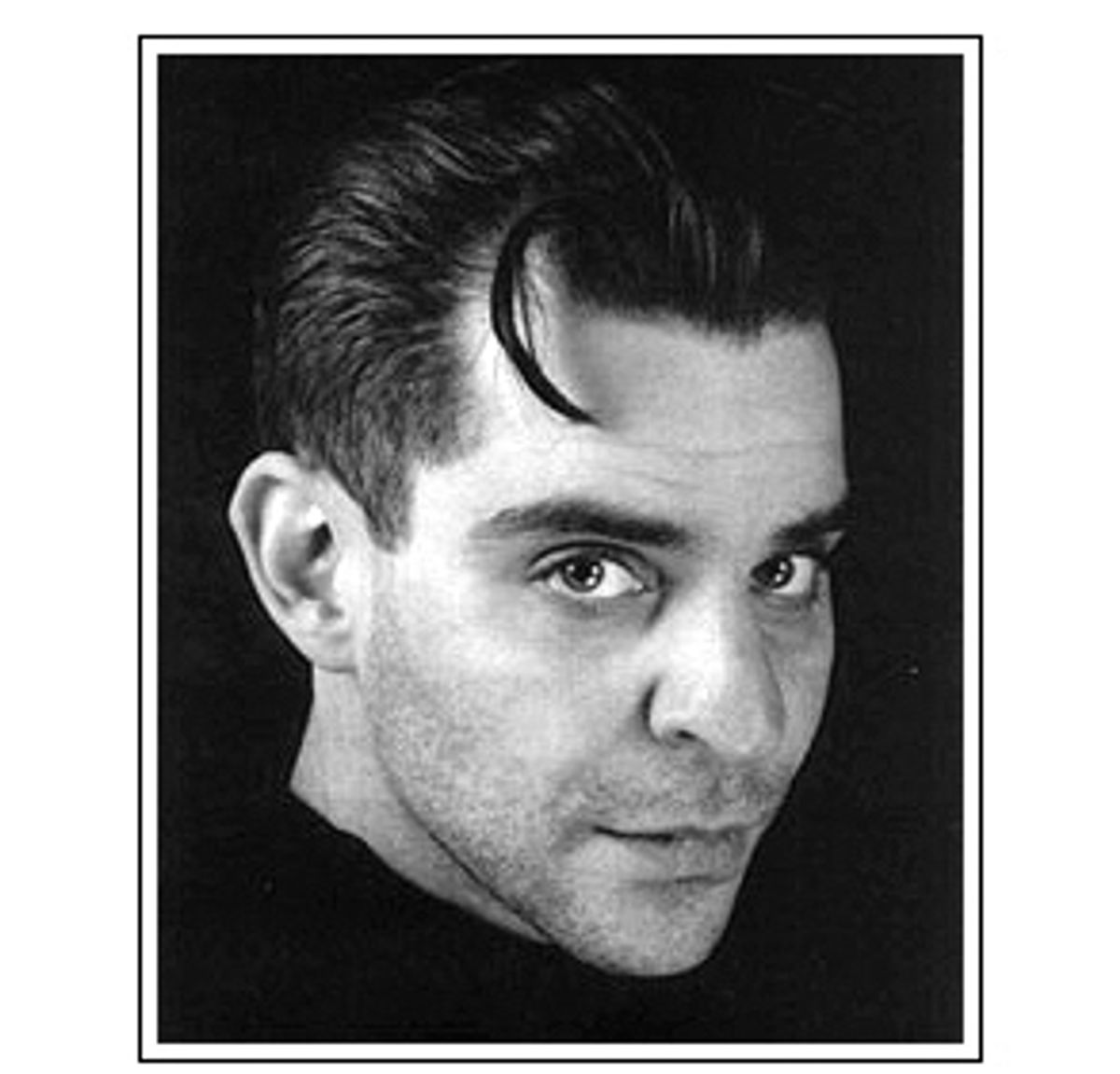
David Rakoff

The author of "Fraud" talks about being Gene Kelly, tiny, tiny writing and the boom in humorous essays.

  • more
    • All Share Services

David Rakoff

When I met David Rakoff, whose new collection of essays, “Fraud,” was published last month, I expected to encounter a chain-smoking, hard-drinking, acid-tongued terror who would quickly put me in my place with a few well-chosen words. I expected the bastard son of Addison DeWitt and Fran Lebowitz.

Instead, he was a gracious, generous and gentle soul. No vitriol, directed at me or elsewhere, was in evidence. I was both relieved and disappointed, like the gullible Weather Channel viewer who girds himself for the Storm of the Century by stocking up on salt, bottled water and other supplies, only to wake up to a mere dusting of snow.

Rakoff warns us in the very title of his book that he is something of a fraud, a cowardly lion whose tough talk hides his fears and insecurities. But then we are all frauds in Rakoff’s world, all deserving of both flagellation and forgiveness.

- – - – - – - – - – - -

How has your association with “This American Life” impacted your career?

It didn’t just impact my career — it made my career. It’s like being awarded a driver’s license without having to learn how to do left turns or parallel parking, just because they want you on the road. That doesn’t happen. So I’m incredibly lucky in that way.

You’ve also dipped your toe in the acting waters from time to time over the years, most recently off-Broadway in David and Amy Sedaris’ play “The Book of Liz.” How do the two disciplines differ?

They’re different sets of muscles. I was going to say that writing is about disclosure and acting is about obfuscation, but that’s such a little lie. Both of them are about obfuscation and masking oneself.

Is the act of writing about masking oneself, or about revealing oneself in the light you prefer?

That’s the thing: It’s about revealing oneself on one’s own terms and about bullying people. [Laughs] It’s interesting — what’s nice about acting is that it’s work that involves other people daily. As you know, writing is not. So it’s been nice to do this play, which has taken up the last quarter of the year — we were up for three months. It’s great to be with people.

Does reading your work in public satisfy that same performing jones?

Yes, it does, definitely. It might even be a little more substantive because the words are your own.

Nearly every piece in “Fraud” finds you in one way or another an outsider. Do you seek out such situations?

Oh, sure. But I think pretty much everybody feels like an outsider most of the time.

You’ve a number of traits that might lead some to consider you an outsider: You’re gay, you’re Jewish and you’re an expatriate Canadian. Have you ever felt pressure from any of those communities to be more of an activist, to more avidly embrace your sexuality, your ancestry or your nationality in your work?

Within the world that I run in, which is a very privileged, insular, small New York world, they’re so normative, and I’m so much a type, that it’s not really an issue. But, simply put, I think it’s far more politically significant that Outside magazine allowed me to, unself-consciously and completely without comment, be visibly, notably gay in a feature article I wrote for it ["Back to the Garden," a revised version of which appears in "Fraud"]. It didn’t have a problem with that at all, and I don’t think anybody noticed. But that seemed significant to me.

It’s an interesting piece. While reading it, I felt a certain interventionist concern for you. You are such an urban being. I became worried that you seemed to be buying into the whole back-to-nature/survivalist training you were undergoing.

The thing that really appealed to me was the stuff you got to make and do. It’s like arts and crafts, but the stakes are life and death. I enjoyed making the things in the wilderness. I found that kind of mastery, that sort of dexterity, is something that really appeals to me; I like to make stuff. I’m handy that way.

There’s a certain challenge such groups like to present, along the lines of “If left on your own out in the wilderness, would you survive?” My answer is no, I wouldn’t, and I couldn’t care less. If society suddenly breaks down, and it’s survival of the fittest, I’m prepared to throw in the towel.

That’s the thing. There are so many other things that would lead up to such a societal breakdown — the looting, the pillaging, whatever. You’d be dead anyway. It’s very rare to be suddenly and hermetically placed in a full survival situation. It’s pure child’s play, a boy’s fantasy.

You grew up in Toronto, a cosmopolitan, cultured city in its own right. So what is it that brought you to New York? And what keeps you here?

There’s no underestimating the history, the sheer historical power, of this city. It’s manifest throughout music, movies, literature, whatever. But what keeps me here is that I’ve been here for 18 years. It’s where I became a grown-up; it’s where most of my formative experiences happened. I groove on — groove on? — that certain direct quality, the emotional immediacy. While Toronto is certainly polite and apparently kind — and it is kind — there’s a social infrastructure that there just isn’t here; there’s a kind of chilly reserve that I no longer enjoy.

I enjoy the fact that, here, everyone in the bank has an opinion about what I’m doing.

Are you living the life you imagined as a youth?

I’m the luckiest person I know. I’m just waiting for the other shoe to drop, checking for lumps. I’m incredibly fortunate right now. The life I lead is different from the one I imagined when I was younger, but equally wonderful. Because it’s real, so it’s very different. You know, all things that are real are different from the febrile fantasy version of them. So it’s more difficult, but it’s richer. It’s more nuanced and … sadder.

But no one’s fantasies ever encompass sadness — even my own. Which is weird, because sadness is a part of everything I think, say, sleep, eat or do. But I’m unbelievably fortunate right now — so much so that it freaks me out a little bit to talk about it. You know what I mean?

I absolutely do. You’re where I was a year ago, when my book had first come out, and I simply couldn’t believe my good fortune. I felt that I was somehow mistakenly living someone else’s life. I used to half-joke that I was on the lookout for runaway buses.

It’s funny you say that. The last time my life was going so well was when I was 22 and living in Tokyo, and then I was briefly felled by that little illness [Hodgkin's disease]. That seemed to be the equation of my life.

May 15 was the book’s pub date, and though I should probably be embarrassed to admit it, I was definitely, on some level, convinced that I wouldn’t actually live to see May 15. I had to fly back from Canada on May 15, and I thought, Well, this is it. Then I realized that, of course, that wasn’t the case, because God’s not as big a drama queen as I am!

What impact did that bout with cancer have on your life? Having survived a serious illness, do you now live life with more gusto?

No, I don’t live with any more gusto; I am still as tremulous and trepidatious as ever. But you must also understand that I felt somewhat dilettantish compared to the other people at the cancer hospital. And that was followed by my moving back to New York at the height of the [AIDS] pandemic. But it had a huge impact on me. It taught me things that are both very ethereal and very direct and pragmatic. Altruism is innate, but it’s not instinctual. Everybody’s wired for it, but a switch has to be flipped. I don’t think that people are naturally sympathetic to other people in that way. So I think having been on the other side of that membrane gave me an appreciation for frailty that I might not have had otherwise.

If you were to be diagnosed again with something, do you think your reaction would be, “Oh no, this time it’s got me,” or something more like, “Well, I beat it once, I’ll beat it again.”

It’s sad to say, but I would probably shut down emotionally in precisely the way I did last time and become just as adamantine and impenetrable. But at the same time, there would also be a sense of “Well … finally! What have you been waiting for?”

If you could swap careers with anyone, who would it be?

Without his politics? Jerome Robbins. I’d be a dancer. Or Gene Kelly.

Are you able to read other writers …

Without feeling bad about myself?

Exactly!

No. [Laughs]

Do you ever say to yourself, “Gosh, I wish I’d written that”?

Sure. Well, more like “Who the hell do you think you are?” directed at myself. Most writing I find chastening. I’m consistently given a reality check by the amount of sheer smarts and talent there is out there.

There are certain writers — Nick Hornby, for one — whose work inspires more than intimidates me. Then there are others, like Michael Chabon, who leave me convinced I’m on the wrong path entirely — that I should turn in my keypad and dig ditches.

That’s the thing — it’s the difference between seeing Gene Kelly dance, who makes you think you could do it, and seeing Rudolf Nureyev, who makes you realize you couldn’t. It’s very, very different.

I’m conscious of it when I read the newspaper. There’s a journalist at the New York Times named Charlie LeDuff. He’s astonishing. He’s like an old-time newspaperman, the kind of people we now read and think, I hope people knew what they had in their presence. I think history will be kind to him.

Before we met, I pictured you as an appealingly acerbic, hard-shelled enigma. I eventually found this to be untrue, of course, and I think that many readers will be pleased at just how much of your gooey center is exposed in the book. Are you ever surprised at how much of yourself you’ve revealed in your work?

I guess I am; it’s that unwitting thing where you really think you’re fooling people. But people aren’t dumb, certainly not as dumb as one is about oneself. I haven’t yet received a lot of reactions, because the book hasn’t been out there very long. I haven’t yet really heard from folks.

Do you relish hearing from people you don’t know?

Sure, if it’s in a kind of unmenacing, uncreepy way. If it doesn’t involve, you know, hanks of hair and tiny, tiny writing.

Most of the pieces in “Fraud” originated elsewhere but have been revised for the book. Was it a positive experience to revisit work that has had a life of its own for some months or even years?

In the final analysis, sure, it was a positive experience. But when I was doing it? Here’s how I like to describe writing: It’s like pulling teeth … out of your dick. The pieces had to become a book, and not just a disparate collection — they had to somehow mesh. There has to be some sort of arc, and I hope that I successfully managed to create one.

I wonder if the relative boom in humorous essays we’re currently experiencing — in your work and the work of David Sedaris, Sarah Vowell, Sandra Tsing Loh and others — relates in any way to the recent rise in popularity of the memoir. You each write primarily in the first person; you base your work primarily on events in your lives. Do we, as a society, feel somehow isolated and therefore see these forms as a way of reconnecting with one another?

I view it more negatively than that; I think it’s probably the culture of narcissism.

I understand why the narcissist is moved to record the minutiae of his existence, but why do so many opt to read these accounts?

I don’t know. I ask myself that every day — and live in fear of the answer.

So you see the rise of the personal essay and the memoir as a negative development?

I think anything I’m involved in, frankly, should be viewed as a negative development.

Brett Leveridge writes for several online and print publications and is an occasional contributor to "This American Life" and "All Things Considered." His first book, "Men My Mother Dated and Other Mostly True Tales," is published by Villard Books.

Super PACS hit “Sesame Street”

The recent court ruling to allow political ads on PBS and NPR reflects the same flawed "logic" as Citizens United

  • more
    • All Share Services

Super PACS hit

A couple of weeks ago, we wrote about how the media giants who own your local commercial television and radio stations have been striking like startled rattlesnakes at an FCC proposal that would shed a light on who’s buying our elections. The proposed new rule would make it easier to find out who’s bankrolling political attack ads by posting the information online.

The stations already have the data and are required by law to make it public to anyone who asks. But you can get only it by going to the station and asking for the actual paper documents – what’s known as “the public file.” Stations don’t want to put it online because — you guessed it — that would make it too easy for you to find out who’s putting up the cash for all those ads polluting your hometown airwaves.

If approved, the new rule would require the ABC, CBS, NBC and Fox affiliates in the top 50 markets to make their files on political advertising available online immediately. Other stations would have a two-year grace period.

In the meantime, the mighty giants of broadcasting have been fighting back. A number of senators serving the industry have spoken up against the proposal and the National Association of Broadcasters (NAB) — led by their top lobbyist and president, the frozen food millionaire and former Oregon Republican Senator Gordon Smith – have been meeting with commissioners urging them to scuttle its proposal or at least water it down until it means nothing.

As Jeffrey Rosen of The New Republic magazine wrote:

“The arguments against transparency offered by the networks show that, having experienced the windfall of advertising dollars that Citizens United unleashed, they have little interest in meeting their legal and ethical responsibility to serve the public interest.”

The FCC is scheduled to vote on their proposal on April 27, and on Monday its chairman, Julius Genachowski, walked into the lion’s den – the really nice one in Las Vegas – and addressed the NAB’s annual convention. He noted that, “Using rhetoric that one writer described as ‘teeth-gnashing’ and ‘fire-breathing,’ some in the broadcast industry have elected to position themselves against technology, against transparency, and against journalism.”

He added, “[T]he argument against moving the public file online is that required broadcaster disclosures shouldn’t be too public. But in a world where everything is going digital, why have a special exemption for broadcasters’ political disclosure obligation?”

Whatever the result on the 27th, those negative attack ads already are cluttering the airwaves like so much unsolicited junk mail and it’s only going to get much, much worse as the super PACs, political parties, the moguls and tycoons, many acting in secrecy, lavish perhaps as much as three billion dollars on local stations between now and November.

But now there’s something new in the mix, especially appalling to anyone who truly cares about public broadcasting. On April 12, by a vote of 2-1, two of three judges on the 9th U.S. Circuit Court of Appeals found in favor of KMTP, a small public station in San Francisco, and struck down the federal ban against political and issue advertising on public TV and radio. For decades there’s been a rule against turning those airwaves over to ads for political campaigns and causes. Now the court has ruled that the free speech rights of political advertisers take precedence.

Imagine if you turned on your TV set someday soon and were greeted by “Sesame Street,” brought to you by the letter C, for “creeping campaign cash corruption.” Perhaps that’s a bit of a stretch, but as the late William F. Buckley, Jr., used to say, the point survives the exaggeration.

If ever there was a camel’s nose under the tent, this is it – and we don’t mean one of those humped creatures that show up on PBS’ “Nature” or an episode about backpacking through Egypt on “Globe Trekker.” The current public system was signed into law by President Lyndon Johnson in 1967. “It will get part of its support from our government,” Johnson said, “but it will be carefully guarded from government or from party control. It will be free, and it will be independent — and it will belong to all of our people.”

The Public Broadcasting Act uses the word “noncommercial” 16 times to describe what public television and radio should be. And it specifically says that, “No noncommercial educational broadcasting station may support or oppose any candidate for political office.” We’ve taken that seriously all these years, and most of us who have labored in this vineyard still think public broadcasting should be a refuge from the braying distortions and outright lies that characterize politics today — especially those endless, head splitting ads.

But in its majority decision the court wrote, “Neither logic nor evidence supports the notion that public issue and political advertisers are likely to encourage public broadcast stations to dilute the kind of noncommercial programming whose maintenance is the substantial interest that would support the advertising bans.”

Sorry, your honors: This is the same so-called “logic” that led the U.S. Supreme Court to issue its notorious Citizens United decision, the one that opened all spigots to flood the political landscape with cash and the airwaves with trash.  “To be truthful” one former PBS board member said, “it scares me to death.” Us, too.

The court decision did uphold the ban on public broadcasting selling ad time for commercial goods and services, although, as corporations and others cover the cost of programming through what’s euphemistically referred to as “enhanced underwriting,” public TV already is close to the line of what differentiates it from commercial broadcasting.

And understandably, with our stations always in a financial pickle, frantically hanging on by their fingertips, it won’t be easy to turn down those quick bucks from super PACs and others. But hang in there, brothers and sisters in the faith: If ever there was a time for solidarity and spine, this is it.

Stations KPBS in San Diego and KSFR, public radio in Santa Fe, have said they won’t do it. If enough of you say no, this invasion might be repelled. And viewers, they need to know you’re behind them.

Continue Reading Close

Bill Moyers is managing editor of the new weekly public affairs program, "Moyers & Company," airing on public television. Check local airtimes or comment at www.BillMoyers.com.

Michael Winship is senior writing fellow at Demos and a senior writer of the new series, Moyers & Company, airing on public television.

The creepy condescension of Caitlin Flanagan

A Salon writer thought it'd be possible to have a real discussion with the controversial writer. Her mistake!

  • more
    • All Share Services

The creepy condescension of Caitlin Flanagan Caitlin Flanagan (Credit: Andrew Zinn/Little, Brown)

There is no way to deny that on NPR today, author Caitlin Flanagan tried to lecture me on how I might have had a “better” adolescence. (There is proof on the Internet, so I know I didn’t hallucinate it.) Specifically, she tried to use me as an example of the perils of having the Internet in your room as an adolescent, because I didn’t happen to meet a great guy to date in high school. The remedy? More princess movies.

Many people, including my actual parents, think I turned out pretty OK. And Flanagan, whose book “Girl Land” I reviewed here, usually restricts her professional vocation of annoying feminists to print. So what was I doing defending my very existence on the radio?

“Do you know about Quakers? They try to find the good in everyone, and I felt you tried to do that in Flanagan’s book,” the producer at NPR’s “On Point” told me, as he tried to convince me to take part in the on-air discussion. (If you read my review, you’ll see this says more about the laceration Flanagan received elsewhere than any unusual empathy on my part.) I told him I was reluctant to engage in something that could turn into a catfight, but was persuaded that the thoughtful tone of the show and its host would prevail. Ultimately, too, I didn’t want to shy away from a fight that I thought was important.

My other worry was that Flanagan would use the first half-hour, which she had exclusively to herself, to moderate her message and preempt any criticism, leaving me to lamely disagree. Others had also seen her analysis as dangerously nostalgic, a fantasy of sheltering precious girls that seemed divorced from real girls’ lives and totally ignored the lives of boys. Turns out I needn’t have worried.

After all, this is a major component of what people pay her for: Trolling, plain and simple, a Michele Bachmann-esque disregard for facts, only better-read and better-written. What could possibly induce her to stop?

On the air, she went even further, by suggesting several times that women and girls are solely responsible for whether men treat them like princesses (as one caller said she suggested to her daughter while watching princess movies, which Flanagan cheered) or like sluts, and whether those men stick around to parent, too. When the host, Tom Ashbrook, politely accused her of setting up a false dichotomy between parents who cared about their daughters in the culture and those who didn’t, she replied, “I think there are, you know, people who are very comfortable with their daughters being part of a culture where they’re servicing boys and they’re even comfortable with their girls performing oral sex on boys they don’t know very well. There are a lot of moms like that and I accept that.”

And then she turned on me. I had first taken issue with how she seemed to demonize boys or imply that they weren’t hurt by gender norms. When I talked about the need for information about safe sexuality and healthy boundaries, she responded, “I think as far as information, what I’m seeing is that girls have lots and lots of information about sexuality. I can show you lots of eighth-grade girls who know how to roll on a condoms because they’ve learned that in school. And I think all of that may be fine for some girls, to send them out into this pornified culture with that information, probably best that they have it.” Some girls, meaning those slutty girls who will never get a man to love them! In any case, when I called her out for that bizarre conflation of porn and sex ed, she got personal.

I’d pointed out earlier that I’d had the Internet in my bedroom as a teen, something Flanagan specifically wants parents to ban. I also described my adolescence not as the dreamy withdrawal she’d described, but as “a very fertile time where I was really lucky to have a supportive community that allowed me to pursue intellectual and creative pursuits.”

Never mind those things. “Let me ask you a question, Irina,” said Flanagan. (The host had already said my name, Irin, correctly.) “Did you have a boyfriend in high school?”

Then I made a mistake — I answered. “I dated some guys who were probably not great guys but I was lucky that nothing really bad …”

“What could we adults have done to you to help you with your dating relationships?” she persisted. We went to commercial before I could sputter a reply. (Nothing could have been done “to” me, and like I said, nothing really bad happened.)

Flanagan had the floor when we got back, at which point she used me as an example of a cautionary tale of how girls who are “empowered” and have Internet access allow themselves to be abused by men. Or something. “My book ‘Girl Land’ is asking, What could we have done differently for Irin, so that in addition to the IM and the Internet and the sex-ed classes, she also had something that would help her interact with boys where she could find a way that boys would treat her kindly?” Flanagan cooed.

Never mind that Flanagan writes in her book about a more traumatizing adolescent experience than I ever had, an assault that took place on a conventional date and without Internet in her bedroom and without “hookup culture.” Was that her fault for not demanding more of men?

“Caitlin, I so much appreciate your concern for me,” I replied, “but frankly, my adolescence was fine … I think that making mistakes is part of adolescence and how you figure out how to partner with people.” I also said, “I don’t think this should be about me, nor should it be about you. This is really about what’s going on in the American culture.” (I lost that battle.)

Ashbrook asked, sensibly, “Is that the measure of a good adolescence, whether they had a good boyfriend in high school?” It wasn’t of mine — I said that for me the measure was that ”I emerged feeling happy and connected and with healthy relationships, got into the college of my choice, have a career that I am happy about, where I get to debate Caitlin Flanagan about female sexuality.”

I’d gone into said debate with the idea of maybe seeing the good in her, or at least seeking a thoughtful discussion of where we diverged and why. That’s where I really went wrong.

Continue Reading Close
Irin Carmon

Irin Carmon is a staff writer for Salon. Follow her on Twitter at @irincarmon or email her at icarmon@salon.com.

Have Wilco and Radiohead become the new adult contemporary?

A New York magazine essay dismisses alt-rock vets as NPR Muzak -- and misunderstands both rebellion and growth

  • more
    • All Share Services

Have Wilco and Radiohead become the new adult contemporary?Thom Yorke, Feist and Jeff Tweedy (Credit: Reuters)

Is there a worse insult in rock music than “adult contemporary”? And is there anything worse for a fan than hearing it applied to a favorite band? For many listeners, Nitsuh Abebe’s recent essay in New York magazine will be a provocation. The esteemed critic (and a Pitchfork colleague) appends the sleepy “adult contemporary” label to several indie-rock darlings, including Wilco, Feist, Stephen Malkmus, Neko Case — and even Radiohead, all of which Abebe essentially lumps together and calls “NPR Muzak.” “If there is a consensus about what counts as respectable, adult music in 2011,” he writes, “then these acts are surely a part of it: While more people consider pop music inherently silly than enjoy it, few assaults are leveled at the seriousness or artistic value of this stuff. It’s tasteful and subtle and brings a few newish ideas to the middle of the road; it adheres to a classic sense of what rock and American music are, but approaches it from artful enough directions to not seem entirely fusty.” This is not high praise. “The main criticism you hear about this kind of record — even outweighing references to Starbucks and/or the bourgeoisie — is that it is just too dull to even bother producing any more complex indictment of it.”

Too dull even to hate: That is the essence of “adult contemporary.” What adds even more sting to the indictment is that these acts are not just reasonably successful within the low-expectations parameters of indie rock, but are well-respected and well-loved as lifers and innovators who have developed distinctive sounds and personas over the years. Indeed, Wilco and Radiohead could be considered the reigning elder statesmen of the American and U.K. underground, respectively. Abebe wonders if these older artists will spark a backlash in younger generations, much the same way the indulgences of ‘70s prog and singer-songwriter fare spurred the back-to-basics fire of punk. However, the relationship between these two generations proves much more complicated than that.

But first: Wilco, adult contemporary? Really? “Adult contemporary” originated in the early 1960s as a radio format aimed at older listeners alienated by the harsher sounds of rock and R&B. Over the decades, it has fragmented into hot AC, soft or lite AC, urban AC, and many other permutations. It’s essentially an umbrella term that has historically covered acts as diverse as Pat Boone, Roberta Flack, the Carpenters, Duncan Sheik and even such country acts as Martina McBride and Lee Ann Womack. It is the pasture to which older acts like Rod Stewart, George Michael and Cyndi Lauper are relegated, often with standards or roots albums; the only reason such artists have continued to prosper is because their audience belongs to a generation that still buys albums. In general, however, the term connotes a smooth, sometimes slick, serious and usually unobtrusive aesthetic — perfect for office visits or dinner parties.

Perhaps dinner parties have changed fundamentally over the years, because if acts like Wilco and Feist are truly “adult contemporary,” then they may be the most adventurous generation of adults in the rock era, not bound by any one genre or any one idea of how music should sound or how it should age. Abebe, again aiming for easy provocation, compares today’s bands to Sting’s safe, toothless solo career, somehow finding common ground between “Russians” and “Bull Black Nova.”

And anyway, amid their experiments with motorik beats and fractured song structures, Wilco actually embraced the equally derogatory and silly term “dad rock” on their new album, “The Whole Love.” “If you won’t set the kids on fire, well I might,” Tweedy sings on “I Might,” the first single. It’s a telling moment in the band’s catalog, a reassertion of their musical mission as well as a complicated bit of household politics. Feist’s music is never quite so self-conscious, but the understated quality of her blues-derived pop songs should not be mistaken for easy listening. Instead, her latest, “Metals,” is more often clenched like a fist or braced for the next unimaginable tragedy. Perhaps the only thing she has in common with Wilco — or with Malkmus, Radiohead or Neko Case — is age. Their audiences may overlap, but the music remains distinctive, different and mostly compelling.

However, the concept of “audience” is a moving target, since groups of listeners are constantly fragmenting and subdividing against acute lines of genre and taste. The idea of “adult contemporary,” then, seems like a relic, only slightly more obsolete than rock radio itself. Even the kneejerk pejoratives Abebe associates with the market seem oddly dated: Starbucks has curtailed not only the number of stores in the United States but also the amount of music it sells, and this year NPR has streamed and discussed a wide range of albums, including punk supergroup Wild Flag, Beirut, young jangle-popsters Real Estate, Fucked Up, Hammers of Misfortune, head-bangers Giant Squid and Ohio thrashers Skeletonwitch. It’s hardly the bastion of middlebrow, good-for-you, let’s-go-crazy-in-the-Volvo music, if it ever was.

To be called “adult contemporary” is to be dismissed as old, out of touch, irrelevant. Adults are the establishment — the very thing kids are meant to rebel against. Abebe admits that it’s unlikely, as “the music world is now fragmented enough that we have the luxury of ignoring things we don’t like, rather than rebelling against them.” However: “One great sign about new independent rock bands, over the past few years, has been a noticeable uptick in the number whose names are vulgar jokes, or deliberately inappropriate — in other words, mission statements that tasteful professionalism and the approval of sober-minded adults are not among their interests — and who play music that’s abrasive or adventurous enough to match.”

But unprintable names in rock music have been around longer than A— C—, and something about that idea — of young musicians embracing abrasive noise as a response to the music of their elders — seems to be as antiquated as “adult contemporary.” It imagines a fairly conventional form of rebellion, one based on a historical model that employs aggression in response to the establishment. If an obnoxous name is real rebellion, give me Neko Case any day. If anything, this current generation’s form of rebellion is new and specific to itself, perhaps nodding to the fact that today’s adult rockers in no way resemble the adult rockers of the past. In fact, arguably the best punk band of the moment is OFF!, a Los Angeles quartet led by Keith Morris, who may be older than 50 but still flails and jumps as maniacally as he did with his former band the Circle Jerks 30 years ago.

Perhaps the latest form of rebellion in music has nothing to do with volume or tempo or band names and everything to do with style and history. Reared on the Internet, where vast archives of music are only a few clicks away, younger artists today rely heavily on the past for inspiration. Yet, few generations have been so savvy about the past as this one, and in surveying the music of previous generations, they are discovering and rehabbing sounds and styles once dismissed. And some of what they’re looking to is the adult contemporary. Saxophone solos, once universally derided, are now centerpieces in songs by Lady Gaga, Katy Perry, and Foster the People. Anthony Gonzalez of the French act M83 continues to plumb the New Romanticism of the early 1980s to craft synth-pop anthems with an overwhelming melancholy, while Dan Bejar of Destroyer (who is old enough to be “adult contemporary”) reimagined ‘80s lite rock, with its flanged drums and slick keyboard sound, as an almost avant garde framework for his musings on the state of North American pop music. Both of their albums — “Hurry Up We’re Dreaming” and “Kaputt,” respectively —are album of the year contenders.

In that regard, the most divisive song of the year isn’t by Fucked Up or Danish destructo-punks Iceage, who have both released excellent albums this year; nor is it by Tyler, the Creator, the California rapper whose much-discussed sick jokes sound like empty provocations. Instead, it’s by Bon Iver, whom Abebe includes among his list of “meh” and “adult contemporary” acts. The Wisconsin-born indie folk singer embraces AutoTune and even worked with Kanye West, but his most controversial act was adding a Korg M1 keyboard to “Beth/Rest,” the final track on his second album, “Bon Iver, Bon Iver.” Although it adds a subtle anthemic quality to the song, the waterdrop sound of that keyboard is more closely associated with the likes of Bruce Hornsby and Steve Winwood than with indie-folk. Many listeners wrote it off as cheesy or ironic, but Vernon has repeatedly asserted his love of the instrument and the genre with which it has been linked. Along with namedropping Hornsby and covering Bonnie Raitt, that approach has established Bon Iver not as “adult contemporary,” but an act that plumbs old “adult contemporary” for new inspiration. That may be the ultimate rebellion: finding new uses for the music adults once rejected, embracing the uncool as the newly subversive.

Continue Reading Close

NPR celebrates crazy forum troll’s decision to practice unlicensed medicine in Libya

A young man with a history of paranoid writings and no combat or medical experience gets an uncritical interview

  • more
    • All Share Services

 NPR celebrates crazy forum troll's decision to practice unlicensed medicine in LibyaKevin Dawes (Credit: YouTube/Kevin Daws)

NPR’s “Morning Edition” profiles Kevin Dawes, a brave young American who went to Libya as a medical aid worker last summer, but who ended up taking up arms against pro-Gadhafi forces. It’s an inspiring tale of one man’s courage, and also one man’s possible mental illness. Because as numerous NPR commenters have pointed out, Dawes isn’t a “medical aid worker,” he’s an unbalanced Internet forum troll who taught himself rudimentary medicine on YouTube.

Michael Woodward comments, below the story:

Kevin Dawes was not a “medical aide worker” he is a self styled medic who taught himself the “skills” through youtube. He has no firearms training and is suffering severely from delusional and paranoid behavior. He is a danger to himself and others. In other stories about him, it is said even that battle hardened rebels are afraid of him and think he is crazy. This story is not researched and needs to be fact checked. I am sure that if you do search for some of his old screen names (try Caro)you will find some of his postings. Also, check out his blog and youtube channel- you will find he is not what this article portrays him to be.

Dawes has been repeatedly permanently banned from the rowdy Internet forum Something Awful for being not just a troll, but a troll widely assumed to be suffering from a possible severe personality disorder due to his insistence that he was the victim of a far-reaching conspiracy involving the San Diego police acting in league with forum moderators. (Upon one banning, moderators advised him, “seek professional psychiatric help and get back on meds!”)

Regardless of his history of trolling SA, he is still performing medicine — operating on people, according to one YouTube video that he’s since made private — without any sort of professional medical training at all, which shouldn’t be encouraged even when it’s not done by unbalanced war tourists.

This isn’t to say that he wouldn’t make a fascinating subject for an in-depth profile, but … his claims probably shouldn’t just have been taken at face value.

NPR has deleted at least a few comments pointing out Dawes’ online history, though others remain.

Continue Reading Close
Alex Pareene

Alex Pareene writes about politics for Salon and is the author of "The Rude Guide to Mitt." Email him at apareene@salon.com and follow him on Twitter @pareene

Fired NPR host sees “McCarthyism”

OWS supporter Lisa Simeone says she was dismissed after right-wing attacks

  • more
    • All Share Services

Fired NPR host sees Lisa Simeone, fired NPR host (Credit: Reuters/NPR)

UPDATED BELOW
Lisa Simeone, host of two cultural programs on National Public Radio, was fired from one of her positions last night for her leading role in the Freedom Plaza occupation in Washington, D.C.  The proximate cause was a series of blogs posts in the Daily Caller asserting that she had violated NPR’s code of ethics, an allegation which Simeone denies.

“It overblown. Everyone’s overreacting,” Simeone told Salon in a phone interview. “It’s like McCarthyism.”

Simeone, a former weekend host of NPR’s “All Things Considered” show, had not worked directly for the network since 2002. As a freelancer contracting with WDAV, a music and arts station in Davidson, N.C., she hosts NPR’s “World of Opera” program.  NPR and WDAV released statements today saying they are “in conversation” about Simeone’s future.

[UPDATE 2:35 pm. Scott Nolan, station manager of WDAV, tells Salon that Simeone will remain as host of "World of Opera."

"Her activities outside of the job do not violate anything in our employee code and have in no way affected her job performance," Nolan said in a phone interview. "She's a terrific host and we look forward to working with her."]

Simeone has been active in a group called October 2011 which has occupied Freedom Plaza in downtown Washington since Oct. 5. The group planned its action last spring before the Occupy Wall Street movement emerged. The October 2011 group has since joined forces with the Occupy DC movement based a few blocks away in McPherson Square.

The Daily Caller is using Simeone’s exercise of her First Amendment rights to beat up on NPR for its liberal ways. The conservative Web site said yesterday:

The political advocacy Simeone has displayed also appears to be an affront to what incoming NPR CEO Gary Knell has said he’d like the network to be: “It’s about journalism, it’s about news,” Knell, who starts on December 1, told the Associated Press after he got the job. “It’s not about promoting one political agenda or another.”

The problem, says Simeone, is, “I’m not an NPR journalist. I am not paid by NPR. I don’t do news. I don’t do analysis. And I have never talked about the occupation movement on the air. I do this entirely in my free time.”

Simeone said she was fired Wednesday night by Moira Rankin, executive producer of “Soundprint,” a weekly documentary program that Simeone hosts. The program, independently produced, airs on NPR stations around the country.

“It was bewildering,” Simeone said. “She started by quoting all these reports from the Daily Caller, and I didn’t know even what that was. She said, ‘Are you involved with this organization [October 2011]? I said, ‘Yes, I was one of about 50 people who helped put this together.’ She said, ‘That’s a problem because I’m getting all these calls. I think you violated the NPR code of ethics.’”

“I said, ‘Can you explain how?’” Simeone went on. “Scott Simon writes Op-Eds. Cokie Roberts [is paid] tens of thousand of dollars in fees talking to business groups. Mara Liasson goes on Fox TV to express her opinions. They all report on the issues — which I don’t do.  I finally said, ‘Are you firing me?’ She said yes.”

As the Daily Caller has reported, NPR’s ethics policy for journalists forbids them from “engag[ing] in public relations work, paid or unpaid.”

The code allows for exceptions in cases such as “certain volunteer nonprofit, nonpartisan activities, such as participating in the work of a church, synagogue or other institution of worship, or a charitable organization, so long as this would not conflict with the interests of NPR in reporting on activities related to that institution or organization.”

Simeone says there is no conflict.

“I’ve never hid my views and my opinions have never leeched into what I do on NPR. People can listen to all my shows. When I was talking about ‘Tosca,’ I could have talked about the relevance today of Cavaradossi, the tenor who is a political prisoner and who is tortured. I didn’t mention it. It’s a show about opera, for God’s sake.”

Simeone called the spread of occupation movement in recent weeks “a wonderful flowering of citizenship” and said she had no regrets about supporting it , despite the fact that she lost a job.

“I’m really, really lucky,” she said. “I’m married to man with a good job and my home is paid for. I’m way luckier than millions of people in this country. I’m not complaining.”

Continue Reading Close
Jefferson Morley

Jefferson Morley is a staff writer for Salon in Washington and author of the forthcoming book, Snow-Storm in August: Washington City, Francis Scott Key, and the Forgotten Race Riot of 1835 (Nan Talese/Doubleday).

Page 1 of 14 in NPR