
Sex
Artificial sexuality
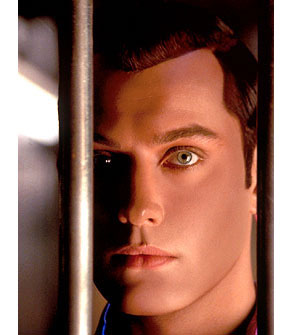
The best thing in "A.I." is Jude Law's robot gigolo, who should make us worry if we still have it anymore.
It says so much that is damning about Steven Spielberg’s “A.I.” that the best thing in it is Jude Law’s Gigolo Joe, a character that serves no useful narrative function. You’ve probably heard or gathered that Joe is a “mecha,” a robot, a machine that has specialized in bringing sexual consolation or adventure to pale and forlorn women who have nearly forgotten the state of rapture. For in the vague future time of “A.I.,” just as the oceans have come up, so the libido of most people (the personality level, even) seems to have gone down.
So Joe can crack a joke and a grin as fast as his thumb-flicking motion can turn on a period crooner to assist in his seduction. You can only imagine the great whirring thing, the Dyno-rod of delight that he keeps beneath his black leather coat. If Buñuel had made “A.I.” you might have had a charming shot of Joe oiling his instrument, or rubbing pine tar on it.
Gigolo Joe is a terrific idea, but then we get everything that Law brings to the part. When I ask if there’s anyone on-screen these days so thoroughly alert and alive, you may begin to feel the irony barely picked up by Spielberg: that mecha Joe is so much more compelling than the real people (the “orgas”) who look down on him. And it isn’t just that Joe can get an endless hard-on to entertain the ladies, it’s more that he is all hard-on — a shiny, freshly painted puppet, Punch’s naughty boy, with a crest of hair that is the hardest nut you’ve seen (or felt in your soft parts) since Bogart’s toupee.
It’s plain to see that this gigolo is acting like a mecha to be a better turn-on, to conjure up fantasies of mechanical endurance. There’s a wealth of wit and character within him, so much sparkling originality and caprice — it left me realizing that, long ago, in “American Gigolo,” Richard Gere had been the true robot prototype, numb to feelings or ideas, just obsessed with matching the right shirt and tie.
But here’s the intriguing point: In so many modern movies, there is the creeping sensation that real-life men and women don’t have it anymore, that they’re weary of sex and all the emotional turmoil that goes with it. Whereas Joe has the happy optimism of someone who has never met a girl he wouldn’t like to fuck. But why is it that our imagination now so readily attributes a kind of sexual vitality to robots, androids or machines?
All the woeful sentimentality of “A.I.” suggests a wish on Spielberg’s part to see the mechas as deprived, underprivileged outcasts. Yet somehow there’s a subtextual energy, a curiosity in us, pulling the opposite way and saying how sweet it might be to be with a machine (call it a pacemaker, a simple little trigger mechanism such as the one that guards Dick Cheney for us all). Just think what a dazzling satire “A.I.” might have been if the robots (even the primitive models) turned out to be kinder people, more trustworthy, better problem-solvers and headier lays than the self-righteous ghosts who can claim organic material.
Why is this? I think it’s because of something that Spielberg never quite grasps — that, for a hundred years now, we have had a species of robot to play with. They are called the people in movies — very lifelike, very pretty, brimmingly sexy, unaging and very obedient to our dreaming urges. Is it any wonder if we prefer these mechas to our sad, failed selves?
David Thomson is the author of "A Biographical Dictionary of Film" (new edition just published), "Rosebud: The Story of Orson Welles" and "In Nevada." More David Thomson.
Taxing strip clubs for rape
Politicians are holding adult entertainment venues responsible for funding sexual assault services
(Credit: iStockphoto/wragg) It used to be that strip clubs were merely blamed for society’s ills. Now they’re actually being charged for it.
In recent years, measures have been introduced in Georgia, Pennsylvania, Texas, Illinois and, most recently, California to apply special taxes to strip clubs — specifically to fund sexual assault services. Now, even if you aren’t inclined to view erotic entertainment as the source of all evil, this might seem an appropriate aim — who wants to argue against additional support for rape survivors? It would seem even more so when you consider politicians’ and activists’ repeated claims of solid scientific evidence showing a link between strip clubs — specifically those that sell alcohol — and sexual violence.
Continue Reading Close
Tracy Clark-Flory is a staff writer at Salon. Follow @tracyclarkflory on Twitter. More Tracy Clark-Flory.
Massage therapists rubbed wrong by sex talk
A Jennifer Love Hewitt show and the Travolta allegations have masseuses tired of being confused for sex workers
(Credit: iStockphoto/sybanto) Joe, a licensed massage therapist, knows what it’s like having a famous client who expects something extra. He had an Academy Award-winning actor begin gyrating on his massage table before raising his hips in the air to show off his erection. “He was hoping that I would play with him in some shape or form,” he says.
Needless to say, Joe isn’t surprised by allegations by two masseurs that John Travolta got handsy during massages. (Travolta’s attorney has denied all the allegations, and called them “ridiculous.”) “It happens all the time,” he says, and not just with celebrity clients. He frequently encounters men who try to fondle him, usually while he’s working on their glutes or lower back and their hand happens to be level with his crotch. “They think they’re so original, but they’re all so much the same,” Joe says, his voice rising. “They all use the same tactics, the same body movements, the same gyrations and grinding my table, the [heavy] breathing.”
Continue Reading Close
Tracy Clark-Flory is a staff writer at Salon. Follow @tracyclarkflory on Twitter. More Tracy Clark-Flory.
A night at the vibrator museum
Early vibrators were hand-cranked, two-person jobs -- and prescribed by doctors. How far we've come since then
(Credit: Antique Vibrator Museum) I can now say that I’ve used a turn-of-the-century vibrator — on my hand, but still.
The silver, hand-cranked contraption is usually kept behind glass at Good Vibrations’ Antique Vibrator Museum in San Francisco — but staff sexologist Carol Queen made a rare exception. “This is very special,” she whispered, unlocking the case and carefully pulling out Dr. Johansen’s Auto Vibrator, a relic from 1904. The “auto” part is not so much: It was a two-person job, with her having to crank the device’s handle to get it thrumming. Pressing my finger tips to its inch-wide circular platform of pleasure, I was pleasantly surprised by its power.
Continue Reading Close
Tracy Clark-Flory is a staff writer at Salon. Follow @tracyclarkflory on Twitter. More Tracy Clark-Flory.
Maggie Gyllenhaal on sexual liberation
The beloved indie star tells Salon about her "vibrator movie" and why she loves playing transgressive women
Maggie Gyllenhaal (Credit: Reuters/Mark Blinch) When I met Maggie Gyllenhaal about six weeks ago, she was enormously and gloriously pregnant, stretching out on a sofa with her shoes off and feet up in a Manhattan office building. (Since that time, Gyllenhaal and husband Peter Sarsgaard have welcomed their second daughter, Gloria Ray, to the world.) We were there to talk about “Hysteria,” the charming, lightweight feminist farce from director Tanya Wexler that explores a key event in the history of female sexuality: the invention of the vibrator by Mortimer Granville, a Victorian doctor who was seeking to cure the mysterious “female malady” that lends the movie its title.
Continue Reading CloseMother-daughter sexperts
Susie Bright and her daughter, Aretha, make parental talks about sex look easy -- and fun
Most parents loathe talking to their kids about the birds and the bees, let alone pubic hair grooming, faked orgasms and “water sports” — but most parents are not legendary “sexpert” Susie Bright.
Better than talking about these things, she penned an advice column in 2009 with her daughter, Aretha, then 19, for the ladyblog Jezebel. Their answers to questions about everything from porn to Paxil were unflinching but playful, and at times controversial. Now the pair have collected those columns into a new e-book, “Mother/Daughter Sex Advice.” Together, they read as an irreverent version of “Our Bodies, Ourselves” for the Internet age. The mother-daughter team also reflect on what the experience of writing the column was like, and it turns out it wasn’t as weird as many would think: For the most part, it was just a continuation of conversations they had been having throughout Aretha’s life.
Continue Reading Close
Tracy Clark-Flory is a staff writer at Salon. Follow @tracyclarkflory on Twitter. More Tracy Clark-Flory.
Page 1 of 403 in Sex