
Sex
The mystery we deserve
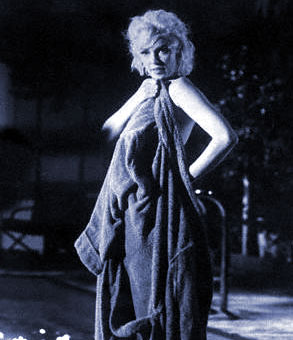
Marilyn Monroe died 39 years ago this month, and we still yearn for answers we'll never get.
Last weekend, the American Movie Classics channel premiered a strange little rescue act from the debris of Hollywood history. They put together a kind of assembly from the footage that survives of a production called “Something’s Got to Give.” This was the movie from which Marilyn Monroe was fired in June of 1962, because she had been ill or late so often that the picture was two weeks behind schedule. A couple of months later — Aug. 5 — Monroe was dead.
To sustain the theory of a complete program, AMC had also put together a Monroe documentary that went through the usual motions and made the normal scandalous suggestions. Thus, in building the case for the studio’s frustration with Monroe, it described how on one occasion she was absent from her set but radiant, in Madison Square Garden, in New York, in a dress that could have been applied like lacquer, to sing “Happy Birthday, Mr. President” to John Fitzgerald Kennedy.
The whole show therefore offered two of Marilyn’s all-time showstoppers: the birthday song (filmed in rough black-and-white), and the gorgeous color footage of her nude swimming scene for “Something’s Got to Give.” What was not mentioned was the way in which the patent stupidity and irrelevance of “Something’s Got to Give” might also have been offered in court as reasons for a disturbed woman of 35 plus taking her own life. Why should anyone so good, mischievous and magical singing “Happy Birthday” have to play in such a drab, mechanical and leering “comedy”? Why couldn’t the system handle a talent such as she had? Why do so many of her movies end up feeling like dirty jokes being offered behind her back? Why did the jokers hate her so much?
I know, it seems impossible these days to explore the jungle called Marilyn Monroe with any purpose. There have been so many books and documentaries that were as speculative, romantic and depressing as novels. Who can tell what she was like? Who really cares now, nearly 40 years later? Why don’t we settle for the idea that Monroe had become such an image that her own “reality” had been smothered? There was nothing there for her to hold on to, so how can we hope to grasp her?
Well, there was one small thing in the AMC documentary that held my attention. There was a man who served as producer on “Something’s Got to Give,” a Henry T. Weinstein. He was very overweight, a man not served kindly by any camera, with many hints of depression. And I would guess that he was filmed not long before his death a few years ago.
I met Weinstein once, researching a quite different project. He was already a Hollywood failure, living in a small apartment in Studio City, soaked in his own sadness. He was also very intelligent, unexpectedly tender in his feelings and insights, and nursing many secrets. It was his job on the movie to do whatever he could to keep Marilyn sweet, present and working. So he followed her moods minutely, and with sympathy. And he noted how there was a point, just before the end, when she seemed better, stronger, ready to finish the silly movie. Then she went away for a weekend, and she was never the same.
That spring and summer, the Cal-Neva Resort, on the shores of Lake Tahoe, was getting ready to open after elaborate refurbishing ordered by new management. That new management was, in large part, Frank Sinatra. Monroe’s costar on the forlorn comedy was Dean Martin.
None of this is revealed here for the first time, though the full story of what happened has never been made clear. But Monroe and Sinatra were intimates that season, and Sinatra was involved in explaining to her how embarrassing that birthday party in New York — her triumph — had been to the president. After all, he was more than willing to bestow the presidential fuck on an actress, in passing, but it was her muddle-headed responsibility if she had ever thought there could be anything more to it. He had a lot of casual sex to avoid falling in love. Sex for her, though, was this big, heavy, soupy thing. And the film of the birthday party was just a touch too blatant. Nothing happened at the Garden, maybe, but any idiot could feel what might have happened. So, cut it out.
And Marilyn, spending a few weekends up at Cal-Neva, with just a few of Frank’s friends — like Sam Giancana — was given a quick education in the kind of man her new beau was, and it was crushing if you think that she could have a big, romantic, old-fashioned feeling for the president. Late in July there was a weekend up at Cal-Neva that is supposed to have got out of hand, a kind of orgy where showbiz people and gangsters used a Marilyn who was already doing too many drugs. It was ugly, and a few days later she was dead.
Of course, it is always possible that she was killed (for safety’s sake), and because no one could be sure what the idiot would say — she was so spontaneous. It is more likely that she was too unclear to recall just what she had taken. But there is a chance that the last shred of fond, daft hope had been fucked out of her and she was weary of being just a body. Don’t expect definite answers, but understand how she is a mystery we deserve.
David Thomson is the author of "A Biographical Dictionary of Film" (new edition just published), "Rosebud: The Story of Orson Welles" and "In Nevada." More David Thomson.
Massage therapists rubbed wrong by sex talk
A Jennifer Love Hewitt show and the Travolta allegations have masseuses tired of being confused for sex workers
(Credit: iStockphoto/sybanto) Joe, a licensed massage therapist, knows what it’s like having a famous client who expects something extra. He had an Academy Award-winning actor begin gyrating on his massage table before raising his hips in the air to show off his erection. “He was hoping that I would play with him in some shape or form,” he says.
Needless to say, Joe isn’t surprised by allegations by two masseurs that John Travolta got handsy during massages. (Travolta’s attorney has denied all the allegations, and called them “ridiculous.”) “It happens all the time,” he says, and not just with celebrity clients. He frequently encounters men who try to fondle him, usually while he’s working on their glutes or lower back and their hand happens to be level with his crotch. “They think they’re so original, but they’re all so much the same,” Joe says, his voice rising. “They all use the same tactics, the same body movements, the same gyrations and grinding my table, the [heavy] breathing.”
Continue Reading Close
Tracy Clark-Flory is a staff writer at Salon. Follow @tracyclarkflory on Twitter. More Tracy Clark-Flory.
A night at the vibrator museum
Early vibrators were hand-cranked, two-person jobs -- and prescribed by doctors. How far we've come since then
(Credit: Antique Vibrator Museum) I can now say that I’ve used a turn-of-the-century vibrator — on my hand, but still.
The silver, hand-cranked contraption is usually kept behind glass at Good Vibrations’ Antique Vibrator Museum in San Francisco — but staff sexologist Carol Queen made a rare exception. “This is very special,” she whispered, unlocking the case and carefully pulling out Dr. Johansen’s Auto Vibrator, a relic from 1904. The “auto” part is not so much: It was a two-person job, with her having to crank the device’s handle to get it thrumming. Pressing my finger tips to its inch-wide circular platform of pleasure, I was pleasantly surprised by its power.
Continue Reading Close
Tracy Clark-Flory is a staff writer at Salon. Follow @tracyclarkflory on Twitter. More Tracy Clark-Flory.
Maggie Gyllenhaal on sexual liberation
The beloved indie star tells Salon about her "vibrator movie" and why she loves playing transgressive women
Maggie Gyllenhaal (Credit: Reuters/Mark Blinch) When I met Maggie Gyllenhaal about six weeks ago, she was enormously and gloriously pregnant, stretching out on a sofa with her shoes off and feet up in a Manhattan office building. (Since that time, Gyllenhaal and husband Peter Sarsgaard have welcomed their second daughter, Gloria Ray, to the world.) We were there to talk about “Hysteria,” the charming, lightweight feminist farce from director Tanya Wexler that explores a key event in the history of female sexuality: the invention of the vibrator by Mortimer Granville, a Victorian doctor who was seeking to cure the mysterious “female malady” that lends the movie its title.
Continue Reading CloseMother-daughter sexperts
Susie Bright and her daughter, Aretha, make parental talks about sex look easy -- and fun
Most parents loathe talking to their kids about the birds and the bees, let alone pubic hair grooming, faked orgasms and “water sports” — but most parents are not legendary “sexpert” Susie Bright.
Better than talking about these things, she penned an advice column in 2009 with her daughter, Aretha, then 19, for the ladyblog Jezebel. Their answers to questions about everything from porn to Paxil were unflinching but playful, and at times controversial. Now the pair have collected those columns into a new e-book, “Mother/Daughter Sex Advice.” Together, they read as an irreverent version of “Our Bodies, Ourselves” for the Internet age. The mother-daughter team also reflect on what the experience of writing the column was like, and it turns out it wasn’t as weird as many would think: For the most part, it was just a continuation of conversations they had been having throughout Aretha’s life.
Continue Reading Close
Tracy Clark-Flory is a staff writer at Salon. Follow @tracyclarkflory on Twitter. More Tracy Clark-Flory.
On the rack: A cultural history of breasts
Did breasts evolve for lactation or to enhance sex appeal? A new book explores why they matter
(Credit: iStockphoto/NadyaPhoto) It’s hard to be boobs. Sure, breasts are cherished as givers of milk and the pinnacle of sex appeal, but the modern world hasn’t been good to mammaries.
As Florence Williams writes in “Breasts: A Natural and Unnatural History,” they’re the most tumor-prone organ in the human body. They “soak up pollution like a pair of soft sponges,” and transmit environmental toxins to babies through breast milk. “Breasts are bellwethers for the changing health of people,” she says. While we’ve “genetically modified our crops to be able to protect them from the ill effects of pesticides,” Williams writes, “we haven’t yet figured out how to modify our breasts.” Aside from using saline and silicone, of course.
Continue Reading Close
Tracy Clark-Flory is a staff writer at Salon. Follow @tracyclarkflory on Twitter. More Tracy Clark-Flory.
Page 1 of 403 in Sex