
Fiction

Ray Bradbury is on fire!

At 81, the veteran author of sci-fi classics "Fahrenheit 451" and "The Martian Chronicles" is suddenly very hot in Hollywood.

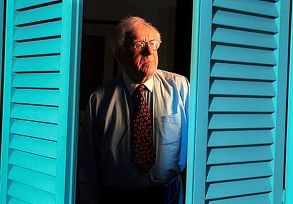
Author Ray Bradbury, now 81 and recovering from a stroke, has recently become the most sought-after writer in Hollywood.

Renny Harlin (“Die Hard 2,” “Cliffhanger”) has signed to direct Bradbury’s time-travel adventure “A Sound of Thunder.” Frank Darabont (“The Shawshank Redemption,” “The Green Mile”) will direct new productions of “The Martian Chronicles” and “Fahrenheit 451.” Bradbury is also adapting his short story collection “The Illustrated Man” for the Sci-Fi Channel and says he’s writing a script based on his novella “Frost and Fire” that will be filmed next year. And the literary establishment has also recognized him recently. Last November the National Book Foundation gave its Medal for Distinguished Contribution to American Letters to Bradbury.

The unprecedented interest by Hollywood in Bradbury’s work is coincidentally timed to one of the author’s major publishing anniversaries. Fifty years ago, the first printed version of “Fahrenheit 451″ debuted in Galaxy Science Fiction magazine.

A future shock masterpiece, “Fahrenheit 451″ was largely overlooked during recent millennial sci-fi retrospectives in favor of other dystopian works such as “1984,” “2001: A Space Odyssey” and “Brave New World.” The novel’s famed central premise (a society where firefighters burn censored books) has long suggested a metaphorical fantasy rather than serious prognostication.

Kerosene-spraying firemen aside, a closer look at the 1953 novel shows Bradbury nailed the new millennium perfectly. There’s interactive television, stereo earphones (which reportedly inspired a Sony engineer to invent the Walkman), immersive wall-size TVs, earpiece communicators, rampant political correctness, omnipresent advertising and a violent youth culture ignored by self-absorbed, prescription-dependent parents.

Far from an abstract nightmare, “Fahrenheit 451″ is now disturbing because its culture no longer seems disturbing. And its dated terminology, such as calling headset radios “seashell ear thimbles,” constantly remind modern readers the novel was written 50 years ago and that its culture — our culture — was intended only as a horrifying possibility.

One “Fahrenheit 451″ prediction was the technological evolution, and moral devolution, of television news. In the novel, a fireman protagonist accused of hiding illegal books is pursued by a carnivorous news media seeking to satiate the blood lust of home viewers. As the fireman flees down the street, chased by helicopters, he sees himself through his neighbors’ windows, running on their television screens.

The day after news helicopters pursued O.J. Simpson fleeing in a Ford Bronco, a New York Times columnist noted that the chase was the “real-life fulfillment” of “Fahrenheit 451.”

Bradbury points to a more current example. “Look at the Chandra Levy case,” he says. “It’s become a Star Chamber. The major networks, the cable networks, they’re being prosecutors. They’re judges and jurors and executioners. Well, c’mon, that’s ridiculous. But they’re doing it.”

The fictional roots of “Fahrenheit 451′s” vision of mass censorship even resemble the complaints of modern media critics.

In the novel, Fire Captain Beatty explains to Montag, the conflicted fireman, that their government didn’t ban reading. Books were simply marginalized as an increasingly inoffensive media and a growing population embraced infotainment at the expense of “slippery stuff like philosophy or sociology.”

Says Beatty: “Bigger the population, the more minorities. Don’t step on the toes of the dog lovers, the cat lovers, doctors, lawyers, merchants, chiefs, Mormons, Baptists … The bigger your market, Montag, the less you handle controversy, remember that! … Magazines became a nice blend of vanilla tapioca. Books, so the damned snobbish critics said, were dishwater. No wonder books stopped selling.”

Bradbury scored yet another prognostication bull’s-eye in his 1953 short story “The Murderer,” wherein a man is imprisoned for wrecking “machines that yak-yak-yak.” The most offensive devices were the “radio wristwatch” communicators.

Said the electronics murderer: “… my friends and wife phoned every five minutes. What is there about such ‘conveniences’ that makes them so temptingly convenient? … Convenient for my office, so when I’m in the field with my radio car there’s no moment when I’m not in touch. In touch! There’s a slimy phrase. Touch, hell. Gripped! Pawed, rather.”

As retribution, the murderer jams radio wristwatch signals on a commuter bus and delights in the “terrible, unexpected silence” he creates: “The bus inhabitants faced with having to converse with each other.”

Substitute a few product terms and “The Murderer” could be passed off as modern nonfiction. True, Dick Tracy also wore a primitive cellphone on his wrist, but Bradbury intuitively grasped how annoyingly demanding and oddly isolating such technology could become.

Today Bradbury continues to criticize modern innovations, putting him in the seemingly contradictory position of being a sci-fi writer who’s also a technophobe. He famously claims to have never driven a car (Bradbury finds accident statistics appallingly unacceptable; he witnessed a deadly car accident as a teen). He is scornful of the Internet (telling one reporter it’s “a big scam” by computer companies) and ATMs (asking, “Why go to a machine when you can go to a human being?”) and computers (“A computer is a typewriter,” he says, “I have two typewriters, I don’t need another one”).

By mocking the electronic shortcuts and distracting entertainment that replace human contact and active thinking, Bradbury shows his science fiction label is misplaced. He cares little for science or its fictions. The author of more than 30 books, 600 short stories and numerous poems, essays and plays, Bradbury is a consistent champion of things human and real. There is simply no ready label for a writer who mixes poetry and mythology with fantasy and technology to create literate tales of suspense and social criticism; no ideal bookstore section for the author whose stories of rockets and carnivals and Halloween capture the fascination of 12-year-olds, while also stunning adult readers with his powerful prose and knowing grasp of the human condition.

One secret to Bradbury’s lifelong productivity is that his play and his work are the same. When asked, “How often do you write?” Bradbury replies, “Every day of my life — you got to be in love or you shouldn’t do it.”

His new novel, “From the Dust Returned,” will be published by William Morrow in October. When I phoned his Los Angeles home for a 9 a.m. interview, Bradbury was thoughtful and cranky, and told me he’d already written a short story.

What makes a great story?

If you’re a storyteller, that’s what makes a great story. I think the reason my stories have been so successful is that I have a strong sense of metaphor. And that with my stories, you can remember it because I grew up on Greek myths, Roman myths, Egyptian myths and the Norse Eddas. So when you have influences like that, your metaphors are so strong that people can’t forget them.

You’ve been critical of computers in the past. But what about programs that aid creativity? Do you think using a word processor handicaps a writer?

There is no one way of writing. Pad and pencil, wonderful. Typewriter, wonderful. It doesn’t matter what you use. In the last month I’ve written a new screenplay with a pad and pen. There’s no one way to be creative. Any old way will work.

What about video games? If young Ray Bradbury from 1940 were here today, would he play video games where a person can experience a simulation of space travel?

That’s male ego crap. I never cared for pinball games when I was 18 or 19. Video games are a waste of time for men with nothing else to do. Real brains don’t do that. On occasion? Sure. As relaxation? Great. But not full time and a lot of people are doing that. And while they’re doing that, I’ll go ahead and write another novel.

What’s an average work day like for you?

Well, I’ve already got my work done. At 7 a.m. I wrote a short story.

How long does that usually take?

Usually about a morning. If an idea isn’t exciting you shouldn’t do it. I usually get an idea around 8 o’clock in the morning, when I’m getting up, and by noon it’s finished. And if it isn’t done quickly you’re going to begin to lie. So as quickly as you can, you emotionally react to an idea. That’s how I write short stories. They’ve all been done in a single morning when I felt passionately about them.

You suddenly have five films based on your work going into production. A coincidence?

I’ve been waiting around a lot of years — that’s the answer. I’m going to be 81 in a few weeks. So if you wait around long enough, things happen. At least in my case.

Which adaptation are you most looking forward to watching?

Oh, all of them. I love all of the arts. I love motion pictures. I love stage. I love theater. I’m putting on an Irish play here in L.A. in about three weeks based on my experiences in Ireland about 45 years ago when I was working for John Huston on “Moby Dick” ["Green Shadows, White Whale"]. And then “Fahrenheit 451″ will be on the stage in a small theater in New York early next year. And my “Dandelion Wine” musical will be opening in Florida in January. So I got a lot of theater projects going too.

You’ve been a longtime fan of movies. What is the last Hollywood picture you enjoyed?

I haven’t seen many recent films. I usually wait until the end of the year. I’m a member of the Academy and they send me 80 or 90 films on tape so I can watch them at my leisure. One of my favorite films in the last three years was “As Good As It Gets” with Jack Nicholson. Brilliant film. I’ve seen it eight or nine times. It’s absolutely perfect. Great screenplay. Helen Hunt is wonderful. Nicholson is incredible. The dog is beautiful. The whole thing is a wonderful, wonderful exercise. Beyond that, films like “Analyze This” with Robert DeNiro. Charming, wonderful and amusing film. And I love to look at things like that after seeing some of the violent films we’ve made. The sick films. The negative films we’ve made. Beyond that, I rent a lot of old films again and again.

What about modern science fiction films, such as “The Matrix”?

I haven’t seen that one yet, but I gather it’s one of the better ones. Most films these days are too long. The screenplay is everything. Otherwise I think we’re all just going to go look at the monsters, aren’t we?

In your short story “A Sound of Thunder,” the outcome of a close presidential election was altered when a time traveler squishes an insect in a prehistoric age. Do you think we were a squashed butterfly away from getting Al Gore?

That’s right.

What do you think of President Bush?

He’s wonderful. We needed him. Clinton is a shithead and we’re glad to be rid of him. And I’m not talking about his sexual exploits. I think we have a chance to do something about education, very important. We should have done it years ago. It doesn’t matter who does it — Democrats or Republicans — but it’s long overdue. Our education system is a monstrosity. We need to go back and rebuild kindergarten and first grade and teach reading and writing to everybody, all colors, and then the whole structure of our education will change because people will know how to read and write.

There’s so much competition for a young person’s attention nowadays. For the record, why is reading still important?

Are you kidding? You can’t have a civilization without that, can you? If you can’t read and write you can’t think. Your thoughts are dispersed if you don’t know how to read and write. You’ve got to be able to look at your thoughts on paper and discover what a fool you were.

Many years ago, I heard you speak and during the question period you chastised an audience member who asked about the decline of reading. You countered that books were more popular than ever. Do you still feel that way?

Well, there is no reading in some areas. Look at our students. What is our future going to be if you have all the people in school right now who don’t learn to read and write? It’s easy to teach reading and writing in kindergarten, so for chrissake do it. There are a lot of books selling today, but the number of people actually reading and digesting and thinking I gather would be quite small when compared to the population.

I was surprised you said in your Playboy interview that corporations were the only way to revitalize impoverished communities.

Well that’s true. They’ve got the money; nobody else has it. People like myself know the secret of cities and how to build them. I give these ideas to corporations and they build them and they revitalize sections of cities — like Century City [in Los Angeles]. But I’ve had to tell them numerous times over the past few years to build it in human terms. Hollywood Boulevard needs to be torn down and rebuilt completely in terms of human beings. Right now, it’s completely dead.

What do you mean “in human terms”?

Places to eat. The secret of cities is eating. In Paris there are 20,000 restaurants. You go down Main Street, people are sitting out and people-watching — that’s what I’m talking about.

The House recently passed the Human Cloning Ban of 2001.

Why would you clone people when you can go to bed with them and make a baby? C’mon, it’s stupid. Stalin and Mao had a great idea about cloning — they killed 80 million people and what’s left is your clones. If you don’t like the way the world is put together you just kill everybody. What you got left is the master race. We have more important things to do than these silly ideas. Let’s clone people in kindergarten and teach them how to teach reading and writing.

Is it better to have the future authenticate your predictions or would you have preferred society to have proven you wrong?

I would have loved to have been proven wrong, yes. I do not like what is going on in our society. Our education system, as I’ve said, is a total disaster.

Were you deliberately trying to prognosticate or simply tell a good story?

It’s a combination. If you’re living in your time, you cannot help but to write about the things that are important. As long as [social criticism is] part of the structure and muscle and blood of the book, it’s OK. As long as you don’t become too self-important, politically. The best advice I ever got was from Somerset Maugham’s book “Summing Up,” which I read in high school. His advice was: Don’t look left or right, look straight ahead, get your work done, enjoy your work, do what you want to do, not what someone else wants you to do.

And that’s been the story of my life. Not pleasing my friends, not pleasing any editor, just myself.

James Hibberd is a staff writer at the Westword weekly in Denver.

“Frankenstein” remixed

This masterful new adaptation of Mary Shelley's classic novel may be the best interactive fiction yet

This originally appeared on The Chimerist, a site devoted to the intersection of art, stories, and technology.

Whatever interactive fiction is (and we’re still figuring that out) it suffers from all the problems of traditional fiction and then some. The vast majority of novels and short stories aren’t much good, but when a branching fiction — along the lines of the old “Choose Your Own Adventure” children’s books — fails to engage, the first impulse is to blame the form rather than the content. Let “Frankenstein,” just released by Inkle Studios and Profile Books, serve as a reproach to that reflex. The app is a creative, subtle and sensitive adaptation of Mary Shelley’s classic novella, and it has singlehandedly renewed this critic’s hopes for interactive fiction.

What this “Frankenstein” isn’t is a replication of the source text with the addition of a lot of digital doohickeys like sound effects and illustrations that animate when tapped. The app is all about the text, even if it is beautifully framed by period art and anatomical illustrations. The reader is presented with a screenful of narration and then offered one or more responses to it. The preferred response, when tapped, delivers up another screen of text. (In an absurdly pleasing visual touch, these appear as sheets of paper fasted together by straight pins.) According to the press materials, the reader’s responses will shape the way the narrative is presented, although not to the degree of substantively changing the plot.

This is an important point. The pleasure of storytelling lies in the dynamic between the surprising and the inevitable. The reader wants to feel the story is going somewhere, that its events follow from each other in meaningful, but not too obvious ways. When a story can go anywhere, it feels meaningless. In Mary Shelley’s novella, which is saturated with the Western tradition of the tragedy, Viktor Frankenstein’s character is such that he must create a monster, and the monster’s body is such that he can never belong among human beings however much he yearns to. A “Frankenstein” that ended with either misfit finding a comfortable place in the world would be a travesty.

But that doesn’t mean the reader doesn’t long for the story to unfold otherwise; that’s the nature of tragedy. The great insight that writer Dave Morris brings to this adaptation of the novel is that while a reader cannot significantly change the outcome of the story, the interactive element can change the shading and flavor of the tale. It can be mournful and reflective or action-packed. The creature and his creator can show greater or lesser ambivalence about their own behaviors. The ambiguity of both figures is baked into Mary Shelley’s novella, and while Morris has nearly doubled the word count of the original, this mostly amounts to playing up or down what’s already there.

Morris — a novelist who has written graphic novels, games and, yes, Choose-Your-Own-Adventure stories for kids — has changed the original text in other ways, as well. (Let’s take a moment here to point out to all future narrative app developers that hiring a real writer who actually knows what he or she is doing is totally worth it.) He’s moved the setting to revolutionary France, a choice that shows shrewd understanding of the idealistic political climate that affected Shelley’s thinking; the new Republic is its own kind of Frankenstein’s monster. He’s also eliminated much of the 19th-century framing of the tale and converted it into two present-tense narrations. One is Frankenstein’s dialogue with either himself or a (possibly imaginary) companion. The other is a second-person account of the monster’s first weeks of life as it spies on a family of dispossessed French nobility and has the chance to observe the loving relationships it can never enjoy itself.

Morris presents the reader with choices I’ve not encountered in other interactive fictions. Is humanity mostly good, or mostly evil? Does the most recent development make you (the monster) feel hope or despair? Is the revolution the dawn of a brave new world or a descent into chaos and barbarity? While I’m usually skeptical that present-tense narration increases the “immediacy” of a story, in this case, it really does work, particularly in the sections concerning the monster. Depending on your own outlook, you may urge him to keep trying to connect with humanity, or promptly forward him on to homicidal rage.

In either case, the narrative is shaped not by the reader deciding to turn left or right, to go down into the cellar or to get out of the house — the usual actions offered on the choose-your-own menu. Instead, the options have more to do with personality and interpretation, beliefs and ideas. As a result of the reader’s choices, the characters seem more like him- or herself, with a concurrent ratcheting up of emotional investment. To my surprise, I found myself more moved by this adaptation of the Shelley novel than I have been by the source text. (Although the app does include the original if you want to compare and contrast.) This is the only interactive fiction I’ve ever read with that quintessential, old-fashioned readerly avidity: the hunger to know what happens next. Of course, I already knew, but that didn’t matter at all.

Continue Reading Close
Laura Miller

Laura Miller is a senior writer for Salon. She is the author of "The Magician's Book: A Skeptic's Adventures in Narnia" and has a Web site, magiciansbook.com.

“The Cove”: A mysterious skull

A new novel begins with a shocking discovery that takes us back to love and life in the South during World War I

This article appears courtesy of The Barnes & Noble Review.

Ron Rash’s atmospheric, strangely uncomplicated novel, “The Cove,” begins with a scene of melancholy and abandonment, the promise of obliteration, and a shocking discovery. It is 1953 and a man called Parton, a scout for the Tennessee Valley Authority, is investigating a remote parcel of land in North Carolina’s Appalachia for inhabitants who will have to be evicted in advance of the valley’s inundation. In a small notch — from which the book takes its title — over which looms a light-exterminating, anvil-shaped cliff, he finds a deserted farm. Pasture fenced by sagging barbed wire, a collapsed barn, a cabin and two wells are the desolate relicts of past life and labor. The general doominess of the setting is further enhanced by an ash tree decked in charms against evil forces, dead American chestnut trees (victims of the plague that wiped them out across the land), and the memory of the now extinct Carolina parakeet. Parton, thirsty, manages to winch up a bucket of water from one of the wells — and with it a human skull.

Barnes & Noble Review
I give little away in revealing this, as it occurs on page 4; it takes another 243 pages and a step back to the late summer and autumn of 1918 to discover the skull’s owner. It is then, during the last months of World War I, that the story takes place. At its heart is Laurel, a young woman afflicted with a large birthmark. She is shunned by the residents of the nearest town, Mars Hill, who believe that the cove is cursed and that she herself is a witch. Both her parents are dead, and with occasional help from a neighbor, she survived the previous summer alone on the farm while her brother, Hank, was away fighting in France. He has returned, absent a hand but resolutely capable and preparing for marriage.

In passage after passage, Rash describes life and work on the farm in its dailiness — the preparation of meals, tending to chores, mending clothes, setting fence poles, pulling wire — creating a sense of order and industry that would seem to promise future happiness and prosperity. But as the initial scene of desolation and death promises the reverse, an air of menace and foreboding pervades the story. And, indeed, like the waters that will inundate the farm decades later, powerful, destructive forces are gathering outside the cove.

On one of her forays to do her laundry in a stream away from the farm, Laurel hears and secretly observes a young man resting in a makeshift camp, playing a flute; days later she finds him near death, stung by a swarm of wasps. She brings him home; he recovers and produces a piece of paper saying that his name is Walter and that he cannot speak or read or write. As we — unlike Laurel or Hank — have already learned that a man has escaped from what turns out to be an internment camp for Germans, we get the picture. Walter won’t speak, but he will help with the farm, and this he does handily, capturing Hank’s admiration and gratitude — and Laurel’s heart.

All the while, anti-German hysteria is escalating in Mars Hill, a volatile temper encouraged by one Sgt. Chauncey Feith, a preposterous character ripped from a handbook of one-dimensional villains. Vainglorious, opportunistic and cowardly, he is a jingo, a sneak and a bully. The son of a politically connected banker, he has been deployed as the town’s recruitment officer, thus avoiding the perils of the battlefield. He has gone about this zealously, congratulating himself at every turn for sending young men off to the war and priding himself on being an “unsung hero, because you couldn’t go around telling people that any man can hold a rifle and stand in a trench but only a select few could do what a general or commodore or recruiter did.” That’s Chauncey Feith for you — believe it or not.

If Walter were to show up at Mars Hill and be recognized, there is no question that he would be strung up as a Hun. Meanwhile life and love go on at the farm. Walter helps Hank in sinking a second well, and the description of digging and lining it deep, deep in the earth is wonderfully potent. Indeed, Rash’s material detail, depiction of work and evocation of place — of nature, woods and stream, the play of light and the oppressive dark of the monstrous cliff — are truly splendid. Still, between the threat of a lynching and scenes from the cove, a vacuum yawns, and into it flows one simple question stripped of complexity: Whose skull? Or, put another way, happy ending or sad? The answer, when it comes, seems perfectly arbitrary.

Continue Reading Close

“Kingdom Come”: Terror in the London suburbs

A new novel traces an advertising executive's search for his father's murderer in a menacingly bland town

This article appears courtesy of The Barnes & Noble Review.

J.G. Ballard was born in 1930 in Shanghai, China, and returned to England in 1946, having been interned with his family in a Japanese prison camp, an experience that inspired his most popular novel, “Empire of the Sun.” Ballard’s astonishing fiction ranges across continents and galaxies, but a quiet London suburb was his home until his death in 2009, and it is to the suburbs that he returned in his last novel, “Kingdom Come.” In its opening pages, the narrator, a London advertising executive named Richard Pearson, travels to one of the “perimeter towns dozing against the protective shoulder of the M25″ to find out who murdered his father.  It sounds like the setup for a cosy English mystery.  But this is Ballard.  It will not be cosy.

Barnes & Noble Review“The suburbs dream of violence,” Ballard declares as we enter the blandly menacing town of Brooklands. Among this “placid sea of brickly gables” Richard searches his father’s flat for clues to the life — and violent death — of a parent he barely knew, a pilot who had “flown millions of miles … and then died in a bizarre shooting incident in a suburban shopping mall.” Three others died, and the suspected gunman, a mentally unstable local, is arrested but then released. The police, the family lawyer, the doctor who treated Richard’s father — all appear to be hiding something, while many respectable Brooklands residents seem to have formed a fascist militia.

When Richard first witnesses a racist attack, he concludes that “a new kind of hate had emerged”; its hub is the Metro-Centre, the mega-mall in which his father was killed. During one visit, Richard sits beside the mall’s manmade beach, where Julia Goodwin, his father’s doctor, has arranged to meet him. “The wave machine had been turned to its lowest setting,” he notices, “and a vaguely gastric swell, like a suppressed vomit reflex, flowed across the colorized water.” This languid, sickly image could only be Ballard’s. No other writer so effectively alienates his readers — and his protagonists — from an everyday reality that he reveals to be shifting, often nightmarish terrain.

At the same time, he soothes us. In “Kingdom Come,” as in Ballard’s short stories and in novels like “Crash,” the rhythmical balance of the sentences has a tranquilizing effect, like the shushing roar of the ceaseless traffic on the motorway outside Brooklands. Richard, too, seems oddly numbed as he probes his father’s involvement with local thugs, falls in love with Julia Goodwin, and is increasingly drawn to the Metro-Centre and to the figure of David Cruise, the mall’s TV celebrity.

The novel’s pace quickens as violence spreads and the Metro-Centre comes under attack. “Fights broke out, fists flailing through the workmanlike rise and fall of police truncheons” as screams are drowned out “by the blades of army helicopters cuffing the night air.” Soon the mall becomes a fortress, hostages are taken, and the wave machine churns up a corpse. Emerging from the wreckage, Richard predicts that “In time … an even fiercer republic would open the doors and spin the turnstiles of its beckoning paradise.” In his final, elegiac vision of suburban apocalypse, Ballard once again allows us to imagine the unthinkable.

Continue Reading Close

Gay literature’s new wrinkle

Nobel-winner Herta Müller has written a dazzling new gay novel. Does it matter that she's heterosexual?

(Credit: iStockphoto/RapidEye)

This week sees the publication of “The Hunger Angel,” by the Romanian-born German author Herta Müller. It’s her first novel to appear in English since she won the Nobel Prize three years ago, and the book, set in a Soviet labor camp in the years after World War II, arrives in America trailing behind it a passel of rave reviews in the European press: a masterpiece, they say, to be put next to Solzhenitsyn or Primo Levi.

But, more quietly, “The Hunger Angel” is something else – a major addition to the tradition of gay literature, and a rare evocation of gay life in the war years and after. Leo, the narrator, is just a teenager when he’s deported from Romania to the Ukraine, but he has already had his first “strange, filthy, shameless and beautiful” assignations in the town park and the local bathhouse. At first he sees his deportation as a welcome escape from his Nazi-supporting father, and a mercy for the mother he truly loves, for in his own eyes he is a double disgrace: not just gay, but an ethnic German who sleeps with Romanians. In the camp, hunger becomes all-consuming, and he longs for home, but he also watches fellow skin-and-bones detainees sneak off to an industrial wreck for sex and knows, “If I’d been caught in the camp I’d be dead.” “The Hunger Angel” lets a gay man embody universal themes of suffering and endurance but also captures the unique contradictions of gay desire – a substantial accomplishment, and one that’s even more impressive because Herta Müller is a straight woman.

Müller is part of a small but growing number of heterosexual writers publishing novels that not only include gay characters as central parts of their narrative, but are largely about gayness itself. It’s a trend that suggests that homosexuality may no longer be the taboo it once was, for writers — and for readers.

These days, in American and British fiction, at least, it’s no longer uncommon for straight writers to feature gay characters in a novel. Think of Claire Messud, whose “The Emperor’s Children” examines a young gay writer’s friendship with his two best friends, both straight women. Or read Jennifer Egan’s “A Visit From the Goon Squad,” which features a young gay kid experimenting first with drugs, then with sex. More recently, Chad Harbach in “The Art of Fielding” didn’t just feature a gay and decidedly not butch baseball player, but a 60-something, theretofore straight college president who falls in love with him. (These examples all feature gay men, obviously: Straight writers’ interest in lesbians is usually less edifying, as any gay person who endured Philip Roth’s “The Humbling” will remind you.)

Yet while straight writers now include gay characters as a matter of course, putting gay people at the center of a book remains all too rare. Gay characters can help straight writers write a book of larger scope, but a novel that concentrates on gay characters is automatically “gay fiction” – and that, sadly, still puts readers off. Gay novelists know all too well that without the right promotion, their books can end up relegated to the “LGBT interest” section of the bookshop, somewhere between the Spartacus travel guide and “Homosex: 60 Years of Gay Erotica.” (If, that is, the bookshop even stocks gay books; if, moreover, the bookshop hasn’t gone out of business.)

For straight writers, taking on gay subjects isn’t just an imaginative risk, it’s a commercial one. And therefore the list of examples is brief, but even so, they suggest that reader opposition to gay-themed books is on the wane. Although fantasy and science-fiction writers may have taken earlier steps, it wasn’t until the 1990s, with Pat Barker’s Regeneration trilogy, that a straight writer saw major success with gay literary fiction on both commercial and critical terms. The Regeneration trilogy,  with its cast of both real and fictional characters during World War I, had a built-in audience among British readers who grew up reading poets like Siegfried Sassoon or Wilfred Owen. Yet on the first pages of “The Eye in the Door,” the middle book, they were plunged into a rough (and fantastically hot) sex scene between two officers of different class backgrounds, complete with war wounds from Passchendaele and bedside Vaseline. “The Eye in the Door” goes on to detail the horrible persecution of gays in the British civil service, sometimes even by closeted gay men themselves, while in “The Ghost Road,” the last novel of the series and the one for which Barker won the Booker Prize, Sassoon, Owen and fictitious soldiers spend page after page thinking about their desire for men, and about the gaps between the military’s sometimes surprising tolerance and the cruelties of civilian life.

You see similar contrasts of confidence and doubt, narcissism and self-loathing, in Annie Proulx’s short stories, most famously “Brokeback Mountain.” The subsequent film was anxiously promoted as a “universal” love story, but Proulx insists that her two ranchers aren’t any old star-crossed lovers, and that gay desire has a special character. Ennis and Jack aren’t just incapable of having their love accepted by society; much more fundamentally, they hate themselves for loving who they love. Proulx told the Paris Review that she now gets fan mail from readers who have rewritten “Brokeback Mountain” with a happy ending, like the stale 18th-century tradition of letting a victorious Hamlet marry a not-drowned Ophelia. “They can’t understand that the story isn’t about Jack and Ennis,” Proulx lamented. “It’s about homophobia; it’s about a social situation.”

Homophobia is naturally a major theme in straight-written gay fiction, but it’s not all about tears and the law. In “Call Me By Your Name,” from 2007, the straight writer André Aciman looked at the enduring power of first love through a teenager’s overwhelming desire for another man, complete with lashings of sex in the forest, at the sea, and in the streets of Rome. (You will never eat a peach again without thinking about what those two guys do to a piece of fruit.) Straight novelists are even beginning to write about gay history, and in particular HIV/AIDS. Tristan Garcia’s “Hate: A Romance,” co-translated by the Paris Review editor Lorin Stein, examined not only the devastation of the first years of the disease, but the virulent debates between proponents of safe sex and more radical gay activists who see barebacking as a political act. That is the sort of thing even many gay writers are not yet ready to discuss.

It can only be a good thing that the terms of gay fiction are expanding to include not only more readers but more writers. Yet gays have been writing about straight people for hundreds of years, and while straight writers who write gay fiction are celebrated for taking a risk and for imagining something beyond their own experience, gay and lesbian writers who do the opposite, such as Colm Tóibín in “Brooklyn” or Sarah Waters in “The Little Stranger,” don’t really get the same credit. Perhaps this is because straight love and desire is omnipresent; perhaps, more homophobically, it’s because we still think gay writers “naturally” have such powers of imagination. Either way, while the situation has improved, gay fiction still suffers from ghettoization, and while straight writers may be mindful of the risks they take in depicting a minority to which they don’t belong, gays who turn to straight subjects can find the new, larger audience for their books bewildering. Michael Cunningham observed as much back in 2000, when he was asked about the success of “The Hours.” “I can’t help but notice,” said Cunningham, “that when I finally write a book in which there are no men sucking each other’s dicks, I suddenly win the Pulitzer Prize.”

Continue Reading Close

Jason Farago is a regular contributor to the Guardian and writes criticism for the London Review of Books, n+1, Frieze and other publications. He is also editor of Art in Common, a blog on art and urban life.

Pulitzers snub fiction

No novel won the coveted prize this year, but does that mean nothing good was published?

Details from the covers of "Train Dreams," "Swamplandia!" and "The Pale King"

The news that no Pulitzer Prize for fiction would be awarded this year came like a slap across the face to a book world still reeling from a Department of Justice suit filed against publishers trying to forestall an Amazon e-book monopoly. Double ouch! But does the Pulitzer snub mean that no good fiction was published in America last year?

I would (and have) argued otherwise, most strenuously; 2011 was an exceptional year for fiction, American and otherwise. I also suspect that the Pulitzer Board itself has not turned up its collective nose at every book produced by American novelists and short story writers in 2011. The Pulitzer Prize may wield far more clout with book buyers than any other American prize for fiction. It can turn an obscure title into a success and a modestly successful title into a bestseller. Readers take it seriously and snap up the books it honors by the thousands. But that doesn’t mean that the Pulitzer Prize for fiction doesn’t suffer from the same problems that afflict every literary prize, no matter its size or influence.

I have some insight into those problems because I served on the Pulitzer fiction jury two years ago. I can’t talk about my jury’s deliberations, however — that was part of the deal. I can tell you that choosing the winner of the Pulitzer Prize for fiction is a two-tier process, a fact that even people well-versed in the literary world tend to forget.

The first tier is the jury’s selection. Three jurors (usually an academic, a critic and a fiction writer) are responsible for wading through huge boxfuls of books. Anyone can submit his or her book to the Pulitzer competition for a small fee, and believe me: anyone does. We got hundreds and hundreds of them, including many self-published novels with titles like “The Bikinis of Alpha Centauri,” most of which read as if they’d been run through Google Translate into Farsi and then run back again into English before being committed to print.

From the many submissions, the jury picks three titles to recommend to the Pulitzer Board, and the board picks the actual winner, as well as selecting the winners of all the other Pulitzer Prizes. The board does have the option to select a title not on the jury’s list, but it rarely does so nowadays.

The heyday for picking no book at all was the 1970s, a time of considerable cultural upheaval and conflict. In 1971, the board rejected titles from Eudora Welty, Saul Bellow and Joyce Carol Oates. In 1974, a stellar jury consisting of Benjamin DeMott, Elizabeth Hardwick and Alfred Kazin (three titans of literary criticism) unanimously recommended that the prize go to Thomas Pynchon’s “Gravity’s Rainbow.” The Pulitzer Board dug in its heels and said no. In 1977, the last time the prize was not awarded, the jury favored ”A River Runs Through It” by Norman Maclean and the board shut them down.

Why? According to the critic and experimental novelist William Gass, who wrote a notorious diatribe on the subject, the Pulitzer Board’s taste is hopelessly mainstream, middlebrow and unadventurous. (In 1941, most of the board did pick Ernest Hemingway’s “For Whom the Bell Tolls,” but one member — who happened to be the president of Columbia University — put the kibosh on that because he considered the book immoral.) However, Gass’ complaint seems an absurd cavil to level against an institution whose power and influence resides precisely in the fact that it speaks to a broad audience.

The Pulitzer Board consists of working journalists and journalism professors, most with a deep respect for literature but relatively little familiarity with the literary world. This can be a strength and a weakness. The Pulitzer’s excellent record at singling out literary works that also appeal to a lot of readers is one reason why it has so much more influence than “insider” prizes like the National Book Award.

However, because the Pulitzer Board is fairly representative of educated Americans, it surely includes a lot of people who don’t really have time to read fiction — or, at least, literary fiction — anymore. Past boards might have been able to settle on a title that most of them had read even if it wasn’t offered as a finalist by the jury; reading at least a few of the “big” novels published during the year was something a lot more people did before the Internet and cable TV came along. In 21st-century America, the novel has become a marginalized and Balkanized art form, and even when avid fiction fans compare notes, they often find they’ve read nothing in common.

Chances are good that the three novels recommended by this year’s Pulitzer jury — “Swamplandia!” by Karen Russell, “Train Dreams” by Denis Johnson, and “The Pale King” by David Foster Wallace — are the only three serious new novels many of the board members read last year, apart, perhaps, from one or two others. These people are, after all, pretty busy doing things like editing the Denver Post and running the Columbia Graduate School of Journalism, jobs that are a lot more time-consuming than they used to be, as well as selecting the winners in the other Pulitzer categories.

By all accounts, the group could not reach a majority on any of the three titles recommended by the jury. It’s certainly unlikely that enough of them read fiction widely enough to agree on an alternate choice. In that, they truly are representative of American readers, and that bodes worse for our national literature than a year without a Pulitzer winner.

Continue Reading Close
Laura Miller

Laura Miller is a senior writer for Salon. She is the author of "The Magician's Book: A Skeptic's Adventures in Narnia" and has a Web site, magiciansbook.com.

Page 1 of 129 in Fiction