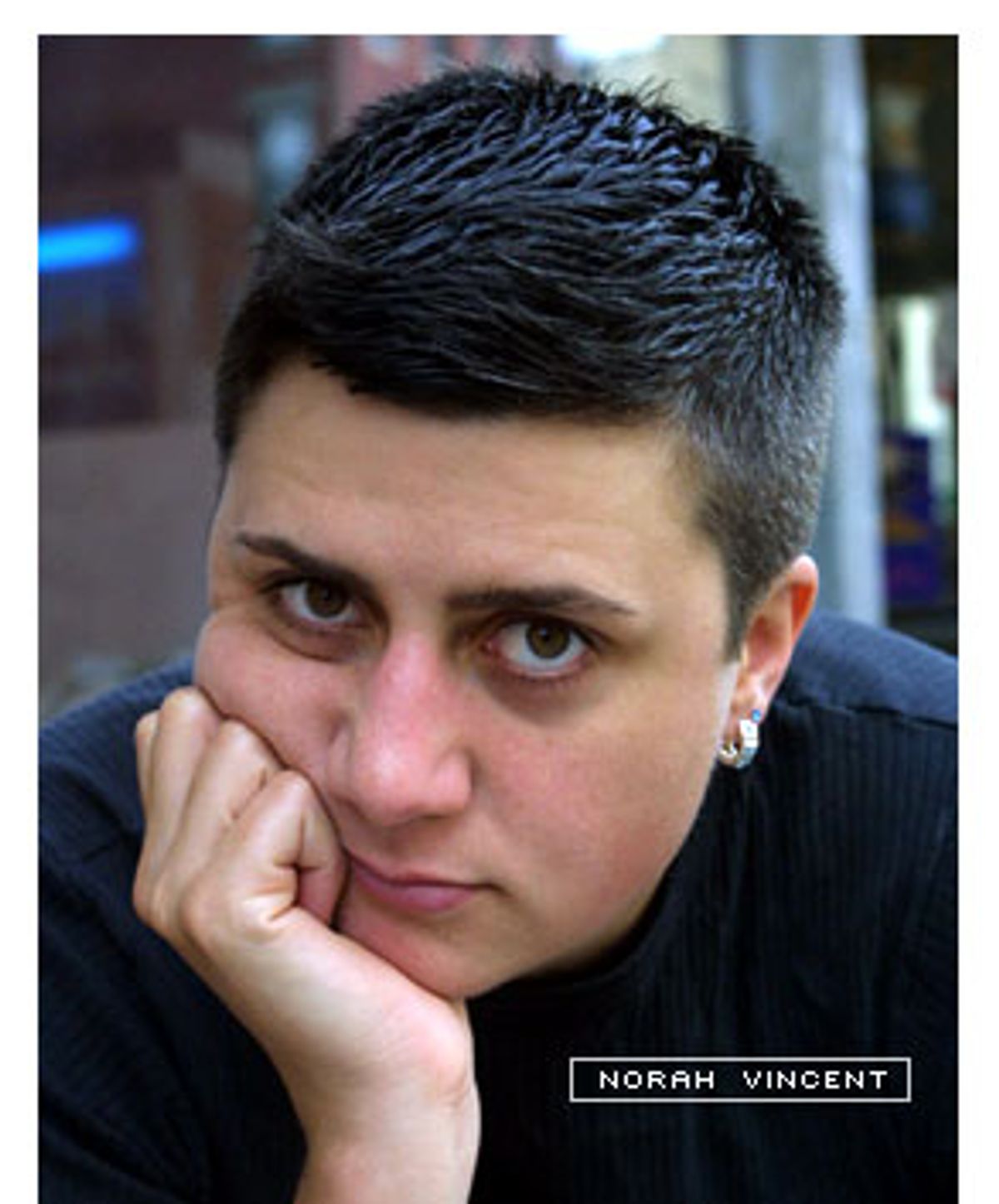
Norah Vincent

Swimming with sharks

"Compassionate conservatism" means creating a social contract where people take responsibility for swimming with sharks -- or sleeping with them.

  • more
    • All Share Services

Swimming with sharks

The recent shark infestation off the coast of Florida (and the insurgent response to it by some surfers) is a perfect metaphor for one of America’s biggest social problems, and for the way in which liberals and conservatives have attempted to solve or worsen it, as the case may be.

By now, every prospective surfer in the country knows that at least seven other surfers have been bitten by sharks in the past few weeks, all in the same stretch of water off Smyrna Beach, where a surfing competition recently took place. (I should make it clear here that I’m not talking about the two other swimmers, one in North Carolina and one in Virginia, who have been killed by sharks in recent days. Neither of them went into the water knowing the dangers.) Some Smyrna surfers, however, having been made aware of the considerable risks, have insisted on braving the waves anyway, which is, of course, their prerogative. But, as always, there’s a hitch. That prerogative of doing what you like with your body comes with a price. Paradoxically, freedoms don’t come free. They come with responsibilities attached.

In this particular case, this means that if a surfer wades into the surf, knowing all too well that 1) those waters are infested with sharks; 2) an alarming number of other surfers have been bitten by those sharks; and 3) the authorities have closed the beaches for this very reason, he must take sole responsibility for what happens to him.

Now, to most litigious idiots, this means that if they get bitten they’ll agree not to sue the state for damages. It would never occur to them, or to us, apparently, that taking responsibility for one’s injuries in this case means a great deal more than not crying foul. Or, at least, it should. It should mean that the person who knowingly swims in shark-infested waters thereby automatically renounces his right to expect the lifeguards on duty to risk their lives trying to save him once the inevitable bite has been taken out of his demonstrably dumb ass. It should also mean that the surfer, not the taxpayer, must absorb the entire cost of whatever help and/or medical treatment he receives during and after his ill-advised swim.

But most Americans, childish and self-entitled as they are, don’t like this idea. “What?” they whine. “I can’t do anything I want and still expect someone else to pick up the tab or otherwise pay the consequences? That’s not freedom.” No, they argue, this must be some politician’s plot. That, or the scourge of compassionate conservatism, President Bush’s ballyhooed philosophy for revamping public policy.

Which indeed it is. To wit: Everyone has to play by the rules. It’s a simple principle, and one that we should, by all rights, expect of every citizen, rich and poor alike. Think of it. If everyone understood that the social contract is a transaction, not an automatic entitlement proposition; a two-way street, not a free lunch; imagine how things would change for the better. Imagine how much money would cease to be wasted on the inevitable results of bad behavior willingly undertaken. Imagine that same saved money supporting programs that help the truly helpless, rather than abetting the sophomoric decision making of the perpetual 2-year-olds with whom our culture is rife.

Doesn’t it strike you, for example, that this death beach scenario, and the way that these would-be water babies have responded to it, sounds an awful lot like the sexual habits of a certain segment of the gay male population? In a recent New York Times article on the 20th year of AIDS, Erica Goode reported the sad finding that, these days, your average Priapus is likely to have lapsed again into having unsafe sex. It seems a new complacency has arisen in the wake of the stunning success of the latest HIV drug cocktails, which have managed, for now at least, to stem the death toll of AIDS.

Think of it. Each young surfer, determined to ride the waves of sexual bliss though he knows the waters to be infested with ravenous, disease-bearing, unscrupulous sharks who’d just as soon maim him as look at him, jumps in feet first. The authorities have warned him against it, but he insists on going in without (sorry for the ham-handed analogy) his wetsuit. Yet, he does so fully expecting that if he meets with a bad end, the Coast Guard will dutifully dispatch its fearless Argonauts to try to save him.

In the real world this translates into spending astronomical sums of money and inordinate amounts of time on finding a cure for a disease that is already curable. Anyone who doesn’t already have it knows how to avoid getting it. Don’t go swimming with sharks. And those who already have it know how not to spread it. Don’t be a shark. Those who have it already also know how to manage it. Would that we could say the same for cancer, Alzheimer’s, Lou Gehrig’s disease and a long list of other fatal diseases. Imagine if we could have said it a mere 20 years after these diseases were discovered.

The current abortion fiasco is a similar case in point. Women want sexual freedom at all costs. They demand it. They deserve it unequivocally, no questions asked. And why? Because they fully expect, and, in the current judicial climate, are not mistaken in this expectation, that the Uterus Guard will swoop in with a scalpel and do for them what they refuse to do for themselves: prevent a pregnancy. And, as anyone familiar with the statistics knows, failure to prevent, or in many cases even to take precautions against pregnancy, accounts for the vast majority of abortions in this country. (Rape accounts for only a tiny percentage.) So, the ladies go swimming with sharks and do so simply because they want to, not caring a whit, of course, for the blastocyst/alleged nonperson who dies in the process of rescuing insouciant them.

Or perhaps, attempting to avert what W.H. Auden called “the necessary murder,” they decide to have the kid and raise him without preparation and without a father, thereby giving rise to all the usual problems like chronic delinquency and maladjustment. This, too, fits our analogy. The reproductive risks an individual takes out of sheer arrogance and brass end up costing the taxpayer, who, like it or not, must come to the rescue.

Even liberals concede this, though in their own way, of course. Two professors, for example, one from Stanford and one from the University of Chicago, recently announced the results of a study that appeared to show a causal link between the legalization of abortion in 1973 and subsequent reductions in crime. Aborted kids are unwanted kids, they reasoned, and rightly so. Unwanted kids often have a harder time of it, and are often raised in less than ideal conditions. They grow up scarred and often criminally inclined as a result. Thus, it makes sense that more abortions would produce less crime.

Now, using that same logic, imagine the result if women who can neither emotionally nor financially afford to raise children out of wedlock (two of the main reasons women seek abortions) stopped having unprotected or insufficiently protected sex whenever the fancy struck them. We’d end up with less crime, and not at the expense of more than a million fetal lives per year.

But, you see, compassionate liberalism is on the side of the silly surfers. Give the people what they want. Everything they want. And then pick up the tab and clean up the mess when they crash. Anything else would be mean-spirited and less than civilized.

Meanwhile, conservatives who see the inevitable link between bad impulse control and bad results, between the inability of many people to see themselves as a part of a society, and the resultant malfunctioning of that society, are seen as cruel and unusual for expecting of all Americans what all sane parents expect of their children: responsibility and fair play.

The mantra of compassionate conservatism should neatly reverse the classic ’70s feminist rallying cry “The personal is political,” and thereby yield the more sensible pronouncement “The political is personal.” If we as a culture could embrace such a philosophy and learn to change our own behavior, rather than expecting government to do it for us, we might change entirely the face of American life. I am suggesting a change from the bottom up instead of from the top down, from the living room out, not from the courtroom in. I am asserting only that altering individual mind-sets will alter individual behaviors, and that in turn will change the society at large.

Continue Reading Close

Veiled intentions

The burqa is a powerful symbol misused by Islamists and Western feminists alike.

  • more
    • All Share Services

When Westerners talk about misogyny and the fate of women in Islamist countries, they fall at once for the decoy, the surface indicator by which all fundamentalist regimes are measured and judged. It’s the same decoy that Islamists use again and again, in every country they dominate, to draw their own countrymen’s attention away from the real social, economic and political problems at hand — problems they came to power promising to solve, but rarely do.

That decoy is, of course, the veil, the abaya, the burqa, the chador, the jalabiyya, and every other possible version, extent or form of hijab that women are expected, and often forced, to wear throughout the Middle East and in some parts of Africa.

The veil is the common currency of subjection, or so the West considers it, and it is the yardstick of Muslim purity, or so the fundamentalists have conceived it. It is a pawn in the propaganda war between the major players in Samuel Huntington’s clash of civilizations, or what Ian Buruma has dubbed the Occidentalists (those who demonize the West) and the Orientalists (those who demonize the East).

Both sides see the veil as the centerpiece of their causes, but both are wrong. The Islamists are wrong because the veil isn’t Islamic, and the West is wrong because the veil isn’t necessarily repressive.

The veil is a symbol manipulated both by those who would willfully misread the Quran to suit their political ends, and by neo-crusaders in the feminist free world who misunderstand its original, and some would say true, meaning and purpose. The Western feminist obsession with the burqa as symbol of oppression is everywhere. Take the Feminist Majority Foundation, the new publisher of Ms. Magazine, for example. On its Web site, it offers, I kid you not, a “Burqua Swatch,” which one can purchase as a “symbol of remembrance of Afghan women” for the low, low price of $5. “This swatch of mesh represents the obstructed view of the world for an entire nation of women who were once free,” according to the foundation’s ad copy. Gift packs of 10 and 20 are also available.

The veil has been an instant, though superficial, indication of reform in either direction, toward or away from the West. When Kemal Ataturk came to power in Turkey in the 1920s, for example, he banned the veil in order to banish what he saw as Mideastern backwardness, and to ally himself culturally and politically with the admired West. Turkey remains the one ferociously and consistently secular government in the Islamic world.

Likewise, during the war in Afghanistan, shedding the veil became a kind of ceremony of freedom for the country’s harshly sequestered second sex. The Western press reported that the first thing many Afghan women did after being liberated from Taliban rule was to tear off their burqas, walk outside and feel the sunshine on their faces for the first time in years.

Elsewhere, the veil has been used to quite different effect. During the lead up to the 1979 revolution in Iran, for instance, female supporters of the Ayatollah Khomeini donned the veil voluntarily as a form of protest against the reigning shah. Doing so was considered a pledge of support for the harsh religious reforms Khomeini espoused as a means of purifying the country of the debauched Western influences he blamed for the corruption and mismanagement of the shah’s regime.

So what should we make of this symbolically loaded change of clothes? It has been said more than a few times lately that Islamist dress codes are really all a sham, and that they have nothing to do with the Quran.

As Jan Goodwin has written in “Price of Honor,” her extensive treatment of women in the Islamic world: “The severe restrictions placed on women by the Islamist movement, such as confinement or complete veiling, have no basis in the Koran or the teachings of the Prophet … veiling the face is an innovation that has no foundation whatsoever in Islam.”

Many among Muslim experts say the same. According to Islamic scholar Zaki Badawi, the Quran is quite simple and direct on the matter of veiling. Women, it says, should not show “their adornment except what normally appears.” Among literalists, “what normally appears” has generally been accepted to mean the face and hands, and sometimes the hair, but has varied according to local custom. One thing is certain: Shrouding the face is specifically never mentioned in the Quran.

The Quranic pronouncement most often quoted to justify the veil (Verse 53 of Sura 33) is known among experts as “the verse of the hijab,” and is related to an instance in the prophet’s life when several male guests had lingered too long after a wedding supper, and thereby invaded the privacy of the prophet, who was eager to be alone with his new wife. Thus, he said:

“[W]hen ye ask of them (the wives of the prophet) anything, ask it of them from behind a curtain [hijab]. That is purer for your hearts and for theirs.”

According to Moroccan sociologist Fatima Mernissi, however, this verse is often misunderstood:

“The verse of the hijab ‘descended’ in the bedroom of the wedded pair to protect their intimacy and exclude a third person — in this case, Anas Ibn Malik, one of the Prophet’s [male] Companions … The veil was to be God’s answer to a community with boorish manners whose lack of delicacy offended a Prophet whose politeness bordered on timidity.”

Some of the prophet’s other utterances regarding women — which are, conveniently enough, never quoted by extremists — reinforce Mernissi’s interpretation of Mohammed’s vision for proper, but not necessarily rigid, relations between the sexes.

“He who honors women is honorable, he who insults them is lowly and mean.”

“Treat your women well and be kind to them.”

And finally, in an admonition to both sexes, Mohammed pronounced: “Say to the believing men that they should lower their gaze and guard their modesty … and say to believing women that they should lower their gaze and guard their modesty.” Clearly the onus of sexual purity falls as much on men as it does on women.

But if the veil is not a requirement of Islam, where did it come from? Goodwin, among others, argues that far from being a religious mandate, the veil “originated as a Persian elitist fashion to distinguish aristocracy from the common masses.” Mernissi supports this view, and offers historical support for the surprising notion that early on, men, not women, donned the veil. “The Encyclopedia of Islam tells us that the hijab is among other things the curtain behind which the caliphs and kings sat to avoid the gaze of members of their court.”

Nonetheless, despite what Westerners like to think, not all Islamic women revile the hijab. Many are grateful for it, and wear it willingly and devoutly, as a form of personal religious observance, a grateful submission (Islam means “submission”) to God, even if it’s not mandated by the Quran. Catholic nuns and Orthodox Jewish women all over the world, including in the West, do the same, and for similar reasons. What’s more, they do so as a matter of choice.

Muslim women also often make what sounds conspicuously like a Western feminist argument for wearing the veil, and it is a surprisingly cogent one. When they are covered, some Muslim women say, not only are they freed from petty concerns about painting their faces for male approval, they are likewise hidden from the often oppressive intrusion of the male gaze. Not such a bad idea when you think of it. After all, what Western woman hasn’t sometimes wished to be invisible when walking through a gantlet of whistling construction workers on their lunch break, or working out in a coed gym when she’s 20 or 30 pounds overweight? Considered in this context, the veil is, arguably, freeing, even a welcome encumbrance.

One Iranian woman, Zahra Rahnavard, expressed this same opinion when she told Goodwin: “The veil frees women from the shackles of fashion, and enables them to become human beings in their own right … Once people cease to be distracted by women’s physical appearance, they can begin to hear their views and recognize the inner person.” In practice, this isn’t always what happens, but then again, in practice, Western women’s “liberation” is not always what it should be either.

As American feminists made so clear during the sexual revolution, women’s fashions are an expression of, and a vehicle for, perpetuating power. Male power. The same is true in the Muslim world, and has been since before the prophet accommodated the disparate, fiercely patriarchal Arab diaspora to his vision.

Mernissi elaborates: “If women’s rights are a problem for some modern Muslim men, it is neither because of the Koran nor the Prophet, nor the Islamic tradition, but simply because those rights conflict with the interests of a male elite.”

This is the rock bottom truth the veil both hides and reveals. In the end, there is no denying the link between what has been called sexual apartheid in the Muslim world and Islamist fanaticism. But neither female abuse nor fanaticism bears any necessary connection to Islam. The Islamist disease (characterized by misogyny and murderous jihad) is not in the Quran, but in the warped souls of those who use religion and women for their own corrupt ends.

Ultimately, the fate of women in the Muslim world is far from sure. The answers will come slowly and at great cost to the individual women who live there. Because so much cultural baggage comes along with the religious provisos modern reactionaries are always invoking, if the West intervenes in women’s lives, it must do so gingerly. Our role must be minimal, because change in these cases must, for the most part, come from within. With the help of organizations like the Human Rights Watch, and with the guidance of venerable documents like the United Nations Declaration of Human Rights, we can nudge and assist grass-roots women’s movements that already exist in Muslim countries and around the world (including the Women’s Action Forum, the Arab Organization for Human Rights, and the Muslim Women’s League, to name only a few.

But we must do so lightly and respectfully.

It’s convenient to forget that many Muslim women have as hard a time imagining living their lives in our part of the world as Western women do contemplating what their lives would be like in the Middle East. Most of us in the West thank whatever God we believe in that we had the monumental good fortune to be born in countries where women enjoy freedom of choice, whatever their manner of dress, career (or lack thereof), family life or religious observance. It’s nearly impossible for us to see even the best that Islam has to offer as anything less than slavery.

But we cannot allow such feelings to cloud our judgment to such an extent that we can no longer tell the difference between what it means to free people from an oppressive culture, and to impose what we consider to be our superior norms on them. This is not moral relativism. In any culture, freedom is indeed the sine qua non of any life worth living, no question, but it must be remembered that freedom includes exercising one’s right, and that includes choosing to veil oneself from head to foot.

Continue Reading Close

Cold, hard facts

The new Cold War will be dirty and covert -- and the Vietnam-era left better get used to it.

  • more
    • All Share Services

Three Americans were taken hostage last spring in the Philippines by the notorious Muslim separatist group Abu Sayyaf, and they have yet to be given the attention, much less the rescue efforts, they deserve — even after one of them, Guillermo Sobero, was beheaded. That brutal slaying occurred back in June, yet the news coverage here has remained peripheral at best, the outcry weak. But now that we’re trotting the globe in search of rogue terror cells and their harboring nations, why is this murder and kidnapping racket not cause for armed intervention? Shouldn’t we put these bloodthirsty terrorists on our list of targets?

The answer is, of course — but where exactly should we place them on our priorities list? The case for war is stronger against Iraq. But recent remarks made by Deputy Secretary of Defense Paul Wolfowitz to the New York Times indicate that the U.S. might be considering moving the war on terrorism first to Indonesia and the Philippines, among other places. Those two governments, which are friendly toward the United States, would likely welcome American help in eradicating terrorist groups operating in their countries.

As the expeditious rout in Afghanistan winds down, larger and much harder questions about the war on terror have been emerging. We are realizing that sacking a virtually friendless and weak government was far easier than eradicating the terrorists they were harboring. Many of al-Qaida’s foot soldiers seem either to have disappeared into the hills, melted back into the population or slithered into sympathetic enclaves in Pakistan. They are as invisible as their Philippine counterparts. What to do? We certainly can’t take on Pakistan, our ally, even though it has harbored Taliban and al-Qaida sympathizers all along, and has nurtured Islamist groups like Lashkar-e-Taiba and Jaish-e-Muhmammad, which are widely suspected to have carried out recent terrorist attacks in Kashmir and the Indian parliament. Inserting ourselves in that mess, if not properly done, could tip Pakistan into a civil war, or even worse, exacerbate the tensions between India and Pakistan and spark a nuclear conflict.

The dilemma is similar in other parts of the world rife with dangerous Islamist sects. Take China, for example, where ethnic Uighurs, who are mostly Turkic-speaking Muslims, are clashing with fearful communist authorities who are bent on crushing the group’s violent, separatist tendencies. Or consider Tunisia, Algeria, Egypt and Saudi Arabia, each of which has had its own bloody brushes with Islamist insurgencies in recent years. What is to be done there?

Indonesia is one of the worst potential hot spots. A newly vocal group of Islamic extremists, calling itself the Defenders of Islam, has taken to the streets of late, wielding wooden sticks and shouting harsh denunciations of gambling, alcohol and most other forms of Western-style entertainment. Frighteningly reminiscent of the Taliban, such groups may gain ground in the power vacuum left by the 1998 ouster of the country’s former dictator Suharto. Indonesia is the world’s most populous Muslim nation, and has had a long history of religious tolerance, but is facing increasingly turbulent times, with its fair share of ethnic conflict between Christians and Muslims. A recently formed group called Laskar Jihad bears a more than passing resemblance to al-Qaida; they are large, well organized and ideologically committed to violence. The Bush administration suspects they may have direct ties with Osama bin Laden. Terrorist refugees from Afghanistan may well find safe harbor among such groups. If they do, will we go to Southeast Asia to get them?

One way or another, we’ll have to. And perhaps the irony of going back to Southeast Asia to fight this war is most appropriate: The war on terror appears to be developing into a battle far more similar to the Cold War, which last brought American forces to Vietnam. Though we might not have envisioned it that way three months ago, it now appears that this will be a war on Islamism, and from the look of things, it’s going to be a dirty, protracted, global and mostly covert operation — not a conventionally fought third world war.

As we did in Central and South America in the ’70s and ’80s, we are probably going to have to take sides in secret, either by arming, funding and training sympathetic guerrilla forces hostile to Islamist regimes, or supporting secular states, even rogue states like Syria, that are suppressing or have already suppressed Islamist threats.

Wolfowitz’s recent remarks suggest that a Cold War approach may be already underway. It’s going to be ugly at times, no doubt, as ugly as the Cold War ever got, especially when foreign governments don’t welcome American intervention. But this time the threat has come home, and we understand better that defeating infiltrators will mean fighting by proxy abroad and on the enemy’s crude terms. We are going to need all the support — at home and abroad — that we can get.

For the foreseeable future, Sept. 11 may guarantee that we’ll get it. After all, we didn’t have the same incentive 35 years ago. Public support for the Vietnam War would have been infinitely greater and longer lasting if North Vietnamese communists had bombed New York and Washington, D.C., in 1965. Likewise, support for the Cold War would have been far more widespread and enthusiastic had the average American had access to Soviet intelligence intercepts (the Venona Papers) and the hard evidence they provided for the presence of active communist spies in our midst. But because neither happened, a lot of people thought conservative anti-communists were paranoid. What’s more, they thought the domino theory was a load of humbug, and in no way justified American foreign policy in the postwar period.

Back then, few people appreciated the extent of the communist threat nearly as much as people now appreciate the Islamist threat, and that could be the only good thing to have come out of Sept. 11. While “quagmire”-obsessed journalists fretted about another Vietnam disaster, we dismantled the enemy in Afghanistan in no time, and with only a handful of American casualties. Though superior technology and perfected air-power strategies are undoubtedly responsible for our swift victory, we should not underestimate the power of home-front resolve. We understood why we were there. We knew what we had to do, and we did it. Vietnam was never so decisive either in morale or in mission.

There will always be sectors of the punditocracy and the anti-patriot professorate that will see some twisted form of imperialist noblesse oblige in America’s war on terror, just as they saw it in every move we made in the Cold War. Writing in this issue of the Nation, Benjamin R. Barber debunks a Cold War strategy in the war on terror, offering the predictable leftist foreign policy prescription. “The war on terrorism must be fought, but not as the war of McWorld against jihad,” he writes. In typical blame-America-first fashion, Barber goes on to say that jihad has been an (almost) understandable response to the evils of brand-name capitalism and globalization, naively assuming that selling fewer cheeseburgers abroad will stem the tide of Islamism. Instead, he refers vaguely to “real options for democratic realists in search of civic strategies that address the ills of globalization and the insecurities of the millions of fundamentalist believers who are neither willing consumers of Western commercial culture nor willing advocates of jihadic terror.”

Our various interventions in Latin American politics during the Cold War were not acts of hubris. Nor were they the fruit of our overweening presumption that sheer might entitled us to extend our own “evil empire” — Amerika. They were attempts, albeit, at times, shamefully enacted, to prevent the communist threat from reaching critical mass in our hemisphere — a strategy the dire necessity of which we are learning only now, after letting a similar threat — Islamism — gather its disparate forces and orchestrate a devastating attack on American soil. Now the wisdom of prevention is starting to make sense to the public.

It will always be the dissident’s privilege to deny that nearly everything seemingly aggressive we do around the globe in the next decade or two will, in fact, be part of an ongoing program of self-defense. But for our own safety, we must unite behind a global war on terror. Some will call this hopelessly hawkish, but it’s unavoidable: Wherever we can help it, we cannot afford to let anti-American, Islamist dictatorships come to power abroad. We cannot be strategically indifferent to even our remotest neighbors, or we will pay the consequences at home.

Continue Reading Close

It’s not just Hamas

It's time for America to stop coddling the Palestinians -- they're bloodthirsty bigots who would have exterminated the Jews if they were in charge.

  • more
    • All Share Services

This latest rash of violence in Israel has brought on the usual avalanche of lament from Palestinian spokespeople and their pan-Arab sympathizers around the world. Why, they moan, does it always matter more to the United States when Israelis die than when Palestinians do? Why do the Americans insist on pursuing such a one-sidedly pro-Jewish policy in the Middle East, even while they pretend to want peace on both sides?

Here is Edward Said writing in the Nation: “In the United States at least, there is no major segment of the polity, no significant sector of the culture, no part of the whole community capable of identifying sympathetically with the Islamic world.” And here is Ali Abunimah in the New York Times: “[I wonder] why Israelis and pro-Israeli spokesmen who are called for comment by the same radio and television stations that call me are rarely asked to condemn the violence that is committed in their name.”

These are familiar questions, and ones to which Pollyanna, pussyfoot diplomats like Colin Powell refuse to give straight answers, preferring instead to ignore the blatant hypocrisy they express. This is political correctness at its most insidious, because it makes us and, more important, our peace brokers, willfully blind to the great and ongoing moral lie staring them in the face.

The lie is this: Palestinians (and, post-Sept. 11, much of the Arab world) hold the rest of the world to a moral standard they themselves neither uphold nor share. They cry for justice, and yet theirs is a culture in which justice is utterly partial (in favor of Muslims, and against the infidel) and administered by the sword alone. They pretend to want peace, though by the rules of jihad, conquest, not compromise, ends conflicts. They want freedom, and yet freedom (especially religious freedom) is precisely what the Arab world so manifestly lacks, and rejects. They want life, and yet they devalue human life at every turn, both the enemy’s (making no distinction between civilians and combatants) and their own (proudly raising their youngest children to be suicide bombers).

If it weren’t for our (and Israel’s) cultural commitment to tolerance and the rule of civic law, to the use of violence only in self-defense and to reaching diplomatic solutions, the Palestinian people would have no cause at all. They would not exist. If treated according to their own barbaric rules, with the same visceral bigotry, the Palestinians would have been exterminated long ago, and all their Jewish executioners enshrined as martyrs. But instead, we have heard them, honored their complaints and done everything — short of absconding — to deal justly with them. But they answer only with more bombs, all the while declaiming our brutality. They want from us what they refuse to give. They act according to one code and hold us to another, never seeing the incompatibility of the two.

Take, for example, the most basic of concepts: the intrinsic value of human life. Who could forget the hideous spectacle this past September of Palestinians celebrating in the streets upon hearing that thousands of civilians had been killed in the World Trade Center and Pentagon attacks? This was perhaps the most shocking footage any of us had ever seen, and that on a day when a lot of shocking footage was rolling into our living rooms.

It truly boggled the mind that any people, no matter what their cause or sufferings, could rejoice openly and unashamedly in the deaths of thousands of innocents. It was grotesque, and demonstrative of a people whose common creed is kill or be killed, and whose disrespect for human life not their own was savagely apparent. This was beyond beastly. No animal stoops so low as to fete the death of his foe. No. This was devilish in its baseness. And what we saw on television was, according to wire reports, only isolated pictures of what was in some places widespread jubilation by thousands.

What’s more, these revelers were not the rogue minority, or if they were, they were not treated as such by their leadership. Far from denouncing this behavior, Palestinian leaders threatened the lives of the journalists who dared to disseminate the damning footage.

Yet, these militants are the very same people who are so loudly clamoring for the rest of the world to mourn the deaths of their children, many of whom died throwing stones and otherwise provoking Israeli soldiers, and many of whom had been raised to consider killing Jews their sacred duty. We are expected to rue the deaths of young men who, by their own enlistment, are bomb fodder, and who believe themselves to be winning a place in paradise by razing shopping malls. We are expected to feel unbounded pity for the mothers and families of these men, who, interviews reveal, feel only pride in the loss of their husband, brother or father. We are expected to stop the killing of people who kill themselves with alacrity, and who laugh at the deaths of all Jews, as well as those they consider to be Jewish sympathizers.

Likewise, throughout the war in Afghanistan, the Taliban have made equally hypocritical stabs at civility, decrying the deaths of Afghan civilians, behind whom they had no compunctions about hiding from American air attacks, and for whom they had done nothing in the five long years of their dictatorship. Moreover, complicit as we now know them to have been in the dirty dealings and strategems of al-Qaida, the Taliban should have accepted without comment the deaths of their own citizenry. Holy war is holy war, and the deaths of civilians are to be received just as sanguinely as they were meted out on Sept. 11. But no. Somehow, the Islamist suicide bomber’s jaundiced moral code does not apply to himself. When it comes to the deaths of his own kin and countrymen at the hands of the infidel, that is something altogether different. Then suddenly, “Western values” apply and are decried without a hint of irony.

The posture of victimhood may be exploited in the West, but consider for a moment what things might be like if the shoe were on the other foot. If Israel were a Palestinian state, complete with superior firepower and all the privileges of internationally recognized statehood, and the West Bank were a Palestinian occupied Jewish enclave, do you really suppose there would be any Jews left to protest?

What’s more, do you imagine that Palestine, like the vast majority of the rest of the Arab world, would be anything other than a repressive dictatorship bent on crushing its God-given enemies? Would it be any different from, say, Egypt, where vicious anti-Semitic rants, and fabricated conspiracy theories routinely run unchallenged on the Op-Ed pages of major newspapers? Would it really be any different from Iraq, where Saddam Hussein gassed hordes of his own people, simply for the crime of being Kurds? Or would it more resemble Pakistan and Afghanistan, where vigilante mobs beat and murder neutral journalists just as remorselessly as they burn their detested white devil in effigy? And all in the name of Allah.

Given the jihad mandate of Islam, would peace talks even be an option if the Palestinians were in a position of power? Peace is clearly a concept utterly foreign to these people, who, even when offered their own state, still will not be satisfied until they possess the whole of Israel and have driven every Jew from its soil. People who celebrate the deaths of their enemies are incapable of understanding, much less making peace. They do not share our values, and therefore cannot partake of them.

Finally, would Jews, and for that matter Christians and Hindus and Buddhists, if left alive, be allowed to practice their religion freely under what would more than likely be an Islamist regime? Well, of course, we know the answer already. Look at Sudan, where Muslims in the north murder and enslave Christians in the south, taking children from their families and banishing them to lives of servitude. Look at Iran, where Muslims, let alone persons of other faiths, fear to transgress strict religious provisos, or Saudi Arabia, home of the perfidious mutawain (religious police), and birthplace of Wahabism, the worst of fundamentalist Islam’s factions.

We have spent immeasurable time and resources trying to fairly mediate the Arab-Israeli conflict. But if we are more sympathetic to the Jews, who could blame us? The Jews do not raise their children to be terrorists. Their leaders do not condone and encourage the murder of innocents. Neither do they applaud and celebrate the deaths of Palestinians and other Arabs. These are not subtle differences, and they mean that even when Israel oversteps its bounds in retaliation, and — like us — is guilty at times of overzealous retaliation and the use of arguably criminal means, they are, as a people, not without some recognizable moral compass. Their sense of right and wrong lies within our purview, and one can argue, the purview of the reasonably civilized world. The Palestinians’ does not.

It is time for the Islamic authorities here and abroad — almost all of whom have been conspicuously uncritical (and often secretly supportive) of the recent intifada redoubt in Israel, the Sept. 11 attacks, al-Qaida or the Taliban, and their fascistic interrelationship — to disavow and actively help to dismantle the terrorist networks and the terrorist milieu that so pervades the Arab world.

It is also time for the Bush administration to stop bending over backward to accommodate the Palestinians, and to stop allowing them to perpetuate the image of themselves as equal partners in the peace process. They are not. And they won’t be until every member of Hamas is incarcerated for life, not just passed through the revolving prison door for the eyes of Western cameras. The United States has been complicit in the Palestinian fraud, Clinton because he was more interested in his legacy than the realities of the Arab-Israeli conflict, and Bush because he has tolerated Arafat’s Janus-faced mendacity with nauseating goodwill, and has been unwilling even to propose extending the war on terror to the next logical locale: the West Bank. Iraq is tertiary. We must set our sights on the nearer culprits.

Continue Reading Close

Send in the clones

The president's opposition to cloning stem cells is based on scientific superstition and Luddite fears.

  • more
    • All Share Services

When I tell people I’m pro-life, they tell me I’m a slave to foolish consistency. But, I reply in true Kantian style, that consistency may be foolish to relativists, but it is the defining feature of any ethics worth following. Otherwise what’s the point? If you can bend your principles to suit your convenience, you’re a pragmatist, which is, by definition, an unethical thing to be. You can’t be pragmatic and ethical at the same time unless you’re lying to yourself. Which is, of course, what a great many people do when they think about embryonic life, whether in the context of abortion, or, more recently, stem cell research and human cloning.

You see, we don’t like to admit to ourselves that the expedient thing is almost always more appealing than the right thing. And since it’s rare that the expedient thing and the right thing turn out to be the same thing, we tend to choose the expedient thing and then try to justify it after the fact. That’s what we’ve been doing with abortion all along, because, well, unwanted babies are just too damned inconvenient. So we’ve had to find a way to kill them without feeling bad about it. And how have we done that? Simple. A fertilized egg isn’t human until, umm, until we decide it is — yeah that’s it — which may or may not be when it has a heartbeat, or brain waves, or, alas, in the case of partial-birth abortion, not until it passes the lips of the vagina and plops out onto the table for all to see. Yes, that should work nicely. Good. Done.

Denial is a beautiful thing.

The same kind of thinking went on a few months ago when we were all up in arms about stem cell research. We needed to kill embryos again, and this time not because they were inconvenient, but because they were convenient. We needed their golden cells, the ones that can grow into organs for transplant, and fresh memories for Alzheimer’s patients, and a million other things that sick people all over the world really, really need and deserve.

And it just so happened that we had a few frozen embryos lying around — ones we’d saved for later because the mothers and fathers who conceived them were on fertility drugs, but, now that they think about it, didn’t want more than one baby. What to do with the surplus septuplets? Aha! Why not save ‘em for later? They might come in handy. And what do you know? Lo and behold that day has arrived. We can make use of these puppies now. Nobody else is using them. They’re just sitting there in the Frigidaire twiddling their blastocyst thumbs. Besides, if we don’t use them, they’re just going to go in the garbage anyway. It’s better to kill them for a good cause and then throw them out in the trash. Right. Great idea. Thanks. See ya.

And now, at last, we come to human cloning. Amazingly, however, in this case conscience might have started seeping in. It seems we may have figured out a way to grow the stem cells we want without actually creating a human being, which may mean we can stop killing for convenience.

This all came to light earlier this week when a small biotechnology company, Advanced Cell Technology, in Worcester, Mass., announced that it had successfully cloned the first human embryo. Upon closer inspection of the results, it turns out that the so-called success was short-lived. “Successfully” turned out to mean that a few of the cloned “embryos” managed to divide once or twice before they died. Hardly a feat of Frankensteinian proportions, but in the insanely competitive world of test tube body snatching, everyone is eager to have his name, or preferably his company’s name, associated at least with the transient eurekas, if not the actual “Hello Dolly” incarnations of playing God.

But some interesting news did surface in the failure. According to the experts, cloning can be done in one of two ways. The egg can be fertilized by the nucleus of an adult cell (a skin cell, for example), in which case, the resulting embryo could, at least theoretically, grow into a human being. That is, if we can figure out how to keep the cells alive into the blastocyst stage and beyond — which is exactly what ACT was unable to do in its labs.

An alternative technique (called parthenogenesis) stimulates, but doesn’t fertilize, the egg, in which case, the resulting “embryo” would never develop into a baby. ACT tried this method as well, with slightly better results. What’s most exciting about this second technique, however, is the fact that, if we can perfect it, it means that a human being need not be destroyed in the process of cloning and harvesting stem cells and perhaps even organs.

President Bush and others responded to all of this by stating in no uncertain terms that human cloning is unethical and should be outlawed. By this, one presumes, he meant all human cloning, or human cloning on principle. Does he find it morally repugnant or perhaps unbearably hubristic for man to climb this far up the tree of knowledge? After all, we were thrown out of Eden for a much lesser offense than making clay figures of our own. A lot of people feel this way about human cloning. Some just find it creepy and too brave new worldish for their taste.

But these are not ethical arguments. These are Luddite fears, and religious prejudices about the place of man in God’s creation. They fail to consider the fundamental question at issue: Are we killing human embryos? That is the real and only compelling reason I’ve heard for why we should be against human cloning. It’s the same reason we should be against abortion and stem cell farming. It’s not OK to kill a person — and yes, I think it’s a person at conception — just because it’s the expeditious thing to do.

If, some day, we can clone human beings successfully, and if (and this is a big if) we respect the civil rights of those clones and allow them to grow into fully functional human beings, then ethically speaking, I see no reason to be against it. How human beings are created — so long as we can insure that they are healthy (which, granted, the current cloning technology cannot yet insure), and so long as we allow them to pursue their own lives and happinesses — is irrelevant. This isn’t to say that our fears about the Boys From Brazil aren’t worth considering. These are fears about technology gone awry, and they are not weightless fears. They just aren’t ethical fears.

Continue Reading Close

The New York Times’ quagmire

Now that the Taliban have been routed, what will the media fret about?

  • more
    • All Share Services

For a long, long time to come, the word “quagmire” will be associated with the New York Times’ coverage of our present war in Afghanistan. This sadly onomatopoeic term has appeared in the Old Gray Lady nearly 20 times in the last 30 days, and has spread to nearly as many newspapers and magazines across the country. Its ubiquity has been tarnishing our morale like the worst of self-fulfilling prophesies, dragging us down into the drooping posture of the Yeatsian beast. We’ve been slouching toward Kabul, or so they’ve said.

But now we’re dancing in its streets. It’s time we shirked this gloomy posture, and stood up to claim our decidedly sure-footed victories in the supposedly unconquerable land of the now fleeing Taliban.

We’ve pulled off a stunning coup literally overnight, and we’ve done so in little more than a month of precision bombing. But, all the while, a ceaseless cacophony of negativity has been wafting from the haughtiest liberal corners of the homefront press. They just can’t seem to let us enjoy our fine hour, however fleeting it may prove to be. There’s always a dark side, always a catch to the small good we seem to be doing, or some hidden failure behind the Pentagon’s proud dispatches.

Now that we have tangible results, the New York Times especially seems more intent than ever on plastering its pages, Oliver Stone-style, with the worst atrocities of this conflict. “See how ugly our friends are?” the pictures seem to say, as if dousing with a cold dose of aversion therapy any incipient sense of accomplishment we might be feeling. Lest we be tempted to forget, when they said quagmire, they meant a moral one. A grotesque stop-action spread of Northern Alliance troops executing a prisoner splashed angrily across the front page of the Times war section earlier this week, and it drove the point home in full color.

But, still, such worthy pictures are not worth their proverbial thousand words. We must have our tuppence from the peanut gallery as well. Take, for example, the ever smirky, ever voluble, Maureen Dowd, quick with her rapier scribble, shredding the morally compromising Allied accomplishments before the blood on them is even dry:

“Still, the rebel forces’ chaotic and grisly entry into the Afghan capital, after the U.S. had ordered them to stay out, illustrated how tough it’s going to be to manage our murky new deals with murky people. The color our foreign policy will be wearing this fall is gray.”

In peacetime, when business was usual, Dowd was comic relief. Her mordant quips were a welcome antidote to the plague of partisanship, and the pretensions of power that are endemic to the Beltway’s blood sport. She spared no one. She said what we’d all been thinking when she cringed aloud at the famous picture of erstwhile Viagra posterboy Bob Dole, lounging astride a lawn chair during a break in the 1996 campaign, his unthinkable twig and prunes threatening to plop out of his too short shorts at any moment. In 1998, she rightly called the death of feminism a mass suicide, alluding, we all knew, to Gloria Steinem’s bogus defense of Clinton’s errant and arrant ways with Monica and Kathleen Willey. She ripped Gore for his wooden, teleprompter personality, and W. for his frat boy braggadocio during the 2000 campaign. She roasted everyone with glee. She always had her pinching gadfly’s fingers on the pulse of absurd Washington, and it was good.

But since Sept. 11, her attitudinal parade of carping verbiage has slung more mud at the war effort, foreign and domestic, than the Pashtuns do at their huts. Talk about a quagmire. It’s hardly a stretch to say that columns like Dowd’s are in no small part responsible for fueling the public’s recent dissatisfaction with its professional opinion makers. It’s been almost enough to make you think that maybe Dirty Harry had a point when he said, “Opinions are like assholes. Everybody has one.”

Dowd is clearly in over her head when she tries to advise the administration on military strategy. “The president should … put down the bullhorn and tell Rummy to get moving,” she recently declaimed. “We’ve been trying to use the Northern Alliance to lure the Taliban out of holes … These proxies who smoke and complain more than they fight, can help. But they are not the key to victory.” That was then, of course.

When she wasn’t playing general, she was sweating through Vietnam flashbacks: “After one of the worst weeks in the capital’s history, filled with federal confusion and deadly missteps, the question was suspended like a spore in the autumn air: Are we quagmiring ourselves again?”

Of course, we’re doing nothing of the kind. But hysterical naysayers like Dowd can’t seem to let that fact stand between them and another chance to jab the usurping, bumbling president who, after the recount of all recounts, turns out to have won the election fair and square; and who has moved largely unscathed through probably the most apocalyptic first 300 days that any American president has ever faced. His approval ratings are in the stratosphere, and whatever else you can say about him, he hasn’t dropped the ball or run the wrong way on the field.

And there’s another upside to this. In a piece by David Rohde, the Times reported that this bombing “appears, in general, to have hit its targets — military bases and government complexes within walled compounds. There was little visible evidence today on city streets of buildings damaged by American bombing.”

So why can’t the rest of the booers and doubters bring themselves to praise a job at least competently if not downright well done? Is it embarrassment? Certainly they, like nearly every journalist who has written about the variegated shakedown of the last two months, must have felt compelled to venture their opinions in the dark, to take stabs at coherence in an incoherent time. Perhaps acknowledging that some or most of those hard prophesies were wrong would only more boldly underscore the insecurity under which they, and the rest of us, are laboring. It’s not their job not to know. Or to admit it anyway.

Then, of course, there are the peaceniks and other “war isn’t the answer” peddlers. Granting that we’ve, at least in part, succeeded in Afghanistan would mean accepting the value of necessary force, thereby negating their raison d’etre. Better to stay the complainant course, wait for entropy to do its inevitable work, and then chime in with a robust “I told you so.”

Finally, there is purposeful kicking. No doubt for some of the upstaged anarchist crowd, who’ve been twiddling their thumbs enviously since Genoa, negativity is a strategy, designed precisely to weaken resolve and support for the war — something my fellow columnist David Horowitz argued played a significant part in our longitudinal failure in Vietnam. Besides, as Osama bin Laden knows all too well, its always easier to raze than to build, to cavil than to roll up your sleeves.

Whatever the reason, the war worriers keep finding any and all excuses to malign U.S. foreign and military policies — even when they are stunning successes. Such is the nature of the game the ruling impresario press is always playing. In one way or another, its livelihood depends on it.

Continue Reading Close

Page 1 of 3 in Norah Vincent