King Kaufman

Backyard boxing is back

When the Intl. Brotherhood of Sweet Scientists gathers, there's beer, barbecue and two amateur pugilists beating the bejesus out of each other.

  • more
    • All Share Services

Backyard boxing is back

A man in a tuxedo is singing the national anthem and about 250 people, hands and hats over their hearts, are facing a huge American flag hanging from a back porch, bellowing along at the top of their lungs. For blocks around, drivers are slowing down, rolling down their windows and making “What the?” faces at their passengers.

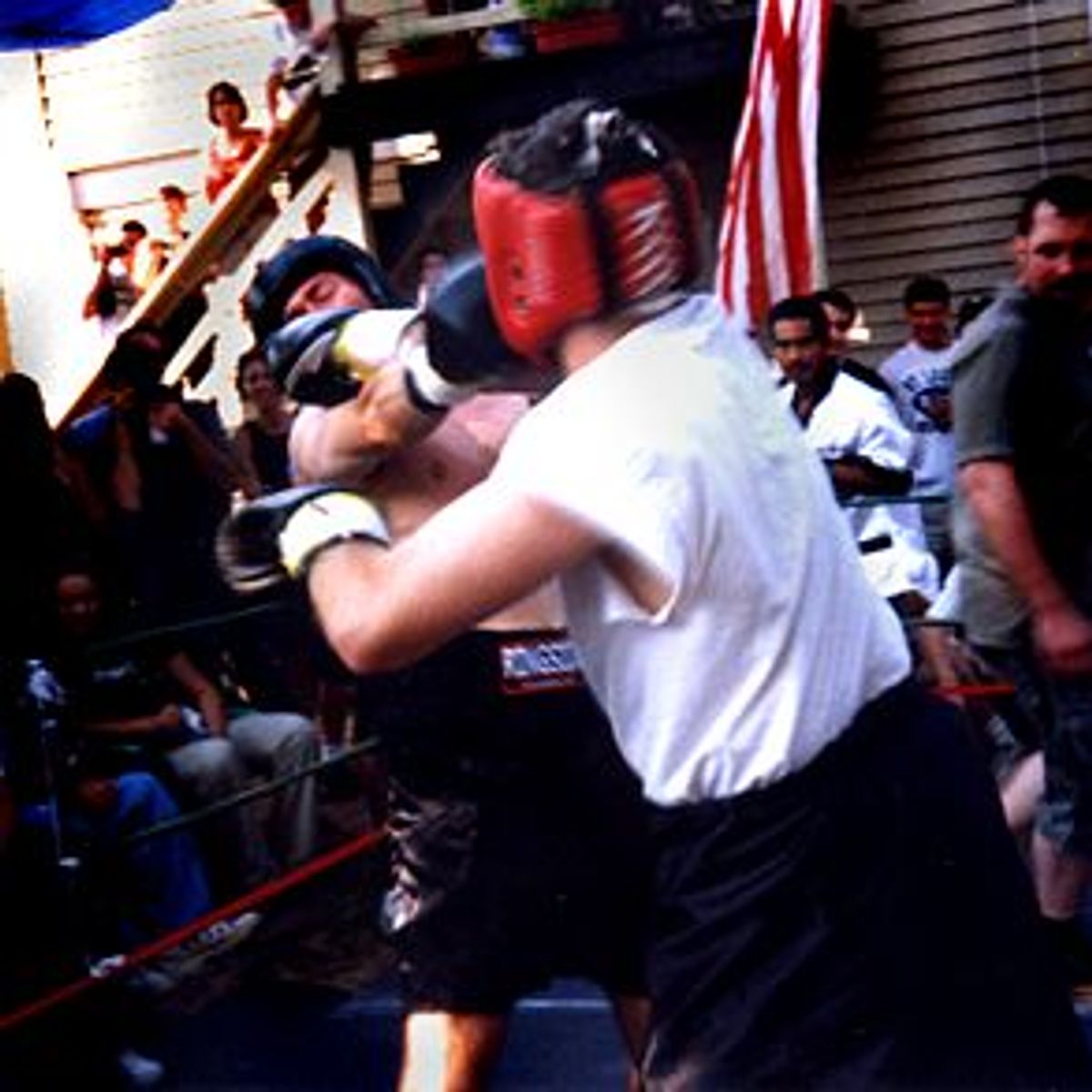
Although this is the third time today that “The Star-Spangled Banner” has been belted out from this crowded backyard, this isn’t a gathering of some patriotic group, not exactly, but rather a meeting of the unsanctioned and highly unofficial International Brotherhood of Sweet Scientists, Local 529. Friends, acquaintances, workmates, roommates and at least one grandma have gathered to drink beer, listen to music, eat barbecue, gossip and watch a select few of their number lace up the gloves and try to beat the snot out of each other.

Backyard boxing, an old tradition revived here over the last two Memorial Days, has branched out to Labor Day.

Backyard boxing is undergoing a bit of a revival around the country, possibly in response to the 1999 movie ” Fight Club.” An Internet search on the phrase reveals a scattering of Web sites chronicling the informal adventures of young people who slug it out with each other, usually amid much drinking and with few rules.

The International Brotherhood is less “Fight Club,” more “Fat City.” The boxers wear gloves, mouthpieces, foul-proof cups and headgear. The ring is homemade, but it’s a ring. The surface is carpet fragments duct-taped together over the grass, with nylon straps and garden hose-wrapped cable for ropes. (Full disclosure: This writer loaned the organizers a utility knife for carpet cutting.) There are judges, referees, seconds and an official timekeeper.

“The way I got the idea of doing it in the backyard was from my grandmother,” says Steve “Iron Skillet” Smith, 28, the founder and organizer of these semi-regular events, the last one of which earned coverage in the St. Louis Post-Dispatch. He’s also the defending heavyweight Hoosierbelt champion, a bottlecap-festooned belt he’ll defend in the main event. (In St. Louis parlance, a hoosier is a lowlife, a redneck.)

“Her father, Tom Murray from Ireland, he used to have the kids invite everybody over,” Smith continues, “and when I started boxing she started telling me that’s what they used to do. I never thought anything of it until I just wanted to just box, just how I played fuzzball in the schoolyard, which I still do. Just, ‘Hey, you wanna go play?’ and we’d go play.”

Smith, who sells underwriting at community radio station KDHX, got into boxing as a way to get into shape. After training for a while, he wanted to get into the ring and test his skills in a match. He fought a sanctioned amateur bout, but found the competition too intense. He just wanted to have fun.

“To do amateur I’ve gotta go in and box in the same ring as these 8-year-old kids are boxing in, and that’s just a completely different level than what I want to do,” he says. “And then you’ll get the 18-year-old kids, who’d just kick my absolute ass up and down the ring, and I’m not going to learn anything or have any fun doing that.”

So, inspired by tales of his grandfather and the boxing tradition of his town — this is the city of Sonny Liston and the Spinks brothers, as well as decades worth of less famous pugs — he went to the backyard. He fought his pal Peter Neukirch, a giant of a chef, to a draw, then beat him by decision in a rematch. Unfortunately for Neukirch, Smith’s been shedding pounds in training, so they’re no longer at comparable weights. So Neukirch will referee today as Smith defends his title against Thomas “Akita” Crone, 32, editor of stltoday.com, a Web site affiliated with the Post-Dispatch.

On the undercard, Smith’s friend Glen “Bad Intentions” McBrady, a 32-year-old apartment building manager, will make his debut against Pablo “Jabbin’ Jew” Weiss, also 32, the owner of the Rocket Bar, a local punk club, and the light heavyweight Hoosierbelt champ. Both fights will consist of five two-minute rounds.

The anthem is sung before each bout, and there are round card girls — and boys — as well as barbecue grills and Port-a-Potties, a sideshow performer and an Irish harpist. The yard is festooned with not only the Stars and Stripes but with the flags of St. Louis and Great Britain — odd, because Smith is proudly Irish-American — and a Jolly Roger.

But before the boys start slugging, the card gets underway with a three-round women’s exhibition. “Vicious” Virginia Remus is about to square off against “Lethal” Lisa Kindleberger. “Vicious” Virginia is a 17-year-old high school student with an 0-1 amateur record.

As a former newspaper boxing writer, I’ve asked a lot of fighters how they got into the sport. The answers tend to fall into one of three categories: Fighters either wandered into a neighborhood gym, idolized a fighter they’d seen on TV, or saw “Rocky” on the late show. “Vicious” Virginia’s answer is a little different.

“Well, when I was in eighth or ninth grade I read ‘The Power of One’ by Bryce Courtenay,” she says. “It deals with a guy named Peekay in South Africa, and he grows up and he boxes and that’s how he deals with all of his issues. And I read it and I was like, ‘That sounds really cool,’ because I’m the middle of three girls, I know what it’s like to not always be on top. So I started boxing.”

When I ask her if she has a strategy against “Lethal” Lisa, a 28-year-old grad student, she sounds a little more like a fighter.

“Win,” she says. “Beat her down.”

Kindleberger has other ideas. “Lethal” Lisa got into boxing when she went to work out with her mom at a gym called Maryland Fitness and saw the club’s boxing trainer, a former pro named David Gamble, working with someone. “I thought that person looked like a badass and I thought I could do it,” she says.

Although their bout is an exhibition and not judged, Kindleberger gets the better of Remus, consistently beating her to the punch. The crowd supports both, encouraging them, cheering their better moments and applauding loudly at the end of each round. Like boxing crowds everywhere, they shout pointless instructions: “Come on, Virginia, use your left, use your left! Use your right!” says one fan, covering the bases admirably.

At the conclusion of the fight Gamble, 33, who trains both and had refereed the bout, tells the fans, “I want you to show my girls some love,” and they do.

“I feel like I could have done better but you always say that in retrospect,” says “Vicious” Virginia. “I’m proud of myself, and that’s all that matters.”

“I think I pretty much dominated all three rounds,” says “Lethal” Lisa matter-of-factly. “I was really nervous going in. I was surprised how out of breath I got with two-minute rounds. Usually I spar three-minute rounds with no problem. I think the adrenaline was going so hard that I got out of breath.”

Glen “Bad Intentions” McBrady would have a similar problem in the second bout of the day, his debut. Earlier in the week, McBrady had sparred, as he often does, with Smith and Crone at the South Broadway Athletic Club, a red-brick boxing and wrestling gym near the Anheuser-Busch brewery that’s seen better days since its founding in 1899.

“In the gym it’s no big deal getting in there,” he’d said, “but I’m curious to see how it’s going to be in front of a crowd, how much pressure there is.”

McBrady is a crafty left-hander who gives Weiss, the “Jabbin’ Jew,” problems early. Weiss has gone in with a definite strategy: “Smoke him in the sternum in the very beginning, and if that doesn’t work, I’ll just stay outside and every time he throws, cross back, hit him in the head, hit him in the stomach, knock his air out.” It’s not working, but Weiss is having his moments, employing a variety of tactics, not all of them Marquess of Queensbury approved.

Smith, acting as McBrady’s cornerman, shouts instructions in his face between rounds: “Keep your hands up. He’s hitting you with some crazy-ass punches, OK?”

In the second round McBrady is starting to look winded. By the end of the third, he’s had enough, and like Sonny Liston 37 years ago against Cassius Clay, he retires on his stool. He’d later learn that he’d been leading on all three judges’ cards, but the nerves he’d been wondering about had gotten the better of him.

“I wasn’t breathing. I was holding my breath,” McBrady says. “It was one of those deals where, I mean, the shots, it wasn’t that big a deal. I mean, obviously they hurt like hell, but it wasn’t like I was groggy, or, it was just, I was hittin’ him and hittin’ him and he kept coming. Finally, in between rounds I felt like I was going to throw up and I just said, You know what? This is it. First time out, it’s in a backyard, so I told Steve, that’s it.”

McBrady says he’ll be back to try again on Memorial Day. “With everything going and the crowd and all the excitement and everything, I just didn’t have the fundamentals hammered into my head enough to keep ‘em going,” he says.

I ask Weiss what the key to his victory was. “You know, I always spar without headgear, so wearing headgear during the fight, I didn’t even feel the hits, and I think he was hitting me pretty hard,” he says. “So the key is to spar without headgear, and then when you wear headgear in a fight you don’t even know the difference.”

I ask him what he’s going to do the rest of the day.

“Well, I’m going to drink heavily, eat some bratwurst and go to the Washington Avenue Beat Fest [an electronic music event] and pump it up,” he says.

Meanwhile the crowd, which grows throughout the afternoon, is having a fine old time. Between bouts a sideshow performer puts on an exhibition of fire-eating and glass walking, and someone breaks out watermelon, soft pretzels and brownies. I ask Adam and Nikki, a pair of self-confessed hipsters, what the appeal of backyard boxing is.

“It’s a beautiful idea,” Adam says. “You’re drinking beer in a backyard, watching people hit each other, for Chrissake. You really don’t need to ask that question. It’s backyard boxing!”

Nikki says she’s not much of a boxing fan but that she’s thinking of putting on the gloves. “I like violence,” she says.

Gate Rettig, 26, came all the way from Chicago for the matches, sporting his best Nader-LaDuke T-shirt. “It’s nice to see this many people getting together and the cops not putting a stop to it,” he says. “It’s a lot of fun. There’s no harm done. And it brings the community together too, because all the neighbors are here, which is great. It’s nice to see people not watching television. That’s the most important part.”

The cops do show up. A cruiser, noticing the commotion from the street, pulls up behind the backyard in the alley. The officer watches part of the second fight, then bids nearby spectators a good day, climbs back in his car and continues on his beat.

“I checked with the prosecutor’s office, kind of,” Smith says. “The guy down the street, his wife is a prosecutor, and she says she has no interest in prosecuting anybody for doing anything like this.”

But Myrl Taylor, St. Louis president of USA Boxing, the American amateur boxing sanctioning body, wishes someone would prosecute.

“I think they’re going to get somebody fucking killed and the thing of it is we’re going to get the black eye for it,” he says in a telephone interview. “We have amateur boxing, the Olympic-style boxing, and we’ve got trained officials there to make sure nobody gets hurt. We’ve got a doctor on site, we’ve got oxygen on site, we’ve got all that. They ain’t got shit.”

Taylor notes that sanctioned amateur fighters, like pros, have to be examined before and after they fight, and are subject to examination by a doctor during the fight. He’s angry that because the backyard boxers don’t charge admission or fight for prize money, authorities are unwilling to hold them to the sport’s accepted standards.

“They’re trying to say, well, they’re just in a backyard,” he says, “but if somebody gets hurt with that shit, what are they going to say? ‘Somebody got killed boxing.’ They ain’t gonna say it was some ignorant asshole that got killed.”

Dr. Michael Schwartz, chairman of the American Association of Professional Ringside Physicians, agrees that no matter how careful and prudent the backyard boxers are, they’re treading on dangerous ground.

“I think it’s ridiculous,” he says. “I think it’s incredibly dangerous.” Schwartz points out that the inherent nature of boxing is to injure your opponent. “So what happens if one of these guys gets critically injured and there’s nobody there, such as a physician, there’s no control?”

I mention Smith’s comparison of what the backyard boxers are doing to a pickup game on the schoolyard. “There’s no problem if they want to have it in their backyard,” he says, “but they should utilize the same rules and regulations that there are in amateur boxing, and the reason there are rules and regulations is because statistically we’ve made mistakes over the years, and said, ‘Look, how is this different than a basketball game?’ Well, the intent of this is to hurt the other individual. Therefore, people do become injured. Most of the injuries are not severe, but the possibility exists for catastrophe.”

The backyard boxing crew does seem concerned with safety, but there are no doctors, no EMTs apparent. Maybe just by dumb luck, there is no catastrophe this day. Nobody gets killed, or even hurt beyond a bloody nose.

The crowd has built to an anthem-belting fever pitch by the time of the main event, “Iron Skillet” vs. “Akita” for the heavyweight Hoosierbelt championship. Smith enters the ring to the theme from “The Good, the Bad and the Ugly,” dressed as Clint Eastwood’s Man With No Name, complete with tiny cigar. He lifts his poncho to display a hand-lettered sign: “A Fistful of Skillet.”

“There were probably about 30 people there who got it,” he’d say later, “but at least those 30 people thought it was funny.” The nickname was chosen one day after Smith, in need of a moniker, and friends had stopped at a roadside restaurant of that name.

None of this impresses Crone, an intense German-born St. Louisan who’d gotten himself into the proper mood before the fight by driving around for an hour and listening to a Korn tape. “It’s stuff I don’t even necessarily like,” he’d said of the hammering music, “but it kind of put me in the frame of mind I want to be in.”

Crone lands the heavier blows in the first two rounds, though Smith is able to land one big overhand right. After the second round, and each subsequent round, Crone lets out a primal roar as he walks back to his corner: “Yaaaagghhh!”

In the third, Crone begins landing solid left hooks to the head. Smith shakes his head as if to say that the blows don’t hurt, but (old boxing joke) they don’t help either.

Kati Fischer, 25, is a graphic artist and Smith’s girlfriend. She designed the International Brotherhood of Sweet Scientists seal as well as posters for the fight. After the fourth round, I ask her how it is to watch her man in the ring.

“It’s awful. There’s nothing pleasant about it,” she says. “It’s like watching a horror film, it’s like your eyes in between your fingers, going like this: ‘Ooh, I can’t watch it but ooh, I have to.’”

I ask how she thinks the Skillet is doing.

“Ummmmmmm, he could be doing better? I’m hoping he’ll do better? I’m hoping he’ll kick his fucking ass!”

He doesn’t. Crone continues to score effectively despite this unorthodox boxing advice from his corner: “Keep your head up, Tommy!” At the end of the fifth and final round, he spits out his mouthpiece and yells, “Fuck yeah! Fuck yeah!” as the crowd roars.

The cheers turn to groans as referee Neukirch announces the judges’ decision: a draw. The crowd seems to think Crone has won, which is how it looks on the Salon card. “I think I won,” Crone says without anger. “I think I won 3-2. It was fun.” Smith, who’d looked frustrated as the bout ended, says, “I’ll go with the judges, but I’m disappointed in my performance.”

In an e-mail the next day, Smith relinquishes the belt. “I feel my performance on Sunday was unbecoming of a champion,” he writes.

Perhaps so, but his 88-year-old grandmother, Elaine Fouche, who first saw her father fight in 1920 and told Smith about the backyard boxing of her youth, loved it. “It was a lot of fun, and I’m so proud of him,” she says. “But I could hardly watch it when he was getting all beat up.”

And even though nobody’s happy with a draw, most people seem anxious to come back for the next backyard boxing show, presumably on Memorial Day.

“It’s a lot of fun for everybody,” says Larry Weir, a co-worker of Smith’s and one of the judges. “I don’t know if it’ll catch on, but if there’s another one, I want to be there.”

Smith’s grandma says she’ll be there too.

“Oh yes. I’m into it now!”

The Year in Sanity: Jim Joyce

His blown call cost Armando Galarraga a perfect game. But from the moment he realized his mistake, he was golden

  • more
    • All Share Services

The Year in Sanity: Jim Joyce** CORRECTS PERFECT GAME TO WEDNESDAY, NOT TUESDAY ** Home plate umpire Jim Joyce calls a strike during the first inning of a baseball game between the Detroit Tigers and Cleveland Indians in Detroit Thursday, June 3, 2010. Tigers pitcher Armando Galarraga lost his bid for a perfect game with two outs in the ninth inning on a disputed call at first base by Joyce on Wednesday night. (AP Photo/Paul Sancya)(Credit: Paul Sancya)

Armando Galarraga was a journeyman Detroit Tigers right-hander who shocked the baseball world on June 2 by throwing a perfect game against the Cleveland Indians. Except, of course, the game wasn’t perfect, because with two outs in the ninth inning umpire Jim Joyce called Jason Donald of the Indians safe at first base when Donald clearly should have been called out to end the game.

Galarraga responded with a you’ve got to be kidding me smile for the ages, then retired one more batter for a one-hit shutout. He later said he hadn’t argued because he was in shock.

But it was Joyce’s response that turned this terrible tale into one that’s almost heart-warming. Not as heart-warming as a journeyman pitcher tossing a perfect game, mind you, but pretty toasty.

Having asked to see the video replay after the game, an emotional Joyce spoke to reporters: “It was the biggest call of my career and I kicked it. I just cost that kid a perfect game,” he said. “I missed it from here to that wall. I had a great angle, and I missed the call.” He also asked to speak to Galarraga, apologized to him and hugged him. Offered the next day off by his superiors, Joyce declined, saying he was ready to face what he assumed would be a hostile reaction from the Detroit crowd.

This eminently reasonable, grown-up reaction stood out because baseball umpires are ordinarily cloistered. They have what amounts to lifetime tenure. They don’t face reporters, rarely admit mistakes publicly and are not held accountable for their actions in any way that’s visible to the players or public. Don’t like that call? Replays showed the ump got it wrong? Tough.

Galarraga said he’d forgiven the umpire, and Joyce’s response to his error has been widely praised beyond baseball. He’s become a go-to example of how to handle mistakes in politics, religion and — especially because his straight-forward behavior came in the midst of BP’s oil-spill debaclebusiness.

Less than two weeks after the blown call, ESPN surveyed major league players for their opinions about umpires. Their overwhelming choice as the best in the business: Jim Joyce.

Continue Reading Close

Why I’m against baseball’s instant replay

The technology won't necessarily rob the game of heart, but it definitely won't fix what's wrong

  • more
    • All Share Services

Why I'm against baseball's instant replayThe Major League Baseball instant replay display is shown in the umpires room before the National League baseball game between the Philadelphia Phillies and Chicago Cubs in Chicago, Illinois August 28, 2008. REUTERS/Steve Green/Pool (UNITED STATES)(Credit: Reuters)

For the third straight baseball postseason, umpires have been making critical, high-profile mistakes in game after game, and there’s a growing drumbeat among media and fans that Major League Baseball has to do something about it. And not just any something, but one specific something: instant replay.

The entire conversation about umpiring has been predicated on the assumption that the only solution to the problem is a technological one, which is fascinating — and maybe just a little troubling — because everyone in the conversation knows two things: There are acres of room for improvement that has nothing to do with technology, and the technology itself is far from perfect.

We know from other sports, especially NFL football, that video replay is hardly perfect. Putting aside the unnecessarily long delays that accompany video replay in the NFL, it’s a simple fact about video that it does not always provide conclusive evidence of what happened. Camera angles can be as deceptive as the naked eye.

And more important, the NFL’s replay system is a laboratory of unintended consequences. Introduced for the same reason many people want to introduce replay to baseball — to put an end to egregious officiating mistakes — it has become the lord of officials. It has changed the way officials call games. Refs now err on the side of the reviewable call, or make no call at all so replay can be possible. They have changed the way they call fumbles and completions. Watch an old NFL game from before replay and you’ll be struck at the difference in officiating and rules interpretation.

People will argue over the specifics of those last two paragraphs, but there’s no one familiar with replay who doesn’t know that replay is far from perfect, that despite — I would say because of — replay being entrenched in the NFL for years, officiating is still such a problem that a huge number of fans can convince themselves that a recent Super Bowl was fixed by the refs.

Yet the only anti-replay argument that ever sees the light of day is the Luddite one: Instant replay would rob baseball, that most human of games, of an essential human element.

That’s a valid argument, but it’s a religious one. No one is ever going to be argued off of it, and if you don’t buy it, you’re not going to be talked into it.

But it’s interesting that the argument against it goes like this: Instant replay might not be perfect, but it’s better than what we have now, so we should use it. That argument ignores a vital question. Is instant replay better than some other solution?

If you’ve been around as long as most of the people who are in the most public part of this argument — media figures and baseball officials — technology has been a series of miracles in your life. You can carry a supercomputer in your pocket that connects you to anywhere in the world all the time? Are you kidding? I’m not even 50 and I remember when it was a big deal that someone could leave you a taped message when they called your house — the only place you could have a phone — and you weren’t there.

Got a problem? Technology can probably fix it, and if not, just wait a little. It’s coming. Marvelous times.

But I think we sometimes forget that technology isn’t the only fix, and it isn’t always the best one, and not just for squishy reasons having to do with idealizing human error. Human error is a bad thing, and technology is often fantastic at doing away with it. But it can also do away with some good human things, like judgment and holistic problem solving.

Think about law enforcement for a moment — and sports officiating is essentially law enforcement. Which is more effective at fighting crime, an elaborate system of video surveillance or a program of job training, substance abuse education and treatment, community investment and so on? Or if that’s too liberal-sounding for you, focus in tighter. If you’re a parent, which is more effective at getting your kids to behave like solid citizens, spy cams around the house or engaged, loving parenting?

If you wanted to design a system that would result in poor umpiring, you would design Major League Baseball’s system. It’s positively medieval. Umpires essentially have lifetime tenure. They are sequestered from the media and answer only to a review system that is as secretive as it is pointless, since it hardly ever results in umpires losing their jobs. Instant replay won’t change that lack of accountability.

“We never know why or when they are fined, or reprimanded or held accountable,” Oakland A’s pitcher Brad Ziegler told ESPN’s Amy K. Nelson last week. “Any time a player is punished, suspended or sent down to the minors, the public knows about it. It would be a lot easier to communicate with umpires if everyone was held to similar standards. Our statistics as players are a lot more quantifiable than the umpires’.”

I am something of a Luddite when it comes to instant replay, not because I’m anti-technology — I have a long-distance line to New York in my pocket, and the call is free? Score! — but because I think baseball has been smart about being slow to change over the last century-plus. Replay would suddenly, irreversibly alter a game that has a pretty good history of solving its problems without radical, game-altering solutions.

I don’t believe baseball should absolutely avoid instant replay because instant replay is evil. I believe it should try to tackle the organizational problems that are leading to the poor umpiring rather than slap an electronic band-aid on them.

Nelson’s ESPN story is about a planned winter meeting between the grumbling players association, baseball officials and the umpires. Nelson describes such a meeting as “rare,” which is a problem right there. Shouldn’t the three parties involved in this major issue for Major League Baseball talk to each other more than rarely?

It’s a good step. I’m not too hopeful it’s going to lead to a new era of transparency and reform. No one from the umpires or Major League Baseball would comment for the story.

Continue Reading Close

Hard times? TV can be your lottery ticket

If you can get your sob story on the tube, you're gold. But what about the other millions of desperate Americans?

  • more
    • All Share Services

Hard times? TV can be your lottery ticketA food line at the Community Kitchen in Harlem

A tweet from NBC reporter Ann Curry:

Ok, here’s a smile: update on our doc on recession/poverty. I love America

http://bit.ly/btt50h

Here’s the text you get when you “share” the video report Curry’s tweeting about:

Overwhelming response to Dateline’s poverty report

A development to the story we brought you about struggling families in Ohio who have been pushed over the edge by this recession. ††There’s been a response from people wanting to help.

http://bit.ly/btt50h

So it’s that old TV thing. NBC does a story on “Dateline” about families struggling through the recession in rural Ohio, and letters and donations and job offers come pouring in from all over the country.

The retired Air Force vet has “job offers in Pennsylvania, Virginia, Arizona, Iowa.” Someone sent him $5,000. A woman reads through tears from a letter she’s received: “In a couple of weeks I will be able to send you some money to help with expenses. I hope this letter raises your spirits and that you know I really do care. Most of all, you have a friend in me. You are going to be OK, and so are your children. I will be thinking of you, sweetie, and praying that lots of other people send you much-needed money.”

She says, “It’s really hard to believe that someone you’ve never met could actually care that much.”  

The food pantry lady has gotten 500 phone calls and donations from Texas, California, Florida, Iowa, Massachusetts, Maine and Canada. She says, “I just can’t even describe how good it feels to know that there are so many people out there that really do care.”

This is absolutely par for the course, it’s what happens every single time there is a sob story on the TV, but here’s the thing: People don’t care. They just respond to what’s on television.

There are folks right down the street in Texas, California, Florida and Iowa who need food and basic supplies. There are good, capable people, some of them retired military, right down the street in Pennsylvania, Virginia, Arizona and Iowa who are looking for work. And, after NBC’s report, those people still need the basics and are still looking for work. And those people who sent the heartfelt letters and the donations and the job offers likely never moved a muscle for those people down the street.

A guy who drove to the food pantry with a Hefty bag of donations tells the food pantry lady, “Cincinnati Ohio’s thinkin’ of ya,” and she gives him a big hug. Really, guy who drove 170 miles to Lottridge to find someone to give your Hefty bag of stuff to? Because where were you and the rest of Cincinnati before NBC aired its report?

Curry, who is among the best in the business and whom I don’t mean to beat up on, gets “a smile” out of this, as she should. She did a good piece about people who are struggling, her viewers responded in overwhelming fashion and the people she reported about are deeply moved by their good fortune.

If you focus in tightly enough, it really is a wonderful thing. That a relatively tiny group of people in Ohio actually did get a lot of help they weren’t going to get without that TV report. It was like a little miracle, and you’d have to have a hard heart indeed not to be touched by the young mom reading the letter or the hardworking food pantry lady who is suddenly able to provide so much more help to so many more people. I love America too.

But back your view out to the larger picture and what you see is something much more depressing.

Obviously, the people who sent money and goods and job offers had both the means and willingness to help their neighbors in need, but instead they helped some people they saw on TV. Now, I suppose it’s possible that every one of them, from the donor of $5,000 to the Hefty bag guy from Cincinnati to the job offerers in Pennsylvania, Virginia, Arizona and Iowa, is doing just as much for lots of other people closer to home and not on the TV.

I would just be willing to bet a lot that they aren’t.

What Curry’s story suggests is that the generosity of the American people can solve the problems of a lot of folks who need help — as long as they can get on TV. Getting on TV is a lottery ticket, and the depressing part of it is that if you’re in trouble, your chances of getting on TV are about the same as your chances of winning the lottery.

What about all the desperate people who didn’t have a TV network drop out of the sky into their local food pantry? How do we turn their story into “a smile”? Because there are clearly people out there willing to help. There just isn’t enough TV to go around.

Continue Reading Close

Worst! Calls! Ever!

Slide show: Umpire Jim Joyce's error ruined Armando Galarraga's perfect game. How does it stack up against history?

  • more
    • All Share Services

Worst! Calls! Ever!Dallas Stars Brett Hull (22) raises his arms after scoring the game winning goal on Buffalo Sabres goalie Dominik Hasek in the third overtime of Game 6 to win the Stanley Cup Finals in Buffalo, NY, Sunday, June 20, 1999. (AP Photo/Charles Krupa)(Credit: Associated Press)

Umpire Jim Joyce’s blown call Wednesday night, which cost Detroit Tigers pitcher Armando Galarraga a perfect game, is already the stuff of legend. Was it the worst blown call in history?

It was the worst blown call in Jim Joyce’s history, that’s for sure. And surely the worst in Galarraga’s until-now ordinary baseball career. Because it merely affected a line in a record book — Galarraga would have been the 21st pitcher in MLB history to throw a perfect game, dating to 1880 — it lacks the historical heft of the greatest officiating mistakes.

View the slide show

Remembering Ernie Harwell

To know the longtime voice of the Detroit Tigers, through the radio or in person, was to love him

  • more
    • All Share Services

Remembering Ernie HarwellFILE - In this Oct. 3, 1993, photo, Detroit Tigers broadcaster Ernie Harwell pauses during a break in the action in the Tigers' baseball game against the New York Yankees at Yankee Stadium in New York. The Tigers say Harwell has died. He was 92. (AP Photo/Paul Hurschmann, File)(Credit: AP)

The best three days I ever spent on the clock were the three days I spent in Detroit with Ernie Harwell, the longtime voice of the Detroit Tigers, in 2002, his last year in the broadcast booth.

Harwell died Tuesday at 92, eight months after announcing that he had terminal cancer that he would not treat. John Lowe of the Detroit Free Press, in what will surely be the definitive obituary, quotes Harwell at the time: “I’m ready to face what comes. Whether it’s a long time or a short time is all right with me because it’s up to my Lord and savior.”

I grew up not listening to Ernie Harwell but to the man who replaced him in the Brooklyn Dodgers booth in 1950, Vin Scully. I hadn’t come to know Harwell until 1999, when baseball broadcasts were still streamed online for free and Harwell had returned to the radio side after five years on TV. Like generations of Michiganders, I quickly fell for his warmth, his charm, his knowledge of the game, his old-timey broadcast voice.

When he announced that 2002 would be his last season, I wanted to write about him, so I got in touch with him through the Tigers, asking if I could come to Detroit for a few days, hang out with him, shadow him. A day or so later there was a voicemail message. That incredible voice was right on my phone! I saved it for as long as I could. I wish I still had it:

“King, this is Ernie Harwell from Detroit. I don’t know that there’s much to write about me, but sure, come on up.”

I had planned to write about a fundamental shift in the way people follow baseball, about how Harwell was one of the last of the old radio men who were identified with a team as much as any player, often more than any player. Now, with most games on TV, far more games on national TV, larger squads of announcers and the Internet providing more baseball information than any one person could ever absorb, fans weren’t dependent on that one broadcaster to serve as the conduit to their team.

Yes. Well, it seemed interesting in my head. A little of that stuff made it into the piece, but after about 10 minutes with Ernie Harwell, I knew that my story couldn’t be about anything but Ernie Harwell.

It’s hard to talk about what kind of guy Ernie Harwell was without sounding like you’re talking about a guy on the night of the day he died. But it was just as hard when he was still alive. I spent three days with him, and he was unfailingly kind, generous, cheerful, energetic, positive and humble. And not just with me. At 84 years of age, he was tireless, making sure as he roamed the ballpark — which he did a lot — that every fan who wanted a moment with him — and there were many — got the moment he or she wanted.

I talked to a lot of people about Ernie Harwell that summer, and in the eight years since then I’ve talked to more people about him and I’ve heard and read many things said about him, and I’ve never heard a hint that the man I came to know in those three days wasn’t the genuine article. It may be that there has never been an unkind word said about Ernie Harwell.

Jon Miller, the ESPN and San Francisco Giants announcer, was hurrying across a field when I sidled up to him asking if I could talk to him for a minute. He kept walking as he asked what I wanted to talk about. “Ernie Harwell,” I said, and he stopped on a dime. All of a sudden, I had his attention and he grew animated as he told stories about Ernie.

Mike Shannon, the longtime St. Louis Cardinals broadcaster, was pressed for time just before a game one day but he told me to sit in the press box and wait for him. Minutes before the first pitch, he leaned out the door of his radio booth. “Where’s the guy who wanted to talk about Ernie Harwell?”

Ty Cobb liked Ernie Harwell, for crying out loud. Ty Cobb didn’t like anybody.

“He’s so generous with his time,” I wrote back then, “that a reporter in town for three days to research a story on him confesses on the third day that he’s just about run out of questions to ask.” That reporter was me, of course. We were sitting in an empty broadcast booth in the Comerica Park press box when I told him that. He looked out at the field for a few seconds, then started throwing out some suggestions, things I might want to ask about.

It sounds silly to say, but after spending time with Ernie I told myself that I would try to be a better person, more generous, more cheerful, more optimistic, more kind. More like Ernie Harwell. I failed miserably at this, of course, but I’ve returned to that thought fairly often over the years, and I like to think I’ve moved just a tiny bit in an Ernie-like direction.

Here’s the story I wrote about Ernie. I think I worked harder on it than on anything I’ve ever written. I did things I never do. I made outlines, wrote things on index cards and arranged and re-arranged them.

I swung for the fences, wanting to do justice to the living legend and the time I’d had with him. I used a flamboyant structure, organizing the piece around Ernie’s call of a single game, weaving his epic story between snippets of a thoroughly ordinary contest between two lousy teams, the Tigers and the Kansas City Royals.

I’m not sure it worked. But you don’t get to hang out with the greats that often, and it’s less often that you end up liking them. I wasn’t going to write just another piece about Ernie Harwell in his last year.

A few days after it ran he sent me an e-mail thanking me for the piece. “Best thing that’s ever been written about me,” he wrote. I’m sure he said that to every single person who ever wrote a story about him. And here’s the thing: I’m sure he meant it every time.

Continue Reading Close

Page 1 of 111 in King Kaufman