National security

The horror, the horror

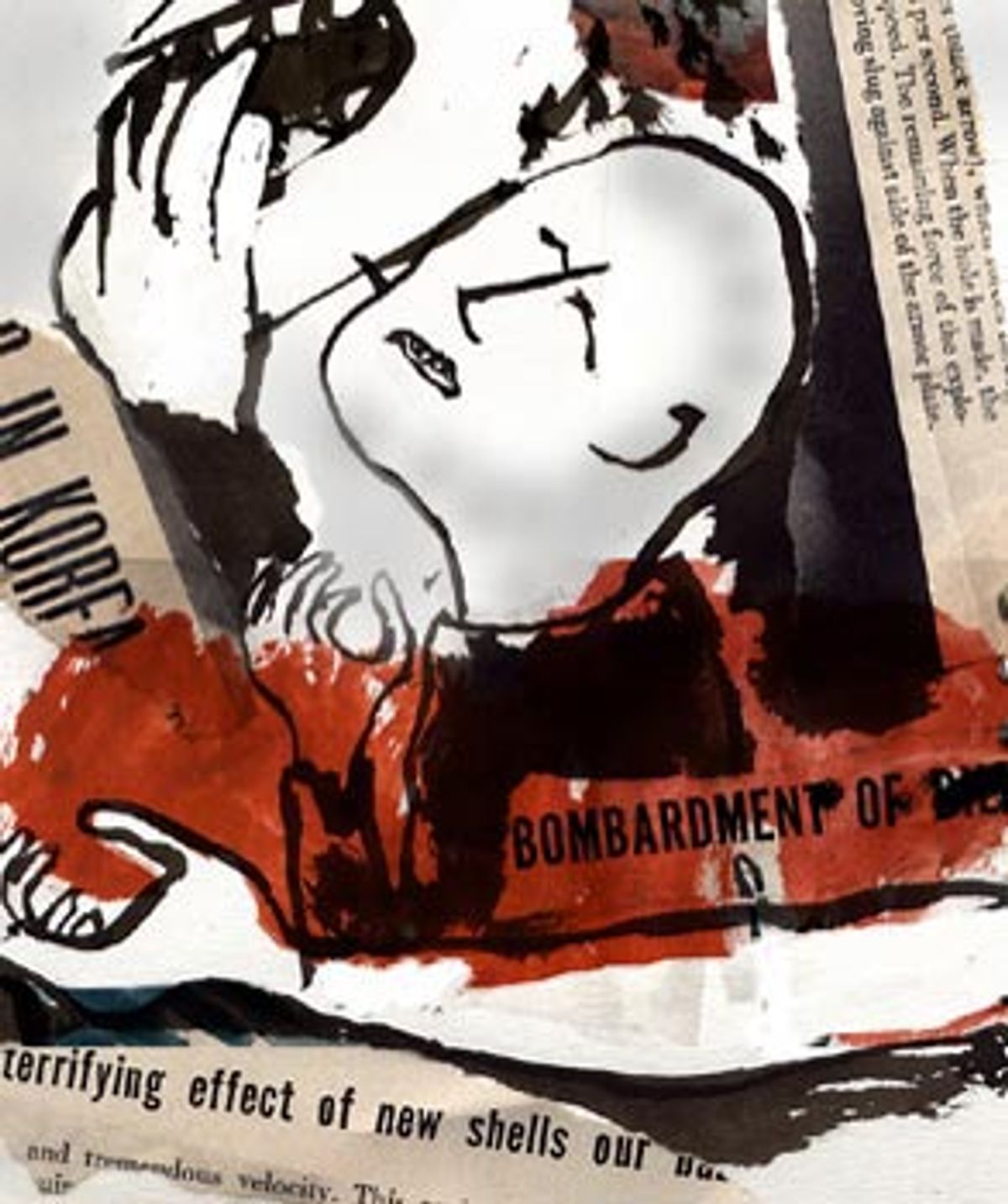
Civilian massacres like My Lai and No Gun Ri are inevitable in the exceptionally ruthless Western way of war. So why can't we just face up to it?

The sixteen-year-old clawed away at bodies, pulling aside arms and legs to hide herself beneath the dead. “I could hear blood flowing down, the sound of blood gurgling out of the bodies,” she remembered. Her throat was burning; she gulped down what she found on the floor. “I drank like a mad person … The horrible thing was that blood kept flowing down from the bodies above me. So I couldn’t really tell whether I drank blood or water.”

There are a lot of ways to tell the story of human warfare, and each will tend to give us a different view of when, how and why we should go to war. One way, almost guaranteed to make a knee-jerk anti-war activist out of any reader, is the personal, face-down-in-the-dirt testimonial, like that quoted above, of Park Hee-Sook, a bewildered South Korean refugee featured in “The Bridge at No Gun Ri” by Charles J. Hanley, Sang-Hun Chose and Martha Mendoza. In July 1950 Hee-sook was forced out of her home by American soldiers, strafed and rocketed by American aircraft on the road she was directed to take and then pinned down by American sniper fire under a concrete railroad trestle for three days amidst the bodies of her dead and dying family and friends.

Another way to frame the narrative of war is by rational analysis — or rationalization — of the factors that lead to success or failure in combat. This kind of treatment flings aside the question of why or whether war should be initiated, and concentrates instead on how it is won. Military historian Victor Davis Hanson, in his new book “Carnage and Culture: Landmark Battles in the Rise of Western Power,” gives us the vulture’s eye view: vast panoramas of hacked, charred, and waterlogged bodies are essentially abstracted to putrefying rectangles on battlefield maps, picked over to illustrate the clear superiority of Western cultural values when it comes to the prosecution of successful bloodbaths.

Hanson’s view in “Carnage and Culture” is grim but elevated, because he claims to believe that Western military dominance has nothing to do with morality. Instead, he insists that the West has usually achieved its goals in war because its methodology is so seldom shackled by any consideration other than military necessity. While it graphically describes many military events, his book remains a kind of aerial survey of the landscape of war, one in which Hanson, according to the New York Times’ review of the book, “more than makes his case” that a uniquely Western ruthlessness, spawned by uniquely Western cultural values, has led to a world in which Western military forces reign supreme.

In “The Bridge at No Gun Ri,” on the other hand, the story takes us down onto the killing fields for days at a time, sharing the wartime experiences of individuals. So we find ourselves cowering with them in a pitch-black ditch to avoid a ferocious rain of “friendly fire,” or watching as another young woman, Yang Hae-sook, plucks her own dangling eyeball off the string of her nerves.

“The Bridge at No Gun Ri” is an expanded version of a Pulitzer Prize-winning story about the large-scale massacre in 1950 of unarmed South Korean civilians by U.S. troops, a story broken by a team of Associated Press investigative reporters in 1999. The slaughter was just one part of the hot, sweating military debacle that unfolded during the first few desperate weeks of the Korean War. As their communist North Korean opponents drove them relentlessly backward down the Korean peninsula from Seoul, the inexperienced American troops and their Republic of Korea allies retreated to what they hoped would be a defensible corner of the country called the “Pusan Perimeter.” With them and behind them was a displaced and panicky civilian populace, many of whom had been driven from their villages.

As soon as the allies crossed the Naktong River into the Perimeter that August, they turned around and blew up the refugee-choked bridges to prevent the enemy from crossing behind them, in the process killing hundreds of screaming civilians on the spans and stranding the remaining thousands of refugees between the river and the North Korean guns. Then the Americans, under written orders, began systematically shooting any refugees who attempted to cross the water. Although the 7th Cavalry Regiment’s slaughter of civilians at No Gun Ri, which is at the heart of the AP journalist’s book, occurred a few days earlier and farther back along the line of retreat, the “reasoning” behind it was much the same as that which drove the order to shoot civilians trying to cross the Naktong river. The American high command feared that among the throngs of refugees were North Korean infiltrators trying to get behind American lines where, it was thought, they would abandon their civilian disguises and fall upon the allies from the rear.

That was the story, anyway. However, while enemy infiltration is certainly a realistic concern once warfare has degenerated into guerilla operations, there was little reason for the North Koreans to resort to such subterfuges at that point in the conflict. The allies were so thin on the ground and so lacking in discipline and experience that conventional North Korean forces easily outmaneuvered them. Some parts of the American front were literally miles apart, permitting the North Koreans to make flanking incursions between two parts of the army. The demolition of the Naktong River bridges was arguably a military necessity, but the North Korean troops were still miles away when the bridges were dynamited. There’s little doubt that the more immediate concern at that moment was to stop the refugees from crossing into the Perimeter.

Hanson would be likely to see the Korean refugees’ ordeal — being shot at and blown up by the very forces that were supposedly sent to save them — as an example of “cultural crystallization,” where “insidious” and “murky” elements of Western culture become “stark and unforgiving in the finality of organized killing.” That’s a fancy way of saying that the stories Americans were telling themselves, true or untrue, when they came to Korea — about who they were, why they were in this war-torn Asian nation, and who they were dealing with — were the driving force and underlying structure of the nationwide massacre in which No Gun Ri was only a bloody blip. The stories, which focused Western cultural values and fears on the refugees, were the justification for the killings.

And a sense of justification for inflicting widespread death seems to be crucial for Western warriors, despite Hanson’s claim that the cutthroat qualities of Western warfare are merely pragmatic or “amoral.” We in the West have in fact created whole systems of moral justification for our conduct of warfare, which Hanson acknowledges — and even contributes to — whether he realizes it or not. First, the war stories he chooses to tell us highlight the qualities of Western culture most Westerners — or at least conservative Westerners — would consider positive: the concepts of individual freedom, decisive efficiency, consent of the governed, private property, innovative technology, capitalism, voluntary discipline and the tolerance of dissent and critique. In the end, Hanson makes a seductive case for the idea that because Western warfare has been incredibly murderous, it has also been relatively speedy and decisive, and has served arguably “good” long-term causes — the important one by his lights, of course, being the advancement of the more treasured elements of Western civilization.

While Hanson honestly admits that, as in the case of the British invasion of Zululand, there is often little or no moral justification for the initiation of the conflicts he dissects, the stories he tells nonetheless almost uniformly congratulate and justify the “amorally” bloody Western way of war. It is only when warriors abandon their good — or at least extremely practical — Western principles, Hanson says, that they begin to lose.

That seems to have been the case with the early losses in Korea, a ground war that American military doctrine had only the year before dismissed as neither necessary or winnable. Most of the Army units sent so hastily into battle were green and untrained (so much for Western “discipline”), their equipment was old and inadequate (“superior technology” it wasn’t), their numbers were underwhelming (hardly an application of “decisive” strength) and their leadership was either incompetent or disastrously overconfident (there wasn’t a “self-critiquer” in the lot). Even the pervasive racism that underpinned such events as the No Gun Ri disaster was a repudiation of the basic respect for individuals and their personal freedoms that Hanson believes is the foundation of Western military strength.

Racism, per se, isn’t one of forms of “cultural crystallization” that Hanson itemizes as having an impact on military operations, Western or otherwise, but his survey of nine “landmark” battles shows again and again how it leads to arrogance, a lack of self-examination and, inevitably, an underestimation of the enemy. Cortis’s underestimation of the Aztecs at Tenochtitlan and Chelmsford’s inattentive attitude toward the Zulu at Isandhlwana are two of the most obvious examples. In Korea, the Americans referred to the Koreans (unimaginatively, given that the same characterizations had been trotted out a decade earlier to describe the Japanese) as “trained monkeys” and “the most barbarian of peoples.” The intelligence chief of the 8th Army called them “half-men with blank faces,” and most of the lower ranks routinely referred to them by the all-purpose epithet for Asians which apparently arose among U.S. troops in the Philippines during the American takeover — er, “reorganization” — in 1905: “gooks.”

If any of these Americans had felt the need to examine their assumptions, the earlier history of the 7th Cavalry Regiment would have proven instructive. The regiment’s signature tune, “Garry Owen” which gave them their nickname of “The Garryowens,” had been adopted by the regiment’s early commander, Lt. Col. George Armstrong Custer. Custer first had it played to accompany an attack on a Cheyenne encampment on the Washita River in Oklahoma in 1868. But in the 1950s the regiment showed little interest in a realistic assessment of Custer. Instead, as part of their orientation to the 7th Cav, recruits sent to Occupied Japan for their largely ceremonial “praetorian guard” duty were shown the Errol Flynn movie “They Died With Their Boots On,” a patriotic version of the events at Little Big Horn, where in reality Custer’s military arrogance and his racist assumptions about his Native American enemies led to his destruction.

The film depicts Custer as a tragic hero and celebrates his success in ridding the American West of “hostiles.” The idea behind the stirring, uncomplicated propaganda dished out to the newcomers, said Sergeant “Snuffy” Gray, was to “get them to love the regiment,” and to be unreservedly proud of their past. It seems to have made the desired impression on Norm Tinkler, who was a 19-year-old machine gunner at No Gun Ri. “We just annihilated them,” he said of the Korean civilians — mostly women, children and older men — killed in the incident. “It was about like an Indian raid, back in the old days.”

Pumped full with martial pride as they were — even though they were largely untrained and completely inexperienced in combat — when the Garryowens were suddenly sent to Korea in July 1950, they were confident that they would be returning to their comfortable quarters in Tokyo in a matter of weeks. They partook of a “military superiority complex” that had come down from the headquarters of the “acting emperor” of Japan and Supremo of the Far East Command, General Douglas MacArthur. As soon as the North Koreans saw them coming, they told themselves, there would be a rout.

But even as the 7th Cav was arriving in Pohang on July 22, other teenaged Americans from the 35th Infantry Regiment were drowning in a panicky scramble across a rain-swollen stream as they tried to get away from a North Korean attack. Such terrified retreats of Americans from positions where they were outgunned and about to be overwhelmed in the early days of the Korean conflict were so frequent they prompted a new coinage, “bugging out,” and the troops often left a shameful trail of dropped weapons, equipment, food, helmets, cartridge belts and even combat boots along the line of flight.

The Garryowens’ first night in the combat zone wasn’t much more commendable. Cooked by the tropical heat, eaten by rice-paddy mosquitoes, revolted by the smell of human excrement used in the fields and primed with lurid tales of sneak attacks, infiltration and atrocities, the Garryowens dug in a few miles behind the front, which was slowly being withdrawn from the environs of the town of Yongdong, captured that day by the North Koreans. As soon as darkness fell, the nervous soldiers began shooting at anything that moved or made a sound. One second lieutenant was killed by his own troops when he lit a cigarette in view of the raw, jittery kids in their foxholes.

Meanwhile, several miles away on the Yongdong road, Park Hee-Sook, Yang Hae-sook and their families were being rousted out of their villages by other Americans attempting to clear the area between the armies, to create what was to become known as a “free fire zone” in another conflict a generation later.

In the wee hours of the next night, the Garryowens were ordered to pull back toward No Gun Ri in a routine maneuver designed to straighten and strengthen their front line. But when the order reached the anxious company commanders, they thought it meant there had been a North Korean breakthrough and that they were in danger of being overrun. Soon a mad, blundering fire fight broke out in the inky blackness between two different units of the American forces who each thought they had encountered the enemy. A story circulated amid the melie that the refugees and their carts and oxen, which the Americans could hear moving behind them as they withdrew, were either actual enemy troops and tanks or a shield of civilians being deliberately pushed forward in front of advancing North Korean troops.

As morning dawned, the crowd of refugees, under a small American escort, was approaching the “exhausted, unnerved and hungry” Garryowens, who had settled in on the heights at either side of the road that paralleled the rail line coming east from Yongdong. Orders had been sent down two days earlier from Division headquarters. “No refugees to cross the front line,” the order read. “Fire everyone trying to cross lines. Use discretion in case of women and children.”

Most commanders, however, had heard the same stories Gil Huff, the regiment’s executive officer did, over and over again. Refugee women, it was rumored, were being caught with weapons and radios hidden in their supposedly pregnant bellies or under the babies on their backs. “I never saw one,” Huff said later. “But it makes a good story, a colorful story.” In any case, it was one that was certainly believed by the skittish recruits at No Gun Ri.

The Air Force was not invited to make exceptions for women and children as they saw fit. Their pilots had been ordered to fire on all refugee parties approaching American positions, whenever they were seen and whoever they might be. Turner Rogers, operations chief of the 5th Air Force, had his doubts about the policy. His fliers were complying, he wrote in a July 25 letter to his superior, but the carnage was likely to attract unwanted press attention sooner or later, and that could prove “embarrassing.” Furthermore, Rogers was annoyed that the Army was not taking care of the problem of refugees themselves, on the ground. He couldn’t understand why they weren’t “screening such personnel or shooting them as they come through if they desire such action.” Besides, Rogers, said, there were many targets of much greater military utility that the Air Force should be addressing instead.

But the policy was still in place on July 26, 1950, when, according to witnesses, U.S. planes either strafed or dive-bombed the refugee column as it rested near the railroad bridge at No Gun Ri. On the higher ground above the crossing, the stressed-out Garryowens apparently took the Air Force attack, and the refugees’ mass flight toward the relative shelter of the high tunnels of the bridge, as the signal to fire — and keep firing — on the bleeding, hysterical, screaming crowd.

The Americans escorting the refugees were caught in the crossfire, too, and several of them took shelter with some of the terrified refugees in a small culvert not far from the railway. Somebody starting firing in at them. “It was like a hornet’s nest in there,” said Pfc. Delos Flint. “One of my buddies got hit. Shot off part of his privates. Hurt him bad. We was in there hours.”

The new 8th Army refugee plan had been radioed down to the divisions just that morning, essentially contradicting Flint’s mission to clear the area and herd the civilians south: “No repeat no refugees will be permitted to cross battle lines at any time.” Still, no evidence has been uncovered that points to anyone in the chain of command giving a direct order to fire on the refugees at No Gun Ri. “The word” just “came down the line,” and most of the troops assumed that someone, somewhere, must have gotten an order, since everyone was shooting.

It continued, on and off, for a couple of days. Many, but not all, of the Garryowens understood that they were to continue to “hold” the railroad bridge against the civilians by firing into the people huddled below it whenever they spotted movement.

Some of the Americans thought they were being sporadically fired on from underneath the trestle, but the bullets they thought were aimed at them were probably from the guns their buddies were firing into the other end of the 40-foot-tall concrete arches. Norm Tinkler, the teenaged machine gunner, detailed how he was able to shoot the refugees under the spans. “I ricocheted them in there,” he said. “I knew how to shoot. Oh, I could see about that much of the wall that was going into the tunnel, and I put it on that.” In any case, the regimental diary compiled after they withdrew on July 29 reported no guns captured or North Korean soldiers killed at the bridge.

There’s a reason that FUBAR (“Fucked Up Beyond All Recognition”) began its life as a military acronym. In desperate, fearful situations where confused people — people toting guns, grenade launchers and mortar tubes — think their lives are at stake, deaths will occur, usually on a wholesale scale, whether or not they are “supposed” to according to the official rules of engagement.

In any case, as Hanson says from his chilly “Carnage and Culture” viewpoint, the dividing line between “honorable” and “criminal” killing in warfare is essentially arbitrary. “Due to our Hellenic traditions,” he writes, “we in the West call the few casualties we suffer from terrorism and surprise ‘cowardly,’ the frightful losses we inflict through open and direct assault ‘fair.’” Incinerating thousands of Japanese civilians in the kind of bombing raids recently cheered in the film “Pearl Harbor” is usually seen by Westerners as not nearly as ghastly as the summary beheading of the parachuting B-29 fliers in China when they were captured.

The whole concept of “civilized warfare” — the idea that certain forms or targets of military violence are unthinkable or immoral — is a convenient mythology that not incidentally permits Western military strengths full rein. It also offers opportunities for us to tell good stories about the “devious,” “shameful” and “sickening” atrocities perpetrated by our enemies — and only by our enemies. As with other mythologies, the “civilized warfare” fantasy and the idea that Americans have, can and should practice it, is an article of almost religious faith.

That accounts in large part for the furious reaction of military partisans when incidents like No Gun Ri garner publicity in the West. And then we must assure ourselves, with another good story, that even if such things did happen (My Lai, anyone?), they were “isolated incidents” and that most “civilized” Westerners don’t kill unarmed women and children. We can’t ever admit the expedient nature of our cherished folklore. Hanson’s view of warfare, one that concentrates exclusively on the clash between armed belligerents, only tells part of the story. We believe in the concept of civilized warfare, and that allows us to pretend that civilians are not or should not be targets. Yet they always suffer and die in wars, and in some cases, as in bombing raids on cities, they are also unquestionably targets.

At the same time, Hanson claims that many of the war stories we’re telling ourselves these days limit our ability to apply our particularly Western warmongering gifts of annihilating firepower and utter ruthlessness. He takes the story of the 1968 Tet Offensive in Vietnam as a case in point. North Vietnam’s multi-focal surprise effort, hitting simultaneously at locations all over South Vietnam during a holiday cease-fire (underhanded! dishonorable! Hanson notes), was actually a military failure for the attackers. Few South Vietnamese joined in the staged “uprising,” and tens of thousands of Viet Cong and North Vietnamese Army lives were lost. Their death toll was especially heavy in their expulsion from the “Citadel” at Hui and during the siege at Khe Sanh, and there were relatively few losses on the American side.

But while the military effect of Tet was minimal, culturally it was devastating. The way the tale was told by Western journalists, from the inevitably grim street-level view of the common soldier (and with few countervailing facts concerning the larger military situation), shocked and demoralized Americans and South Vietnamese alike. The effect of the offensive was particularly devastating coming as it did after Gen. Westmoreland’s confident statements the preceding November that the Vietnam war was “winding down” and that he could see “light at the end of the tunnel.”

The demolition of Westmoreland’s pleasant fiction of imminent victory accelerated what Hanson otherwise sees as the Western virtues of dissent and self-critique about the conduct of warfare. In some of his landmark battles, the participants’ internecine fighting over intent and methodology actually improved their strategy and tactics, and the pooling of brainpower helped them avoid pitfalls. But in retrospect, the deep divisions between the military and its civilian controllers over matters of mission and scope in Vietnam created a military no man’s land where there was no possibility of victory. The stories our journalists were telling us — “We’re doing this for nothing” or “We’re making no strategic progress” or “We’re perpetrating more horrors than we’re stopping” — Hanson maintains, essentially prevented the military from acting in accordance with other, more crucial Western characteristics like our preference for direct, pitiless and decisive battle, and our tendency to systematically continue any given slaughter until the enemy’s ability to return to the field is completely obliterated.

Our leaders’ acceptance of convincing scenarios about the potential entry of China or the Soviet Union into the Vietnam conflict also warped our military decisions and responses. We hesitated to mine North Vietnamese harbors or to effectively bomb military and industrial facilities or to stringently and directly interdict supply lines in Cambodia and Laos.

Worst of all, according to Hanson, we didn’t let ourselves even dream of invading North Vietnam itself with the full, efficient weight of our military superiority. A completely serious Western-style military assault on the North would have been horrifically costly on both sides, of course, but the overall human losses might have been significantly less in the long run (especially if we add the deaths that occurred after the fall of South Vietnam). But we didn’t have the will to win that way, and we didn’t have the grace to quit.

The stories told in both “Carnage and Culture” and “The Bridge at No Gun Ri” foster two entirely opposite dangers. Hanson pretends that he has laid aside questions of morality, but his thesis actually presents a moral justification for gigantic, no-holds-barred, scorched-earth warfare by arguing that this strategy makes the most productive use of resources, is most likely to achieve definitive victory and is soonest over. Shooting or bombing refugees who might conceivably have posed even the slightest danger to the allied troops is therefore perfectly in consonance with his principles of “amoral” efficiency. “The Bridge at No Gun Ri,” on the other hand, demonstrates what Hanson’s businesslike sort of warfare involves at the human level, and is likely to make Westerners protest the use of such brutality in the future.

In the Western way of war, there is a constant tension between utility and justification, which has only grown greater as our culture has developed. The Western principles of individual freedom and the consent of the governed weigh heavily on the kinds of stories we are able to tell ourselves about why and how we will make war. A free press protected by the ideals of democratic government and a mass media created by capitalism and innovative technology can now widely disseminate war stories, like that of No Gun Ri, that bring us face-to-face with the realities of combat and utterly destroy our ability to believe in the gallant mythology of “civilized warfare.” Thus Western culture might now have “crystallized” to the point that our growing interest in honesty and truth about war could hamper our future ability to apply the ugly but pragmatic principles of our past triumphs.

Hanson is right that Western civilization, such as it is, was built and maintained on carnage of the most obscene and terrifying kinds, up to and including firebombings of cities and distraught kids killing refugees — and their own buddies — in battlefield backwaters. The question now is whether Westerners can view blood-chilling true stories of retail warfare like “The Bridge at No Gun Ri” with a clear eye and still recognize the necessity, when and if the time comes, to use our superb abilities — and our will — to kick ass and take names.

Judith Greer is a writer who lives near Charleston, S.C. She is a former Air Force officer and graduate of the University of Southern California's School of International Relations.

Israel’s drone dominance

If you want to know how drones will change America, look to the Jewish State -- where they're already widespread

(Credit: Benjamin Wheelock)

Stark Aerospace of Mississippi is perhaps the only foreign-owned company with FAA permission to fly a drone in U.S. airspace. Based in the town of Columbus, not far from Mississippi State University, Stark is a subsidiary of the state-owned Israel Aerospace Industries — not that you could tell from looking at the company’s website, executive leadership or affiliations. You have to go to the Mississippi secretary of state website to learn that two of Stark’s three directors are Israelis.

So too with the America’s drone industry. The Israeli influence is not visible but it is real, documented and extremely relevant to the future of drones in America. If you want to know how drones may change American airspace in coming years, just look to Israel, where the unmanned aerial vehicle market is thriving and drones are considered a reliable instrument of “homeland security.”

“There are three explanations for Israel’s success in becoming a world leader in development and production of UAVs,” a top Israeli official explained to the Jerusalem Post last year. “We have unbelievable people and innovation, combat experience that helps us understand what we need and immediate operational use since we are always in a conflict which allows us to perfect our systems.”

Israel’s drone expertise goes back to at least 1970, according to the UAV page of the Israeli Air Force. Mark Daly, an expert on unmanned aircraft at Jane’s Defense in London, notes the Israelis were the first to make widespread use of drones in Israel’s 1982 invasion of Lebanon, when the aircraft were used to monitor troop movements.

Now, as the Arab media and Western reporters such as Scott Wilson of the Washington Post have reported, the Israeli Defense Force uses fleets of constantly hovering drones to intimidate and control the Arab population in the Gaza Strip.  (The residents call these drones “zenana,” which both sounds like the aircraft’s distinctive buzz and is Arabic slang for a nagging wife.) The IDF regularly uses drones for targeted assassinations of suspected militants, saying the drones enable them to use “precision strikes” to avoid hurting civilians. Yet as Human Rights Watch has documented, the drone strikes during the Gaza War killed scores of children who were nowhere near armed combatants.

Israel markets its expertise in defense to the rest of the world. Israeli academic Neve Gordon cites a glossy government brochure on drones titled “Israel Homeland Security: Opportunities for Industrial Cooperation,” which boasts, “no other advanced technology country has such a large proportion of citizens with real time experience in the army, security and police forces.” The chapter called “Learning from Israel’s Experience” notes that “many of these professionals continue to work as international consultants and experts after leaving the Israel Defense Forces, police or other defense and security organizations.”

The work has paid off when it comes to drones: The Jewish state is the single largest exporter of drones in the world, responsible for 41 percent of all UAVs exported between 2001 and 2011, according to a database compiled by the Stockholm International Peace Research Institute. Israeli companies export drone technology to at least 24 countries, including the United States.

In addition to exports, Israeli companies also create subsidiaries in consumer countries. “To increase sales outside Israel, Israel’s defense companies have to set up subsidiaries in target markets, rather than expand local manufacturing,” Haaretz reported  in 2009. The Israelis “set up Stark in 2006 to drum up business in America,” according to Haaretz, because the U.S. prefers “to buy armaments and other defense gear from local companies.” In 2007, Stark  “inaugurated its first production outfit, which makes Hunter unmanned vehicles that it sells through Northrop Grumman. In fact, the U.S. armed forces have been using [Israeli-made] Hunter drones since the early 1990s.”

As for domestic drone uses, the Israeli example is perhaps most instructive at the U.S. border. The 5 million Palestinian Arabs living in and around Israel, like the 11 undocumented resident aliens in the United States, are ineligible for citizenship in the land they call home. Both groups are subject to monitoring, barriers to entry and rapid expulsion. Not surprisingly one of the first uses of drones by the Department of Homeland Security was to monitor the U.S.-Mexico border, where it now flies Israeli-made Hermes 450 drones.

And the Israeli example is instructive not just at the border, but also south of it, where the Mexican government has allowed the U.S. to fly drone missions as part of the drug war. Mexico has, apparently, learned a thing or two from its northern neighbor about the best country for buying drones. In March, when it allegedly purchased two new drones of its own, it knew where to go: Israel.

Continue Reading Close
Jefferson Morley

Jefferson Morley is a staff writer for Salon in Washington and author of the forthcoming book, Snow-Storm in August: Washington City, Francis Scott Key, and the Forgotten Race Riot of 1835 (Nan Talese/Doubleday).

Can the NYPD (legally) spy on mosques?

A civil liberties expert explains how the city's Muslim surveillance program may have broken local and federal laws

NYPD Police Commissioner Ray Kelly (Credit: Reuters/Brendan McDermid)
This piece originally appeared on ProPublica.

Last August, the Associated Press launched a series detailing how the New York Police Department has extensively investigated Muslims in New York and other states, including preparing reports on mosques and Muslim-owned businesses, apparently without any suspicion of crimes being committed.

The propriety and legality of the NYPD’s activities is under dispute. Mayor Michael Bloomberg – who claimed last year that the NYPD does not focus on religion and only follows threats or leads – is now arguing that, as he said last week, “Everything the NYPD has done is legal, it is appropriate, it is constitutional.” Others disagree. In fact, Bloomberg himself signed a law in 2004 prohibiting profiling by law enforcement based on religion.

This week, Attorney General Eric Holder told a congressional committee the Justice Department is reviewing whether to investigate potential civil rights violations by the NYPD.

To get a better understanding of the rules governing the NYPD – and whether the department has followed them in its surveillance of Muslims – we spoke to Faiza Patel, co-director of the Liberty and National Security Program at the Brennan Center at NYU Law School.

The NYPD did not respond to our request for comment about allegations it has violated the law.

So Mayor Bloomberg and police commissioner Ray Kelly say everything that the NYPD did was legal and constitutional. Other people have disagreed – Newark Mayor Cory Booker, for example, said the wholesale surveillance of a community without suspicion of a crime “clearly crosses a line.” What restrictions is the NYPD operating under?

They are operating under at least three sets of rules. The first and most basic set of rules is the consent decree from the Handschu case – the so-called Handschu guidelines. This was a 1970s-era political surveillance case that was settled through a consent decree. The NYPD had been conducting surveillance of a number of political groups in the ’60s and ’70s. The initial consent decree regulated the NYPD’s collection of intelligence about political activity. It first said the NYPD can only collect intelligence about political activity if it follows certain rules. For example, the NYPD had to get clearance from something called the Handschu authority, which was a three-member board that consisted of two high-level police officials and one civilian appointed by the mayor.

Then, post-9/11 the NYPD went to court and asked a judge to review the consent decree because they wanted to have greater freedom in their counter-terrorism operations. What they wound up doing was adopting guidelines based on the FBI’s guidelines from 2003, issued by Attorney General John Ashcroft. These were different in several important ways. The first was that there was no pre-clearance, at all. There was no requirement that the NYPD get approval from the Handschu authority before they undertook any intel gathering about political activity. The second was that the guidelines explicitly say the NYPD can attend any public event or gathering on the same basis as another member of the public. So if I can go to a church, the NYPD can go to a church. But it goes on to say that the NYPD can’t retain the information it gathers from going to such public events unless it is connected to suspected criminal or terrorist activity.

So if you look at, say, the NYPD’s guide to Newark’s Muslim community obtained and published by the AP – which maps out mosques and Muslim-owned businesses without mentioning and suspicions of crimes – aren’t the police retaining exactly this kind of information?

There are a couple of documents that suggest they may have violated Handschu. For example, the [2006 NYPD report] on the Danish cartoon controversy, which is a collection of statements in mosques and other places that have been taken down by undercover officers or confidential informants.

What are the other rules the NYPD operates under?

The second set is that the NYPD has a profiling order in place, and New York City also has a racial profiling law. They are slightly different. The NYPD order [issued in 2002] does not include religion among the categories that they define as profiling. But the New York City law does. It prohibits police officers from relying on race, ethnicity, religion or national origin as a determinative factor in initiating law enforcement action. Normally you have quite a difficult time in racial profiling cases showing they’ve used one of these factors as the determinative factor. In this case, if you look at the documents, it seems quite clear that the NYPD had its eyes quite firmly on the Muslim community. So it’s possible it is also in violation of this law.

The third set of rules is, of course, the U.S. and the New York state constitutions. Within the Constitution you’re looking at least two broad categories of provisions – potential First Amendment claims for free speech, freedom of association and free exercise of religion. The other piece of it would be potential equal protection claims.

There was another AP story this week reporting that a bunch of federal grant money and equipment used as part of surveillance and investigation of the Muslim community. Does that muddy the legal questions about whether they were following federal rules as well?

The federal program that was giving them money is the HIDTA program – High Intensity Drug Trafficking Area. It’s geared toward providing funds to combat drug trafficking. HIDTA itself does allow for counter-terrorism spending to be an incidental purpose. It requires the HIDTA Executive Board to basically make sure that funds were being used for the purposes that they were supposed to be used for. So I think there’s a real issue about accountability and oversight of the use of HIDTA funds here.

So if the NYPD did potentially violate the Handschu guidelines and city law you mentioned, what are the penalties?

Well the Handschu lawyers already went to court last year and told the judge that the documents that had been released by the AP suggested that there had been violations of the Handschu decree. They asked for discovery so they could check the files of the NYPD to see whether they had violated the prohibition on keeping dossiers. I believe that that discovery will likely be starting soon. So there’s clearly a remedy through the Handschu mechanism. Because it’s a consent decree, it’s an ongoing thing. The judge has supervisory jurisdiction. There are also issues under the racial profiling law and under the First Amendment.

We’ve also turned to the question of oversight. The FBI, for all its faults, does have a fair amount of oversight – an inspector general internally and congressional oversight. We think a similar thing would be a great idea for the NYPD.

Continue Reading Close
Justin Elliott

Justin Elliott is a reporter for ProPublica. You can follow him on Twitter @ElliottJustin

The weakness of Obama’s strength

The president's image of national security success shows how little he has changed in U.S. foreign policy

President Obama and outgoing Chairman of the Joint Chiefs of Staff Admiral Mike Mullen in September 2011. (Credit: Kevin Lamarque / Reuters)

From Adlai Stevenson in 1952 to John Kerry in 2004, Democratic presidential candidates have usually been seen by voters as weak on the crucial issue of national security. Now, that seems to have changed, with defense becoming arguably President Barack Obama’s strongest asset in his 2012 reelection campaign. “Polls show voters believe Obama is handling the title ‘commander in chief’ better than other aspects of his job,” as USA Today bluntly put it last month.

Some Democratic pundits are giddy at their party’s turnaround on national security. “There’s no doubt Obama’s had a better first term in the White House on foreign policy than any Democrat going back to Truman, and frankly better than most Republicans’ first terms as well,” crowed Michael O’Hanlon of the Brookings Institution. Michael Tomasky has argued that Obama is on his way to being “not just a good but a great foreign-policy president.”  Michael Cohen made a good case in Foreign Policy for the Democrats being “the new national security party.” In other words, Obama has reversed decades of public perception about Democratic weakness, and it is time to uncork the champagne.

Not so fast. While it is welcome news to those of us who prefer the Democratic Party on domestic issues that it has finally neutralized Republicans on the crucial issue of national security, two problems persist. First, Obama’s popularity on foreign policy has come at great cost. Second, if the Dems exploit their national security advantage in the 2012 campaigns, they may be committing themselves to a permanent “Republican lite” agenda on the issue. American foreign policy still contains strong elements of militarism, interventionism and special-interest influence. Only if and when President Obama cures those underlying diseases can he be considered a great foreign-policy president.

Start with Obama’s national security track record. Obviously, it is far better than President George W. Bush’s, a low bar. Of all the post-Truman Democratic presidents, Obama’s tenure is equaled only perhaps by JFK’s. Successes have included the killing of Osama bin Laden, the downsizing of the American presence in Iraq, presiding over the relatively orderly exit of Hosni Mubarak in Egypt, and backing the removal of Gadhafi in Libya without sending U.S. troops. Obama and the Democrats deserve credit for laying the groundwork for a withdrawal from Afghanistan, and in showing the American people that diplomacy and multilateralism are not curse words but common sense. Most recently, the administration has begun paying more attention to Asia, where America’s attention should really be focused.

But these victories have been accompanied by significant failures. Obama’s escalation in Afghanistan was a predictable fiasco. His inability to turn the U.S. into an honest broker between Israel and the Palestinians is probably the proverbial final nail in the coffin of the so-called peace process. Obama never made clear how intervention in Libya was a vital strategic U.S. interest, and his engagement with Iran was halfhearted. Most disturbingly, from Guantanamo Bay to military commissions, the administration has continued many of the worst civil-liberties policies of its predecessor. And it is has even added some of its own in the form of stepped-up drone attacks, which not only kill scores of civilians but are vital in turning Pakistanis in crucial areas against the United States.

More broadly, Obama has been unable to fundamentally reorient U.S. foreign policy away from intervening in every region across the globe. The administration has not persuaded Americans that restraint would be both a wiser and more just approach to international affairs. It has not made the case that American exceptionalism is just a nationalist myth common to most nations. Instead, Obama has largely been successful in convincing the public that America can better dominate the world with something of a lighter touch.

If Obama and the Democrats rely on this approach in hopes of keeping the presidency and gaining seats in the House and Senate, they may only be extending America’s chronic foreign policy problems. If the administration does not even try, let alone succeed, in telling the American people that their defense budget is bloated, that the country must be much more selective in engagement across the world, and that civil liberties should be more than just an afterthought when conducting international affairs, all triumphs will be partial at best. Yes, Obama has proven terrific in regaining the national security edge the Democratic Party has relinquished for so long. And yes, that pays great dividends in both implementing the Democrats’ domestic policies and in turning Americans against the hyper-nationalist and -militaristic positions that defined the George W. Bush administration.

But we have seen the movie before. Lyndon Johnson’s administration was so obsessed with appearing soft on national security that this fear played no small part in embroiling the country in the disastrous war in Vietnam. More recently, many Democrats voted in support of the Iraq war for fear of seeming soft on the war on terrorism. Though Obama seems far too shrewd to engage in any quagmires of that scale, obsessing about electoral advantage has undeniable costs.

“Since at least the 1990s, the Democrats have embraced the premises of the GOP in national security,” says Julian Zelizer, author of “Arsenal of Democracy: The Politics of National Security — From World War II to the War on Terrorism.” “It’s about being tougher and more aggressive, not about international cooperation or dialogue with other countries.” Branding themselves as the “tough” party on national security is tempting, but if it prevents the Democrats from offering a genuine alternative to the current Republican Party, it may be too great a cost.

And therein lies the difficulty for Democrats, of course. Human nature presents challenges for any leader hoping to illustrate the counterintuitive reality that military power and obstinacy are actually only of limited use in the conduct of foreign policy. “When people are insecure, they’d rather have somebody who is strong and wrong than someone who’s weak and right,” President Clinton famously said after the 2002 midterm elections. Though cynical, Clinton was correct in his assessment. “It’s hard to tell people that you’re against being strong — the rhetoric sounds too good, even when the results aren’t,” says Zelizer, a professor at Princeton.

Obama has admirably succeeded in regaining the national security electoral edge from Republicans, who are still committed to pursuing hawkish policies even though they’ve been shown repeatedly to be wrongheaded. But success comes with its costs. When, and only when, the Democrats wean America off its addiction to global dominance can it truly claim to be a great party on national security.

Continue Reading Close

Jordan Michael Smith writes about U.S. foreign policy for Salon. He has written for the New York Times, Boston Globe and Washington Post.

The shadow of suspicion falls in the Mall of America

Visitors who have done nothing wrong are winding up identified in counterterrorism reports

On May 1, 2008, at 4:59 p.m., Brad Kleinerman entered the spooky world of homeland security.

As he shopped for a children’s watch inside the sprawling Mall of America, two security guards approached and began questioning him. Although he was not accused of wrongdoing, the guards filed a confidential report about Kleinerman that was forwarded to local police.

The reason: Guards thought he might pose a threat because he had been looking at them in a suspicious way.

Najam Qureshi, owner of a kiosk that sold items from his native Pakistan, also had his own experience with authorities after his father left a cellphone on a table in the food court.

The consequence: An FBI agent showed up at the family’s home, asking if they knew anyone who might want to hurt the United States.

Mall of America officials say their security unit stops and questions on average up to 1,200 people each year. With 4.2 million square feet under one roof, the two-decade-old mall is a monument to suburban shopping and entertainment. Nearly 100,000 people from around the world pass through on a given day.

The interviews at the mall are part of a counterterrorism initiative that acts as the private eyes and ears of law enforcement authorities but has often ensnared innocent people, according to an investigation by the Center for Investigative Reporting and NPR.

In many cases, the written reports were filed without the knowledge of those interviewed by security. Several people named in the reports learned from journalists that their birth dates, race, names of employers and other personal information were compiled along with surveillance images.

In some cases, the questioning appears to have the hallmarks of profiling — something that officials at the mall deny. In nearly two-thirds of the cases reviewed, subjects are described as African-American, people of Asian and Arabic descent, and other minorities, according to an analysis of the documents.

Mall spokesman Dan Jasper said the private security guards would not conduct interviews based on racial or ethnic characteristics because “we may miss someone who truly does have harmful intent.”

Much of the questioning at the mall has been done in public while shoppers mill around, records show. Two people, a shopper and a mall employee, also described being taken to a basement area for questioning. Officials at the mall would not address individual cases.

“The government is not going to protect us free of charge, so we have to do that ourselves,” said Maureen Bausch, executive vice president of business development at the mall. “We’re lucky enough to be in the city of Bloomington where they actually have a police substation here [in the mall] … They’re great. But we are responsible for this building.”

Reporters at the Center for Investigative Reporting and NPR obtained 125 suspicious activity reports totaling over 1,000 pages dating back to Christmas Eve, 2005. The documents, provided by law enforcement officials in Minnesota, give a glimpse inside the national campaign by authorities to collect and share intelligence about possible threats.

The initiative exemplifies one of the enduring legacies of the terrorist attacks 10 years ago: Organizations and individuals are now encouraged by U.S. leaders to watch one another and report any signs of threats to homeland security authorities.

There is no way for the public to know exactly how many suspicious activity reports from the Mall of America have ended up with local, state and federal authorities. CIR and NPR asked 29 law enforcement agencies under open government laws for reports on suspicious activities. Only the Bloomington Police Department and Minnesota’s state fusion center have turned over at least a portion of the paperwork.

In 2008, the mall’s security director, Douglas Reynolds, told Congress that the mall was the “number-one source of actionable intelligence” provided to the state’s fusion center, an intelligence hub created after 9/11 to pull together reports from an array of law enforcement sources.

Information from the suspicious activity reports generated at the mall has been shared with Bloomington police, the FBI and, in at least four cases, the federal Immigration and Customs Enforcement agency.

The push to encourage Americans to report suspicious activity began in the aftermath of Sept. 11, 2001, when government officials and citizens found out there had been hints about the attackers that intelligence analysts had missed.

In the decade since, the Justice Department and Department of Homeland Security have launched programs urging citizens to report suspicious activity. The private sector, including the utility industry and other businesses concerned with protecting “critical infrastructure,” have their own surveillance and reporting systems. Homeland Security Secretary Janet Napolitano has made such reporting a priority.

Last year the Department of Homeland Security launched a promotional campaign, “If you see something, say something,” encouraging Americans to report anything perceived as threatening.

Among those formally enlisted were parking attendants, Jewish groups, stadium operators, landlords, security guards, fans of professional golf and auto racing and retailers such as the Mall of America. Visitors “may be subject to a security interview,” the mall’s website says.

The suspicious activity reports from the mall are rich with detail. They contain personal information, sometimes including Social Security numbers and the names of family members and friends. Some of the reports include shoppers’ travel plans.

Commander Jim Ryan of the Bloomington Police Department said shoppers are not under arrest when stopped for questioning by private security. He said even he would walk away if the questioning seemed excessive.

“I don’t think that I would subject myself to that, personally,” he said. Ryan, however, defends security procedures at the mall.

Ryan said such reports are crucial to the nation’s safety in the post-9/11 era. He said the suspicious activity reports could be held by his agency for two decades or longer. He acknowledged that the mall’s methods, and reports the security guards file, may “infringe on some freedoms, unfortunately.”

“We’re charged with trying to keep people safe. We’re trying to do it the best way we can,” he said. “You may be questioned at the Mall of America about suspicious activity. It’s something that may happen. It’s part of today’s society.”

Some national security and constitutional law specialists question the propriety and effectiveness of such reports.

Dale Watson, a former top counterterrorism official with the FBI, said the mall’s reports suggest that anyone could be targeted for intrusive questioning and surveillance.

“If that had been one of my brothers that was stopped in a mall, I’d be furious about it — if I thought the police department had a file on him, an information file about his activities in the mall without any reasonable suspicion to investigate,” said Watson, who played key roles in the investigations of the 1995 Oklahoma City bombing and a 1998 attack on U.S. embassies in East Africa.

Shoppers, who for the most part had no idea that a visit to the mall led to their personal information being shared with law enforcement, reacted with anger and dismay when shown their reports.

“For all the 30 years that I have lived in the United States, I’ve never been a suspect,” said Emil Khalil. The California man was confronted at the mall in June 2009 for taking pictures, and he said an FBI agent later questioned him at the airport. “And I’ve never done anything wrong.”

Monica Lam, Center for Investigative Reporting

Brad Kleinerman, at home with his youngest son, was stopped after Mall of America security guards said he looked at them in a suspicious manner.

Mike Rozin, chief of a special security unit at the mall since 2005, acknowledged that the vast majority of people who come into contact with his unit “have done nothing wrong, have no malicious intent.”

“They just act in a suspicious manner that obligated me to investigate further,” Rozin said. “We talked to them for an average of five minutes, and they’re able to continue their shopping.”

Francis Van Asten’s experience with mall security lasted much longer.

On Nov. 9, 2008, the Bloomington resident videotaped a short road trip from his home to the Mall of America. Van Asten, now 66, planned to send it to his fiancée’s family in Vietnam so they could see life in the United States.

As he headed down an escalator, camera in hand, mall guards caught sight of him.

“Right away, I noticed he had a video camera and was recording the rotunda area,” a security guard wrote in a suspicious activity report.

Van Asten, a one-time missile system repairman for the Army, was questioned for approximately two hours, records show. He was asked about traveling to Vietnam and how he came to know people there. The FBI Joint Terrorism Task Force was alerted. He was given a pat-down search, and the FBI demanded that his memory card be confiscated “for further analysis.”

Authorities were concerned about his footage of an airplane landing at Minnesota’s nearby international airport. They also worried Van Asten was conducting surveillance of mall property.

Exhausted and rattled, Van Asten had trouble finding his car after the ordeal was over.

“I sat down in my car and I cried, and I was shaking like a leaf,” Van Asten said in an interview at his home. “That kind of sensation doesn’t leave you real quickly when you’ve had an experience like that.”

Bobbie Allen, a musician who lives in downtown Minneapolis, was stopped for writing in a notebook. As he waited for a lunch date on June 25, 2007, Allen jotted down some words, which caught the attention of security guard.

One guard wrote in Allen’s suspicious activity report: “Before the male would write in his notebook, it appeared as though he would look at his watch. Periodically, the male would briefly look up from his notebook, look around, and then continue writing.”

Guards asked for his name and for whom he was waiting. Allen, who is black, felt singled out for his race, according to the report. The guard responded that he was “randomly selected” for an interview.

The guards called Bloomington police, after deciding Allen was uncooperative and his note-taking “suspicious.” Allen was cleared, but a suspicious activity report was compiled, complete with surveillance photo, age, height, address and more. Much of that information ended up in a Bloomington police report.

Jeffrey Rosen, a law professor at George Washington University, said such actions trample on traditional civil liberties protections and shift unaccountable power into private hands.

Rosen said the risk of abuses is high, particularly if there turns out to be a lack of proven results. “If all they’re getting for amassing suspicious activity reports on innocent people in government databases is the arrest of a few low-level turnstile jumpers and shoplifters, that doesn’t seem very sensible,” Rosen said.

In Allen’s case, he responded in a way few others have: He complained to the Minnesota Department of Human Rights and filed a lawsuit. Department investigators concluded that there was probable cause to support Allen’s claim of racial discrimination.

Allen declined an interview, citing a settlement agreement reached with the mall.

Not everyone had a negative reaction to being written up. After a report naming him was forwarded to the FBI, Sameer Khalil of Orange County, Calif., said he believed that police and private security have an important job they must do.

“I think [the mall's program] makes America safer,” he said.

Businessman Najam Qureshi discovered how the suspicions at the mall can linger.

The FBI arrived on his doorstep shortly after a run-in with mall security. His family moved from Pakistan to the United States when Qureshi was 8. Police once pulled over their car for a minor traffic violation, and Qureshi remembers his father saying, “You don’t have to fear the police here. They are here to help.”

Qureshi opened a small kiosk at the mall so his aging father, a former aeronautical engineer named Saleem, could keep busy. One day in early 2007, Saleem Qureshi left his cellphone in a mall food court. When he returned for it, security personnel had established a “perimeter” around the phone, along with other unattended items nearby that did not belong to Saleem — a stroller and two coolers.

The “suspicious” objects eventually were cleared by security, documents show. But mall guards pursued Saleem Qureshi with questions.

“Qureshi moved around a lot when answering questions,” security guard Ashly Foster wrote in a report. “At one point, he moved to his kiosk and proceeded to take items off of two shelves just to switch them around. … He seemed to get agitated at points when I would ask more detailed questions.”

Four years after his father ended up in a suspicious activity report, his son was shown the report for the first time.

“Everybody that lives in this country,” said Najam Qureshi, “is a person of interest as far as these reports are concerned.”

– - – - – - – - – -

The Center for Investigative Reporting, the nation’s oldest independent, nonprofit investigative news center, reported this story along with National Public Radio. You can contact the reporters at gwschulz-at-cironline.org, zwerdling-at-npr.org and abecke-at-cironline.org.

Read the extended version on the Center for Investigative Reporting’s project site, americaswarwithin.org.

Margot Williams of NPR contributed to this report.

Continue Reading Close

Has our bloated security budget made us safer?

We've spent nearly $8 trillion on counterterrorism since 9/11. It's time to assess the results

The killing of Osama Bin Laden did not put cuts in national security spending on the table, but the debt-ceiling debate finally did. And mild as those projected cuts might have been, last week newly minted Secretary of Defense Leon Panetta was already digging in his heels and decrying the modest potential cost-cutting plans as a “doomsday mechanism” for the military. Pentagon allies on Capitol Hill were similarly raising the alarm as they moved forward with this year’s even larger military budget.

None of this should surprise you. As with all addictions, once you’re hooked on massive military spending, it’s hard to think realistically or ask the obvious questions. So, at a moment when discussion about cutting military spending is actually on the rise for the first time in years, let me offer some little known basics about the spending spree this country has been on since September 11, 2001, and raise just a few simple questions about what all that money has actually bought Americans.

Consider this my contribution to a future 12-step program for national security sobriety.

Let’s start with the three basic post-9/11 numbers that Washington’s addicts need to know:

1. $5.9 trillion: That’s the sum of taxpayer dollars that’s gone into the Pentagon’s annual “base budget,” from 2000 to today. Note that the base budget includes nuclear weapons activities, even though they are overseen by the Department of Energy, but — and this is crucial — not the cost of our wars in Iraq and Afghanistan. Nonetheless, even without those war costs, the Pentagon budget managed to grow from $302.9 billion in 2000, to $545.1 billion in 2011. That’s a dollar increase of $242.2 billion or an 80 percent jump ($163.6 billion and 44 percent if you adjust for inflation). It’s enough to make your head swim, and we’re barely started.

2. $1.36 trillion: That’s the total cost of the Iraq and Afghan wars by this September 30th, the end of the current fiscal year, including all moneys spent for those wars by the Pentagon, the State Department, the U.S. Agency for International Development, and other federal agencies. Of this, $869 billion will have been for Iraq, $487.6 billion for Afghanistan.

Add up our first two key national security spending numbers and you’re already at $7.2 trillion since the September 11th attacks. And even that staggering figure doesn’t catch the full extent of Washington spending in these years. So onward to our third number:

3. $636 billion: Most people usually ignore this part of the national security budget and we seldom see any figures for it, but it’s the amount, adjusted for inflation, that the U.S. government has spent so far on “homeland security.” This isn’t an easy figure to arrive at because homeland-security funding flows through literally dozens of federal agencies and not just the Department of Homeland Security (DHS). A mere $16 billion was requested for homeland security in 2001. For 2012, the figure is $71.6 billion, only $37 billion of which will go through DHS. A substantial part, $18.1 billion, will be funneled through — don’t be surprised — the Department of Defense, while other agencies like the Department of Health and Human Services ($4.6 billion) and the Department of Justice ($4.1 billion) pick up the slack.

Add those three figures together and you’re at the edge of $8 trillion in national security spending for the last decade-plus and perhaps wondering where the nearest group for compulsive-spending addiction meets.

Now, for a few of those questions I mentioned, just to bring reality further into focus:

How does that nearly $8 trillion compare with past spending?

In the decade before the 9/11 attacks, the Pentagon base budget added up to an impressive $4.2 trillion, only one-third less than for the past decade. But add in the cost of the Afghan and Iraq wars and total Pentagon spending post-9/11 is actually two-thirds greater than in the previous decade. That’s quite a jump. As for homeland-security funding, spending figures for the years prior to 2000 are hard to identify because the category didn’t exist (nor did anyone who mattered in Washington even think to use that word “homeland”). But there can be no question that whatever it was, it would pale next to present spending.

Is that nearly $8 trillion the real total for these years, or could it be even higher?

The war-cost calculations I’ve used above, which come from my own organization, the National Priorities Project, only take into account funds that have been requested by the President and appropriated by Congress. This, however, is just one way of considering the problem of war and national security spending. A recent study published by the Watson Institute of Brown University took a much broader approach. In the summary of their work, the Watson Institute analysts wrote, “There are at least three ways to think about the economic costs of these wars: what has been spent already, what could or must be spent in the future, and the comparative economic effects of spending money on war instead of something else.”

By including funding for such things as veterans benefits, future costs for treating the war-wounded, and interest payments on war-related borrowing, they came up with $3.2 trillion to $4 trillion in war costs, which would put those overall national security figures since 2001 at around $11 trillion.

I took a similar approach in an earlier TomDispatch piece in which I calculated the true costs of national security at $1.2 trillion annually.

All of this brings another simple, but seldom-asked question to mind:

Are we safer?

Regardless of what figures you choose to use, one thing is certain: we’re talking about trillions and trillions of dollars. And given the debate raging in Washington this summer about how to rein in trillion-dollar deficits and a spiraling debt, it’s surprising that no one thinks to ask just how much safety bang for its buck the U.S. is getting from those trillions.

Of course, it’s not an easy question to answer, but there are some troubling facts out there that should give one pause. Let’s start with government accounting, which, like military music, is something of an oxymoron. Despite decades of complaints from Capitol Hill and various congressional attempts to force changes via legislation, the Department of Defense still cannot pass an audit. Believe it or not, it never has.

Members of Congress have become so exasperated that several have tried (albeit unsuccessfully) to cap or cut military spending until the Pentagon is capable of passing an annual audit as required by the Chief Financial Officers Act of 1990. So even as they fight to preserve record levels of military spending, Pentagon officials really have no way of telling American taxpayers how their money is being spent, or what kind of security it actually buys.

And this particular disease seems to be catching. The Department of Homeland Security has been part of the “high risk” series of the Government Accountability Office (GAO) since 2003. In case being “high risk” in GAO terms isn’t part of your dinner-table chitchat, here’s the definition: “agencies and program areas that are high risk due to their vulnerabilities to fraud, waste, abuse, and mismanagement, or are most in need of broad reform.”

Put in layman’s terms: no organization crucial to national security spending really has much of an idea of how well or badly it is spending vast sums of taxpayer money — and worse yet, Congress knows even less.

Which leads us to a broader issue and another question:

Are we spending money on the right types of security?

This June, the Institute for Policy Studies released the latest version of what it calls “a Unified Security Budget for the United States” that could make the country safer for far less than the current military budget. Known more familiarly as the USB, it has been produced annually since 2004 by the website Foreign Policy in Focus and draws on a task force of experts.

As in previous years, the report found — again in layman’s terms — that the U.S. invests its security dollars mainly in making war, slighting both real homeland security and anything that might pass for preventive diplomacy. In the Obama administration’s proposed 2012 budget, for example, 85 percent of security spending goes to the military (and if you included the costs of the wars in Iraq and Afghanistan, that percentage would only rise); just 7 percent goes to real homeland security and a modest 8 percent to what might, even generously speaking, be termed non-military international engagement.

Significant parts of the foreign policy establishment have come to accept this critique — at least they sometimes sound like they do. As Robert Gates put the matter while still Secretary of Defense, “Funding for non-military foreign affairs programs… remains disproportionately small relative to what we spend on the military… [T]here is a need for a dramatic increase in spending on the civilian instruments of national security.” But if they talk the talk, when annual budgeting time comes around, few of them yet walk the walk.

So let’s ask another basic question:

Has your money, funneled into the vast and shadowy world of military and national security spending, made you safer?

Government officials and counterterrorism experts frequently claim that the public is unaware of their many “victories” in the “war on terror.” These, they insist, remain hidden for reasons that involve protecting intelligence sources and law enforcement techniques. They also maintain that the United States and its allies have disrupted any number of terror plots since 9/11 and that this justifies the present staggering levels of national security spending.

Undoubtedly examples of foiled terrorist acts, unpublicized for reasons of security, do exist (although the urge to boast shouldn’t be underestimated, as in the case of the covert operation to kill Osama bin Laden). Think of this as the “I could tell you, but then I’d have to kill you” approach to supposed national security successes. It’s regularly used to justify higher spending requests for homeland security. There are, however, two obvious and immediate problems with taking it seriously.

First, lacking any transparency, there’s next to no way to assess its merits. How serious were these threats? A hapless underwear bomber or a weapon of mass destruction that didn’t make it to an American city? Who knows? The only thing that’s clear is that this is a loophole through which you can drive your basic mine-resistant, ambush-protected armored vehicle.

Second, how exactly were these attempts foiled? Were they thwarted by programs funded as part of the $7.2 trillion in military spending, or even the $636 billion in homeland security spending?

An April 2010 Heritage Foundation report, “30 Terrorist Plots Foiled: How the System Worked,” looked at known incidents where terrorist attacks were actually thwarted and so provides some guidance. The Heritage experts wrote, “Since September 11, 2001, at least 30 planned terrorist attacks have been foiled, all but two of them prevented by law enforcement. The two notable exceptions are the passengers and flight attendants who subdued the ‘shoe bomber’ in 2001 and the ‘underwear bomber’ on Christmas Day in 2009.”

In other words, in the vast majority of cases, the plots we know about were broken up by “law enforcement” or civilians, in no way aided by the $7.2 trillion that was invested in the military — or in many cases even the $636 billion that went into homeland security. And while most of those cases involved federal authorities, at least three were stopped by local law enforcement action.

In truth, given the current lack of assessment tools, it’s virtually impossible for outsiders — and probably insiders as well — to evaluate the effectiveness of this country’s many security-related programs. And this stymies our ability to properly determine the allocation of federal resources on the basis of program efficiency and the relative levels of the threats addressed.

So here’s one final question that just about no one asks:

Could we be less safe?

It’s possible that all that funding, especially the moneys that have gone into our various wars and conflicts, our secret drone campaigns and “black sites,” our various forays into Pakistan, Libya, Yemen, Somalia, and other places may actually have made us less safe. Certainly, they have exacerbated existing tensions and created new ones, eroded our standing in some of the most volatile regions of the world, resulted in the deaths of hundreds of thousands and the misery of many more, and made Iraq and Afghanistan, among other places, potential recruiting and training grounds for future generations of insurgents and terrorists. Does anything remain of the international goodwill toward our country that was the one positive legacy of the infamous attacks of September 11, 2001? Unlikely.

Now, isn’t it time for those 12 steps?

Continue Reading Close

Chris Hellman is a Senior Research Analyst at the National Priorities Project (NPP).

Page 1 of 38 in National security

www.salon.com/topic/national_security/