Jay Dixit

Vigil at the Armory

As family members waited for news of survivors, they had to contend with prank phone calls, Tony Soprano jokes and the dull ache of dwindling hope.

  • more
    • All Share Services

Vigil at the Armory

It’s just days after the destruction of the World Trade Center. Outside the New York State Armory on 26th Street, the wall is plastered with fliers about World Trade Center workers who are missing. The signs feature names, physical descriptions, color photos, names of employers, tower and floor numbers, home phone numbers and pleas for help. “Anyone who may have known Rich, please call us ANYTIME.” “Floor 105, still hopeful family!!! Great Dad and missed soccer coach.” Other signs offer hope for the families. “Hold on, help is on the way. Anything is possible when you believe.”

“Come sit with us,” says a woman sitting on the sidewalk and smoking a cigarette. “We can tell you about Lucy.” The woman, Teresa Galdames, is looking for her cousin, Lucy Fishman. She worked on the 105th floor of World Trade Center Tower 2, as an administrative assistant for Aon Insurance. Lucy is 36 and has two children, one 3 and one 11. She was last heard from at about 8:55 a.m. on Tuesday morning, when her husband spoke with her. Teresa, Lucy’s sister, Bertha Bracken, and dozens of other friends and relatives have been looking for Lucy for the past three days.

A couple of times, Teresa tells me, they’ve had false hope from “bogus Internet lists.” On two different sites, she says, Lucy’s name has come up, on one saying she was fine, and on another saying she was injured. Those reports turned out to be wrong — Lucy was nowhere to be found. Anybody can post information about anybody on those lists, Teresa explains to me, and people have been putting up jokes, saying Tony Soprano is OK. She can’t understand why anybody would want to play a prank on them.

We hear that the city is requesting DNA samples from missing people. “Shit, I would have brought in her toothbrush, I would have brought in her hairbrush,” says Teresa. They’ve already faxed in Lucy’s health and dental records. At the apartment, a friend of the family has been calling hospitals in New Jersey. But the main command post is at Lucy’s home in Brooklyn. At one point, there were 30 people there working to locate her. “We were calling from the home phone, we had the computer, we had the fax line going and we had 12 cellphones going at the same time,” says Teresa.

Inside the Armory is a brightly lit arena filled with people, soldiers and food. Lucy’s sister Bertha is standing with Brian Howley, who is looking for his wife, Jennifer Dorsey, an insurance broker for Lucy’s company, Aon. Jennifer is five and a half months pregnant. Bertha and Brian didn’t know each other before, but they met three hours after the buildings collapsed. “Brian’s going to be my friend for the rest of my life,” says Bertha.

“Pataki gave me a hug,” Brian says. “I gave him a picture.”

Bertha, a junior at the NYU School of Social Work, is giddy from exhaustion. Her eyes are red from crying. “Look at me, I look like I’ve been smoking crack all day,” she says. “I bathed with some baby wipes.” She shows us an area where she’s spread cardboard boxes on the wood floor of the Armory to sleep on. “This is my crack den, over here,” she says. “This is my nice Castro Convertible.”

Bertha says she spoke to somebody who saw her sister at work that day. That’s the last time anybody saw her alive, she says.

The arena is hot from the bodies of hundreds of people. “I’ve been sitting in this corner all day, just so I don’t have to be around all those people, crying, smelly, hot,” says Bertha. “I’ve never seen so many volunteers in my life; you’d think they could bring a fan.”

Food is abundant — “like a movie set,” says Bertha — and every few minutes, somebody comes up to us offering snacks or drinks. “For three days, I’ve been like an animal, lying on the floor, eating with my hands, peanut butter under my nails,” she says. “I was like, ‘Can somebody call their grandmother and get some hot food over here?’ I’m not kidding — like half an hour later, there’s 50 plates of pasta.”

Teresa has a TV interview scheduled with NBC for midnight. “I hate when they ask, ‘What kind of a person is she?’” says Teresa. “‘How would you describe her in just one word? Generous? Kind? Giving?’”

“I hate how TV reporters are always like, ‘What do you make of this? How do you feel?’” says James. “There’s like 8 million burnt bodies, how do you think I feel? Shut the fuck up.”

“Every time I try to think about something else, every time I try to talk about something else, I always come back to this horror,” says Teresa. “I try to think, this is my daughter’s first day of school. But it always comes back to this.”

We go outside to an area where TV news crews have set up. “Don’t cry during the interviews,” Bertha warns Teresa. “We have hope. People need to know that we’re rational, we’re serious.”

As we’re waiting, a stranger comes up. “I heard there were 10 people who were caught in a pocket of air. It’s unconfirmed.”

“I have hope. Look at earthquakes. They find people two weeks later,” says Teresa. She gives him a flier. “This is Lucy. She’s my cousin. She’s missing.”

James and Brian do an NBC interview together. One interview leads to another, and ABC, NY-1 and CNN talk to them as well. By the time that’s over, it’s about 1:30 a.m., and they decide to go home. “These past three days have been like one day,” says Teresa. “I have a wedding to go to Friday. Somebody said, it’s tomorrow, I said, what are you talking about, I thought today’s Tuesday.”

Even though it’s been almost three days, they’re coming back out here tomorrow. “At this point, I’m not expecting somebody to tell me she’s alive, she’s sitting in my living room,” says Teresa. “I just want to hear, ‘I passed her on the stairwell on the way down, and she was alive then.’ ”

“I’m going to have to relearn how to live after this,” says Bertha. “It’s like I had a baby or something. I can’t remember what my life was like before this.”

“None of us can,” says James.

When I return to the Armory on Friday, the mood has changed. Instead of crying in the streets, people seem hardened. There are fewer people, and the ones who have come back have a dogged determination on their faces. Part of the reason they’re here today, they tell me, is just so they can feel like they’re doing something. They’ve spent their days going to the hospitals, going to the morgue, checking the lists at the Armory and providing hairbrushes, razors and toothbrushes to the police for DNA analysis.

Some people tell me that if their missing relatives are dead, they want to find out as soon as possible, so they can mourn for them. But most are still optimistic. “I’m positive there are air pockets there, more pockets than we imagine, where people are alive. I’m holding out hope,” says Carolyn Staub, a 30-ish woman who’s looking for her brother-in-law Craig, a fund manager who worked on the 89th floor at the investment-banking and brokerage firm Keefe Bruyette & Woods. She’s here with Craig’s brother, his mother and his godmother.

Anthony Luparello Jr., 31, is here with a friend looking for his father, Anthony Luparello Sr., a maintenance worker for Aon Insurance on the 101st floor. Anthony and his father survived the World Trade Center bombing in 1993, and that, he says, is giving him hope. “If he could make it out then, he could make it out this time,” says Anthony. “There’s six levels down in that basement. There will be a lot of survivors. There will be.”

A man named Nelson Ortiz is looking for his brother Pablo, a superintendent of the World Trade Center responsible for overseeing construction. Pablo was last seen on the 73rd floor. “I keep thinking my brother’s going to come out of one of these buildings and say, ‘Come on, Nelson, it’s time to go home,’” he says. “He’s a survivor and he knows construction. He knows where to go.”

Nelson tells me he’s stopped passing out fliers because it wasn’t doing any good. Yesterday, he says, he handed out fliers, and since then, his mother’s phone has been ringing off the hook. “When you’re looking for somebody and the phone rings, your heart jumps because you think you’re getting some information: armory, hospitals, doctors,” says Nelson. But the callers were merely well-wishers who wanted to pour their hearts out to Nelson and pray with him.

On Saturday, the crowd at the Armory is smaller still, and the determination in people’s eyes has turned to desperation. The families of victims wander around, clutching their fliers, with no apparent destination. They talk to volunteers; they try to get on camera so they can spread the word; they look like they’re sleepwalking. I spot Nelson again. Today, he’s with his 13-year-old son, who he says is giving him strength. Still, he’s less optimistic. He’s been chasing down bad leads for the past two days.

Yesterday he got a message from a hospital in upper Manhattan, he explains, saying they had Pablo Ortiz. “I felt great, super, it was explosive,” says Nelson. He headed straight for the Armory and, with the help of an officer, got the hospital on the phone. The first thing they asked for was the patient’s date of birth. It was Jan. 25, 1951 — exactly one year before Pablo’s. To be sure, Nelson asked whether the patient had tattoos of dragons on his arms. The hospital checked and said no. Nelson’s heart sank. It was the wrong guy. “I was like, ‘Oh, no,’” says Nelson. “I know, it’s so selfish.”

Today, Nelson is discouraged. “This is another day, and it’s getting dark again. Now it’s starting to sink in that I lost a brother,” he says. “There’s no good news today. I don’t think there’s going to be any good news tomorrow. Before, it was hope. Now, I’m looking for a miracle.”

Today seems to be the day of false hope for everyone. I meet Luis Espinoza, an Ecuadorian-American man who’s looking for his wife, Fanny, an SEC compliance officer who works for Cantor Fitzgerald on the 104th floor. He’s wearing a T-shirt with her photo on it. He says he had it made the day before at the mall. Tuesday and Wednesday he didn’t eat or sleep. On Thursday his brother took him to the NYU hospital, where doctors gave him a shot for insomnia and prescribed sleeping pills.

Luis, 40, is here with his brother Harry, 30, and sister Marilyn, 27. Earlier today, the family did an interview on Channel 41, a Spanish-language station, in which they held up the poster with Fanny’s photo. Minutes later, a call came in from a woman saying she had seen Fanny at Metropolitan Hospital and that she was in critical condition. Her uncle, who took the call, was so excited to hear she was alive that he didn’t have the presence of mind to take down the caller’s name or number. The family dropped what they were doing and rushed to Metropolitan Hospital. But she wasn’t there.

“We think maybe they meant New York Metropolitan area,” says Marilyn. “We don’t think it was a prank call. We’re praying it’s not.” The call came in right after the TV interview, so they presume the caller recognized Fanny from the photo on TV. “The lady who called was on her way to see a patient, and she saw her. They said she got tubes all over her mouth, all over her nose, that’s why she can’t talk,” Luis tells me. They talk to the producers at Channel 41 to try to get another interview so they can ask whoever it was who called to please call again. Meanwhile, Luis calls the phone company to try to find out the caller’s number. It turns out the caller was calling from a pay phone.

“You lose hope. They tell you to be realistic, prepare yourself for the worst little by little, not to lie to the kids,” says Marilyn. “Then we got this news today and you feel guilty, like how dare I think like that? And you get hopeful again. It’s like a roller coaster.”

They do a second interview, but the woman never calls back.

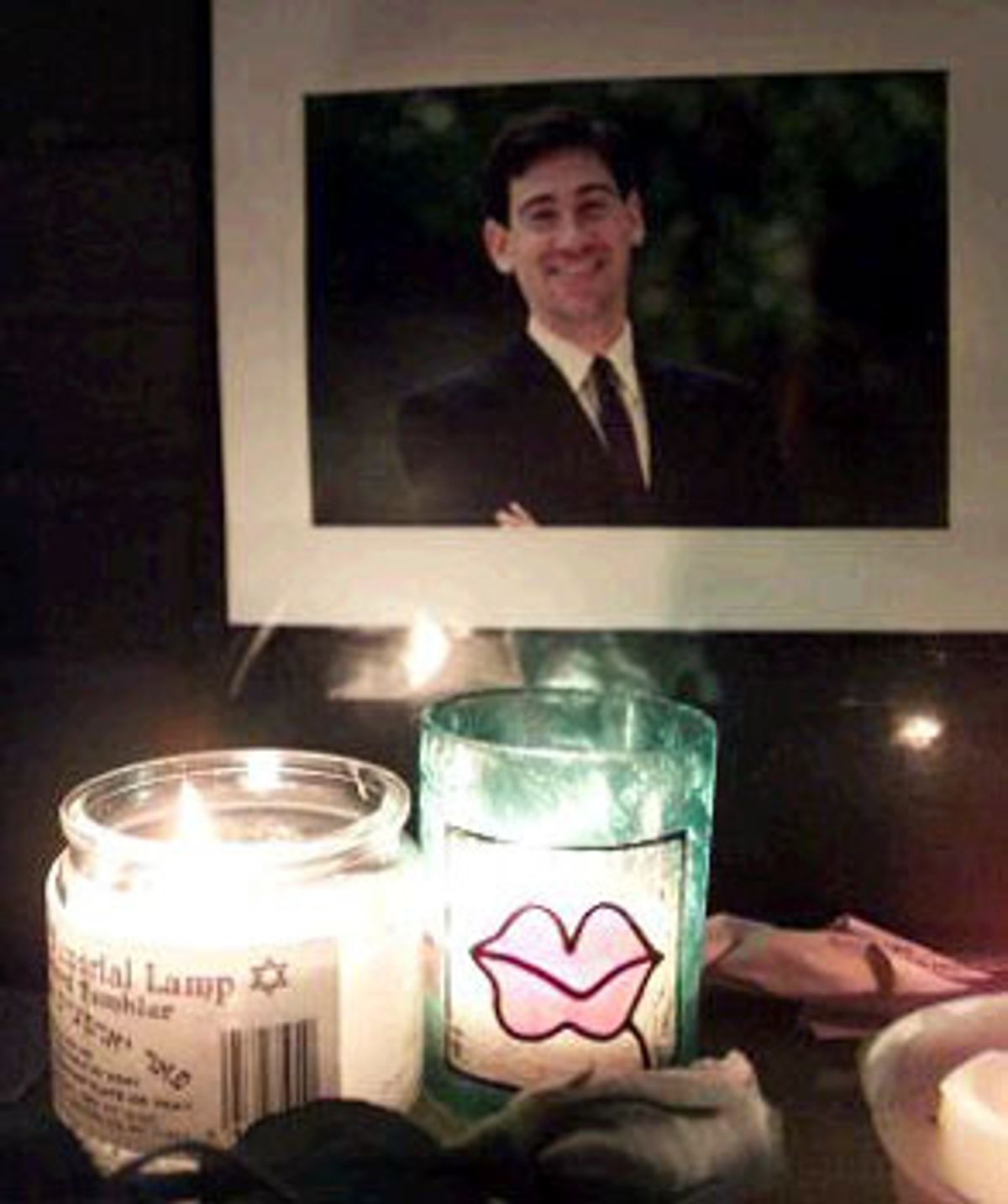
By Sunday night, the wall of hope extends for a block in all directions. There are children’s cards with messages like “Keep your head held high and hope and pray for all the people gone,” and “I am truly sorry. I will keep you in my prayers.” A multicolored canvas for well-wishers to write their thoughts on has messages like “Our hearts are broken but our spirit is alive,” and “We will never forget you.” The petals from thousands of flowers — red, yellow, white — have been fused to the ledge by trails of melted wax from the candles. People from all over the city are here reading the wall now, National Guard, police, volunteers and civilians. They walk slowly, tears in their eyes as they read the information on the posters. They’re not looking for anybody in particular; they just want to study the details of the missing, to pay their respects and to know who these people were. The wall of hope has become a memorial.

Tonight, the few people who are out are not letting themselves think in terms of being hopeful or not hopeful. David Vincent, 51, a high-ranking commodities manager for Eastman Kodak, has driven here from Rochester, N.Y., to find his daughter Melissa, a 28-year-old technical recruiter for Alliance Consulting who worked on the 102nd floor.

David approaches the whole thing like a law enforcement agent conducting an investigation. “These are the facts we have,” he tells me. Melissa was in the shower at 7:10 a.m., according to her roommates; she lives in Hoboken, N.J. and takes a bus to the train station, then takes a PATH train into work; she placed a 911 call at 9:02 a.m. and seven one-hundredths; the call lasted one minute. She had a meeting scheduled for 8:45 a.m. “It’s been described that she’s also traditionally a little bit late for work, about 15 or 20 minutes, which helps us believe that she might not have made it to the office,” says David. “Right now I have nothing that places her in that office at that time.” David hopes that maybe Melissa was still down in the subway area when the building collapsed.

He knows about the 911 call because he’s already obtained the logs from Melissa’s cellphone service provider. Now he’s working on getting the 911 transcript. “We know the 911 call was placed, we know to the hundredth of a second when it was placed, we know what call center it went into and we know it was recorded,” says David. But the NYPD won’t release a transcript, saying they have to sift through thousands of pages of transcripts before they can find that particular call. David is working on obtaining a court order. He also has his congressional representative, Louise Slaughter, applying pressure on the police department.

“People have asked me, how do I feel about the president being here, what do I think about the repercussions of all this,” says David. “I don’t feel anything. All I’m channeled on is finding my daughter. It’s completely tunnel vision. If you approach it differently than that, you can’t do what you have to do. That’s the way I’m built.”

Later that night, I spot Bertha. She seems subdued. I ask her if she’s had any news. “Has anybody had any news?” she asks. “They added a thousand names to the list today. They have a deceased list now.” She’s been spending her days at the Armory, she says, just waiting for updates and doing nothing else. Inside, she says, “There’s nothing. There’s no hurt, there’s no pain, there’s no anger, there’s no sense of closure. There’s nothing left.”

Without exception, everyone I speak to emphasizes how supportive everyone has been, how beautiful it is the way people have come together, how strangers have reached out to them, calling them from as far away as Brazil to express their love, condolences and sympathy. It’s as if the family members of the missing are trying to prove in their minds that the evil of the terrorist acts is outweighed by the goodness of what is going on around them. They are trying to convince themselves that even if some people are capable of extraordinary evil, people are fundamentally decent — the same sentiment expressed in the Anne Frank quote I see written on a sign in Union Square Park later that night: “I still believe, in spite of everything, that people are really good at heart.”

In the midst of all the suffering, the family members of the missing have formed a bond. Nelson tells me something I dismiss at first as exaggeration. “It’s not even about me finding my brother anymore,” he says. “Because even if I find my brother, there will still be people who don’t find their people. If somebody else finds their loved one, I find mine.”

Now, getting ready to go back inside the Armory, Bertha volunteers the same sentiment. “At this point, we love each other so much, we’re brothers and sisters inside the Armory,” she says. “We’re one family. If one person gets out, we’re equally as happy for that person as we would be for ourselves, for our own family member.”

The entire operation has now moved to 54th Street and the National Guard has taken back its Armory. But Bertha says, “I’m not going to leave my sister. I’m going to be there until I find her.”

Although search and rescue workers are continuing their efforts, Mayor Giuliani has been emphasizing to family members that they should prepare for the worst. On Tuesday, Giuliani said that finding a live survivor in the ruins at this point would be nothing short of a “miracle,” and announced that family members of those still missing could apply for death certificates.

A memorial service is planned for Lucy Fishman this weekend, and her family is struggling to accept the loss. But other families are not yet ready to move on. Luis and his family held a mass for Fanny last Saturday, but its purpose was not so much to say goodbye as to offer prayers of hope. “We heard that the governor announced you could get a death certificate,” says Luis’ brother Harry. “But Luis doesn’t want to do that. He’s holding on a little bit more.”

I can has cheezburger … and pathos?

The lolcats, the Internet's most famous felines, may be hilarious. But in their yearning, I see nothing less than the tragedy of the human condition.

  • more
    • All Share Services

I can has cheezburger ... and pathos?

The first time I saw a lolcat — those funny images of felines with grammatically questionable captions — it took me a minute to understand the joke.

“What’s with the misspellings?” I wrote the friend who’d IM’d me the link. “Cats are dumb and can’t spell?”

“Pretty much,” my friend replied.

“And they have bad grammar?” I wrote, still processing the idea.

“Yes,” he wrote. “Get it?”

I did. In fact, I couldn’t stop laughing.

By now, even the most casual observers of the Internet are aware that lolcats have become a certifiable Internet phenomenon. Their flagship site, Icanhascheezburger.com, is one of Web 2.0′s big success stories — on track to top a billion page views this year — and its content is entirely user-generated. Readers upload over 5,000 homegrown submissions every day, of which six or eight are posted on the site. And in October, the lolcats got their very own coffee table book, “I Can Has Cheezburger,” published by Gotham Books.

I love lolcats. I’m not ashamed to admit it. Sure, they’ve been around for almost two years — but the site posts fresh new jokes every day, and I’m never disappointed.

But what draws me to the site even more than what’s funny is what’s sad. My favorite lolcats are not the rapscallions pining for “cheezburgers” or helpfully upgrading your RAM, but rather a brilliant and underappreciated subgenre of sad lolcats — tragic figures of grief, yearning and unrequited love. But I’ll come back to that.

What makes lolcats different from the cat porn of the past — the motivational posters of the ’70s and ’80s featuring furry kittens hanging from tree limbs, covered in toilet paper or in some other kind of adorable predicament — is that lolcats aren’t trying to be cute. In the cat-based imagery of ages past, cats retain their iconic traits: curiosity, skittishness, the tendency to curl up in a ball and just lie there. Even the YouTube cats of today perform characteristically catlike actions, repeatedly flushing toilets, dragging their paws along piano keys or getting flung off the ends of treadmills.

Lolcats are different in that the characters they portray — and yes, they are portraying characters — don’t represent cats at all. They’re a completely different kind of beast, mischievous (if incompetent) rascals, scheming for cheeseburgers and stopping at nothing to get them.

Take the lolcat that started it all, created by a Hawaiian blogger named Eric Nakagawa, who posted it in January 2007. The image features a cat with a crazed look of pure animal hunger, its eyes maniacal with desire, asking, “I can has cheezburger?” Underneath is the comment: “The Internet’s piece de resistance, the website’s raison d’etre.”

This ur-lolcat created such a sensation that Nakagawa turned it into a blog, spawning not only the eponymous Web site but also a whole mythology. The cheezburger has become the Philosopher’s Stone of the lolcats mythos — the most prized, cherished and elusive object in their universe. It is for this reason that, when a tiny kitten being sniffed by a Great Dane 20 times its size needs a quick escape, it says, “I iz not cheezburger, kthxbai.” It is for this reason that when a user finds a photo of a cat sitting by the window with its paws in its lap, the caption reads, “I iz waitin for cheezburger man. Does you have a money?”

The Web is now spawning a wave of next-generation lolcats sites that take the lolcats concept and run with it. There’s lolpresident, loldogs, and even lolhan, a site devoted to Lindsay Lohan that includes such classics as “I layded you an egg but I’z hidin it.”

There’s lolcats magnetic poetry, lolcats translators, even a lolcats Bible Translation Project that renders familiar verses into Standard Feline English. The Supreme Being in the lolcats cosmology is “Ceiling Cat,” a meme that began with a photograph of a cat peering down from a hole in the ceiling — “Ceiling Cat is watching you masturbate” — then became so standard that this feline deity is now routinely worshiped.

Thus, Genesis 1:1 is rendered as, “Oh hai! In teh beginnin Ceiling Cat maded teh skiez an da Urfs.” (Satan, of course, is represented by a black cat called Basement Cat.)

This is all funny stuff. But I submit that the true genius of lolcats lies in their tragedy.

In one classic example, one cat is crying, and another is hugging it and saying, “Don’t crai. We’ll get cheezburger someday.” It’s sweet and poignant and wistful all at the same time. Life can be hard, it says, and we don’t always get what we want, but even as we long for things we may never have, we draw succor from the reassurances of those we love. Sure, it’s ridiculous that what the cat is yearning for is a cheeseburger. But the cheeseburger is not really a cheeseburger — it’s a symbol.

Here’s another: A brown and black calico looks out the window of his apartment only to notice a beautiful white female on the balcony across the way. His heart quickens, in the scenario I imagine, then he swallows hard and quickly looks away, unable to muster the courage to speak to her. The caption: “Evry dayz, 3 o’clockz … Mebe one day I sez meow to her.” Who among us hasn’t felt that longing and regret? Who among us hasn’t passed an attractive stranger in the supermarket or on the street, only to kick ourselves afterward for letting the opportunity slip between our fingers?

In fact, there’s a whole species of the genus Lol devoted to the tragic: the “lolwalruses,” or “lolruses.” If lolcats are incorrigible little rascals, lolruses are romantic heroes, born to suffer, whose lives are dominated by the exquisite misery of love lost. The lolrus meme originated with a single diptych. The first panel displays the walrus lovingly cradling a bucket, a look of absurd delight on its face. In the second panel, a trainer is ripping the bucket away as the walrus looks on in helpless panic. And the saga of the lolrus and its beloved bucket takes off from there.

Clearly, I’m moved by these pictures. But what is it about the lolruses and the sad lolcats that is so gut-wrenching?

To try to understand, I turned to Bob Mankoff, the New Yorker’s brilliant cartoon editor. After all, a lolcat is just an image with a caption — in other words, a cartoon.

The first reason sad lolcats can be so powerful, Mankoff suggested, is their comedic structure. The meaning of a lolcat is rarely straightforward — rather, there’s a punch line of sorts, a layer of meaning you have to think about for a moment in order to grasp. So the punch line, the same thing that makes the lolcat funny, is what makes it sad. You could call these tragic strips.

The best example I know of this kind of cartoon is one by Charles Addams that depicts a male and female unicorn standing on a sliver of land in the rain as Noah’s Ark sails away.  Having arrived too late, all the unicorns can do is watch the ark recede into the distance as the waters rise around them. The image conveys so much regret — the idea that we were so close, that we could still have these magical creatures among us today if only we’d been more patient. It’s the sadness of missed opportunities.

But the unicorn cartoon still has the structure of a joke. You have to “get” the extra layer of meaning, grasping that the unicorns aren’t, say, marooned on a desert island, but standing on a mountaintop as the floodwaters surge around them. “It’s not just sad, because something that’s just sad — someone being killed, run over — we know what that feels like,” says Mankoff. “Here, you’re using a mechanism that’s usually involved in humor: the cleverness of getting it.”

A second major factor in the poignancy of the sad lolcat, I would argue, is the use of animals. The comic form is generally a prophylaxis against sentimentality. By articulating profound feelings through cats and marine mammals speaking garbled English, we’re able to shroud genuine emotions in pseudo-irony — which means those animals can evoke deeper emotions without fear of mockery or cheapness.

Animals are also childlike and helpless. When we see a cute little dog in a New Yorker cartoon, it triggers the responses we have toward children. Cartoon dogs are childlike creatures: They’re cute and have big heads, big eyes, exaggerated, childlike features.

Of course, to express human emotions, you need an expressive face. “It’s cats, not scorpions,” says Mankoff. “It’s cats, not rats. If somehow on YouTube there was a rat flushing the toilet over and over again, we wouldn’t think it’s too interesting.”

It is because animals are able to move us so powerfully that many tragic strips use animals instead of people. In one New Yorker cartoon, a dog is lying on the couch, while another dog, his therapist, sits in a chair and takes notes. “They moved my bowl,” says the dog on the couch. The message isn’t really about the moving of bowls at all, but about our problems in life, our frustrations, our sense of being victims.

“The animals aren’t animals at all, they’re stand-ins,” explains Mankoff. “They’re hybrids we use as devices to talk about the feelings we can’t name in other ways.”

The same is true of the sad lolcats and the lolruses. Consider LolSecretz. It’s like PostSecret.com — which publishes anonymous bathroom-wall-variety confessions (“I had gay sex at church camp,” “I only love two of my children,” etc.) — except it uses images of cats. In one, a black cat says, “I just wishes I wuz white.” In a third, a world-weary cat with dead eyes gazes longingly at a knife, saying, “i killed mahself 6 timez … 3 to go.”

Just as the dogs in the New Yorker cartoons don’t represent actual dogs, these cats don’t represent cats at all, but people. By using cats, icanhascheezburger can access themes more tragic and poignant than it could using people. You wouldn’t enjoy a comic of an actual person fingering a blade and contemplating suicide — but when it’s a cat, you can accept it. You can even laugh.

And that’s the real answer to the puzzle. We’ve gone from cats as cats, to cats as scheming rascals, to cats as human beings. The sad lolcats represent people. We have seen the lolcats, and they are us.

Continue Reading Close

A banner day for neo-Nazis

Last month, Hatewatch shut down, declaring that the battle against hate groups has been won. It hasn't.

  • more
    • All Share Services

Six years ago, I declared in an article for a Yale University magazine called the New Journal that “the Internet may be the best thing that has ever happened to help the struggle to spread the word of white power.”

I concluded the article by referring readers to a then recently created Web site called Hatewatch, a watchdog site that indexed and linked to hate groups on the Internet in order to expose them, while also linking to sites devoted to debunking hate propaganda. Citing a statement by essayist Logan Pearsall Smith — “How it infuriates a bigot when he is forced to drag out his dark convictions” — Hatewatch operated on the principle that the best way to combat hate was to expose it for what it was, to fight hate speech with more speech.

So I was shocked last month to read that Hatewatch was shutting its doors. First started in 1995 by a Harvard Law School librarian named David Goldman, Hatewatch was the first major site to track online hate groups — the neo-Nazis, white supremacists, Holocaust deniers, Klansmen, black nationalists and gay bashers who saw the Internet as their chance to spread their messages to the world. It attracted incredible media coverage, helped to focus public attention, provided a reference for law enforcement and attracted 1 million visitors a year.

But Goldman thinks that Hatewatch has done its job. “We have succeeded in fulfilling the mission we set for ourselves,” he wrote in a farewell message posted on the site. After six years of heading the volunteer-run organization, Goldman was ready to move on. Bolstered by news that hate sites simply weren’t proving to be such powerful recruitment tools as many had feared and by indications from other anti-hate organizations that the prognosis wasn’t as dire as once believed, Hatewatch’s founder argued that while hate groups once flourished in the shadows, they simply couldn’t thrive under the bright lights of the Internet:

From the beginning, these organizations’ self-proclaimed desire to create a digital “white revolution” was carefully monitored and documented by civil rights organizations, Hatewatch among them. The standard and often repeated quote was that the “Internet is the greatest thing to happen to hate.” Much to our joy it has in fact been one of the worst.

Goldman says the slumping Internet economy was not a factor in the decision to shut down Hatewatch. Although Hatewatch was a registered nonprofit agency, it got scant funding. At the same time, it required very little money to run. Hatewatch benefited from the efforts of hundreds of unpaid volunteers every month, and Goldman and the four other employees never drew a salary. It was simply time to pass the torch.

“I felt as if I needed to step back from the material itself — and, hopefully, for people to see the vacuum that was left by Hatewatch to step into that. I’m not a professional civil rights activist. I’m a librarian by trade.”

Goldman’s decision to shut down Hatewatch was roundly criticized by other anti-hate organizations, like the Anti-Defamation League and the Simon Wiesenthal Center. If hate sites had turned out to be less threatening than expected, wasn’t that due, in large part, to the efforts of sites like Hatewatch? A closer look at how hate groups use the Internet suggests that, if anything, Hatewatch was due for an expansion.

Hatewatch has always been controversial. Film critic Roger Ebert famously attacked it, and debated Goldman at the Conference on World Affairs. By linking to hate sites, Ebert argued, Hatewatch gave free publicity to haters, providing a “virtual supermarket” of hate tools for bigots of all stripes. While other sites, like the ADL’s, flagged the lies and distortions on hate sites, Hatewatch merely provided links to sites — where the groups could describe themselves however they wanted.

Still, Hatewatch was an effective tracking tool. If the Internet was going to turn small, isolated groups into a large, organized movement, Hatewatch was going to ensure that such an expansion took place in the open. And it succeeded in that goal, drawing thousands of visitors a day and extensive media coverage.

But Hatewatch’s success was limited by its own design. In fact, Hatewatch was based on a number of largely unfounded fears about the way that hate on the Web would proliferate.

Until recently, common wisdom held that the Internet would cause the number of hate groups to grow out of control. A recent advertisement sponsored by the Simon Wiesenthal Center reads, “On the day of the Oklahoma bombing, there was one hate site. Now there are over 2,000.”

But many critics have questioned these numbers. For starters, they make no distinctions about the nature and severity of individual sites — from hardcore white supremacy sites to sites that include racist jokes or a recipe for a pipe bomb. Second, it has always been hard to differentiate between the Web sites of major hate groups and organizations consisting of a lone member. How many people does each of these hate sites represent? Third, the increase in hate sites — like the increase in the overall number of Web sites — partly reflects the fact that more and more people and organizations are getting online. Adding to the confusion is the fact that many groups have more than one domain name and operate multiple sites. Taking all of these factors into consideration, a more conservative estimate by the Southern Poverty Law Center puts the number of hate sites closer to 400.

Another fear was that the Web would become a major recruitment tool for hate groups. But there is no statistical evidence showing that the Web has led to an increase in membership. The Southern Poverty Law Center estimates that the membership of hate groups has remained about the same over the past few years.

What’s more, many people have long worried that the Web would not only provide a forum for hate but could actually provoke people to violence. In 1998, Salon suggested that hate sites on the Internet might be “the main culprit behind the epidemic of hate crimes,” citing the murder of Matthew Shepard. A “Dateline NBC” special report called “Web of Hate” reported that Benjamin Smith — the 21-year-old college dropout who went on a shooting spree in Indiana and Illinois in 1999, firing at African-Americans, Asian-Americans and Jews, and killing two and wounding nine — had been inspired by the rhetoric he found on the Web site of Matt Hale’s group, known as the World Church of the Creator. But aside from a few anecdotal reports, there is currently no statistical evidence to suggest that Web sites directly provoke people to violence. Evidence may yet surface linking Web sites to violence, but so far, that connection is not as clear as people feared it would be.

Hatewatch may indeed have overestimated the number or significance of the hate groups it dragged into the spotlight. But if anything, the group underestimated the task at hand. When Goldman announced the demise of Hatewatch he was, in effect, conceding that Hatewatch had outlived its usefulness. Instead of closing shop, he should have expanded it. Hatewatch’s job was far from done.

For one thing, the Internet still provides a virtual community for haters in rural locations. It gives a scattered group of people a means to communicate with one another in secret, trade goods, sell things, publicize their events and potentially inspire others to action — without the threat of interference from anti-haters. Many haters have trouble finding a place to meet in the brick-and-mortar world where they won’t encounter opposition from anti-hate activists. Hale, for instance, can hardly hold a meeting without getting attacked by protesters. And Klansmen are regularly outnumbered at Klan rallies by anti-hate protesters. For these people, the Internet is a safe haven.

Web sites may not offer a reliable count of how prolific hate sites are (or how numerous their members), but they act as introductory brochures to the ideology of a particular group. Most sites don’t change much over time, and they aren’t places people return to again and again. Instead, people might make contact via a Web site, and then quickly move on to text-based, person-to-person venues such as discussion groups, chat rooms and e-mail. “That is really where you see discussions of ideology, discussion of tactics, things that give you insight into what’s going on in the movements,” says Mark Potok, editor of the Southern Poverty Law Center’s Intelligence Report.

The anti-hate community overestimated the impact of the Web and underestimated the importance of chat rooms, newsgroups and e-mail. For Hatewatch to focus on Web sites alone — as opposed to other forms of Internet communication — was anachronistic. “Everyone was going crazy over these sites,” says Ken Stern of the American Jewish Committee. “I think there’s a parallel with how the stock market was going crazy over Internet-related things.”

Hatewatch should also have expanded to track haters’ fundraising. The Internet has proved to be an unexpected financial boon to many white supremacists, particularly those involved in the genre of music known as hate rock, helping them do more business and raise more money for their cause. William Pierce, one of the world’s most notorious racists, paid $250,000 to acquire Resistance Records and its Web site. This year he expects to do more than $1 million in business, much of it through Web orders. “There’s a whole world of e-commerce out there centered around hate,” says the ADL’s Jordan Kessler. Sometimes, haters sell items that are not clearly connected to their beliefs, so they can make money without their customers knowing who they’re doing business with. By keeping track of how hate groups are raising money, Hatewatch could have helped people who might inadvertently be supporting them.

Hatewatch should also have expanded beyond its exclusive focus on hate groups per se. The latest trend in hate organizations is “leaderless resistance,” in which haters are encouraged not to join groups but rather to become “lone wolves” and act alone. The rationale is that by joining a hate group, a hater becomes known to civil rights organizations. By promoting solo activism, hate groups also protect themselves from legal liability they faced in the past, as when Tom Metzger, leader of the White Aryan Resistance, was found guilty of inciting murder and jailed after three members of his group beat an Ethiopian student to death in Portland, Ore. By tracking these exchanges, and free-agent haters, Hatewatch could have provided useful insights into how organizations like the World Church of the Creator operate.

Where hate flourished less than expected, Hatewatch worked, and where hate flourished more than expected, Hatewatch could have done more. As professor Donald Green of Yale University’s Institution for Social and Policy Studies puts it, “If a stop sign augments traffic safety, why tear it down?”

Continue Reading Close