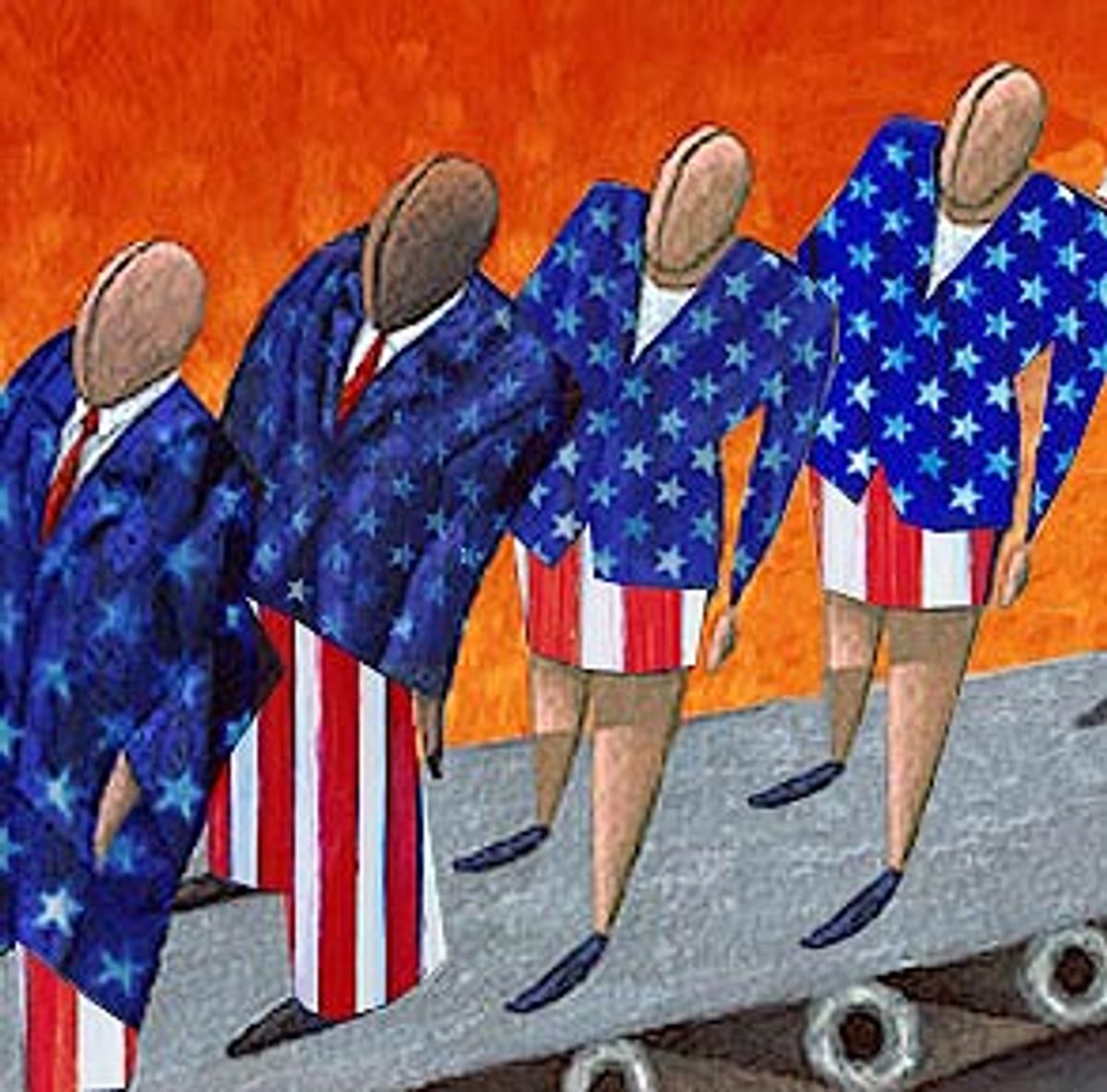
First Amendment

Democracy held hostage

We are fighting for freedom -- including the right to vigorously debate. But the war fever crowd wants us all to march in step.

Truth is not the only early casualty of war. So is rational thought. War breeds hysteria and a rush to conformity. The herd, under attack, instinctively groups together and seeks assurance that everyone is trustworthy and loyal, everyone is primed for defense.

That’s what we’re experiencing in our country in the weeks after the Sept. 11 terror attacks — assaults so seemingly out of the blue, dramatically violent and diabolically orchestrated that they shook the nation’s confidence to its core. Within hours after the terror offensive, before the shock had begun to fade, the country’s political leaders and media elite rushed to assure us that the country was united and resolute. This was certainly true when it came to giving aid and comfort to the victims of the attacks. These were days of unprecedented national heroism and generosity. But as the weeks go by, it becomes increasingly clear that when it comes to the more vexing questions of why we were attacked and how we should respond, there is no national consensus yet — nor even a clear consensus within the Bush administration.

The country is undergoing a cram course in geopolitics, comparative religion and military strategy that is long overdue — as well as a deeper soul-searching that is inevitable after this type of trauma. All of this brings with it a certain amount of intellectual and political friction, which is necessary and good for the country. As the better angels of the Bush administration have admonished us, the last thing America should do is let loose the usual round of ineffectual military fireworks — a spasmodic reaction that might temporarily salve the wound to the nation’s pride, but create even deeper troubles for us. What we need more than anything right now is careful deliberation and spirited debate. We need, in short, for our democracy to come fully alive.

Unfortunately, the calls for herd-like conformity are on the rise. In the last week, self-appointed sheep dogs from across the political spectrum have begun yapping at our heels, pushing us to all think alike and move in the same direction. When “Politically Correct” host Bill Maher dared suggest that the American habit of shooting cruise missiles at enemies from safe distances was “cowardly,” he was quickly alerted that he had gone beyond the bounds of acceptable discourse — even though that’s his job. (Remember, his show is called “Politically Incorrect.”) Several local TV stations promptly dropped his show, FedEx and other sponsors cancelled their contracts, and even after Maher issued an apology, White House spokesman Ari Fleischer felt compelled to pile on — despite the fact that his own boss had also snorted at the cruise missile strategy, which, in the president’s words, only menaced camels’ behinds and empty tents. Fleischer used the Maher controversy to issue this creepy Orwellian pronouncement: “Americans need to watch what they say, watch what they do, and this is not a time for remarks like that; there never is.” (Creepier still, someone in the White House then took scissors to the official transcript of Fleischer’s remarks to make them less chilling.)

Susan Sontag was similarly singled out for censure in the editorial pages of the Wall Street Journal and other thought-police strongholds. Her crime? She ventured to say that the American people are not being served by a political and media caste that seeks only to reassure us, instead of enlightening us: “Our leaders are bent on convincing us that everything is OK … We have a robotic president who assures us that America still stands tall … But everything is not OK … The voices licensed to follow the event seem to have joined together in a campaign to infantilize the public. Where is the acknowledgement that this was not a ‘cowardly’ attack on ‘civilization’ or ‘liberty’ or ‘humanity’ or ‘the free world’ but an attack on the world’s self-proclaimed superpower, undertaken as a consequence of specific American alliances and actions?”

One might not agree with Sontag’s characterization of the terror attack, but it certainly should be allowed for consideration amid all the mandatory media flag-waving. Even those who are bent on a massive military response would do well to know more about our enemy before we attack. One can agree, as I do, with Christopher Hitchens’ definition of our enemy as “Islamic fascists” bent on imposing the same “bleak and sterile theocracy” on our society as they have on theirs — and still call for prudence as we contemplate the enormous challenge of counterattacking a rising ideology, not simply an army. This fanaticism is made even more daunting an enemy by the fact that it has gained a foothold not just in rogue nations, but throughout the Middle East, even in so-called friendly countries, and perhaps most alarmingly in politically unstable, nuclear-armed Pakistan.

Certainly there are voices on the left — Noam Chomsky’s among the most prominent — for whom no U.S. military action would ever be justified, even when the nation is directly attacked as it just was. But these reflexively anti-American or doctrinaire pacifist voices are a small minority within the vast population to the left of George W. Bush. And yet to conservatives like David Horowitz and Andrew Sullivan they are representative of a sprawling fifth column of “appeasers.” This broad-brush attack ,of course, serves these conservative pundits’ agenda. They claim they are motivated by a profounder sense of patriotism than their opponents’ when they demand that Bush critics fall in line behind the president. But their true aim is political. They want to use the current crisis to settle old political scores, rally support for our less-than-commanding commander in chief, and stifle legitimate dissent. This is not patriotic, it’s antidemocratic. What’s more, it’s against the national interest.

As Bush administration officials keep reminding us, everything is different about this war. It’s clear that our leaders have not yet figured out how to deal with this enormously complex threat. They’re not even certain it is a war. What we need now, more than ever, is the widest and most energetic debate as the country makes sense of what has happened and how to respond. We don’t need blind conformity. We need fearless self-scrutiny. What should the U.S. role be in the Middle East? How should we strike back against our foes without spreading the fires of Islamic fanaticism? Why do the impoverished populations of the region find radical fundamentalism more enthralling than the benefits of Western culture?

But the sheep dogs are quick to snarl that this kind of talk is left-wing equivocation. Bellicosity now rules, from the New Republic, which denounces the “fatalism” of America’s cautious “elites,” to the Weekly Standard, which accuses the New York Times of “moral idiocy” for running occasional pieces critical of Bush in our time of crisis. Some of the loudest saber-rattling has been coming from the National Review, which on this week’s cover roars the full-throated battle cry, “Let’s Roll!” and predictably attacks the “blame America first” fifth columnists in our midst.

As usual, it’s often the armchair generals — like radio brigadier Rush Limbaugh, who managed to avoid military service during the Vietnam war — who cry the loudest for blood. These soft-fleshed but eager warriors were undoubtedly dismayed by this week’s reality check from the Defense Department’s reigning hawk, Paul Wolfowitz: “I think it can’t be stressed enough that everybody who is waiting for military action needs to rethink this thing.”

So far, the Bush administration has displayed admirable patience despite the pressure for immediate vengeance. After his swaggering cowboy talk of “smoking them out” and “hunting them down,” Bush has tempered his language, reportedly on the sage advice of his more experienced father. Under the leadership of Secretary of State Colin Powell, the administration is now working hard to assemble an international coalition, including key Arab states, to isolate and defeat the terrorist movement. This difficult task is made even tougher because of the arrogant unilateralism of the Bush administration’s first seven months, a go-it-alone strategy that alienated even our European allies, got the U.S. thrown off the U.N. Human Rights Commission, and put us on the Middle East sidelines as the growing sparks from the Israeli-Palestinian conflict lit up the entire region.

Before Sept. 11, Powell himself seemed sidelined, pushed aside by administration hard-liners. Fortunately, in the past two weeks, the White House seems to have recognized that it urgently needs Powell’s experience and diplomatic craft. This global acuity certainly can’t come from the president himself, one of the least traveled and most internationally uninformed chief executives in American history (a man, let us recall, who during last year’s campaign couldn’t name the leader of Pakistan, Gen. Pervez Musharraf — a figure who now looms large in Bush’s first global crisis).

While Powell is a reassuring force to the international community, he is a primary target of the bellicose American right. While clamoring for the left to keep its silence and rally behind the president, these conservatives have no qualms about hectoring Bush, demanding that he jettison Powell and declare war on virtually the entire Islamic world. In a recent open letter signed by over 40 leading conservatives, including William Bennett, Jeane Kirkpatrick and William Kristol, the group pressures Bush to not stop with bin Laden and his network, but to extend the war into Iraq, as well as Iran and Syria if they don’t withdraw support from the radical Hezbollah group.

It’s not only conservative pundits calling for democracy to be put on hold for the duration. More distressingly, the silence-is-patriotic mentality has also gained momentum in the Democratic Party, the press and even liberal activist circles. On Capitol Hill, Democratic leaders suddenly sound accommodating about Bush’s missile defense plan — an astronomically expensive and militarily dubious dream that, in light of what we’ve learned about terrorists’ likely choice of weapons, cries out for more congressional scrutiny than ever. Many Democratic challengers in next year’s elections are also throwing in the towel, declining to run after somehow concluding that democracy is unpatriotic in days like these. And Jimmy Carter, who last summer could find nothing to commend about the Bush administration, now calls upon his fellow citizens to support the president with “complete unity.”

Meanwhile, the Sierra Club has taken down its “W Watch” department from its Web site, for fear of not seeming sufficiently respectful toward the president. “Now is the time for rallying together as a nation; the public will judge very harshly any groups whom they view as violating this need for unity,” announced the Sierra Club spokesman, sounding as if he had been programmed by Ari Fleischer. Of course, Big Oil’s friends in the Bush administration and GOP felt no similar need to make peace with the Sierra Club during these days of national unity, taking the opportunity to renew their assault on the Arctic National Wildlife Refuge.

The major press organizations have also taken pains to seem properly deferential toward the Bush administration. There were no loud cries about press freedom when Defense Secretary Donald Rumsfeld made it clear that much of the U.S. war on terrorism would be conducted in secret. One military official went even further, blithely informing the Washington Post, “We’re going to lie about things.” While not even the most aggressive reporters would demand classified information that could put soldiers’ lives at risk, the Pentagon clearly wants to go further than that in controlling news about the war. “No more televised Vietnams” remains the Defense Department’s mantra; Bush II wants to keep the news as scripted as it was during Bush I’s Persian Gulf War.

An elite press consortium made up of the New York Times, Washington Post, Wall Street Journal and CNN also apparently handed the Bush administration another big favor this week when it indefinitely delayed making public the results of its Florida election recount. The long-awaited analysis of 200,000 disputed ballots from the presidential election was supposed to be published on Monday, but the Times quietly informed its readers in a Sunday essay by political reporter Richard Berke that the “move might have stoked the partisan tensions” and “now seems utterly irrelevant.” A journalist involved in the project later told Inside.com, “There’s a sense that now is not the time to be writing about something that might make it look like someone else should have been elected president.”

The Times’ decision to withhold information that is clearly the public’s right to know is a startling one, and in its desire to avoid reopening potential wounds, more therapeutic than journalistic. In 1971, a much more divisive time in the nation’s history, the Times was motivated more by First Amendment considerations than by appeals to a narrow patriotism when it pressed to publish the Pentagon Papers. In lifting the restraining order that the Nixon administration had brought against the Times, U.S. District Judge Murray Gurfein, a Nixon appointee, agreed that the paramount value for the press — even in a time of heightened national security concerns — must be the public’s right to know. “The security of the Nation is not at the ramparts alone,” declared Gurfein in his surprisingly passionate decision. “Security also lies in the value of our free institutions. A cantankerous press, an obstinate press, a ubiquitous press must be suffered by those in authority in order to preserve the even greater values of freedom of expression and the right of the people to know.” It would be wise of the Times and the rest of the press to keep these words in mind during these fearful times as the government feels emboldened to clamp down on the flow of information.

Some smaller newspapers were much more blatant in their hurry to abandon the First Amendment. Earlier this week, the Daily Courier in Grants Pass, Ore., fired a columnist who criticized Bush for “skedaddling” on Sept. 11 and “hiding in a Nebraska hole.” The paper’s editor, Dennis Roler, announced that only “responsible and appropriate” criticism of the president would now be allowed. Perhaps he hasn’t read the Walter Lippman quote emblazoned on the top of his own Web site: “The theory of a free press is that truth will emerge from free discussion, not that it will be presented perfectly and instantly in any one account.”

Les Daughtry Jr., publisher of the Texas City Sun, showed an equally uncertain grasp of the principle of free speech when he promptly fired city editor Tom Gutting for writing a similar opinion piece about Bush. Daughtry then felt compelled to engage in a humiliating bout of Maoist-style abnegation, apologizing not only to his readers but to “all our country’s leaders and especially President George W. Bush” for temporarily allowing his city editor to exercise his First Amendment rights. Feeling he had not gone quite far enough in his exaltation of the president, Daughtry penned a second letter to his readers. declaring that Bush has “the full support of virtually every citizen in the United States, except, of course, Tom.”

America suffered grievous, unprovoked injuries on Sept. 11 that no nation should passively endure. A vast majority of the American people ardently supports President Bush’s vow to bring the organizers of this terror “to justice, or justice to them.” But maintaining this consensus as Bush leads the country into battle will not be easy. To do this the administration must convey a clarity of purpose and an honesty which have thus far been in short supply. When White House vizier Karl Rove and Ari Fleischer feed an egregious lie to the public about why the president did not immediately return to the White House on Sept. 11 — insisting that Air Force One and the White House were under threat — and then try to spin their way out of it when the story unravels, that does not inspire confidence. When Colin Powell promises that the administration’s evidence against Osama bin Laden will be shortly revealed to the world and the next day this evidence is suddenly declared classified information, it only adds to the skepticism about the government’s anti-terror operation, even among our allies.

Franklin Roosevelt proved a master at building support for last century’s epic struggle against fascism. Before Pearl Harbor, he faced strong isolationist and anti-draft sentiment; afterwards, he had to grapple with a press and public prone to marked mood swings, rising and falling with the country’s fortunes on the battlefield, and a home front that was often torn by racial and labor conflicts. Yet he reached out to the Republican Party to build bipartisanship, cultivated the press, and most importantly eloquently conveyed to the American people why we were fighting and the enormous significance of the outcome. He mobilized the country for its historic conflict without resorting to the totalitarian measures of our enemies — with the glaring exception of the internment of Japanese Americans, a tragic misstep that some of our current paranoid fringe are now clamoring to inflict on Arab-Americans. “Though the United States was miserably unprepared for war in the spring of 1940,” observed Doris Kearns Goodwin in “No Ordinary Time,” her study of FDR’s wartime White House, “Roosevelt never doubted that the American people would eventually win the war, that the uncoerced energies of a free people could overcome the most efficient totalitarian regime.”

Lyndon Johnson and Richard Nixon, in contrast, utterly failed to build a winning consensus for the Vietnam war. This was partly due to the two presidents’ paranoid and autocratic style. But, more significantly, Johnson and Nixon were in charge of a war that was vastly more difficult to justify than World War II. While a case could certainly be made that defeating a communist takeover of the country was a noble cause, it was much harder to convince Americans that the North Vietnamese were a threat to their way of life. And the U.S. military, despite its strenuous efforts to win the hearts and minds of the Vietnamese people, never succeeded in uncoupling the communist dictatorship of Hanoi from the legitimate nationalist aspirations of the country’s majority.

America’s latest war has already opened many of the old Vietnam wounds, with conservative critics charging that the current voices of “appeasement” are the same ones that stabbed the U.S. in the back in Southeast Asia. But this is not the right lesson to take from Vietnam. It was not the antiwar movement that blocked an American victory over Hanoi; the war itself was unwinnable without escalating it to a level that would have risked nuclear war with China and the Soviet Union. It was unwinnable because most Vietnamese, who we were ostensibly fighting for, did not want us to win it. The lesson, then, to be learned from Vietnam as we confront our latest totalitarian foe is that the American soldiers must never again be sent to countries where their mission is impossible and the majority of people regard them as the enemy.

Peter Feaver in the conservative Weekly Standard persuasively argues that the best analogy to “America’s New War,” in CNN’s horrid marketing phrase, is the Cold War. Like the global war against communism, the war against terrorism must be fought on an ideological as well as military level, and much of it will be carried out through diplomacy, espionage and “shadow conflicts.”

Considering that our enemy is a fanatical strain of Islam that has taken deep root in a burgeoning, youthful generation throughout much of the Muslim world, the struggle is also likely to be protracted, lasting much longer than one presidential term. “If fundamentalism seems particularly rife in the Muslim world this is because of the population explosion,” observes religious scholar Karen Armstrong. “To give just one telling example, there were only 9 million Iranians before World War II; today there are 57 million and their average age is 17. Radical Islam, with its extreme and black and white solutions, is a young person’s faith.”

Our “war” on terrorism, then, only fits the definition in a metaphorical sense. It will be vastly harder to conduct such a struggle, because the enemy is a belief system, not a nation state. And our first goal must be to understand why Western culture — with all its consumer toys, action movies and seemingly unlimited freedoms — is not as compelling to these millions of young people as a religious mission whose greatest expression of faith is martyrdom.

In light of the complexity and likely duration of this conflict, it is essential for the Bush administration to build a deeply entrenched public consensus — and this can’t be done by lying, hiding information, short-circuiting civil liberties or any of the other old “national security” techniques of suspending democracy. Consensus, instead, must come over time from thorough and open debates, as Feaver recognizes: “Many of these debates will be specious, but not all will be. Indeed, the Second Cold War may be harder to fight than the last one, leaving ample room for responsible disagreements among reasonable people. We will have to nurture those debates, learn from them, and forge the best possible policy in an extraordinarily difficult political climate.”

In the end, it won’t be military superiority that determines the outcome of this war. As our implacable fundamentalist foes have told the world, this is a war of values. We cannot win by sacrificing ours. If democracy and freedom are to win over the forces of terror and theocracy, they first must flourish at home.

David Talbot

David Talbot is the founder and CEO of Salon.

Convicted for words, not deeds

Verdict on Massachusetts Muslim marks further erosion of fundamental U.S. rights

Tarek Mehanna of Sudbury, Massachusetts convicted on terrorism charges. (Credit: Reuters)

BOSTON — Call it “the week that was” when it comes to shredding the Constitution. First the Senate passes a rider to the defense bill that would make it legal for the military to arrest American citizens anywhere in the world, including U.S. soil, at the whim of the executive branch — this or any future executive branch.

Then comes the conviction yesterday of a Massachusetts man for viewing and translating jihadi videos online. The eight-week trial featured starkly contrasting portrayals of the bearded Muslim, Tarek Mehanna, a Sudbury, Mass., fundamentalist who traveled to Yemen and has made no secret of his contempt for U.S. foreign policy.

His Boston legal team haloed him as a kind and loving man, if an angry and opinionated intellectual type. They argued he was being persecuted for his disapproval of  U.S. foreign policy. The government countered with the belief that Mehanna was just the sort of hater who’d take glee in seeing Americans getting gunned down in bloody shopping malls.

American Muslims took it on the chin big-time this week, between the Mehanna case, the more troubling rider to the 2012 National Defense Authorization Act now waiting for the president’s signature, to say nothing of home improvement chain Lowe’s yanking sponsorship of the “All American Muslim” show on TLC.  If the president signs the defense bill unamended, it will represent the single biggest civil liberties betrayal of his presidency.

The implications are profound and simple.

“They both came out the same week, but they are part of a pattern of putting to one side the fundamental freedoms we’ve taken for granted. We’re into a whole new legal terrain,” said Nancy Murray of the Massachusetts chapter of the American Civil Liberties Union. ”As the Senate gutted the Bill of Rights, just as it gutted the right to due process and the right to trial by jury, the whole notion of presumption of innocence goes out the window. And the scary thing is that it could be applied to all U.S. citizens.”

When not watching Lowe’s ads on the popular reality show, Muslim parents are sure to hit the pause button for a quiet word with their children about expressing strident opinions online. And they won’t mean maybe, either, because sentencing for Mehanna is set for as soon as April 12, and he may never see the light of day again — he could be sentenced to life in prison.  The message is unequivocal: You’d better watch your Muslim mouth. 

Mehanna made no bones about watching jihadi videos and translating them for friends; no bones about lending CDs to people in the Boston area in order, as the prosecution asserted, to create like­-minded youth; no bones about  discussing with friends his views of suicide bombings, the killing of civilians, and dying on the battlefield in the name of Allah. He translated texts that were freely available online and looked for information there about the 19 9/11 hijackers too. He even inquired into how to transfer files from one computer to another, and how to keep those files from being hacked.

However unpopular those acts may be, civil libertarians say they fall well within the margins of First Amendment protection. They are bracing themselves for repeal, but their immediate concern is the ending of posse comitatus, a far more serious matter. If the president, a constitutional scholar, signs the Senate-passed defense bill as is, then in the stroke of a pen he’ll have re-answered the age-old joke: “Is this a free country, or what?” The answer will be a resounding “or what,” but it’s no joke. Coming on the same week that the Bill of Rights had its 220th anniversary, you have to ask what’s more depleted these days: America’s outrage or its unkeen sense of irony?

The ACLU of Massachusetts submitted a brief in the Mehanna case, but it was refused by Judge O’Toole, who felt it was not suitable for this trial. The amicus curiae urged the court to proceed with the utmost care to prevent protected speech from constituting the sole basis for charges of conspiring to provide material support to terrorist groups. The brief said Mehanna had “engaged in discussions and watched and translated readily available media on the topics of global politics, wars, and religion, all of which are topics of public concern. That his views may be offensive or disagreeable, or that they may ‘create like-minded youth,’ is of no consequence to the heightened protection to which his expression is entitled as a result of the First Amendment.”

Through such acts Mehanna was convicted yesterday of conspiracy to provide material support to al-Qaida. If such speech is not protected as a free expression under the First Amendment, “then the government’s implicit view that such speech could alone support conviction threatens to render the material support statute a vehicle for the suppression of unpopular ideas, contrary to the dictates of the First Amendment and fundamental American values.”

Civil liberties advocates make the “slippery slope” argument. In the 2010 case Holder v. Humanitarian Law Project, which decided whether providing nonviolent aid like legal advice to terrorist groups constitutes material support for terrorism, the Supreme Court ruled that you can advocate as an individual, but if your advocacy is coordinated with an outfit on a terrorist list, then it’s criminal conspiracy and you can be convicted of giving terrorist support.

The ACLU believes that Mehanna’s activities were not shown to meet that test, “so the real reason for convicting him seems to be missing,” Murray said. “The trial featured all sorts of allegations of traveling but there was no hard proof that his advocacy was coordinated with a group.”

Grounds for appeal appear to be more than ample. “For one thing,” said Murray, “the courts should be very worried that it criminalizes unpopular speech. The First Amendment should’ve protected his translating material that he read on the internet. Unless they could’ve said he was doing that at the behest of a terrorist group, they’ve never actually made that direct connection.”

Continue Reading Close

Inside the attack on the First Amendment

An op-ed got Davis fired from his government job. He's hardly the first to have his free speech rights trampled

Colonel Morris Davis (Credit: Wikipedia)
This originally appeared on TomDispatch.

Here’s the First Amendment, in full: “Congress shall make no law respecting an establishment of religion, or prohibiting the free exercise thereof; or abridging the freedom of speech, or of the press; or the right of the people peaceably to assemble, and to petition the Government for a redress of grievances.”

Those beautiful words, almost haiku-like, are the sparse poetry of the American democratic experiment.  The Founders purposely wrote the First Amendment to read broadly, and not like a snippet of tax code, in order to emphasize that it should encompass everything from shouted religious rantings to eloquent political criticism.  Go ahead, reread it aloud at this moment when the government seems to be carving out an exception to it large enough to drive a tank through.

As the occupiers of Zuccotti Park, like those pepper-sprayed at UC Davis or the Marine veteran shot in Oakland, recently found out, the government’s ability to limit free speech, to stopper the First Amendment, to undercut the right to peaceably assemble and petition for redress of grievances, is perhaps the most critical issue our republic can face. If you were to write the history of the last decade in Washington, it might well be a story of how, issue by issue, the government freed itself from legal and constitutional bounds when it came to torture, the assassination of U.S. citizens, the holding of prisoners without trial or access to a court of law, the illegal surveillance of American citizens, and so on.  In the process, it has entrenched itself in a comfortable shadowland of ever more impenetrable secrecy, while going after any whistleblower who might shine a light in.

Now, it also seems to be chipping away at the most basic American right of all, the right of free speech, starting with that of its own employees.  As is often said, the easiest book to stop is the one that is never written; the easiest voice to staunch is the one that is never raised.

It’s true that, over the years, government in its many forms has tried to claim that you lose your free speech rights when you, for example, work for a public school, or join the military. In dealing with school administrators who sought to silence a teacher for complaining publicly that not enough money was being spent on academics versus athletics, or generals who wanted to stop enlisted men and women from blogging, the courts have found that any loss of rights must be limited and specific. As Jim Webb wrote when still Secretary of the Navy, “A citizen does not give up his First Amendment right to free speech when he puts on a military uniform, with small exceptions.”

Free speech is considered so basic that the courts have been wary of imposing any limits at all. The famous warning by Justice Oliver Wendell Holmes about not falsely shouting “Fire!” in a crowded theater shows just how extreme a situation must be for the Supreme Court to limit speech.  As Holmes put it in his definition: “The question in every case is whether the words used… are of such a nature as to create a clear and present danger that they will bring about the substantive evils that Congress has a right to prevent.” That’s a high bar indeed.

The Government v. Morris Davis

Does a newspaper article from November 2009, a few hundred well-reasoned words that appeared in the conservative Wall Street Journal, concluding with these mild sentences, meet Justice Holmes’s high mark?

“Double standards don’t play well in Peoria. They won’t play well in Peshawar or Palembang either. We need to work to change the negative perceptions that exist about Guantanamo and our commitment to the law. Formally establishing a legal double standard will only reinforce them.”

Morris Davis got fired from his research job at the Library of Congress for writing that article and a similar letter to the editor of the Washington Post. (The irony of being fired for exercising free speech while employed at Thomas Jefferson’s library evidently escaped his bosses.)  With the help of the ACLU, Davis demanded his job back.  On January 8, 2010, the ACLU filed a lawsuit against the Library of Congress on his behalf.  In March 2011 a federal court ruled that the suit could go forward.

The case is being heard this month. Someday, it will likely define the free speech rights of federal employees and so determine the quality of people who will make up our government. We citizens vote for the big names, but it’s the millions of lower-ranked, unelected federal employees who decide by their actions how the laws are carried out (or ignored) and the Constitution upheld (or disregarded).

Morris Davis is not some dour civil servant.  Prior to joining the Library of Congress, he spent more than 25 years as an Air Force colonel.  He was, in fact, the chief military prosecutor at Guantánamo and showed enormous courage in October 2007 when he resigned from that position and left the Air Force. Davis had stated he would not use evidence obtained through torture back in 2005.  When a torture advocate was named his boss in 2007, Davis quit rather than face the inevitable order to reverse his position.

In December 2008, Davis went to work as a researcher at the Library of Congress in the Foreign Affairs, Defense and Trade Division.  None of his work was related to Guantanamo.  He was not a spokesperson for, or a public face of, the library.  He was respected at work. Even the people who fired him do not contest that he did his “day job” as a researcher well.

On November 12, 2009, the day after his op-ed and letter appeared, Davis was told by his boss that the pieces had caused the library concern over his “poor judgment and suitability to serve… not consistent with ‘acceptable service’” — as the letter of admonishment he received put the matter.  It referred only to his op-ed and Washington Post letter, and said nothing about his work performance as a researcher.  One week later, Davis was fired.

But Shouldn’t He Have Known Better Than to Write Something Political?

The courts have consistently supported the rights of the Ku Klux Klan to use extreme and hateful words, of the burners of books, and of those who desecrate the American flag.  All of that is considered “protected speech.”  A commitment to real free speech means accepting the toughest cases, the most offensive things people can conceive of, as the price of a free society.

The Library of Congress does not restrict its employees from writing or speaking, so Davis broke no rules.  Nor, theoretically at least, do other government agencies like the CIA and the State Department restrict employees from writing or speaking, even on matters of official concern, although they do demand prior review for such things as the possible misuse of classified material.

Clearly, such agency review processes have sometimes been used as a de facto method of prior restraint.  The CIA, for example, has been accused of using indefinite security reviews to effectively prevent a book from being published. The Department of Defense has also wielded exaggerated claims of classified material to block books.

Since at least 1968, there has, however, been no broad prohibition against government employees writing about political matters or matters of public concern.  In 1968, the Supreme Court decided a seminal public employee First Amendment case, Pickering v. Board of Education.  It ruled that school officials had violated the First Amendment rights of teacher Marvin Pickering when they fired him for writing a letter to his local paper criticizing the allocation of money between academics and athletics.

A Thought Crime

Morris Davis was fired by the Library of Congress not because of his work performance, but because he wrote that Wall Street Journal op-ed on his own time, using his own computer, as a private citizen, never mentioning his (unrelated) federal job.  The government just did not like what he wrote.  Perhaps his bosses were embarrassed by his words, or felt offended by them.  Certainly, in the present atmosphere in Washington, they felt they had an open path to stopping their own employee from saying what he did, or at least for punishing him for doing so.

It’s not, of course, that federal employees don’t write and speak publicly.  As long as they don’t step on toes, they do, in startling numbers, on matters of official concern, on hobbies, on subjects of all sorts, through what must be an untold number of blogs, Facebook pages, Tweets, op-eds, and letters to the editor.  The government picked Davis out for selective, vindictive prosecution.

More significantly, Davis was fired prospectively — not for poor attendance, or too much time idling at the water cooler, but because his boss believed Davis’s writing showed that the quality of his judgment might make him an unsuitable employee at some future moment.  The simple act of speaking out on a subject at odds with an official government position was the real grounds for his firing.  That, and that alone, was enough for termination.

As any devoted fan of George Orwell, Ray Bradbury, or Philip K. Dick would know, Davis committed a thought crime.

As some readers may also know, I evidently did the same thing.  Because of my book, “We Meant Well: How I Helped Lose the Battle for the Hearts and Minds of the Iraqi People,” about my experiences as a State Department official in Iraq, and the articles, op-eds, and blog posts I have written, I first had my security clearance suspended by the Department of State and then was suspended from my job there.  That job had nothing to do with Iraq or any of the subjects I have written about.  My performance reviews were good, and no one at State criticized me for my day-job work.  Because we have been working under different human resources systems, Davis, as a civil servant on new-hire probation, could be fired directly.  As a tenured Foreign Service Officer, I can’t, and so State has placed me on indefinite administrative leave status; that is, I’m without a job, pending action to terminate me formally through a more laborious process.

However, in removing me from my position, the document the State Department delivered to me darkly echoed what Davis’ boss at the Library of Congress said to him:

“The manner in which you have expressed yourself in some of your published material is inconsistent with the standards of behavior expected of the Foreign Service.  Some of your actions also raise questions about your overall judgment.  Both good judgment and the ability to represent the Foreign Service in a way that will make the Foreign Service attractive to candidates are key requirements.”

There follows a pattern of punishing federal employees for speaking out or whistle-blowing: look at Davis, or me, or Franz Gayl, or Thomas Drake.  In this way, a precedent is being set for an even deeper cloud of secrecy to surround the workings of government.  From Washington, in other words, no news, other than good or officially approved news, is to emerge.

The government’s statements at Davis’s trial, now underway in Washington D.C., do indeed indicate that he was fired for the act of speaking out itself, as much as the content of what he said.  The Justice Department lawyer representing the government said that Davis’s writings cast doubt on his discretion, judgment and ability to serve as a high-level official.  (She also added that Davis’s language in the op-ed was “intemperate.”  One judge on the three-member bench seemed to support the point, saying, “It’s one thing to speak at a law school or association, but it’s quite a different thing to be in The Washington Post.”  The case will likely end up at the Supreme Court.

Free Speech is for Iranians, not Government Employees

If Morris Davis loses his case, then a federal employee’s judgment and suitability may be termed insufficient for employment if he or she writes publicly in a way that offends or embarrasses the government. In other words, the very definition of good judgment, when it comes to freedom of speech, will then rest with the individual employer — that is, the U.S. government.

Simply put, even if you as a federal employee follow your agency’s rules on publication, you can still be fired for what you write if your bosses don’t like it.  If your speech offends them, then that’s bad judgment on your part and the First Amendment goes down the drain.  Free speech is increasingly coming at a price in Washington: for federal employees, conscience could cost them their jobs.

In this sense, Morris Davis represents a chilling precedent.  He raised his voice.  If we’re not careful, the next Morris Davis may not.  Federal employees are, at best, a skittish bunch, not known for their innovative, out-of-the-box thinking.  Actions like those in the Davis case will only further deter any thoughts of speaking out, and will likely deter some good people from seeking federal employment.

More broadly, the Davis case threatens to give the government free rein in selecting speech by its employees it does not like and punishing it.  It’s okay to blog about your fascination with knitting or to support official positions.  If you happen to be Iranian or Chinese or Syrian, and not terribly fond of your government, and express yourself on the subject, the U.S. government will support your right to do it 110% of the way.  However, as a federal employee, blog about your negative opinions on U.S. policies and you’ve got a problem.  In fact, we have a problem as a country if freedom of speech only holds as long as it does not offend the U.S. government.

Morris Davis’s problem is neither unique nor isolated. Clothilde Le Coz, Washington director of Reporters without Borders, told me earlier this month, “Secrecy is taking over from free speech in the United States.  While we naively thought the Obama administration would be more transparent than the previous one, it is actually the first to sue five people for being sources and speaking publicly.”  Scary, especially since this is no longer an issue of one rogue administration.

Government is different than private business.  If you don’t like McDonald’s because of its policies, go to Burger King, or a soup kitchen, or eat at home.  You don’t get the choice of federal governments, and so the critical need for its employees to be able to speak informs the republic.  We are the only ones who can tell you what is happening inside your government.  It really is that important.  Ask Morris Davis.

[Note on further readings: You can check out the ACLU’s full-filing text on behalf of Davis by clicking here.]

[Disclaimer: The views expressed here are solely those of the author in his private capacity and do not in any way represent the views of the Department of State, the Department of Defense, or any other entity of the U.S. Government. It should be quite obvious that the Department of State has not approved, endorsed, or authorized this post.]

To stay on top of important articles like these, sign up to receive the latest updates from TomDispatch.com here.

Continue Reading Close

Peter Van Buren spent a year in Iraq as a State Department Foreign Service Officer serving as Team Leader for two Provincial Reconstruction Teams (PRTs). Now in Washington, he writes about Iraq and the Middle East at his blog, We Meant Well. His book, We Meant Well: How I Helped Lose the Battle for the Hearts and Minds of the Iraqi People (The American Empire Project, Metropolitan Books), will be published this September.

We need to reclaim the First Amendment

The horrific treatment of protesters shows how "free speech" is now reserved for corporations and the wealthy VIDEO

Protesters at University of California, Davis react after being pepper sprayed by police on Friday, November 18, 2011 (Credit: AP Photo/The Enterprise, Wayne Tilcock)
This originally appeared on Robert Reich's blog.

You’ve been seeing this across the country … Americans assaulted, clubbed, dragged, pepper-sprayed … Why? For exercising their right to free speech and assembly — protesting the increasing concentration of income, wealth, and political power at the top.

And what’s Washington’s response? Nothing. In fact, Congress’s so-called “supercommittee” just disbanded because Republicans refuse to raise a penny of taxes on the rich.

Meanwhile, the Supreme Court says money is speech and corporations are people. The Supreme Court’s Citizens United decision last year ended all limits on political spending. Millions of dollars are being funneled to politicians without a trace.

And a revolving door has developed between official Washington and Wall Street – with bank executives becoming public officials who make rules that benefit the banks before heading back to the Street to make money off the rules they created.

Other top officials, including an increasing proportion of former members of congress, are cashing in by joining lobbying power houses and pressuring their former colleagues to do whatever their clients want.

Millionaires and billionaires on Wall Street and in executive suites aren’t contributing all this money out of sheer love of country. Their political spending is analogous to their other investments. Mostly they want low tax rates and friendly regulations.

Why else do you suppose tax rates on the super rich are now lower than they’ve been in three decades, and why – even though the long-term budget deficit is horrendous – those rates aren’t rising? Why else do the 400 richest Americans (whose wealth is larger than the combined wealth of the bottom 150 million Americans) now pay an average tax rate of only 17 percent?

Why do you think Wall Street got bailed without a single string attached – not even being required to help homeowners to whom they sold mortgages, who are now so far under water they’re drowning? And why does the financial reform legislation have loopholes big enough for bankers to drive their Ferrari’s through?

And why else are oil companies, big agribusinesses, military contractors, and the pharmaceutical industry reaping billions of dollars of government subsidies and special tax breaks?

Experts say the 2012 presidential race is likely to be the priciest ever, costing an estimated $6 billion. “It is far worse than it has ever been,” says Republican Senator John McCain.

If there’s a single core message to the Occupier movement it’s that the increasing concentration of income and wealth at the top endangers our democracy. With money comes political power.

Yet when real people without money assemble to express their dissatisfaction with all this, they’re told the First Amendment doesn’t apply. Instead, they’re treated as public nuisances – clubbed, pepper-sprayed, thrown out of public parks and evicted from public spaces.

Across America, public officials are saying Occupiers have to go. Even in universities – where free speech is supposed to be sacrosanct – peaceful assembly is being met with clubs and pepper spray.

The First Amendment is being stood on its head. Money speaks, and an unlimited amount of it can now be spent bribing and cajoling politicians. Yet peaceful assembly is viewed as a public nuisance and removed by force.

This is especially worrisome now that so many Americans are in economic trouble. The jobs recession grinds on, seemingly without end. Homes are being foreclosed upon. Qualified students cannot afford college. Or they’re forced to take on huge debt loads they can’t repay in a jobless economy. Schools are firing teachers. Vital social services are being axed.

How are Americans to be heard about what should be done about any of this if they are not allowed to mobilize and organize?  When the freedom of speech goes to the highest bidder, moneyed interests have a disproportionate say.

Now more than ever, the First Amendment needs to be put right side up. Nothing less than the future of our democracy is at stake.

Continue Reading Close

Robert Reich, one of the nation’s leading experts on work and the economy, is Chancellor’s Professor of Public Policy at the Goldman School of Public Policy at the University of California at Berkeley. He has served in three national administrations, most recently as secretary of labor under President Bill Clinton. Time Magazine has named him one of the ten most effective cabinet secretaries of the last century. He has written 13 books, including his latest best-seller, “Aftershock: The Next Economy and America’s Future;” “The Work of Nations,” which has been translated into 22 languages; and his newest, an e-book, “Beyond Outrage.” His syndicated columns, television appearances, and public radio commentaries reach millions of people each week. He is also a founding editor of the American Prospect magazine, and Chairman of the citizen’s group Common Cause. His widely-read blog can be found at www.robertreich.org.

How the First Amendment got hijacked

Corporate money is now protected speech. But when people try to exercise their right to protest, they get evicted

This originally appeared on Robert Reich's blog.

A funny thing happened to the First Amendment on its way to the public forum. According to the Supreme Court, money is now speech and corporations are now people. But when real people without money assemble to express their dissatisfaction with the political consequences of this, they’re treated as public nuisances and evicted.

First things first. The Supreme Court’s rulings that money is speech and corporations are people have now opened the floodgates to unlimited (and often secret) political contributions from millionaires and billionaires. Consider the Koch brothers (worth $25 billion each), who are bankrolling the Tea Party and already running millions of dollars worth of ads against Democrats.

Such millionaires and billionaires aren’t contributing their money out of sheer love of country. They have a more self-interested motive. Their political spending is analogous to their other investments. Mostly they want low tax rates and friendly regulations.

Wall Street is punishing Democrats for enacting the Dodd-Frank financial reform legislation (weak as it is) by shifting its money to Republicans. The Koch brothers’ petrochemical empire has financed, among many other things, candidates who will vote against environmental protection.

This tsunami of big money into politics is the real public nuisance. It’s making it almost impossible for the voices of average Americans to be heard because most of us don’t have the dough to break through. By granting First Amendment rights to money and corporations, the First Amendment rights of the rest of us are being trampled on.

This is where the Occupiers come in. If there’s a core message to the Occupier movement it’s that the increasing concentration of income and wealth poses a grave danger to our democracy.

Yet  when Occupiers seek to make their voices heard — in one of the few ways average people can still be heard — they’re told their First Amendment rights are limited.

The New York State Court of Appeals along with many mayors and other officials say Occupiers can picket — but they can’t encamp. Yet it’s the encampments themselves that have drawn media attention (along with the police efforts to remove them).

A bunch of people carrying pickets isn’t news. When it comes to making views known, picketing is no competition for big money .

Yet if Occupiers now shift tactics from passive resistance to violence, it would spell the end of the movement. The vast American middle class that now empathizes with the Occupiers would promptly desert them.

But there’s another alternative. If Occupiers are expelled from specific geographic locations the Occupier movement can shift to broad-based organizing around the simple idea at the core of the movement: It’s time to occupy our democracy.

Continue Reading Close

Robert Reich, one of the nation’s leading experts on work and the economy, is Chancellor’s Professor of Public Policy at the Goldman School of Public Policy at the University of California at Berkeley. He has served in three national administrations, most recently as secretary of labor under President Bill Clinton. Time Magazine has named him one of the ten most effective cabinet secretaries of the last century. He has written 13 books, including his latest best-seller, “Aftershock: The Next Economy and America’s Future;” “The Work of Nations,” which has been translated into 22 languages; and his newest, an e-book, “Beyond Outrage.” His syndicated columns, television appearances, and public radio commentaries reach millions of people each week. He is also a founding editor of the American Prospect magazine, and Chairman of the citizen’s group Common Cause. His widely-read blog can be found at www.robertreich.org.

Court reaffirms: Sex much worse than violence

A high court ruling underlines the increasingly obvious problems we have with nudity but not gore -- and why

Sex is scarier, and more dangerous, than violence.

That was the cultural belief the Supreme Court reinforced on Monday when it rejected an attempt to ban the sale of violent video games to minors. Despite the frequent rhetorical link made by politicians and activists between sex and violence in the media, when it comes to First Amendment exemptions, sex stands entirely on its own. The majority ruling states clearly that federal obscenity law applies only to “depictions of ‘sexual conduct’” and not to scenes that are “shocking” for other reasons, like extreme violence. The Court ruled in the 1968 case of Ginsberg v. New York that states could ban the sale of sexual material to children, even if the content is not considered “obscene” for adults.

This latest ruling reveals a remarkable double standard — one that dissenting justice Stephen Breyer calls out in his written remarks. He asks:

[W]hat sense does it make to forbid selling to a 13-year-old boy a magazine with an image of a nude woman, while protecting a sale to that 13-year-old of an interactive video game in which he actively, but virtually, binds and gags the woman, then tortures and kills her? What kind of First Amendment would permit the government to protect children by restricting sales of that extremely violent video game only when the woman — bound, gagged, tortured, and killed — is also topless?

He ultimately takes this argument to a place I’m uncomfortable with, calling for more aggressive restrictions, but his basic point is well made: There is a disturbing inconsistency here.

Blogger Nilay Patel points out that the Court’s decision uses examples of gruesome scenes in “Grimm’s Fairy Tales,” “Snow White” and “Lord of the Flies” to make “a forceful case for treating video games exactly the same as any other literature or media” — but it also underscores “the incredible disparity in American societal attitudes toward sex and violence.” Because if those are valid defenses, then why aren’t depictions of nudity or other sexual content in literature also reasonable arguments against restricting the sale of sexual content to children? As Breyer argues: “For every Dante, there is an Ovid. And for all the teenagers who have read the original versions of Grimm’s Fairy Tales, I suspect there are those who know the story of Lady Godiva.”

What it really comes down to is that, as Justice Samuel Alito wrote, “For better or worse, our society has long regarded many depictions of killing and maiming as suitable features of popular entertainment, including entertainment that is widely available to minors.” Killing and maiming? Bring it on! But nudity or “sexual conduct”? Good heavens no — we are a civilized people. This attitude pervades our culture, as Adam Cohen writes in Time magazine: “The court’s tougher line on sex parallels the movie industry’s voluntary ratings system, which is much quicker to give a rare NC-17 rating for sex than for violence — but the industry has not done much to explain its double standard, either.”

Regardless of your feelings on this particular case, the culture-wide acceptance of violence over sex deserves some critical attention. It’s no accident, at least on a primal level, that sex and violence are so often linked. Evolutionary psychologists point to the violence that can erupt between male animals during sexual competition. It’s also the case that scientists have found a neural link between the two behaviors — in mice, at least. I’m partial to the philosophical explanation: Violence is destructive and can cause death, while sex brings life (OK, it can also bring death, but I’m talking symbolism here). There are the inherent themes of dominance and submission, power and vulnerability; and then, of course, there is straight-up sexual violence.

Developmental psychologist James W. Prescott, formally of the National Institute of Child Health and Human Development, argues that there is a “preference for sexual violence over sexual pleasure in the United States.” He says, “This is reflected in our acceptance of sexually explicit films that involve violence and rape, and our rejection of sexually explicit films for pleasure only (pornography),” he says. “Apparently, sex with pleasure is immoral and unacceptable, but sex with violence and pain is moral and acceptable.”

We do love our sexy violence, don’t we? A gun-toting busty babe makes for a Hollywood blockbuster — but if all the blood, gore and cleavage was replaced by simple nudity or sex? No way — at least not until we’re behind closed doors, secretly watching it by our lonesome.

I am far from the first to suggest it, but it deserves to be said again: Our cultural blood lust is such a blatant transference of sexual shame and repression. (By the way, in a cross-cultural survey, Prescott found a strong link between “deprivation of body pleasure” — meaning physical affection that is, importantly, not explicitly sexual — and “the amount of warfare and interpersonal violence” in a society. I’m just sayin’.) Sometimes I really have to wonder who we’re most trying to protect by restricting sexual imagery.

Continue Reading Close
Tracy Clark-Flory

Tracy Clark-Flory is a staff writer at Salon. Follow @tracyclarkflory on Twitter.

Page 1 of 16 in First Amendment